Have you noticed that our garlic has been grown in China. You will find it at the grocery store, or the corner market, or at the pizza place in boxes labeled "peeled garlic." I guess I have been eating it for awhile. My complaint is that it seems ridiculous to get garlic from China, and by that I mean everyone's garlic -not just a few restaurants that want a special garlic that can only be grown in China, sort of the Prosciutto diParma of China kind of thing. If it ain't coming from China, I guess its coming out of California. Do you remember Gilroy garlic? Gilroy is in California, and thats still pretty far from here. Isn't it one thing to get apples from Argentina in April, but another to get garlic from northern China in late spring? I mean, its not a seasonal issue, just a cost concern. How did this happen? Remember the garlic saves you from a heart attack phase of American Life? I think too much garlic went into making pills and then we started needing huge quantities of tasteless garlic for those pill-popping types trying to stave off that next heart attack. This turned on the global garlic market, maybe. Or was it that Chinese garlic growers were just waiting for a place to ship all that extra garlic they were growing. I don't know if I should care about where my garlic comes from. Or should I grow it myself in pots on the sidewalk, CSA the damn bulb, and what about all that garlic going into the food we eat out or that is processed?! Michael Pollan, TAKE ME AWAY!
Kvetching Compostable?
I now know the drawback to not having a compost repository here in Brooklyn or Queens. Last autumn, we lost our Spring Creek Compost Facility to ???. So now our free compost is less free. We have to drive over the Verrazano Bridge to the tune of what, 8, 9 or 10 dollars -what is it these days? Yeah, I know, the FDR shoot me up to the Willis Avenue Bridge, gets me to the Bronx facility for nothing. But I missed the Bronx weekend for a variety of reasons like I don't have a car and I gotta borrow one. They gotta get the Brooklyn/Queens Facility back on line. Gotta.
Been There
Artists Mai Yamashita & Naoto Kobayashi
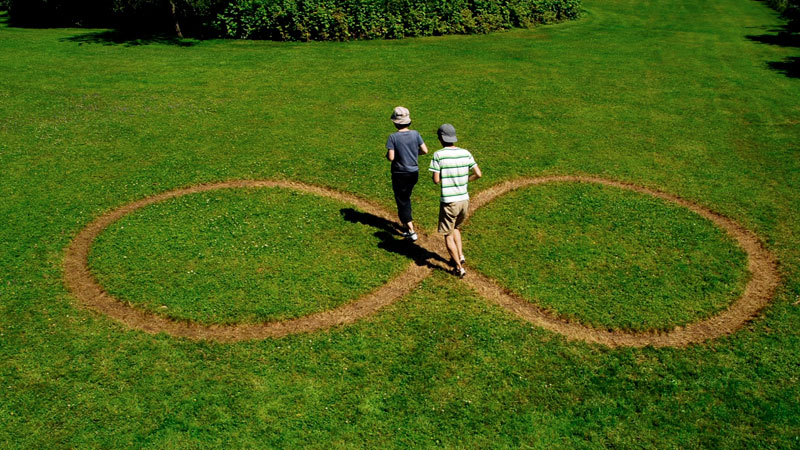 A friend knowingly sent me this video from youtube. They've exhibited all over Europe.


I completely understood because, you know, I've been there. In summer 2000.
Just beginning
After two weeks, 2 hours a day
After 21 days, 2 hours a day
My project was about something completely different, and I must say, a bit more complex. But my hat is off to the two artists. I can't really say much about their cheeky video. My work, shown here was about connection, both to the land I found myself in and the artist, Janine Antoni, who had walked here before me. It was an ascetic reaction to a self indulgent atmosphere. It was about evidence, about tracing the paths of others, about redrawing discarded elements, about stating emphatically what is important to me. It was about path-making, making one's mark, but also understanding it shall eventually be displaced. This work was made in the last few weeks of the Skowhegan class of 2000.
Toolish Pride
Spear & Jackson long-handled trowel

 Spear & Jackson spade
 By-pass pruner is a Felco #2

 Mini-rake - Ames brand
Lopper -mystery, the logo has worn off

One of my favorite tool sources is Peaceful Valley Farm Supply -thats where I got my spade. Another good source is Lee Valley Tools. Its hard to get good gardening tools locally. Most hardware stores carry Ames or Tru-temper brand tools. I've had those, but used them up. But the Ames mini rake my wife found at Lowes. We needed something small for our small garden and this fit the bill.
To Prune or Not to Prune
 I prune. Its as meditative as weeding, but more of an art. For those not interested or just prone to the wild, your roses don't need pruning. Its about us after all and they would be just fine without us (yet with more dead canes). I have three types of roses in my garden. A climber, a hedge rose, and something else I yanked out of my grandma's garden just before she sold her house. I prune them all, but each has its own program.
The climber:
I want the climber, Rosa New Dawn, to stay less than 8 feet tall, stay anchored to a trellis, and bloom as much as possible. In late March I cut out canes that interfere with this plan. I gently bend the larger canes, getting them as close to horizontal as possible without stressing it. Then I tie the cane to the trellis. I prune out perpendicular (to the trellis) canes that extend too far out because they may poke me in the eye or something. I also prune canes that are poking the wall behind the trellis. The result is a loosely espalier-like rose bush. Those horizontal canes will deliver vertical flowering branches. The more horizontal (really, diagonal) canes the climber has, the more flowers it tends to produce.
The hedge rose:
These things are meant to be rose-flowering fences. You could probably shear Rosa Knockout and do it no harm. I like to selectively prune my hedge rose for shape (I have only one). I prune out dead twigs and thin branches where I think the shrub is too dense. I also trim the sides of the shrub because I do not want it to encroach on neighboring perennials.
The ? rose (probably old garden rose, tea perhaps?):
This is one with wonderfully scented, double flowers appearing in June and again as the flowering stems are pruned. This bush has one strong cane, about 5/8-inch thick and a few smaller canes and twigs shooting off it. I prune the spindly twigs out and then cut the remaining canes down to roughly pencil thickness near outward facing leaf buds (bud eyes). Once 4 feet tall, its now less than 3 feet. This one blooms after each pruning of flowering stems during the growing season.
Rose pruning tips:
- I like to prune in late March, just as the temps are warming above freezing at night. Its a good time to do it because there are no leaves to block your view of the canes and the new leaf buds (bud eyes) are becoming swollen and visible.
- Prune out dead wood. If you suspect disease, clean your pruners with bleach before moving onto other rose bushes.
- Prune out last year's rose hips.
- Use a by-pass pruner. I use a Felco #2 and have had it for 15 years. The blade is removable and sharpenable. Keep it sharp for the cleanest cuts.
- Make your cut in one pass. If it takes more, your pruner's blade is too dull or the cane is too thick and woody. If its too thick, use a large by-pass pruner called a lopper.
- I cut the cane about 1/4 inch above the desired leaf bud, slicing parallel to the direction of the leaf bud (bud eye). See diagram below.
- My grandmother swears by sprinkling Epsom Salts around the roses in Spring. Its also known as Magnesium Sulfate. I don't treat my roses to these bath salts, but hey-she's been gardening for 70 years.
- Wear leather gloves if you don't like thorns pricking your hands.
 Grandma's rose cane
 Climber New Dawn cane
 Dumbarton Oaks
I had long heard of Beatrix Farrand and Dumbarton Oaks, but never seen the work in person. Until three weeks ago. Dumbarton Oaks is a residence, turned research institution, garden, and park in Washington DC. The Dumbarton Oaks site is steeply sloped and Farrand, the landscape architect, sculpted the land at the rear of the house into a series of terraced, walled rooms. Each room is very specific and I marveled at the details. Farrand worked this land between the 1920's and 1940's, a time I might describe as a zone between early century neo-classicism and mid-century modernism. Each room is like an outsized NYC backyard in their rectilinear, walled fashion. As you step away from the rear of the house, the design opens up to the natural contours of the landscape, and then eventually into a woodsy ravine.
 The orangerie
 The mossy steps
 My favorite part, Farrand's amphitheater converted
by landscape architect Ruth Havey into a reflecting
pool. Notice the curving allee of trees sweeping down
the hillside. A real folly.
 Beech roots, grass, and spring bulbs
 Terracotta wall detail and WinterJasmine
 Pruned Wisteria on many walls
 The rose garden, one of the larger rooms
 The details in a brick staircase
 The forced perspective lawn (to make it look longer than it is)
 What you can hardly see are the steps in the lawn as this space is terraced
 Strange gutter around an empty walled garden
which I presumed was for growing vegetables.
I think the gutter was to catch runoff from the
hillside so that the planting field would not
become too soggy at seeding time.
The orangerieThe mossy stepsMy favorite part, Farrand's amphitheater convertedby landscape architect Ruth Havey into a reflecting
pool. Notice the curving allee of trees sweeping down
the hillside. A real folly.
Beech roots, grass, and spring bulbsTerracotta wall detail and WinterJasminePruned Wisteria on many walls The rose garden, one of the larger roomsThe details in a brick staircaseThe forced perspective lawn (to make it look longer than it is)What you can hardly see are the steps in the lawn as this space is terracedStrange gutter around an empty walled gardenwhich I presumed was for growing vegetables.
I think the gutter was to catch runoff from the
hillside so that the planting field would not
become too soggy at seeding time.
New York City Garden Center and Plant Nursery Map
This map of nurseries is not an endorsement of any particular business, but a resource for anyone looking for a nursery in the NYC area. Undoubtedly, I missed a few that are out there. Use the comment option if you have a favorite I missed. I chose to not include any florists or hardware stores that also sell bedding plants. There are many more of those in NYC.
I included some nurseries that are in NJ, Yonkers, and Long Island despite their outlying status. Those are marked with the empty marker.
Some regions are woefully without local nurseries, although many of these areas are probably served by hardware stores, florists, and some big box stores. Specifically Queens, which has more planting space than any borough, but also is in closer proximity to all the suburban nurseries.
MAP TO THE NURSERIES:
Zoom in, click on green icons for more information.
View NYC Garden Nurseries in a larger map
Its Spring in DC
Four hours south, in DC, it is spring. Bulbs blooming, cherry trees blooming, magnolia blooming, daphne blooming, hellebore blooming, forsythia blooming, Vinca blooming, and a new plant for me, called Sweet Breath of Spring, was blooming and scenting the world around it. Unfortunately Sweet Breath happens to be bad breath as it is invasive. But it truly sweetened the air.
 Lonicera fragrantissima
Lonicera fragrantissimaThe EPA Gardens
Walking alongside the Mall while in DC last week I noticed these signs describing rain gardens. They were sponsored by the Environmental Protection Agency, whose headquarters they decorate.

 Apparently the gardening method the signs describe is demonstrated right before our eyes. Now I'll admit, I'm no fan of this administration's EPA and so I want to be hard on them. It is early spring after all, so the fact that there are little to no plants in the demonstration rain garden should not be made too much of. Hey, they're trying right?
 How easy will it be to find plants that like both drought and flood as the sign describes? The image appears to represent a coneflower and maybe a baptisia or some kind of sage, perhaps. Hard to say exactly. A list of plants useful in this flood/drought environment would have been useful.
 Could identification tags on the ground where these happy plants may be lying dormant have been useful? The patch of brown mulch I did see didn't exactly inspire me to plant a rain garden.
The average yearly rainfall in DC is about 39 inches. DC's downtown mall area is low lying, so collection of water from all those rooftops is a good idea. But downtown DC has a manicured landscape, heavy on the concrete, evergreen shrubbery, magnolia and cherry trees. Most of DC's runoff goes to the city sewer system, then into the Potomac River.
Apparently the gardening method the signs describe is demonstrated right before our eyes. Now I'll admit, I'm no fan of this administration's EPA and so I want to be hard on them. It is early spring after all, so the fact that there are little to no plants in the demonstration rain garden should not be made too much of. Hey, they're trying right?How easy will it be to find plants that like both drought and flood as the sign describes? The image appears to represent a coneflower and maybe a baptisia or some kind of sage, perhaps. Hard to say exactly. A list of plants useful in this flood/drought environment would have been useful. Could identification tags on the ground where these happy plants may be lying dormant have been useful? The patch of brown mulch I did see didn't exactly inspire me to plant a rain garden.The average yearly rainfall in DC is about 39 inches. DC's downtown mall area is low lying, so collection of water from all those rooftops is a good idea. But downtown DC has a manicured landscape, heavy on the concrete, evergreen shrubbery, magnolia and cherry trees. Most of DC's runoff goes to the city sewer system, then into the Potomac River.
Cave Plants
Last week my wife and I were on spring break. We decided we could make it to Washington D.C. for a couple of days. We stayed right across from the Woodley Park Red-Line Metro station. Have you been in Washington's subway system? If you are rather used to NYC's subway, Washington's will blow you away. I have only been on it a few times in my life, but I saw it with open eyes this time around.
First of all, we descended on an escalator that seemed to be 200 feet long. Then we descended again on another about 1/3 as long as the first. By the time we were in the "tube", it was hard for me to estimate how deep under the street we were. It is not like in NYC, where the grate above your head leads to the sidewalk above.
These subways are CLEAN and somehow appear futuristic, way more than the Tokyo subways I rode on a few years earlier (they were even cleaner). It must be the concrete half-pipe the station is in. Adapted with sound deadening panels and rather dimly lit, it is an unusual "subway" experience.
One morning on our way to downtown DC, I noticed a green color across the tracks. It was near the lights that run the length of the tube along the tracks. Closer inspection revealed what I believe is a moss and maybe a fern. This discovery was amazing and quite beautiful. As we traveled the subway that day, I looked out the window at every station that had a central platform and, yep, there were the same plants growing out of the concrete, near the lights.


It was too dark to photograph well with my snapshot camera. Afterward we speculated on how they came to grow down there. Spores blew in on the draft or spores and seeds in the soil during construction -these are our ideas. Their must be enough moisture in the air or working its way through the concrete to support them. Of course, the lighting provides the energy.
First of all, we descended on an escalator that seemed to be 200 feet long. Then we descended again on another about 1/3 as long as the first. By the time we were in the "tube", it was hard for me to estimate how deep under the street we were. It is not like in NYC, where the grate above your head leads to the sidewalk above.
These subways are CLEAN and somehow appear futuristic, way more than the Tokyo subways I rode on a few years earlier (they were even cleaner). It must be the concrete half-pipe the station is in. Adapted with sound deadening panels and rather dimly lit, it is an unusual "subway" experience.
One morning on our way to downtown DC, I noticed a green color across the tracks. It was near the lights that run the length of the tube along the tracks. Closer inspection revealed what I believe is a moss and maybe a fern. This discovery was amazing and quite beautiful. As we traveled the subway that day, I looked out the window at every station that had a central platform and, yep, there were the same plants growing out of the concrete, near the lights.
It was too dark to photograph well with my snapshot camera. Afterward we speculated on how they came to grow down there. Spores blew in on the draft or spores and seeds in the soil during construction -these are our ideas. Their must be enough moisture in the air or working its way through the concrete to support them. Of course, the lighting provides the energy.
NYC Nursery Map
This map of nurseries is not an endorsement of any particular business, but a resource for anyone looking for a nursery in the NYC area. I'm sure I missed a few that are out there. I chose to not include any florists or hardware stores that also sell bedding plants, as there are so many more of those in NYC that it would overwhelm the map.
I've also included some nurseries that are in NJ, Yonkers, and Long Island that are within driving distance of NYC. These are marked with an empty green marker.
Some regions of NYC (Queens and Bronx) are woefully without local nurseries, although many of these areas are probably served by hardware stores, florists, and some big box stores.
MAP TO THE NURSERIES:
Zoom in, then click on green icons for more information.
View NYC Garden Nurseries in a larger map
Garden Coach
I've been coaching, tutoring, consulting (whatever you call it) for years, helping friends with their garden problems. If you are motivated, but do not know where to begin, do not understand the nature of your soil or other environmental conditions, do not know what to plant because you are bewildered by the variety, or just plain stunted by the thought of killing your first plant -a coach may be for you.
I have been gardening for almost thirty years. In those beginning years so much of what I had grown died or was unproductive because of my inexperience. Fortunately I learned early that gardening is an experience of life and death. Failure is an important part of the education of a gardener. Through it we learn the depth of our commitment to our work. We learn what not to do, because it forces us to seek out the reason for the failure.
I understand that people may want many different things from their gardening efforts. For those who are interested in vegetable gardening, perennial cultivation, annual planting, basic design and hardscape construction ideas, irrigation information, soil amendment guidelines, organic principles, native habitat planting -coaching may be the way to go. For those who want a design and installation, you should contact a landscape architect or garden designer, or at the very least a landscape service. Garden coaching, I would say, is not for you.
Garden coaching is for those who are motivated to do it themselves, or at least think they may want to give it a shot. There is a lot to learn and if you are adventurous, you may never deem your activity a success. That is good, because continuous learning is part of the art of gardening and the joy of it.
You should always remember, as a beginning gardener, that you do not have to do it all in one season. In fact you cannot and this is a blessing. You have a life, gardening is not your full time work. Gardens are organic creations and are forever changing. However, if you understand the principles underlying much of the work, you will be rewarded for it.
So if you have a yard of any size and you see its potential, but don't know where to begin, consider a garden coach. Look over my blog posts and read my bio, as it may help you decide if I am the coach for you. Its mid-March. In NYC this is the time to start thinking about doing in your garden. You see, I'm already coaching you.
Contact Frank at nycgarden@gmail.com for more information.
I have been gardening for almost thirty years. In those beginning years so much of what I had grown died or was unproductive because of my inexperience. Fortunately I learned early that gardening is an experience of life and death. Failure is an important part of the education of a gardener. Through it we learn the depth of our commitment to our work. We learn what not to do, because it forces us to seek out the reason for the failure.
I understand that people may want many different things from their gardening efforts. For those who are interested in vegetable gardening, perennial cultivation, annual planting, basic design and hardscape construction ideas, irrigation information, soil amendment guidelines, organic principles, native habitat planting -coaching may be the way to go. For those who want a design and installation, you should contact a landscape architect or garden designer, or at the very least a landscape service. Garden coaching, I would say, is not for you.
Garden coaching is for those who are motivated to do it themselves, or at least think they may want to give it a shot. There is a lot to learn and if you are adventurous, you may never deem your activity a success. That is good, because continuous learning is part of the art of gardening and the joy of it.
You should always remember, as a beginning gardener, that you do not have to do it all in one season. In fact you cannot and this is a blessing. You have a life, gardening is not your full time work. Gardens are organic creations and are forever changing. However, if you understand the principles underlying much of the work, you will be rewarded for it.
So if you have a yard of any size and you see its potential, but don't know where to begin, consider a garden coach. Look over my blog posts and read my bio, as it may help you decide if I am the coach for you. Its mid-March. In NYC this is the time to start thinking about doing in your garden. You see, I'm already coaching you.
Contact Frank at nycgarden@gmail.com for more information.
Rates:
$100 for the first consultation lasting up to two hours
$50 per hour thereafter
Oh, That's Who...
I have been gardening for twenty-five years. My first gardening memory is pulling out clumps of Sedum (I didn't know its name at the time) that grew as a ground cover along the side of my house. I moved it somewhere and it lived. I paid attention to its progress. Later on, I found myself moving clumps of grass around, doing the same thing. To this day I still move my plants around, and maybe too much. But, much like in those early years, they mostly keep on going.
In my mid-teens I began growing tomatoes, basil, and green beans for my mother. My father had been doing it previously but had since lost interest. I wasn't very good, losing tomatoes to wilt half-way through the season. Answer -dump miracle grow on them. Plants still lost. Hmmm.
In those restless years I moved to Portland, Oregon. There I took up work with a landscaping company and had my first yard garden. I let the lawn grow tall just to see what would come up (neighbors hated that). After moving back to NYC, I began gardening for a couple in Great Neck, NY, and worked with a deck builder in Manhattan.
In 1997, I went to graduate school in New Mexico to earn an Master of Fine Arts. I had a yard garden and container garden, and spent time helping many friends with gardening problems and picking up some garden work. I earned a minor in landscape design while there and also designed and installed a home landscape for the local chapter of Habitat for Humanity. I started reading J.B. Jackson and other cultural geographers.


After graduate school, in 2000, I came back to NYC, and begun work at a summer-only artist residency program in Maine. I gardened when and where it was possible. Around this time I stopped reading OG magazine, felt it was repeating itself. In 2002 I began work on a large lot-sized private property in Brooklyn. That project took a parking lot and transformed it into a garden -it took nearly two years. Unfortunately, it has since been sold and is under the wrecking ball. During this period I began creating gardening and nature motif art projects.


In 2004 I decided to turn the soil strip in front of my apartment into a garden after my landlord removed some old telephone poles from the area. Also in 2004, after a year of house renovation work, I had enough resources to rent a studio in Red Hook, Brooklyn. I began painting steadily again. After a rent increase, I moved my studio to a shared sublet in Dumbo, and after an increase there I moved again, and hopefully finally, to Sunset Park. In 2007 I began this blog and also began reading Paul Shepard's writing.
 Brooklyn garden, October 2007
I do have a personal garden design approach, that of a strong hardscaping structure softened by abundant plantings, and a fundamentally organic approach to gardening practices. Organic, for me, is not a political stance, but just plain practical. My gardening prefers the hardy over the temperamental, rain over irrigation, compost over fertilizer, creatures over pesticides. Yet I will from time to time indulge in things that may require special attention. In other words I have a philosophy, developed over many years of experiments and failure, that is open but principled.
In my mid-teens I began growing tomatoes, basil, and green beans for my mother. My father had been doing it previously but had since lost interest. I wasn't very good, losing tomatoes to wilt half-way through the season. Answer -dump miracle grow on them. Plants still lost. Hmmm.
While in college, I worked at a retail greenhouse and occasionally doing various landscaping jobs. I started reading Organic Gardening magazine. After graduation, I spent a couple of years building decks and planting gardens on rooftops and in backyards in Manhattan. I read Sara Stein's Noah's Garden in just a few days.
In those restless years I moved to Portland, Oregon. There I took up work with a landscaping company and had my first yard garden. I let the lawn grow tall just to see what would come up (neighbors hated that). After moving back to NYC, I began gardening for a couple in Great Neck, NY, and worked with a deck builder in Manhattan.
In 1997, I went to graduate school in New Mexico to earn an Master of Fine Arts. I had a yard garden and container garden, and spent time helping many friends with gardening problems and picking up some garden work. I earned a minor in landscape design while there and also designed and installed a home landscape for the local chapter of Habitat for Humanity. I started reading J.B. Jackson and other cultural geographers.
Two views of my small, L-shaped New Mexico garden in 1998
After graduate school, in 2000, I came back to NYC, and begun work at a summer-only artist residency program in Maine. I gardened when and where it was possible. Around this time I stopped reading OG magazine, felt it was repeating itself. In 2002 I began work on a large lot-sized private property in Brooklyn. That project took a parking lot and transformed it into a garden -it took nearly two years. Unfortunately, it has since been sold and is under the wrecking ball. During this period I began creating gardening and nature motif art projects.
Greenhouse I built and tended at Socrates Sculpture Park in 2001-02
In 2004 I decided to turn the soil strip in front of my apartment into a garden after my landlord removed some old telephone poles from the area. Also in 2004, after a year of house renovation work, I had enough resources to rent a studio in Red Hook, Brooklyn. I began painting steadily again. After a rent increase, I moved my studio to a shared sublet in Dumbo, and after an increase there I moved again, and hopefully finally, to Sunset Park. In 2007 I began this blog and also began reading Paul Shepard's writing.
Brooklyn garden, October 2007I do have a personal garden design approach, that of a strong hardscaping structure softened by abundant plantings, and a fundamentally organic approach to gardening practices. Organic, for me, is not a political stance, but just plain practical. My gardening prefers the hardy over the temperamental, rain over irrigation, compost over fertilizer, creatures over pesticides. Yet I will from time to time indulge in things that may require special attention. In other words I have a philosophy, developed over many years of experiments and failure, that is open but principled.
Spring and Fall Frost Date
If you were wondering "when is that last frost date here in NYC," below are two maps of first and last frost dates of the New York State season, courtesy of the wonderful people at Cornell University. These frost dates are "roundabout," so it is always wise to follow the weather when thinking of planting tender plants or deciding whether or not to harvest those last few tomatoes. Any given year we can push or pull these frost dates. But looking at those NYC dates tells me we in the city are very lucky indeed.

Click on the map for a larger view

Sumac Surprise
Yesterday I was taking a break, walking around the Brooklyn Bridge Park area. I noticed that many of the branches of the Staghorn Sumacs (Rhus typhina) planted there were broken, people snapping them for the clusters of red drupes that sit atop the branches. Going over to inspect the damage, I noticed for the very first time why these are called "Staghorn" Sumac. I always thought it was because the branches resemble the antlers of a young stag, which is true, but more than that, it is because the sumac branches are covered in a fine hair, giving them the appearance of a young stag's new antlers.

The hair was soft, felt-like, and attractive up close. I was amazed at discovering this. I really like Sumac, so easy to grow and very attractive. However it does spread, so you may need to have the room to let it go or hem it in with an underground barrier. I really like the cultivar Rhus typhina 'Laciniata', growing in two locations at the Brooklyn Botanical Garden. Isn't it beautiful?


The hair was soft, felt-like, and attractive up close. I was amazed at discovering this. I really like Sumac, so easy to grow and very attractive. However it does spread, so you may need to have the room to let it go or hem it in with an underground barrier. I really like the cultivar Rhus typhina 'Laciniata', growing in two locations at the Brooklyn Botanical Garden. Isn't it beautiful?
New York City Free Compost Facility Map
**CURRENTLY THERE IS NO FREE COMPOST PROGRAM UNTIL FURTHER NOTICE**
Scroll up or down through the garden calendar on the left of this page to check for current NYC Free Compost Giveaway dates. Click on the event for more details.
View Larger Map
The Spraying
In thinking about native plants for our area recently, I dug into my library and took a new look at a book I read 15 years ago. That book, Noah's Garden by Sara Stein, was one of my quickest reads ever. Probably my quickest and I think that is because it fed something in me that I had a voracious appetite for at the time. I re-read one chapter this morning, The Aphid on the Rose, and you know it has the same resonance today. It fostered fifteen years of growth as a gardener and now with much more experience to rely on while rereading, it only makes more sense. Back then, just after graduating college it may have been passion alone that had me tear through this book, but now it is experience and sensibility that have me re-reading it.
Lately I have been thinking about whether or not I am really interested in flowering plants at all. In looking at my garden, in which everything flowers, you would ask how that could be. But since childhood I have been incredibly excited about the creatures of the yard and garden. I started thinking that maybe I plant for the insects and birds, the life which the garden attracts (myself included). I love the plants, their forms, colors, and scents. Yet I get even more excited when these attract the creatures that make the garden buzz with life. Stein's The Aphid on the Rose focuses on the complexity of "solving" garden insect problems. It turns out that we may not need to solve anything except our problem of planting the highly domesticated species that we are so attached to.
When I was a child I had an empty fish tank. I brought this tank out, into the yard and filled it with as many types of caterpillars I could find. In this tank I remember collecting what I thought was an exciting new kind with numerous hairs, charcoal grey with a reddish dots along its back. That early enthusiasm along with my young attachment to all things "wild" in our rather uncultivated yard gave me the insight to realize the negative impact of what was to come. Not long after my first encounter with the Gypsy Moth caterpillar, the population exploded and trees were being defoliated. Where I lived, on Long Island, oaks were the predominant tree and a favorite food of the caterpillar.

Tanker trucks were driven in on sunny summer afternoons where kids were playing outside, birds and squirrels doing their thing. Out of these tanker trucks came men with firehoses. Out of these hoses came a bitter smelling fluid shot upwards at high pressure. The undersides of trees, 60 or 70 feet up, where doused in this fluid which to this day still I have a scent memory. Not being fully aware of what was happening we kids stayed outside to watch.
On the ground, after the work was done, Gypsy Moth caterpillars were everywhere writhing, some laid still, some hung half connected to the tree bark. But the devastation did not limit itself to the caterpillars. All kinds of insects and crows, blue jays, sparrows and chickadees, even squirrels lay dead on the ground. It was a massacre. For a day the trees dripped this poison. In June, with less frequent rains, it was hard to imagine this poison "washing away." The spraying happened every summer for two or three years.
Eventually less and less people had sprayed. Less and less gypsy moth infestations occurred. They are always present, but in greater or lesser numbers. Yet I can say, with the skillful observation of a child, that none of our trees succumbed to the gypsy moth population. My family had not sprayed.
Last summer I was traveling through central Pennsylvania on Interstate 80 and I noticed the forest looked like it was having a very late spring. Seemed odd, but it was early June, so maybe. On my way back two weeks later, I realized that this was not the case. We stopped at a rest stop in the affected area to take a look at the trees. Gypsy caterpillars everywhere, but dead now. A state employee at the rest stop told me what I had already deduced, that they recently sprayed.
 Defoliation in Allegheny Forest due to Gypsy Moth caterpillar
I don't have the knowledge to know if this was a mistake. In recent years there has been many threats to the hard and softwood forests of North America. The state may have made the decision that the caterpillars would weaken the trees to the point that other problems would wreak havoc. My instinct is to say that it was a big mistake, that the woods will recover as long as the whole of the ecosystem is intact. It seems to me that blanket spraying of chemicals ensures that the ecosystem is not fully intact.
I think people make emotional decisions when it comes to their trees being defoliated or, for that matter, their roses made limp by aphids. This emotional response gives way to chemical attack. Rachel Carson wrote about the often unannounced aerial spraying of the Gypsy Moth caterpillars in our area in the late 1950s in her book Silent Spring. Back then they used DDT mixed in fuel oil! I do not know the chemical agent used in the late 1970s and early 80s, but it is hard to believe that we were still reacting the same way to the caterpillars after two decades of experience. And, as my Pennsylvania experience attests, we are still reacting with a chemical onslaught after five decades.
Lately I have been thinking about whether or not I am really interested in flowering plants at all. In looking at my garden, in which everything flowers, you would ask how that could be. But since childhood I have been incredibly excited about the creatures of the yard and garden. I started thinking that maybe I plant for the insects and birds, the life which the garden attracts (myself included). I love the plants, their forms, colors, and scents. Yet I get even more excited when these attract the creatures that make the garden buzz with life. Stein's The Aphid on the Rose focuses on the complexity of "solving" garden insect problems. It turns out that we may not need to solve anything except our problem of planting the highly domesticated species that we are so attached to.
When I was a child I had an empty fish tank. I brought this tank out, into the yard and filled it with as many types of caterpillars I could find. In this tank I remember collecting what I thought was an exciting new kind with numerous hairs, charcoal grey with a reddish dots along its back. That early enthusiasm along with my young attachment to all things "wild" in our rather uncultivated yard gave me the insight to realize the negative impact of what was to come. Not long after my first encounter with the Gypsy Moth caterpillar, the population exploded and trees were being defoliated. Where I lived, on Long Island, oaks were the predominant tree and a favorite food of the caterpillar.
Tanker trucks were driven in on sunny summer afternoons where kids were playing outside, birds and squirrels doing their thing. Out of these tanker trucks came men with firehoses. Out of these hoses came a bitter smelling fluid shot upwards at high pressure. The undersides of trees, 60 or 70 feet up, where doused in this fluid which to this day still I have a scent memory. Not being fully aware of what was happening we kids stayed outside to watch.
On the ground, after the work was done, Gypsy Moth caterpillars were everywhere writhing, some laid still, some hung half connected to the tree bark. But the devastation did not limit itself to the caterpillars. All kinds of insects and crows, blue jays, sparrows and chickadees, even squirrels lay dead on the ground. It was a massacre. For a day the trees dripped this poison. In June, with less frequent rains, it was hard to imagine this poison "washing away." The spraying happened every summer for two or three years.
Eventually less and less people had sprayed. Less and less gypsy moth infestations occurred. They are always present, but in greater or lesser numbers. Yet I can say, with the skillful observation of a child, that none of our trees succumbed to the gypsy moth population. My family had not sprayed.
Last summer I was traveling through central Pennsylvania on Interstate 80 and I noticed the forest looked like it was having a very late spring. Seemed odd, but it was early June, so maybe. On my way back two weeks later, I realized that this was not the case. We stopped at a rest stop in the affected area to take a look at the trees. Gypsy caterpillars everywhere, but dead now. A state employee at the rest stop told me what I had already deduced, that they recently sprayed.
Defoliation in Allegheny Forest due to Gypsy Moth caterpillarI think people make emotional decisions when it comes to their trees being defoliated or, for that matter, their roses made limp by aphids. This emotional response gives way to chemical attack. Rachel Carson wrote about the often unannounced aerial spraying of the Gypsy Moth caterpillars in our area in the late 1950s in her book Silent Spring. Back then they used DDT mixed in fuel oil! I do not know the chemical agent used in the late 1970s and early 80s, but it is hard to believe that we were still reacting the same way to the caterpillars after two decades of experience. And, as my Pennsylvania experience attests, we are still reacting with a chemical onslaught after five decades.
Brooklyn Native
A comment posted recently by The Flatbush Gardener got me thinking about native plants. His question, "I'm looking for sources [of seeds] for ecotypes local to or near NYC and Brooklyn, Including Long Island, Any recommendations?" But my resources were old, and in books. So I hit the internet and realized quickly that native is used quite broadly.
When we say "native" to Brooklyn, do we mean native to North American, Eastern, Northeastern, Mid-Atlantic coastal, coastal woodland, coastal wetland, etc. etc? Ten or twenty thousand years ago, Long Island was non-existent to just formed from retreating glaciers. The Flatbush Gardener and I both live on the out wash plain immediately south of the Harbor Hill Terminal Moraine. Any plants that found their way here did so from the mainland and no doubt populations of plants shifted as temperatures were on the rise and the ocean advanced inland. If 10,000 years ago plants were colonizing the Long Island land mass, what were they?
Brooklyn may have a specific geopolitical identity, but it does not have a highly specific identity with regard to its native plants. Those growing here may be the same as those native to parts of New Jersey, Connecticut, Eastern Pennsylvania, Maryland, Massachusetts, Delaware, the Hudson Valley and further. The Nature Conservancy's EcoRegion Map describes our region as North Atlantic Coast. Yet I would feel comfortable saying that Brooklyn has much crossover with another of their named regions, the Lower New England Northern Piedmont.
The benefits of this are great when it comes time to plant natives in our gardens! We can choose from a wider range of plants than if we were planting natives for very specific ecosystems, like the Pine Barrens of Long Island or New Jersey. And this is a boon, because sources for native plants of the Pine Barrens are limited, but sources for natives of the greater region are plentiful.
But how do you know the plants or plant seeds that you are about to purchase are native to our area when they are labeled simply as "native"? Its wise to look to the experts.
For those of us in New York City, we can start with NYC Parks. Visit the Native Plant Center in the Greenbelt on Staten Island (I plan to do so this spring). Check out the Native Flora Garden at the Brooklyn Botanical Garden. Peruse the Audubon Society's book titled Eastern Forests. The New York Flora Association has an atlas of NY flora that will be useful in determining natives from non-natives. Also check out the NYS Dept. of Environmental Conservation site which includes rare native plant listings for New York State. This book LONG ISLAND NATIVE PLANTS FOR LANDSCAPING: A SOURCE BOOK, by Karen Blumer published in 1990 by Growing Wild Publications should be awfully useful if you can find it (used at Amazon).
From these listings and display gardens you can cull true regional natives that work for your particular garden environment as well as the local ecosystem. Jot down specific plant names and then move on to places that sell native plants or seeds.
Locally, we have the Westchester Community College Native Plant Center. They have a plant sale in early May. As I mentioned in a previous post, you can order native plant seeds from the New England Wildflower Society. A group called Plant Native has an excellent website with listings of native plants by region as well as listings by region of nurseries that sell native plants.
Once you know the botanical name for the regional natives you want, you can also go to your favorite nurseries or catalogues to seek them out. Here is a list of some regional native plant suppliers:
Fort Pond Native Plants
Toadshade Wildflower Farm
Environmental Concern - all the way in Maryland but a great service
Partnership for NJ Plant Conservation - a listing of NJ nurseries that sell natives
For a good dose of info on ecotypes, visit Wild Ones.
For more information on the New York Bight Watershed .
More on the New York Bight and Atlantic Coastal Plain .
Another on the geology of our region by the USGS.
When we say "native" to Brooklyn, do we mean native to North American, Eastern, Northeastern, Mid-Atlantic coastal, coastal woodland, coastal wetland, etc. etc? Ten or twenty thousand years ago, Long Island was non-existent to just formed from retreating glaciers. The Flatbush Gardener and I both live on the out wash plain immediately south of the Harbor Hill Terminal Moraine. Any plants that found their way here did so from the mainland and no doubt populations of plants shifted as temperatures were on the rise and the ocean advanced inland. If 10,000 years ago plants were colonizing the Long Island land mass, what were they?
Brooklyn may have a specific geopolitical identity, but it does not have a highly specific identity with regard to its native plants. Those growing here may be the same as those native to parts of New Jersey, Connecticut, Eastern Pennsylvania, Maryland, Massachusetts, Delaware, the Hudson Valley and further. The Nature Conservancy's EcoRegion Map describes our region as North Atlantic Coast. Yet I would feel comfortable saying that Brooklyn has much crossover with another of their named regions, the Lower New England Northern Piedmont.
The benefits of this are great when it comes time to plant natives in our gardens! We can choose from a wider range of plants than if we were planting natives for very specific ecosystems, like the Pine Barrens of Long Island or New Jersey. And this is a boon, because sources for native plants of the Pine Barrens are limited, but sources for natives of the greater region are plentiful.
But how do you know the plants or plant seeds that you are about to purchase are native to our area when they are labeled simply as "native"? Its wise to look to the experts.
For those of us in New York City, we can start with NYC Parks. Visit the Native Plant Center in the Greenbelt on Staten Island (I plan to do so this spring). Check out the Native Flora Garden at the Brooklyn Botanical Garden. Peruse the Audubon Society's book titled Eastern Forests. The New York Flora Association has an atlas of NY flora that will be useful in determining natives from non-natives. Also check out the NYS Dept. of Environmental Conservation site which includes rare native plant listings for New York State. This book LONG ISLAND NATIVE PLANTS FOR LANDSCAPING: A SOURCE BOOK, by Karen Blumer published in 1990 by Growing Wild Publications should be awfully useful if you can find it (used at Amazon).
From these listings and display gardens you can cull true regional natives that work for your particular garden environment as well as the local ecosystem. Jot down specific plant names and then move on to places that sell native plants or seeds.
Locally, we have the Westchester Community College Native Plant Center. They have a plant sale in early May. As I mentioned in a previous post, you can order native plant seeds from the New England Wildflower Society. A group called Plant Native has an excellent website with listings of native plants by region as well as listings by region of nurseries that sell native plants.
Once you know the botanical name for the regional natives you want, you can also go to your favorite nurseries or catalogues to seek them out. Here is a list of some regional native plant suppliers:
Fort Pond Native Plants
Toadshade Wildflower Farm
Environmental Concern - all the way in Maryland but a great service
Partnership for NJ Plant Conservation - a listing of NJ nurseries that sell natives
For a good dose of info on ecotypes, visit Wild Ones.
For more information on the New York Bight Watershed .
More on the New York Bight and Atlantic Coastal Plain .
Another on the geology of our region by the USGS.
In the Dead of Winter, Wildflowers
If growing perennials from seed is something you would like to try, consider buying some wildflower seeds this winter from the New England Wildflower Society. They are available now and orders must be received by March 15th. Prices may seem a little high if you do not take into consideration that these are native, wild-collected wildflower seeds. All proceeds benefit the society.
The catalogue offers over 200 native flowering plants, shrubs, and small trees. Growing from seed may be the only way to get many of the varieties they offer and while growing perennials from seed can be difficult, these wildflowers could be an extroadinary addition to your garden.
 This seaside goldenrod, Solidago sempervirens, I yanked out of a crack in the asphalt on a rotting pier in Red Hook where I had my studio. There it barely grew twelve inches each year. In my garden, it grows to five feet. There are so many varieties of goldenrod and many are native to New England or the mid-atlantic region, this one included. It has excellent foliage that looks much less weedy than the other goldenrods you may be familiar with. However, in my garden, it suffers from some late season, bright orange rust that never does more harm than wilt the lower leaves. If you want this plant, but don't have any asphalt around from which to yank it or maybe would prefer to not yank it, you can grow it from seed.
The catalogue offers over 200 native flowering plants, shrubs, and small trees. Growing from seed may be the only way to get many of the varieties they offer and while growing perennials from seed can be difficult, these wildflowers could be an extroadinary addition to your garden.
This seaside goldenrod, Solidago sempervirens, I yanked out of a crack in the asphalt on a rotting pier in Red Hook where I had my studio. There it barely grew twelve inches each year. In my garden, it grows to five feet. There are so many varieties of goldenrod and many are native to New England or the mid-atlantic region, this one included. It has excellent foliage that looks much less weedy than the other goldenrods you may be familiar with. However, in my garden, it suffers from some late season, bright orange rust that never does more harm than wilt the lower leaves. If you want this plant, but don't have any asphalt around from which to yank it or maybe would prefer to not yank it, you can grow it from seed.
Sowing the Seeds of Change
Recently there was a post on GardenRant by one of the ranters, Michelle Owens, about the cost of seeds for vegetables going up. It got me thinking. I have just nearly completed a book called The Future of Capitalism by Lester C. Thurow. It was written in the middle nineties, but has been to me still pertinent. The long to short of it is simple, the times they are a changin'. And we're not prepared.
I wonder how long will it be before low skill industries like seed production move away from high wage areas like North America. In our age, isn't it likely we should be getting our seeds from Asia, not North America? It appears less likely that nursery plants would ship around the world profitably because of their health during shipping. But seeds, in their dry state with their low weight and all the handy work necessary for their production and packaging?
Let us not make too little of our desire for cheap seeds. An American low skilled worker costs a lot more than a comparably low skilled worker in other parts of the world. We could keep seeds at eighty five cents a package if we submit to this capitalistic reality. How does a seed company like Johnnies compete with an international conglomerate that produces seeds in far away lands for less than pennies? Johnnies got it somewhat right- in America they produce seeds in an area that is relatively wealth poor and has an abundance of low skilled workers. But in this age, that exact description fits a hell of a lot more places than Maine and those come much cheaper than Maine.
We see two markets developing. Not unlike the organic foods markets. Educated, highly skilled, maybe wealthy individuals will be marketed to with locally (meaning U.S.) grown seeds of ever expanding varieties and heirlooms and so on. This attracts the set who believe they are playing a part in saving the world and eating healthy. And you know, they are right. At least partially.
The other market is what I can only call the Walmart market. This is a much larger group of customers who really cannot afford $5 seed packets. They will be attracted to campaigns emphasizing low cost, reliability, and accessibility. Huge suppliers from around the world will produce Roma and Early Girl tomato seeds for this market, sold at big box stores for low prices. At least for a while.
The people in between these two markets will probably split the difference, sometimes Walmart, sometimes Johnnies.
The truth of our American lives is that real wages have been falling for years. We are more productive than the rest of the world, yet we do not grow in personal wealth, if anything we are in debt. There are all sorts of reasons for this. But as those seed packets go up in price to accommodate for oil's influence, we must also consider that these seed packets are supporting our local neighbors. Without help or further price jumps, I can only see a hard road ahead for the local seed producer. Inevitably, the market that buys expensive seeds is much smaller than the market that buys at Walmart.
The economic divide has most people on the wealth poor side, but there will always be room for a few local producers who charge accordingly for their seeds. But the motivation of capitalism is to find the cheapest resources and seeds will, if they haven't already, be produced far away for very little money. This will keep seeds at low prices as long as customers accept their seeds coming from distant lands.
This is not xenophobia. This is strictly a discussion about economics, the price of seeds, and our quality of life. We know our choices have far reaching effects, but so many of us are hamstrung by our falling real wages when it comes time to make these choices. We find ourselves in quite a pickle.
Just a quick internet glance for medium size tomato seeds:
Johnnies: packet of 50 seeds is $8.20
Burpee: packet of 30 seeds is $2.65
Park: packet of 30 seeds is $1.95
Big difference, but it probably could be a greater difference.
I wonder how long will it be before low skill industries like seed production move away from high wage areas like North America. In our age, isn't it likely we should be getting our seeds from Asia, not North America? It appears less likely that nursery plants would ship around the world profitably because of their health during shipping. But seeds, in their dry state with their low weight and all the handy work necessary for their production and packaging?
Let us not make too little of our desire for cheap seeds. An American low skilled worker costs a lot more than a comparably low skilled worker in other parts of the world. We could keep seeds at eighty five cents a package if we submit to this capitalistic reality. How does a seed company like Johnnies compete with an international conglomerate that produces seeds in far away lands for less than pennies? Johnnies got it somewhat right- in America they produce seeds in an area that is relatively wealth poor and has an abundance of low skilled workers. But in this age, that exact description fits a hell of a lot more places than Maine and those come much cheaper than Maine.
We see two markets developing. Not unlike the organic foods markets. Educated, highly skilled, maybe wealthy individuals will be marketed to with locally (meaning U.S.) grown seeds of ever expanding varieties and heirlooms and so on. This attracts the set who believe they are playing a part in saving the world and eating healthy. And you know, they are right. At least partially.
The other market is what I can only call the Walmart market. This is a much larger group of customers who really cannot afford $5 seed packets. They will be attracted to campaigns emphasizing low cost, reliability, and accessibility. Huge suppliers from around the world will produce Roma and Early Girl tomato seeds for this market, sold at big box stores for low prices. At least for a while.
The people in between these two markets will probably split the difference, sometimes Walmart, sometimes Johnnies.
The truth of our American lives is that real wages have been falling for years. We are more productive than the rest of the world, yet we do not grow in personal wealth, if anything we are in debt. There are all sorts of reasons for this. But as those seed packets go up in price to accommodate for oil's influence, we must also consider that these seed packets are supporting our local neighbors. Without help or further price jumps, I can only see a hard road ahead for the local seed producer. Inevitably, the market that buys expensive seeds is much smaller than the market that buys at Walmart.
The economic divide has most people on the wealth poor side, but there will always be room for a few local producers who charge accordingly for their seeds. But the motivation of capitalism is to find the cheapest resources and seeds will, if they haven't already, be produced far away for very little money. This will keep seeds at low prices as long as customers accept their seeds coming from distant lands.
This is not xenophobia. This is strictly a discussion about economics, the price of seeds, and our quality of life. We know our choices have far reaching effects, but so many of us are hamstrung by our falling real wages when it comes time to make these choices. We find ourselves in quite a pickle.
Just a quick internet glance for medium size tomato seeds:
Johnnies: packet of 50 seeds is $8.20
Burpee: packet of 30 seeds is $2.65
Park: packet of 30 seeds is $1.95
Big difference, but it probably could be a greater difference.