One Sexy Cold-Frame


Well, there it is: the cold-frame. I put it in the front yard, facing south in a patch of asters. I put it there because there are fewer bulbs coming up in the aster patch. That black BBQ  paint sure gives it style!

I put legs on it to keep it off the upcoming plants. One design change had to be made on the spot. I didn't take into account the warping of the glazed roof panel frame. One piece warped out over night, so I added one block to each side to hold the frame in place. The back is held in place by its hinges. I think this will solve the problem, and anyway -its a 30 dollar project.

With the lid open you can see the interior. I have one pot inside now with a couple of broccoli seeds in it. I am attempting to sprout broccoli outside in the cold-frame and inside the apartment simultaneously.

Life Without the Fridge?

It seems some folks out there are going gangbusters. They're chucking the fridge. Even for those of us who live in the city, within seconds or minutes of dozens of groceries or eating establishments, I don't see this catching on. I work evenings/nights. I make four nights dinners on Monday morning and in the fridge they go till the day they are to be eaten. But why take my example as a reason to keep the ol' Frigidaire. The Times article that covers this story did a decent job of telling it like it is.

But of course we previously lived without the fridge. We had root cellars and other storage for food, no? Imagine dairy cellars and meat cellars. I worked in Maine where there was an old farmhouse that had a white-washed dairy cellar underneath that was "see your breath" cool in the depths of summer. Meats were dried, smoked, and salted. But rodents, insects, and mold were always a problem before the electric fridge. It was a big job keeping the family fed and thats largely what certain members of the family did. Life without the fridge? The fridge is liberation, baby. Or will some new technology liberate us from the fridge?

"FOR the last two years, Rachel Muston, a 32-year-old information-technology worker for the Canadian government in Ottawa, has been taking steps to reduce her carbon footprint — composting, line-drying clothes, installing an efficient furnace in her three-story house downtown." She tossed the fridge.

The writer really didn't have to mention the three story house, did he? Not unless he wanted to point to a larger "footprint" concern without making it too obvious. Her-three-story-house. Of course multiple story houses are more efficient than say, one level ranch types. So she's got that going for her.

Some kind of footprint arms race going on these days. Homes with angel wings.


If You Were At All Thinking of BioFuels...

I've long held negative opinions about the "biofuel" boom. The only answer to our energy problems is efficiency, not changing "forms" from one fuel to another. Some forms are more efficient, yes -but what we really need to tackle is how much we use. This, in my opinion, is the only place we can make real progress. Taking energy from one form and converting it to another on a large scale always creates unwelcome by-products . We need to focus on using less energy, or on creating tools (cars, appliances, trains) that require less energy and do more. This is the one sure way of reducing pollution. I often think of the old farmstead with its water-pumping windmill. What of locally-produced electricity? If our home-systems required less energy to do the same work, we could generate locally with much greater success.

Check out this post from the Organic Consumer Association on the Ethanol Scam. It can't possibly say it all, but its a nudge.

My Farm

Have you heard of this business -MyFarmSF.

It operates like this: You pay a one time fee ($600-1000), they come in and install a vegetable garden in your yard. You pay them a weekly maintenance fee ($35+/-), they come by once a week to maintain it. They harvest vegetables and give you some or all of the produce. This is a for profit venture. For people who want home-grown vegetables but are so busy they cannot do it themselves, yet can pay for it.

Anyone willing to do this here in NYC? Call it PSA, Personally Supported Agriculture.

What have been people's experiences with the soil in their backyards? I've been doing research on companies that do soil testing for hydrocarbons (like gasoline, benzene, toluene) or heavy metals (like lead or cadmium). Accurate Building Inspectors, also known as the Ubells of The Guru's of How-To on the Leanoard Lopate Show offer these services. They offer many tests, but the charges are real high.

I had some of these tests done 6 years ago for a landscape job I was doing on 15th Street around Park Slope, yet I don't remember the company name, but I do remember that the results told me little of what the compounds meant to a gardener. I ended up excavating much of the fill that was present and replacing it a hundred cubic yards of compost/soil mix from Nature's Choice in Jersey. We didn't grow any vegetables either.

Apparently, a major metal to be on the look out for is lead. Natural accumulations in soil average 10 parts per million. The EPA considers 300 parts per million to be the upper limit of allowable. With lead, its the children we most worry about as it is absorbed more by their guts than those of adults. Fruit (tomatoes, peppers, eggplants, etc.) do not tend to store lead. But the non-fruiting parts of vegetables, and leafy greens do uptake and store lead. The upper level of soil holds the most lead. Therefore, any soil-contacting vegetable (like carrots, turnips, radishes) will have lead on it's surface should there be a problem with lead in your soil.

Where does lead most likely come from in your yard. Two places: Old house paint (old renovation debris stored on site or chipping exterior paint) and car exhaust. Of course, lead has since been removed from these sources, but the problem with lead is that it doesn't migrate through the soil. It stays put, no matter how many years are between your soil and the lead contamination.

The University of Minnesota Extension has a page dedicated to soil lead with some suggestions for remediation. A similar page at Cornell.

But I have friends who simply vegetable garden their urban plots. Best we do is see that the lot was always used for a residence. You can do this via old fire insurance maps of NYC. There can be rather obvious signs of potential problems like dirty fill or construction debris, buried rusty auto parts, or that no plants or weeds are growing there, or even that the soil smells "chemically."

I'd love to hear stories of people's back yards. What are they like? What's your soil like? Do you grow vegetables? Would you pay someone else to do it for you in your own yard?

A Night Radio


I was listening to Studio 360 this morning while at the studio. I actually got off the internet, out of the house and to the studio by 10 am. Hard to imagine on a Saturday.  I heard this poem on the program, by Japanese poet Shuntaro Tanikawa, called A Night Radio:

I am holding a soldering iron
tinkering with a '49 Philco
Despite warm tubes, the radio is stubbornly silent
but its odor still fresh, mesmerizes me
Why do ears wish to hear beyond their capacity?
I think we hear much too much nowadays
and I feel nostalgic over this broken radio's silence
I can't say which is the more important to me,
tinkering with the radio or writing a poem
I long for the days when I'd nothing to do with poems
and walk those dusty childhood roads
But I've forgotten about women and friends 
as though time did not exist
I just wanted to hear, should have heard something more
My breath held, my ear cocked in every summer's towering clouds
In the muttering of family get-togethers in an untidy room
Refusing to compress living into a story

This is how I feel, often enough when I am working on a painting -particularly a stubborn painting. I long for the days when I'd nothing to do with paintings and walk those dusty childhood roads. It was comforting to hear someone with as much achievement as Tanikawa express this feeling. And to bring back that childhood feeling -a warm evening, focused intensely on some activity, some doing and all time is lost. Nothing exists but the warm, now cooling, envelope of air, a dimming light, your hands and mind. The intensity of love of life in that moment.


This painting has been kicking my butt for too long


How I Made My Cold Frame


Below are pictures of the cold frame I made. I have a table saw at work, so this made the job easier than if I had to make it at home. But cold frames can be made from a variety of things, like stacked bricks or cement blocks with an old glass window on top. If you are making it out of wood, you could just jigsaw (or even hand saw) some plywood into a similar pattern and throw a piece of plexiglass (or even plastic sheeting) on top.

The pattern can be as simple as a rectilinear box, but I sloped mine so I could let more sun into the box and allow rain or snow-melt to run off the lid. Yours could be set onto or into the ground. I will raise mine a few inches with some screw-on wooden legs because I do not want to smash any underlying plants (upcoming bulbs, particularly).

My cold-frame has quite a small footprint at roughly 28 x 18 inches, but they can be much larger and taller. I designed mine for a city gardener, someone with a small garden and not too many plants to start.

I used scrap wood left from student projects at work. This wood is primed, finger-jointed 5/4 pine. It is 1 and 1/16-inch deep by 5 and 1/4-inch wide. In order to get the height that I wanted, I used a dado to rabbet-joint and glue two pieces together, making for a 10-inch wide board. This gave me a maximum height of 10 inches for the rear plank. The side planks are cut on a diagonal, sloping from 10 inches down to 8 in height. I bevel-cut the top of the rear plank to accommodate the slope of the side planks.


I cut rabbet joints at the four corners to more securely hold the four sides and to help keep out cold air.


I cut the front plank at 4 inches high, leaving another 4 inches for a piece of polycarbonate glazing. I dado cut a groove into the top of this front piece to snugly hold the glazing. After that, I bevel-cut the top of the front piece at 30 degrees to help shed any water.

This view points to the inside-bottom of the cold-frame. I rabbet-cut the bottom to accommodate planking that will be the floor. Exterior water will shed without contacting the interior floor planks with this set-up. However, if you set yours on or into the ground, floor planking isn't necessary.

These views show the polycarbonate glazing on the front. I used glazing here to increase the amount of light reaching the plants inside. You can see how it is held tightly within the groove on the front plank. I cut the glazing 1/4 -inch taller between the side planks so that the roof-glazing would make contact with it.

The roof glazing is a sheet of double-walled polycarbonate set into a dado-cut groove in the wooden frame. The rear of the glazing-frame can be seen below resting on the back planking. Out-door hinges will attach the roof glazing frame to the cold-frame.

This is the cold-frame with the roof glazing on. I left the plastic film on the glazing so that I know which side goes out.

This is a close-up of the roof and front panel glazing. The glazing is held snug in the dado-cut grooves in the wooden frame. The roof glazing overshoots the front plank by 1/2 -inch so that rain drips beyond the frame.

For now, I will use a stick to prop open the cold-frame for venting.

The joints will all be set with waterproof wood glue and out-door quality screws. I will paint the cold-frame to protect it from weather and sun damage. If I had made this out of cedar or redwood I would not bother, but this finger-jointed pine is really meant for interior applications. But with a good couple of coats of paint, it should last long enough. I have some old black barbecue paint that I think will do for the outside. The inside I'll paint with glossy white house paint. The idea is to not spend any money, or more than I have to. The polycarbonate cost 30 dollars at Canal Plastics, and that's about what this whole project is worth to me.

I see that I could buy a really nice one at Johnny's for $325 plus shipping. Maybe in better times. I could also add an automatic roof opener (I actually have a couple of these, but they're in Minnesota, I think). These openers are often wax-filled cylinders. The wax expands as it heats up and pushes a bar which opens your roof. The roof needs to be lightweight for this and the polycarbonate fits the bill.

Tom Chrisptopher at Green Perspectives has some good points on the use of a cold-frame. The kind he describes is much larger, and I like his idea of using the removable-pin hinges as a way of connecting the side planks. His point about "managing" the opening and closing of the roof is well taken. I want to experiment to see how it goes, but will get the auto-open cylinder if it becomes too much hassle.

When I Was Your Age I Walked Ten Miles for a Full Watering Can -Without Shoes

Uh, excuse me, this generation here. Just wanted to quietly mention that, uh, I garden. Yeah, just like you -vegetables and flowers, perennials and annuals, trees and shrubs when possible. I have friends my age who do it too. Yeah, I am that generation. Yup -ipods, email, loves the great indoors. Now, if I have to hear one more old fart bitch about how this generation and that generation aren't going outside and digging in the dirt!

Yeah, we have problems. We don't make enough to buy a house or we rent in cities or apartment complexes. So we have no dirt! But when we do have a house, when we do have rooftops, balconies, or little strips of land that our landlord allows us to use, we garden -and we do it with the same passion and excitement for learning and growing that your generation does. So stop the skeptical whining.

Sick-of-it.

A quote from the New York Times Home & Garden section, in the article "New This Year: Tried and True" by Ann Raver:

"But Mr. Hinkley expressed skepticism about these new gardeners. “I just don’t think there’s another generation moving in,” he said. “The next generation is so into not being outside.”
Mr. Druse agreed. “Texting, blogging, e-mail,” he said. “They keep their iPods in the garden, just in case somebody sends them an e-mail.” He gets e-mail messages from fans who listen to “Real Dirt,” his weekly podcast, while they’re weeding, he said, and he wonders how many will stick it out after the first onslaught of cucumber beetles.
“A lot of people won’t be successful at growing food,” Mr. Druse said. “There are bugs and critters and animals, and you can’t fool around without improving the soil.” "

I suppose we are not tried and true? We, as young ones, watched someone we loved or respected, someone from another generation, garden. That becomes the seed that sprouts when it chances upon soil. My grandparents gardened, my father gardened. As a young person and ever since, as long as I have had soil, gardened and failed and kept on going. There are a lot of young people curious about gardening, composting, green anything. Its time we stood up.

Seed Starting Summary


I'm about to start my seeds. The cold-frame is almost built, the seeds are on my desk. I only have to gather containers and pick up some starting mix. By this weekend, all should be ready to go. I am thinking of starting some broccoli seeds directly in the cold frame as well as inside the apartment.

Cornell Cooperative Extension -Suffolk County has a fact sheet on starting seeds indoors. Since seed starting is not something I have done indoors since 1995, I gave it a perusal. I think I get it.
In short:
  • don't start too soon
  • use clean containers
  • use clean soil-less starting mix
  • keep evenly moist
  • have appropriate warmth
  • strong light after germination
  • harden-off outside before transplanting
Thats it in a nutshell.

If you don't have a south facing (must be south and unblocked by buildings!!) window, you won't have enough light to grow strong, stout-stemmed seedlings. They'll be what is called "leggy", pale-colored, and generally flopping over. You'll need some florescent lights hung roughly an inch over your germinated seeds. For a great conversation about seed starting, check out this post at Simple-Green-Frugal Co-op. Its the only way, unless you winter sow outdoors. I'm interested in this method, and will try a tomato out to see what happens, but I cannot rely on it until the experiment is concluded. Anybody out there with this experience in our zone?


Color in the Winter Landscape or These Dragons Seem Like Caterpillars to Me


My wife and I went to the New Year Parade in Chinatown on Mott St. It was a wonderfully warm and sunny day. The exuberance of color reminds me of childhood, the feeling that color can and does excite. Click on the photos for better resolution.


Of course, it wouldn't be a parade without...

Beautiful young women sitting on car backs


Young men doing martial arts


Politicians, business men, or mobsters on floats with beautiful young women


Corporate mascots, like this Chinese Ronald MacDonald


Dragons!


The dragons always make me think of caterpillars.

How This Article Hurts My Brain or The Savannah Hypothesis


Garden Rant picked up on a story from the Boston Globe Ideas Section titled, "How the City Hurts Your Brain." I do not disagree with the idea that we need to immerse ourselves in natural habitat. I would like to make the point that most of what this "Ideas" article is attempting to drive home, through simplified science, we already understand intuitively.

Some things I need to go on about:


"The brain is a wary machine...The mind is a powerful supercomputer...easy to short-circuit..."
I really don't like the consistent "mind as machine" analogy in this article. Its not even about philosophy or a mechanistic view of nature, but more like writing as if the reader really couldn't understand it any other way these days -oh God, aren't we so like machines nowadays. Lets leave the mechanistic ideas in the 20th century- haven't we given enough to our dear machines already.


"Imagine a walk around Walden Pond..."

This is artful. The evocation of Walden Pond without any mention of our nation's most famous nature hermit, Thoreau, who brought to the fore the idea of the poetic, transcendant escape from urbanity? Just mentioning Walden Pond, sans Concord no doubt, evokes our landscape escape fantasy. And Emerson? C'mon. Of course, Emerson owned property outside of the city to escape to.


"It's not an accident that Central Park is in the middle of Manhattan...They needed to put a park there."
At least the article mentions Olmsted (though forgot Vaux) -someone who actually envisioned our cities with a more complex environment. Marc Berman, the psychologist the article quoted (above statement), is right, but not for the reason the article implies. By no means did Manhattan look like it does now; it grew up around Central Park and with it. Which, incidentally, had many farmers and gardeners and an African American community living within its future bounds before construction. Ultimately the siting of the future park was an administrative, government decision.


"...research has demonstrated ... the mental demands of being in a city -- makes people more likely to choose chocolate cake instead of fruit salad..."
How do we account for all the overweight people in the countryside and the overall fitness of those in cities. Nature makes us slimmer? No, but exercise does, and I sure do walk a lot in the city. So I guess we eat chocolate cake -so what, we walk it off.

"...found less domestic violence in the apartments with views of greenery."
How many times do we need to say that correlation is not causation? Couldn't there be some other factor involved in higher domestic violence rates that also correlates with less trees, grass, and parks outside our windows and doorsteps?

"...most urban greenspaces are much less diverse. This is due in part to the "savannah hypothesis, which argues that people prefer wide-open landscapes that resemble the African landscape in which we evolved."
And finally, my favorite -the "savannah hypothesis." Not to put too fine a point on it: BUNK. Its obvious why people like low-clipped lawns today: clear sight lines, clean for laying, sitting, soft underfoot, and you can kick a ball around, etc. The deeper connection we have to the lawn has more to do with miming the tastes of European aristocrats of the last few hundred years. The aestheticized, pastoral landscape was born out of the estate home with its view of the shepard, his flock and the grass -grazed short by sheep. Central Park's Sheep Meadow puts it in name. Economics don't trickle down, but aesthetics sure do. Let us thank ingenuity for the IRON SHEEP, our lawn mower, or we'd be listening to bleats all day. The lawn is the image of order in the landscape, with its clear sight lines and simple aesthetics. I don't think many people are conscious of the roots of their landscape aesthetics, but mime them anyway.


The savannah landscape has unclean sight lines to any pleistocene man, who's greatest enemy may have been a low-stalking lion or hyena, it caught fire often, and who knows what else - so its no front lawn. Another point I'd like to make is that wealthy aristocrats had great landholdings and would have farmland, grazing land, and wooded lots for hunting, logging, etc. While we can mime the lawn aesthetic, we cannot maintain the forest that stood beside it on our little plots -its one or the other and we've largely chosen the other to our detriment.

Below is a quote from Henry Miller's Tropic of Capricorn (beware *# language). After about one hundred pages of manic ranting:

"...The city grows like a cancer; I must grow like a sun. The city eats deeper and deeper into the red; it is an insatiable white louse which must die eventually of it is inanition. I am going to die as a city in order to become again a man, therefore I close my ears, my eyes, my mouth.

"Before I shall have become quite a man again I shall probably exist as a park, a sort of natural park in which people come to rest, to while away the time. What they say or do will be of little matter, for they will bring only their fatigue, their boredom, their hopelessness. I shall be a buffer between the white louse and the red corpuscle. I shall be a ventilator for removing the poisons accumulated through the effort to perfect that which is imperfectible. I shall be law and order as it exists in nature, as it is projected in dream. I shall be the wild park in the midst of the nightmare of perfection, the still, unshakable dream in the midst of frenzied activity, the random shot on the white billiard table of logic, I shall know neither how to weep nor protest, but I shall be there always in absolute silence to receive and to restore. I shall say nothing until the time comes again to be a man. I shall make no effort to preserve, no effort to destroy. I shall make no judgements, no criticisms. Those who have had enough will come to me for reflection and meditation; those who have not had enough will die as they lived, in disorder, in desperation, in ignorance of the truth of redemption. If one says to me, you must be religious, I shall make no answer. If one says to me, I have no time now, there's a c*#t waiting for me, I shall make no answer. Or even if there be a revolution brewing, I shall make no answer. There will always be a c*#t or a revolution around the corner, but the mother who bore me turned many a corner and made no answer, and finally she turned herself inside out and I am the answer.

"Out of such a wild mania for perfection naturally no one would have expected an evolution to a wild park, not even I myself, but it is infinitely better, while attending to death, to live in a state of grace and natural bewilderment. Infinitely better, as life moves toward a deathly perfection, to be just a bit of breathing space, a stretch of green, a little fresh air, a pool of water. Better also to receive men silently and to enfold them, for there is no answer to make while they are still frantically rushing to turn the corner.

"I am thinking now about a rock fight one summer's afternoon..."


After this passage, Miller turns to reflect on his childhood, calmly. Its an intense shift, all turning on a park, a wild park.


This Weather is a Little Salty

This is the worst weather. Snowy, sleety, rainy with slushy puddles at every crosswalk. Wet, cold feet one day -frozen slush the next. I'll take frozen weather over this mix any day.


An article on the New England Wildflower Association website got me thinking about all the salt we throw down whenever it snows. I curse my landlord whenever I have to negotiate the stoop and sidewalk with no salt or shoveling. I hated shoveling snow when I was a kid, I don't wish to do it now. Plus, who has time to stay on top of continuous snow fall? But I could help my world a little if I did. As for road salt, having driven long distances in snow recently, I know that snow and ice causes havoc and a whole lot of stress.

Checking on the web for solid information about roadsalt effect on gardens, the soil, and the water, I found surprisingly little (for the web). I wonder if this is because we feel positively about salting. That said, I did find these sites and stories:

New England Wildflower Association thoughts on salt use in winter
Salt Association U.K. says its how we much we use, not that we use.
L.A. Times story about the affects of salt on an Adirondack lake
Times Herald Record of the Hudson Valley on salt use
Milwaukee Journal Sentinal on road salt effects
Cornell Cooperative Extension on salt effects on plants
University of Minnesota Extension on minimizing salt damage to trees

Salt washes into our water and soil, salt spray negatively affects roadside plants. I speculate that most don't use enough sidewalk salt to see the affects on their gardens (or lawns) but the salt does build up in the soil and groundwater for negative long term affects. Until we find alternatives, or stop driving so much in frozen precipitation, I suppose road salts will continue to be a problem. If you own your home, you can stop using salt on your property. You can use sand, wood ash, cat litter (unused!), or other gritty substances that stick on the surface of the ice. Shoveling more, sweeping slush to the curb would help too. Or we can wear those unfortunately named crampons.

New York City requires that you deal with the snow and ice in four hours, which we all know is hardly enforced in most unManhattanly locations. Read NYC Code 16-123. You have four hours after snowfall to begin removal, excepting the hours of 9 pm -7 am, after which you should have begun by 11 am. However, they do not mention salt at all, but do mention wood ash, sawdust, or sand for throwing down on ice. How environmental our city code has become!

Hardiness Explained-Part II

Its been a cold winter for us in New York City. Yeah, I know, friends and visitors from up north and west. Its not nearly as cold as your plot. But for us in this coastal crotch, where we frequently rise to zone 8 over winter, its been cold. Its been a winter more true to our cold-hardiness designation. So what happens when spring approaches? Will we suddenly be back in zone 8? Bill Cullina, tell us more about plant hardiness.

Cold Frame


I'm gonna make a cold frame. I have some scrap wood at work, that'll dictate its size. Its primed, finger-jointed pine, that'll dictate that it be painted. I'll look about for some double-wall polycarbonate, maybe Canal Plastics. I already tried Peter's Plastics on Fort Hamilton Pkwy, but he didn't have any. I have loose hinges in a crate in the closet. I'll put legs on it so that it doesn't interfere with the bulbs shooting up in a few weeks.

I ordered seeds from Kitchen Garden Seeds. This is one below, Black Russian.


I went looking for varieties that responded to problems I had last year. Bushy-ness or "containerability", determinancy, disease resistance, and of course, taste. For tomatoes, I'm trying: Black Russian, Sungold Cherry, Orange Pixie Large Cherry, Milano Plum, and Bella Rosa. Then there's the Asian Mesclun Mix, the Sugar Ann Snap Peas, and the Salad Bush Cukes.

I'll post photos of the cold frame when its done.

I Usually-Never Start Seeds

This is one of those usually nevers- or never reallys, if I take a hard look at it. Seed starting -I like the idea. Its the doing part that sinks it.

Seed catalogs, options. I can pick from a greater variety of vegetables than I could ever find at my local nursery. I can pick exactly what I want. Yet its easy to overbuy tons of seeds which leads to sprouting way more than I could grow out in the plot or planter. And I'm terrible at killing the sprouts of the over-planted.

But hear me out on the indoor sprouting part. Its like having houseplants. Really, I don't do houseplants. They make me anxious because they don't take care of themselves. I have a few, yes-but they are survivors, the hardiest of all houseplants I've ever had because they simply survived my continual neglect. When they droop, I hear the call to water.

But to get back on topic, its that I see indoor sprouting as raising tender, needy houseplants for 8-10 weeks. Oh, its their limp leanings and pale colorations, but also their demand for breezes, and regular watering -hey not too much! Is the temperature just right, or are they getting too drafty near the window. 

This is the work I do to save money on starts at the nursery? It makes sense if I am planting an army of vegetables, or saving seeds from years prior. But then -there it is again, the notion of picking just the right vegetable variety, not the joyless workhorses they sell at the nursery, your "Better Boy"s and "Black Beauty"s. And I can start 'em when I need 'em, not when the nursery has them. Also, I can do it organically, should I wish to do so.

This is what gets me trying it again, buying just the plant that I think I want, that I feel will match my conditions. So I've done it -I bought some seed packets.

Mind you I may have just 30 square feet for planting, but now I am looking at tomatoes from the latest catalog (Scheepers) to arrive. Then there's the snap peas and cucumbers for containers. What else? Last fall I bought at the BBG Italian Arugula, Slow-Bolt (really?) Cilantro, and Mesclun Lettuce Mix. Though these don't count so much because they'll all be sowed outdoors directly into their containers -along with the bush beans later to come.

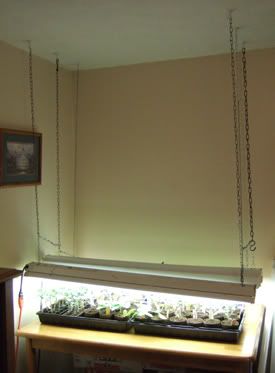
So I cut some wood for a window shelf, high above the cats' paws but still in window sun. Now I need the starting tray, or something to catch the water. I'm also going to make a cold frame -on legs, so that I don't smash the emerging bulbs under it. If this goes well, maybe I'll change my tune.

Or maybe not. This is city living, isn't it? The farmer's market at Borough Hall had $1 tomato starts last spring, of which I bought Striped German, Brandywine, and San Marzano. But they were all indeterminate varieties that sprawled all over. I'm looking for shorter season varieties, determinates that will produce before the sun drops below the buildings.

Is that commitment? The beginning of something new. Gardeners' need growth, something new to challenge their impulse. For me, with so little space, its going to have to be indoor seed starting -this year.

When looking at images of seed starting, I found this post from simplegreenfrugalco-op about easy indoor seed starting.

But this appeals to my senses: Wintersown.org. Check it out.

Warmish

Today was the most spring like day in a month, this after two weeks in Minnesota and two weeks in New Hampshire. I think we went above 40 degrees and it got me looking at the garden. This was a bad year to experiment with overwintering young broccoli plants, although one or two are alive. Its been colder than our normally abnormally warm winters. And I've been away, never expecting my tented broccoli to dry out in two weeks. I think this hurt more than the cold.


The side garden, snow mostly melted by today

But over in the side garden I noticed that the spinach I planted last fall was still alive, poking green through a thin crust of snow. And the parsley too was still cookin' albeit under a thicker blanket if snow.


The warm day melted most of the snow that covered these planters

I'm thinking about expansion more than ever, but the question is how. There's a dilapidated lot down the block, and a community garden a short bus ride away that I've been hesitantly moving around. I kinda just want to do my own thing, but then there are so few opportunities to touch soil in NYC. There's bureacracy and organizing to do when planning community gardens. The lot down the street belongs to a contractor, has an old foundation in it, and lots of trash. And no water. But the fence has blown down and it'd be good to clean it up. I don't think the neighbors would mind, but you never know until done.

Warmish, sunny day ruminations -and all those old and new seeds packets exerting their influence.