When I entered the foyer there was the scent suggestion of rotting fish heads, and by any stretch this is not so unusual in my building. But then I had the thought -had my fish bones arrived? Are they in our apartment? No, they weren't, and just as I passed our apartment door, I heard my neighbor opening hers. I looked outside and asked her, "Did you get a package, does it smell like fish?"

"Yes, yes, please come and take it," she said in her nightgown. Who could blame her eagerness to rid herself of it. I told her it was only fertilizer, and not to worry, but as soon as I put it in our place, its fishhead funk was so powerful that I had to return it to the hall, with a promise to put it in our van the next morning.
After reading about the interaction of phosphates and soil-bound lead in stories about sewage sludge, and then again in last year's
article in the NYTimes about fish bones used, alternatively, to reduce the impact of lead in garden soils, I decided to do some research of my own. There must be a source of free fish bones somewhere in the northeast, right?
Well, I couldn't find any, but I did find the scientists working on the fishbone formula. They sell their own fishbone meal (
Apatite II) for use in a lead abatement process. Further along, I noticed that many organic producers have shifted away from ruminant bone meal (mad cow worries) to fish bone meal in their phosphorous fertilizers. After reading, and then some more reading, I decided to go with a fish bone meal from an organic producer that came in considerably, considerably, less than the Apatite II sold by the ton. I do not know how much I need, but I know it's not a ton. I bought 30 pounds. For the record, the 'inventors' of Apatite II say you must use their product for real results.
In as simple terms as I can concoct, the phosphates (they are negatively charged, so an
anion) will bond to the lead ions (they are positively charged, a
cation) and create what is called new 'phosphate phases' (
Apatite,
the mineral) that are stable, or highly insoluble. I'm no scientist, and my research, is, well, on the internet, so I am not here to claim some miracle cure for high soil lead content. However, it was worth the try.

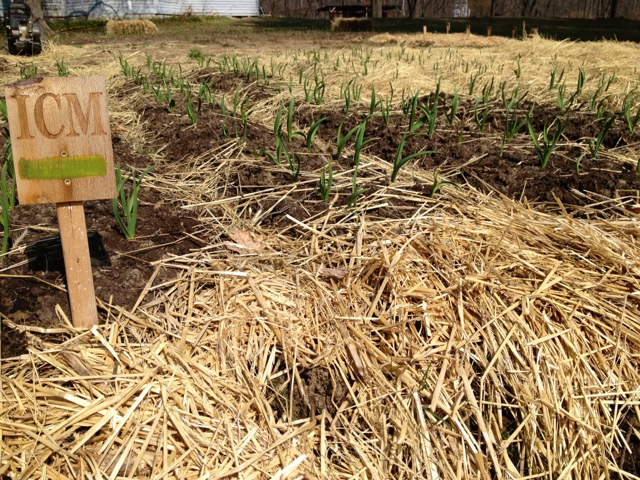
I applied the fish bone meal to the beach farm last Sunday. Why the beach farm? Last autumn I had the soil tested, and received my results this January. The lead was higher than I would like, way under the residential limits, mind you, but high enough to leave me disappointed. A turning in of a slow-releasing, high phosphate fertilizer seemed the least I could do to try to diminish our exposure to lead.
Where plants were already in the ground, I could only rake the meal into the surface. Young garlic takes well to a fine-tined leaf rake. The lettuce-then-tomato and other empty beds received copious fish bone turned into the soil to a depth of about 10 inches.
The odor was of decaying fish, but that seemed perfectly natural as the breezes blew in from the ocean only three hundred yards away. It was an enhancement.
The beds raked, I then went over to the large, now empty, paper sack. I looked it over as if, perhaps, I had missed something that would be entirely too late to correct. I found the finest of fine prints on the back of the sack, down toward the bottom. It read "Information regarding the contents and level of metals in this product is available on the internet at
http://www.aapfco.org/metals"
Yikes. I'm adding fish bones to my soil to improve the metals content, not add to it! When I got home, I went to the site. At first I couldn't find any useful information, but the site did lead me to another:
http://www.aapfco.org/rules.html. On that page there is the startling information below.
"fertilizers that contain guaranteed amounts of phosphates and/or micronutrients are adulterated when they contain metals in amounts greater than the levels of metals established by the following table:"
Metals |
ppm per
1% P2O5
|
ppm per
1% Micronutrients3
|
| 1. Arsenic |
13
|
112
|
| 2. Cadmium |
10
|
83
|
| 3. Cobalt |
|
|
| 4. Lead |
61
|
463
|
| 5. Mercury |
1
|
6
|
| 6. Molybdenum |
42
|
|
| 7. Nickel |
250
|
1,900
|
| 8. Selenium |
26
|
180
|
| 9. Zinc |
420
|
|
To use the Table chose one of the following three situations:
1. Fertilizers with a phosphate guarantee; but, no micro-nutrient guarantee:
Multiply the percent guaranteed P2O5 in the product by the values in the table to obtain the maximum allowable concentration of each metal. The minimum value for P2O5 utilized as a multiplier shall be 6.0.
2. Fertilizers with one or more micro-nutrient guarantees; but, no phosphate guarantee:
Multiply the sum of the guaranteed percentages of all micro-nutrients (as defined by AAPFCO's Official Fertilizer Term, T-9) in the product by the value in the appropriate column in the Table to obtain the maximum allowable concentration (ppm) of each metal. The minimum value for micro-nutrients utilized as a multiplier shall be 1.
3. Fertilizers with both a phosphate and a micro-nutrient guarantee:
A. Multiply the guaranteed percent P2O5 by the value in the appropriate column. The minimum value for P2O5 utilized as a multiplier shall be 6.0. Then,
B. Multiply the sum of the guaranteed percentages of the micro-nutrients by the value in the appropriate column. The minimum value for micro-nutrients utilized as a multiplier shall be 1. Then,
C. Utilize the higher of the two resulting values as the maximum allowable concentration (ppm) of each metal.
My fish bone fertilizer has a phosphate guarantee of 18%, but not micro-nutrients (#1, above). According to their information, I need to multiply 18 by 61 (for lead quantities) to reveal the
parts per million of lead in my fish bone meal. WHAT? That is outrageous. This would mean that my natural fish bone meal has 1098 ppm of lead? What about cobalt? 2448 ppm! And remember, it says that the fertilizer is considered adulterated
only if the amounts are actually higher than these.
This can't be right, yet this is where I found myself after following the link on the bag. So I sent Dr. Earth an email to ask about this, but guess what, the good doctor must be busy, because a week later he still hasn't responded to my concerns.
Today, I realized that the link given on the bag was incorrect (I've corrected it above). I found the site which it intended to link, which then lead to three western state agencies (why are
they better at this?) that test fertilizers for certain heavy metals.
The Washington State
results for my fishbone meal.
The Oregon State
results for my fish bone meal.
The California results appear to be un
linkable, but their results can be seen by following the main link above the chart.
All three states had somewhat different test results. Washington had the most comprehensive test. The numbers are extremely low compared to the numbers achieved by the formula given by the
Association of American Plant Food Control Officials or AAPFCO.
So where does all that leave me? Scratching my head. I will retest my soil in a couple of months to see if or how the levels have changed.
.