Harvest Update


I pleaded via email last night for a Tuesday harvest. I think that rain is imminent, possibly sooner than Wednesday. I made my case, and permission to arrive today has been granted. We will soon be off, three hours north, pulling bulbs.

Tangents of a Garlic Harvest


I don't mean to complain. I love what I am doing, but there are moments when I hear the voice of reason, devilish reason. Why am I doing this? There are things I simply cannot know if not discovered first hand, by doing. Such as?

For instance, I never would have known that I was allergic to something in the dried leaves of garlic (probably mold). I never would have found out how much our white cat could need to devour those rustling, dried leaves. Could I ever have understood the difficulty of making any money with such a prospect, or how useful it is to own an empty barn or warehouse? Never could I have known that three hours of driving there and then back would create the arc of my attentiveness or how easy it is to have the red and blue lights flashing on my tail.

I should be harvesting today, or even last week, but my hosts were getting married. They are newlyweds and need some time. Meanwhile, I am spinning in my chair with anxiety that every last day was the last day those bulbs would be harvestable. I'm advised that Wednesday would be the best day for my visit, yet the forecast is for rain. I imagine our van, motionless in holiday traffic, with steamed windows. I see the rough and split Asiatic bulbs. I see nine months of work come down to one day in July.

I haven't seen the field since the nineteenth of June. It has been virtually without water for over two weeks. That's okay if all is ready to harvest, but rain now would be a disaster. I fret, just moments before harvest, that I have not found a location, an affordable location, to hang my harvest for the next month. The studio is, putting it kindly, over-warm. At home I suffer from the newly discovered allergy, as if 1500 bulbs could find a place in the apartment, although the cat would be in heaven.

In three days all this will be settled.

After The Cure


These 'Tuscan' had their curing finished off by a week in our air-conditioning. I can now cut the leaves and roots off.

Standards dictate that marketed garlic have their stems cut to 1/4-inch. However, I've been struggling with a low-cost method to package variety packs of garlic. Today, I decided I would break standard, leaving a length of neck so that I could tie them together and label the bunch. I'm pleased.

I also experimented with some Allium vineale that I had sitting around. I gave some to Marie to see what she could concoct with this cured weed. I've saved the largest for replanting.

And I thought it cute that the colors of the garlic matched quite well the colors of the wood and silicone rubber stamps I made two weeks ago. The stamps will make writing labels for 10-head bundles easier.


First of July


I planted my early fall crop seeds today under the blazing high sun. It's time and I'm getting more organized this year. Must be the farming.

Broccoli Romanesco, cauliflower Sicilian violet, broccoli Di Cicco, more bulbing fennel, and more romaine lettuce. Not sure if the plots will be tilled by the Fed this October, so I'm keeping down the numbers for fall.

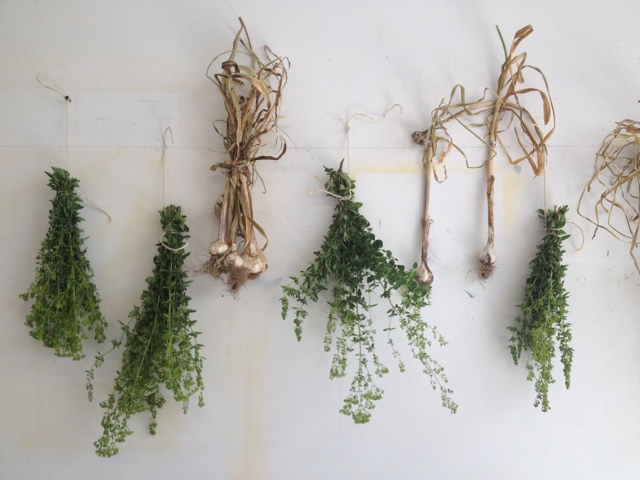
I've no pictures of such a mundane task with potting soil, so I add the one below of Friday's oregano harvest drying in the studio.


Good Morning


The day after the storms was so nice, so cool, breezy and pleasant, we had to have our coffee out of doors. The lilies are in bloom -all of them. The landlady surprised me, as I had my head down pulling the smartweed and dayflower, with a good morning. I didn't even know to whom I replied until I looked up. Then the landlord, who breathed "there he is -the gardener." What's going on here, I thought. And then I enjoyed the lilies.


I pulled him off the fennel that I had harvested a few days earlier, at the beach farm. These swallowtail caterpillars like feathery foliage -like carrots or queen anne's lace, but also parsley and maybe cilantro. I've none of this in the garden so I put him on the cosmos -the most feathery I we have. Seems not to his taste as he whirled and whirled around the hundreds of leafy choices, never choosing any, or so it seemed.


Wrinkles


This is healthy garlic, harvested on May 29th at the beach farm. The wrappers, those layers of paper-like sheaths, are actually the dried leaves of the garlic plant. The more leaves, the more papery layers. Wrappers are important because they protect the garlic in the ground and later in storage. Well-wrapped garlic will store longer.

Turbans harvest early, and this year, especially so. May was an exceptionally wet month and despite well-draining sandy loam at the beach farm, the soil was wet when this variety was ready for harvest. Except, we want to avoid water in the last week or two before garlic harvest. As the leaves dry above ground, they are also doing so below ground. Wet soil leads those dying leaves to split and maybe rot. When the wrappers rot, the garlic inside has less protection.

Have you ever wet paper and then left it to dry? If so, you know what happens -it wrinkles. That's what you see in the above Turban. The wrappers were wet and when dried in the curing process, they wrinkled. It's perfectly good garlic, just less attractive. I remove the outermost wrapper, losing most of the attractive purple mottle, in order to present a healthier looking bulb. We've been having drier weather now, so I don't expect any more wrinkles.


Change Of Season


The sun is now setting earlier, yet it feels that summer has only begun. That the peak of summer sunlight does not coincide with the peak of summer is a celestial twist, an affirmation of the skewed order of things. And here a divide in the vegetable kingdom, more pronounced this year than others, and maybe due to the warm spring and wet month of May.

The lettuce have peaked, with outer leaves folding down toward the soil. We've only 5 heads remaining, but wow, what a productive 20 square feet.

Cilantro now fully bolted and flowered, the young to return in a month's time. I wish I cooked enough for all the cilantro that can be grown in 2 square feet.

Snap peas, slow to start, but invigorated by the month of May, are finally letting go of the cucumber trellis. Fennel, finocchio romanesco, is close to flowering and bulbs are being pulled. Carrots here?

The French beans, first planted in the Turban garlic beds. Second planting was last Saturday.

Asclepias syriaca in bloom; scented evenings at the beach farm.

 Always worth a closer look.


Sizing Up Garlic


All garlic growers separate their harvested garlic into two categories: table (food) and seed. To qualify as seed stock, harvested garlic must be physically perfect with large clove and head size, show no signs of disease, mold, rot, or damage throughout the growing season and in storage. Some states regulate garlic seed stock, refusing import (e.g. Idaho) as part of disease quarantine efforts. New York State does not regulate its garlic production and has no seed stock certification process.

Table quality garlic can be as perfect as seed quality, but it is not required. Table garlic is smaller (sometimes quite small), can be found with damaged wrappers, sometimes a soft clove or two, and may have disease that does not affect its edibility. If you grow table garlic, your concerns are yield, so you will toss the obviously sick, and sell the rest. If you are a seed grower, one diseased bulb (white rot, bloat nematode) can terminate a field's seed.


The garlic on the left is high-quality seed stock garlic purchased from Oregon, the garlic on the right is high-quality table garlic purchased at NYC Greenmarket. If you feel tempted to plant that  farmers' market garlic (it is big and beautiful after all), don't. Several of the diseases in NYS  fields will remain for years once they are introduced, and many can be hosted by any allium species in your garden.

When you buy from a farmer touting seed garlic, you enter a trust with him or her that they're honest about the health of their fields. They cannot know everything, and healthy looking garlic can harbor disease, but that farmer should be observant and resist selling anything as seed that has come from a field showing signs of the worst diseases. New seed in the field will be quarantined until it reproduces year after year with no disease. Old seed is trusted seed and a seed grower will be wary to ever run down his or her supply.


These are two seed stock quality bulbs from Washington state. Porcelain 'Georgian Crystal' on the left and Rocambole 'German Red' on the right. At 3.5 plus inches, it is arguable that these are too big. Giant bulbs have less flavor and may be more difficult to cure successfully for long storage, but no matter, you won't eat these -you'll plant them.

The best seed bulbs run from 2 to 3 inches across. Farmers' observation has long proven that the smallest bulbs and small cloves will produce weaker plants. They will grow, but less vigorously, and you will find small cloves on small bulbs at harvest time. Last autumn I planted garlic seed of the same cultivar from two different sources. One delivered medium-sized bulbs with medium-sized cloves. Another delivered giant bulbs with large cloves (the one you see above left). Both were sold as seed.

The soil and cultural conditions were consistent row to row. Yet, this image shows the difference between the two. The garlic on the left is nearly twice as large as the garlic on the right. The plants look healthier too, a deeper green with thick-stalked scapes. They are the very same cultivar grown in the very same soil -the only difference was bulb and clove size.



Bee Swarms?


NPR has been talking lately of bee swarms and starving bees. Just a thought -honey may be costly but flowers come cheap.

Bees, kiss my aster! I've got lots in my small garden. Each plant has dozens to hundreds of flowers. Asters can be sunflowers, goldenrod, chrysanthemum, fleabane, marigold, dandelions, dahlias, zinnia, echinacea, and on and on. If you have flowers, you probably have asters. Bees love them. If you want to feed your hyper local, artisanal, hand-pressed, cold-brewed, Breucklynn bred honey habit, plant an aster.

House Beautiful


The landlady recently ordered the removal of our tree pit asters. She can't really do that, I mean, landlord's don't own the tree pits, do they? But her team of slow-moving, low paid handy men have all day. These were the guys who sprayed herbicide to do in the weeds around our garden a month ago (and garden plants are still dying a slow Monsanto-engineered death). Meanwhile, in 99 degree weather, another was painting the house with a roller and bucket. So many guys, but the dump never gets less dumpy.

Betsy worked hard in nasty dog and cat turd studded tree pits to make the asters orderly. I then lifted Chrysanthemums from the other beds to fill the street side. Asters are a great choice. They naturally grow under trees, are tough, don't require anything but rain, and they flower with buzzing activity in the fall that warms your heart. So far, dogs (and their owners) have resisted filling these with new turds. It doesn't look like much now, but it would, in time. Got to give it time. 

Last year's asters were self-seeded into the tree pits by wind.


Ahh, the newly-painted siding. I'm not cherry picking, it all looks like this.

All the new plants mashed by the painter's boots.

I had a run in with the landlord's daughter. She complained that the cat dander was working up her asthma as she left our building. I said that it could easily be the carpet in the foyer and staircase that smells like a thousand wet dogs. She couldn't agree, and in fact, said that given our rent, I should keep my complaints to myself and, of course, I am always welcome to leave. 

I do not like having the rent held over me to shut me up. The landlord can raise the rent if it's needed to keep maintenance up -everyone understands this, but a landlord has some obligation to maintain their building -at least the common areas. New tenants came in last year and their rent is nearly 50% more than the previous tenant, but those new tenants will attest that little has been done to improve the place. So the complaint that we don't pay enough to do some upkeep feels rather hollow. 

We hear you, we can always leave -so we're looking.


The Great Scape


Time is measured in movement of sunlight across a meadow. It was still early after the shallots were harvested, the sun now striking the tips of garlic plants. I walked the rows bending the necks of flower stalks between pointer and forefinger. A bead of garlic-scented water forms at the break, fingers get tacky.

The word 'scape' is derived from the Latin word for stalk -scapus. It is the flowering stalk that rarely sets flower. Let a few go to see what they can do. You will still get garlic from those left or forgotten.

Each Allium ophioscorodon (hardneck) variety has a distinctive scape morphology - thin, thick, short, long, looping, curving, long-beaked or short beaked. The weakly-bolting Allium sativum, namely Turban and Asiatic varieties, also produce scapes, but with less vigor and still a soft neck. Asiatic varieties produce giant beaks at the tips of their scapes. Most of these were sent to Skowhegan School of Painting and Sculpture for their Trustee/Governor weekend in July. There will be pesto at the big dinner.

Allium sativum var. Turban 'Tuscan' were harvested on scaping day. They are the earliest of the early, and should be pulled after the bulbs size up, but before the plants lodge (fall over). Mine were partially lodged, but I think no worse for the wear. It is with a touch of sentimentality that I look at these empty rows. Not long from now this field will be harvested.


I think of people carrying eggs in spoons. 

I've moved the sidalcea this year to be nearer the sun now that the zelkova street trees nearly shade out the entire front garden. Happy is the green wasp, nestling into the mallow like a cat to nip.

 I don't recall picking these lilies -a little garish for my taste, but their scent is great, and hidden from pickers on the backside of the poor patio, under the yew tree, smothered by phlox and aconitum greens. Walk by -all you get is the scent.


A Call To Shallots


It was a little after five a.m. when I woke to the sound of birds. I'd forgotten this. I was surprised by the portability of sound riding on air moving fluidly through aluminum screened wooden portals. City windows are closed windows; they keep out bird calls as much as enduring nightmares of shut-eye thievery. Here I was on the edge of the woods, bird calls the early morning trash cans clanging, and I rose, dressed, and was out of doors in as brief a time it takes me to relieve myself and park on the couch by eight a.m. on any ordinary day.

A clump of French Grey shallots, Allium oschaninii, just before harvest. When they are near ready, the plant leaves will "lodge." This is fancy terminology for falling over. Notice how the bulb tops are near the surface. Despite planting close to the surface, the shallots appeared to pull down deeper into the soil. When we pulled away the crab grass along with an inch of soil during the last weeding, the shallots were again near the surface. If the weather remains completely dry, lodged shallots can remain in the soil for some time.

Shallot harvesting is much like garlic in that you will need a shovel to loosen the roots and soil before pulling in all but the loosest soil. Don't be surprised by the earthworms that like to roost in the roots.

Each single shallot planted will become a cluster of 6 to 10 new shallots. There appears little to predict shallot size other than great soil. After pulling, shake out the soil and lay the clump aside. Do not rinse them -water is to be avoided. The new shallots will be naked, but will, in time, form a tough skin.

We built custom racks to transport and cure our shallots. The curing can take 3 to 4 weeks, with humidity the greatest factor. Cool, dry, air flow -that's always best.

After 5 days, they'll look like this.