Lakeside Esplanade


The new lakeside is open for 4 hours each weekend day from Oct. 20 through November. I headed out last weekend during the pinkest of all events -a breast cancer walk-a-thon in Prospect Park.

My approach.

The stone near the drum circle.


No one was around.

Low, dappled light and asters.

Strong bones.

Imagine the ducks here.

For reasons unknown to me, the paved path doesn't move continuously along the waters edge. One must go around an area with trees and shrubs to get to the other side.

Which makes me wonder why this "path is built into the planting behind the wall. Is it because they know people will tramp back here or do they not know?

I am glad they retained the WWI monument. I'm not a fan of the structure, but I'm fond of the statue.

Evocative of the great death and misery of WWI, its deco-gothic figures are haunting in the way few war memorials allow.

On the other side, the "indoor" rink. Minimal, airy, yet hard-edged. An outdoor rink sits beside, but the whole affair sinks back into the landscape. Some will have trouble with its blunt angularity, but the whole building complex, from lakeside, does not overwhelm.

There are lawns.

Construction is nicely executed.

And Abe finally has a place that doesn't feel like a back alley.

And, yes! They finally fixed the stairs that lead to Abe. The easiest job has taken years.
These urns were updated, restored, repaired, recast? However, they're new.

But not these, just down the path.

Turning back, a view toward "Music Island" where music is no longer made.

I imagine this a view of what Prospect Park must've looked like in the 19th century. We are lucky to have it so late in the game.

Between chaos and order there is only maintenance. And what plans has Prospect Park Alliance or Parks for maintaining its new jewel? Some staff who were tying wire to a hole cut in the chain link mounted on the slope of the music grove spoke frankly -there's little chance of this holding up as far as they can tell. 

An obvious point of departure: The nicely detailed fencing is hardly barrier to those eager to head out onto the peninsula.

It beckons, a vanishing point leading your eye to a place all your own. Leap that fence, hangout unmolested by the strollers; drink 40s, smoke, enjoy what nature intended. Let's get the clean up and restore volunteer group ready.

On my way out of the park, I found the swarm of pink had grown. I could see them marching way across the lake as well as before me. I imagined they circled the park entirely. They beat drums, danced, whistled, and carried signs.

And the stone that was painted to resemble the autumn leaves had been turned pink (ish).

And I made my way out of the park, passing through the muck below the lake.


Sandy


As the media pumps up the arrival of Sandy the hurricane, stay tuned to weather Frank. It's looking pretty good at this time for a collusion of Sandy and the coming trough of low pressure. But there's still time for anything to happen.

Three Year Soil


This is the former tomato bed. It is ready for this season's garlic. This soil has really improved and it is hard to imagine the sandy, weedy mess it was only three July back. Last winter I added fishbone meal, dolomitic lime, and biweekly burials of roughly 2 gallons of vegetable scraps, coffee grinds, egg shells, and what else. I stopped adding the scraps in this location around March something. I expect great garlic to grow here.

Where The Wild Things Are


They're in my gut and in my back, jumping around, banging their heads, slamming into walls.

Regular readers and friends, you may have noticed that there hasn't been any posts this October about my garlic farming. You may remember that by early October last year I was already on my plot upstate tending to the business of a small garlic farm and posting. Not this year, and there is a good reason: I have yet to secure a place to grow my crop.

Above you see my Crocus sativus, Saffron crocus, that should have been in the ground early this month. They are now sprouting in storage. It makes me sad, but also frustrated and deeply stressed. I have over 25 hundred dollars worth of the best seed garlic money can buy sitting in my studio. Over the last two months I would have been preparing, measuring, sourcing, labeling, and otherwise getting ready for the rush of planting had things gone as expected.

But they haven't and I've been sitting on my hands. I resist the temptation to tell the story because it simply isn't the time for that. All I can say is that I've been ready to get this done and yet there has been foot dragging, and now, at the last minute, a lease was presented with wording that I cannot agree to.

The stress of not working when I know I could and should wears me down. If the organization does not communicate with me an effective solution to our problem over the coming days, I will either need to find tilled land somewhere within driving distance to plant or Hudson Clove will clove no more.

If it comes to that, I will have 150 pounds of a wide variety of seed garlic for sale at my cost.


Final Days At The Beach Farm


Still Speckled Roman tomatoes on the vine. This is a keeper heirloom, with great tasting, juicy sauce tomatoes, indeterminate production, and held its own against Verticillium and Fusarium wilts.

Despite my organized planting of Allium vineale last fall and my exacting harvest of them this summer, new field garlic is still popping up the bed.

One reason field garlic is so hard to extinguish -bulb and roots are more than 5 inches below the surface. I'll leave these to the fields from now on.

The Ruby-Crowned Kinglet was fluttering through the beach farm. Remarkably comfortable with my presence, the Kinglets pulled bugs from the fennel and tomato plants throughout my visit.

The beach farm is now looking meek. The Fed is supposed to have come in this week to begin tearing up the boundaries. I cleaned up mine so they wouldn't have to. They want us to be more organized, but that will be a tough sell to this crowd.


The Stepford Seed


Is it just me, or has someone else shuddered at the Baker Creek Seed homesteading nostalgia? The wholesome youth of its proprietors, the relentless use of their own family in marketing images, and the explosive growth of the company into nostalgia-based, thematic retail outlets coalesces into enough discomfort that I shy from buying.


I suppose there is little more American (Americana?) than this strange concoction of business, entertainment, and family. The Times mentioned the weirdness of Baker Creek a few years back, but came around by the end. In fact, I only found myself looking at their website after a link was given to them in the excellent NYTimes story on the vegetables of East New York (no weirdness there). In this article they mention the hybridizing going on in some of these gardens. And isn't that a point worth pondering? I don't see us going forward by selling backwards. In fact, although I grow mostly heirlooms now, I often drop varieties because they do not stand up to disease or are generally unproductive. Hybrids that reap the taste and texture benefits of heirlooms while improving health and vigor of the plant wouldn't be turned away by this gardener.

Finally, don't get me started on banjos, fiddles, and harmonicas at farmers' markets. I like Blue Grass as much as the next, but I don't need it with my cabbage.


Style Sheet


Screen shot, Iphone of Iphone.

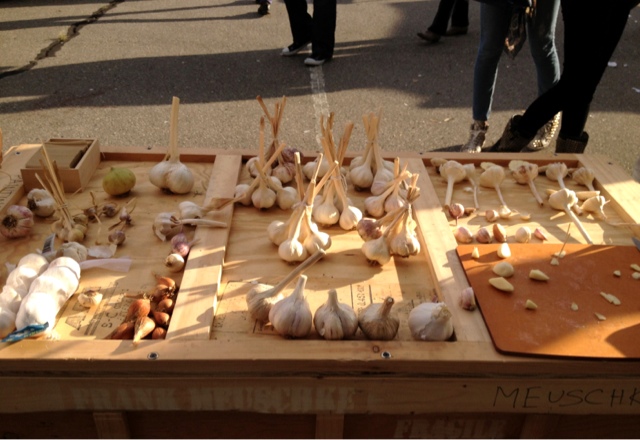
On Sunday I used my phone, available light and some white foam core to photograph all the different strains of garlic I will plant this November. Farms conventionally display a quarter, situated adjacent to the garlic, to show the size of their produce. It is useful to understand the size of the strain you buy, but I wanted to do so with a little more playfulness. My studio mate, Matt, offered up his boxes of thread spools. Why not? They're colorful, although not always the same size, they are similarly sized, and even I have an innate sense of their scale since playing with them as a child.

At first I did a number of shots with two bulbs, then a bulb and a clove, but in the end I settled on simple. We also tried some blue-cast gator board as the backdrop. That was electric and so settled on a warmer tone board.


Your Eyes Are Like Limpid Pools Of Chicken Fat


For those out of the loop of that reference -these are the words of Wimpy to his newly dear Olive Oyl. In response to Popeye's anger, Wimpy proposes an eating duel. 

Until recently, I spent a little more on a three liter container of XV olive oil for pan frying and much less on a 17 oz bottle of DeCecco "All Italian Olives" XV olive oil for dipping, salads, flavor. This oil is a consistently fruity xv olive oil. I had always bought this DeCecco oil at one of our local "farms," Golden Farms, where it sold consistently for less, as did their Organic Valley milk (two 1/2 gallons for $7), among others.

For months now, workers at Golden Farms have been picketing along with labor groups in front of the store. Months ago we decided to stop shopping there. It really is our only serious grocer within quick walking distance, but we've gotten used to traveling farther. Honestly, I just wish the owner would resolve the issue so this contentious corner can go back to the place I by Bonne Maman preserves at 2 for $5. Yet I can't understand why the owner isn't fined by the city if he is not paying what the city says he is supposed to pay.

Anyways, we had run down the last of our DeCecco. Months ago, Frank, owner of Caputos on Court Street, had given me a lesson in extra virgin olive oil. I told him then that I wasn't ready, but this past Saturday, I made the leap and bought the two above: one Italian, one Californian.  Frank had asked me if I wanted peppery or fruity, but I ended up picking neither. The Californian is solidly grassy, really, like eating a fresh cut lawn, and the Italian more like green butter. What impressed us was the body of  both oils, that they had body at all, that it didn't act as a liquid so much as a fluid food.

Given how we use these oils (I still bought a 3 liter for frying), they really weren't all that pricey. Roughly 10 bucks for the Californian and $13.50 for the Italian -or maybe the other way around (I hate fluorescent price tags on my shelves and rip them off immediately). The same size as the DeCecco (1/2 liter) but more complex, integrating better with the simplest companions like bread or tomatoes. In fact, I think I just discovered my dinner.


Action Items


Yesterday I was at Weir Farm NHS in Connecticut for some long-range planning. It's very interesting to be a part of how a park will reveal its mysteries. The weather was great, at least until I left, when it rained all the way home.

The Last Tomato?


I'm heading out to the beach farm for what probably is the last visit this October or even November. The Fed wants us to remove all items this year so they can straighten the paths, or at least that is what they're saying. My wood and net tomato cages will come out, then. The tomato beds will be on the opposite side next year. If I grow garlic at the beach farm, it will grow where the tomatoes did these last two years.

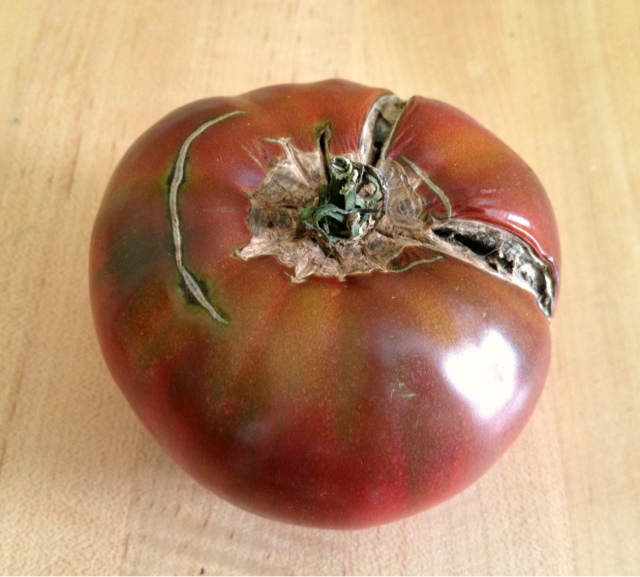
This last tomato, Black Russian I believe, is still quite firm. They were rotting awfully fast during those last weeks of August into September. Fruit flies were abundant. I ate the second to last yesterday and found it perfect.

Poly Nose


When I was a kid these were called polynoses. Of course, now adults, we call them samaras (really, who does?). Maybe the reason they were called polynoses then was what we did with them: peeled the flat end into two, placing the sticky out-folded ends onto the bridge of our noses, giving us multiple noses -polynose.


The Bees Of Autumn


It's as if they are out too late, getting drunk on nectar, then pass out at the tap. The next morning they move their limbs slowly, doing so until the sun activates their consciousness, puts the buzz back in their six-legged step.


The Bad Seed

The difficulty of getting garlic bulbs for seed purposes spawned my initial idea to grow enough garlic to get seed quality garlic out to Mid-Atlantic gardeners. Much of the trouble with garlic supply, I now believe, is due to the high prices farmers are asking. They are pushing the limits of their quality control in order to pull in as much as possible from this high dollar crop. Over a certain number, quality garlic is hard to handle. Additionally, there are terrible pests of garlic and since farmers can only know their own field well, when they pull  from neighboring farms to compensate for the demand, they risk spreading these pests around the country. I've gotten mostly good seed and some lousy -all at very high prices. Read on to see how this seedy saga plays out...


August 15:

The American Midwest has been struck with a garlic growing disaster. Many farms lost their entire crop. No, it wasn't the drought (although that affected many), but another weather-related problem. It's called Phytoplasma and is spread by the leafhoppers that were incredibly abundant at an earlier date than usual this year. Many seed outlets (like Seed Savers Exchange) that source from Midwestern farms have had to relay that their seed cannot be fully trusted, yet it is still offered for sale! I sourced some seed last year from a Midwestern farm. This year I did not due to spotty performance in the field.


September 22:
I received my replacement garlic tonight, in a large white, red and blue priority box. I picked it up, felt a rolling, a ba-dumping. Upon opening the box I found a single layer of newspaper covering yet another pile of loose bulbs, except, unlike the last time, this large box had considerably less bulbs so that they were free to roll around while traveling across the country. Really? I mean after the complaint and the return of 70% of my three hundred dollar order, you really just put a piece of newspaper on top and call it fixed?

Really, they did. I sorted the bulbs, pulling out the dented, bruised, nicked and gouged. Nearly 25% of them, and I also feel shorted on the weight. There may be enough customers out there, but I ordered a lot -15 pounds of high-priced garlic! And to mention that I sent the offending bulbs back at my cost after being double charged for shipping the first time. Yet all that would have been healed had they just put a little extra effort into that box traveling cross country in planes and trucks with turbulence and bumps.

So I sent another email, understanding that I'm testing the farmer's patience, stating that there was again damage, attaching some photos of said damage, and that I would be willing to pay two dollars more a pound to get my seed bulbs in perfect shape. And left it at that.

To compound the grief, I also received another order, for a similar amount from another farm out west, just yesterday. While the box was packed well and tight with newspaper and bulbs in paper bags, there was a considerable amount of gouge damage on those as well! Sharp, bias cut stems the culprit, must have happened in the warehouse or packing.

Took photos, sent them to that farmer, to which she replied today that she would make it right. Given was the very same reason provided by the other farm. Hot and dry in the barn and a newbie in the ranks. Hot and dry makes the wrappers fall off, while the newbie throws garlic around like its the cheap stuff at the grocery store.

I received seed from both these farms last year and all was perfectly well. So what's going on this year? I can't say, but here's what the second farmer did: she offered to replace five pounds of the damaged garlic even though I only lost four pounds. Yes, thank you -you're telling me that my business is important with something of value, not just words.

Meanwhile, the other farmer is now blaming it on NYC postal workers' uncharacteristic rough handling. I say, if you know (or even think) that to be the case -protect your merchandise with better packaging. I explain this in another email. The farmer says they will ship out another 2 pounds to make up for the damage that day, but also that no one has ever complained of this problem.

October 1:

I sent out an email to the above farmer because I had not yet received the replacement. Priority boxes tend to move pretty fast, and at least 10 days had past. The farmer said she had sent it long ago. I asked for a tracking number, she said there was none. The final email said she would issue a refund check. Honestly, I have no idea what is going on over there, but I get the sense that there is chaos, that the business model of garlic seed is under stress that I cannot see from my vantage point.

September 29:

After my day informing the garlic curious public about the differences in garlic at the Dumbo Arts Festival, I headed up to Saugerties to visit (for the first time) the Hudson Valley Garlic Festival. Garlic Festivals are sprouting up everywhere these days, for better or worse I cannot say. This one's been around for awhile. I thought I should check out the product and pay a visit to one of the founding members of NY's Garlic Seed Foundation, David Stern.

After attending his lecture, which provided the basics for gardeners, I made way to the GSF tent to ask some serious questions. I let them know that I was growing commercially, albeit on a small scale. My first question: how do I find garlic seed I can trust? To make this long story short, the answer was almost unequivocally -you can't. In fact, this crowd behind the table seemed at best cynical about the prospect. When I said that I bought retail-priced seed from Pacific NW growers, I was practically laughed at. Then told I shouldn't have. Most of these guys had never heard of these Pacific North Western farms. Why would they, they're in the farming business, and what farmer would spend 20 bucks a pound for seed. In fact, they're unsure about getting 9 bucks for their own garlic seed.

On their table was a book I've read, well-known as the "garlic growers bible" written by Ron Engeland. Now, I was well aware that his farm was no longer his farm, and that it was now in the hands of another owner, another nameless owner. Although this made me uneasy, I still bought nearly 45%, of my seed from this farm. After all, this is the farm that wrote the garlic grower's bible, their prices are very high, and they farm in a quarantined county of Washington State. So I pestered Mr. Stern when he emphatically stated that I should not buy from that farm in Washington. Why not? But also, hey, you've got that farm's book on your selling table!

Well, says he, that farm is sourcing from all over and you can't trust it. Their business is apples now, and by the way, what are they charging for garlic seed anyhow? What?! I wouldn't ever pay that much, and certainly not from them. So, I ask, what happened to Mr. Engeland, the author of the "bible?" He sells irrigation equipment. Oh.

Back, then, to the question of who can be trusted. I pester Mr. Stern, director of the Garlic Seed Foundation, about who to buy seed from. He answers that the foundation's website has a list of seed suppliers. I counter that it also says at the top of their pages to beware the Bloat Nematode which has been found all over New York State. So who can I trust? What about here, at the festival? I've seen lots of lousy looking garlic here and hardly a few who's product looks reputable as seed. He sent me to a couple of farms, one of which had sloppy product, and the other a farm that only sold Spanish Roja. The Roja looked decent, but the farmer said he had problems with Fusarium Wilt, the disease which happens to mimic both the symptoms and timing of Bloat Nematode.

After engaging in a long conversation with that farmer, I felt convinced enough to buy a couple of pounds, although I am shrinking away from that confidence now as I read all the agricultural extension reports about the dreaded nematode. I then visited another farmer who kindly labeled his two types of garlic as seed or table. I returned to the Garlic Seed Foundation to inquire with Mr. Stern about his attitude toward that particular farm which, incidentally, proudly displayed the logo of the Garlic Seed Foundation on his banner. Stern said he doesn't know, or is not familiar with that farm. So I mentioned that he was a member of the foundation he directs, to which he replied that this fact is meaningless, membership in his organization has no bearing on the quality of the product. Oh.

Wow. So where to go now? I went back to speak with that farmer. He, as convincing as any, said his seed was good, but no farmer would ever guarantee their garlic and neither would he. I understand this point, and I bought three pounds. Mind you, this NYS "seed" is going for $8-10 a pound, nowhere near the retail price of Pacific NW seed I find in web-based catalogues. I am beginning to separate price alone as an indicator of quality. New York farmers would like everyone to think this way, but I also sense frustration in not being able to accept selling "seed" garlic for 20 bucks a pound. In fact, they're mad about it, yet can't seem to meet whatever mysterious profile is expected in order to command those high prices. Still the nagging question -which farms can you trust for seed?

Finally, I return to the Garlic Seed Foundation one last time. I engage another farmer behind the stand about varieties and storage lengths. She said that at one time she tried to grow all the varieties, but soon after gave up and settled on the same two varieties everyone grows -Porcelain and Rocambole, but mostly Porcelain. I mentioned that I would be growing on Long Island, which has a different soil and climate profile than upstate. She asks where, and I name the farm near which I grow and the farmer who works it. At once, Mr. Stern appears and casts doubt on the whole affair: "That land has nematode," he hollars.

I let him know that the farmer informed me of the problem he had after buying seed from a Canadian source (often it is claimed that Canada was the vector for the nematode). He never indicated that there was any nematode issues on the land that I am leasing, or that it has even been farmed in the last 10 years. In fact, this farmer had told me that he recently bought seed from Mr. Stern at $9 a pound, a price he had a hard time swallowing. I started to wonder if there were issues between these two farmers, or maybe all of them.

Mr. Stern also sold seed stock to Johnny's Seeds for $9 a pound. You know them, the seed catalogue based in Maine. He seemed angry that they resold his garlic at a high price of $18 a pound. He also said he wouldn't deal with them any longer since Johnny's had knowingly distributed nematode infested seed to customers and never issued any statements to the fact. I do not know if this is true, but it's what he said.

I feel like I visited the garlic seed kitchen and found a mess. After seeing the mess, doubt has been cast on every corner of production -the soil, the seed, the integrity of farmers. Garlic's inability to produce true seed is a curse on its cultivation. With less than half my seed in my possession, and only a month to go before planting, my idea seems more speculative than ever. I've been culling out bad cloves or bulbs from all the seed I receive. Only a sharp eye and beginner's luck are in my corner now.

October 3:

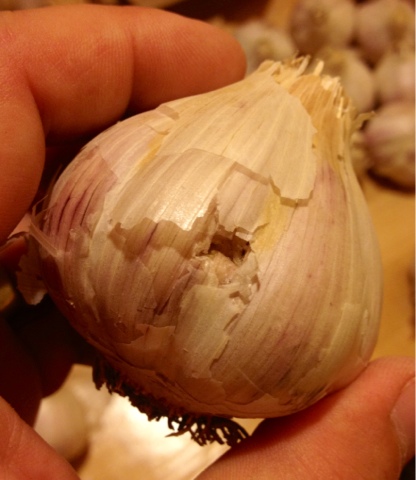
I received a box of garlic from another seed source in the Pacific Northwest. Fifty percent was just what I was expecting, good-sized clean garlic. The other 50% were too small for me to call seed, and the largest among them were beginning to dessicate. They were, however, clean and undamaged. The price for 10 pounds of Spanish Roja garlic is over $205 dollars, but the bulbs look like they will not produce good sized bulbs. Meanwhile, I'm culling out the bad cloves from those sizable Roja bulbs.

October 4:

I received my replacement supply from the Pacific Northwest farmer who offered to replace 5 lbs to my 4. They far exceeded my expectations. Not only did they put in a nice note, they bagged each bundle and, this is hard to believe, individually wrapped each and every extra bulb in newspaper! But they didn't stop there -this farm offered me a bag of Romanian Red cloves to try out. This is a farm that I will continue to deal with and their prices are exactly the same as all the other farms. I will send them a warm letter.


October 6:

I unwrapped each individually-wrapped replacement bulb today and, as would be expected, each was in perfect condition with all wrappers intact. Shipping loose bulbs is never a good idea at this price. Meanwhile, I've pretty much decided that 100% of the remaining bulbs from the first farm cannot be used. They are shrinking at an incredible rate in their almost wrapper-free condition. Now I believe that they may have not been grown well since Porcelain varieties are known to store fairly long. I am now debating whether or not to eat the cost of this loss $(236) or begin emailing the farmer (who already was tired of dealing with me) that I want my money back. Not good.


I'm also waiting on new seed, the final and largest component of this year's stock, from the farm that David Stern of the Garlic Seed Foundation warned me against, but only 5 months too late to be of value.

October 9:

I am concerned about the dessication of the German Hardy bulbs, both the undamaged originals and the replacements. The damage conversation pushed this problem to the back burner, but it is still a month to go before planting and the bulbs are shrinking fast. I emailed the farm, said that I simply cannot plant these bulbs as my prior year's experience tells me these will fail in the field. I did not ask for my money back, but simply opened the door so the farmer would have the chance to offer it. That's what they did. I now have ten pounds of shrinking seed garlic to consume or toss.

Still waiting for the bulk order from Washington State.

Update: October 11

Received seed from the final source and most look good. There was physical damage to some artichoke varieties and gouges on some cloves of the Purple Stripe variety. Japanese, much sought after and sold only in limited quantities, had some moldy cloves and physical damage. I sent an email with pictures to that farm. Given the quantity of seed I ordered from this farm, the damage I consider minor.

Still waiting for a refund from the earlier farm who sent damaged bulbs multiple times.


Bargain Basement


I'm looking to clear out the three or four hundred bulbs I have left as we gear up for planting this November. These bulbs are the smaller, less than perfect bulbs culled from those I sold previously. They will also be unlabeled. Mixed varieties, $6.75 by the pound. Interested, visit  Hudson Clove.


Fingersnail


There was a snail in our cut basil. They don't do much damage down at the beach farm so I still have a heart. A snail slithering (if you can call it that) on your skin is a strange sensation. Try it sometime. The best way to remove a snail from your skin is a quick flick of the wrist.


Thank You, and Goodnight


The other night, walking from the station, I had the peculiar notion to pass by the side yard and have a look. Aren't we always greeted with something when we have these peculiar notions? Well, this something was a trashed garden. I have no idea what or who or why. Just smash, smash and toss. Pots were thrown onto other plants, the irises I painstakingly planted as a back border were mostly torn out or flattened. The perennials to the street side looked danced upon.

And so I give up. This is maybe the third time this year there was damage to this garden. Next year, I will not make any attempt in this side yard. I've got better things to do. 


The Seasons


It's hard to leave the beach farm today, but I've little energy for pulling the few weeds or yanking the dried cucumber vines. So I sit with the breeze to my side. Tilden is empty, too, lacking the activity of summer. Somehow, I feel as if I've missed the summer this year. How can that be?

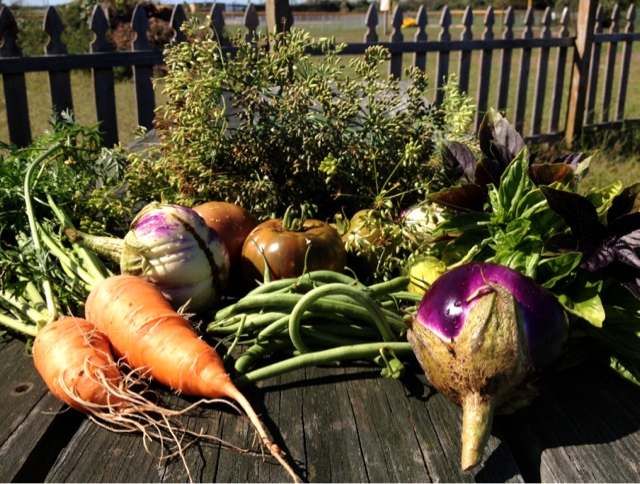
We began in grand fashion, grilling on weekends, planting on schedule. The garden was full of experiments this season, with plenty of success and some notable failures. I've discovered which filet bean, the French green bean, I prefer to grow out of 6 strains attempted. "Nickel" the outright winner, but also "Velour" for its deep blue-purple coloring. Fennel grew wildly and the tomatoes had no blossom end rot to speak of.

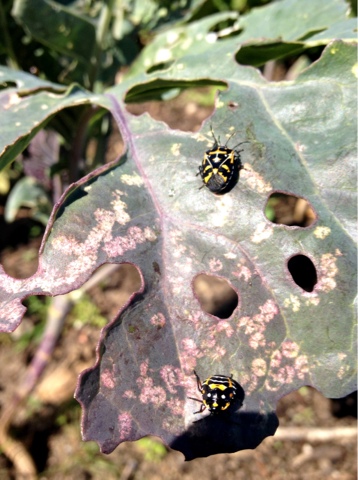
My fall brassica and lettuce plantings were delayed by our trip to Minnesota. They never overcame the lengthy run in the starter tray and now the purple cauliflower and Romanesco broccoli succumb to a menacing hoard of harlequin bugs thanks to the excessively warm winter. And there are worms, many worms, although not the typical cabbage moth worms -these are striped down the length and have some color. 

It was a stellar year for the herbs. I've clipped more fennel, rinsed it, and will heat it to 140 degrees in the oven with hopes of extinguishing whatever life remains within its branches. I gave it the hard eye under harder sunlight, and did not see anything remotely like life on its stems or seeds. Where do those gnats come from?

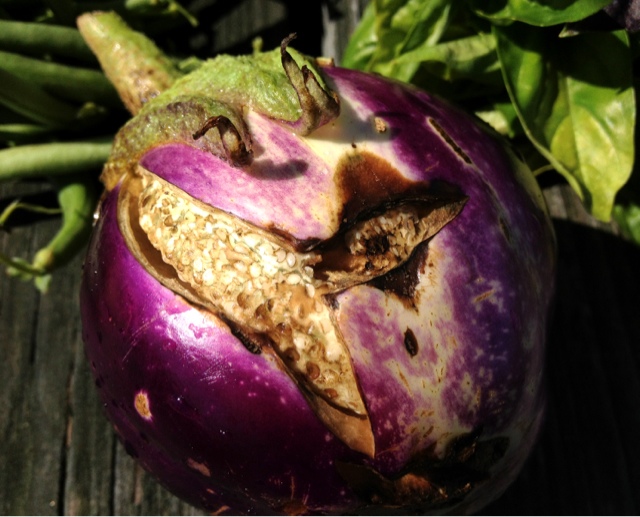
The carrots did much better this year, although initially pungent, they are getting sweeter as cooler nights become the norm. The eggplant, a seed gift from Marie, are the most beautiful I've grown. "Rosa Bianca," from Hudson Valley Seed Library. They taste wonderful too, but you must get them before any rain because they split like tomatoes.


The Fed wants us out by October 1 this year. Oh, yes, that's today. Clean up they say. No occupancy during the off season, too. They want to fix 'er up. A dumpsters a comin'. Who really knows, although I've been told the tilling is off the table and that is good news. But, they have declined to replace our well-aged, rusting, leaking, galvanized steel pipe irrigation lines, and that is not such good news. I'm not really sure what to expect on my next visit.

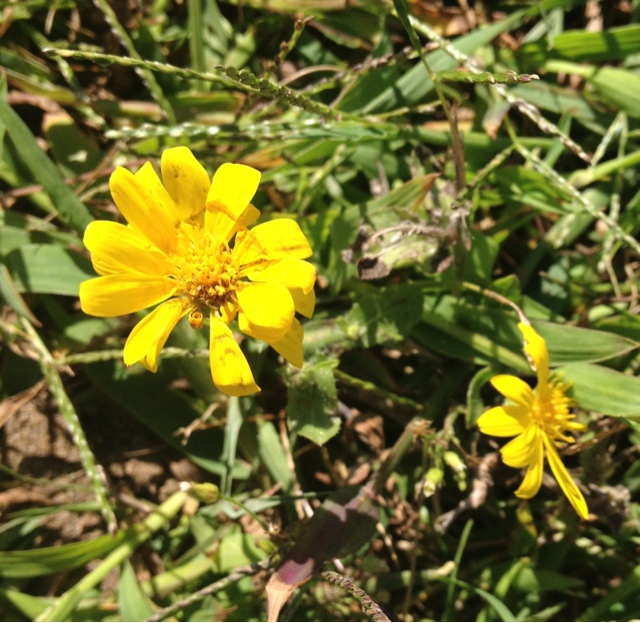
This yellow flower was blooming in the lawn. I've never seen it before, or at least not there in the lawn.