Our Global Butterfly


Yesterday I went to the Museum of Natural History with Betsy, my cousin (Red Hook's PokPok manager/waiter, ask for Jeff) and his girlfriend to see the Our Global Kitchen exhibit. I wasn't expecting much since Betsy reported that a prior exhibit on bioluminescence had little in the way of bio, just a bunch of artificial displays. Honestly, if your up on food, this exhibit isn't for you -you'll hardly see anything new. The most fascinating display was a plastic mock-up of Michael Phelps' breakfast.

Fortunately we paid full price, allowing us the chance to see the butterfly exhibit and even though I wish the museum built a Rose Center-like glass orb filled with tropical plants and humidity, it was worth every penny to spend some time with any Lepidoptera in the middle of winter.

For all the power of an iPhone, I happened upon a weakness: under the Metal Halide type lamps, the phone's sensor whipped up a moire-type effect. Of course, there was the usual darkness induced slow-shutter blurring, but I could salvage several shots. I recognize that I'm becoming more self-conscious about taking shots with a phone -it's so common now that even my mediation feels mediated.


Daft


These are some daffodils growing in our side yard. It's an exceptionally warm garden, even with the cold temps of the latter half of January. So, you could imagine my surprise...

...when I drove by these daffs on my way to the Food Co-op on Cortelyou Avenue yesterday. Scooby says eeuuuh? Now that's too early in a winter that isn't particularly warm! As I was driving, I couldn't stop to make sense of it all, but was taken by the few people milling around the flowers. They must be confused by the display too -it was so paranormal. Look at the placement -who plants bulbs like that? And only on this corner, only in the public lawn?Though I was late for everything ahead, I made sure to double back on my return from the co-op.

As I wrapped the corner, I rolled down the window to take the photo. Shutter hardly pressed and a minor army of stand-arounds approached my vehicle. I heard ROLLING! Then I understood -they didn't mean me. Movies, right -that's why they look so wrong. Springtime in New York.

Moving Day


Today my brother and his girlfriend are wrapping up their packing. They've decided, only a month ago, to move to Florida. This is moving day, with the overstuffed rental truck, the kid, a puppy. What luck should a snow storm be winding up on the same. Good luck movers; won't 75 degrees feel fine after today.


Attitude Adjustment


No one knows more than my wife that I am in need of some attitude adjustment. That's why she eagerly put my new exercise bike together while I was at work yesterday, the long day (7am-11pm). I am happy to report that it works. It took some effort to break a sweat, finally reaching my target heartbeat of 160. The first twenty minutes or so I could only feel the warming tingle of blood coursing through my extremities  -working, but not exercising. Then it hit, after twenty minutes but before thirty, at mile 6, resistance level 3, 19 mph, the sweat began to run. The final ten minutes, the cool down, were oxygen fueled euphoria -or the closest I've come to it while sweating. The readout can not be trusted, but I was entertained by the idea that my 40 minutes on the exercise bike burned 1/5th of my calorie intake for the day. If it were true, I'd ride for 2 hours in a vain attempt to shed 1700 calories every day, eating whole pizzas for lunch.

The best thing about exercise, and this is nothing newsworthy, is its ability to adjust attitude. It magically cleans up all that garbage I am capable of finding within. I wasn't sure if this foldaway bike would become just another piece of furniture to hang a sweater on, but after today I feel reassured. I used to go for fast walks in the park, but I always felt repelled by the morning rush traffic between here and there -somehow more intolerable in morning than evening. And then I was always distracted by the park itself, I could never stick to my practice, and time passed, and then it was late. The bike -I just get into the sweat gear, get on for 40 minutes, then jump in the shower, all in an hour.


Seasoning


"One should never make a show of having a deep knowledge of any subject. Well-bred people do not talk in a superior way even about things they have a good knowledge of. It is people who come from the country who offer opinions unasked, as though versed in all manner of accomplishments. Of course some among them do have a really enviable knowledge, and it is their air of self-conceit that is so stupid. It is a fine thing when a man who thoroughly understands a subject is unwilling to open his mouth, and only speaks when he is questioned.

...there must be no talk of moods in things they must need accomplish. They must be free from this care and that they must not let their feet linger. It does not turn to summer after spring has closed, nor does the fall come when the summer ends. The spring ahead of time puts on a summer air, already in the summer the fall is abroad, and soon the fall grows cold. In the tenth month comes a brief space of spring weather. Grass grows green, plum blossoms bud. So with the falling of leaves from the trees. It is not that the trees bud, once the leaves have fallen, but that because they are budding from beneath, the leaves, unable to withstand the strain, therefore must fall. An onward-urging influence is at work within, so that stage presses on stage with exceeding haste."

Yoshida Kenko, 14th century


Automaton Farms


As an lone, absentee farmer, I enjoy the prospect of a certain amount of automation, but the automation below requires an enormous amount of material control so that it functions as it's supposed to. I do think the first video's machine movements are strangely beautiful, somehow suggestive of Theo Jansen's Strandbeests (see video at bottom). It should be no surprise that both these inventions were born of the same culture.

Consider how much effort we put into the reduction of labor (or the increase in the productivity of the labor we retain) at the expense of people, and the locus of this practice has been agriculture for the last 200 years. Imagine GPS controlled machines that harvest apples, tomatoes, or pumpkins (it's already the norm for grains).  If they could be wind powered like the Strandbeests, wouldn't we find a way to get behind it? All this a reminder of how much we want to escape the fields and that I really need to finish reading Machine in the Garden, a great study by Leo Marx.

Thanks to Pruned for bringing these videos to my attention. 


Wind


Not a fan. Don't like wind.

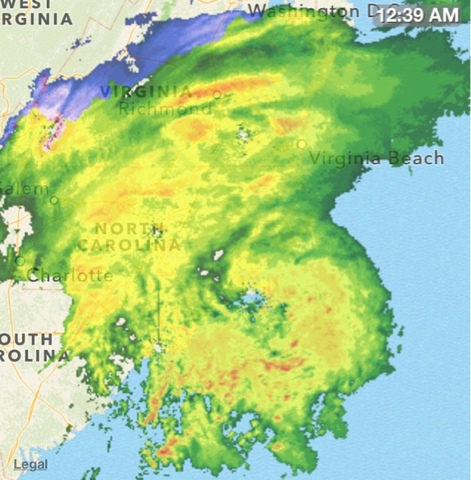
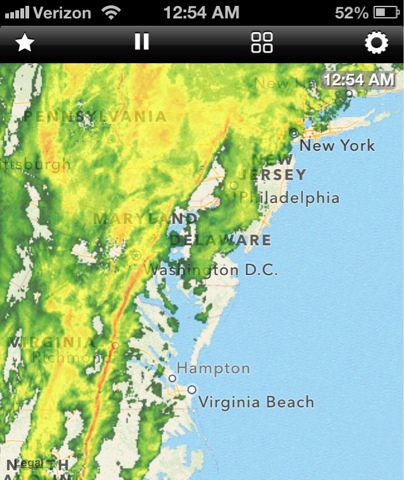
Last night it was reported that some storms were moving through at 100 mph. That's pretty fast when you consider average travel speed for weather is about 35 mph. Some thunderstorms travel at 50 and rarer still is 70, making 100 pretty darn fast.

Along with with these storms came a good amount of wind. Wind gusts out on Long Island were recorded over 60 mph around 4am, just around the time I was awakened by the rain. Today, in NYC, we'll see winds over 20 and 30 with some higher gusts.

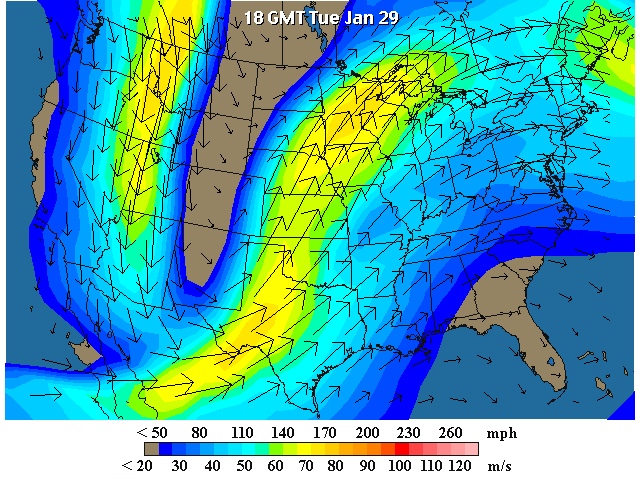
I've been reading lately about the effect ice cap melting will have on weather patterns across North America. In short, a warmer North Pole will increase the amplitude of the jet stream in winter (image below). Increased amplitude creates slower west to east movements of storms, increases their moisture content, and also amplifies the pressure gradient between troughs and ridges (ridges are high pressure and troughs are low). Science has modeled this effect of ice cap melting and this storm appears as a case study.


Time And Pasta


I bought what may amount to a few pounds of seed. From Johhny's several individual greens in quarter to one half ounce packages (including the pricey wild arugula and a pound of dwarf peas for the greens), not the usual greens mixes, and German Stripe tomato. From Fedco it's potatoes, in 2.5 lb sacks, of three varieties (blue-white, red-white, and yellow all around), carrots, parsley, cilantro, and some Sun Gold to go with my Indigo Rose tomatoes. From Peaceful Valley, it's a gallon of fish emulsion and another of kelp for foliar feeding (a new thing for me), sweet Italian long peppers and a New Mexico variety (I swear to do better with regular peppers this year), a new timer for the beach farm (the old was Sandy inundated), and maybe a pump sprayer (but not without more research) which simply means I have not 'placed' this order yet. I will probably order Black Russian tomato seeds from my original source -Kitchen Garden Seeds (many other suppliers show smaller, different tomatoes). I've already ordered 300 pounds of alfalfa meal from Agway for the garlic farm.

I recently received a hand me down computer from a video editing and effects lab. My beautiful iMac, circa 2004, G5, white, and still working, simply cannot handle the internet any longer under its final OS. I wanted to get 10 years out of that machine, but I'll accept 8, yet I never imagined it would be the web that would take it down. So, I accepted the offer of a Mac Pro tower (man, it's big), along with a somewhat yellowed Dell monitor. All I had to buy was a keyboard and mouse. The machine has more visual effects software than I can dream to use, including CS5 and 6. It has two drives, one a terabyte. It's a lot of machine, but its been through the ringer, yet I hope to get another two years out of it. These Mac Pros are strong runners, but unfortunately Apple chooses to phase them out by not writing OS updates for them, forcing the small market of professional users to buy again even though these machines could continue on.

Also, I bought a recumbent type exercise bike. Exercise. I could use some. The gadget was relatively inexpensive and it nicely folds up for stow away in our small dwelling. Much (much) cheaper than a gym membership and not ten blocks away on a cold day. I like gyms, just not that one. Also, my gardening this spring will revolve around greens, meals around eating lots of them, because time and pasta are not kind.


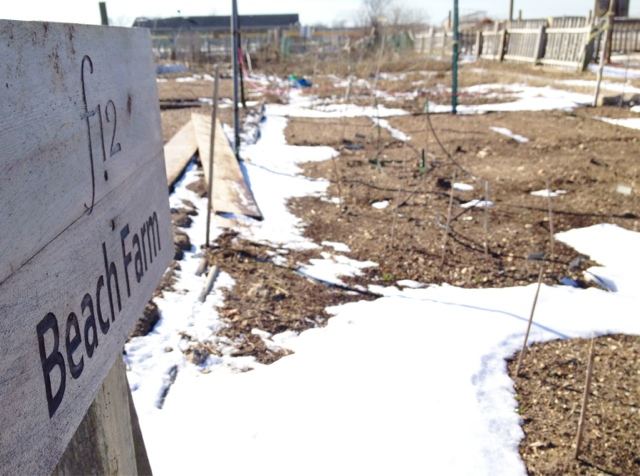
Beach Farm, MidWinter, Post Sandy


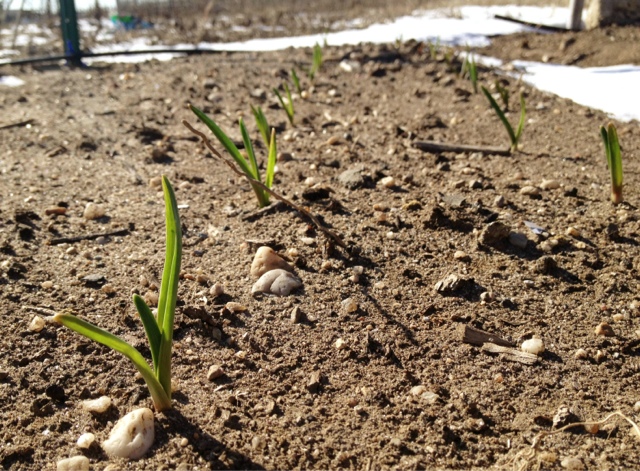
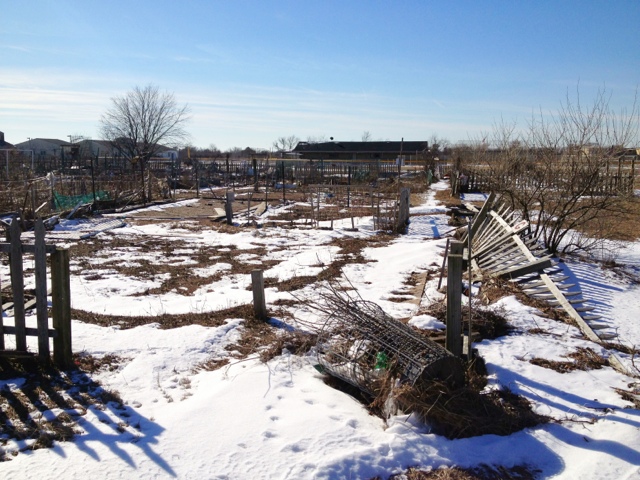
What a cheerful sight it is to see those over eager, warm-weather loving garlic varieties popping up so neatly in their rows. It warms the heart in the face of the cold winds and disarray. It's somewhat ironic that the warm weather garlic is the variety most likely to sprout and deal with the cold.


Ft. Tilden looks not a wink different from the days after the storm, except the Johnny on the spots dropped, well, on the spot. The garden has not seen any kind of improvement from park staff or gardener. We have yet to receive our contract, but should gardening here be on for the year, I doubt that much will be done that isn't out of the gardeners' initiative and that's how it should be. A little ownership, a little pride. Many things are needed, starting with a cleanup of so much crap. The fencing all around needs lifting or shoring. That can bring us to where we were before the storm. I'd like to see a compost corral instead of the useless compost bins. An incredible improvement would be some kind of pergola over at least part of the picnic area so you can take a shady break -but this is maybe out of the scope of the garden's core identity. Too luxurious.


Over at Floyd Bennett Field gardens, they're battling a natural gas pipeline regulating station to be built just down wind. You can read all about that on Karen Orlando's blog Outside Now.


Camera Futura


I sit in the studio contemplating what makes an image a photograph and an image a painting. When may a photograph, an image, cross over and become material for painting? When should the photograph stay put, be printed, or be celebrated as a photograph?

I stare at images much the same way I stare at places. Seeking something to grab on to, something worth repeating. I've always loved photography, since before my first 110 camera (if you don't know what that is, I'm sorry). I remember my first picture - a seagull passing in front of the evening summer sun, to the west northwest of Hither Hills State Park near Montauk. I think I was 6, but maybe I was 10, so at least somewhere between those ages.

Capturing an image is a magical thing, although maybe we give it less consideration in this age of digital recording. Film was precious, you waited, you were discerning. Sometimes, oftentimes, you simply got lucky.

Painting is something else all together. As a young man I was feverishly impressed with abstraction, with composition, with layering of translucent color. Getting older, seeking challenges and a way to undermine repetitiveness, I began looking less toward abstraction and more at the world around me. That was not yet twenty years ago.

Beginning around 2005 I began using my photographs as source material for paintings. Even though this is common practice amongst most artists I come into contact with, there is still a pestilent sentiment that this is somehow misguided, lazy, and lacking true artistry. Of course, this idea is lazy and misguided and is often the view of those who do not make art themselves but like to show you how much they know.

I have a beautiful photo of the bridge to the Rockaways on my wall. It's been there for some time, and was intended to become a painting, but I wasn't feeling it, for lack of a better explanation. The original was a rather small file, taken on my old, dead Canon a80. To print it large, I needed to upsample it in photoshop. Unlike many small photos printed this large (26 x 48 inches, image below only a portion), the artifacts of the process did not undermine its printed quality. I quite like it, it's enlargement fuzziness makes the photo, and that makes it suspect as a subject for painting. And then I ask: why not put photographs out there?


This semester I am managing my regular day job running an architectural model facility for architecture students. I've also agreed to take on teaching two courses. I'm on a tear to pay off my undergraduate debt before the twenty year mark this May. Of course, there is that pesky graduate school loan, but despite that I do think this spring I will look down to see a new camera in my hands thanks to the extra pay from the extra course load. There are quite a few excellent cameras out there, from pocketable to professional, so choosing will be tough. But it is time, especially as I admonish my new students for using their phone cameras for their projects. Of course, photos don't need to be great for making paintings, but should a shot be print worthy, it's nice to have started with a great camera.


Snow For The Farm


The minor snow that has fallen on eastern Long Island will be helpful at the farm during the colder days and nights ahead. The turban varieties, ever eager to grow, were the first to sprout in early December and will benefit from a layer of insulating snow. The rest still underground, but not too deeply thanks to light soil and vigorous root growth, will also benefit from the 32 degree blanket. It wouldn't take much time to bring freezing temperatures several inches below ground with several days of hard freezing temperatures and no snow cover. Garlic is tough, however, and regularly survives much lower than the twenties and teens. Although, surviving it isn't exactly needing it, so I'll take the snow.


Quoddy Peat


Back in summer, remember summer, I posted about our trip to Maine. We traveled to the beautiful Quoddy Head State Park to see the rocky coastline, balsam forest, and bogs. The surprise of the trip was a bog that is suffering erosion from rising seas. Bounded by an inland bay to the west and an ocean cove to the east, the erosion reveals peat in all its anaerobic glory, in a way I've never seen -its natural state.

We could see years upon years of layered peat, from light and dry on top to wet, dark, and spongy below -the peat already in a process of transformation. Did you know that peat eventually, under the right conditions, becomes coal? 

I do not use raw peat in the garden or on the farm, and I plan to reduce my use of peat to nearly zero this year, primarily by purchasing a fine compost mix for seed starting instead of the common peat-based seed starting mix. I'll report here how that turns out. Consider doing the same, yep, -for peat's sake.

UPDATE: I bought compost and vermiculite to combine as a substitute for peat-based mix.


Season of Seeds


Today I feel well enough to sit at the computer. Three cheers for that. My first task was to go through my seed basket (right beside the computer) to see what was there, what was still viable, and what is missing. I've gotten a lot of print catalogues, and I've perused them. My sole complaint -no one has everything I am looking for. I even went to the strange Baker Creek, some reason thinking they are comprehensive, but nope, they had what I would consider only a minimum of what I expected in tomatoes. I've been looking, over the years, for a source of a German Striped tomato, one hopefully just like the one I bought from the Borough Hall farmers market when I first started planting tomatoes in the side yard. It was by and large my favorite tomato for looks combined with taste, next to the Black Russian, which satisfied my tastes more than even the Brandywine had been able. I have found a couple of sources online, and will order from one of them. I do wish, however, that I could get all my seeds from the same source.

Last year I tried a number of new vegetables at the beach farm. It was a season of experiments, which did not much for the looks of the garden, but I learned a lot. Of tomatoes, Hillbilly and Pineapple performed poorly, although Pineapple may have suffered from my neighbors inconsiderate placement of Italian squash vines. Beam's Yellow pear suffered immediately and irrecoverably from Verticillium once established. I will not plant any of these again. Black Krim was fine, but in my mind, no better than the rather similar, but larger Black Russian. The velvet tomato was interesting to look at with its blue-grey leaves, but everyone agreed -they don't like eating flocked tomatoes. Indigo Rose, the new hybrid, high anthocyanin tomato piqued every passerby's curiosity. Once you learn when it is ready (the bottom must turn red), it becomes an interesting addition to your tomato repertoire. Indigo Rose is an acidic, juicy round tomato, that in my estimation requires the over the top sweetness of a Sungold Cherry to balance it. Cut both up for a mixed tomato salad and the brilliant orange and deep purple commingle well, visually and to your palette. Additionally, the plant was vigorous, completely unaffected by the Verticillium going around the tomato patch, and produced until the first frost. Finally, I was highly impressed with the Speckled Roman tomato I received from Seed Savers. I admit I haven't been expecting much in terms of production from many of the heirloom tomatoes, and even less from heirloom paste tomatoes as they compare to hybrids, but the Speckled Roman plant, just one, outperformed my expectations. The clusters were large, tomatoes at least three inches long, definitely speckled, productive over at least two months, did not succumb to disease, and most important -they were meaty and juicy, which in my experience is lacking in so many paste-type tomatoes.

This year's tomato list looks like this: German Stripe, Black Russian, Indigo Rose, Speckled Roman, Sungold, Bella Rosa, and a couple of others yet to be determined.

Another experiment was growing, on scheduled successive seedings, French fillet beans. Why fillet beans? They are regarded as finer than the "American type," which also means fussy. I found it partly true in both regards. I planted five kinds -three green, one yellow and one purple. All tasted good, with more distinctive vegetal flavors, but one must be attuned to such distinctions. If you are a green bean is a green bean type, then don't bother, because picking the French fillet is part of the art of growing them. These need to be harvested on the early side, never late as they get stringy and seedy once larger than 1/4 inch thick. You may also run the risk of yanking the poorly rooted varieties out of the ground or breaking stems when harvesting because these beans cling heartily to their vines. Be careful, be early, and you will be satisfied as I was with Nickel for the green and Velour for the purple. Soleil was a good tasting yellow, but I felt the plant had low vigor -however, I will try these again. All came from Territorial Seed.

Bulbing Fennel did well in our spring planting, although our farm had been invaded by earwigs which seemed to enjoy hanging out in the branch junctions. Fennel is particularly popular with the swallowtail caterpillars, but neither creature appeared to affect its productivity. The variety I grew last season was Finocchio Romanesco from Franchi Sementi (source: GrowItalian). Our fall planting was swamped by Sandy, so hard to say how that would have turned out. All in all, I think I have some learning to do with bulbing fennel, sometimes known as Florence Fennel, whereas there is little to learn about seed fennel, or wild fennel, vulgare, as it is so easy to grow you suspect you'll never be able to stop it! The young leaves of wild fennel are some of the sweetest leaves you'll ever taste.

Finally, we had great success with lettuce last season. A dry April and wet May led to excellent growing conditions for our spring patch, creating large heads of both Victoria butterhead and Jericho romaine. Jericho did well into June, despite some early season high temperatures. Our lettuce was planted in our tomato beds, well timed to harvest just as the tomatoes were exceeding two feet. The butterhead type did have useless outer leaves and by June, a preponderance of earwigs within those outer leaves. This did not affect the romaine, which we thought was rather tasteless until we realized that it needed some heat to build its flavor profile. The June romaine was fantastic. I seeded again for fall planting, but that was a failure due in part to our yearly departure to Minnesota (hard to care for seedlings) and then again due to Sandy swamping the plants that remained.

Of course, we grew many other plants at the beach farm this last season, including Romanesco Broccoli and Purple Cauliflower -both which were swamped by the storm surge. Last years incredibly warm weather favored the Harlequin Bug, which was also ravaging any  cruciferous vegetable at Fort Tilden. If we are lucky, the storm surge killed some of those very hard to eradicate (hard freezes do the trick, but where have they gone?) bugs. We grew heirloom eggplant, Rosa Bianca, which were slow to take off, but once they did they produced some of the most gorgeous eggplants I've ever seen. Unfortunately, they were highly prone to splitting open, from beauty to beast in one thunderstorm rain -and we had several last summer. I did better with carrots this year, making sure to dig deeply before planting. Now, how to keep them from softening to limp on the way home? Water buckets, pails of wet sand?

Of course, we are not sure what will come of the beach farm this coming season. We are unsure of the state of Ft. Tilden or the greater Gateway National Recreation Area. I am thinking of planting our vegetables in the empty rows of the farm out east, but that will require greater planning and execution than I may be capable of from our Brooklyn roost. It's time to order seeds and worthwhile to remind myself not to get ahead of today. I have an exhibit to mount this weekend in Providence and a bad cold to recover from; so thankful then that there is still enough winter before us to keep this year's farm and garden challenges at bay.


The Fog

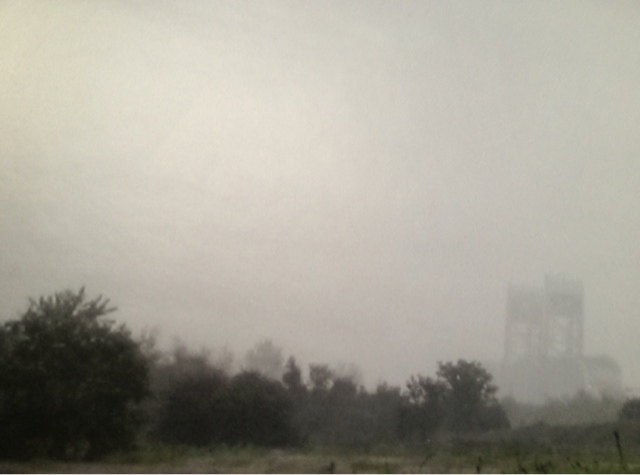
I quizzed myself over and again. I googled various versions. This new cough, its first spasm registered as I entered the van after exiting Agway, could it have been caused by the fog? I felt fine, but the dry cough increased throughout the day. My brother was visibly disturbed. He didn't shake my hand. There's flu fear going around. But the fog, could it be an irritant? Could it make someone cough?

After a bout of wheezing in the summer of 2009, I spent the next year with a smart-alecky (like me) pulmonary doctor. Spots on my lung's X-rays resulted in a year and a half under the radiological gun looking for obvious changes in size and location of those spots. I had no idea what brought it on. Was it the radon from a month's worth of steamy showers at a residency, or was it a year and a half of dirty, dusty, toxic fumes at work? Maybe I was allergic to cat dander, or maybe the general moldy disrepair of our wooden apartment building? I had no idea. And we still don't. On my last exam, a PET scan rendering my full body in three dimensional layers of flesh, muscle, fat, veins, organs, and bones, I was released from pulmonary care -I was clear.

Ever since, I've been more sensitive, succumbing more easily to sinus and bronchial infections than I could remember. My condition is not aided by working in a brew of sickness and infection we like to call college. After 2011 -a particularly bad year, I learned the fine arts of identifying sick students -Is that sweat on your brow, I've noticed you are still wearing your coat, so how do you feel? I've got into the habit of spraying down our computers, switches, and handles with a citric-based germicide. It takes several hours to beat the flu so students are always asking why the keyboards are sticky.

Students come to school sick as a matter of rote behavior. They anticipate that their professors will have low tolerance for their absence. They are probably right. Plus, they are behind on their work, probably close to failing. These are the ones that compromise the health of those less able to bounce back; they are the chronically unprepared.

With less than a week before my exhibit in Providence, with work still to be done, I have had to accept today while plugging away half-heatedly, that at best I have a cold and at worst the flu.

I am very well aware of washing my hands, short of OCD. I've isolated myself in the studio since Thursday. I did what I could to not get sick and i felt great, until I didn't.

Was it the fuel pump at the gas station, the ATM, any number of interior door handles, the change from the lackluster coffee I bought or was it the cup, maybe it was that strange and needy friend who required sleeping on our couch last night because of something about vibrations in her Manhattan apartment building? I'll never know, and now it shouldn't matter, but I feel slightly better for the opportunity to express the confoundedness of getting sick out of thin air, or was it the fog.


Tomorrow


Despite the forecast of dense fog (a fog I've already seen emerging in Greenwood on my way home from the studio this evening), I plan to head out to the farm tomorrow morning. The temperatures are warm and I want to take advantage of that as well as inspect the rows for winter growth. I would like to try out my new nejiri gama, a sickle-type hoe, and measure for irrigation. Irrigation?

Yes, I have six or eight rows not planted, and I plan to plant, ahem, experiment with growing tomatoes, New Mexican chile, fillet beans, potatoes, lettuce, mixed greens, pea greens, and probably others, all from quite a distance -Brooklyn. So I will need to measure for irrigation piping, to be installed with a timer and yet to be determined emitters.

I will head out to what is becoming my Agway, in Riverhead, to order this spring's nitrogen -alfalfa meal (I've pretty much ruled out blood meal -too expensive to ship and no one has it locally, in bulk) and start poking around for barn space. I am also going to pick up lime to spread with my new Minneapolis-area thrift store-purchased drop spreader. You cannot beat $5.99 for a 22-inch drop spreader! It's a black plastic Earthway model, which I plan to outdo by building my own that straddles a 40-inch row, has heavy duty all-terrain tires, and a large hopper using the thrift store unit as a model.

A drop-type spreader is important because it leaves lime and fertilizers exactly where you place the machine, whereas the common broadcast spreader flings these materials quite broadly. Not only is a broadcast spreader wasteful and inaccurate for row farming, but the one that was left on farm has proven to not even be able to handle the terrain without tipping over (that was fun).

Now, if I am to grow 40 foot rows of say, tomatoes or potatoes, what on earth will I do with the produce should I be successful? Well, not to get ahead of myself, but I rather think I will set up a small CSA-type scenario, maybe a FAFSA -friends and family supported agriculture. I won't take preseason shares as does a typical CSA farmer, primarily because growing from such a distance is still quite an experiment, but will sell shares of produce near harvest. This is a safe, albeit tentative (my operation is still rather tentative) way of dealing with the risk. Methods of economical distribution still to be worked out in 2013, however the following year, should I continue with this madness, I will plant enough garlic to support a physical market location and that location would be the outlet for any additional produce.

Sounds like a plan, right? Well, I'm still taking suggestions. Next up -ordering seeds.


On Farm Fracking


Imagine a farm. Do you see an old fashioned windmill? You might. Those old workhorses of farm water pumping have been staples of the American farm scene since the mid-19th century.

Today, farms, particularly those in Iowa but elsewhere too, have been taking advantage of high average winds. Wind farms are often installed on farmlands where they do little to interrupt the practice of farming, take up little space, and as far as I can tell from the towers I've visited, are quiet.

As some of you know, NYS is embroiled in handwringing regarding the institution of horizontal gas drilling using the process of hydraulic fracturing. I need not get into the details here, but suffice to say that it is a process that is heavily dependent on water and chemicals, creates millions of gallons of fluid waste that is salty, radioactive, and chemical laden, creates air pollution in the form of truck traffic, dust, and noxious chemical aerosols from the condensing process, all locally as in -on farm.

Farmers are hurting financially and that is particularly true for dairy farmers in New York State. I cannot blame a farmer for selling the rights to the health of his land for a large lease payment and royalties when so much is not going in his favor. But, at the same time, as a consumer of local farm foods, including dairy, meat, and vegetable, I cannot accept the practice as a solution to our farming problems.

Wind farms and farming are good companions. I do not believe we can solve all our energy problems with wind, but I do believe that wind farms can help sustain farmers. But that should not be all they are doing to grow sustainably. They should be diversifying their product, reaching out to new markets, seeking ways to be more efficient with technology. Government farm bills can be written to aid the smaller farm, and USDA programs for slaughter and packaging could be instituted for the smaller, local, high quality producer. I believe it's time for mid-sized producers of cured artisanal meats and cheeses, adding value to farm produce and feeding the growing interest in local sourcing and high-quality products. Aren't we ready to trade in our Oscar Meyer for la Quercia? We can do this New York, but not if we sell out to immediate gains at future expense.


I will refuse to eat any produce or product that I can reasonably discover is produced on "fracked" land. I know I am not alone on this. We can reasonably assume that fracking on farm land in the southern tier will push up the price of farm land in the Hudson Valley and elsewhere. This will drive up the costs of already higher-priced produce from these regions. The net result, I believe, will be lower consumption of high quality local foods and consequently, less local farming. This is the effect fracking in New York State may have on our access to local, high quality produce, meat, and dairy, to say nothing of the possible pollution of our air, streams, rivers, and estuaries.

Demand to know what the state plans to do when a spill occurs, or flooding rains take out a waste water pond. Demand to know how the waste water will be treated by your local sewage treatment plant discharging into the Mohawk (a Hudson tributary), Susquehanna, or Delaware. Demand to know the safety of drilling waste water brine spread onto your local roads in lieu of road salt (which washes off the road, right?). Demand to know where the millions of gallons of water will come from for drilling. Demand to know who gets priority to water should there be a drought. Demand to know what's coming out of those condenser tanks on your farm.

Yes, we all benefit from cheap gas, in the short term. I do, you do, all of us. Which is why we must get together -we're all in this, to choose another way for the long term health of New York's farmland.

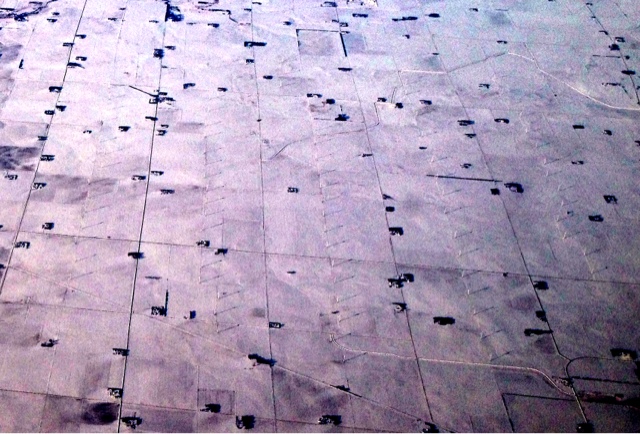
Iowa farms with wind field

Last Day


We flew in from Orlando early Friday. Lucky, flying standby, we got bumped up to first class. Nothing too special, it appears to me to be the way flying was when it first appeared on the commercial carrier scene -more comfortable, more service, smoother ride, but I could hardly imagine paying the premium for it unless my wallet was well endowed.

Days before leaving are solemn, made more so by a memorial service for Betsy's aunt that we attended once we landed yesterday. I did get to meet her great aunt Margaret, a woman with lots of spark at nearly 101. I have never met much of Betsy's extended family on her mother's side, mostly because her mother is no longer with us. I never met her mom, regrettably, because she died years before Betsy and I met.

There is snow on the ground and the light is brilliant. The temperature a pleasant 18 degrees, far better than the 4 or 5 while we were wearing shorts in Florida. It's tough to leave Rex behind, more so these days due to his declining health. There is always the chance that this could be the last time we see him. We won't be able to return, in any meaningful way, until late July. I'll be wrapped up in the garlic harvest at that point, plus school, so scheduling will be tricky.

Travel is a luxury, like so many others, that requires agency of time. There are so many places we haven't been, that we would like to experience, but our responsibility to family is powerful, and instead of using our time off to travel to exotic locations, we dutifully truck to see family.

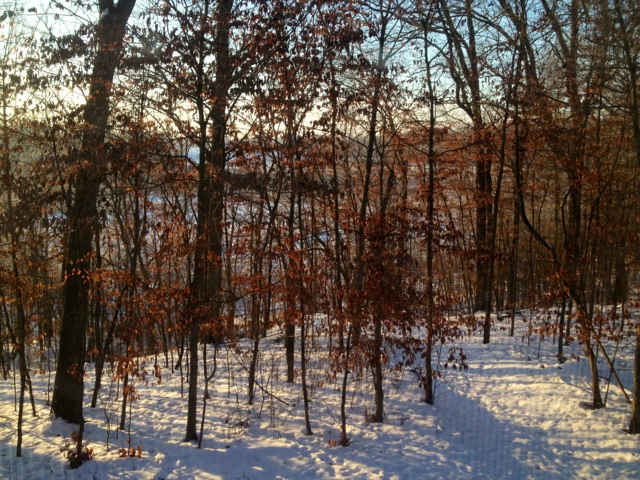
There's no need to complain about this, one day it'll be different. We will soak up our last day here in the frozen woods of Minnesota. Tomorrow, by noon, we will warm up the van and trek east toward Madison, Wisconsin. The cats will mew in discomfort. We will stop in Menominee (ba dada bop) for our usual cup of better road coffee. Eyes will glaze over as numbing vibrations of interstate travel permeate the fingers and bums of being while our van unceremoniously rolls over two hundred thousand miles somewhere in Ohio.