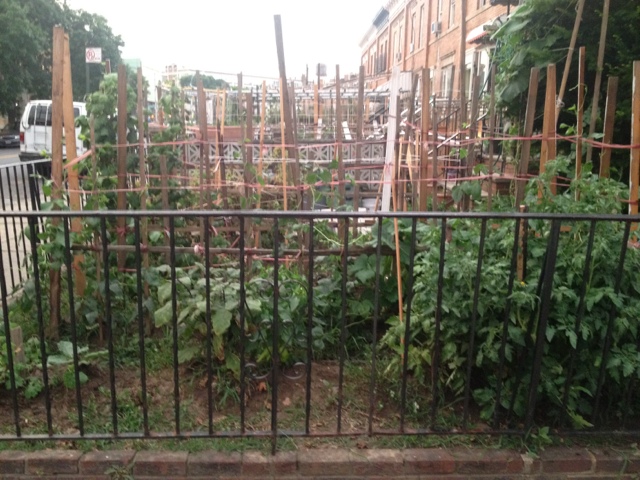
Potential


Finally, there's little to do in the garden, but look around and wait. The weeding is low, the summer planting all done, spring's harvest complete. To eye the garden without a sense of work is a relief.

It has been a galloping year with the beginning of a distant, small farm, two solo painting exhibits, teaching, the day job, and somehow the notion that all this can be blogged. The beach farm an island, now, away from all those activities, its potential transferred from sea into air into mind at most a loping amplitude. 

So, we watch tomatoes.

Milano plum.

Speckled Roman.

San Marzano.

Indigo Rose (black, blacker, blackest. Ripe?)

Pineapple, Hillbilly, or Brandywine I cannot say.

Black Krim.

Black Russian.

Beam's Yellow Pear and yellow wilt.

Miniature White cucumbers.

Milkweed that survived the whack job.

Those that did not.

Foeniculum vulgare. The sweetest young greens you can imagine.

White eggplant.

Larry's leftovers broccoli (I can never take all that he has, but would if I could).

A small patch of Nantes carrots.

And our small patch of the ocean.


Drought conditions across the United States over the last 6 months.


FIN Agli


And there lay an empty field, but for the remaining weeds, straw, and compost.

Three boxes of garlic, some hauled to the studio, and some to the apartment.

There is something anti-climactic about harvest, it is not truly the end, but the beginning of the public aspect of growing commercially -the packaging, the marketing, the selling. A couple of weeks ago I whipped up a bunch of tags, settling on those below, printed and cut them. Home grown, to the last. No cultivars this year, only varieties.


Truth Telling:

This year's crop was low yielding. I planted 1835 cloves from 292 heads of garlic. In a perfect world I would harvest 1835 healthy, marketable heads of garlic. On average, one would see 5 times the amount of heads planted, or, for me, about 1500. I'll be marketing closer to 1000, none at seed standard, which is far more difficult to achieve than I could have imagined.

Those varieties and cultivars that grew well did so because I spent money on high-quality seed. Yet, I also spent good money on middle to low quality seed, or what I would now call not seed. Beginner's mistakes are great, because the failures they induce are the best teacher. My greatest failure was brought on by my willingness to give in to lower cost, great-looking heads of garlic at Union Square Greenmarket. I can now say from experience, it's too risky. Beautiful, large heads of garlic sold as food may have the worst diseases lurking under their wrappers. By the time you see the damage in your garden, it's too late. You do not want to introduce these pests if you ever intend to grow any allium species. White Rot can last decades and the Bloat Nematode several years in the soil or on alternate hosts. Cornell has begun (finally, wonderfully) subsidized testing for Bloat Nematode.

And then there are the minor problems. A wet May that led to one less wrapper on my Purple Stripes and consequently, a helluva lot less purple stripes. Bulbs that never sized up. I've had a couple (meaning two) bulbs rot on me in the apartment. You know it when that happens -you smell garlic. Honestly, garlic shouldn't give off any significant odor once it dries. When you smell garlic, you have a problem -sniff it out and destroy the whole bulb. Problems with PayPal. Oy. Would people actually want to fill out order forms and send in checks? If you're reading this and considering buying a bundle, fill me in -PayPal or check in the mail? This year the quantity is so light that email orders could work, but with larger quantities, orders could get lost. And finally -packaging. Wow, we still haven't figured out how to package and deliver in a garlic-friendly, low-cost and recyclable way.

It's a long road to a garlic bulb too.


The Seeds Of Summer


Fall crops are best for those vegetables that require cooler air to turn them sweet. But no reason not to give in to lettuce and other greens, too. And I'm giving bulbing fennel another whirl. Good luck finding vegetable starts at any nursery in late July or early August. You have to seed these yourself. And it's just harder to start seeds in summer. It's hot, it's dry, the pests are lying in wait, and you've planned your vacation for the middle of July. It's all too easy to get discouraged.

For me this means that the lettuce seeds just refused to sprout. Too hot is that bed. Ok, fine, 55-60 days says this is early. The broccoli and cauliflower did sprout, but first were ravaged by a digging squirrel and now, what remains, is being gouged by cabbage worms.

I re-seeded the overturned broccoli and these are now up (again) and I flicked the green worms to their jelly graves this morning. What's next? Our camping trip to Maine. Who will be the guardian of our seedlings then? I may just bring them indoors and have our cat sitter sit for them too.


Frenching It


This year I'm experimenting with French filet beans, or haricot vert, or Freedom beans if you're feeling rather 'merican. I've read they are difficult -is that what makes them French, or is difficult but rewarding the French raison d'etre? Either way, these beans have proven both difficult and easy, and the season's only just begun.

'Maxibel' on the left and 'Soleil' on the right. Soleil is decidedly difficult, it has not grown more than 6 inches since planting, looks pale and generally not vigorous. I've thinned the row last week and it appears better this week. I will give it credit for being a yellow filet, as all yellow beans tend to be less vigorous and susceptible to disease. Maxibel, so far so good, but waitin' on your beans.

The second planting of Maxibel and Soleil, seeded three weeks after. Something has nibbled to nothing the tender tops of Soleil. Not looking good for Soleil.

On the left, 'Fin de Bagnol,' center 'Nickel,' and to the right 'Velour.' Fin has been the fastest grower and already has some harvestable beans, but is struggling with leaf hoppers. Nickel is deep green and just began to produce flowers. Velour is a purple-skinned filet growing not quite as tall, but healthy, with a more open habit.

It does have lovely flowers and the beans are a deep purple with a fine pubescence -therefore Velour.

This week we have a handful of Fin de Bagnol beans. Taste is not unlike the larger American-style green beans, but more tender -finer. What I've read makes these beans difficult is their incessant harvest requirement. Don't miss it or your French beans become English or worse. Here you can see the mottling on the leaves caused by what I think are leaf hoppers. The damage looks Whitefly, but I didn't bring in any plants that weren't seeded by yours truly and I've seen the hoppers. They were here before when this was the garlic bed. Hasn't yet seemed to affect productivity.

The second seeding of Fin, Nickel, and Velour. Something nibbling here, but I have not found the pest. I'm starting to believe it is a rabbit. I've never seen rabbits around the garden, but this year I've seen them nearby. A gardener told me she has seen one hanging out near my beans at dusk. Hasenpfeffer anyone? Oh, no, it's a cute little bunny. I would never, but I do have bird net just as good for beans (and strawberries too) as it was for tomatoes.


Nesting


Out of cat's reach, air circulation, compartmentalization. Ikea. Wow. Now, will that Velcro hold 20 pounds?

Taking Flight


The snap peas finally gave it up and the cucumbers were seeded. Despite super hot temperatures and only a drip line to moisten them, each and every one of Territorial Seeds 'Miniature White' (although what makes them miniature, I do not know) sprouted. I'm pleased. These will grow fast now, and we'll have cucumbers in just a few weeks. And these look as if they're spreading their wings. 


Fruit, Feline, Friday


I'm really hungry and there's lots of fruit. Red seedless grapes, strawberries, pineapple, watermelon, and strawberry-rhubarb from last weekend's fruit being whipped into something too. I can eat too much fruit and the result is something like a hangover -must be all that sugar.

And we're about to eat hotdogs, Sabrett with skins. I don't eat a lot of hotdogs. Hot dogs. When I separate the words, I begin to understand.

There was talk of grilling at the beach farm, but it gets late for the trip when we're unprepared. And there is, albeit minor and light, a chance for some moisture. Will it make it here, will it not be wrung dry by Pennsylvania's hills? Not a lot of moisture in the air these days.

And the cats, they're happy we're home instead of at Tilden, which, incidentally, is about to be even more overrun by Williamsburgers. See this.


Jimmy's Emerald Isle


This is my beach farm neighbor and the sea of green before you is his plot. It puts mine to shame. His tomatoes no blight, his eggplant is two feet tall (mine have finally put on a second set of leaves). He packs in more plants than I can imagine. He already has ripe tomatoes, corn, peppers, and cucumbers.

Clearly I'm green with envy. So, what's his secret?

Each year he adds 20 new bags of topsoil and compost. And evidence suggests blue crystals dissolved in water. Now I understand those cups and bottles. They represent heavenly manna pouring right into his plot.


A Harlequin Romance


Betsy had a thing for our mustard greens, the weather had been kind to them, and each week there were more leaves to cut. But, on the day we expected to finally pull them, an orgy of Harlequin Bugs, Murgantia histrionica, was near at hand. The warm winter had been kind, given that we are on the boundary of their range (hardly, right?), and this summer the population has exploded.

I'm instantly transported to my grandmother's instructions. A peanut can filled with a quarter cup of pungent liquid and a nickel for every beetle -Japanese beetles, Popillia japonica, on her roses. Not a can in sight, nor any pungent liquids, we pulled the old mustard (an excellent trap crop) and lay them in a wheel barrow, picking up the strays with loose greens. Because they're mating, they often run attached and as much as they do damage, any sensitive being would find smacking them with a brick at that moment a bit hard to manage. No? Well, I brought them far away, sensitive being that I am.

We'll see how my sensitivity works if they come back to devour my purple cauliflower and Romanesco broccoli next month. Harlequin Bugs like Brassicas like broccoli, cauliflower, collards, etc., radishes, mustards, and I hear, even tomatoes. Watch for them.


Garden Variety Drought


No one would consider our region in a real drought, but surely we are having another garden variety drought. No? One not unlike the period of, maybe, January through April? Summer rains are thunderstorm rains, which tend to be hit or miss. Here, it's been all miss, whereas Central Park may have seen a bit more hit.

We did have significant rain in May, which put most of our plants in better standing to deal with the utter lack of rainfall since June 12. Now, as I walk about, I see even some weedy plants beginning to slump their leaves until nightfall. Our garden, planted for only rain watering, is hanging in there, but is beginning to show the signs of stress. Although, our garden is hardly the worst of it.

The United States has broken the record for the warmest 12-month period on record. Last summer was the 2nd warmest on record, this winter the 4th warmest, and this spring was the warmest on record. This heat has been described as a one in 1.6 million event. Those are some odds. The middle country, anywhere from the mid-west of Missouri to the mid-east of Ohio to the south east of Georgia have been under severe to extreme drought conditions for some time. Record or near-record temperatures have exacerbated the problem.

I recently discovered that the farmer, Lou Pendleton, who grows the French Grey shallot sets that I plant, has lost his entire crop. Not just the shallots, mind you, but all his varieties of garlic too. Of course this didn't just happen, but has been in the slow and steady works since March. There simply wasn't enough rain to supply his unirrigated fields of sandy loam. The crop simply shriveled. This was his first serious loss in 13 years and he's discouraged.

A farmer of edible allium saves their seed for the next year.  When he loses his crop, he loses everything. The price of seed has gone up quite a bit since the early nineties and one would have to buy a lot to replace what has been lost. And then there is the issue of disease, as one always buys new stock without total confidence.


Harvest Day


The night before I emailed a pleading request that we arrive on Tuesday, the third, to avoid holiday traffic, and the rain that was forecast. Request granted. We left at 10.

This is the beak of the flowering stalk on an Asiatic variety called "Asian Tempest." These were supposed to harvest alongside the Turban variety, both being the predecessors of the common Artichoke variety (think California, grocery stores). The Turbans were harvested three weeks prior, having lodged (fallen over). There is less science than art in the harvesting of garlic. Different conditions will produce different results. We harvested our Silverskin variety on the same day as the Asiatic, although they should be a few weeks apart. Someone was late, or early, but either way, the dry conditions we've been having spared us any problems with a late harvest.

This Asiatic cultivar not only stood tall, but was still growing scapes at this late date. Bulbils on the Asiatic cultivars are quite large.

And our field produced a few regressions: a Silverskin and Artichoke, both sativum, produced bulbils. Above are the bulbils penetrating the stem of the Artichoke cultivar "Inchellium Red."

Of course, these two varieties are softneck varieties, the flowering stalk bred out of them over who knows how many years. Above is the "seed head" of a Silverskin cultivar known as "Silver Rose."

Fields ready for harvest are hardly attractive. Above, the Artichoke variety lodges, partly, while the Rocambole and Porcelain stand tall. Hardnecks, ophioscorodon, do not lodge, but all varieties become brown.

It has been dry, but the upstate soil holds moisture. No bulb was harvested that didn't have some moisture in the root zone.

There have always been toads in this field.

I dug and pulled while Betsy tied bundles of ten, arranged by size, then tagged. Do not confuse this garlic for that. Untrained eyes will see one garlic where there are ten. And get them out of the sun.

Into the van went the bundles, 6 hours after arriving. It was late, we stayed over night, in the local Best Western. I needed that tick check sooner than later. I never saw a tick in the field, but I had found one on my back a month prior. All clear.

The garlic arrived in the studio on the Fourth. With no elevator, we carried boxes of bundles up four flights of stairs. Then I built a rack out of scrap wood left behind by one of the several artists leaving our building since the rent increase. We went home at dark, searched the airwaves for Hudson River fireworks, but found none. And slept.

A friend was discarding one of those "indoor" ac units. I collected it, because a studio cure is not the best cure -it's just too hot. The sensors I have measured the highest temperature at 93.5 degrees F, although relative humidity has been quite low. The ac unit appears to reduce any max temperature by 4 or 5 degrees. It is still too warm and I am thinking of finishing these off in our apartment. 

There is one more harvest to go, tomorrow, in fact. I left a quantity of several varieties to see how much latitude there is in harvest times during dry weather. But there are 350 of a Purple Stripe variety and the Creole, precious Creole. We leave early, farmer early, so to return with our bounty before the elevator shuts down for the evening. And then it will be done, a year of garlic growing. 


Kensington Farms


We live on the edge of a Bangladeshi community. No one seems more willing to grow vegetables in their front yards. These two shots hardly tell it. Vegetables of choice: tomatoes, eggplant, squash, cucumbers, runner beans and hot peppers. Roses are popular too.


Wet Bed


Although not a technical witches broom -which has more to do with branches on trees and shrubs, it's useful to describe the sprouting of each new clove long before the garlic bulbs are harvested. The bulbs above are a Creole variety called "Pescadero Red" that were trashed a few days ago. I received this cultivar gratis from a grower who sent small seed bulbs of the variety I did order. I had no room for this Creole in my garlic beds, so I planted the cloves in the herb bed.

The witches broom appears to be common among Creole cultivars (although my other beach farm Creole didn't broom), but could also be the result of very rich soil, over-fertilization, a warm winter, or poor storage prior to seeding. In the herb bed, at least two of those conditions were met. You may have noticed that these bulbs were harvested bare naked, with absolutely no wrappers. This is due to irrigation. Timed for every two or three days during this hot and dry spell, the wrappers simply rotted away in wet soil as the leaves dried down above.

Of course, the other beach farm garlic was fine because the irrigation to those beds was cut off. Garlic is best served by one or two weeks of dry weather before harvest. The weather doesn't always provide us with the best circumstances, and a little water from a thunderstorm won't ruin a healthy crop, but constant irrigation will.