Reminders From A Remote Location


I happen to be one part of a two-person exhibit called Nearer Than Eden, at The Hunt-Cavanagh Gallery at Providence College of Providence, Rhode Island. The opening (which is really a closing) is tomorrow, Thursday, March 21, from 6 pm until 8:00-plus pm. If you happen to live in the area, consider swinging by to see our work before the show comes down Friday afternoon. I think you'll enjoy what we've put together and there will be wine, free wine. Make a night of it, as this Thursday also happens to be the first Providence Gallery Night of the 2013 season, complete with gallery tour busses and guides.

Afterward, I'm shooting up to Boston to see a friend, sleep, have breakfast, shoot back down to Providence to de-install, then heading back to Brooklyn and with luck, time enough to make it to Fairway for some nighttime, congestion-free grocery shopping. Since I am in a student computer lab at the College of New Jersey (our internet has been out for a week, no reason given by Verizon), passing time before Betsy's curated exhibit, Value Added, opens, I only have this FB showcard image as a teaser.


Interior Motive


*Our plot's soil was tested by SUDS, and appeared to have no elevated levels of arsenic or lead (I had already tested for that earlier on, fish bone meal applied) and is either not showing signs of PCBs or has not been tested yet. Now we wait for their tests, but I had planted garlic in late November, after Sandy, anyways. They still don't understand gardeners or gardens. Betsy will be upset about the beach closure because she loves the ocean, but I believe she will agree with me that the inundation was caused by people, not waves, and that it will be decades before the beach is properly protected by plant covered dunes. If the garden is not re-opened, there will be a deep hole in our lives, but not entirely unexpected given the Fed's general dissatisfaction with the garden at Tilden.


Migrations


I rose before 6 am so that I could pick up the eleven flats of onion seedlings languishing in the studio. I did not want to haul each down the 4 flights of stairs on Saturday; I wanted the elevator and its operator, Carlos, and that meant getting there early so I could still get to work on time. Carlos knows all about my ajo and cebollas, and his wife is a big fan.


The plan was to leave them in the van until tomorrow, sitting on top of 300 pounds of alfalfa meal, but I had a few spare moments to do today what needn't wait until tomorrow.


A couple went here, around the roses, the only spot new growth isn't seriously pushing up.


Most went in the side yard, a location that leaves me wary because it's the spot most often trashed by unknown (but sometimes known) feet. The weather is enough of a challenge, but the people, the wild cats, even a squirrel could do my trays in. Please, leave my cebollas alone!


Although my heart was in the right place, I ended up using some peat-based potting mix when I ran out of vermiculite. I will do better next year. Now, sun must do its part to make these guys stand up. I will feed with kelp and fish soon enough and plan to transplant by the end of March.

Other Migrations:

Three weeks ago, Betsy and I received notice that all artist tenants in our studio building will be, effectively, kicked out. Our leases are up in August, but they are forcing out those on the fifth floor by this April one. We were given until June, to which I replied that wasn't going to happen because of the harvest. Apparently the landlords are feeling pretty confident about our dismissal, despite the fact that most of us have new leases. They have offered to move us to another building, but at that building's new rate which is nearly double what we are now paying. Funny, I didn't see this coming because I thought they were satisfied with the 45 percent rate increase they demanded last year. If you want to know how this feels, read last year's complaint. I can't even give it any emotional energy. Simply put, it's over.

I do not know what we will do, or where we will go, or how this will change our art practices. I would like to mention an absurdity: I can rent an acre in The Hamptons, near the ocean, for 350 dollars a year or I can rent 140 square feet (1/300th of an acre) in Gowanus, near the canal, for 6300 dollars a year.

Update: less than 24 hours something already messed with my onion flats. Either cats were laying on them or a squirrel was digging in them, or more likely both. Bollocks.


Flowers For Fabio


Years ago, at night, me and my long blonde hair were in the shower, which abuts the stoop just outside the little, frosted bath window. With the bath light on, one could make out from the stoop that I was in the shower. A woman calls, then knocks on the window, "Fabio?" "Fabio?" "Fabio!"

The only Fabio that I knew was the one from romance covers, and me a vision of long blonde hair and all, what romance-minded woman wouldn't call for Fabio from our stoop? What could I do but slide the window open, dripping, shirtless. "Fabio?," asks the woman. No, no, Frank, says I. "Oh, is Fabio there?" No, says I. She didn't speak much English and appeared to be blind. That's how I learned that someone named Fabio, a Columbian man, lived on the second floor of our building.

Fabio and I became fast friends when I started gardening the sliver of soil outside our building. He enjoyed getting out of his steaming hot apartment on summer days, choosing instead to stand in the shade of a telephone pole on our sidewalk, moving slowly with it as the sun slid east to west, until the Yew tree cast its own shadow onto the sidewalk later in the afternoon. He spoke as little English as the blind woman who once knocked on my window, the woman I later learned was his sister in law.

He enjoyed the garden, most of all the flowers, and could often be spied from our windows with his nose buried deep in a rose or lily. I cut stems for him to bring up to his place and sometimes introduced new scents, like the pungent freshness of a geranium leaf or sweet fragrance of the native honeysuckle. We offered tomatoes, basil or cilantro from our pots when the side yard became our little vegetable patch.

Almost every day Fabio headed down Ocean Parkway on his very serious bicycle, all the way to Coney Island. Another opportunity to get out of his hot apartment, and be physical. Fabio was a vigorous, healthy man, a little over 6 feet tall, and lean. He would carry his bike down from his apartment, full riding gear on, head out and return a few hours later.

On a beautiful spring day, Fabio was outside, and we were pulling our bikes out of the apartment for a commute to the studio. Excited by our ride, he went up to get his bicycle. But he didn't understand that it wasn't a round trip for us and apparently he needed company. Demoralized, he returned his bike to his apartment as we rode off, a vision of harmony in the face of his own internal anguish. We often asked his wife, who we call Mrs. Rojas, how Fabio was doing and she would always say that he was okay. We had noticed he wasn't riding his bicycle as much, or at all. When Betsy would speak with him in Spanish, she could gather that he wasn't feeling as well, but had a hard time pinning down the problem.

Within a year's time, Fabio went from a vigorous, athletic man to a shaking, weeping, screaming man unable to dress himself, unable to care for himself, unable to communicate anything but stuttering gibberish. Out of fear and dementia, he would find himself on the landing without any pants on, as we tried to talk him into returning to his apartment. He would try to escape his apartment, or our building, half dressed, and upset. One evening, as I spoke on the phone with an artist friend, there was a knock on our door. It was Mrs. Roja's sister, who in broken English tried to explain that Fabio snuck out and because she was blind could not go to find him. I told my friend that I had to go.

Betsy went one way, and I went the other. There were kids on the street and I asked them which way did the old man go, to which they responded that way, hands pointed in opposite directions. I chose the path given by the oldest, a girl, maybe 13, and made my way to Church Ave, where I stood on the corner, looking in all directions. There! Across the street, trying to get on the B35 Eastbound, but he had no money. I called Betsy and she ran the few blocks and we lured him away from the bus stop. He remembered and trusted us (for a reason unknown to us he raged verbally about his wife). Taking his arms, we crossed the street, slowly walking him back to the building. We stopped in front of the garden, lilies in bloom. I plucked one for him, held it up to his nose, and he buried himself in it, orange dust now all over his face as he smiled.

It was easy to imagine a bad situation on the street, a raving man without pants (he simply could not lift his legs into pants any longer), a tazer, or worse. We weren't always around to help, nor could we be there because of work or otherwise. Sometimes he was cared for by a health aide, sometimes his blind sister in law, sometimes his wife, but there were times when he was left alone out of some necessity or a late train. This is when the police would be called, an ambulance arrived, and although we did this with some hesitancy, most often they were helpful, and sensitive, although they rarely had a Spanish speaker in the group despite my insistence that this was necessary.

Mrs. Rojas, a health aide herself, asked us not to call the police, and we could only presume this was because there was no health insurance available, or possibly for reasons of immigration, but there were times that we simply had no other options as we tried to convince Fabio to head back up to his apartment, tried to lift his legs into his his pants, his feet into his shoes, to calm him down. He appeared to like the ambulance, always relaxing within its box, under its oxygen, soothed by its questionnaire. His part-time aide was late in one instance, and she pleaded for his release from their care. I had to sign a form, holding the EMTs free of responsibility for his release. That was last spring.

This summer Fabio's son was getting married, and so came up from Florida to visit his father, to fit him into a tux. He told me he would get them out of NYC, move them to Florida as soon as he could. I hadn't seen much of him in ten years and wasn't sure if this was just bluster. Fabio couldn't make it to the wedding, it was in Columbia after all, and the day before we were to leave for Minnesota, Mrs. Rojas asked if I would look in on him while they were in Columbia. I wanted to help, but I had to tell her we were on our way out too, and wouldn't be around to look after him. His son was there, in the hall at that moment, and maybe that is when he realized that this arrangement, a hodge podge of aides, family, and neighbors doing their best was untenable.

We continued to listen to Fabio's wails from the apartment upstairs, opposite. Often Mrs. Rojas would come down to ask that I help lift Fabio off the floor, onto a chair or couch. It was sad, upsetting, but okay. And life went on like this for the months of autumn, through Sandy, through garlic planting and school finals. When we returned from Minnesota after Christmas, a trip mired in our own family's health and age issues, we learned that the apartment upstairs and opposite was empty. The Rojas had moved out, down to Florida. I felt terrible that we couldn't say hasta luego, Fabio. And we would do anything to have him upstairs, wailing and demented, over those who live above us now. A true neighbor.

Hasta luego, Fabio


It's Not The Blog...


...That's the problem. It's everything else. I'd rather not have this place, a good place albeit full of critical thoughts, skepticism, and occasional melancholy, bear the weight of pure malcontent.

I simply won't write when all that is on my mind and plate is trouble of one kind or another. But there are a few good things and they deserve mention:

My wife. It isn't said nearly enough that she is the best part of my life. My friends and family whose support over the last 20 years has made everything possible. My art has kept me thinking and focused (in two exhibits currently). The garden, any, where lessons on how to live are masterfully rewritten.


When The Blog Wakes


Today is my birthday.

I'm at the studio listening to an episode of Science Friday on the radio. It's about time travel.

I've decided to take a class, again, at the Lower East Side Printshop. I want to make prints, monotypes specifically, because they can be made quickly, but are still beautiful.

As we introduced ourselves, encouraged by the teacher to tell as much, I delivered an oration of everything I am doing lately. Teaching two classes, managing the architectural model shop at school, painting, a community garden, a blog, a small farm.

A woman turned to ask if I had a time machine. I answered "No," in case you were wondering. However, I do not have kids and I have little to no social life.

Much is going on lately, some good, some not so good. I have a lot to say, but little will to write it. The blog, then, is mostly quiet.

Should the blog enter a coma, don't fret. I'm still alive and breathing, listening to what's going on, maybe even thinking or dreaming.

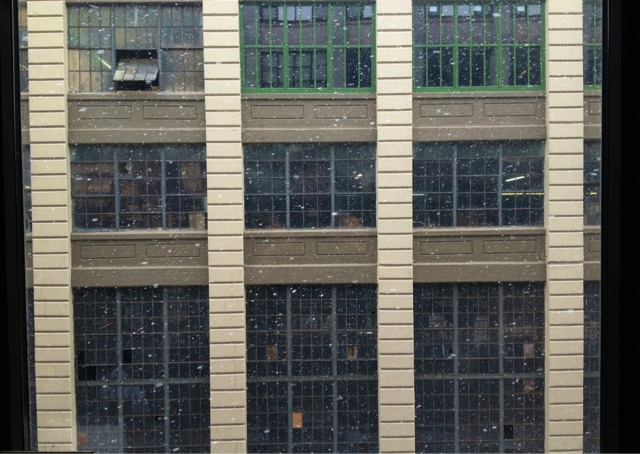
Only near spring can the forecast be for 50 after two days of snow flakes. Enjoy the weekend.


The Onion Seedling


From a distance an onion seedling comes up looking like a dicotyledon. But an onion is a monocotyledon; a single embryonic leaf emerging from its seed.

A day or two later, the illusion of a dicot gives way to the monocot as the tip emerges from the soil, a pronounced fold in its embryonic leaf. Other features of a monocot: roots are adventitious, flower parts come in threes, and veins are parallel. Lilies, bananas, ginger and grasses are monocots. 


Memory Lane


After a short visit to the garlic farm last week I finally had time to head to my old neighborhood. I wanted to know what has happened to what anyone I grew up with would simply have called the farm


On a wedge of land between Oxhead Road and N. Washington Avenue, this property and the neighbors around it were largely a mystery to me and most of my friends even though it was only a half-mile away, as the crow flies. Sure, we went by it all the time, but never set foot, never interacted. I didn't even know, or do not remember that I knew, that the farmer was a black man, Long Island's only African American farmer. 


I was relieved to see that the triangle wasn't filled with new, plastic-sided homes, but something was different.


I rounded the pointy tip, the most acute corner I know, to read the sign which did its level best to explain. Hobbs farm, I had now recollected the name, was no longer in the family. 


The old barn had me thinking a church was involved. I could see that there was a a segmented garden -maybe a community-type plot.


And so I left it, glad to see the farm was still there, but sure that it was no longer as before. And since I was but a half mile from my childhood home, I decided to pass on by to see how it has changed since my mother was forced to sell it as part of her divorce settlement.


Maybe there is a German word for the feeling one gets when they see the shape of their childhood house dressed in different clothing. I know those oak trees like I know the back of my hand, I can walk around them in my mind, isolating lichens and patterns of bark. I know the scent of the thin soil, the patches where only moss will grow, the colonies of black ants. I do not know those cars, or those new shrubs, or how they've changed the orientation of the drive.  I don't know who is inside my room.


My school bus stop, down the road, between those pines. Remember the anxiety of your first time, wondering whether or not you're in the right place, or worse, that you had missed the bus entirely. Running for the bus, yelling wait! A bus from the south was always better than one from the north.


On our road, we lived at the pinnacle of what we called a hill. The drainage was poor here, so that after heavy rains, a large puddle would form. It seemed that all the town could do was to place what we called cannon balls on either side of the pond. I was fascinated by these sooty black orbs with flame atop. I cannot believe I never tried to take one home (or did I?). Standing water was not common to our stretch of the woods, so I was also in love with these puddles, several inches deep, which we had to skirt by passing through the yards in order to get to or from our bus stop. I was disappointed when a formidable puddle in the morning had drained by the end of a school day.

To the left I jumped a ramp on my bike and went over the handle bars. To the right I passed through at night, jumping the fence to get to friends. This is where we trick or treated until we switched to eggs. The house at the top of the hill, on the left, belonged to a man who burnt his trash. The house on the top to the right had a free-roaming dog named Randy who always managed to visit our barbecues. The house at the top belonged to a man who died in his driveway as he worked his chainsaw on trees fallen by hurricane Gloria.


Just a few doors down, behind this house, I rode my first horse. Led by a brunette in riding pants and boots, three times around, it cost only a dime. I may have been five or six. 


Vermiculite Sandwich with Extra Onions


I have extra, unused rows in my garlic field. At first I thought I would fill them with tomatoes, potatoes, green beans and the like. Now I'm thinking that's just too much effort at this time. So, what to fill those empty rows with then? Onions. From seed.

I purchased these 5-inch deep, 2 by 2-inch wide cell trays, eschewing positive cost to cell-count ratios for longer roots, longer tray times, or what is often referred to as leeway. 

Large holes at the bottoms and ribbing on the side which purports to fight off root binding.

The team. After last summer's trip to Maine where I saw peat bogs first hand, I decided to try a different approach to a peat-based starter mix. After some hand wringing, I made an on the fly decision at the Agway to go with a decent compost (no sludge) and a generous dose of vermiculite.

The resulting mix was light, held moisture, yet appeared to drain well enough. It wasn't spongy the way peat-based mixes are, but in fact was somewhat grainy so that it was tough to poke holes for seeds to drop into.

Three onion types. Three trays. Each tray of 10 x 20 inches holds fifty cells, but to spare soil, space and effort, I planted two seeds in each, on the bias, roughly one inch apart so that each tray holds one hundred.

I ran out of my soil mix by the 550th cell, and had to short my goal of 1200 onion starts. Each 1/16th ounce seed packet held about 500 seeds, so that I could have planted more, but then I thought this is enough. Of course, I'm planting onions because they fit the overall business of my little acre. Garlic, shallots, and why not onions? They're on the same schedule, roughly, and require a similar care. Now sprout you little boogers!


Hoedown


These are my new tools. They lack the grace of fine Dutch tools; in fact they rather have an American brutality about them. Made in the Missouri Ozarks of discarded farm implement discs and ash wood handles, they're inexpensive, tough with a fair amount of coarseness. Although they're probably more than is required on my stone-free sandy loam, one never knows what ground may be broken in the future. I expect these to last.

The opposite edge is ground on a wheel and watch those fingers sharp. If you're interested, it's Rogue Hoe.    What I've here is their standard hoe (5.75 by 2 deep, shallow curvature), the mini (4 across, 3 deep), a mini scuffle (3.5 by 3.5 by 4 inches), and a soil rake (6.5 by 6.5 and 4 lbs).

Etymology of the hoedown: it is speculated that a hoedown is a type of dance that mimicked the hoeing of fields (do the mashed potata). But I propose that since we go to a hoedown, it may have also stemmed from the notion of laying down our hoes so that we can have some fun.


The Sophomore


I made my way out to the farm Monday morning to collect 300 pounds of alfalfa meal from the Riverhead Agway. They had expected me two weeks prior, but given the nature of the storm, Nemo, I declined. Rounding Quail Hill Farm near 10 am, I was greeted by a road block. A massive snow-blowing truck was throwing snow 50 feet to the south. After ten minutes, I was tempted to run the van over the farm road, but I didn't, probably wisely.


After a potholed, rutted journey over a road that could only have been devised to keep traffic out, I made it around to the private road. It's a road to grandiose, stony facade and column, poolhouse and pond, and I parked because farmer has me feeling more entitled than artist ever has. 


Blocking the road, yes, but wouldn't a friendly farmer's wave do, a wave from he who toils on the land, provides the stony facade and column a vision of the pastoral, reassures him and her that agriculture is not peasantry, but all the more pleasantry? So, yes, I parked on the private road, and from here a simple wave to just over there could rouse me to unblock their passage. But then nothing much came of it.


The farm road was covered in snow of variable depth, impassable by minivan or rather the promise of digging out was just as great an impasse, so that I hiked in.


Easy enough on old snow, frozen then melted, rained on and refrozen, now crusty.


Enter the farm from the eastern gate and we first notice the saffron patch, which I thought appeared remarkably sound given recent weather. A surprising amount of growth put on since the studio-bound sprouting, early November planting, and December flowering - a full two months late.


This hardly looks like a farm in winter, but a farm in drought. The decision not to mulch was a difficult one, born of cost and wind. I still cannot determine a mulch that will stay put in the face of so much daily scouring.


If you look closely at the field, orderly, pale greenery emerges. Bare soil warms rapidly under the strong February sun. A month ago most rows had no emergence, but the warmth of just a few days last week and the bare soil have given the eager varieties (notably the soft-stemmed and variable hard-stemmed varieties) the signal to push up. Rocambole, Pocelain, and Purple Stripe varieties appear to have the will to stay put, a botanical mind for the mild bipolarity of winter. This wasn't an issue in the cold zone farming upstate, but as my experience at the beach farm bore out last season, Long Island's coastal warming contributes to the early growth. But it's just that warming that allows us to grow every variety. All I can do is prepare better next season, plant a little deeper, and be mindful of the higher amplitude climate patterns offered by the warming arctic.


I had hoped that all the snow of the last month would provide a protective blanket for the crop, but the heavy winds removed most of the snow just as quickly as it had accumulated. In fact, the reason for the road closure was that much of the snow that had fallen two days prior to my visit had blown off the fields and onto the road.


The most eager growth belongs to the Turban variety. Above, to the right, is the strain 'Thai Purple' and to the left is 'Tuscan.' Several 'Tuscan' had begun to sprout before planting time, recalling now how planting was delayed by lease issues and our tropical friend Sandy.


During Long Island winters like the kind we've been having for years now, temperatures rarely dip below twenty degrees F, especially this close to the ocean. Extreme jet stream events brought extraordinary cold to the region this January, delivering occasional nights with single digit temperatures, fierce winds and damage to the eager strains. While garlic is a tough plant, energy will be lost to regrowth and stress will create opportunity for disease.


Another problem has been heaved cloves. By a long shot, not nearly as much as the other farmers' garlic, but enough to make me pissy. Every clove lost to something like this is a bulb lost to market. Pulling them out is incredibly tough, made all the harder by frozen soil just below the sun-warmed surface. The first dozen or so came up in January, while the soil was still soft as recently tilled, and those were tough to remove, their roots so firmly embedded in the ground. This visit, a month later, revealed another dozen or so. I'm not completely convinced that this is caused by rapid, intense root growth pushing the clove two, three or four inches up above ground. Maybe it's frost heave, given the moisture, the freeze thaw, the patterned cracks in the beds. Next year there will be deeper tilling, deeper planting, bed firming, and possibly some mulch because this problem is unacceptable.


To the left of the signs you see rows of minor hills running perpendicular to the garlic beds. This was the cover crop planted in December, back when warmer days seemed the norm. Nothing has sprouted there, and honestly I have no idea if it should. A cover crop in winter could help with another vexing problem.


The soil conservationist's nightmare. The snow that remains puts in stark relief all the blowing farm soil. If it weren't for this display, an untrained eye would hardly realize that any soil was being lost to the wind. I don't like it, not one bit. I have winter clover to plant around March one for my main walking row, an area roughly 1200 square feet. I have no equipment to roughen the soil compacted by our feet, nothing but a new, five pound, six-inch rake to break the soil. That will be a long day.


From here, my whole acre, the larger parcel intended for next year's crop. Despite crankiness about my sophomoric missteps and a blustery, incessant wind, I thoroughly enjoyed walking the rows. Spring approaches, and early summer's work beyond understanding, winter's rest and the warm, strengthening sun are solace.


As I hiked out, down the curving road toward the wood and van parked on the private road, the sun behind me lit the trees brilliantly. These trees on the south prong of Long Island's fork glow in the sun and are toned evenly under clouds. They are unlike any I've seen. The species, yes -white oak, aspen, beech, but the brilliance of the bark across species appears different here and I wonder if it has to do with the lichen and the ocean.


Why Not, QBot?


It was Chinese New Year, so we went to Flushing, Queens (my first neighborhood, just newborn) to explore several dumpling and hot pot houses for lunch. My mother was surprised to hear me call Flushing Chinatown, then had to explain to her that the place we lived over 40 years ago is not the place she remembers. We were so full after the second place (a mall food court that blows mall food court experiences you've had out of Flushing Bay), and so many restaurants that return trips are warranted. I might add, if you're at all like me, once you eat in a Chinese community, you will resent having to go back to your corner takeout.

When LaGuardia's patterns take planes over Flushing it's at first disconcerting, and ultimately colludes with the taller buildings, Chinese printed signs, and busy sidewalks to create a more cosmopolitan feel than you might expect. You do feel as if you could peg the bottoms of the lifting, slow moving planes with a handball. The image above, made with an iphone's 4mm lens, pushes the plane farther away than it really is. It takes getting used to, but less so inside the Queens Botanical Garden.

I've intended to visit QBot for some time, ever since the construction of their new administrative/visitor building. It's LEED platinum certified, possibly the greenest building in NYC, and all that may mean zilch to a wayward polar bear. But to this guy, it's the only serious reason to visit this underfunded garden.

The three dimensional water feature -used to recycle runoff, process gray water, achieve modest outdoor cooling, for irrigation, and as a visual design element is the heart of this building. Systemic water, a merging of liquid functionality with the designed landscape is hardly common and it makes my heart beat a little faster. 

There were problems, of course, but all told these appear to be born of staff shortages or design quirks that can be addressed with some attention. The larger garden lacks a coherent design, lacks interest and given the resources poured into this new building and parking garden, it would serve Qbot to find a way to build a master plan that revisions the garden following these examples. They'll never be NYBot or even BBot, so be Qbot and give us a reason to travel to Flushing by offering something completely new, something so 21st century.

I think it's reasonable to keep people off green roofs. We want people to see, yes, but there should be a way that doesn't impact the plants. 

Mounded roses in a ringed circle?

An excess of funny, CNC machine-carved statuary?

Maybe a master plan that merges eco sensitivity with Chinese design, given the neighborhood in which Qbot resides? Many of the great eco-design landscape projects of late have been in China (Quinhuangdao Beach, Shanghai Houtan Park, Crosswater Ecolodge, etc. etc.). Qbot lacks space, but couldn't they access some of the wasted land of Flushing-Corona Park? Surely Flushing Creek (or what's left of it) could be cleaned and greened. Were you aware that many of NYC's early plant nurseries were this side of Flushing Creek (true -I've got maps)? Perhaps a China-NY partnership could help pay for such appreciation of the value of a growing Queens (Flushing soon to be the largest Chinese community outside of China) community. Could be awesome. 

But until my grand scheme comes to pass, we should revel in Cornus sanguinea, Winter Flame Dogwood. Brilliant on a gloomy day.

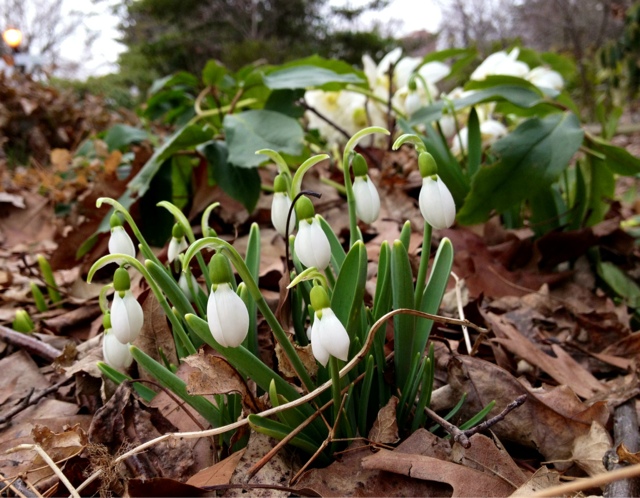
And snowdrops and hellebores, too.


February Farm


Windy at the farm, yet surprised how much I enjoyed the time walking the rows. I had to hike in, then out, and was struck by the warmth of a February sun and the beauty of the trees' branches entangled with the sky.


The Forgotten Season


No matter if you are a home gardener or small time farmer, at this time of year we all begin to feel as if we have forgotten something. Maybe you have forgotten that today is the day of valentine? Uh-uh, no, it's not that, it's a nagging that builds and fades until the last tomato is planted in May. Or is it June?

Have you gotten all your seeds? What will you plant them in? Have you waited too long to start? Is it too late? Maybe too early, so relax. But is it? When should these be planted out? Two weeks before frost, two weeks after? Ack, when will the last frost be in this crazy zone anyway? Maybe I should just start outside. Maybe there'll be just the right moisture, the ideal germination temps. Or not. I better order those cell trays. 

This morning that's exactly what I did, choosing expense and glory over affordable and chancy. Five-inch deep 2x2-inch cells, fifty per, and reusable with cleaning. I ordered fifteen of those along with trays known to the trade as the '1020,' and as it's name suggests -roughly ten by twenty inches. Skip the domes, use cling wrap, and heed the seed.

My Fedco order arrived three days ago: three sixteenths of an ounce of onion seed, or put another way, 750 to 1200 onions to be (or not to be?). I bought seed not because they are tiny, fussy, or difficult, but because they do not harbor disease the way sets and starts do. Seed, then, was the only way to keep with the allium program in my unsown rows, even though seed must be started early, maybe now, or possibly later, soil temperature of 60 degrees, consistent moisture, but not soggy, watched and waited on, until perfect transplanting sometime in March or April, but who can be sure. 

I'm excited for onions, more so than for the cilantro and parsley, carrots and Sungold that came with this shipment. Onions are the second most consumed vegetable beside the tomato; roughly 17 pounds per person in these United States. Each year American farmers plant a crop worth four billion dollars, although my crop will be worth less than five hundred. Borrettana Cipollini, Rossa Lunga di Tropea, Rossa di Milano. Storage yellow, seasonal red, storage red.