Another Way Home


A mustard, Dame's Rocket (mine isn't near bloom), what? The leaves and color seem all wrong. Anyone?


Same building, eastern exposure, a large "lawn" filled with very healthy-sized weed (field, but so often under trees, (woodland garlic then)) garlic. I didn't pick, they were just out of my reach (the lawn is four feet tall and behind a retaining wall of brick).


 Off with their heads! shout the daffodil crowd. 


The Garlic Fields


It was cloudy at the farm, breezy, the air moist, still warranting a jacket. On my last trip, around the equinox of March, I saw growth in every row and was pleased. This trip there was still more growth, yet also signs of trouble.


Twenty two 40-foot rows of garlic and one row of saffron crocus.


Last season, at the upstate farm (below) growth was luxurious by mid April. Everything was grown in a bed of local compost. The season was also warm, all winter, and there wasn't much wind in this protected spot. Note how good the Griselle shallots look in the center row -lush, green, spidery foliage.


These are the Turban variety strain 'Thai Purple.' Like its sibling 'Tuscan,' these came up last December and continued to grow throughout the cold winter. Turban strains are earliest to harvest, and that explains their large size at this date. My experience suggests that the yellow discoloration of the leaves is due to winter damage.


At this point, most of the garlic looks healthy, despite the raw attitude of the bare soil, lack of compost and mulch. Above the Creole strain 'Burgundy.'

An Asiatic strain, 'Asian Tempest,' that I had some concern about was isolated from the rest. So far, so good.


The Purple Stripe variety strains, like 'Chesnok,' come up slow, with wider leaf angles than the other hardneck varieties. This strain did poorly last season, at the upstate farm, and I blame poor seed garlic. I hope this new supply from a better farm grows larger and healthier.


Now look at this. One of the advantages to planting in orderly rows is the ease with which you can account for your planting. Clearly this bed is in the red. Take another look at last season's bed of Griselle at the upstate farm in April. I didn't lose one of those -each and every one a perfectly healthy specimen. I lost none in storage, and had them tested for nematode, which came up negative. So this is a major disappointment. The soil is actually quite similar here to the soil at last season's farm (although that was amended with compost). The rain? No, shallots should be able to handle cold and rain over winter. Fertilizer? Maybe, although I did add slow-releasing organic fertilizers before planting and again in late March. Lime? Did that, too, in quite the same manner as last season's upstate farm (which had an even lower pH). Hmmm.


This strikes me as a generally healthy looking shallot, although less healthy than last season's specimens. Look at the one behind. Not so good. Unlikely that this is a fertilizer, pH, temperature, or water problem when one is good and its neighbor not good. That kind of irregularity tends to mean only one thing -pests.


An adjacent row of garlic, Porcelain variety strain 'German Hardy,' showed a few weak and stunted plants. Not good. I dug one up, careful to maintain an envelope of soil around the roots.


AACCKK! WTF? Oh, this could be very bad. I knew I shouldn't have planted anything from New York State farm sources, but I did. The seed was clean, in great shape, after last year's experience I knew what to look for, and the farmer looked me in the eye and said it was good. I thought I should have this strain and that desire could be the undoing of my entire crop.

First question -what is that black stuff? Fungus, yes? Also the white fluff? My first reaction was emphatically White Rot, Sclerotium cepivorum! It is the worst thing you can get in your garlic or onion field beside garlic bloat nematode, Ditylenchus dipsaci. White Rot favors cool and wet temperatures (check) but this black fungus seems a little large for the black sclerotia which is often described as poppy seed-sized. Have I grown a super White Rot? I pulled three stunted garlic plants, all from the same bed of German Hardy (and adjacent to the Griselle shallots) and inspected them, then disposed each in a trash bag brought back to Brooklyn.


I didn't want to leave the farm this way, but culling poor performers was my last task. 


Man v Maggot


The next morning I headed outside to more closely inspect the garlic I had tossed in the trash. I didn't want to do this on the farm for fear of spreading pestilence around. I shook the soil off of the plants, discovering that the roots were healthy and the black fungus was not a collection of orbs, but a sheet type, similar to lichen in form and almost rubbery. The black fungus was only attached to the old clove skins.


As I said before, the roots were healthy on all three specimens, but the clove was rotting from the inside. It's possible the black and white fungal matter were completely secondary and not indicating White Rot.


I scraped away some soil on the final specimen and found something. Movement.


Worms, or rather  maggots, Onion Maggots, Hylemya antiqua -a serious pest that is difficult if at all possible to get rid of. It was only then that I made a connection to my adjacent, poorly growing Griselle shallots. Where did they come from? Probably in the field already (they overwinter in the soil), or they migrated from a nearby field via tractor or even from wild onions or garlic in the grass alongside my field. So far the obvious damage is on the west side of my acre. Now I need to get back to pluck all the stunted shallots and garlic and dispose of them in trash bags. Once these maggots pupate and morph into flies they will be impossible to contain. There are no useful controls. Farming is hope in action. 


Peas, Potatoes and Other Growings On


While I was at the farm for reasons garlic, and due to an exceptionally low number of weeds, I spent half my time there filling empty rows with other needs, wants, and experiments.


Pea greens. These multi-colored pea seeds belong to a variety which is known for producing quality vegetation over quality peas. I planted 80 feet of these, or about 2/5ths pound. If they do well, I will bunch and sell if you're interested.


I ordered three varieties of potatoes, choosing ones that I tasted last fall (all farmer market purchases). German Butter, Purple Viking, and Red Maria -all from Moose Tubers, a Fedco Seeds company, and all certified seed potatoes.  I cut them, probably later than is best practice, allowing them to begin suberization (form corky skins) for 36 hours. In retrospect, I should have planted the potatoes whole since I discovered that I had enough for one and two thirds rows and they weren't suberized at planting. I've never planted potatoes before, so this planting falls under experiments.


One row of potatoes. The light stuff all around is alfalfa meal.


I also planted patches of spring greens in all of my short garlic rows. Look at how tiny the Wild Arugula (also Roquette or Selvatica) seeds are. In addition to this, I planted spinach, regular arugula, pac choi (for salad), purple mizuna, and 'Ruby Streaks' Mustard. We were not able to plant at the beach farm this spring, so I decided to have a go with this personal crop at the garlic farm.

As for our tomatoes, peppers, lettuce, and what else, I am waiting to hear about the beach farm's opening. I would prefer to plant those nearer to Brooklyn because they will come into fruit after the garlic harvest and when you want a fresh tomato, a half hour away is way better than two and a half hours.


Pepper and Daffodil

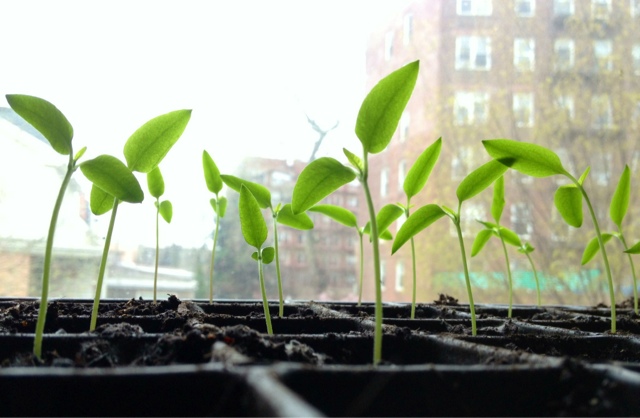
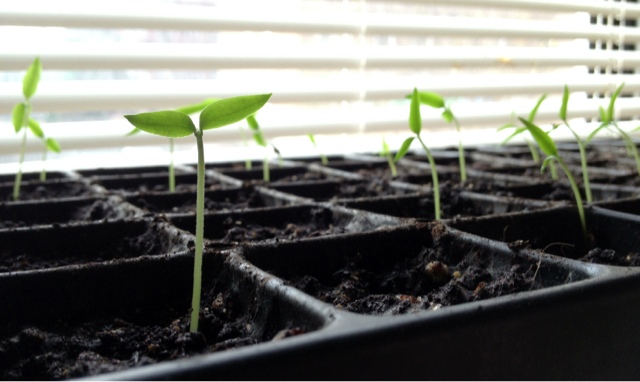
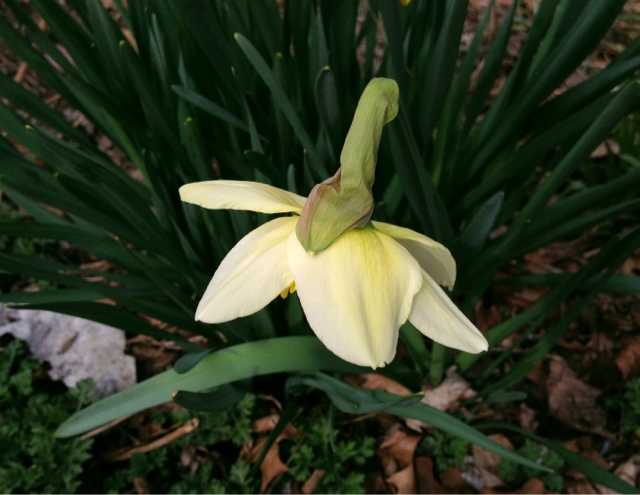
In recent years these two have not shared time. I've started all late this year and the consistent coolness has kept the flowers. Soon the peppers will need to go out so the tomatoes can take their place on the starting shelf.


Moss Gathered


See the first part of this patio project here.


After laying another layer of landscape fabric, I spread and raked the bedding sand -the zen part of laying patio stones. For an area this size with irregularly shaped flagstone, there's little use for screeding the sand. That would be appropriate for laying bricks or cut stone with uniform thickness.

My willingness to smooth the bedding sand is extraneous. As soon as I start laying stones I will mess it up with my boots and knees.


Because I needed to match the level of the older paving, I chose to start here, in the absolute lowest corner. You don't want to start somewhere else only hoping to meet level of the lowest spot after hours of laying stone. 


When you are working with stones on hand, fitting the puzzle can be challenging. I tried to refrain from tearing out stones already laid, but it was impossible. Sometimes you must undo what's already been done in order to move forward.


Late in the day I had almost all the stones set, excepting some small internal pieces and the transition to the adjacent, sloped paving. Hosing down the stones allows water to settle the sand.


The next morning I bought additional bedding sand to fill in the gaps, set the smaller stones, and make the transition between the old and new. We also moved the big yellow stone in the back from the front of the house -Mr. Spinks has a thing for stones.


After pouring the additional sand on the laid stones, I swept it about.


Then I set the path stones, which were simply laid onto the soil. The owners want to use the spare stones to separate the garden from the path, something they will do later. Afterward, I hosed the patio down, then took to sweeping it again to remove any excess bedding sand, and once again hosed it down. Job done.


Conceptually, not much different than before, but with an extended patio from the stone seat (with the pot on it) backward and a low, stone retaining wall and step. There's a plumbing project to be done in the lower left corner, after which I may come back to set the stones behind the pot. And an arbor, maybe.


The Irony of Good Morning


I was able to wake up today having forgotten the events of yesterday in Boston. Maybe it was because I was at the farm yesterday, completely out of range of the media, my attention close to the earth. This morning I went out to garden just a bit, before heading out to work. The irony of the upstairs tenant's first and only words to me in six months, "good morning." Afterward I went to the corner deli and as I waited for a sandwich, suffered the shock and gut sickness of the bombing via color photos on all the area newspapers. How can I eat?

The train was eerily empty today and the same for the Columbus Circle station. So is school.


Seedings

I am told via internet birdie that a 9 pound package is on my doorstep. I hope not! In fact, I hope Mr. UPS rang the bell of a neighbor, and dropped it inside. These are seed potatoes, my first. Betsy has grown potatoes before, in gardens and sculptures, so I will defer to her experience.

Tomorrow I go back to the patio work, with more hopes of wrapping that up. Then, on Monday I must get out to the farm -I am thinking about it night and day. So much happens between winter and summer, also known as the last three weeks. I seed tomatoes this Sunday. The peppers I seeded last week are up! And just as they did a friend contacted me from New Mexico with a stash of green chile seed to offer. So, I will seed peppers again. And the onions, so many have croaked, but just as many have made it and the warm sun of the last days really perked them up. I reseeded the empty cells, knowing that it is probably too late for large bulbs (day-length sensitive, these onions, and need to size up the plant before they size up the bulb at solstice).

Gathers No Moss


A couple of weeks ago I was courted by a couple I know from my years at Skowhegan. We see each other from time to time at events revolving around the folks from the program and we would get to talking about gardening. At a party for a couple leaving for the west coast, they told me about a large tree that had come down. More recently a neighbor had built an extension with roof deck that overlooks their fingerling yard. This inspired them to ask me to come by for an appraisal. 

I am particularly busy right now, but they contacted me during a particularly difficult week at work (a story for another day, March was too full of lousy things). The opportunity to stretch some old muscles and envision an escape route from my day job was all I needed to sign on. 


The layout had been seventy percent garden, thirty paving. The site will have expanded paving in one area, but less in another, while all paving becomes more usable. Two years ago there was a large tree towards the back, south side, shading the whole yard. It has since come down and the yard is now very sunny by the after noon. You can see the small roof deck on the left. 


The job amounts to utilizing on site flagstone and boulders for a retaining wall and patio near the house, while expanding a garden bed in back. There may be a pergola/arbor built in autumn for shade and screening depending on the neighbor's use of the roof deck. The owners removed garden plants to a nursery towards the back, clearing the path for our excavation.


All these stones were removed for use in the new patio, a term the owner rejects. Excavated soil was placed here for the new garden bed.


At the end of the first day we had all paving stones removed, the patio bed excavated (mostly), and 2/3 of the bedding material on site.


The next morning we brought in the bedding sand and remaining gravel, now 65 bags in total, or put another way, over 3200 pounds. Mixing my own bedding material was Larry's (of J&L Landscaping) idea given the problems around getting 1.5 ton of bulk crusher run into Brooklyn on a Saturday. It was a lot more labor, made all the worse because the DeKalb Home Depot had zero gravel, stone, or sand in stock. What? Not only was that location just 10 minutes away, but their website said they had it all. Silly me, I had physically checked stock at the Hamilton Avenue store, and that is where I ended up going, at the cost of time and money.


My helper had to take off before noon on Sunday, so the rest was up to me. First task was to use a laser to perfect the soil level that had been generally excavated the day before. This extra soil was dumped on the path.


Boulders rise up out of the soil like whales surfacing the ocean. The owner did not commit to having them removed or hammered, so I worked around them and planned on a thinner bed where they rise up. Is it better to have them removed? Yes, but everyone makes choices, and this one they can live with.


After laying out landscape fabric (its need always in question; there's no harm in using it), I mixed and spread the different size, angular stones and construction sand (not mason or play sand) over the 9 by 10 foot area, raking for general level.


Then wielded the tamper, which is a bit of exercise, but really you should let gravity do the work. I brought the landscape fabric up the sides of the excavation so that it would rest behind the large stones that will be placed to retain the soil. In front of the tamper is the fabric covering the largest boulder, just below the four-inch bedding mix ceiling. A one-inch layer of bedding sand will be placed over this bedding mix.


The patio bed has a slight pitch toward a drain just beyond the corner, but the remaining flagstone and concrete against the house slopes quite aggressively toward the neighbor's house. In order to avoid a tripping transition between the old and the new, I will have to creatively transition the newly laid stone with the old. Removing all the stones and concrete would have made for a level patio, from house to retaining wall, but the owner wasn't interested in tearing up the old concrete.


It was requested that this stone become a seat in the center of that very sloping transition. It was the largest stone of the day, taking all my effort to get it in place from across the yard. My hope is that it not only works as a seat, but somehow aids the transition between the old and the newly placed paving stones.


Using the stones on site, I pieced together a retaining wall. It may seem counter intuitive, but when setting the stones in gravel it is often advantageous to set the stone onto its smallest point. This allows the greatest height and girth to be at the top so that more soil is retained. Just make sure the stone is well-seated in the gravel and locked in by neighboring stones.


Fitting stones isn't art or science.


Just look at all the available stones with an eye for lines that merge well with the last stone set.


This is how I left it, Sunday. I will return next weekend to place the bedding sand and lay patio stones.


Painting With Peppers

I seeded peppers today. This is the year, I've already said that I will grow a proper pepper. Forty nine cells of four different pepper strains. Forty nine? One, two, three, four, fi...but there's 50 cells in that tray! Right. Well, there was just one onion seedling still hanging on in that tray and I just couldn't do it in after showing such tenacity. Forty nine.

Tomatoes will be seeded in a week or so. Late is the order of the season. Nothing will be put in too early. Lettuce? Yes. Soon. Monday?


I went to see the Catherine Murphy showing downtown today, before work. I headed down Crosby Street, where twenty years prior I worked for a gallerist in a part-time, not at all paid position. Such a different place back then, and I was reminded viscerally of those times as I stepped into Peter Freeman's new(!) gallery on Grand Street. It was the scent of old SoHo galleries, their rotting plaster and floors. I do not recall odors within any of Chelsea's galleries, but if there were it'd be polished concrete and a refinished built-in. Floors don't give under your weight in Chelsea, they push back.

Maybe it's the throwback to my formative years, or maybe it's simply the work. Murphy has a way with the thingness of things, and a full appreciation for the abstract in the representation, a mastery of 20th century composition, a compassion for banal coloration, and knows how to load the unloaded.


And no fear of green, either.

Busy Busy


Well the corner daffs are finally blooming. This shot was from last weekend and now they are all a-bloom. The side yard could use a cleaning, but I won't get to it. I pulled in a tray of dead onion seedlings to plant my tomatoes and peppers, but I haven't managed to do that either.

I am one third of the way through teaching 2 pt perspective to 30 students today and that makes me want to celebrate. The night class, they're the real challenge. Sixteen students, of widely ranging abilities (so many ranging on the side of, um, no I haven't done the work), will need to be dragged, kicking screaming, through the picture plane.

This weekend I am beginning a patio project in Fort Greene. Simple enough, but lots of laborious lifting. Blue slate, old school, two inches thick and irregular to be laid on a bed of crushed gravel and bedding sand, all 3000 pounds of it. Then a small pergola (arbor to some) erected over it sooner or later, probably in the fall.

The weather promises to be nice, and the labor refreshing after so much lecturing on sight lines, station and vanishing points. My tongue gets twisted and palette dry when repeating the words picture plane and perpendicular as much as I have. Placing stones requires little more than grunts and occasional swearing.


Sunday Farmer


Last Sunday I made my March trip out to the farm. I restrict these trips, costly as they are in time and gas dollars, and I would go more often if it were, say, outside my back door. This trip was necessary because there was work to be done, it was a beautiful day and the farm can be restorative.


My first task, a task that could have been accomplished on my last visit were I ready for the work, was to hoe a 6 x 120 foot row between the beds. This is a utility path and I have no desire to keep it bare soil. I was dreading the physical labor, but my new soil rake made short work of it -I finished in 20 minutes!


After leveling with an ordinary rake, I used a hand-held spreader to distribute White Dutch Clover, Trifolium repens. Won't grow too high, adds nitrogen, can tolerate foot and vehicular traffic. Go go clover cover crop.


Afterward, I inspected the rows more closely. The Saffron Crocus, Crocus sativus, appears to be doing quite well despite its already sprouting, two months late planting. There will be locally grown saffron come autumn.


If you are a regular reader, it's no surprise to hear from me that wind is one of the biggest challenges to growing near the ocean. The evidence laid bare on my rows, the prevailing winter wind's direction is marked on the soil by northwest to southeast striations.


But! What's this pale emergence? None other than December's very late planted cover crop on my other 60 percent. With luck this cover should be vigorous and dark green before June. Then we'll till it under to plant summer's cover.


My last visit, during the bluster of February, revealed much freeze burn on the eagerly growing Turban strains, but they are beginning to look better. Above is Thai Purple, with a good amount of raw heat, an early harvest and one of the earliest cured garlic strains to market.


Here we have Burgundy, one of three Creole strains I am growing this season. I'm expecting much from this strain -attractive crimson skins, sweet, and a very long shelf life, nearly as long as the Silver Skin strains. 


The smartest garlic I have in the field -Italian Purple, a Rocambole strain. I got my seed from Keith Stewart of Union Square Greenmarket fame, so these are the most local, most acclimated of any seed garlic I have planted. Despite its cold-weather intelligence, these have had quite a bit of late season heaving. In the photo you will see two phenomena -the cracked soil at the back and the soil lump just under the emergent leaf. To my mind this is the evidence of frost heaving of the planted cloves, not the other explanation, which was rapidly growing roots pushing the lightweight clove toward the surface. All my cloves were planted at least two inches below the soil line, yet many are now at or above the soil line. It's a big problem, and it can't happen again. Next season's planting requires much deeper tilling and planting in this soil. No cloves forced their way to the surface in last season's upstate farm.


Alfalfa meal has become this season's source for nitrogen and organic matter, both of which are lacking in my field. The cost of shipping blood meal and goose-eaten corn gluten meal had me resist both of these nitrogen-rich fertilizers. I need four times as much alfalfa meal as the two others (3 % vs. 12% available nitrogen), but Agway ordered it for me at $22 per 50lb sack and no shipping costs, which combined made it competitive with blood meal, with the added benefit of alfalfa's organic matter. 


Alfalfa meal is dusty, like most fertilizers, so you want to wear a mask if you're pouring a lot. All fertilizers have peculiar odors, but this one smells like a clean horse stall, which in my book ain't all that bad. The down side to alfalfa meal is the increase in quantity needing to be spread. There'll be four times as much spreading as corn or blood.


Into the hopper of my five dollar, used, elderly, Earthway drop spreader. A better deal there has never been. The rows were spaced such that I could walk the spreader over two rows at a time, although I may just make a spreader good for a four rows at a time, sometime down the line. Alfalfa's light weight and consistency make it easy going in a drop spreader, but I don't think I would try it in a broadcaster (lawn people know what I'm talking about).

Something about the alfalfa brought out the bees.


I made several passes over each row until I used 150 pounds on the entire plot. Given the wind and other concerns, I couldn't just leave the meal sitting on top of the soil. Tedious, yes, but I passed over each row of garlic with a leaf rake to stir up the soil and provide lodging for blown fertilizer. I also timed the spreading to be just before the coming rain, which came the next morning and not long after the wind had died down. 

I have another 150 pounds to spread before early May, considerably more difficult as the leaves will be much taller than the axle of my spreader. I don't like scraping the soil with the rake either. This must be given more thought for next season. In fact, I have a gallon of kelp and another of fish to spread with a pump sprayer and that may be the best way to go during the active growing season.

Preparing to leave, I headed to the van, blindly walking into a cloud of midges. You do know that nothing says spring like a swarm of mating midges, don't you?


Rosemary Canary


If there ever was a canary in our warming coal mine, it's rosemary. We all have them, and they don't die each winter any longer -even when in pots. Mine, ill-treated as it is in the side yard, happens to be flowering now. Those at the beach farm, in full sun, flowered 6 weeks ago.


Out Like A Lion


A dandy lion.

The cold and blustery days of March, complete with three snowfalls, put my onion attempt to shame. A shame made all the more goading by the boisterous growth of the dandelions. Hoop-house dreams I guess.

Now, let's put melancholy March to bed.


Limbo Farms


Traveling from Queens to western New Jersey last Wednesday, Betsy and I found ourselves with a spare half hour. We stopped in at the beach farm to see how things were going. The park and garden looks as it did the day after Sandy's inundation, although this was no surprise to me as I had been there several times since. As spring approaches the washed out garden is beginning to look a little to sad to bear.

There wasn't much growth in plot, with the exception of the garlic I planted in late November. It appears to be doing okay and no matter what happens with Tilden, I plan on harvesting.

It appears that the chives are making their best effort to come back. Maybe alliums have less trouble with salt, or maybe it just wasn't enough salt to matter all that much. Limbo means the loss of our Asian and mesclun greens season. I guess I could simply plant my new seeds, running the risk of being chased out or fined, but really, I'm too busy right now to live like that. We're supposed to find out by the end of April whether or not the Ft. Tilden Community Garden will be re-opened for gardening, and until then we wait, and start new seeds for the new season.