Planet Boron


I left the house at 6:30 am last Friday to head out to the farm. I should always leave this early, or even earlier, but I usually don't get out until 7:30 or 8 am. It's either before rush or after, and there's always traffic, especially on the two lane highway into the Hamptons. At this time of the year the vans, dually pickups, and cars of those servicing the rich line the road from the end of Sunrise Highway to Amagansett. Tourists? Them too, but not usually at my travel hours. Traffic, now adding nearly an hour's travel to the farm, is the greatest reason I wish to move to the northern prong, somewhere between the Sound and the Bay. 


I left early so to arrive before the team from Cornell's Long Island Horticultural Research and Extension Center. Sandy, the vegetable (potato, particularly) specialist, and Dan, the entomologist, were coming out to see my field with hopes of aiding their diagnostics. Scott Chaskey, farm director of Quail Hill Farm, had suggested I contact Sandy about my maggot problem. Since then I had sent several photos of maggots and rot, dropped off two sets of samples, and engaged in a string of emails.

Cornell has been fantastic, providing me with services I couldn't accomplish on my own or afford. Delivered samples have been tested for possible viruses (turns up negative), maggots identified (they think seedcorn maggot), and visually inspected for fungal disorders (Botrytis observed on some).


On this visit, the field generally looked healthier. Part of the reason is that the plants are now growing rapidly, but also because the maggot problem has waned (which could just be the eye of the storm). Yet, Sandy and Dan got to see first hand the general condition of most of the plants, particularly the early Turban, Asiatic, and all of the later harvested softneck varieties. To their eyes my plants are suffering from environmental and cultural conditions that have created opportunity for pests. It is hard to disagree with this position given the state of my field. After all, I planted in soil completely unprepared for a field of garlic, organic matter is low with no compost added, pH was low and limed just before planting, so that nutrients may be locked up.


I hit my garlic book the day prior to investigate any mention of purpling leaf tips, which to my eye seemed entirely out of the ordinary. Yellow sure, but purple must indicate a deficiency. I discovered a paragraph, in a section on fertilizing, in which the author suggests that a boron deficiency has been shown in one researcher's tests to promote purple leaf tips. Oh. I pull out my soil test to see if boron is one of the micro nutrients tested. Yes it was and look at that -boron zero. Ah, some evidence! Now, how do I find boron and is it too late to apply it?


After the leaves purple they wrinkle and die, which isn't good for the health of the plant or the developing bulb. Each leaf is a sheath around the bulb, feeding and protecting it. Sandy thinks now is a fine time to apply boron as a foliar spray. She tells me it is a common deficiency in strawberries and is applied regularly. She also took leaf cuttings to send to Cornell's lab to test for nutrient deficiencies.

Meanwhile, I set about Googling boron on my phone, looking for a source of the mineral and reading the few sources of information on the stuff. Should have known the product Borax is a variant of boron that apparently can be used on plants. I see by the Internet results that the product called Solubor (also Polybor, Granubor, Fertibor) isn't readily available retail and my field pretty much needed it yesterday. I see that those products are all made by the company Borax (as in 20 Mule Team).

From their website:
Borax operates California's largest open pit mine in Boron, California - one of the richest borate deposits on the planet. While boron is present everywhere in the environment, substantial deposits of borates are relatively rare. We supply nearly half the world's demand for refined borates,  minerals essential to life and modern living.

While I am deeply concerned about the appropriate dosage of Borax per acre (apparently Boron is an herbicide in higher (and unknown) quantities), I run to town to the hardware store to pick up some cheap Borax. Nope, don't have it. I head to the grocery store, but yet again nothing. Fine, I'll have to come back to the farm to spray Boron, yet the extra time will help me find a more suitable product, one maybe with a label for agricultural purposes, although it will cost me in time and fuel.

Interlude: Scenes From The Perimeter


The grass around the field is beginning to get lush and hummocky.


The kale we so enjoyed a month ago is now blooming its head off.


The wheat field.


The leaves are just now filling out the trees.


Sorrel on the edge of the wheat field.


It had been a very long day, but I felt I hardly got any work done. I walked the rows spraying kelp and fish, I weeded some, I planted a row of onions, and I spent and hour or so with the folks from Cornell. My field was spared the cool weather weeds, prompting Cornell to comment on the swell weeding I've been doing. Hardly true, and now the warm weather weeds have sprouted, just waiting for the perfect moment to take off.


Elephant Garlic, a leek.


The Turban strains 'Tuscan' and 'Thai Purple.' 


Rocambole 'Italian Purple'


Last minute problems that aren't being taken too seriously. I knew what these were, after all -what else would they be? Colorado Potato Beetle, Leptinotarsa decemlineata. The irony was that the potato specialist peered at my two potato rows just this morning, just as the potatoes broke through the dry crust, and there was nothing there. By the end of the day, each crack in the earth in which a potato leaf attempted to emerge was a mini swarm of potato beetles. Out came my Japanese hoe, Nejiri Gama, sharp as a sword piercing beetles, slicing them one by one.


The sun now down, I needed to go. The deer were out, and they are abundant around these fields. They skirt the fence in herds.


A train blows by, headed west.


Nice


Wow. The new Blogger compression looks ok on the phone, but on the desktop -I don't think so. Can they not get this right, with all the resources at their disposal? At the very least the image should center automatically. These two photos are exactly the same, cropped and "brightened" on the phone, but the bottom was scaled (supposedly to their x-large setting) and compressed by Blogger, the top downloaded from the phone and resized in Photoshop. 


Other Fields


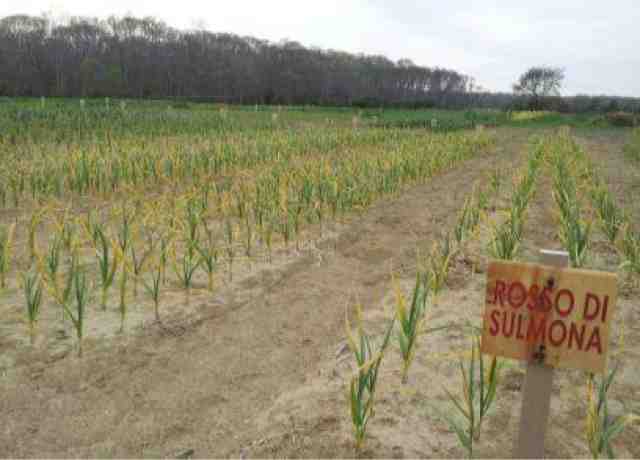
This is Toby's garlic. He grew it from garlic purchased from Hudson Clove last summer. I'm not recommending anybody plant my garlic, but chances are if it looks healthy by planting time, it is. Toby's garden appears to bear that out. I know he's not the only one who planted my garlic last year and I wonder if anyone else wants to let me know how theirs is growing.


Beepin Flowers


We were driven out of the house early today to see why it was there was beeping and cursing going on, for what worked out to be hours. A half marathon apparently had closed down all the local roads, and no one knew. Our small streets became clogged with cars, angry drivers, and no reason. It was road madness. Since I was outside, I pulled my samurai hoe from the van and made short order of weeds, moved a few plants, then took photos of some flowers.

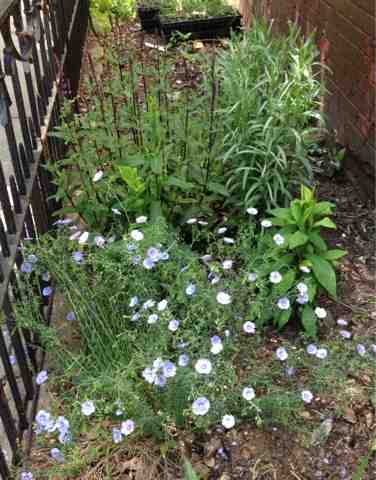
Flax, sun barely shining through the clouds. We planted two of these Larry specials last year. One returned this season.


 Geranium gracing the iron fencing, just beneath grandma's rose.


 Grandma's rose stretched itself this spring, reaching over the hacked shrub rose.


The scent is a light citrus spice. The first bud of the season was cut for my grandmother on mother's day. She still has a nose for flowers at 98.


We thought tradescantia bit the dust, but some has come up in odd places -in this case under the rose. Iphone refuses to do well with the blue-purple, especially with yellow on top.

Today I head to Flushing for some Hot Pot and dumplings with a visiting friend, but only after I visit an open studio in LIC and hit the hydroponics store off the LI Expressway. I've been eyeballing this place for years and years, now finally have a reason to check it out.

May's Apple


This is our May apple flower. I don't know why I think it's rarefied, but I treat it as such. An unlikely, delicate, ephemeral green in our yard?


It's holding its own amongst the blue hosta, the asters, the day lilies, Norway maples and ever roving pokeweed. This is a competitive crowd. And then there's the fauna.


I think the yew tree that shades the area offers a respite from most human interaction and so we have yet again a May apple.


Field Notes


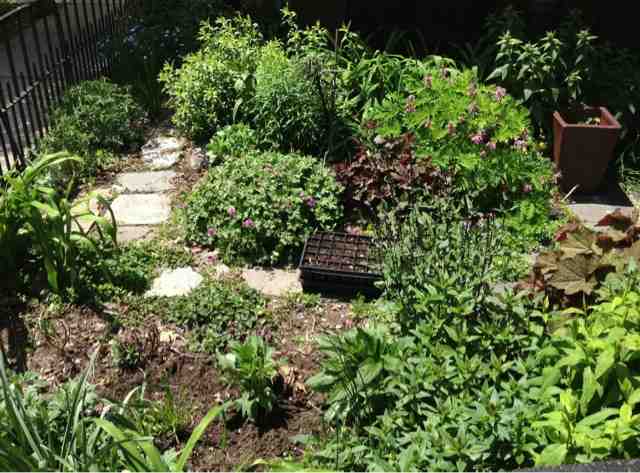
Last year the side garden received more than its share of regular trouncing, but it's growing again so we're at it again. Some plants came back from the dead either from their own roots (salvia) or from self seeding (dicentra eximia). Overall things look okay except for the bare spot where the trouncing was too much. Here we've moved some delicate natives that years back I bought at the New England Wildflower Society in Massachusetts. They're slowly coming to life as natives so often do. 

I apologize for these sunny, hard iPhone photos. I've been eyeballing cameras for months now and cannot decide. When you cannot decide, don't do anything. Obviously I do not have my intended use down and/or the cameras that are out there do not meet my needs. It's hard to beat pocketable iPhones for convenience if not for bokeh. It's not even that there aren't great cameras out there. It's just me and the money, I guess. 

In better blogging news, google has updated their mobile blogging interface to finally include inserting photos within the text body! They will still be scaled and on the blurry side, but I'll take the incremental improvements. This post was made on the bus, a somewhat nausea inducing experience, but a great use of down time. 

Our may apples are producing fruit and I think that's remarkable. Remember that I plucked these from a cull pile on a Van Cortlandt Park trail building trip.

On Friday I plan to head out to the farm. I was sent a photo from another farmer showing some strong yellows in my long storing varieties. They were yellow before, so I'll need to visit to comprehend  what is really going on. I'll spray my last dose of fish and kelp meal, plant the remaining onions (so late now, but why the hell not?), and pull some weeds. I'm not a religious sort, but clearly the success of this year's crop is out of my hands. 

Next week I have a meeting with the folks at New Amsterdam Market, the high priced foodie market in the old Fulton Fish location near the South Street Seaport. I contacted them last December but hadn't heard back until just the other day. It appears they're interested and if their stall prices aren't too high, so am I. Now I just need to harvest some healthy garlic. 

Update: Might I now say that these photos look terrible on a computer screen. I think Blogger is scaling these terribly so that they are more than blurry, but pixelated. Yech.

It's Damp


And there's asparagus to be had. Note to self: don't buy bread at the farmers' market just because it's convenient. Especially on a humid day like today. In fact, just don't. It's not fresh enough for the price. I know the wheat is NY wheat, but when the crisp turns into the chew...


BBG Tuesday


We walked from our place, across Prospect Park, to BBG to sniff the lilacs. We were not alone -Tuesdays the sniffing is free.


I sniffed a female carpenter bee (I think), unknowingly. Fellow sniffers, bee careful. We did notice a lack of honeybees.


I had recently received emails and envelopes touting the newly renovated native plant garden. So we headed in and I began to wonder which component had been renovated. Did they mean the trees that were taken out by recent storms were cut and carted (not completely)? Hmm. Maybe I just don't get here enough to know and see the difference. Above: Heart-leafed Groundsel.


Or did they mean the not yet finished Pine Barrens garden? I love the idea, or I think I do. I wish they did this at the Queens Botanical Garden. BBG is stealing their fire, figuratively and maybe literally because real pine barrens need fire to self sustain. Well, either way, I always love the native plant garden (which has plants from several eco-types and regions) because I always discover and rediscover there.


High bush blueberry in bloom.


Someone knows what this plant is (red stem, geranium type flower). The label said, falsely, Wild Columbine.


Ladyslipper (iphone cameras hate yellow).


The long, cool spring and lack of rain has promoted a late, leafless canopy. Some plants, like this Virginia Bluebell were in sun, under the trees. Other plants, like the May Apples, were wilting under the high sun where they would normally be in shade. This was made especially difficult by the sudden loss of full grown trees last fall.


May Garlic


Ahab's Maggot


I'm now visiting the farm at two week intervals, primarily for weeding -picky, on your knees weeding. I've been lucky, its been cool and dry so that major weeding has been unnecessary.  I bought three hoes in February so that I can work like a real farmer and Saturday I used them. But as I said before, these hoes are brutal. I decapitated a handful of garlic because of slightly mistaken gestures. The cuts are clean, off with their heads! clean, and what remains must be dug out. I'm not clear on the reason, but these hoes have three sides of the blade razor sharp so that even mere side swipes cause injury. Even though I was able to weed the entire plot in 3 hours (that is how long it took me to weed last year's plot at a quarter the size), it is time to retire these hoes from intra-row duty. Next visit it's all hands and knees. 


I was taken by this enormous (so large that it wouldn't fit in my camera) cherry right beside the farm gate.


And happy to see the pea greens I planted two weeks ago had all come up, each and every one. Let the FFSA (friends and family supported agriculture) begin. These are for salads and stir-fry.


The other reason for my visit of course is the health of my rows. Above is a good example of unhealthy garlic. The leaf curl is the primary indicator (yellowing leaves, secondary) of acute disease.


Digging up garlic now shows that last November's planted cloves are gone or nearly so. In my field, some were eaten by the maggots, but most were used up by the growing plant which by May are growing on their own. Notice how large the stem is -this would have been a nice sized bulb.


Look inside the red circle to see what I believe is a young maggot. Onion maggots have several generations a year and right now we are between generations. In looking for samples to send Cornell, I found some pupae and some very small maggots, but few flies or mature maggots like I found two weeks ago.


What concerns me is that the next generation will be ready just as the garlic begins forming its cloves -what we call the bulb, and a feast for that next generation. The thought is dispiriting.


Then I notice the light over the wheat field, the way it plays off the budding trees. I make my way to the field's edge. The sky is not the dirty blue of Brooklyn, not even the sharp blue of a winter's day. 


I look to the northeast where a new farmer, Frank, (two Franks? Long Island generates the most Franks) discs his field. He is not alone. Their voices carry on the wind -I hear them with perfect clarity, yet they sound diminutive, far away. That same wind carries the perfume of ocean-side convalescence.

 
How bad can things be, really, given the beauty all around? It is easy to take myself too seriously, to allow a fatalism to take root. Though the force of circumstance is insistent, I cannot allow it to take away all force from myself.


And I go about hoeing my rows, culling the culls, bagging the samples, spraying fish and kelp, and then planting the heirloom onions.


I quit at sundown to drive back to Brooklyn, passing through the Hamptons now filling with its seasonal inhabitants; the restaurant lots filled this Saturday evening. At Riverhead I detoured north toward the Sound, to drop a large brown paper bag filled with smaller bags of culled garlic at the doorstep of Cornell's Horticultural Research Laboratory. It was dark, nobody was around, and that felt rather comfortable. Although I had traveled the North Fork route time and again since the days I was free to drive a car, many times at night, I was struck by the darkness and the stars.


Green-wood, Go


I haven't gone back to Green-wood Cemetery since last Sunday, but I drove by it twice today. I think you must go. Right now, probably due to the long stretch of cool, sunny days, several things are in bloom at once and the trees are still leafing out. Have you seen the electrical brilliance of azaleas along side the chartreuse and burgundy of trees just leafing out? If you haven't, go. Now.

You will also see magnolias, dogwoods, and cherries in bloom. At. The. Same. Time. If I didn't have to work tomorrow, you'd see me there too.


Shady

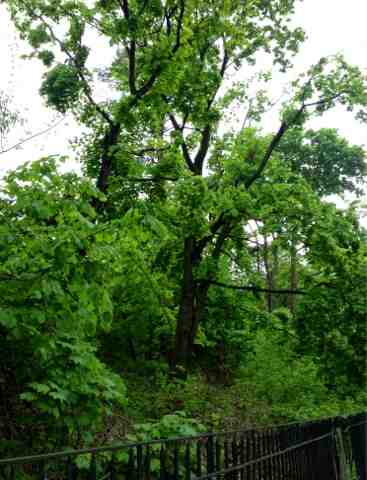
Zelkovas are not tall trees, but they shade the garden well if not the house at all. This garden spot is too shady now for the long ago chosen sun-loving perennials. I hear we may have a stretch of clouds and maybe rain beginning Tuesday which means I should transplant some of these sun worshipers to the side yard tomorrow.


Greenwood Brief


The cherries and dogwoods are in bloom. If I had to choose between the two, I think I would go dogwood. I would have, should have, taken more pictures on our brief visit, but then it was just for a quick lunch on the way to the studio. Go yourself, the trees in flower are worth every bit.

"Garfinkel" appears to be alive and well. Maybe you'll see him.


This guy seems exasperated with his own boredom. Sigh.


I noticed that these trees, methinks horse chestnuts (?), and several others along 37th Street are dead. 

Now, I should go back for an extended visit, maybe with a new camera in hand if I can make myself get off the fence. Someone, please, push.


A Sunday For Gardens


As it was, last Sunday. And as I've mostly been tucked away in an office building for finals, or at the studio during my last days of tenancy, I have not been outside, but I can see -it's been gorgeous for gardening. The struggles of agriculture have allotted me a renewed appreciation for the flower garden. Vigor and tenacity are its hallmarks -mostly. I'll always grumble about the cat shit and trash (napkins!) in the garden, but I've come to see that as part of city gardening, not its better part, but part nonetheless.


The old brass lamp lady has found a new place to call us to the garden.


Angelique.


The shrub rose got out of hand, huge before its time. I cut it, no mercy. This is usually done in March.


Its thorny remains. No no need to have a rose bush shading out the perennials. In fact, under this rose is the only place weeds reliably grow in the front yard garden -nothing else gets established.


As it is the sunlight conditions are changing rapidly with the growth of the Zelkovas; three years since their arrival, they have changed everything on the sidewalk and garden where most plants were picked for full, hot sun. (Photo from a less sunny day)


I never liked the placement of several lilies I bought four years back. I've also never dug up and moved a lily while it was actively growing. Now I have. Three lilies moved to sunnier locales, away from pickers who don't climb short fences, and more visible to all. Check out those adventitious roots extending from the stem.


Since I was concerned about the lily's tolerance for transplant I made sure to dig far and wide, transplanting the soil as well as the plant. Did you know that garlic is a lily?


Angelique, the second.

Then we went to Greenwood, for lunch, dogwoods, cherries, and others.


Dark Matter


Last Thursday Carlos told me that the whole 5th floor of our studio building (Flavor Street Studios, aka Industry City -a name I refuse) had been emptied of its occupants, leases or not, grievances or not. He asked if we were going too, and I can tell he is feeling bad about the whole thing. Aren't we all.

Peruse this article by one of the few dedicated to the dark matter of the artworld, a term I used to dispute, angrily, but now feel its gravity. The only press given to our studio problem resides here.

blurb about gentrification of Sunset Park. Of course, we don't consider ourselves gentrifiers -sure we have art degrees, but we're not of the landed class, have no savings or trusts, are not looking to convert work spaces into living spaces or move into the neighborhood. We simply want to work in industrial buildings -where people were meant to work. And these buildings had a lot, a lot, of empty space. I do not think pressure from gentrification is driving us out, but landlords who have never felt comfortable with artists, the casualness of our operations, the hard luck, and no-profit business model we employ (I've been castigated more than once by the landlord's representative). They also don't want to lose control and letting us be is losing control.

Maybe I'm giving them too much credit. They don't have to rent to artists and we don't have to rent from them. Either way, losing the studio in a month's time makes me not want to work at all. You feel like packing up to get on to the next place as soon as possible. Problem is, we've no reasonable place left to go in Brooklyn, and maybe all of NYC. I've been in four neighborhoods in ten years, so migrant artist might be the right term for the last decade. I'm doing hard research into some nearby cities destroyed by urban renewal and white flight in the 60s that have yet to turn it around. I'll let you know how that turns out.

When I searched for one of the linked articles above, Google provided this ad:


Inauspicious 2013


This is the pipeline being constructed right on the side of the road to Ft. Tilden. Animals, dead ones, are piling up along the barrier. They run across the road as they always have, meet a new dead end, then cars. If you want to read about this pipeline project traversing our national park, read Karen Orlando's blog.


The community garden at Ft. Tilden looks as it had the day after Sandy.

While the Fed hasn't asked for us to come back yet (I heard a rumor they will soon), and the park is officially closed, I've had access every time that I've visited since Sandy.

 Our plot looks fine, with considerably less weeds.

Except, the shallots I planted here are missing, which means only one thing -maggots. They were easy to find. I've been searching on the web for others having this problem. I saw no evidence here or at the farm of onion maggots at planting or in storage.


A positive sighting -cilantro seedlings are coming up. Apparently, cilantro seeds can tolerate saltwater inundation. And fennel seeds can too, as they are coming up everywhere (I knew I created a monster!). Also, daffodils, lilies, chard, elephant garlic, chives, and loads of field garlic. What appears to have succumbed? Strawberry, fig, thyme, oregano, and sage. We'll see how things look in a month.


Cool Days Hot Sun

I made mincemeat of my pepper seedlings after their first night out. Busy with an art application, I didn't go out to raise the lid until 11 am. Lost a good number to the hothouse under the glass, but still enough remain to get a good crop at the beach farm (should we get the green light). I'm headed there now to check on the garlic and feed them a kelp and fish liquid mix.


Tragedy of the (Maggot) Commons


The plan was to begin work trips with two week intervals, but the onion maggot infestation was weighing heavy on my mind. I went on Saturday, no time like the present. The goal was to remove as many obviously diseased plants as I could find.


This is a sad sight. It's not only the dying plant at center, but all the others that aren't even there anymore. One month ago each and every clove I had planted was up and growing, but now several are simply gone (below ground they rot).


This is the culprit.


A most disgusting sight.

The maggots eat away the planted clove, destroying the young plant's source of energy and inviting bacteria and fungal infection. Yet, the garlic has substantial roots now and the growing stems can survive the initial onslaught. In pulling dozens of plants I hope to stave off the more damaging second generation of maggots, already a glimmer in the bulbous eyes of flies, that will come near the time of bulb formation. You may recognize in this problem what can turn a farmer into a pesticide user. A wise farmer is a polyculturalist, and dare I say it -a prudent applicator of pesticides, organic or otherwise.


I wonder how well my garlic could survive the maggot attack had the field been better prepared. Currently low in organic matter, not abundantly fertile, and low in pH, the surviving plants all have the appearance of plants under stress. Of course, I was ready to prepare this field a year ago, but as you know I didn't get on the land until after Sandy.

I pulled roughly one percent of my garlic, disposing of them in black plastic bags, toting these back to Brooklyn. Of shallots I've lost nearly 30 percent, so far, and I am on course to lose the entire crop. I also believe, although the plants were bearing it on Saturday, that a magnitude of my garlic is under attack by the maggot. The increase in sick plants in just five days was rather disheartening, the infestation spread to each and every bed. It's not only my garlic, a neighboring farm is showing signs as well. With two months until harvest there is good reason to question whether there will be any harvest at all.