Retail Seed Garlic


I was at the Riverhead Agway to buy some Harmony 5-3-4 organic fertilizer for this fall's garlic planting and I noticed at the register countertop a small box of seed garlic. It came all the way from The Netherlands or so the packaged product had, if not the actual garlic. Notice the eight dollar price for two rather measly bulbs. At least the retailers are noticing the interest in growing garlic in gardens, but this looks to me like a last resort.


Clean Dirty


A handful of folks, respected folks, have stated that they prefer the dirty garlic to the clean. While I appreciate their aesthetics, this is food and I hate all the silty dirt that cruds up the countertop, so in practice I prefer the cleaned. Do you clean or do you dirty?


The Autumn Special


I spent the afternoon at the beach farm with a friend, cleaning bulbs of garlic for market. He had never been and marveled at the tranquility, the ocean, and the idea of grilling and beer here, so close yet far from the epicenter of our city. 

The cold front, an autumn special, a perfect column of rain, wind, and climate transformation swept through overnight, but its aura of change came more in its approach than its passing. 


By The Bundle


Excitement is ramping up for New Amsterdam's Market. They believe it will be their biggest yet as anticipation has mounted over the long, marketless summer. Yesterday I built table-top, shallow produce "crates" to display my garlic. I will laser-cut signage today. But how to handle the fray? Should I have bags at the handy for people to drop their choices into or should I bundle their choices after they select them, or both? Maybe I should pre-bundle and tag so that the buyer knows what they are getting. Or should I just tag bags for each variety they purchase (although this could lead to a lot of brown paper bags)? I am stumped on the best way to handle the transaction. I believe education is part of what I am offering, so it goes that the buyer should be able to have labeled garlic at home, but labeling each and every bulb would be ridiculous. This leads me to the prospect of bundling by threes and labeling, but still priced by the pound. But what of the soul who only wants one of each or even just one of some?

We have only one two by six-foot table, with a bench behind us of the same thirtysix-inch height. If a buyer comes to the display and starts grabbing unlabeled garlic, but then wants it labeled, things could get confusing awfully fast. This leads me to the brown bag option -pre-labeled brown lunch bags at the foot of each variety crate. The buyer can drop each variety into its respective bag, which we will weigh and they will pay, placing all in a larger paper and handle bag. Seems overly fussy, no? So I come back to pre-labeled bundles of three. For those who want it all (and who doesn't?) I could have pre-labeled one-of-each variety bundles. Hmmm.

The fussy labeling and bundling is a lot of work. It seems unlikely that I will be able to bundle all my bulbs for sale before September 29 and I sorely understand that every label strung and knot tied is lost time and money. If you were to approach a produce table with seven varieties of garlic that you may want to buy, what would you find valuable?

I am doing the Dumbo Arts Festival again this year, under artist Heather Hart's Bartertown project. This time around I'm considering my barter project on the order of Work For Cloves. I'll have folks on a leisurely art stroll come to my booth to tie and label bundles for barter of loose garlic cloves. I've never been much of a Tom Sawyer, so the event should be rather amusing. How many can we get done that day? How many people want to participate in the local food system? How many people will work for cloves?


Big Melons


Our van is in the shop again. No surprise that my mechanic, a fair man, told me that I got robbed at that AAMCO in Ohio. That mechanic should have replaced the bearings on the used axle, but didn't. Now the axle has to come out, again, to do so. And, I need rear brakes, which I knew, but was putting off until school started and the income that comes with that. Even though my mechanic, Saleem, is taking out the axle, replacing inner and outer bearings, replacing my rotors and disc breaks, and plugging a nail hole in my tire, his price is still only a third of what the Ohio mechanic charged us for simply taking out the old axle and putting in the used one. When you're in that kind of trap, I suppose you have to eat price gouging.

On my walk home, I passed these gigantic melons or gourds growing in a front yard. I like how they are supported by additional stringing. The fruit were maybe 16 inches long and 8 inches in diameter and gravity's pull was palpable.

Now I am off to the studio to make some more garlic bundles, one of which is going to a local nursery that happens to have some spectacular wooden bulb crates (for carting my garlic to New Amsterdam Market) they are willing to give me just for the asking.


New Amsterdam Market


In a little less than three weeks I will have my first garlic sale event at New Amsterdam Market. I've never been, so I've been image searching the market to get a sense for the space, tables, and overall aesthetics of the market. I think the pictures give a good sense of the atmosphere. Don't laugh, either, it is that kind of creation. Robert LaValva, the architect of the market, has insisted on designing a sense of place so that all the tables, signage, and what-have-you are identical no matter what the vendor is selling. It's as if the civic space/marketplace has become the product, not only the venue, and the local producer/vendors participate in his work. I get that and I think Hudson Clove's aesthetic sensibility fits well into his scheme as far as I can see from my Google image search.

Now I will make some low-rise pine wood crates to cradle the different varieties of garlic and shallots and maybe a two tier pine tower to display garlic bundles. Should saffron come into play, at a later market, I will need to devise a system for packaging and selling the threads. Maybe you can tell me how much saffron is enough saffron in a package? Marie, ideas?

Finally, you should know that New Amsterdam Market and it's environs are under threat of corporate development. Please read this article in Serious Eats, as it tells you all about it and why New Amsterdam Market is worth saving. The horror of the American suburb is its utter homogeneity, its total fear. Every new mall and false village filled with the same franchises dulls our collective senses. Fearful people who dream of opening new businesses but have little new ideas or the stomachs for risk -they open a franchise. Risk-taking residents try the new Potbelly sandwich instead of Subway. High end or low end, it's all the same, and I hope ingenuity can withstand the forces of homogeneity this time around.


Retiring Field


And so wraps up a season of growing in Amagansett.


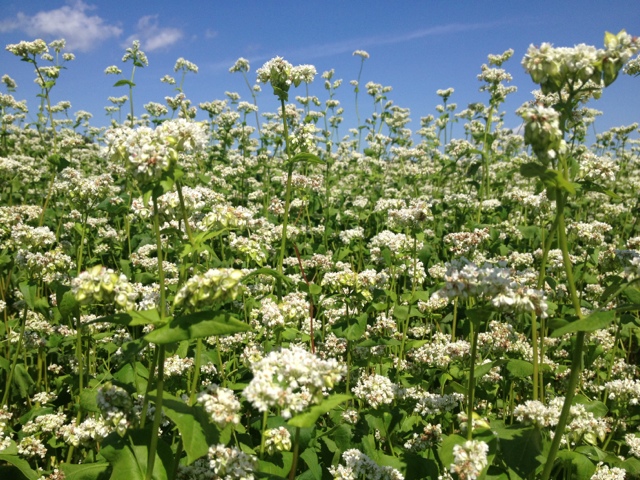
A sea of buckwheat doing as it should.


Thick and flower full, rising three feet above the earth.


It's flowers give way to green and white seed pods which turn mahogany as they mature.


No weeds can be seen, or none seriously, under the buckwheat, and that is its purpose.


Yet only ground well tilled or disced and mellowed will allow the buckwheat to take hold.


Toward the end of my day of pulling potatoes and crocus, I stopped to take in the bucolic scene.


And the sun then set on the buckwheat, and on my field.


But before I left, the dew point shifted, the air then scented, and the clankery of aluminum batting adrift from athletic fields, as I plucked greens from self-seeded spring peas.


Experience of Soil


I pull several bundles of garlic from the loft, bring them down to ground level, trim them of their leaves and roots, and then squeeze, sniff, poke each clove. If all is satisfactory, the bulb is further cleaned. At first culling, I've been losing about 20% to Botrytis mold, depending on variety. Once the bulbs are in the Brooklyn studio, I lose another 10-15% over a seven day period. On top of my other losses earlier in the season, crop yield is about 40% of the total planted. I'm on target to lose 4000 bulbs.

The mold is a consequence of wet soil, said wet soil a consequence of too many rainy days and nights, daily fog and mist, until about July four, when they turn that stuff off for the sake of the crowd. By that date, most of my garlic has been harvested, yet what remains still gets to sit in wet soil. With soil like that, one can only hope for dry weather during harvest, like I had hoped for this season. It didn't work.

Most people comment on the sand that must be my growing medium, but most people don't really give too much thought to the diversity of soil types in what can be a very small area. My farm is predominantly BgA/BgB or Bridgehampton Silt Loam of between 0 and 6% slope. The soil is tight and holds water remarkably well, yet it is still classified as well-drained. The significant property, the available water capacity, is rated at 14.9 inches or very high. From the USDA and NRCS glossary of terms:

"Available water capacity (available moisture capacity)
The capacity of soils to hold water available for use by most plants. It is commonly defined as the difference between the amount of soil water at field moisture capacity and the amount at wilting point. It is commonly expressed as inches of water per inch of soil. The capacity, in inches, in a 60-inch profile or to a limiting layer is expressed as:

Very low: 0 to 3 Low: 3 to 6 Moderate: 6 to 9 High: 9 to 12 Very high: More than 12"

In other words, available water capacity describes how much water the soil will hold between deep rains or irrigation cycles and the point at which a plant will wilt due to lack of moisture. 

For comparison, take a look at Southold farmland, near the barn where I cured my garlic. We have two predominate soil groups, RdA and HaA or Riverhead Sandy Loam and Haven Loam of 0 to 2-3% slope. The available water capacity of these soil types is between 4.3 and 5.1 inches or very low. This means plants here will wilt far sooner than plants at the Amagansett farm. Now, don't get me wrong, I do not want the plants to wilt. However, I would rather irrigate when needed over waiting for the rain to stop and watching the bulbs rot in the field or barn. I've decided, if I am to step into another season, I need to set foot onto Haven loam (as was intended, but that is another story).

I spent the last two days packing garlic for folks all over the New York City and Long Island. Each bulb, every clove, has gentle pressure applied by my fingers several times. Each bulb also gets the sniff test, but this is less effective as the scent is not sulphureous, but only a very mild ferment of vegetation. Any bulb with a clove in doubt is rejected. The last thing I want to do is send out a bulb with a few moldy cloves, but even as each is subject to several checks over two weeks, I cannot see inside the clove where it may wait, only to bloom one or two weeks after it ships out. I cannot understand why, but it is worth noting, that not all the varieties are subject to the mold. Turban and Porcelain have had little to none, where as the Rocambole and Marbled Purple Stripe have had some to a lot.

No one decides to farm and finds that all has gone well. It's no different for a new garden. I've been thinking lately that a difference between gardening and farming is simply one's expectations. Gardeners can let things go, a lost tomato here, a rotten squash there, but the farmer is in it to produce! But then, just as a garden gets better with time, as you improve the conditions, so does the farm field. Things really begin to turn the corner around a garden's third year and year four often comes as a great surprise -how did all this happen?!


Hudson Clove Live


The online garlic store is now open. Whew! Here you can buy an eleven bulb "gift bundle" or five varieties by the quarter pound. Please note that USPS shipping prices are quite reasonable if you are purchasing less than three pounds for shipment anywhere in the USA, but rise dramatically if your package weighs more and ships to any state south or west of the Appalachians. This new postal service pricing was a surprise to me and quite confounded my Paypal shipment price calculations. If you live far from the Mid Atlantic and you see a ridiculous price for shipping, you will save money by finding alternate sources in your region. Also, one final word on shipping: If Paypal doesn't utilize your current shipping address, please email me on the day of your order with your current shipping address. I can circumvent the Paypal shipping address it forces you to use and get the box out to you. Ok enough about all that.

You can also visit Hudson Clove on Sunday, September 29, at this autumn's first New Amsterdam Market near the old Fulton Fish market. Here, you will be able to buy garlic priced by the pound, one bulb or thirty, and mix varieties.  If I do not sell out at the September 29 market, I will return on October 27. Also, I was asked to return Sativum ? Sativum to Bartertown at the Dumbo Arts Festival on Saturday, September 28, in where else but Dumbo, Brooklyn. I will not be selling garlic, but will be offering free raw tastings, garlic education, and loose cloves to take home.


Treachery


I had a long day at the barn, yesterday, selecting, cleaning, and culling bulbs for market. The humidity and temperature fluctuations have not been kind as I lose about 15% to mold. The mold is on the inside of the clove skins, so it turns up simply as a soft bulb or clove and is discarded. This problem is consistent across all the varieties I sampled, except for one. Can you guess which it is? No surprise that it is the variety that all the northeastern farmers grow and sell at farmers' markets, the Porcelain. It took me a whole season to discover that this is likely the primary reason farmers have only this one variety. The yield will be far too reduced in the other varieties for them to remain profitable.

While I was trying to get my work done yesterday, a farmer leasing from the trust pestered me with lecture and questions. This a farmer who could give as little as a wave, a smile, or a hello when we were introduced or as I returned with my harvest over a month's time. There's only three of us at the barn and I simply couldn't understand the problem. I didn't even have to avoid her, she ignored me, but I would continue to wave and say hello.

Again, while I was pulling garlic bundles, she decided to lecture me about the unsustainability of my operation (I don't know where you are coming from, but all that driving), about how unlikely it is that I would make any money (she's throwing out figures, estimating my crop numbers), in fact how foolish it is to even try (cause you won't). She tells me I need to find land closer to NYC, maybe Nassau or Jersey and I'm starting to feel, in this one-sided conversation, that she's hoping to get rid of me.

After this, she goes into a bit about other farmers stealing her work, and that I need to protect my work from other farmers. She describes the growing and selection of successful, unusual varieties of garlic (and her tomatoes) as intellectual property and as such should be treated with zipped lips (don't name your strains, varieties, no signs with names in the field, don't invite farmers to your field, and whatever you do, don't blog about it!) She then goes so far as to say that she would sell her intellectual property for one hundred thousand dollars after a neighboring farmer saw her tomatoes and asked to buy 10,000 seeds (she does seed). As a capstone she says not to be paranoid. Right.

I'm wondering at this point if this is how a bully makes friends.

Afterward, I'm outside cleaning my bulbs and the farmer returns (farmers seems to come and go a lot). She asks me what my garlic is going for, gives me a lecture on making money on my crop that includes my labor and driving time (impossible). She sees me culling bulbs with soft cloves and insists that I sell them as seconds (this I can agree with). Then she offers to buy "10 pounds of my favorite garlic." My first instinct is, wow that's great. She says it's hard to get good garlic around here (I find that hard to believe) and she wants garlic that will last through the winter. She asks how many bulbs in a pound, I hold up some of the smaller ones, and she says no, bigger ones. Sensitive to what she said earlier, I ask what she's going to do with them. Friends, gifts, CSA members (her farm).

So, the farmer wants 10 pounds of my favorite (best), large-sized (seed) garlic. She'll pay $18 a pound for it. Did she succeed in making me paranoid? I imagine her laughing, saying thems the breaks kid.


Return of the Beach Farm


We lost a number of tomatoes on the vine because we weren't there to pick them, the weeds are tall and deep green, verticillium has done its damage to the heirloom tomato plants, only one green bean has sprouted, the volunteer butternut squash (where did that come from?) spread to every corner of our little plot. All the result of our benign neglect. But look at the harvest! There were still tomatoes to pick, and a butternut squash, and the peppers -they've really produced!


The pepper plants are tall, bushy, full of flowers and peppers. The sun scald is on the wane.


Bountiful sweets and hots.


The neighboring plot I cleared and planted with buckwheat looking a little weak. Shorter, thinner, paler, and flowering sooner than expected. Also, not one bee in sight. 


The buckwheat flower is said to be highly attractive to bees, so either there's no bees around or these flowers aren't the sh*t. When I visit the garlic farm tomorrow, I'll be on the lookout for bees. Soon both the beach and garlic farm's buckwheat will be cut.


First tomatoes plucked. Black Krim, Black Russian. Both excitingly delicious.


And the green New Mexico chiles were pan roasted, dry, and blended with farmer market tomatillos for mildly medium hot salsa verde.


Tick Safari

As I headed to check out the Beach Farm today, I switched on WNYC for the last bit of the Leonard Lopate show. An episode on ticks inspired me to post, even though there's so much else to do on the day after returning from Minnesota (it's good to be home).

In June, during the beginning of harvest season, Betsy and I were ocean camping near Montauk. We took a day off from all the hard work and Betsy requested a hike. I shrank from the idea, blaming the only thing that can keep me from a hike in the woods. I well knew that the ticks on the southern prong of Long Island are as rampant as anywhere, although when I was a kid, we ran wild in the summer shrubbery of Hither Hills State Park and I only remember flicking one of the parasites off my clothing in all of those seasons. Now, an adult, over 40, and with Lyme (no 'S' people!) disease rolling off the tongues of so many people, I can hardly stand the idea of walking a Long Island woods. But, we went anyway.

We had no repellent, and if you are going to hike in field or forest, this is your third line of defense. Your second is the proper clothing, which most of us are unprepared for when we decide on an impromptu hike in summer (we're wearing shorts, of course). The first line of defense is constant, and I mean constant, checking. The ticks I remember from my childhood were slow moving, sometimes taking hours to reach the hairline at the back of your neck. Now, like the contemporary zombie, they appear to move much faster.

We walked down slope, checking myself at every incidence of brushing anything trail side. A little embarrassed, then, when an elderly woman racing downslope with shorty shorts and walking stick forced us to the side of the trail. Checked again. Oh hell, she's flying through here, maybe the six tick warning signs at the trailhead were merely bureaucratic overkill. Maybe. At about ten minutes into our downslope hike we approached a 'T' intersection with a wider, carriage road trail. However, I didn't like the sea of tall grasses we had to breach to enter the carriage road. I stopped, breathed, and quickly made my way through the grass gauntlet.

Immediately I made a visual inspection and there was a small, reddish brown dot moving rapidly up my leg. I looked at the other leg and spotted a larger tick, instinctively swiping, launching it who knows where. I went after the tiny tick that was high-tailing it up through my leg hairs, but I fumbled and it dropped into my boot. Untie laces. Unboot. Oh, no, how will I find that booger in there? But I must, right? I took the insole from my boot, carefully, and with nothing short of eagle eye found the pest. Can you find the tick below? Imagine (this is quite an enlargement of only part of my insole) trying to find that speedy larvae or nymph in your hair or worse (think warm regions). This is why so many people who get Lyme do not even realize they have been host to the tick.


A magnification of that larval or nymphal tick on my insole.

So, after thorough checking of both Betsy and I, what were we to do? Go back through the grass gauntlet not 10 minutes after we started our hike or go on? We went on. What we decided to do, in order to manage what feels unmanageable, was make our walk a tick safari. Yes, we counted ticks, in fact -who could spot the most. Once we began training our eye on their preferred habitat, it became so easy to find them (and so much easier than photographing them!) that we gave up the contest. They were everywhere, trailside. Studying them was fascinating, and necessary, since there was no way we were going off trail to find a mushroom or look at a flower. 

We found Black-Legged Ticks and Lonestar Ticks. They climb a stem or long blade of grass and wait. If you spot one, it may have only its forelegs extended, and if you tap the stem, the vibrations will inspire the tick to spread all its legs. They don't jump, as some like to say, but simply cling mechanically with tiny barbs on their legs to your clothing or hair. Once they're on, they hustle to find a meal -this is their one chance! And it is completely a matter of chance. For the hundreds of ticks we spotted, how many will have a deer, raccoon, possum, cat, dog, or person brush their blade of grass?

Enough, apparently, and we're largely to blame (when are we not?). The deer population has exploded and deer are an important host (therefore the common moniker -deer tick). So much land was cleared in forestry and farming (take a look at this painting of Weir Farm, CT, painted near the turn of the 20th century) that deer had little to no habitat after European colonization until relatively recently. Afterward, with the rise of suburbs and exurbs, we groomed a lot of wild land and farm land into perfect deer habitat. I would have never considered seeing deer where I spent most of my childhood, on Long Island, 60 miles out of New York City.  A few years ago, on a train ride to Port Jefferson station, I spotted a deer in the woods. The north shore suburbs, all the way to Great Neck, may see deer in their gardens soon enough. Meanwhile, our attitudes about wildlife have gotten pretty soft. We fear hitting deer with our cars (the automobile is their only natural predator on LI), but shrink from other management options.

Enter into the debate a sore spot for gardeners (isn't getting Lyme Disease the sorest spot for gardeners? Or is it deer eating the Hosta?).  No, no, it's invasive garden plants. Apparently one such plant, Japanese Barberry, Berberis thunbergii, not only is an invasive species decimating the understory of our deciduous forests (along with the hungry deer), barberry is also a meal that deer cannot eat, a perfect tick breeding habitat, and an excellent home for the juvenile tick's host -the White-Footed Mouse. Read the short story here, but definitely read this full-on article.

Betsy and I stayed on carriage roads for the rest of our hike, a hike all the less adventuresome for it. Instead of returning up the trail from which we came down, we worked our way back to the road and suffered high speed traffic over tick searches. When we got back to camp, we searched each other and self-searched. So is the life with ticks. I haven't been checking myself at the farm, and I've never seen a tick on farm, but that doesn't mean they aren't there. I suppose, in part, that constant cultivation and mowing keeps the tick populations down, and the deer fence doesn't hurt, yet I should get in the habit of treating the farm as I treat the woods.

It appears to me that better trail grooming practices, although more time consuming, would help reduce tick bites. Trails can't always be the width of carriage roads, but they can have brush trimmed from the edges, grass cut at trailside by maintainers. Any trail creates openings in the canopy, allowing sunlight in, which creates opportunity for grasses and other sun loving plants to grow and lean into the trail. When I was trained for trail grooming by the NYNJ Trail Conference, we carried pruners, maybe shovels, but we didn't carry shears or scythes.

Click on the image to better see what the trail community is saying about ticks on their hikes.


Fly Over Country


I rather don't like the moniker, although I understand it. It's easy to dismiss the vast interior of the United States in countless ways, but I don't think we should, for more reasons than I can get into. 

Wendell Berry said "Eating is an agricultural act." Think about that. Agriculture is the foundation (still) of our civilization and like it or not, we are all agriculturalists. We farm by eating. Every bite is a clod turned by plow, every gulp an ounce of aerosolized pesticide, each nibble a nameless, faceless laborer stooped in the field. 

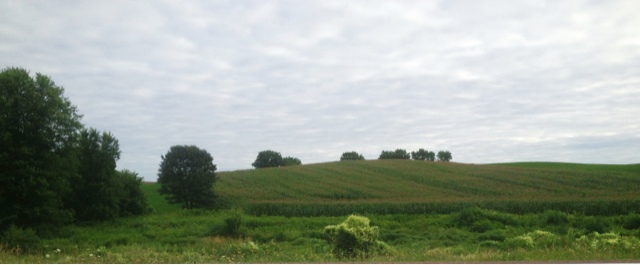
Corn and soy are the most intensively mechanized and industrialized crops grown. It's all you will see on Interstate 80/90, between Pennsylvania and Wisconsin with the exception of an apple orchard in Ohio and tomato field in Indiana. There are no laborers in these fields, only the occasional machine. As I passed through, two weeks since my last drive, it had become Roundup season. Brown as the severest drought; a visual disturbance, as much as a chemical one. 


A yellow plane made a severe descent, disturbing too, in the manner of an imminent crash. But then it arcs upwards, circles around and completes the same maneuver. As I pass the woodlot, I can see its purpose, and it seemed ostentatious, like a car transformed into spectacle, or an excessively loud Harley, to fly a plane in that manner, to spray pesticides by machine, without an eye for the kill. 

Interstate 90/94, in Wisconsin, traverses a patchwork of corn fields, cow pasture, bogs and woods. The highway cuts the line between the sweet Midwest and acidic north woods. Corn is grown, cows milked and cranberries harvested; boundaries manifest greater diversity. I was taken by the blossoming of the knotweed Silver Lace Vine, at the boundary of farm fields and highway. It rose up, a green white light. 


Clockwork Orange


“But where I itty now, O my brothers, is all on my oddy knocky, where you cannot go. Tomorrow is all like sweet flowers and the turning vonny earth and the stars and the old Luna up there. ... And all that cal.” -from A Clockwork Orange, by Anthony Burgess

While I was racing across the soul numbing scape of exurban housing, corn and soy, Betsy entered the woods, no doubt to escape, and found what we didn't because we hadn't been entering the woods, a woods crazed with fallen trees and the high business of mosquitoes. 

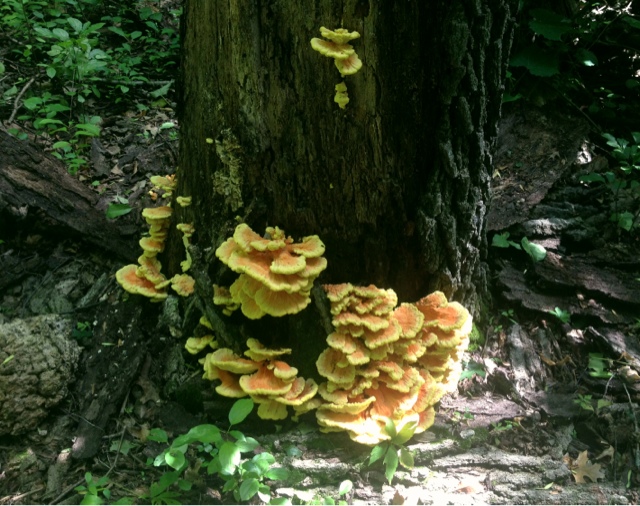
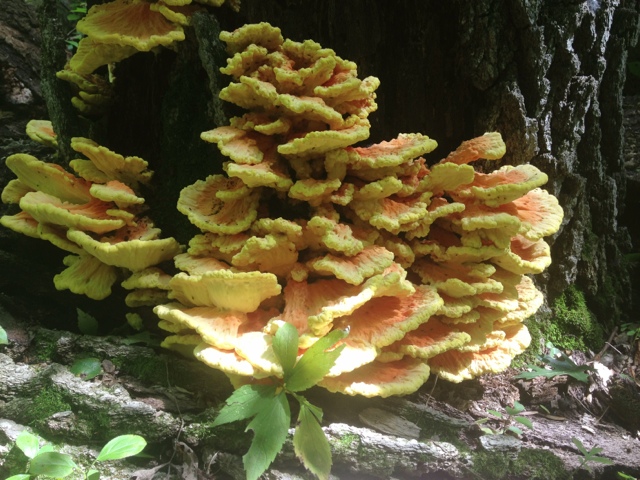
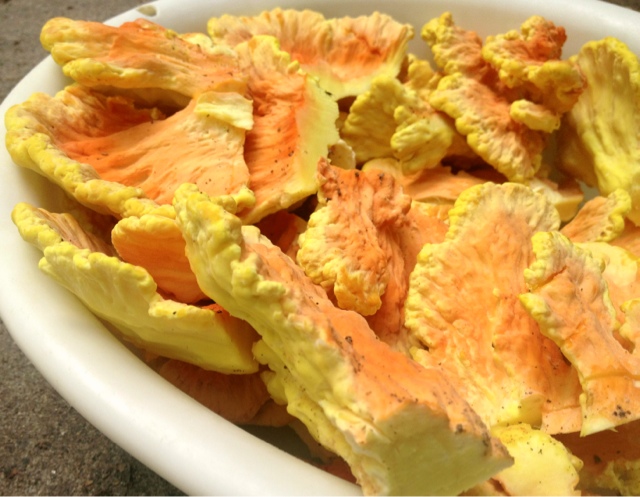
And was rewarded for the effort by this orange and yellow beauty. Arriving like clockwork every August, although this year on the opposite side of the woods, the sulfur shelf, chicken-o-the woods, Laetiporous sulphureus finds its way to our table. 
She found it and harvested at exactly the right time, leaving some for me to see, and in that 18 hours the little flies and black beetles had made their way to it. We cut another bunch and left the rest to nature.

Tomorrow we load the tiller, our other things, one cat, ourselves into the van. Rex will be upset, in fact he very much expects us to move to his homestead. But we cannot.  At least not now. That arouses many feelings in him and us, all of which would get a hell of a lot more complicated should we, like a clockwork orange, just do the "good" thing.