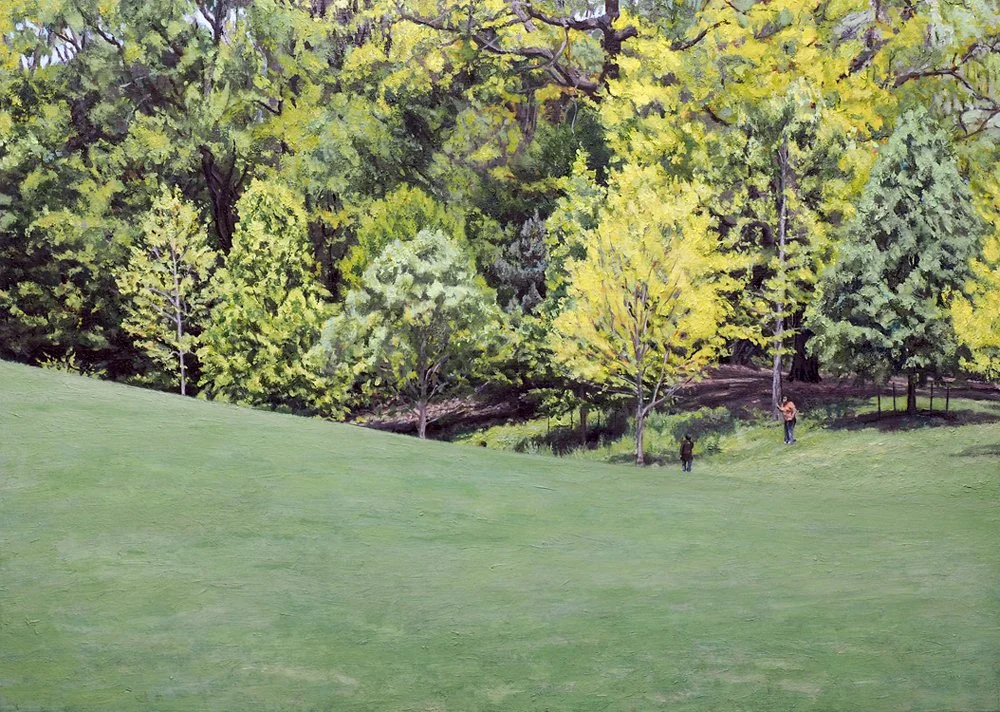
It was a Friday night, mid-summer, at Elise Giardella’s salon, Presenting at 17. In a room of eight or ten people, I had already been presenting for twenty minutes when there was a knock at the door. When Elise opened the door, I was surprised to see the late Kanishka Raja had been waiting. He entered the darkened room, shuffled around chairs and legs to an empty seat three or four feet from me. On the screen were paintings from my Prospect Park series, among many other images I showed that evening. At Presenting, the artist could speak about anything of interest—any tangential item an artist might think about at the perimeter of their practice. I took full advantage of that by discussing my writing, sharing related images, as well as my work.
Raja was impatient. Our relationship was already pretty thin and when we did find ourselves in the same company, there was occasional friction. Why had he come? On the surface, we shared little. I couldn’t recall speaking with him about my work or his. Yet there he was, on a Friday night in New York City. He could have been anywhere, but there he was, waiting for me to finish my monologue about landscape, nature, and culture. Finally, when the lights had been turned on, he was able to ask the one question he had interrupted his evening for—why are your paintings so strange?
At first, I wondered if he could not articulate the reason for himself, but then I thought that maybe he just wanted me to say it, to confirm what he had already thought. I still do not know why he went out of his way that night. The whole episode seemed rather performative: the knock at the door mid-presentation, the entry, the interruption, the impatient sitting, and then one question. I don’t recall what my answer was for him that night and I wish I did, but I am not sure it matters much now.
When I graduated from my graduate program, I emerged into a painting scene that had begun to be dominated by abstraction. At Skowhegan School of Painting & Sculpture, the summer just after graduation, I had heard from artists in the prime of their careers that abstraction in painting would be the only way forward. What no one had learned that summer, possibly because they never thought to ask, was how in love with abstraction I had been, since a teen looking at art in New York.
In undergraduate school, I learned painting from old men who were brought up at the height of modernist abstraction. Because my early work, although abstract, had absorbed the structural elements of landscape, I was informed by them that I should never try to make a career with landscape paintings. After graduation, I discovered painting never spoken about in school, much of it representational. Through that, I became acutely aware that I had little observational drawing skill or even the motivation to learn. In what seemed a vast period of time—the four years between undergrad and grad school—I also realized that my painting was largely emotional labor.
So, at twenty-seven, I went to grad school to learn how to observe, to draw, and that led me to paint en plein air. This practice wasn’t what I had intended, nor was it a lark. It was an intuitive understanding of what was necessary to bring that earlier emotional labor under control. The space in which I had chosen to do this was intentional. While most go to school to learn under people they admire, I chose New Mexico for a different reason—the connection I had to the land (discovered several years earlier) and the sense that it had something to teach me. I trusted my intuition despite not knowing what would come of it. After twelve months of figure drawing, I was ready to paint in a wholly new way.
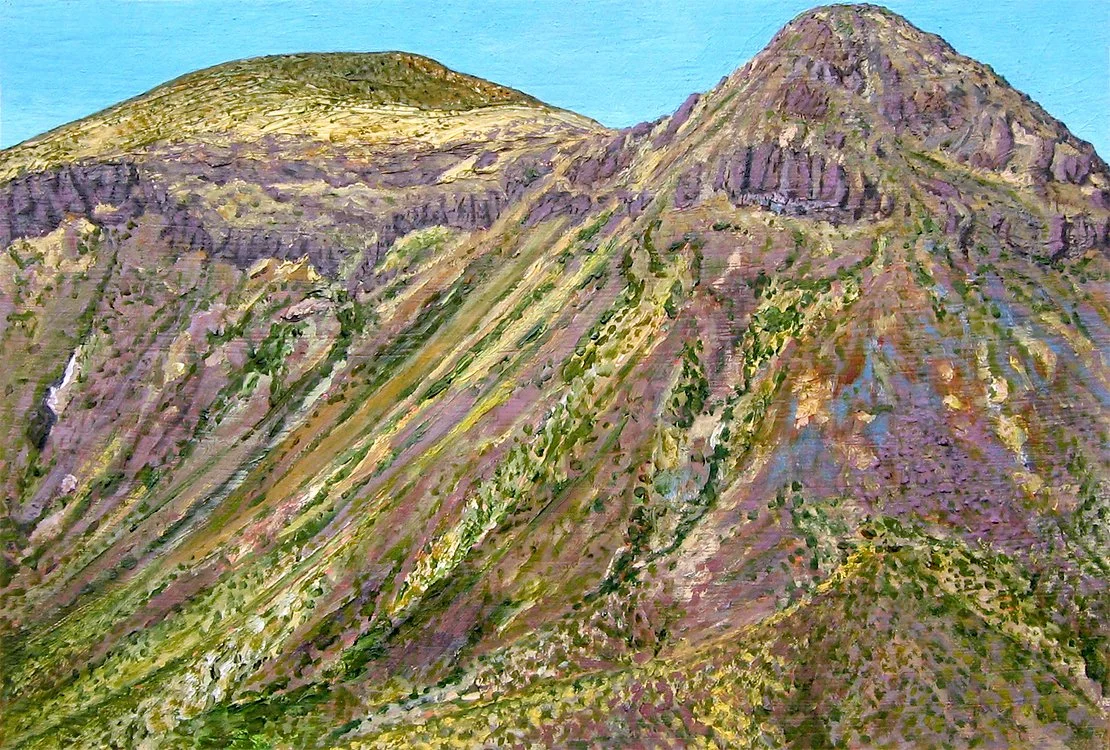
Mountain No. 1, oil on panel, 2000
That work, plein air landscape of the mesas and hills around me, in the Chihuahua Desert, is the mature combination of my prior interests. These paintings landed me a spot among sixty-four at Skowhegan, but I struggled with how my work fit into the space of contemporary art. Yet there I was. What I understand now is that the jury, some of them faculty, saw something exceptional in the work, yet they had difficulty articulating what that was. Maybe they saw a story written in Latin—they recognized individual letters, maybe even the roots of words they did know, but had little idea how to translate it, let alone how it could move forward.
It wasn't as if I didn't know that landscape, certainly in the register of en plein air, was a dead language. Its death was the force that allowed me to reanimate it, to fill it up with abstraction and emotion, and speak through it. If all that was seen was another landscape painting, sadly that dismissal meant a refusal to see the engine behind the work, something I believe is more important than how work presents at a glance.
For the sake of story-telling brevity, I now must package influence, thought and experience into a small container—one that may be unpacked another time. With this in mind, I jump to 2009: after economic collapse, two years of writing about parks and gardens, years of painting that struggled to resolve, and a month as artist-in-residence at Weir Farm (a park). In that year, I began a new series. These paintings compressed the emotional labor of my pre-grad abstraction, photographic mediation, the observation of plein air painting, awkward color, and the familiar spaces of Prospect Park, Brooklyn. With this work, I bring the conversation back to Kanishka’s one question.
In what does this strangeness lie?
In part, it is restraint. In the context of my work, restraint is a form of controlled emotion. It is deliberate containment: a way to shape how the viewer encounters feeling. In the Prospect Park paintings, restraint turns emotion into a structural element, rather than outlet for narrative or expressiveness.
By stripping emotion of narrative, expression, or catharsis, it leaves it suspended and unmoored; it is experienced as pressure rather than message. Emotion applied this way is treated the way abstraction treats color or form, but it refuses translation. It is present and alive—enough to be felt, but not fully discharged. What I have created is abstract painting, but what has been abstracted isn’t form, it's emotion.
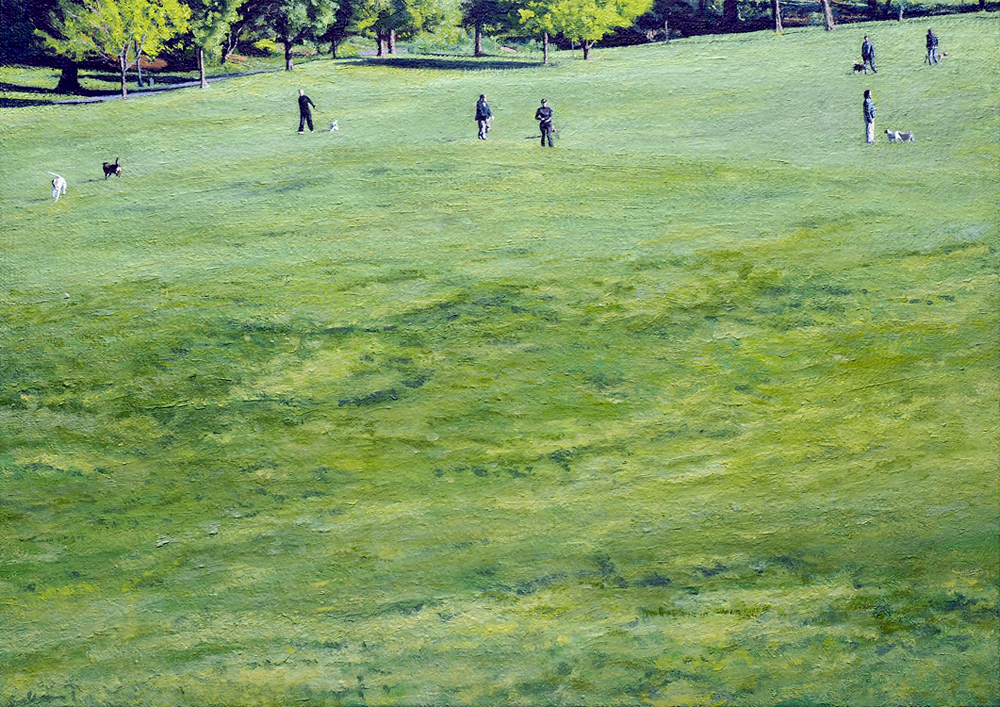
From the Prospect Park series, oil on panel, 2010-2014
Another element of the strange in my work is emotional ambiguity bound to the familiar in the form of Prospect Park. These paintings look as though they should explain themselves. After all, the park is recognizable, legible, ordinary—and yet they don’t explain, they don't tell for what reason they came to be. We know the park is not wilderness, but neither is it fully social. It is space that is regulated, designed, and enclosed. It is part ecosystem, part social infrastructure, part recreation ground, so that the spaces the park creates carry the anxieties and tensions of its hybrid status. The condition of hybridity and ambiguity is made visible, so that viewers must confront how even green space can feel alienating in contemporary urban life.
The paintings become an intimate psychological chamber, whose spatial emptiness can be filled by the viewer’s own relationship to public landscape. These park spaces are not merely seen, they are felt. Yet they don’t tell you what to feel, they make you aware that you are feeling.
All of this is heightened by the imposed viewpoint resembling that of a person already present in the park. That positioning is intentional: it places the viewer inside the painted space without offering a stable point of orientation or narrative footing. The result is a sustained psychological unease: the viewer feels present, attentive, and quietly unsettled, caught between certainty and incomprehension, and aware of their own act of looking. The lingering tension is that of being inside the scene yet denied any understanding of it.
Now anchor that tension to a field of green. A long time ago, a professor told me never to make a green painting (or a landscape, for that matter). Despite this possibly sound advice, I chose to make these paintings almost entirely green, compounding the sense of strange. How? Green is a neutralizing color, which can be unsettling where excessive because it lacks the emotional cues of other colors. Green, then, can act as a kind of emotional camouflage.
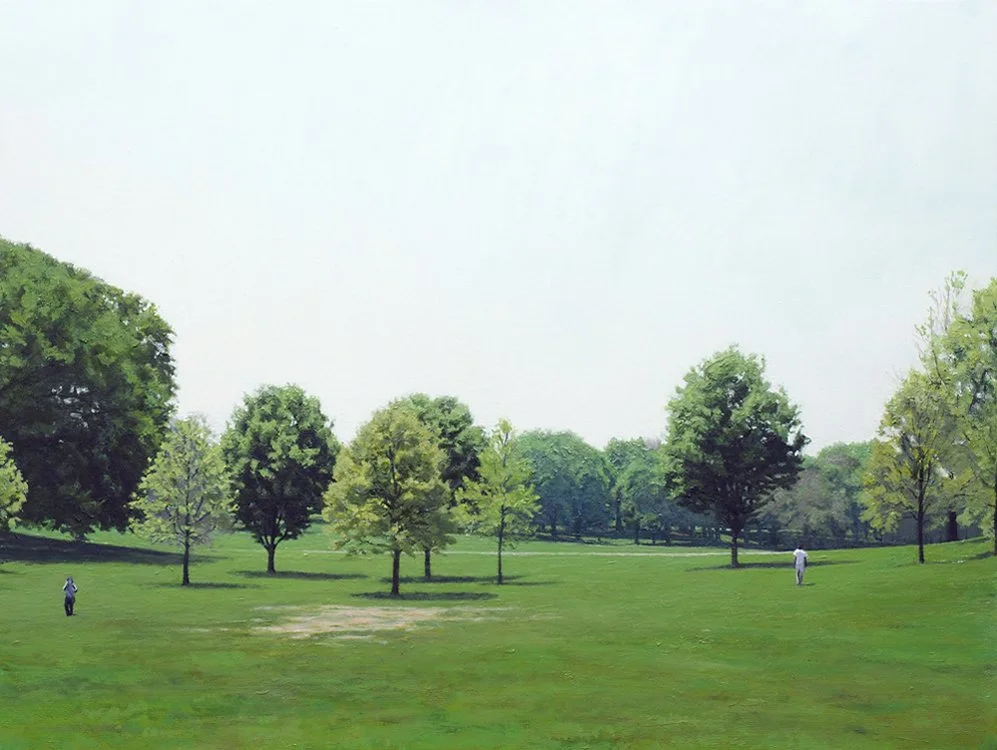
From the Prospect Park series, oil on panel, 2010-2014
These paintings deliver so much green that they appear gentle and approachable, while quietly intensifying their sense of estrangement. Such little tonal or chromatic contrast prevents the eye from resting or easily exiting the space. Instead, the eye is held inside a field of color. Nature, typically encoded as green, becomes a container rather than a refuge. By letting green dominate, I accepted its flattening, deadening tendencies and turned them into psychological content.
The result of all these choices, are paintings that are too psychologically charged to be decorative, too restrained to be cathartic, too familiar to be comfortably strange, and too strange to be comfortably familiar. The eye moves, but meaning doesn’t settle. In response, viewers begin to test possibilities, linger, hesitate, and return. They negotiate the situation, eliciting mental activity in response to the painting’s emotional uncertainty. The act of looking becomes slow, recursive, and self-aware—more like thought than perception. When painting withholds thought, it forces the viewer to carry it instead.
My youthful love of abstraction and its emotional ambiguity had been funneled into the apparent realism of these paintings. A paradox: painting that looks like it should explain itself, but doesn’t. Viewers feel both drawn in and resistant when confronted by work, delivered without spectacle or irony, that promises legibility and then quietly breaks that promise. The work also won’t tell you what to feel, doesn’t resolve the discomfort, nor does it aestheticize confusion. It may be a burden—the quiet transfer of unresolved feeling from painting to viewer, but it begs another question: How much should a painting give and what is the viewer responsible for?
A little late Kanishka, but thank you for coming out on a summer night and asking your question. You showed up for my work, in your own way, when few other artists had.*
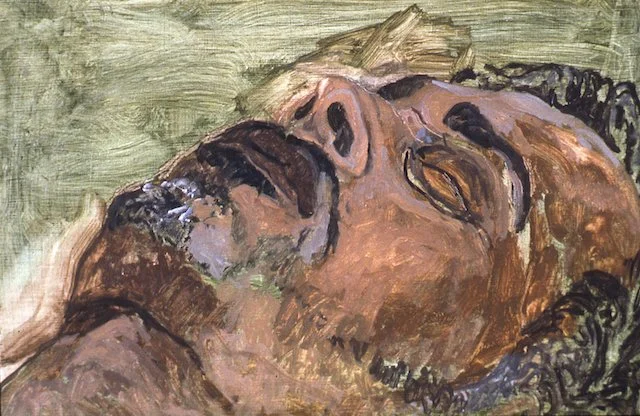
Kanishka Raja sleeping: from a small series of quick paintings of participants asleep, 2000
*John O'Connor, Mark Albright, Steve Locke, Ridley Howard, Carrie Mae Weems, Jenn Viola, Felix Esquivel, and, of course, Betsy Alwin are on the top of that list of artists who have showed up for my work. I am grateful.