Cathy Opie's Landscapes

Cathy Opie's Landscapes

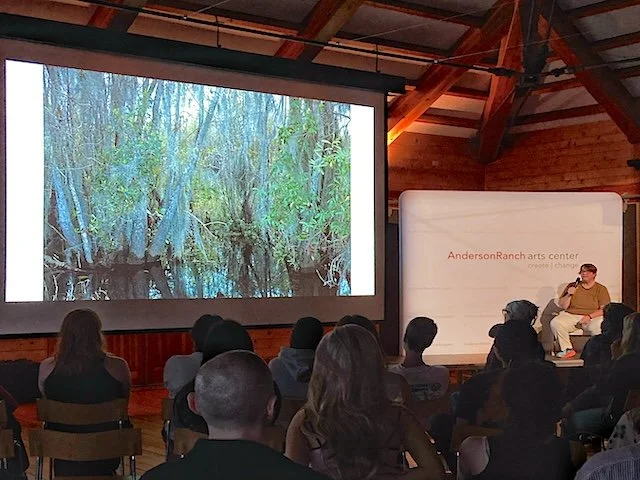
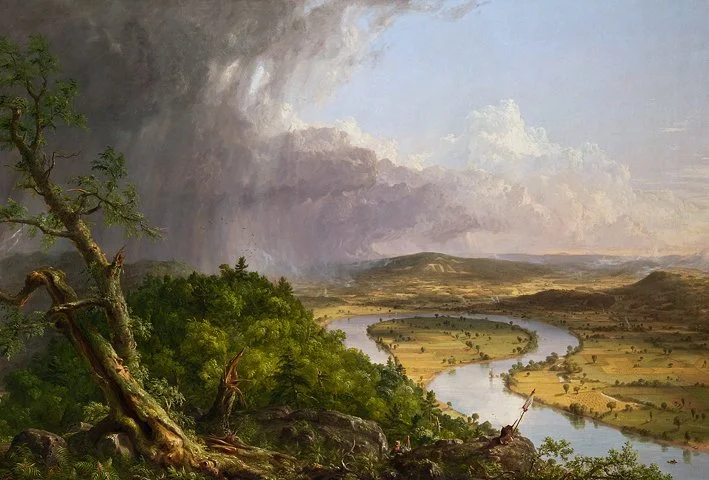
I was surprised to see landscape represented in Cathy Opie’s recent work. I often find myself frustrated by artists who’ve taken on landscape later in their career, but if I am honest, this feeling is sometimes nothing more than professional jealousy. Given that, how easy it would be to couch that jeolousy in a negative critique of the work. It seems I can forget that landscape doesn’t belong to me, or anyone, but for a few hundred years, has been a symbolic entity that artists can tap, turn over, reproduce or renounce.

Read More

Interview With Painter Joe Noderer, PT 1

Interview With Painter Joe Noderer, PT 1

I first met the painter Joe Noderer on Instagram -then, after a couple of years, on a Google Meets for this interview. Social media creates an environment where finding interesting artists is easier yet also may have you wading through a massive amount of less interesting art. Joe is one of the most interesting landscape painters of our day. An idiosyncratic painterly language, links to artists working long before him, and work untrammeled by judgement or environmental despair are key to this distinguished painter. Read on to find out how Joe came to practice painting near Pittsburgh, PA, how he forged his career early on, learn about his influences and what concerns him today.

Read More

Interview With Painter Joe Noderer, PT 2

Interview With Painter Joe Noderer, PT 2

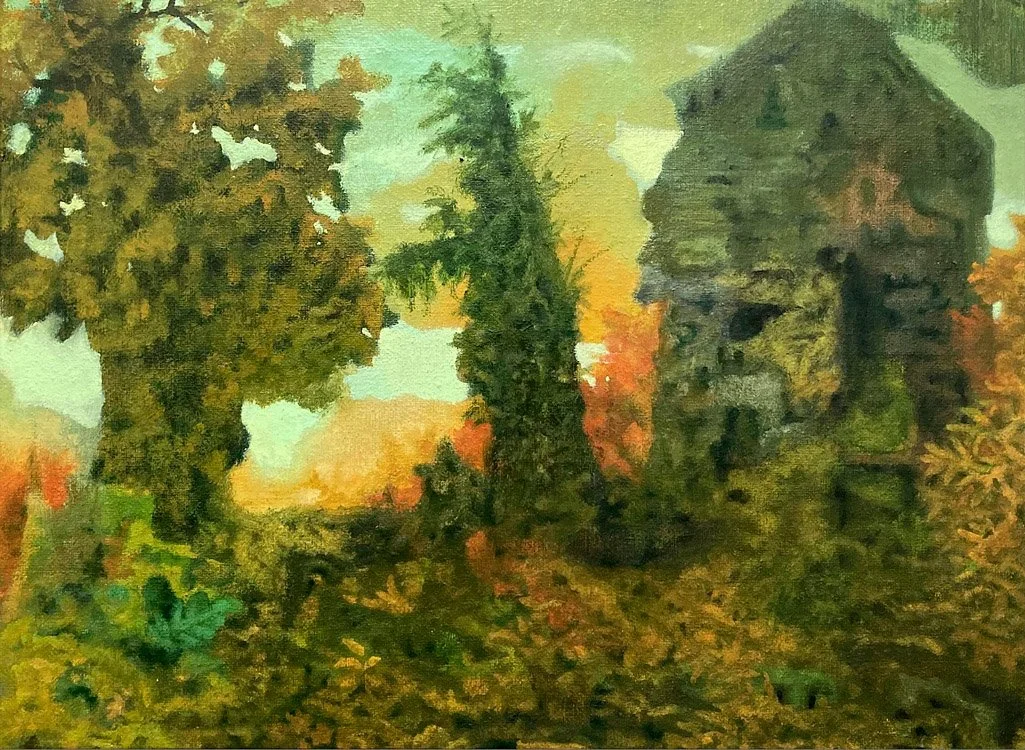
Earlier on I mentioned going to the Carnegie. There’s the Museum of Natural History and then the Museum of Art; they’re connected but also distinct. As a kid, I don’t remember going to the fine arts aspect, but I remember going to the natural history part quite a bit. Because, like any kid, I liked dinosaurs. Anything else there -the hall of minerals, the geologic stuff, the dioramas there, are out of sight. They are from the golden age of dioramas. Those contained worlds were very influential to me and that makes a lot of sense [when] looking at my work and that idea of a window.

Read More

Interview With Painter Joe Noderer, PT 3

Interview With Painter Joe Noderer, PT 3

In your later, shall I say "bearded portraits,” I draw visual connections ranging from Ole Peter Hansen Balling's John Brown to Goya’s Saturn Devouring his Son. What do you think about all that?

You’re not reaching too far with “Saturn Devouring his Son.” That’s definitely an image I saw when I was a teenager. When we see that painting, now, there’s an element of goofiness to it. But there’s also a blunt, downplayed, but in that way believable, violence to it with the mutilated corpse he’s holding. I’ve always been drawn to that kind of grizzliness.

Read More

The View as Enclosure

The View as Enclosure

In the autumn of 2001 I had an experience at the Mattituck Museum, in Waterbury, Connecticut. The exhibit, Images of Contentment: John Frederick Kensett and the Connecticut Shore was on display upstairs. His Hudson River School style is typically described as Luminism, its hallmark a tranquil scene with evanescent light, and in Kensett’s case -more often than not an image of the conjunction of water and land. The impact of each work is an experience of restfulness and calm, a bath of even, transcendental light in the reassuring, supportive bosom of nature. 

Read More

OUR WEEDS

Welcome to the weed atlas!

The Weed Atlas compiled here is hardly complete and subject to review and update. I'm including those weeds that I found in New York City -in yards, in the cracks of sidewalks, in parks, on piers. NYC enjoys most of the weeds common to eastern North America, so that if you find yourself here and the weed you are trying to identify is in, say Clearfield, PA or Springfield, MA, the atlas may be of use to you.

Many of us go to the Web or an phone app when we want to identify something, and that is no less true for the weeds in our yards. For years I depended on the book Northwest Weeds as my weed ID source because no proper book had been published for the Northeast. Today, that is no longer the case, so that some of what I publish here has been cross-referenced with the excellent Weeds of the Northeast by Uva, Neal, and DiTomaso.

Deciding what is a weed and what is not is a fool's errand. But for the sake of limits, I define weeds to be those plants that grow of their own accord in areas disturbed by the activities of humankind, and are, by my definition, regionally and often globally, ubiquitous. Some weeds can also be distinguished as invasive, not always alien, to a region. Weeds go wherever we do.

The atlas follows in alphabetical order, with the botanical name first when I can accurately state it. All listings have at least one photo, which can be clicked for a larger image to help in identification. Some of the plants listed are noted as edible, but please don't eat anything unless you have positively identified and properly prepared it.

OUR WEEDS

______________________________________________________________________

Achillea millefolium, Common Yarrow, Milfoil, or Field Yarrow

Common Yarrow is a perennial plant often associated with old cultivated fields and sometimes lawns. When mowed, it can form mats of fine foliage close to the ground. Of course, field yarrow is related to the garden Yarrow, but its flowers are generally white, sometimes with a pinkish tinge, and its foliage is very finely cut. Garden Yarrow has been bred to have many colors and in some strains, soft gray foliage. I grow both kinds in my garden, but beware, the field Yarrow spreads rampantly.

_______________________________________________________________________

Ailanthus altissima, Tree of Heaven

Young tree, often found growing on fencelines and in pavement cracks.

Ailanthus will grow almost anywhere -roofs, windowsills, cracks in pavement. It has an extremely aggressive nature and is incredibly resistant to permanent removal. I once removed a concrete pad from a backyard in Brooklyn. Underneath this old concrete, hundreds of little Ailanthus roots waiting for the right opportunity. Can be taken out, but requires perseverance. Often confused with Sumac. Ailanthus will get much taller than sumac, in fact Ailanthus will be a tall tree in short time. The sumac has deep red, upright seed heads, the Ailanthus drooping pale yellow seed clusters.

_________________________________________________________________________

Alliaria petiolata, Garlic Mustard

Garlic mustard.

I spied thousands of Alliaria petiolata, or 'Garlic Mustard,' plants and hundreds of Hesperis matronalis or 'Dame's Rocket' from a Metro North train window. I saw several good looking clumps of Garlic Mustard in Cadman Plaza Park this spring, where I pulled some leaves and crumpled them in my hands to catch the faint release of garlic/onion scent they're named for. Garlic Mustard is an edible, invasive plant of woods, hedgerows, and fields. But it is the woodlands where it does the most damage. It many locales it remains green all winter, grows early and quickly, and is known for crowding out woodland spring ephemerals.

_________________________________________________________________________

Hesperis matronalis, Dame’s Rocket

Dame's rocket -also a mustard.

A relative of garlic mustard, the cottage garden Dame's Rocket is seen here blooming alongside garlic mustard. I first became aware of weedy mustards when I lived in southern New Mexico -it was the plant growing along all the ditches in winter. Mustards tend to be cool weather biennials, and in our region that means you'll see them green up early in spring and flower by May, but they will also green up in autumn in preparation for the next spring. If you want to pull them, make sure to grab under the horizontal part of the stem, just beneath the leaf litter, to get the whole root or they are very likely to come back.

_________________________________________________________________________

Amaranthus spp., Pigweed

Amaranth comes in many forms, some weeds, some cultivated for their leaves, roots, seeds or ornamental uses. There is a woman who comes by late spring into summer pulling the amaranth from the fence line along the sidewalk, I presume, to eat. There are several varieties of this plant and so are easy to misidentify. All have the telltale inflorescence, although with variations in length, bushiness and color. It is an annual plant that tolerates dry conditions. Dig it up early and don't let it go to seed as thousands of seeds per plant can last up to thirty years in the soil.

Amaranth gone to seed.

_________________________________________________________________________

Ambrosia artemisiifolia, Common Ragweed

Common Ragweed. Not many people see this culprit for their allergies. This hardly distinctive plant, flowers at the same time as showy Goldenrod, and Goldenrod gets the blame. Even allergy pill manufacturers show yellow flowering plants in their ads. The test is simple -bright and showy flowers are meant to attract pollinators because wind won’t carry the heavy or sticky pollen. Shake a ragweed plant in flower (you nor the pollinators will see the tiny yellow-green flowers) and a plume of “smoke” will fog the air beneath it.

The name Ambrosia is a mystery to me, but artemisiifolia refers to the leaf structure which is similar to many Artemisia plants like the mugwort found one entry below. To some the foliage looks similar to that of French marigold, a plant whose origin is really Mexico.

The stems of Ragweed are reddish and pubescent -meaning that there is hair present.

Ragweed flowering stems are straight, point upward, but sometimes leaning over. From above they look mostly green with hard to see flowers.

How to know that Ragweed is responsible for your allergies? The flowers all face the ground. Flowers that face the ground are less likely to attract pollen-spreading insects like bees and flies. Flowers that are bright and yellow, facing outward, attract insects. Ground-facing flowers depend on the swaying and shaking caused by the wind. The wind picks up this pollen as it drops out of the flower, spreading it several feet or yards or miles. Ragweed is wind pollinated, and that, my friends, is something to sneeze at.

_______________________________________________________________________

Artemisia vulgaris, Mugwort

Artemisia vulgaris is the weed of NYC metropolitan life. This is the plant that greens brownfields, empty lots, roadsides, sidewalk cracks, chain-link fence rows, and overpass embankments. One summer along the waterfront in Williamsburg, I witnessed thousands upon thousands of lady bugs crawling over a practical monoculture of mugwort. All that red and green, quite amazing.

Some confuse this plant's early growth with common Chrysanthemum. Please don't. The underside of Mugwort's leaves are fuzzy and light gray, and its foliage highly aromatic, where as the chrysanthemum foliage is not as distinctive. Mugwort leaves become thinner and elongated as the plant matures; its flowers are inconspicuous. Mugwort is perennial and spreads via vigorous rhizomes -so pull, pull, pull or enjoy the greenery. I have noticed one sidewalk garden in Red Hook that seems to have struck a fine balance between their perennials and the mugwort, but this charm is not the norm.

At flowering, mugwort will take on a rangy appearance -with small lanceolate leaves and small flowers.

Mugwort flowers up close.

_________________________________________________________________________

Asclepias syriaca, Common Milkweed

Milkweed jumps out thanks to its broad, fleshy leaves with pubescent undersides, mass of flowers, and erect habit in fields and meadows. A native to North America east of the Rockies, it is only considered a weed in disturbed areas like old farm fields by crabby old farmers. It likes sandy soil and is common among our community garden plots in Ft. Tilden.

The leaves have a light gray pubescence on the underside.

Asclepias syriaca

exudes a milky sap when any part is torn and is a favorite of the Monarch Butterfly in its larval stage. Milkweed is known to produce useful fibers, and its young shoots, buds, and flowers are edible when cooked. But do not confuse it with the

Dogbanes

, which look very similar if you are not looking closely.

Apocynum cannabinum

, Indian Hemp or Hemp Dogbane. Notice its reddish stems and different flowering character. Indian Hemp will produce a milky sap just like Milkweed.

___________________________________________________________________________

Celastrus orbiculatus

, Oriental Bittersweet

In summer the vine is green with small cream-colored spots. In autumn, the vine hardens and darkens.

Late autumn berries, commonly used for wreaths.

Oriental Bittersweet, native to eastern Asia, loves fence rows. I first came across this vine on the stockade type fence around our backyard and you'll probably find it on chain links just like the one above. The berries hang on long and are a favorite of birds, so despite their good looks, if you want it gone, get it before it sets fruit. Just make sure it's not the native variety,

American Bittersweet

,

Celastrus scandens

. The decorative possibilities of the vine in late autumn are well known, but selling it live or cut is illegal in some states. No wonder it is 'bittersweet.'

___________________________________________________________________________

Chenopodium album

, Lamb's Quarters, also Pigweed

Mature plant, streetside.

The 'goosefoot' name refers to its leaf shape.

Chenopodium

(the name: cheno-goose, podium-foot describes the leaf shape) is commonly known as Lamb's Quarters. Some call it Pigweed, confusing it with the

Amaranthus

species. The common name may hold water however, it seems taxonomists may be changing the

Chenopodiaceae

classification to

Amaranthaceae

. This weed grows everywhere in the city and is a common weed from my childhood yard. Drought, sandy soil, and compacted earth are favorite locations for this plant. It can stay compact and bushy, yet sometimes is open and willowy . Young leaves are eaten in salads or cooked and some make a meal out of the seeds -in this way it is similar to amaranth. I like it for its intense magenta leaves often found half way up the plant.

Mature lamb's quarters with magenta leaves at its base.

Fruit in later summer.

Magenta fruit in autumn.

________________________________________________________________________

Cynanchum nigrum

, Swallowwort

This one's called Swallowwort, cause it'll swallow anything in its path.

The fascinating flower, not quite black, more dark plum colored.

________________________________________________________________________

Commelina communis

, Asiatic Dayflower

The

Commelina

species here is the non-native, asiatic variety. There are a few tell-tale traits to divine the two. In NYC, you probably have

Commelina communis

. It's called Dayflower because the flowers are with us only for a day. Its quite a beauty and I let it be in corners of the garden. It spreads but Dayflower is easy to pull.

Dayflower with a common garden companion, Smartweed.

_________________________________________________________________________

Draba verna

, Whitlow Grass

__________________________________________________________________________

Erigeron philadelphicus

, Common Fleabane

This specimen sprouted in early spring in my Brooklyn garden. It began blooming in mid-May. Fleabane is native to these parts, and belongs to the great family of Asteraceae.

It has a pleasing form until flowering, at which time the leaves begin to yellow and the stems get wily.

Pretty, pinkish-white daisy-type flowers. Is it the bane of fleas? I hope I'll never know.

___________________________________________________________________________

Fallopia japonica

, Japanese Knotweed

Attractive plants make successful weeds.

The heart shaped leaves on young red stems give it away.

Don't let those quaint and attractive leaves of the young Japanese Knotweed fool you -the bottom photo shows how large these can get when not attended to. An attractive herbaceous perennial, it escaped garden cultivation years ago to become a major weed of wetlands, roadsides and yards. The specimen above grows in a fence row in my Brooklyn neighborhood, and has sent its rhizomes to the sidewalk strip adjacent to it where it grows a similar height each year. Persistent, one must continually remove rhizomes, roots and stems. The young shoots are edible, making spring pulling more tolerable.

______________________________________________________________________________

Hedera helix

, English Ivy

English ivy scrambling up trees and across the ground in Prospect Park.

Hedera helix

may not be a weed to many, and I don't always consider it a weed myself. But this plant does escape and does get out of control. I think we may have all seen at least one tree with this plant growing all over it. For the many who have shady spots in front of or behind their homes, this has been the answer to concrete. However, there are many different varieties - so choose one that is attractive and less invasive to woodlands. To remove, simply pull it up. It roots from cuttings of the vine, so remember to pick up the pieces.

_______________________________________________________________________________

Lamium purpureum

, Purple Dead Nettle

Purple Dead Nettle is common in fallow fields, disturbed areas, and even lawns. This specimen was found in a community garden plot in late March, having sprouted after the plot laid fallow over winter. It's similar to garden Lamium and a quick spreading ground cover.

Its flowers are attractive to bees because it blooms profusely when little else does. You'll often find Purple Dead Nettle blooming near a common look-alike,

Henbit

.

________________________________________________________________________________

Lamium amplexicaule

, Henbit

Henbit will bloom during cool weather, just like its cousin, Dead Nettle, and you'll often find them side by side, possibly confusing them because of their purple flowers. Henbit has a tap root, so pull when the soil is wet for greater effectiveness. Apparently the name Henbit reveals how chickens like to snack on some part of the plant, and some say it is an edible spring green for those folks not too chicken to eat it.

________________________________________________________________________________

Linaria vulgaris

, Butter and Eggs

This nice specimen of

Linaria vulgaris

was found on a fence line at the sidewalk's edge in Red Hook, Brooklyn. Likes well drained soil, so I suppose a demolished building's old site will do. Butter and eggs refers to the coloring of the flowers, but this lovely weed has dozens of colloquial names.

_______________________________________________________________________________

Malva neglecta

, Common Mallow

Mallow leaf.

Malva neglecta

is a common roadside, lawn, and garden plant. It belongs to the large family of Mallows that includes Hollyhocks, Swamp Rose, even cotton. Some call Common Mallow by the name "cheeses" due to its round cheese-wheel like fruit. The flowers range from white to pink to purple and are often quite attractive, no doubt aiding this plant's success in some yards. To pull it, you should soak the ground first as it has a tough taproot. Apparently it has edible leaves and roots and a long association with humans.

Mallow patch.

Mallow flower.

_____________________________________________________________________________

Oxalis stricta

, Yellow Wood Sorrel

Yellow Wood Sorrel is one of those North American natives that is also native to Europe and Asia. It's therefore ubiquitous and most often considered a weed. It's often confused with, or called, clover because of its trifoliate leaves. With a somewhat lemony flavor, these may be edible, but consider that most Oxalis species have oxalic acids which in quantity will prove harmful.

_______________________________________________________________________________

Phytolacca americana

, Pokeweed, Pokeberry or Poke

Pokeweed bush.

Phytolacca americana

is native to the North American continent. As a kid, I used to let the pokeweed grow tall in our backyard and then harvest the stalk, drying it in the sun for a week. Afterwards, I made spears with the woody, straight stalks. Us kids also made "wine" and dye with the berries. We never drank that wine, fortunately intuiting that this was a bad idea. And of course, it is a bad idea because all of this plant is poisonous. However, it is common to boil the young greens in the American South. You may still be able to buy cans of it down there.

Pokeweed in a can.

Poke berries are loved by many birds. While this plant is perennial, it also propagates via seeds dropping from all those happy birds. Pull to remove from the garden, but leave some in the wild parts for the birds. I find pokeweed to be attractive, but that may be just nostalgia.

Pokeweed leaves, berries and rose-colored stems.

_____________________________________________________________________________

Plantago lanceolata

, Ribwort Plantain, Narrowleaf Plantain

Basal rosette.

Mature flowering plant.

Flowers.

_______________________________________________________________________________

Plantago major

, Common Plantain, Broadleaf Plantain

Single plantain with seed stalk.

A patch of plantain.

Plantago major

is one of the most common weeds of roadsides, lawns, and pathways. This plant will grow in wet or dry compacted soil, areas little else can. There are native species of this plant in the area, but if it's in your garden it is likely to be this one. Best method for eradication is to pull it after a good soaking rain and keep your soil aerated. Otherwise, you'll just have to live with it.

_______________________________________________________________________________

Polygonum caespitosum

, Long-bristled Smartweed, Oriental Lady's Thumb, Smartweed

There are several native and non-native forms of

Polygonum

and some are very invasive. The one we most commonly find in our gardens is

Polygonum caespitosum

. As I stated in

Our Weeds, part 1

, I often leave this weed in the garden for its ability to fill blanks with its attractive foliage and pink flowers. It self-sows abundantly so that there is never a shortage of plants. The young plants are distinctive and easy to pull.

A good sized patch of Smartweed.

It can be a nice garden plant -for a weed.

_______________________________________________________________________________

Rumex acetosella

, Red Sorrel or Sheep Sorrel

I think Red Sorrel is really good-looking in a field of grass, where it is likely you'll find it. It is also found on other disturbed areas like roadsides or brownfields. It tolerates poor drainage and acid soils. If you have it, dealing with those conditions may be part of the mitigation process. Apparently it has a strong sour taste and has been known to be fatal to sheep.

Red Sorrel.

Red Sorrel flowers can also be yellow.

_______________________________________________________________________________

Rumex crispus

, Curly Dock

This stand of Curly Dock has been getting stronger by the year. I think we lose neighbors to it. It may eat people.

Aphids enjoying the succulent stems of Curly Dock.

_______________________________________________________________________________

Silene latifolia

(

alba

), White Campion

White Campion is an attractive, flowering weed of pastures, meadows, and other weed-filled places. Maybe you don't want to pull it, but if you do, it has a tap root. Wet the soil thoroughly first to make the pulling easier.

______________________________________________________________________________

Tragopogon dubius

, Western Salsify

You might think

Western Salsify

is a giant dandelion. Common throughout the American West, it is making inroads into the drier parts of the eastern states. Hard to get much more east than Long Island, NY.

Dandelion-like seed head can be up to 6 inches across.

_____________________________________________________________________________

Trifolium repens

, White Clover

Trifolium repens

is a part of the Pea family of plants, and one of many Trifolium (clover) species including Red Clover and Hop Clover. If you do a web search of the word clover you'll get equal parts how to kill it in your lawn and how to grow it in your lawn. Either way you have it, clover is an introduced species commonly used as forage for livestock and honey production. White Clover is a perennial, spreading over ground and rooting at its stem nodes. Pull it or leave it. It does form patches, though some like it more than grass. Doesn't bother me one bit in a lawn.

A community of white clover.

________________________________________________________________________________

Trifolium pratense

, Red Clover

Red Clover is much like the white clover, but more upright and typically larger. It is often found in old farm fields and roadsides.

______________________________________________________________________________

Veronica persica

, Persian Speedwell, Birdseye Speedwell.

I found this specimen of Persian Veronica in an athletic field in Red Hook, growing at a bland time of the year, maybe late March. I yanked it up and planted it in a barren spot underneath a rose. Now it cannot be stopped, but is easy to pull should it go too far.

Flower.

______________________________________________________________________

Post Post


Is this now a post post journal in accord with our new post truth environment? I admit to being busy with so many different projects that the will to post has been minimal or rather, non-existent. To blog one has to make time or have time, an idea to flesh and flush out, images to give sight to sore eyes, and an editor -always have an editor. Is it that there is nothing new to report? Hardly -there are too many things to report.


The garlic is in last season's potato bed and even more at the neighbor's sheep farm. We may see Hudson Clove return to small sales next year. The bed of herbs is taking in the glories of climate changes that helped create the longest growing season in our region's written history. Depending on one's micro-climate it was possible to grow throughout November. I believe November 19 or so was the first time it froze long enough to do in the cold-sensitive plants and the brassicas lasted into December.

Our lawn has turned completely from grass to creeping charlie. I may use the language of the walking dead to describe it from now on: another area has turned. I could go into a description of creeping charlie, but a visit to Wikipedia should do. Creeping charlie was likely brought to our place, intentionally or otherwise, by my father in law. Our vegetable gardening created bare patches that allowed it to get stronger. The lawnmower chopped it into little bits; each sprouting into a new plant as the weather permits. Last summer and this summer the weather was all too permissive. It spread far and wide and quite literally there is now no more grass. It's also invading the perennial garden and after we had the dumpster removed from the drive, I discovered it growing underneath. Raking leaves is out of the question, unless you want it to spread wherever you move those leaves. My father in law raked and hauled leaves into the woods, over the slope -a good practice, generally. At slope bottom, however, there is now a large colony of charlie that I have low initiative to deal with. I've seen it in the middle slough, too and then again sliding down the slope into the back slough.


While everyone was lining up to buy things on black Friday, I lined up herbs and flowers to prep for a winter indoors. The rosemary was over-wintered in its pot last year and hung in there, but took until mid summer outside to really take off. Much larger and greener than last year, and not so delicately ripped from its summer bed, I hope it will survive once again. Along with lantana, it will be spending the winter in warm, dry, sunny bedroom window.


The pineapple sage wouldn't have made it to bloom if the season hadn't been so extended (although it may have in the greenhouse). There is nothing this red in November around here, poinsettia excluded (we overwintered and oversummered one from last Christmas). I've cut a few branches for rooting and even brought the whole plant in. I will cut it back hard after flowering is complete and see how it does.

Some Siberian cold (often the coldest place on earth) has been dislodged and is making itself felt now. The Army Corp wisely held up the DAPL so at least some of those protesting the pipeline would be inclined to head indoors. The ridiculously warm temperatures gave those not familiar with the Dakotas a false sense of our climate and would have been hit hard by the forty mile an hour winds and zero degree temperatures of the last few days. The cold and wind forced me to bring our agave and opuntia cacti in from the greenhouse. My educated guess is that these can survive zero degree F temperatures as long as they stay dry, but I decided not to chance it. They will also spend the winter in warm, sunny bedroom window.

I, however, will spend the sunny part of days out and semi-out of doors. You'd be surprised how easy it is to get used to 15 degrees F. I just spent 20 minutes outside this morning, sans jacket, to take some photos. It's the fingers one needs to worry about, especially where there's wind. 


Above is the south side of the studio building we've been working on for the last year. I think the temperature inside has stabilized at 34 degrees F despite the 17 degrees F outside and is warm enough to do some interior framing and insulating (where I'll be after this). With the luck of the longest growing season, the grass seed I planted here in early October not only sprouted, but grew in somewhat. Then, in one of the many furious acts born out of every last day above freezing, I tilled it all but a two foot wide grass strip in order to winter plant a native savanna garden from seed mixes I purchased from Prairie Moon.


I also tilled behind the building, on the west side, where I will broadcast a woodland mix of forbs and sedges. I do not expect this to be as easy as my milkweed experiment turned out to be. Disturbed areas like this are perfect for invasive plants (like garlic mustard) to take over, so I have to act immediately. In the greenhouse, towards late winter, I will also seed five inch deep cell trays with many of the grasses and some forbs. These will be planted directly around the building and elsewhere on the land where large oaks have fallen to create sunny openings.

As I look out the window, I see that it is flurrying again. Till next time.


The Hallow


The leaves have largely left the trees yet there hasn't been much of a freeze. A few weeks ago I wouldn't have thought this to be, after that first bitter morning gave us the shiv. My projects continue, in fact some have come to flower, not a moment too early, like the sage, better late than not at all. Things have turned around through early mid November.


Broccoli laid out last April, still in bed, dreaming up florets. It's both in flower and production, an odd duck in brassica land.


Whereas summer planted broccoli is beginning to form heads that should never set flower.


October came with a few freeze warnings but has chosen a different path. Just once did a clear night after a warm day provide a frosting for the garden.


Eggplant is an impressive plant -it takes long to establish but is one of the last to go. Its tolerance of light frost is likely due to the insulation provided by its pubescent leaves.


Starbursts of fennel, they did not produce meaty bottoms or seed.

_________________

Halloween is the Christmas of autumn (see that the box store has both decorations on display simultaneously). It was named Hallowmas long ago (Shakespeare: "like a beggar at Hallowmas"), and stems from Hallow evening (Hallow e'ening). All Hallow's Eve, the 31st of October (it used to be in May), the evening preface to All Saints Day on November the first. On November the second we have All Souls Day because you cannot mix the especially good with the rest of us. We speculate that the Church ordained these holy (hallow) rites on these autumnal dates to commingle with the rites of the pagans. Remembering the martyrs and saints and even the common dead must have had a very different tone in the warm growth of spring.

The emotions and attitude of growing darkness, chilling air, graying, stormier days, and the browning of plant life despite plentiful harvests could lead a mind to superstition and omen. Superstition leads us to an awareness of sin, that our darkening days in the face of so much good fortune must be accounted for, and that we account for it by accusing ourselves of the darkness that we confront at the cold edge of autumn. What else could have been offered, holy or pagan, to salve the confrontation with the portent of one's death from cold, disease, or starvation? Think of the dead -the saints and the rest as you enjoy today's plenty in the sweet of a soul cake.

"A soul! a soul! a soul-cake!
Please good Missis, a soul-cake!
An apple, a pear, a plum, or a cherry,
Any good thing to make us all merry.
One for Peter, two for Paul
Three for Him who made us all.

 Down into the cellar,
And see what you can find,
If the barrels are not empty,
We hope you will prove kind.
We hope you will prove kind,
With your apples and strong beer,
And we'll come no more a-souling
Till this time next year."

By Christmas, as the larder dwindled from plenty to rations at the grim precipice of the full course of winter, the attitude of holy or pagan rites change to the spirit of hope, to the growing light as the earth begins its tilt toward the equinox, but also the superstition of redemptive suffering through the depths of winter. Why do I suffer? Because you are a sinner. Be mindful of this, suffer, and you will find redemption. The experience of spring is so wholly positive, so ineffably discordant with the experience of winter that our psyche again seeks superstition in the redemption rites of spring.

_________________

Several years ago a woman wearing a patterned skirt, equally of deep red and bright white, sat across from me on the subway. This color combination was visually captivating and I thought about why these two colors, put together, had such power. I considered things that come in red and white and two that came to my mind were Santa Claus and meat. Yes, fat marbled red meat. I thought about the promise of fatty red meat at the precipice of winter. I thought about venison at winter's solstice, its winter fat, but also of flying reindeer pulling Santa Claus in a red and white outfit. This fat, jolly piece of marbled meat or at the least sheathed in the colors of meat. What a gift to anyone trying to survive the winter, at its outset, when hope, hunting, the preservation of meat in freezing temperatures, and the ash-covered, fire-cooked meat (the irony that industrial era Santa comes down the chimney) are a bulwark against the longest season. Of course, I'm mixing histories and rites, but the psyche and the imagery so specific leads me to, at the least, wonder about such things.

Happy Halloween.


Breath

The breath of autumn is now well upon us. It scatters the leaves as well as my mind, and puts the quick into my step. As in life and age, autumn has a way of shifting the unimportant away. In our cold clime that first freeze can be an icy slope. One descends from warmth to frozen in a day or two. No lollygag of a New York City autumn -there is terminus.


The paper wasps have finally crawled deeply into buildings and the ants have long left the work atop their mounds. There is a grasshopper on the garage wall, but no longer in the garden. Flies find their way in as do lady beetles and what remains of the mosquito swarm has descended into the basement stairwell.  A woolly bear and a large wood spider hastened from the unfinished studio. A week ago I heard the frog's last chirp.


Last week we had our first frost, and tonight, should the skies clear, we will have our first freeze. We can now accept bringing in plants, out of sympathy for them, as we do with our pets. Will the lantana come in? Will the begonia tubers be saved? Should I unearth the rosemary and pot it?


Despite better planning, the fall vegetables have not gone as hoped. Cauliflower was a wash, and the broccoli too. Green beans just a week or two too late and nibbled. Brussels sprouts have more leaf than sprout thus far. Spring planted broccoli continues to flourish. Eggplants always do better until they just can't and I have yet to harvest the majority of potatoes.


Although it is nearing winter (it comes earlier here), there are still several outdoor projects to complete. I need to replace a porch balustrade, cedar plank the utility room landing and replace several mossy and rotted plank ends on the porch. There is a window frame to repair -it should not go another winter, but it is on the second floor and I don't prefer ladders. A brick walkway has remained a gravel trench. The gutters continue to fill with leaves -this can wait, but not beyond snowfall. Warmer temperatures are required to apply a second coat of paint to the alcove where siding, sill, and door were replaced by the height of summer. The studio has much remaining, but there is now power and today the concrete contractor is placing the insulation foam. Progress. Should I call the mudjacker for the sidewalk that cants to the house? Is there time? Is there money?


Milkweed Zoo

Milkweed growing has been a great success for most of the six (or was it seven?) varieties I sprouted last spring. Doing particularly well is A. incarnata (swamp milkweed), A. verticillata (whorled milkweed), and A. tuberosa (butterfly weed). Take a look at those hardy roots on that sixteen inch tall swamp milkweed. The five inch deep cell trays that were terrible for vegetable starting were great for milkweed because I could leave them to develop strong roots without worry about setting them out too late.


I've planted out in the yard and woods a majority of the plants, and all that remain in cell trays are only unplanted due to the continual and relentless mosquito attack this late summer. We've had a highly unusual, severely wet and humid August and September which has had a deleterious effect on some of our vegetables, our studio building progress, and even our mood. It's even bringing on an early, brown autumn as wet Septembers are prone to instigate.

But enough about that. We did have a couple of dry, sunny days, one of which had me near the greenhouse bed of giant Asclepias syriaca, common milkweed in mid August. The milkweed, leaning from height and heavy rains well into our potato bed needed to be put back in its place. Being milkweed and August, I anticipated finding Monarch caterpillars, but there were none. What I did find, however, is a startlingly rich collection of other insects. Some were feeding on the plants while others were feeding on those feeding on the plants, and still some feeding on the litter of those feeding on the plants.


Black-legged Meadow Katydid.


Possibly a Blue Mud Dauber or maybe even a Steel-blue Cricket Hunter, and of course -an ant.


Mating Lady Beetles -likely the good, bad, and ugly kind otherwise known as Harmonia axyridis because they eat plant pests (good), were introduced by us humans (bad), and enter the house by the thousands in autumn (ugly).


And their offspring meeting an ant.


But what of this offspring, with its yellow coloration, different patterning, black legs, and little or no spines? After much digging, I'm going with the Ash Grey Lady Beetle, Olla v-nigrum -I do recall seeing a wine-colored 15-Spotted Lady Beetle earlier this year, submitted to BugGuide and identified. We'll see what the insect community has to say about this guy.


A Large Milkweed Bug, Oncopeltus fasciatus.


Paper Wasps.


Red ant. Which kind? So many kinds...


Flower Crab Spider


Another kind of flower crab -notice the chunky hind quarter? The females change color to match their surroundings.


Yellow Jacket.


Had I spent even more time I would have found even more creatures; frogs, crickets, grasshoppers, moth larvae (Tussock Moth comes to mind). Check out this good post on the merits of maintaining a balanced ecology of the butterfly garden. Yes, we plant milkweeds for the Monarchs, but nature has its own way and we have ours. It's likely better to let nature take its course while we do what we can to better the circumstances of all living things.


I like the moment when the ant meets the paper wasp.


The monarch caterpillars do not seem to be fond of the old, possibly tough, Common Milkweed near the greenhouse and vegetable garden. No, they were found of a young A. syriaca, the butterfly weed (A. tuberosa) and the Swamp Milkweed (A. incarnata). I prefer the last two, myself, for their nicer flower, form, and spread and so it is that these species, butterfly and plant, are in our flower garden.


It was only a matter of hours between these two photos.


Chrysalis still intact, metamorphosis nearly complete, and because it is late in the season, we wait for what some call the "super Monarch" -the one that flies all the way to Mexico and then breeds next year's northerly migrating offspring.


Plenty of nectar nearby.


To kick off the long flight.


Minnesota Grown

At Minneapolis' large Lyndale market, on late summer weekends, you'll find lots of folks perusing, window shopping, often eating some kind of corn, brat (said brot) or danish. There is a difference from the markets I have become accustomed to back in NYC, largely Brooklyn's Grand Army Plaza or the Union Square Greenmarket. Those markets have served as a kind of model and have skewed my experience of the markets here in Minnesota.


On the wooden table are paper trays, each carrying two or three tomatoes. I'll get to the trays in a minute, but let's fix on the sign. It says "Home Grown Tomatoes $5 each tray." For those regular to or familiar with Greenmarket might wonder if these folks are farmers or neighborhood gardeners. Home grown?

"Home Grown" to a Minnesotan means that this produce was grown locally, probably within 100 miles. You might think, "isn't that obvious, or isn't that required to be a part of the market?" Well no, here it is not. At the market you will find several resellers -distributors of produce from bananas to corn grown by someone else and likely somewhere else in the world. Not to be kept in check by ideological purity, this market believes if you're out for home grown tomatoes you may also want to pick up your weekly supply of bananas. So it is that you see little placards, usually handwritten, stating that these tomatoes are grown by us farmers, locally. When you don't, whether it is or isn't, home grown remains in question.


Trays. I'm not sure why this has come to be the accepted presentation of produce at Minnesotan farmers' markets, but it is the norm for most markets. It serves to keep people from squeezing every tomato because one doesn't pick through the trays, or even the half pecks or bushels. You must buy the whole bucket.

At the crowded weekend markets there will be enough trays displayed on tables to give you a feeling of plenty, but that ordered plenty is nothing like the cornucopian dream overflowing tables under some of Grand Army's tents. That display of abundance offers such deep reassurance, it leaves you feeling rich and spending more, whereas the ordered compartmentalization of produce on Minnesota farm market tables leaves you feeling that you've received your share.

The scant baskets at small town farmers' markets presents like a Soviet dispensary. A single basket of tomatoes, two of potatoes, and three of pickling cucumbers hardly seems worth the effort for the farmer or for us. All of which leads me to think of the nature of these markets, how they are, in broad generalization, an urban affair that caters to the whims and desires of an urban mind that requires such comfort as the perception of overabundance in the countryside. I am a bit conflicted on whether or not to indulge this fantasy or whether or not farmers should, yet I do enjoy its effect no less for being aware of it.


The Minnesota climate favors vegetables suited to three months of long day growth, little in the way of tree fruit, melons or any other long season, heat-loving produce. The staples are there: tomatoes, carrots, cucumbers, eggplant, bell peppers, etcetera, but the markets lack surprise and adventurous experiments. Are Minnesotan diets less adventurous? Do regional culinary traditions create limits?

Fresh produce farming in Minnesota has largely shifted from a German/Norwegian/Polish to a Hmong enterprise. This demographic shift has brought most of any new variety to the market. In fact, any excitement in going to market lay in the good southeast Asian produce available. Are the neatly arranged baskets and nearly flawless produce a Hmong introduction?

Minnesota agriculture is a 20 billion dollar industry, but the majority of that is giant farm commodity production: corn, soy, barley, wheat, oats, sugar beets. The vast, vast majority of farmers in Minnesota are white men of an average age of 56 operating on 25 million acres or nearly half of the state's land area. Of the tens of thousands of farmers, less than 500 identify as Asian American. At the Lyndale location of the Minneapolis Farmers' Market, I hazard the guess that half of the vendors are Asian American. This alone tells me we would have much less fresh, "home grown" produce available to us if these farmers weren't so enterprising.

Few of these market farmers are growing organic produce, however. It's not that people aren't buying it or that it won't be found in nearly every large grocery store. Yet, at the weekend farmers' market, I think I saw one farmer out of several dozen that claimed "natural" or "no pesticide." My guess is that certification is a long and costly process to the market farmers, but there is also a short growing season and weather hazards a plenty. The yield reductions of organic growing, alone, could turn a profit into a loss.

As of the 2012 census, there were seventy three thousand farms in Minnesota. Of that number, roughly seventeen thousand have sales of less than $1000. Of that same number, roughly ten thousand have sales over $500,000. The other farmers, all 56,000 of them, have sales somewhere between $1000 and $500,000. These are not profits or even salary, just receipts.

To keep yields up, market growers might require more labor and land, and I'm not convinced the traditional Minneapolis Farm Market customer is as willing to part with more cash for higher priced, locally grown organic. Local farmers may have a hard time competing with the Cascadian Farms or Earthbound Farms you find at Whole Foods.

As much as I would like to enjoy the Minneapolis Farmers' Market or even our small local markets, I don't visit them often (I do go to a local apple grower for apples in season and our farm park for meats). Although our vegetable garden is small it provides us with three to four months of no pesticide produce and our local cooperative market fills in for much of the rest of the year. Sometimes I think of getting my garlic growing going again and I wonder whether or not I could find local customers willing to pay high prices for the crop. My experience has been that city-dwelling New Yorkers are excited by their connoisseurship of the authentic, the obscure, the unusual in all things, even produce. I cannot say, yet, if that is true for the folks of Minneapolis -although if beer is any indication (better local beer here than anything I've had), it is possible.


The Spoils of Summer

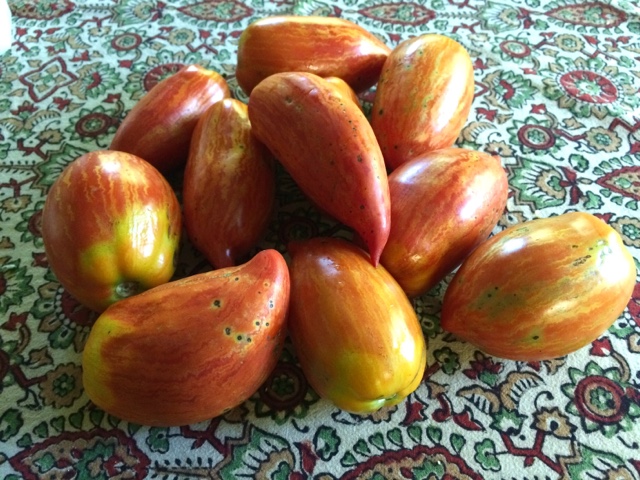
Now that I've figured out to successfully grow bell peppers, I tend to be at a loss for what to do with them. This means I eat them raw quite a bit. August is high season for eggplant which continues until the frost. The tomato plants have the look of late September, nearly caput, and even the fruit have taken on the scabs of blight. Below my beloved speckled roman paste tomatoes. Despite heavy blight, they still produced, if a bit more unsightly.


Pulping


My favorite heirloom Roma (speckled Roman, above), have been pulped in the sloppy strainer contraption I bought several years ago. It's been a terrible year for tomatoes, so humid and damp that blight set in well over a month ago. It's been a very good year for green beans and potatoes, broccoli and basil. The fall cauliflower and Brussels are floating giant leaves but no sign of anything edible yet. 

Soon we leave for a weekend in Milwaukee to hang an exhibit. I'll be showing photographs, a first. I'll post the information when it's all set up. In the meantime, check out my Instagram feed (you can find it here), from which I've harvested, maybe even pulped, the exhibit's images. 


When Fruit Flies

Did you bring fruit flies home with those grocery store peaches? Have they multiplied in your compost bin or on other fruit? To get rid of them, place a day or two worth of fruit cuttings in a stainless steel bowl with a large paper towel over the top, leaving about a half-inch or so uncovered on one side. That will be the entryway. Even if you left an 1/8th-inch uncovered with paper towel, they would find their way in. Leave the bowl on the counter top over night. Do not disturb it in any way. The next morning, the earlier the better, grab a ceramic plate with a smooth bottom (so it makes a tight seal against the bowl's rim) and ever-so-gently place it on the paper towel covered bowl. Take the bowl outside, preferably away from the door you exited, and dump the fruit scraps into the compost pile.

Shake your other fruit. Did any more flies appear? If so, eat, can, or freeze fruit those that are over-ripe and repeat the process. Your kitchen should be clear -for awhile. Fruit flies will find fruit no matter where it is, lay eggs, and rapidly a few flies will become a fog of them. If the flies are not laying eggs in rotting fruit, they'll try the counter top compost bin, and lastly the kitchen sink drain. See this link for ten more traps and a way to deal with the drain.

Fruit flies are one of the most studied insects and have been used heavily in biological research. Click on the fruit fly link to read up on them (and their uncanny sex life). Below, one of the more unusual sex life of insects photos I have ever seen, thanks in part to the photographer's insert.