gardening

Post Post


Is this now a post post journal in accord with our new post truth environment? I admit to being busy with so many different projects that the will to post has been minimal or rather, non-existent. To blog one has to make time or have time, an idea to flesh and flush out, images to give sight to sore eyes, and an editor -always have an editor. Is it that there is nothing new to report? Hardly -there are too many things to report.


The garlic is in last season's potato bed and even more at the neighbor's sheep farm. We may see Hudson Clove return to small sales next year. The bed of herbs is taking in the glories of climate changes that helped create the longest growing season in our region's written history. Depending on one's micro-climate it was possible to grow throughout November. I believe November 19 or so was the first time it froze long enough to do in the cold-sensitive plants and the brassicas lasted into December.

Our lawn has turned completely from grass to creeping charlie. I may use the language of the walking dead to describe it from now on: another area has turned. I could go into a description of creeping charlie, but a visit to Wikipedia should do. Creeping charlie was likely brought to our place, intentionally or otherwise, by my father in law. Our vegetable gardening created bare patches that allowed it to get stronger. The lawnmower chopped it into little bits; each sprouting into a new plant as the weather permits. Last summer and this summer the weather was all too permissive. It spread far and wide and quite literally there is now no more grass. It's also invading the perennial garden and after we had the dumpster removed from the drive, I discovered it growing underneath. Raking leaves is out of the question, unless you want it to spread wherever you move those leaves. My father in law raked and hauled leaves into the woods, over the slope -a good practice, generally. At slope bottom, however, there is now a large colony of charlie that I have low initiative to deal with. I've seen it in the middle slough, too and then again sliding down the slope into the back slough.


While everyone was lining up to buy things on black Friday, I lined up herbs and flowers to prep for a winter indoors. The rosemary was over-wintered in its pot last year and hung in there, but took until mid summer outside to really take off. Much larger and greener than last year, and not so delicately ripped from its summer bed, I hope it will survive once again. Along with lantana, it will be spending the winter in warm, dry, sunny bedroom window.


The pineapple sage wouldn't have made it to bloom if the season hadn't been so extended (although it may have in the greenhouse). There is nothing this red in November around here, poinsettia excluded (we overwintered and oversummered one from last Christmas). I've cut a few branches for rooting and even brought the whole plant in. I will cut it back hard after flowering is complete and see how it does.

Some Siberian cold (often the coldest place on earth) has been dislodged and is making itself felt now. The Army Corp wisely held up the DAPL so at least some of those protesting the pipeline would be inclined to head indoors. The ridiculously warm temperatures gave those not familiar with the Dakotas a false sense of our climate and would have been hit hard by the forty mile an hour winds and zero degree temperatures of the last few days. The cold and wind forced me to bring our agave and opuntia cacti in from the greenhouse. My educated guess is that these can survive zero degree F temperatures as long as they stay dry, but I decided not to chance it. They will also spend the winter in warm, sunny bedroom window.

I, however, will spend the sunny part of days out and semi-out of doors. You'd be surprised how easy it is to get used to 15 degrees F. I just spent 20 minutes outside this morning, sans jacket, to take some photos. It's the fingers one needs to worry about, especially where there's wind. 


Above is the south side of the studio building we've been working on for the last year. I think the temperature inside has stabilized at 34 degrees F despite the 17 degrees F outside and is warm enough to do some interior framing and insulating (where I'll be after this). With the luck of the longest growing season, the grass seed I planted here in early October not only sprouted, but grew in somewhat. Then, in one of the many furious acts born out of every last day above freezing, I tilled it all but a two foot wide grass strip in order to winter plant a native savanna garden from seed mixes I purchased from Prairie Moon.


I also tilled behind the building, on the west side, where I will broadcast a woodland mix of forbs and sedges. I do not expect this to be as easy as my milkweed experiment turned out to be. Disturbed areas like this are perfect for invasive plants (like garlic mustard) to take over, so I have to act immediately. In the greenhouse, towards late winter, I will also seed five inch deep cell trays with many of the grasses and some forbs. These will be planted directly around the building and elsewhere on the land where large oaks have fallen to create sunny openings.

As I look out the window, I see that it is flurrying again. Till next time.


No Small Potato


Potatoes grow fast and huge, here. The frame can hardly contain them.


A couple of days back I went out in the morning to find one third of the potatoes flattened. Raccoon? Deer? Owl flapping its wings? Coyote maybe? Don't know, but I had to string them up to get them off the surrounding plant beds.


We hardly, if ever, consider potato flowers. These are light, light purple. Most of the others are white. They're nice to see, and appreciate, floating above the dense bed of green.


Garden Architecture


After 15 years, this greenhouse of redwood and polycarbonate, has finally come out from under tarp and mouse droppings. It was purchased for my project at Socrates Sculpture Park in Long Island City, Queens, in 2001, assembled amidst the acrid haze of September 11, and the structure became a refuge during a very dark time. The company, Gardenhouse, generously donated their profit by giving the structure to my project at their cost.

Our site, formerly Rex's dog pen, was excavated last fall and filled with Class 5 gravel (a mixture of 1 inch or less rock, sand and some clay), hand compacted by me this spring, and laid with the cheapest concrete pavers from a preferred regional box store. Redwood is great for this kind of structure because it really doesn't warp and is one of the best rot-resistant woods. The polycarbonate held up well, but I hosed down the panels last fall and the hard water left spots inside the double walls. Oh well, still have a greenhouse! 


Because thunderstorm winds are a concern, Betsy made L-shaped pins from two-foot long, 1/2 inch rebar which holds down anchoring straps at seven points along the perimeter. As they rust, the pins will bind to the soil which provides extra grip. Also around the perimeter, I laid landscape fabric and 2 inch granite gravel dug from nearby "landscaping" in anticipation of high speed rain runoff from the 45-degree pitched roof, weeds, and the little boost of rock's heat retention. The brick edging is an unfortunate compromise.

I am renovating a portion of our front porch deck so that I could use the old, long cedar planks as framing for our raised herb bed. After ensuring the rusty screws and nails were out, I ripped the boards on the table saw to cut out the rotted sides. The heart of these boards are perfect, so if you are looking for free raised bed material I would look for a deck carpenter in your area. Our boards haven't been treated in at least sixteen years, if ever, and each had a nice coating of algae and lichen. Still, I placed the up-side out and the underside toward the planting. You could do the same if you are concerned or unsure about the treated nature of free, old deck boards.


After building the first raised bed I rather liked the structure over the hastily made front yard vegetable beds of last year. I had potatoes to plant and thought a raised bed would be easiest for "soiling up" mid season. I tilled, built the two side walls out of 14 foot old cedar deck boards, added humus from the base of a giant old oak tree that spits out a fine, peaty substance from a portal 5 feet up its trunk, then added the rotting straw that covered the garlic beds, and finally several cubic feet of compost. I left the 40-inch end boards off so I could run the tiller through to mix these ingredients in. 


I dug a trench and planted the potatoes at about 12 inch spacing, covered the potatoes, then dug the center trench and so on. In a raised bed with rich soil I am anticipating that I can tighten my spacing. Don't take my word for it, however, see Rodale's 7 Ways to Grow Potatoes.


The greenhouse, nearly completed (still rocks for the back and side, one vent operator to install and some window cleaning). We moved our New Mexican Opuntia and Agave inside the greenhouse, mostly to avoid the cold rains, but also to get them more sun than the house could provide. The front of the greenhouse will be tilled and seeded for grass, then stepping stones or maybe brick walkway from the garage pad to the door. 


Inside the greenhouse, on a quick-built table made of cedar taken off the house last fall, are starter trays and cold-stratified milkweed seeds of seven varieties. I am generally two weeks behind on most projects, so these got started a little late, but milkweed enjoys warm soil sprouting (you'll notice even well-established plants are some of the latest to come up). The milkweed seedlings are sprouting and now share the table with summer vegetable seedlings and strong-looking starts purchased last week at one of our area's better unique and heirloom variety vegetable nurseries -Shady Acres.

If you are thinking of a free-standing greenhouse like this, I'd like to offer some considerations. Make sure you have a solid base to build on that is level as these greenhouses won't piece together well if they are bent out of form by off-level pads. Make sure you place it in a sunny location! Don't laugh, if you build in fall or early spring it could be quite sunny, but not from May through October. Do consider wind and overhanging branches. Gardenhouse says it can withstand a wind load of 85 mph. Why chance it? Make sure to anchor it in some fashion, put it in an area that provides a windbreak yet doesn't allow a large limb to come down on it (note that home insurance usually doesn't cover structures like these). Finally, if you have lots of paper wasps, they will love to explore your new greenhouse as a fine place for their nests of stinging motherf$#ers. I was stung four times last year, mostly because I put my hands near a nest I could not see. Paper wasps are very observant and will watch you as you get close. They will leave you be if you do not get too close, but if you do, in a flash one or more will drop on you and leave its painful stinger. In short, you may have to spray a long term pesticide on the rafters, as difficult as that decision is. Wear a mask, cover your skin and eyes, because it's hard to avoid getting doused when spraying up into a pitched roof. Don't forget places like under a table. The long term stuff should last all season, meanwhile you can use clear sealant to close up gaps that allow creatures in, and with some luck, the next year you will not have to spray.


Local Compost


Local composting sites are great, whether they are municipal or commercial. For eighteen bucks you can buy a cubic yard (3 feet by 3 feet by 3 feet deep), but you'll need some practical transportation. In my case, I fill three old recycling containers (16 x 24 x 16 inches) and throw them into the ol' van at the high cost of shoveling, my back and nine bucks.

The low cost is the primary benefit, but there is also the virtue of steaming compost over bagged, soggy stuff that is shipped hundreds of miles or more. Local composting also encourages municipalities to pick up leaves and grass clippings and provides a location for people and landscapers to drop off small tree trimmings, drop, and brush. And late to the game but ever increasing, is a supply of compostable food scraps supplied by food purveyors and municipalities.

My criticism of local compost is that it is often too woody, given how much of it is made from shredded or chipped local brush and tree trimmings. Another complaint I have about compost brought in, meaning not made by ourselves, is that I consider it inactive. When I compost at home, the pile is teaming with visible and invisible organisms. This activity is what provides the compost its boost when given to the garden. Bagged compost is often a cold, soggy mess that needs to be re-inhabited by organisms already present in your garden. The local pile, steaming and faintly scented of ammonia, doesn't have the larger organisms of my home pile. It is, in other words, a less complex ecosystem.

So, every compost has its virtues and those virtues are context sensitive. If you live in an urban environment, bagged compost may be the way to go. In the sub or ex urbs, local compost can be trucked in by the yard and is the most cost effective especially if you extract the delivery charge (usually around $75). Whether in the city, burbs, or country, you can often find a nursery that makes an artisanal batch, bagged and at a fairly high price.

All told, the best compost is extremely local, it is your own. Now, I've got to get that new pile started.


Pushing Spring


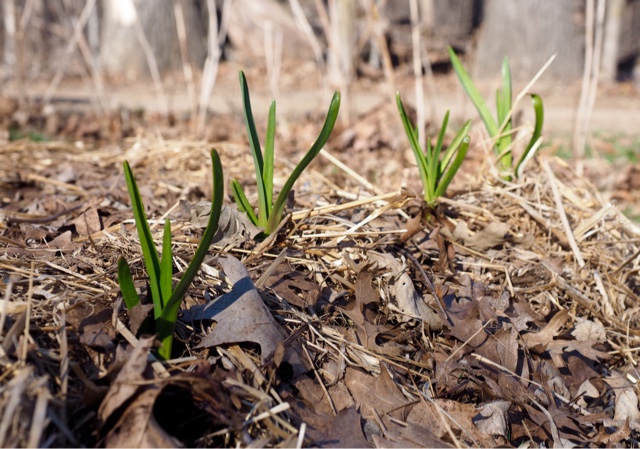
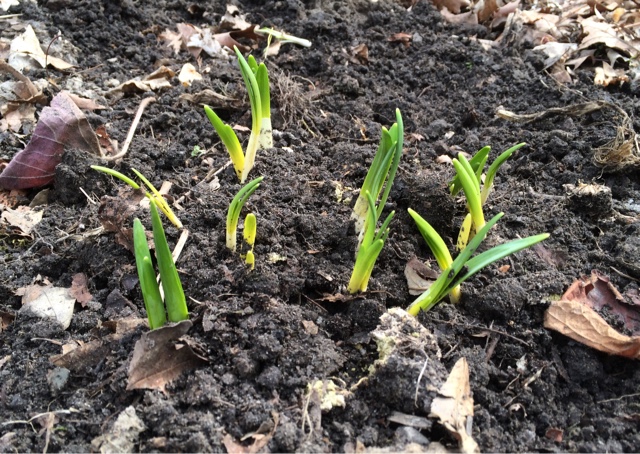
I was beginning to be concerned. After all, I planted my garlic this season just before Thanksgiving. In New York that is nothing, but here? My concern was relieved by the sudden growth pushing past the straw and leaf mulch about a week ago. Below is the Turban variety 'Xian.'


Today I have two tasks. While tending to the fire which boils down the maple sap I've collected (15 gallons so far), I am preparing the bed and laying pavers for the floor of the greenhouse. I need to get the greenhouse up as soon as possible so that I may sprout this year's milkweed seedlings inside it. 


While pounding stakes for the level lines I spotted some bulbs pushing up through the tangle of nettle. I dug them out and placed them into a new garden near the driveway. Didn't think I'd get any gardening in today, but I think this counts. And what luck,  just miles to our south, some areas received seven to ten inches of snow two days ago. 


The Truth About Gardening


Today is Halloween, and fortunately these plants you are about to see were put into their pockets last weekend, or was it the weekend before I went up to Duluth to help install an art project? Truth is that I cannot recall, but at the very least, when I look outside, now that our long summer has changed to autumn, I see that someone has put these plants into the ground.


I like buying plants in autumn because they're usually discounted, if a bit root bound from a summer in a pot, and since I have no trouble keeping plants alive I rarely lose one to a root bound condition. It is winter that I am worried about. Egged on by continuously warm weather, I allowed these potted plants to sit around as I wondered whether this warmth would hold out. I used the time on more pressing housework, notably siding and windows. Meanwhile, the vegetable patch looked like August and it was October.


Although finally, while I was in Duluth, a light freeze made an appearance, yet the weather hadn't really changed. We are about to go into the sixties for several days. Gardening is out of the question, the idea needed to be put to bed. Rather, I'll be using a two part epoxy resin to harden rotted brickmould and jambs, waiting over night, then filling these pockets with a two part epoxy putty, waiting over night, and then priming and painting them.


I'll be using the best paint possible, and fortunately Sherwin Williams sent me a customer appreciation coupon for 30% off, starting tomorrow. The best paint available is expensive, over seventy dollars a gallon, but windows are way more expensive. Your contractor will tell you it is three thousand a hole and you are surrounded by holes; we all like a picture of the land on our walls. A window is the conceptual preamble to landscape painting, so I do not underestimate its hold on us. Yet a cold of twenty below zero is a phantom that makes sieves of our aesthetics and the rot in a jamb exposes the carpenter who refused our only defense -that apotropaic, pink spun glass.


It may be unfathomable to those in warmer corners, but I welcome the oncoming cold as a return to interiority, away from the outdoor projects I thought I could accomplish last spring. These will have to wait. There are indoor projects to be sure, but there is studio time, professional development, and even this journal to attend to.


There is a landscape project I wish to accomplish, at either a sculpture park or county park. Details to be worked out, but this Swamp Milkweed, Asclepias incarnata, is the seed of it. And I've yet to plant the garlic. Soon, maybe in a week's time. And painting, too, of course, there are several running in the studio now and an exhibit in Milwaukee for next fall. I will be teaching my course, once again next summer, at Art New England.


Bugbane or Cohosh, Cimicifuga racemosa.


The Notions


This is what a beginning garden looks like. A few old farm implements, an older garden overcome by the shade of growing trees, a tub of transplants waiting for human inspiration, a lawn overrun by creeping charlie, and a trio of notions about how things will come together in the future. The notions: grandma's tea, seaside goldenrod, and Heuchera of Brooklyn.


The Headwaters


Driven to rise early by force of street sweeping law, I headed south to my old place on Friel to see how things have held up. Little has changed in our old building. Still the disrepair and blandness, but now less a garden. 

In autumn of two thousand two this was the sunniest, most pleasant of all the apartment wrecks I had seen in several Brooklyn neighborhoods. I had never considered living in, where? -Kensington? Behind a chain link fence, under the blazing hot sun, there were telephone poles stacked in what would later become the garden.

With the arrival of three Russian Zelkova, sun had been replaced by shade -the light loving garden I had planted then stretched beyond its limit. Change was a force, plants groped for light or gave up, and when we chose to move, some of these plants were boxed for transport on a plane and a few others went to friends. I assume that the rest met a dark end by glyphosate.


The corner piece of a neighborhood has returned fully to the weeds, excepting a few daylily and phlox -stalwarts of the brown brick wall. Gardening is presence. We assert ourselves with the language of plants. For my old neighbors my presence is still felt, now in absence of flowers and a plethora of ailanthus, smartweed, and poke.


_________________


Having made a quick peace with the old place, I moved on down Coney Island Avenue, Avenue J, Bedford Avenue, and the Belt, over the Gil Hodges to Fort Tilden, the beach.


To my eye, beach farm neighbor, Jimmy, has taken over the old plot. This pleases me. Jimmy's a good gardener, fun, conversational, and present.


 It is reassuring that the neighboring plot, adjacent to the west, is still as weedy as always.


And that Wolf has continued on with his tomatoes.


I was charmed by the sight of my old garlic signs used as stakes to support new beds.


______________________


At the moment I have the sensation that this is all I miss of New York City -the ocean, its sandy buffer, the dunes and the salt-enduring flora.


I stood, I sat, for about an hour, alone, but for the gulls.


_____________________


I was reminded at Tilden that I wanted to bring Seaside Goldenrod back to Minnesota, yet I didn't want to risk taking a plant from the sandy roadside of Rockaway Point Blvd -outside the park (but why chance it). I headed to Red Hook, where the cracked asphalt streets and sidewalks can yield many clumps of S. sempervirens.


I found this cluster on a trashy, industrial block, growing below a security cam and above the asphalt. I grabbed my shovel and scraped its roots from the pavement.

I've grown one Seaside Goldenrod, pulled from a Red Hook pier, in my Friel Place garden. It did okay, suffering from an orange rust each year until, finally, it did not return under the shade of the new street trees. Of course, I like it for its air of the beach, its flowers well-loved by bees, and especially because I thought it may do well in a garden covered by sidewalk-salt laden snow.

I do not know how tolerant of cold it will be, after all it is a seaside plant, but indications are that it is growing along the Great Lakes. I am saddened to see it is listed as a non-regulated invasive species in states like Wisconsin and Indiana. Apparently it is making inroads along our salt-encrusted highways. Could it be that a coastal native is problematic, as much so as a day lily, queen anne's lace, and all the others along highways that are among the most highly "disturbed" sites we have? Am I at the forefront of an invasive wave of Solidago sempervirens? Will it be my fault?

In a case like this, I choose a source that supports my endeavor. From the USDA:
"Nevertheless, because seaside goldenrod has a moderate growth rate, a shorter life span than other Solidago spp., a limited ability to spread through seed, and produces seedlings with low vigor, it is not considered an invasive plant."

Additionally:
"It increases the value of wildlife habitat by providing food and shelter for butterflies, birds, and small mammals. The migrating monarch butterfly uses seaside goldenrod as one of its primary food sources in the fall."

This adaptive plant has the potential to spread itself along the corridors of our own ruination. It also provides an excellent bit of habitat in the difficult, salty locations we've demanded. I have attempted to walk the garden plant/native plant tightrope over the years and it appears that Seaside Goldenrod in a Minnesota garden is the net I fall into. A condition of native is always where one chooses to draw the line. At one end is purity (and Michael Pollan's take on nativism's racial and nationalist ideology) and the other end chaos (and the destruction of the beauty we perceive within ecosystems).


Solidago sempervirens, bagged and ready.


The Transplant


There is a patch between the curving drive and the yard, on the north side, where Rex's dogs used to reside. The dogs, Trixie and Elmo, passed away years ago. Last autumn, Betsy flew out of LaGuardia with a box of bulbs, roots, stolons, and rhizomes in her carry-on. She planted them here, among the old dog pens. This spring we sold the chain link pens to a woman tending goats, or was it pigs? 


As it turns out, this is a very prolific location, maybe the most fertile in the yard. The plants that grow here are a hodge podge of Lamium, Creeping Charlie, Jewelweed, Milkweed, Bellflower, Virginia Wetleaf, and smattering of Lambsquarters, clover, grasses, and other weeds. These surround the remaining dog house, one that is hard to part with because it was so lovingly crafted to resemble the human house it shared land with at Rex's old place.


This is the canopy of a single Jewelweed, Impatiens capensis.  I say canopy because it is built like a tree and is beginning to shade out the transplants.


Just look at the size of that stem, maybe three or four inches in circumference. To the right is a Maximilian sunflower, Helianthus maximiliani, carried to Brooklyn from southern New Mexico, and now to Minnesota. To the left is one of two Bleeding Hearts, Dicentra eximia, holding their own under the shade of the giant Jewelweed.


I'm happy to see what I know is an aster growing among the Milkweed, but I cannot tell if it is the weakly growing Anna Potschke or the more aggressive New York Aster. I'll take either, but would love to see Potschke do well here since it suffered so much in Brooklyn.


The Milkweed, Asclepias syriaca, grows strong here and like common Milkweeds everywhere, it appears rather randomly wherever it prefers. I suppose that's what makes it a weed to the farmer or landscaper. I hope gardeners appreciate it. I've seen some spectacular specimens in yards here -they are quite sculptural, exerting considerable presence. We are planning on a wildflower meadow over the septic drain field and will likely transplant some of these to that location.


Each lily transported from Brooklyn have made this home. They are all doing quite well, as they had in Brooklyn (people's sticky or damaging fingers aside). I may miss the bloom, or part of it, as I will be away in New York City for a presentation in late July and then in Vermont for the first part of August teaching my course Landscape Into Art.

When I am there I will pot up some rather large specimens that could not be, nor should have been, crammed into a box. Roots trimmed, watered heartily, I will leave them for the week while I am in Vermont, and then, on my return to Brooklyn, pick them up for the return trip to Minnesota. I do not look forward to this drive, haven't for years now, but the plants, their care, and the stowaway creatures that will make the van a home for the trip will make it a more interesting ride.


Lawn Of Plenty


It was about mid-May when I decided to carve five small rows into the front lawn for this year's vegetable patch. It is the sunniest, flat space on the land here. In the distance, the driveway and a hedgerow of Hydrangea arborescens -a solution to coarsely articulated snow-plowing and a mass of foundation plants in the way of a future house project. Seven weeks from the day the tiller expressed itself, the vegetables are taking advantage of our long, northern days.


My first round of green beans didn't arrive, quite possibly because I didn't water the seeds enough or maybe due to three year old seeds. They were all French beans, ones that trialled well, hmm -three years ago. So I bought new seed from the big box (so many home projects!) and planted those. Meanwhile it had been raining heavily for a few days -that's when some of the old seeds showed up, 'Velour,' I think. So far no problems with bunnies -or deer, raccoons, hedgehogs, and whatever other vegetable munching varmint one can have. So lucky -that's all it is.


One four inch pot of flat leaf parsley has become eighteen by twelve inches of parsley -use it daily.


One four inch pot of cilantro has become two feet by twelve inches of cilantro -makes a nice pesto!


The garlic is still green, but I know well enough to start harvesting them. As these go, their rows fill with herbs, green beans, and eventually those brassicas I fully intend to start one of these days...


Four pepper plants from a cell pack of four heirloom varieties. This one set fruit super early.


A cell pack of Japanese eggplant have provided us with an orb -not the usual thin and elongated fruit. What gives? I do prefer the way less seedy elongated varieties. Oh, Japanese eggplant doesn't always imply elongated fruit? These are 'Kyoto,' a round eggplant, and I ashamedly renounce my ignorance!


One four-cell pack of, hmm, I forget the name, but cucumber. I do recall it saying compact, and this one is definitely compact. We grew them in pots, elevated off the ground in metal pot stands that happened to be here. A couple of things to point out: these four plants in two pots have been productive for their size and have not succumbed to mildew. They have yet to reach the ground and have many flowers per vine. I recall googling the variety at the nursery, Shady Acres! Ahh, they have a plant list- It is Spacemaster. Pick them pickle size for best flavor.

A word about Shady Acres. Heirloom. That's the word. Seriously, Minnesota has some catching up to do when it comes to organic garden supplies and heirloom vegetable starts. It is very difficult to find what I came to expect -even at Larry's on the corner in Brooklyn (Best Deal on Bloodmeal!). I edify every nursery I come into contact with, including Shady in regards to fertilizer choice. I heard about Shady Acres from my neighbor who is busy trying to grow Minnesota's largest pumpkin, and was grateful for the recommendation -they carry heirloom vegetable starts. For me this means they have a variety of tomato beyond Rutgers, Beefsteak or Early Girl for the person who simply didn't get to starting his own.


Potatoes. They grew incredibly tall, so high that they could no longer be soil-mounded. Then a week of heavy thunderstorm rains, about seven inches in all, ensured that they would lay flat until they turned back up toward the sun, which they have, albeit more prostrate than before. They have been flowering for a few weeks now, with new potatoes sure to be available soon. I've decided to wait on those, aiming for the bigger potato of the future.


The tomato plants are some of the healthiest I've grown. Again, an heirloom variety pack from Shady Acres provided the starts. Ours have been in the ground for about five weeks, have grown over thirty inches tall, and some are producing tomatoes. We also have a grape variety, four plants in total. We won't get a ton of tomatoes out of four heirloom plants, but this year required low input, experimentation, and observation.


What is remarkable is the health of each plant. No visible disease, no wilt or cankers, no blossom end rot (can we thank high Cal-Mg soils?), simply robust plants. Look at that impressive stem. It helps to be gardening in a spot that has yet to see any vegetable growing. We haven't had any Colorado potato beetles either, so here's to hoping that our little clearing is protected by the woods and wetlands that surround it.


Lastly, the bug-eating army of amphibians can't hurt. And what of the pansies? It hasn't been a very warm summer so far, but plenty of days in the lower eighties. Here it may be that pansies just won't quit.


Our Vegetables

My attitude about garlic growing is considerably more casual than in previous years. So far these varieties have shown excellent progress without more than a dose of blood meal and liquid fish fertilizer. The French grey shallots have done exceedingly well with little maintenance but the occasional weeding.


In fact, since the top photo was taken, they have lodged -meaning it is near to harvest and hardly any different from the time frame of my 2012 upstate New York growing experiment. These will be cured on the porch.


Very few interesting things going on with the garlic. They are taller, lankier than my Long Island grown garlic, although these were planted from my own LI grown heads. Each variety made the transition, so far, from coastal New York to Minnesota pretty well. There has been one interesting thing -the strange appearance of dead flies on some of the leaf tips.


They seem glued in place. Has another creature done this? Saving them for later? Or has the garlic done them in? No answers, yet.


About a month and a half ago I planted potatoes. They appear to be doing exceptionally well, with each rain adding another few inches in the last three weeks. No Colorado Potato Beetles yet and I can't keep enough soil on hand to mound up!

Of course, we put tomatoes, peppers, and eggplant in two weeks back. They were planted in 14-inch wide strips tilled into the front lawn -the only place sunny enough for vegetables. So far no creature has come to eat. I'm wary of adding green beans knowing how well rabbits take to those tender seedlings. Deer have not browsed, although we do have a resident raccoon living in a big, old maple in the woods about 75 feet from the garden. So far she's only been good for digging up a single, just-planted spud and harassing Betsy by tipping over her newly planted coleus.


Gardening at the Boundary


That day, maybe a week ago, it really came down.


I know nothing about late spring snow. Nothing. When I was a child, in New York, it snowed during our Easter break -it was early April. The day prior was warm, even the day it snowed it was warm, so much so that I was out riding my bike in the street with my brother. Although it was cloudy, the big, wet flake snow came without warning.


This snowfall is different, intermittent pellets and flakes. It was windy too, driving the pellets hard. As is often the case, the snow did not stick. The snow was not the trouble at all. It was the cold that presented itself the following night. 


I woke to find a frost on the little wetland.


 Crystals coated all the leafed out, saturated-looking plants in the early sun.


The parsley I had just planted showed crystallization along its veins (interesting that this happens, no?).


The  cilantro.


The Virginia Wetleaf succumbed (but recovered) to the eight or so hours well below freezing.

____________________

The last frost date for our location is roughly May twenty. I do not think anyone would suggest that the last two months have had ordinary temperatures, we haven't. Since March, we have had days that topped out at 10ºF and 82ºF, although most have been in the forties through the sixties. Our March monthly average high temperature was nearly 46ºF and the April average so far is 59ºF. Daytime temperatures have long suggested I should be growing things that California is having trouble providing. Think twice. I watch the trees and the vegetable gardens. Only this week are the oaks beginning to show the chartreuse of spring and there has been zero garden activity.

Warm air masses, heated by their descent from the Rockies and Great Plains, move in from the south and west, and locally there is sunlight warming the thermal mass of land without the cooling influence of great bodies of water. The day warms nicely. At night, however, without the moderating influence of clouds, radiational cooling is strong. I recall a typical temperature differential in NYC to be about 15 degrees. Here, in Minnesota, I have seen 20+ as the norm. Beyond nightly cooling, there is always the threat of a cold airmass coming down from the north whenever the jet stream decides to do something funky. Minnesota is the common entry point for cold air, it is the reason people think this state is cold. 


Which brings me to another weather detail. I noticed the window box of just planted pansies was bone dry. What? I had watered it in, deeply, just the day before. Hmm. Something unusual had happened -dry air, exceptionally dry air. Two days after the snowfall, and the day of the overnight freeze, our relative humidity had dropped to 12%, twelve percent! Our dewpoint was nearly 1ºF by the late afternoon. Meanwhile, our high temperature was 55ºF and the winds were up. The water simply evaporated. Despite this, the pansies toughed out the freeze and drought, as those in the pot above attest.


The dry air, the sudden cold from the north, the high temperatures, the wind, no rain, and of course, heavy rain are all typical. We live at a climactic boundary with little to moderate each influence. This is the education of a gardener.


What's Old Is New

One of my present tasks is to attend to thousands of well-kept magazines that my father-in-law left behind: National Geographic from 1918 onward, Life from the beginning to the end, Scientific American from the 1950s onward, Sky and Telescope from then to now, and so on and on. Among these larger lots are a handful of Organic Gardening magazines. Would any of you, readers and gardeners, be interested in one of a handful of lots of Organic Gardening magazine? Here's my pitch:

Old magazines are full of old printing techniques, laughable fashions, advertising with crude, unmerchantable copy, and outdated storylines. However, printing and fashions aside, Organic Gardening is 99.5 percent as fresh today as it was the year it was published. In fact, I leafed through one Rodale Press magazine from the 1940s the other day and was surprised to see the same problems and solutions printed then as you would see today (except their less than thorough take on sewage sludge as a fertilizer). Sure, the hybrid varieties touted then as an improvement may now be thirty years old, but the growing information is solid and the text is short and to the point. It's great to see articles on wild plant foraging, native plant gardening, chicken-raising, pickling, and all the other how-to know-how OG was known for back in the day that is de rigueur today .

Organic Gardening was printed as a half-sized edition of 8 x 5.5 inches. The paper used is nearly newsprint and yellowing from age, although each copy is fully bound and complete. You may notice the musty smell of an old magazine boxed in an old house -it's part of the charm. If you are interested in obtaining a year of OG, drop me a comment and email: nycgarden@gmail.com. It'll only cost you the shipping (USPS, flat rate).