invasive plants

Findings


I'd like to tell you what kind of Oak this impressive bark belongs to, but in age, among oaks, it is a challenge without leaves. No matter, this old, large oak is anchored near a clearing made by wind of storms and pressure of fungus and disease.


On the bark of a giant that had fallen last summer, I place garlic mustard just pulled. I keep it off the soil so that it properly desiccates, a lesson learned a year ago. Now committed to the project of eradicating the weed, I think of it as gardening, a task with its own time, that I can accomplish while out photographing the woods, searching for mushrooms or ramps, or completing some other woodland project. Away from fallen logs or large stones, I make piles so the mustard remains obvious to me later, as I check on its desiccation or dispose of it. Officially known as Garlic Mustard, Alliaria petiolata, I've pulled enough acreage of it now to refer to it as "skunk mustard," because its garlic-onion odor reminds me more of that mammal's funk. Click here for a concise and useful journal article on all things problematic with garlic mustard in North America.


This upland spot was (still is?) an oak and sedge stronghold for quite some time. Now cleared of its main shade oak, what may grow in these changed conditions? Its slopes are partially covered with Pennsylvania Sedge, Carex pensylvanica, and some Virginia Waterleaf, Hydrophyllum virginianum. I found these native strawberries, Fragaria virginiana growing in patches, too. A straight line trail runs through this location, with plenty of soil disturbance from quadrupedal hooves and nosing through leaves and soil for food. Maybe I could intervene beyond pulling weeds by giving some complementary plant a foothold. We tend to avoid plants consumed by deer and in this way we consume them by exclusion.


While pulling skunk mustard I stumbled upon this snake, a common Eastern GarterThamnophis sirtalis. Its reaction to my sudden presence was no reaction at all.


As I continued to hover, pushing my fingers into the dried leaves to pinch-grab below the prostrate brassica stems, concern took over. I let it be, moving on around a tree to grab more mustard.


Then I spotted two more, one with coloration slightly dull compared to the other, sunning themselves near their burrow. My leaf rustling was too much antagonism and the one to the right took off. Minnesota isn't known for its snakes, although I am happy to see them here in our woods. Along with our frogs and salamanders, they are an important indicator of the land's well-being.


It's been very dry so far this spring (and despite constant snow cover, the winter was short on snow). In our new climate reality, we anticipate extended dry periods along with excessive rains from thunderstorms. Because of the lack of runoff from non existant spring rains, I was able to navigate the entire small wetland, plodding across acres of dried, sun-bleached naples yellow grasses. I witnessed the garlic mustard making inroads into the wetland as well as an arm or two of Creeping Charlie, Glechoma hederacea. I also spotted considerable patches of Stinging Nettle, Urtica dioica growing among the garlic mustard, but also several feet farther into the wetland. There is a tree, likely an ash, rooted at the edge of the wetland but fallen into it that has continued to send up branches along its trunk. Under the tree's crown there is a muddy circle where only the plants, above, are growing. At first glance I thought "Marsh Marigold?" Maybe not. Thoughts?

I did make a soggy-footed attempt into the great wetland on the south side. I wanted to see the willows -the first pale greening of spring, up close, but I didn't make it far enough in to be truly rewarded. Underneath those grasses were channels and ponds of water still draining from a much larger supply of slopes than the little wetland to the north. I did see evidence of Swamp Milkweed, Asclepias incarnata, about twenty five feet from the wood's edge. The exploration of the wetlands, our sunny places, compels me to engineer a boardwalk (literally -cut logs, debarked and placed longitudinally, with boards run lengthwise between them). Future projects.


Closer to the house, on the dry slopes bloom Bloodroot, Sanguinaria canadensis. Maybe these can be planted in the clearing among the wild strawberries?


There have been many sightings of hawks, vultures, eagles, sandhill cranes, turkeys of course, and others to make seeing the more common birds seem, well, common. Yet the first robin of spring was worth pausing for, as well as bluejays and cardinals hanging together.


And while squirrels aren't on anyone's favorites list, they have yet to cause us any trouble, likely because their habitat is still largely intact. They do not come toward the house and didn't mess with last year's garden. This bounding fellow has a red head, feet, and tail. I wonder if it this one, from last fall, or a relative.


The Woods Today

Back in NYC I might take a walk from time to time, but more often than not it was for the purpose of getting somewhere that I might find myself on a walk. Today, after gaining some ground on research for my (other, new) summer course Shipwreck of the Minotaur at the Mayapple Center for the Arts and Humanities, I chose to take a walk through the woods with some purpose in mind, but mostly to get out of doors for an hour. I did need to check on the sap buckets, as cooler weather has extended our sap season, and also to check on my Easter day's garlic mustard eradication project around the back slough.


I've kept my eye on the Tradescantia spp. that I transplanted from Brooklyn last year in a new garden where the old lilac used to dwell. It looks to have survived. The same garden is now home to the old Brooklyn 'New Dawn' climber rose (a rose that has seen four different yards over its years), a sedum I found growing here in the woods, Dicentra eximia from Brooklyn too, and whatever else was growing there that we've decided to allow (and hopefully not that horseradish I did my best to dig out).


In the front yard, all varieties of garlic are now soaking up the sun. Incidentally, these are not German Hardy, but an artichoke variety, possibly with 'giant' in the name, that were shipped gratis, likely because of poor size thanks to drought and fire in the garlic seed producing region. There are as many commas in that sentence as garlic in this row, but my point is that the sign is a stand in.


I headed into the woods, although the wind made for a biting chill and a hazardous walk through the ready-to-fall. So much dead wood squeaking and creaking like a brig on the open seas, I hesitated to pause for the earliest of ephemerals like Virginia Waterleaf, Hydrophyllum virginianum or the mystery plant, below, that caught my eye as I hiked off path to navigate a significant enlargement of the water line in the back slough.


I was motivated to get back to the slopes of the slough to check on the garlic mustard that I chose to spray with a low percentage mix of glyphosate and water last Sunday. Spring is the time to deal with garlic mustard, particularly March and the earliest of April. Virginia Waterleaf, ramps, some rosa species, a few asters, and other early, less pernicious weeds are coming up and I have no desire to affect those in the act of ridding the woods of garlic mustard. In these zones hundreds, probably thousands, of garlic mustard seedlings are sprouting from the seed bank. It was not an easy decision to spray, especially within a yard of the slough's water line. And I am frustrated to report that after six days the results were not significant. Most leaves were mottled, but the plants were not in the state of distress I would have expected. I've considered that I may need to apply a second course, although I am not happy about that. It was necessary to do so, even with a much higher percentage of glyphosate, on the buckthorn "hedge" growing alongside the garage pad. What I have to consider is the compression of the wet soil in spring. It appears to me the less foot steps, the better, especially after the frost heave has done such a nice job of loosening, aerating, and draining the soil surface.


In the past I thought garlic mustard didn't do well in flooded soil, and maybe it won't if the slough remains flooded. However, what I've seen is that in early spring the ice melts and freezes and this heave extracts the garlic mustard from the mucky soil. It then floats, roots and all, in the spring melt water, preserved in a cool water bath until conditions improve. At the water's edge the leaves and stems of garlic mustard are bluish gray to the deepest purple and often hard to spot against the dark water. The garlic mustard a foot or two away, on drier land, have some purple to the stems, but the leaves are quite green. So green, in fact, that it is a little painful to pull or spray at this time where you find yourself longing for the green of spring.

So what happens to this water's edge garlic mustard? Does it die? I don't think so. Many of the plants, some of which I simply scooped out of the water and some which were easily pulled from the muck, had the biggest roots. Garlic mustard is a biennial, so last year the seedlings emerged and grew strong, despite the waterlogged soil, and this year they are ready to grow and set seed. I'm not willing to wait for the sake of observation, yet I am sure many will escape my vision or reach, and I will be a witness to their success.

As I make my way around the slough, eyes to the ground, I think much about what good the garlic mustard could be doing. What species make use of it for cover or for food? Does it stabilize the soil on the wooded slopes? Is balance achievable? Is garlic mustard simply symptomatic of a woods so degraded by other culprits (err, humans, for instance)? In other words, how necessary is the work I've begun, and am I causing more harm than good? And, you know, I like questions.

If you would like to see more photographs of the woods, follow me on Instagram @frankmeuschke where I post regularly under the hashtag #thewoodstoday.


Cedar Blush

The foggy morning was a prelude to the storm that just ended. Blue sky, something we've had little of this winter, is now in its stead. It is these weather events that make a cold climate tolerable, just rewards for what can be hard.


Moisture riding the push of warm advection crystallizes on cold twigs and grasses.


And sumac not yet pecked by the birds.


I love the cedars that grow here; reminding me of those that break the monotony of old fields on Long Island. They, of course, are the same species, and aren't truly cedars -Eastern Red Cedar, Juniperus virginiana. These are tough trees, can be over nine hundred years old, tolerate drought and wet, cold, and the poorest soils. While deer browse your expensive arborvitae hedges, by the looks of the Eastern Reds around here, they hardly touch them. There is gin, of course, and the aesthetics which, to my eye, are some of the best an evergreen can provide.

There is a moment every autumn, usually middle to late, when the cedars turn bronze, red, mauve, blushed or however you may see it. This change requires a loss of some of chlorophyll's green and the development of red anthocyanins and the two, together, create this bronzing effect. This is painter's stuff, mixing reds and greens to create blacks more green or more red. The dark bronze contrasts with the white of aspens and snow and plays well with ochre field plants.

Like so many plants you love, someone, somewhere lists them as invasive. How can this be, you ask, after all it is a native in its range! Well, I rationalize it this way -Eastern Reds grow readily in farm fields and get a bad rap for its ability to grow readily from bird-dropped seeds in these fields. The other reason is the loss of fire as a control agent, but this is our fault, and we shouldn't be blaming the cedar. Finally, because we plowed under so much prairie that there is less than one percent of it left, managers curse the Eastern Red for colonizing what's left that isn't being managed by fire. Given these rationalizations, I still wouldn't blink if I had the opportunity to plant one on our land.  I may well have that chance in one of the many clearings created by downed large oaks or bass that have given rise to another accomplished colonizer -common buckthorn.


Winter Mind


Winter has finally come to us. Temperatures below 20 degrees F, snowfall, car doors frozen shut with the last freezing rain, the clinkeling of ice crystals shed at forty five miles per hour. Despite this wintry attitude, we here at PrairieWood have work to do. The new shop is now standing with roof and ceiling. It never occurred to me that I would work into the night, outdoors, at just a handful of degrees above zero, but I did just that last Sunday so that we could get the wiring in before the ceiling closed out our access.

While I've been able to put most house projects on hold until springtime, one thing is still weighing heavily on my mind -the woods. What once went concealed by countless leaves is now made obvious by the contrasting wet bark and newly fallen snow. If I could sum up its appearance in one word, it would be diagonal. What is it about a wood of slanted trees that is so disturbing? Is our sense of order satisfied by horizontal ground and vertical columns of trees? Is the removal of angled wood a goal of a "clean" woods? 

What we need here is a plan, a forest plan, to guide us in the care of these woods. But wait. Why do the woods need our care at all? Isn't that awfully anthropocentric? Couldn't the woods take care of itself as it has for thousands of years?


Why is it so hard to look at the woods and see ourselves in it? We entertain the woods as a medium of passage. We experience the woods, but are not a part of it. Our aim is to be out-of-the-woods. We are beasts of clearings where a few selected trees may stand sentry. Why not the woods? Is it a blow to our ego to be among such large beings? Or is it the inherent danger of a sustained presence in the woods, the mashup of life and limb? Maybe this is the most practical tack, that a life in the woods is a life fraught with falling timber. Even among the trees there is danger. No elderly tree gives way without taking or scarring those around it. The falling of a great old tree reverberates through the forest, destroying the order, remaking communities, providing opportunities for well placed upstarts. 


I've realized how easy it is to make a metaphor of the woods, but the questions are more difficult. In our short time here we've had to ask many, and no answer is quite right. Any intervention is yet another question, or string of questions. We cannot extract ourselves from the story of the woods; people created it and we are living it. 


I regret to speak so abstractly, but somewhere in this line of thinking is a better perspective that may be teased out in writing. I understand intuitively that we have a role in this mess, that we are the aliens among the trees, roadsides, and fields. We cast dispersions on the plants and animals that take advantage of sensitive niches, but were it not for us this would hardly be the case. We are the aliens, the agents of drastic change. We project it onto others (plants, animals) while claiming our place. There would be no buckthorn, no garlic mustard, no barberry or burning bush if it weren't for our own invasive nature. Can we make it right? Can you take it back? Can you undo the done? 


This is a defining aspect of our culture. We invade a place, instigating the consequences that we see all around us and then tell ourselves that it is the others' fault, it is their doing that has created the mess and maybe, just maybe, we'll commit resources to cleaning it up, and it will be ongoing, forever perhaps. The productive citizen looks away; it's just easier that way, isn't it? We can spend a life throwing resources at a problem that traces back to exactly where we stand. Is it rational to label plants and animals invasive and yet completely ignore our responsibility for it? 


In the woods I see the paradigm of our conflict, one as much with the natural world as it is with other human beings. I am left asking you if an answer, one that can never be fully right, is to look away or to commit the resources to try to correct the damage, forever, perhaps. And what to make of the trying, because trying isn't necessarily accomplishing anything other than assuaging one's conscience of total responsibility. 


I don't mean to be melodramatic. It's simply that so much of what appears to ail us today is hindered by our unwillingness to take responsibility, or at the very least, to understand our responsibility. I am not personally responsible for the rampant buckthorn in the woods, but I sure can see how it came to pass and how I've benefited from our ancestral migration to this place. 


Ignorance (in the sense of not knowing, but also ignoring) leads to bad decisions, or self-centered ones, and consequences difficult to ameliorate. For instance, water holds in the middle swale, in the back woods, and leads to ponding, mosquitoes, and to water-logged roots which can bring an untimely death to the trees there, fallen timber, more sunshine, and then faster buckthorn spread. I considered trenching a drainage so that the captured water could drain into the great wetland. Autumn came and I saw that some trees at the center of the middle swale remained green-leafed long after the rest went yellow.


Upon investigation, the bark and leaf, below, spoke. These are silver maple, Acer saccharinum, the fast growing, brittle-wooded tree of wet areas in the Eastern Forest.


I can only guess that silver maples living at the boundaries of its range put the species under pressures not necessarily found near its core. So I came to an understanding of this middle swale. I will not dig a trench to help drain it, yet I will dig deeper into what else is growing, and dying, in this area, and attempt to understand it before acting or, quite possibly, not acting at all.


The questions of how to act and what sustained gestures are both possible and effective, are for our winter mind. What can be done that limits the rampant buckthorn and doesn't undermine the fragile species under threat from its able fecundity? We spent a quantity of time pulling garlic mustard from the drainage stream connecting the northern, small wetland to the great, southern wetland. Our work was effective, but it also appeared to me that there was a significant reduction in jewelweed in the very same area. I'm working on memory, now, but I thought it was more prolific in that region in past years. So I wonder, was it the garlic mustard that reduced the jewelweed population to nearly zero, was it natural swings in population due to unusual temperatures or flooding, or was it our trampling feet that inhibited its seed from sprouting? 


Every action has consequences, so many of which are unknown. I recall how, as a child, certain people were inclined to spray pesticides into the tall oak trees to bring down gypsy moth caterpillars. Our camp director screamed, during lunch, that by God he was not going to allow those trees to die! Our neighbor brought in a pump truck, unannounced in summer time, and sprayed his trees. I am still haunted by the overwhelming bitter smell of the pesticide, the sticky residue dripping from the trees, the dead birds and squirrels on the ground. His trees didn't die, nor did the camp's, but then, neither did the vast majority of unsprayed trees.


Each of us who is responsible for a part of the woodlands at the edge of the prairie has to choose for ourselves whether to act, or look away, to spray herbicides and trample, or do nothing. There is no mandate, we operate independently of our neighbors and yet nature cares little for these arbitrary boundaries.


I am inclined to act, yet feel overwhelmed by the magnitude of what is necessary to be effective. We hesitate to spray herbicide, usually in two or more applications, but pulling is incredibly time consuming, physical and often, incomplete. Should we adjust to the new, simpler woods, make peace with the knowledge that we brought this thicket on ourselves? Could there be a middle ground where buckthorn and garlic mustard and all the others are accepted to a degree, where we do not look away but effectively manage the woods?


*all photos are from October, showing yellow-leafed sugar maples along with the green understory of buckthorn -low growing, young plants spread north while the large shrubs reside on the south facing slope.


The Headwaters


Driven to rise early by force of street sweeping law, I headed south to my old place on Friel to see how things have held up. Little has changed in our old building. Still the disrepair and blandness, but now less a garden. 

In autumn of two thousand two this was the sunniest, most pleasant of all the apartment wrecks I had seen in several Brooklyn neighborhoods. I had never considered living in, where? -Kensington? Behind a chain link fence, under the blazing hot sun, there were telephone poles stacked in what would later become the garden.

With the arrival of three Russian Zelkova, sun had been replaced by shade -the light loving garden I had planted then stretched beyond its limit. Change was a force, plants groped for light or gave up, and when we chose to move, some of these plants were boxed for transport on a plane and a few others went to friends. I assume that the rest met a dark end by glyphosate.


The corner piece of a neighborhood has returned fully to the weeds, excepting a few daylily and phlox -stalwarts of the brown brick wall. Gardening is presence. We assert ourselves with the language of plants. For my old neighbors my presence is still felt, now in absence of flowers and a plethora of ailanthus, smartweed, and poke.


_________________


Having made a quick peace with the old place, I moved on down Coney Island Avenue, Avenue J, Bedford Avenue, and the Belt, over the Gil Hodges to Fort Tilden, the beach.


To my eye, beach farm neighbor, Jimmy, has taken over the old plot. This pleases me. Jimmy's a good gardener, fun, conversational, and present.


 It is reassuring that the neighboring plot, adjacent to the west, is still as weedy as always.


And that Wolf has continued on with his tomatoes.


I was charmed by the sight of my old garlic signs used as stakes to support new beds.


______________________


At the moment I have the sensation that this is all I miss of New York City -the ocean, its sandy buffer, the dunes and the salt-enduring flora.


I stood, I sat, for about an hour, alone, but for the gulls.


_____________________


I was reminded at Tilden that I wanted to bring Seaside Goldenrod back to Minnesota, yet I didn't want to risk taking a plant from the sandy roadside of Rockaway Point Blvd -outside the park (but why chance it). I headed to Red Hook, where the cracked asphalt streets and sidewalks can yield many clumps of S. sempervirens.


I found this cluster on a trashy, industrial block, growing below a security cam and above the asphalt. I grabbed my shovel and scraped its roots from the pavement.

I've grown one Seaside Goldenrod, pulled from a Red Hook pier, in my Friel Place garden. It did okay, suffering from an orange rust each year until, finally, it did not return under the shade of the new street trees. Of course, I like it for its air of the beach, its flowers well-loved by bees, and especially because I thought it may do well in a garden covered by sidewalk-salt laden snow.

I do not know how tolerant of cold it will be, after all it is a seaside plant, but indications are that it is growing along the Great Lakes. I am saddened to see it is listed as a non-regulated invasive species in states like Wisconsin and Indiana. Apparently it is making inroads along our salt-encrusted highways. Could it be that a coastal native is problematic, as much so as a day lily, queen anne's lace, and all the others along highways that are among the most highly "disturbed" sites we have? Am I at the forefront of an invasive wave of Solidago sempervirens? Will it be my fault?

In a case like this, I choose a source that supports my endeavor. From the USDA:
"Nevertheless, because seaside goldenrod has a moderate growth rate, a shorter life span than other Solidago spp., a limited ability to spread through seed, and produces seedlings with low vigor, it is not considered an invasive plant."

Additionally:
"It increases the value of wildlife habitat by providing food and shelter for butterflies, birds, and small mammals. The migrating monarch butterfly uses seaside goldenrod as one of its primary food sources in the fall."

This adaptive plant has the potential to spread itself along the corridors of our own ruination. It also provides an excellent bit of habitat in the difficult, salty locations we've demanded. I have attempted to walk the garden plant/native plant tightrope over the years and it appears that Seaside Goldenrod in a Minnesota garden is the net I fall into. A condition of native is always where one chooses to draw the line. At one end is purity (and Michael Pollan's take on nativism's racial and nationalist ideology) and the other end chaos (and the destruction of the beauty we perceive within ecosystems).


Solidago sempervirens, bagged and ready.


The Creep

Looking to the north we see the little wetland. Not so little, so maybe I should start calling it the north wetland. It's a glorious place.


Turn around and this is what you will see. Maybe you are familiar with it -Creeping Charlie, Glechoma hederacea. Charlie is the third weed in our list of once appreciated, now fallen plants. Unfamiliar to me, it turned up the charm early this spring with its geranium-like scent when crushed or walked on (I was quite ready to plant it in garden paths), but it turned on the creep as I got to know it. Now I see that it inhabits every garden, every path, and most of the lawn.

Creeping charlie was most likely brought to this location by my father in law. He may have planted it in his garden, where it still grows but less vigorously. From there it went to the lawn, where it spread readily via lawn mower-chopped stolons, each able to start a new plant. The spread from the lawn down into the woods was brought on by leaf raking. Bits of charlie would get caught up in the rake and leaves which were then deposited down slope each spring. The herb found the super rich soil, damp ground and shady location to be perfect.

Since this zone is a hotbed of garlic mustard and creeping charlie, I think mechanical extraction is the way to go. This side of the woods, the wet and cooler side, is likely habitat for the scattered ferns I see to the east and west. Twenty years of leaf deposits have made a very rich soil for future planting, meanwhile I will need to find another way to remove an acre of leaves from the charlie infested lawn.


In This Cornahh -Garlic Mustahhd!

The fight against garlic mustard, Alliaria petiolata, will be a long one. Above, you see a partially cleared area to the east of the drainage stream and an uncleared zone to the west (right side). Below you see the waterway and woods we are trying to protect.


Jewelweed, Impatiens capensis, is a native inhabitant of this part of the woods but comes to rise late as it is quite frost intolerant. It's also a lovely plant in leaf, flower, and remedy. I love this part of the woods and do not want to see it over run, but that's what's in store without our management. Sadly, we'll have to create some compaction damage in order to pull garlic mustard. With that in mind, keen observation is drumming up some techniques that keep us pulling only once a year until the seed bank is exhausted. This area has now been completely cleared (but not of buckthorn, another day).


In all, we cleared about 1 acre of garlic mustard. That's a drop in the bucket, but we had to start somewhere. Above, you see it gaining a foothold among our rare wild-growing ferns. Garlic mustard is a biennial that outcompetes everything around it by growing before winter loses its grip. It also leaves chemical compounds that help establish its foothold.

From Wikipedia:
"Garlic Mustard produces allelochemicals, mainly in the form of the cyanide compounds allyl isothiocyanate and benzyl isothiocyanate,[16] which suppress mycorrhizal fungi that most plants, including native forest trees, require for optimum growth.[17] However, allelochemicals produced by Garlic Mustard do not affect mycorrhizal fungi from Garlic Mustard's native range, indicating that this "novel weapon" in the invaded range explains Garlic Mustard's success in North America.[18] Additionally, because white-tailed deer rarely feed on Garlic Mustard, large deer populations may help to increase its population densities by consuming competing native plants. Trampling by browsing deer encourages additional seed growth by disturbing the soil. Seeds contained in the soil can germinate up to five years after being produced (and possibly more).[19] The persistence of the seed bank and suppression of mycorrhizal fungi both complicate restoration of invaded areas because long-term removal is required to deplete the seed bank and allow recovery of mycorrhizae."


And above, another reason it's so pernicious. Like the monster in a movie, just because you gave it a good whack doesn't mean its dead! All my piles of garlic mustard turned their growing tips upward after a day or so, continuing to flower and set seed! You cannot compost these unless it is well before, well before, flower formation. Don't think chopping them up is good either, and stay clear from the weed whacker if you find yourself falling behind -it will just distribute the very viable seed. I found that even picking up piles created great opportunities for the seed heads to get stuck to my muddy shoes and transport elsewhere.

I am no fan of Monsanto, nor pesticides of any kind. That said, I am considering the use of glyphosate during a dry period of early or late winter when there is no snow and the garlic mustard is green. It is about the only thing that is up at the time and from what I understand (considering how everyday the use of this product is on our food crops) it will have little obvious effect on plants dormant at that time. I will test this theory, and be considerate as can be.

I am sad to say I did not get to every major patch of garlic mustard growing this year. The back swale comes to mind, and everything over the bridge was completely untouched by us. Now that the woods are summering, the mosquitos prevalent, and the seed heads likely to break, I may just leave the thousands that remain until autumn.


Spring Ephemera


Too much woods and too little time.


I am excited to find ordinary ramps, Allium tricoccum, the kind that grows in dense matts, has larger leaves, and reddened stems in a far corner of the woods, just below the road, next to an ash tree, Virginia Wetleaf and Wood Anemone. I've looked in all corners by this time, and this appears to be the only patch making the common ramp the rarer of the two in our woods!


In other ramp news, this patch of A. burdickii appears to have been chomped by deer with good taste.


At the edge of the north slope, Large-flowered Bellwort, Uvularia grandiflora. Could its wilted appearance be a defense against browsing deer?


According to Illinois Wildflowers: "The presence of this plant in a deciduous woodlands is an indication that much of the original ground flora is still intact." That's good news, but it's not the whole story in our woods. I do think this bellwort is another worth trying to cultivate.


The quantity of Viola species makes identifying them a hassle, at least for busy guys like me. They grow everywhere -in the lawn, in the gardens, in the woods, on the old farm roads and paths. They are lovely. This one might be Northern Bog Violet, Viola nephrophylla.


We have blue, white, lavender, purple and yellow violets growing all around. Above, Downy Yellow Violet, Viola pubescens.


Jack In The pulpit, Arisaema triphyllum, are coming up throughout the woods.


Jack can change to Jackie from year to year, depending on reproductive success in the prior year. According to Minnesota Wildflowers: "Males tend to be smaller than females and have a small hole at the bottom of the spathe which allows pollinators to escape (with their pollen) more easily. Female plants lack the hole and pollinators are more likely to become trapped, better ensuring successful pollination." Pollination leads to the multicolored fruit seen here.


Wood Anemone, Anemone quinquefolia, growing in the drier, upslope woods near the old tractor road. 


In another, forgotten location, a pink variety of Wood Anemone.


I spotted this from across the bridge. Lousy phone photo, but maybe you can help ID it. The leaves are reminiscent of Red Elderberry. It is a pretty weak specimen, looks to be damaged by limb-fall, and is growing under a canopy of cottonwoods.


Walking the old tractor road, pulling buckthorn, I leaned in to pull this one until my vision kicked in to halt me.


A nest of baby spiders, no idea what kind, but possibly an orb weaver type. An ephemeral of another kind -off into the world younglings, and do your good work.


__________________

The greatest, visible threat to the woods and its ephemerals is the invasion of the biennial herb Garlic Mustard, Alliaria petiolata, and the shrub or small tree known as Common Buckthorn, Rhamnus cathartica.


In this fine looking scene it is easy to forget that it is greened with an army of mustard only a week away from blooming. I've begun pulling it out as I walk through the woods, but this process eats time quickly and there is always more mustard to be found! I may have to wholesale cut them back with a weedeater or sickle just to stem the tide. As is so often the case with strong weeds, these break at the root only to regrow. Any gardener knows what happens then -it simply grows back even faster, setting flower and seed on a smaller, harder to pull plant. Garlic Mustard has a 5-7 year seed bank, but it should get a little easier each year.


Garlic Mustard is bad, but nothing in our woods is as challenging as Buckthorn. Every fallen tree is another opportunity for this plant. While this corner has been a Buckthorn stronghold for many years, it really took off after a great White Oak toppled in a bad thunderstorm four years ago. It now grows on the trail as much as to the north and south of the trail.


Buckthorn can become an impenetrable thicket above and below ground. A tangle of fibrous, tough roots chokes out plants below the soil and a dense cover of leaves smothers ephemerals and low growing shrubs from above. Although many young saplings die back in winter, each sprouts new leaves from the lower stem and ground each spring. I hand pull up to 1/4-inch diameter twigs in advancing areas, but in established "groves" larger shrubs and twigs must be dug out, doing further harm to the plants that may have coexisted thus far.

Within the great wetland, large Buckthorn grow on the slightly higher ground occupied by the beautiful Red Osier Dogwood and Pussy Willow. Its seed is dropped by perched birds, which then sprout and overtake the dogwoods and willows. I haven't seen it to go head to head with cattails or get a sure foothold in the ephemeral pond of the back swale. In fact, after last year's flooding, I see many small upstarts didn't sprout this spring. Can we flood them out? If not water, then I love the idea of burning them out, although this would be hard to do safely.

Forestry experts, ecologists, park managers, and many others often discuss the advancing Buckthorn and Garlic Mustard as an ecological issue, a problem of "native" forest habitat. Surely it is, but for me this is a gardening problem. Intellectually, I agree with the experts, but my motivations are less than pure. I simply don't like the look of a Buckthorn monoculture and prefer to be able to see through the woods. I like surprises, yet Buckthorn and Garlic Mustard offer none other than the ability to show up in a previously unheard of location. It may be that ecological problems are more easily taken on when we believe we act for our own interest.


The Buckthorn and The Squill


These are squill, Siberian squill, wood squill, Scilla siberica in the woods. My father in law loved them, and no doubt had many on his old, family property. These escaped from the perennial garden planted in the driveway roundabout and were likely pushed to this spot by a misguided snowplow. They're lovely in spring, and they spread. It's hard to know how to treat them. Is our woods pure? Absolutely not, so why remove something so pleasing to our eyes. To some degree I accept this quandary as part of who we are. How, then, do I pick and choose which "invasion" to sustain and which to eradicate? What is nature? I do not believe it is a world without humanity, but then I do believe that we can be terribly short-sighted.

We have to accept that we are the Earth's most active agent of change and  that we are not in control. Things get out of hand, we lose interest, we cannot manage every outcome. Amid the chaos, there are lovely things and terrible things, there is squill and there is buckthorn. We disparage the buckthorn and admire the squill, while doing little about either or choosing one over the other because it charms us. This weakness keeps us interesting. We despise buckthorn because it is so bland, so visually unpalatable, as much or more than for its aggressive growth. Then, we justify time consuming, expensive, aggressive eradication with ennobling gestures toward native purity.

The radical streak in Nature abhors a museum. We are nature. The way we change the land is nature while we are here, and for some years after. We are the buckthorn and the squill amongst the oaks and the orchids.


A Subtlety


We returned at midnight from a week-long trip to southern New Mexico and Arizona. The following morning, the sun reflected not grey or brown of twigs and branches, but emergent bright green leaves of the lilac. Later, strong southwesterly winds carried thunderstorms and heavy rain and a chorus of frogs heralding the arrival of spring.


The following day, in the great wetland, shrub willows bloom. Although the oaks reserve their enthusiasm, there are buds or blooms on red maples, willows, and basswood.


 Colorful catkins decorate the woodland floor.


The earliest and predominant herb is garlic mustard, Alliaria petiolata. Invasive precisely for this reason, getting it's start before the snow has departed, gaining ground in the leafless sunshine of early spring. The woods is an impeccable example of humanity and forest, neither untouched or wholly impaired, unintentionally altered to the benefit of some species over others. Should we remain here, its condition will be the project of my days. 


It will be helpful to identify some of the earliest plants, some of which may be detrimental to the spring ephemerals and some that may be the ephemerals. Minnesota shares several native plants with New York, so I am not completely out of my league, however at the earliest stages of growth, identification becomes quite a bit more difficult. This plant, above, is growing in the sunshine, in the garlic patch, in the woods, everywhere! It has blue-green, mildly glaucous leaves and reddened glaucous stem. My first guess is in the direction of buttercup, Ranunculaceae. Does anyone recognize it? Please, comment if you do.


Another early riser, looking more like columbine or possibly a meadow rue, Ranunculaceae?


This looks familiar, but I haven't found a good web source for early growth characteristics, Minnesota woodland plants, etc. etc.  Only so much time in a day.


Not garlic mustard, but what?


Ahh, something a different, lanceolate grey-green leaves. Asteraceae?


This grass, throughout the woods but primarily on paths, has been up since early March. Clump forming and flowering now, I'm guessing a sedge, maybe Carex pensylvanica.

____________________

Understanding what lies underfoot, what calls over the wetland, what tree is more likely to fall is quite a bit of my task now. Despite having visited here for a dozen years, although mostly in winter, I have yet to witness much of what happens. For this reason I temper my big ideas and ambitious projects, settling instead to witness the changes before me. Time is short, yes, but I keep asking myself if the ideas I do have would be any better than what is already there. So I watch, taking in as much as I can, and see my own ideas transformed in the process.


A Good Blanket


Raking leaves. This is a thing now, a must do thing. So why not do it when it is unseasonably warm in March? No good reason. Although the top inch of the soil is a mushy, slippery mess, underneath that top layer it's frozen solid. Except near tree trunks. There I find I can dig a little, but there's no good reason to.


 And, there's this.


But, also this. It took me too long to identify this garlic mustard. Shame on me. Visibly green before the snow had fully melted and the soil still completely frozen must have thrown me. It's the only thing growing out there, well, besides the garlic in our little plot and the duckweed in the swale.

Seventy degrees F on Sunday, a high temperature and highly unusual, possibly a record. I sat on the front porch steps in the evening swatting away mosquitoes. Yes (you say No). Yes. Thankfully, yesterday afternoon, a cold front came in. Twenty four degrees F when I rose this morning, and with St. Patrick's luck the mosquitoes had no warm places to hide. Our little pot of gold.


Feeling Out Boundary


For years I have been looking across the wetland, visually leaping from this side to that. I hardly noticed it was a farming plot, hardly recall seeing corn or soy. When visitors see it from the upper floor in the snowy winter, they say how nice it is that we have a view of a lake, which is of course, an illusion. For quite some time I wanted to follow the edge of the wetland, crossing the wide drainage that marks southwestern boundary of our land, and I knew well enough this had to happen in winter. It turns out March is a good time, the soil is deeply frozen, and the air might be fifty degrees.


At the beginning of this great March melt, snow becomes puddles, ground frost begins to let go.


Water is beginning to move. A warmish day, sunshine, and then an attraction to any hint of burbling, the sound of moving water, is the first symptom of spring fever.


Crossing the wide drainage at the southwest corner of our lot where electrical infrastructure meets the woods, marsh grass and cattails meet the scoured land of the gravel mine. This is a boundary I've often met, but never crossed.


Along the western edge of the wetland we find the most Eastern Cottonwood, Populus deltoides. It likes wet feet, and can be found on wetlands, along streams and rivers, on lake edges, and occasionally upland. Large trees with trunks often bending and soft wood, they are prone to break. This is the source of its common name, I think, not the downy white fluff it distributes in late spring.


The wooded hillside slopes sharply, then levels out in a zone that accommodates occasional flooding. I have found that the four-legged and the two-legged creatures like to share paths whether made by us or by them. Here, we walk along a well-trodden deer path, one well-scoped by bow hunters.


As we gain on the farm field, the land rises up just enough to take it out of the soggy soil well-defined by the Cattails, Typha latifolia. Here I see a close resemblance to an oak savanna, a wonderful little spot containing grasses, annual and perennial plants, a large Bur Oak, Quercus macrocarpa (I think) and several smaller ones.


Growing too are large buckthorns with their countless berries. The oaks probably pre-date the buckthorn. New oaks are unlikely to be seeded, sprouted, and survive the shading without the regular fires that give oaks an edge.


Lichens (maybe orange Xanthomendoza weberi and grey-green Physcia aipolia) grow on even the lower oak branches. Rampant buckthorn growth will shade out the lichen too. I have to start seeing the positives of buckthorn, what were they again?


The farm road, which bisects the wetland and forces the drainage through a culvert.


The immaculate, stone free, black earth of the farmed hill to our south. I wonder why cover-cropping is not practiced in this region and have yet to do the research. I suspect that there might not be enough growing season to get soy or corn and sprout a cover before a freeze sets in, but then I am guessing. According to the MCWD, an agency that monitors our watershed, our sub watershed is draining phosphate-laden water to Dutch Lake. This field is near the head of the shed and yet another guess is that it's providing a good part of that input. Residential septic systems and lawn fertilizers are providing the rest. 

My knee-jerk response is to worry that it soon will have homes on it. The owner leases it to a local farmer, and from what I can find, its owner does not live on the property which totals 68 acres of woods, wetlands, and farm fields (other than this farm field, which is isolated by topography, woods, and wetlands). A quick search shows the owner as Stone Arch Development, but a google search for that shows only a corporation named Stone Arch Organizational Development. Adding more complexity to property ownership, the notion that our own "development" is acceptable, but any future development should be off limits, or at least out of sight. 


At the culvert, water flows in from the big marsh.


And flows out toward the south, draining another few miles of wooded hillsides, residential yards, and horse fields until it reaches Dutch Lake, and ultimately into Minnetonka, overtops into Minnehaha Creek, sent over the falls, then into the Mississippi, and off to a stint in the Gulf of Mexico. 


Turning back to the north we get the only wide open view of the woods within which we live, apart from satellite views. The cropped view highlights the house, toward which I drew an arrow. Witnessing the open, bright marsh and dark woods together was an eye opening experience.


Finding Time For The Garden

Now that the spring semester is over, we've been able to make some time for the garden -pulling weed sprouts, moving some volunteers to bare spots, and soaking up the good weather. The front garden has changed fast with the growth of the Zelkova trees. Our garden was a full sun planting but now it is ninety five percent shade. The lilies, the phlox, almost everything is stretching for what little sun passes between the trees. Since we are unsure of our future here it is hard to make the decision to replant. It is also interesting to watch plants on the move. The phlox have moved eighteen inches to the east, doing a number on the asters which I wouldn't have previously thought possible (the asters are pretty tough). The climbing 'New Dawn' can tolerate some shade, but it also will need to move by next season. 


The carpenter bees are spring active, and deliriously hug the bleeding hearts, poking holes in the tops to extract something sweet. Below the telltale marking of the male between the eyes.


These geraniums are in the new shady zone, and will need a new home by next season.


Johnson's Blue geranium is on the corner, in a spot that gets the most sun, maybe four to five hours at this time of the year.


The iris, too, gets some sun under the yew tree at the back of the side yard.


The mayapple, Podophyllum peltatum, with bloom under it's green umbrella, below the yew tree, surviving and moving ever so slowly to the corner's minute of sunlight.


Tradescantia, or spiderwort, blooms in the front yard's pocket of sun, but also made its way to the side yard, growing confidently between the paving slate.


And this hitchhiker, the star of Bethlehem, Ornithogalum umbellatum, finding a pocket of sun between the ever enlarging Dicentra eximia and another geranium in the side yard.


Caught In The Crabapple


On may way to photograph the park for possible, future paintings I got caught up in the spectacle of the park circle crabs, something I usually miss but not in this ever so unusual year where you may see forsythia, daffodil, tulip, dogwood, crabapple and cherry blooms all at once.


While photographing, I encountered a voice. Wha? Where?  Up, fool.


A woman, high up in a crab tree, remarked on the serious appearance of my point and shoot as she read among the flowering branches. She descended, I showed her this shot, and we moved on.


In the park late blooming maples.


Phragmite reflections.


Sunning turtles.


The lesser of the celandines becoming rather morer in the wake of fallen timber,


Giant woodland 'field' garlic, so much larger than those of the field.


And big earthworms drowned in heavy rain-swamped lawns.


Painted Pea


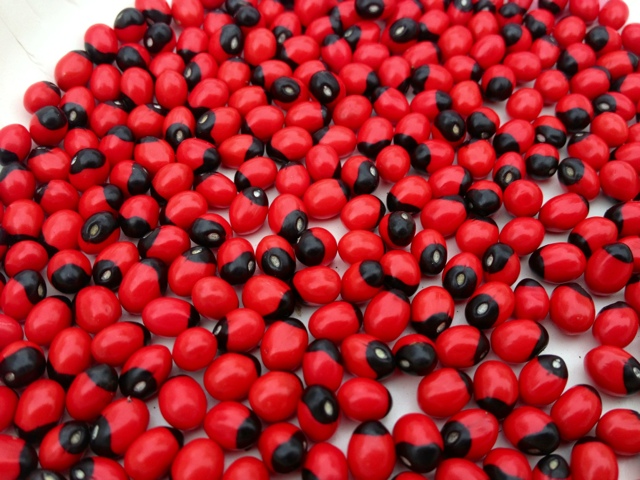
A berry, or rather a pea, and a rather poisonous one, spied on a ratty sump fence the day I arrived in Orlando. Marie asked what it was; a reader, friend, and expert in Peruvian culture suggested Ormosia coccinea and I called it a day. Yet something was nagging at me. A website stated the popular, good luck pea was the seed of a tree and my sump specimen was certainly not a tree. Although maybe it was young, maybe it suckered from so many hacks.

An image search yielded clusters of pods and peas that looked right, but of different species. Not the huayruro of Peru, but Abrus precatorius. A vine, not native, and invasive weed of Florida. That rings true -sump plants tend to be weeds.

Now I'm wondering if jewelry makers would be interested in these striking red seeds. I've already contacted Bonbon Oiseau, although peas may not fit her oeuvre. Would you wear poisonous seeds?


Cardinal Matters


I'm well aware of the disdain (see Garden Rant) and the rhetoric (see Michael Pollan).

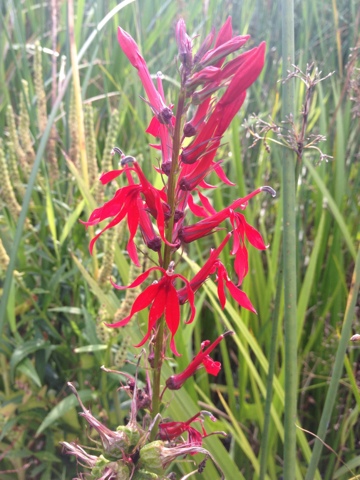
Still. As I look upon this cardinal flower, Lobelia cardinalis, I immediately, emotionally respond to its presence.

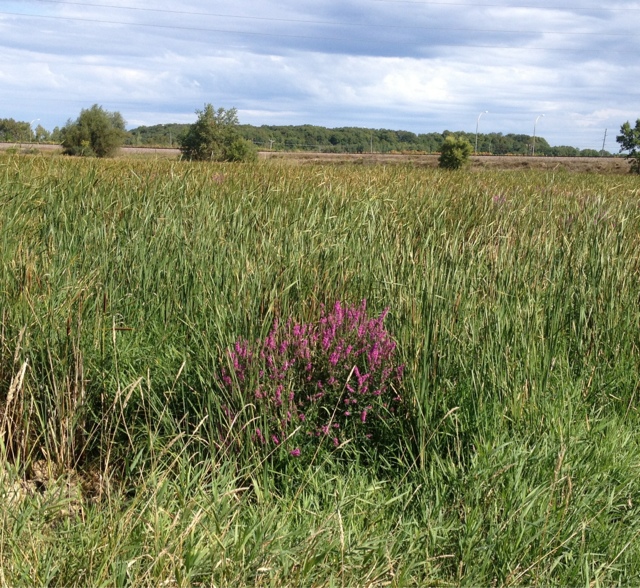
On the other hand is purple loosestrife, Lythrum salicaria. It's pale purple wands are pretty, especially so en masse, which is often how one finds it, but hardly stunning. Is this a learned response? If purple loosestrife was a native plant, would I espouse it's regal nature?

I do not know. What I do know is that seeing cardinal flower marsh-side is rare, yet finding purple loosestrife is becoming exceedingly common in Hennepin County ditches, wetlands, and cloverleaf water basins.

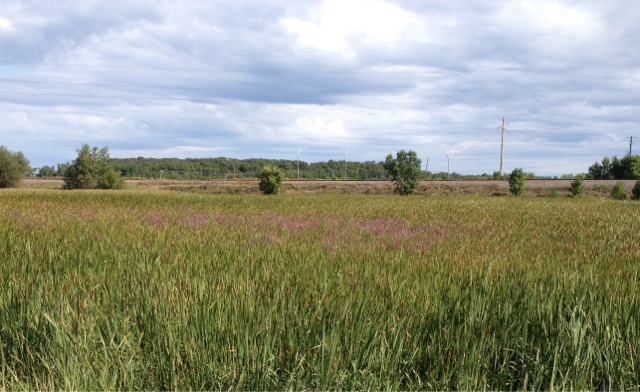
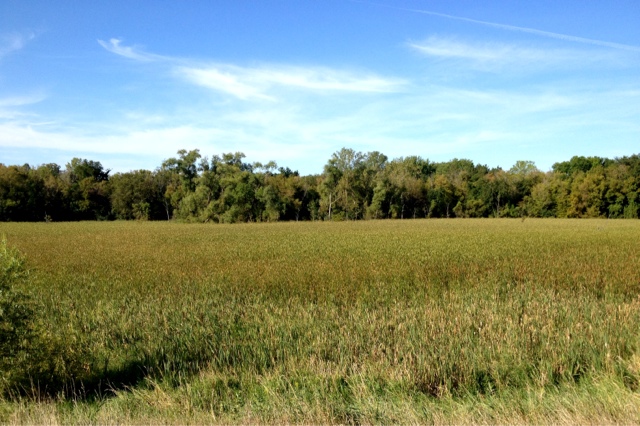
Rex likes the purple loosestrife, he says it's pretty where the marsh is just a wash of green. He believes the loosestrife cannot outcompete the cattails and rushes. But I doubt that, as evidenced by New York State's marshes and wetlands. Those must have once looked like Minnesota's, but now many are nearly a monoculture of purple loosestrife. After bloom in July and August, the wetland becomes a wash of dismal brown, whereas Hennepin County wetlands offer a kaleidoscopic interference of green and gold.

I'm not sure people care all that much. Like Rex said, it's pretty, and it's spread appears incremental, hardly noticeable. The government has policy, it is a known invasive, it is illegal to harbor it on private property (this is where tongues tingle with politi-lingual fascism), and it's hard to control. And maybe, maybe, an appreciation for rarified things in life is an elitist affair. And maybe people, humanity, has a thing for the strong, aggressive, and adaptable in life. Maybe.


Cardinal Matters


I never did post the cardinal flower images from my Carmans River trip last August, so this post from my other blog will do double duty today. Minnesotan wetlands do not get the attention they deserve, certainly not from NewYorkers (how could we know?). I've hardly delved into their living beauty, but in short...


I'm well aware of the disdain (see Garden Rant) and the rhetoric (see Michael Pollan) around native plants, ecosystems, and plants termed 'invasive'. I've tried to understand both positions over the years.

As I look upon this cardinal flower, Lobelia cardinalis, I immediately, emotionally respond to its presence. I wonder if I'm the only one who has noticed this stand amongst the grass and cattails.

On the other hand is purple loosestrife, Lythrum salicaria. It's pale purple wands are pretty, especially so en masse, which is often how one finds it, but hardly stunning. Is this a learned response? If purple loosestrife was a native plant, would I espouse it's regal nature?

I do not know. What I do know is that seeing cardinal flower marsh-side is rare, yet finding purple loosestrife is becoming exceedingly common in Hennepin County ditches, wetlands, and cloverleaf water basins.

Rex likes the purple loosestrife, he says it's pretty where the marsh is just a wash of green. He believes the loosestrife cannot outcompete the cattails and rushes. But I doubt that, as evidenced by New York State's marshes and wetlands. Those must have once looked like Minnesota's, but now many are nearly a monoculture of purple loosestrife. After bloom in July and August, the wetland becomes a wash of dismal brown, whereas Hennepin County wetlands offer a kaleidoscopic interference of green and gold.

I'm not sure people care all that much. Like Rex said, loosestrife is pretty, and it's spread appears incremental, hardly noticeable. Minnesota government has policy, it is labeled invasive, it is illegal to harbor it on private property (this is where tongues tingle with politi-lingual fascism). Yet maybe, maybe, an appreciation for rarified things in life is an elitist affair. And maybe humanity has a thing for the strong, aggressive, and adaptable.

Maybe.