prairie wood

If A Tree Falls In The Woods...

And no one from New York City was there to read it...


When I moved from one place to another there was the feeling that I was about to begin again, start over, endeavor for a fresh start. Nothing wrong with this, in principle, but in practice I could have been more measured. In this case, that measure is in the order of hundreds. Simply put, my newer url isn't ranked.

New York City Garden, the blog address, continues to get hits in the hundreds per day, which is piddly by Internet standards, but something compared to the single digits Mound is receiving. It has not been an issue of content, either. NYCgarden is a blog address with a link history, a search history, let's face it, a Google history, and the history of the web is long. Pages are not forgotten, they are linked to or hit upon as freshly today as the day posted. It became a brand, in a sense, my brand, however ridiculously named by my ignorant logic. I thought, then, that the blog name needed to be attached to the content so that google searches would find it. The name is local, bland and functional. No matter, nycgarden dot blogspot dot com gets traffic, prairiewood dot blogspot dot com does not, and in this way nycgarden has value.

What I intend to do is resurrect the dead, just in time for Easter, by publishing again at nycgarden.blogspot.com. All prairiewood and mealhub posts will be integrated into nycgarden. Nycgarden will take on the MOUND masthead and its updated visual appearance. Sidebars will be integrated in some fashion, although many sidebar links will be dropped because they are NYC-centric and superfluous. It will be searchable, all posts and labels will imported and categorized by date and label, back to 2007. Eventually, I will look for a new dot something url that Blogger can redirect all traffic toward.

When a tree falls in the woods, you'll have a much better chance of hearing it.


NYC To MOUND In a Single Bound


NYCGARDEN had a great run, but I am now living outside of New York City, at the western edge of North America's eastern forest, known as the Big Woods in Minnesota. I'm still writing and taking pictures at MOUND. I will keep this site active as it still receives many visitors, although new posts will all be at the blog site linked above. If you were following me at NYCGARDEN, I hope that you will switch to MOUND.


Our Bubble


It's cold, people been saying it, making hay about it, FB feeds are full of it, especially the city New Yorkers. The native Minnesotan doesn't make too much of the cold, but I'm willing to point out that, here, it's cold all the time, so much so that when it is over 15 degrees F, we say it's warming. A few days ago, at a restaurant, the server said it was freezing out, and I laughed because, you know, it was 33 degrees below  freezing. Freezing (32 degrees F) is warm, here. To put our coldness problem another way (cue the northern gardener eye roll), the frost free date is solidly mid-late May. That's right, May 15 or 22.  


So how wonderful that I should discover a conservatory in our neighboring city, St. Paul, open to all citizens for free, or donation. It is not grand by world-class glasshouse standards, nor festooned with cutting edge design, but it is warm and humid. Wow. Such a simple pleasure. The indulgence was smile inducing. 


A stream with moss-covered stone and fern.


And palms.


Some tropical flowers.


Then, an extremely formal garden wing with standard forced bulbs and yet, amazing. 


The light, the humidity, the warmth just what we need.


It reminds us that spring, too, happens here by conjuring its sensation.


That artifice is in our nature.


And it thrills us.


At a cost.


But do not dwell on that.


Enjoy the glass bubble.


The fish tank.


And the overpopulating Koi.


Brightly colored birds.


And Orchids.


And be out the door by four.


________________________

On March 1, 2015 I will discontinue posting on NYCGarden. However, I will keep NYCGarden active because so many people continue enjoy my old posts via Google searches, blogger links, and word of mouth. You can continue to read my new posts at my other blog, Mound.

What's Old Is New


One of my present tasks is to attend to thousands of well-kept magazines that my father-in-law left behind: National Geographic from 1918 onward, Life from the beginning to the end, Scientific American from the 1950s onward, Sky and Telescope from then to now, and so on and on. Among these larger lots are a handful of Organic Gardening magazines. Would any of you, readers and gardeners, be interested in one of a handful of lots of Organic Gardening magazine? Here's my pitch:

Old magazines are full of old printing techniques, laughable fashions, advertising with crude, unmerchantable copy, and outdated storylines. However, printing and fashions aside, Organic Gardening is 99.5 percent as fresh today as it was the year it was published. In fact, I leafed through one Rodale Press magazine from the 1940s the other day and was surprised to see the same problems and solutions printed then as you would see today (except their less than thorough take on sewage sludge as a fertilizer). Sure, the hybrid varieties touted then as an improvement may now be thirty years old, but the growing information is solid and the text is short and to the point. It's great to see articles on wild plant foraging, native plant gardening, chicken-raising, pickling, and all the other how-to know-how OG was known for back in the day that is de rigueur today.

Organic Gardening was printed as a half-sized edition of 8 x 5.5 inches. The paper used is nearly newsprint and yellowing from age, although each copy is fully bound and complete. You may notice the musty smell of an old magazine boxed in an old house -it's part of the charm. If you are interested in obtaining a year of OG, drop me a comment and email: nycgarden@gmail.com. It'll only cost you the shipping (USPS, flat rate).


_______________________

On March 1, 2015 I will discontinue posting on NYCGarden. You can continue to read new posts here.


Tread Of Time


The night is dark but for the power company's safety lamp. It is dangerously cold near, below, or well below zero. The wind blows, not a howling, but a deep woooh through the trees. The whimpering of the iron porch rocker transcends walls, its complaint in every room. If you stare into the night, nose chilled by the cold relay of a double-paned window, you will see little, if anything, but the sodium lamp's sickly orange-yellow glow cast onto the woods and snow. Turn out the lights and sleep. Only daylight brings the ghostly imprint of Disney's dark dispatch, the tread of time debossed into crystalline water, our drive the Grauman's of faunal drama.


Our porch steps a barrier -for now.


           _________________________

On March 1, 2015 I will discontinue posting on NYCGarden. You can continue to read my posts here.


The Mink

Are you living, fully, if you always get the shot? Don't get me wrong, the shot is important, but that's its own thing. You cannot always have the camera with you, or the best one. Sometimes interesting things just happen. It's better to just be present for those moments, and for me, here, those moments often involve animals (after all, we don't have children).

 I watched a large owl fly up the driveway, or should I say -flyway. I've seen a red fox happily pouncing on an invisible object. After years of trying to spot the bird responsible for that jungle call, I finally spied the pileated woodpecker straight up, atop a dead tree. There were the flying squirrels on a blustery, snowy night near the woodpile. A coyote at five ayem, a buck at four. A snowy owl in the woods. And now, finally, a confirmational sighting of what was only a black blur plunging through the deep snow last winter -a mink, Neovison vison.


When phone cameras fail. That center-image shape is it, one of a veritable Muybridge series of shots that succumbed to the common bug screen. 


The best I have, cropped from actual pixel resolution, makes for a mysterious looking creature. As it first passed into my view I thought, huh strange looking squirrel, but only for a split second. It bounded from a tree to the recycling pile, then over to the rear steps, underneath them, then to the ac unit, then back to the tractor implements, then toward the cold room, then up this tree about 20 feet, then down it, and on and on over about three or four minutes.

           _________________________

On March 1, 2015 I will discontinue posting on NYCGarden. You can continue to read my posts here.


Peckers Gonna Peck


The Red Bellied Woodpecker, Melanerpes carolinus. Often heard, but never seen, peckin away at the house trim. 'Nuff rotten wood out in the woods, you should give it a try sometime.


I's just tryin get a good look atcha.


___________________________

On March 1, 2015 I will discontinue posting on NYCGarden. You can continue to read my posts here.


Taking Out The Trash


Our pails, a silent sentry, as instructed -three feet apart, at the intersection of the woods, road and drive. A hawk, circling high overhead, issues its gritty reeeeeeeahh. The road, here, is quiet and I am noise.


Downslope, down road, toward the late autumn sun, down low.


Removing the trash and recyclables is a journey by any New York City standard. I, for one, was fond of dropping my trash right out the window into the pails below, but not here. No, trash removal has several steps, one of which is rolling the bin down slope, toward the culverted passage between one wetland and the other, then upslope to the road.


To my mind, it is cold out, for November, maybe six degrees F, yet the empty-handed return along the tenth-of-a-mile drive frees my senses for seeing, and I found myself trailing farther down slope, into the wetland, along a deer trail.


The wet lowlands contain the most attractive sites on this land, but the green season mosquitoes chase me out too quickly. In the white (or brown) season, I take time.


The drainage opens up, like a park, onto the wetland, the edge of which is favored by deer, coyote, turkey, and me.


Although the ground has yet to freeze, the wetland is firm enough for walking. I've explored its perimeter, before this moment, in December or January.


The wetland is, by its nature an amphitheater, a concavity, surrounded almost completely by upland elevated fifty to a hundred feet above the occasional water line. On its western flank is the headland of an esker that carries southward to frame lakes that were at one time deeper and larger. Our (Rex's) house sits on land that was likely a small island or peninsula, long ago, near this lake's northern boundary.


Recent heavy rains have been quickly eroding the steeply sloped land to the northwest and northeast, washing out sediment that fills the small wetland due north of house island. Soil and organic matter have been filling this basin for thousands of years. Trees have taken root in drier spells, then were soaked out in wetter ones. Water enters the large wetland at three points -east, north, and west, converging, then heads south toward a pinched outlet that funnels the water to a small, nameless pond, then farther on to Dutch Lake, and finally into Harrison Bay.


The cattails (I haven't yet identified the predominant species) have exploded into their fat and furry season, regal and rough. Finally, my camera and fingers are beat back by the cold and I head back into the woods.


The bones of the land are most clear in winter. 


In The Beginning


God created the heaven and the earth. And the earth was without form, and void; and God said, Let there be compost, to replenish the earth; and then God said, But you must choose it, and make it in all seasons, and you must site it appropriately, for ease of doing it, and for aesthetics of sight and scent. And God commanded it, so it was done, there, behind the wood pile.


The Animals


In the absolute dark of early morning, along the tree line, coyotes were illuminated by headlights. Two hours later, as the light began to swell, deer browsed the leaf litter where Rex's bird feeder had been strung, and squirrels scamper about playfully all day, while various birds make appearances (although less so since the feeder has come down). 


Turkeys are plentiful, crossing the yard dutifully every day, but are hard to approach on the squeaky, newly fallen snow. 


Supper


In the upper Midwest, and probably other regions, dinner is called supper and lunch is often dinner. For supper, then, I made the 15 minute, thirty mile per hour drive through town and then out of it, curving west, at thirty-five miles per hour, then forty-five, until just over the Dakota rail trail. Slowing down for an acute right, gassing it uphill, past the Gale house, the event barn, the market garden (frozen as it is), yielding left, toward the visitor center. One other car, facing west, shared the lot. I shuffled over packed snow-covered gravel, a soft left at the chicken coop, pushed the glass entry door, projected an unfocused hello and then scoped the upright, glass door freezers. 

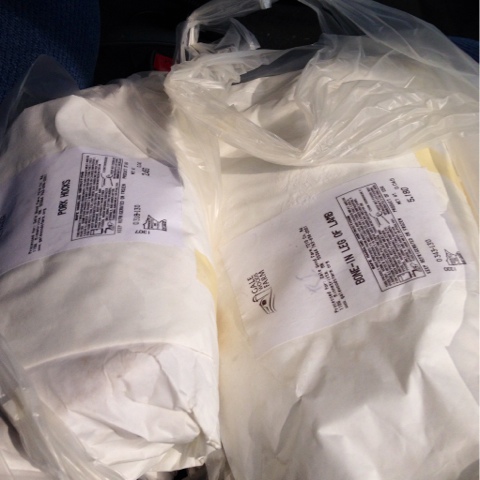
All but two shelves empty. A sign reads pork is coming in on the fifth of December. I tally four roasting chickens, five "Frenched" racks of lamb, a single leg of lamb steak, copious beef liver and tongue, eggs, a head or two of cauliflower and romanesco broccoli, a basket of onions, garlic, and of all things, late-frost tomatoes. 

I pick out two whole chickens, a leg of lamb steak, one onion, one garlic (although I have plenty back at the house), cauliflower and broccoli. Before leaving I ask how long this can possibly last, to which the startled clerk replies, oh, we have no intention of going anywhere. It is hard to fathom this attitude of permanence, but I will work on it.


Stairway


Could a dying man's last wish be a new set of steps? In his slow decay is it trying or comforting to see rotten and skewed rebuilt upright? Is time best spent fixing the things that can be fixed? Our answer was yes, so Betsy and I spent the last ten days or so in Minnesota rebuilding the porch legs and constructing a new staircase with Rex's blessing. He and his aide sat porch side, observing, while we took to our work.


The porch was sinking in the northeast corner, evident at the junction of house and porch where a gap had formed over the years. It wasn't until we removed the porch steps and it's stock standard, 45 degree, three step stringer that we could begin to see the whole of the problem. The house architectural drawings indicated below the frost-line 12 inch concrete piers and 4x4 treated posts. The problem was that these posts were to some degree covered at the base with wet clay soil, not at all elevated above the moisture-holding concrete, and not at all anchored in any way to the concrete piers.  They simply rotted and moved from their original position allowing the porch to slowly pull downward. Although our intention was only to replace the staircase, and as is so often the case, when you look into it you realize the full extent of the work before you.


First, remove the old staircase, the lattice work under deck, then the fascia boards.


Old, rotten-bottom posts removed as we jack up the porch with a very old school jack. 


New treated posts installed with steel post-header ties (the old were toe-nailed).


Not choice, but available: plastic post bottoms to separate the new post from the concrete pier. Each is said to be good for five thousand pounds.


We also compromised on the anchor -galvanized steel angles at the back of each post, then each post backfilled with course gravel.


I found this blue-spotted salamander, Ambystoma laterale, under the plastic near one of the posts. Trying to get it out, it only climbed in deeper, so I let it be. I wonder how it keeps dirt out of those bulging black eyes.


After the posts were set and anchored we set about doing the staircase. The main complaint about the old steps was their steep incline and rickety railings (they had rotten) so we stretched the run to five feet from the porch. This changed the configuration from four, eleven-inch treads with eight-inch risers to six, twelve-inch treads with five and three quarter-inch risers.  The longer run had the structure landing on the concrete pad, adding concern about frost heave (which every one else was less concerned with). We compromised by designing the railings so that they are integral to the staircase structure but do not attach at all to the posts holding up the porch roof. This allowed us to remove the chance that frost heave pressure would be applied to the porch posts.


I reused as much of the original cedar risers as I could, but this also meant that I was limited by their length. We had wanted to overshoot the stringer sides by an inch or so but the old boards wouldn't allow it. We compromised by bringing the riser board to the top of the tread instead of behind it, and extended the tread board just a half inch on either side.


The treads were notched around the posts.


I fitted the post notch with a small piece of cedar to fill.


The different shades of cedar on a cloudy day.


While it was a marathon effort for him, Rex made the journey out to see the finished staircase. The following afternoon, I found him sitting on them.  I don't think I will get as much joy out of doing these projects without him there to appreciate it. Things need to be done, to be sure, but his glowing appraisal makes it worth the extra effort. As I had to leave to get back to work in NYC, not two days after I wrapped up the work on the staircase, I knew I could be seeing him for the last time. He said to me "you have value, remember that." Seems like such a simple thing, but it chokes me up. Rex was motivated to get the staircase rebuilt because his elderly friends were having trouble climbing the old set when they came to visit. I suppose, then, that a staircase could be a last wish. It's a way to extend oneself beyond the boundaries of life and death, a courtesy to those friends who will thank me for the effort and good work, at his house, soon enough.


Frog Rescue


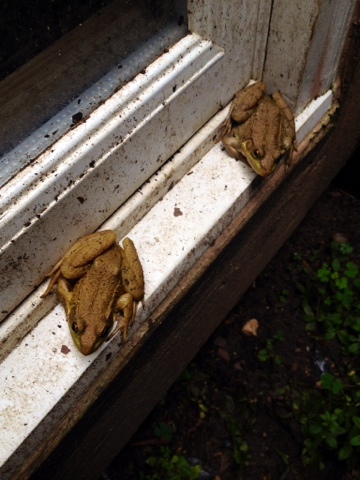
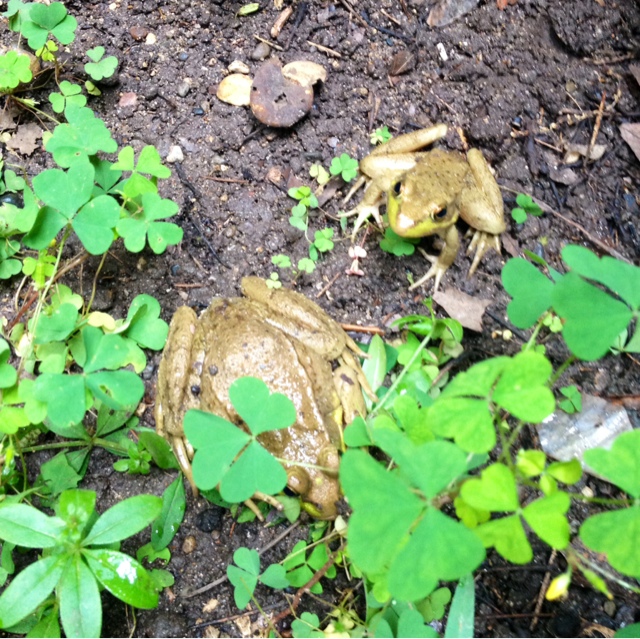
There were six large frogs stuck in the window pit. Now there are none. 


I apologize for the less frequent blogging. There is no internet service at our place in Minnesota. Soon another story. Soon. 

Farm Park


Minneapolis has a farm within its park system, Gale Woods Farm.


They raise cattle, sheep, pigs, and chickens, in addition to a number of crops. They expose school groups to farming and offer volunteer opportunities. The park is about 15 minutes from our place.


You can buy pastured meats at a fraction of the NYC price (5 lb leg of lamb -$36). As far as I know this is unique to the region, is hardly known even to locals, and is a great resource in a region that has not quite made pastured meats accessible to the urban population. Food is generally more expensive in the Minneapolis region than it is in NYC, variety is dismal, international foods are harder to come by, and produce is not well-stocked or good looking. There is a grand farmers' market in Minneapolis, but it's a drive into downtown. Fortunately, smaller markets are popping up including one in our town despite the fairly short season.


Lily Pad


 You might find a frog on the side of the porch. It happens.


 But would you expect to find one inside a day lily?


Hiding spot, feeding hole, great place to meet the opposite sex?


 Do you leap in a single bound or climb the stalk, waiting for the flower to open it's doors?


And do they know the doors close after dark?


Dissolution


We arrived in Minnesota early Sunday afternoon after two days of driving and two nights of miserable lodging. It's hard to imagine making this drive anymore after a dozen years of doing so, twice annually, and it's quite possible this will be our last. Rex's ability to take in oxygen is at its limit as is the machine's ability to provide it. He is slowly suffocating to death. We like to imagine his lungs will finally give out under the influence of morphine and heavy sleep, but one can't know. 

His days are filled with an anxiety of breathlessness and jokes mustered around such a condition and a general disposition lighter than one might expect. Every now and then he makes it to his Estonia grand, orchestrating his nimble, digital memory. We cook and although he passes on most lunches, he eagerly takes in dinners under the magical influence of prednisone. We are lucky for his nine to five caregiver, Patsy, whom he listens to as much as she patiently listens to him. The dissolution of age will come for us all, gradually or quite suddenly. It is best to have a plan.


The best indicator of Rex's declining health was the gradual but evident retaking of the trails by plants and fallen timber. Many have become impassable with tangled windfalls and occasional widow-makers, the soft padding of chips disintegrated into soil, the buckthorn and even trillium growing center trail. There was considerable flooding this spring and the smaller marsh became the smaller pond, it's overflow draining underneath this bridge. The rain fell so long and heavy that pond waters rose high enough to float the bridge, dismantling it, and nearly over washing the driveway forty feet beyond. In other words, the woods is a mess and in need of a chainsaw samaritan who will work for cord upon cord of wood. Do you know one in the Twin Cities area? Email me.


The moisture and cool, darkened understory has produced a good crop of mushrooms, like these corals and those below.


Ductifera pululahuana or the White Jelly (Roll)


Last year's unharvested chicken, the ghost chicken.


Right alongside the driveway, growing on a strategically placed, chainsawed oak stool, is this summer's small but wanted chicken.


A day later it looked like this.


And the day after that, we harvested.


Clockwork Orange


“But where I itty now, O my brothers, is all on my oddy knocky, where you cannot go. Tomorrow is all like sweet flowers and the turning vonny earth and the stars and the old Luna up there. ... And all that cal.” -from A Clockwork Orange, by Anthony Burgess

While I was racing across the soul numbing scape of exurban housing, corn and soy, Betsy entered the woods, no doubt to escape, and found what we didn't because we hadn't been entering the woods, a woods crazed with fallen trees and the high business of mosquitoes. 

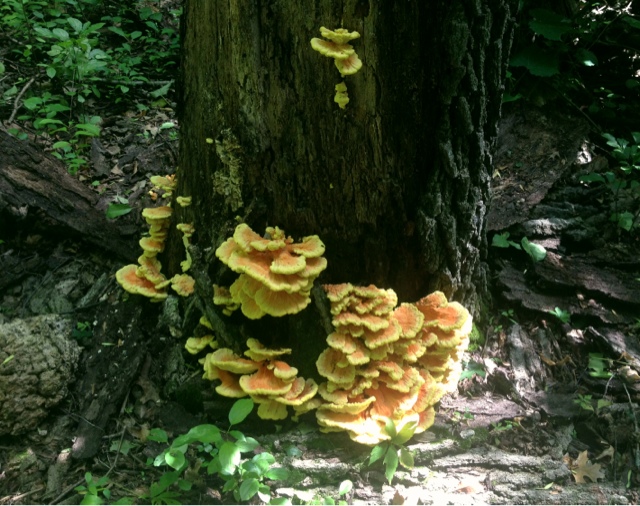
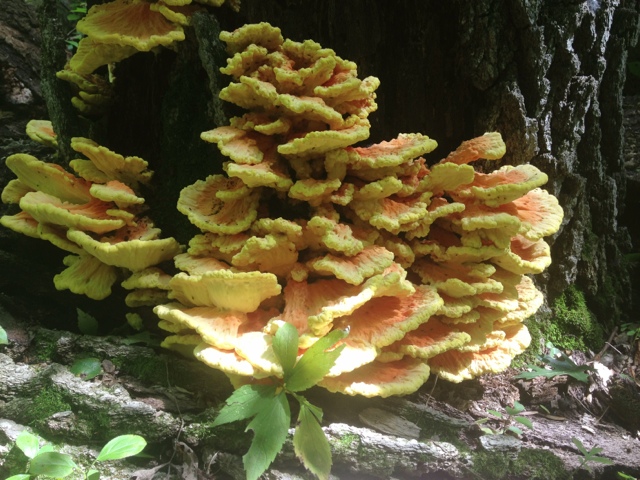
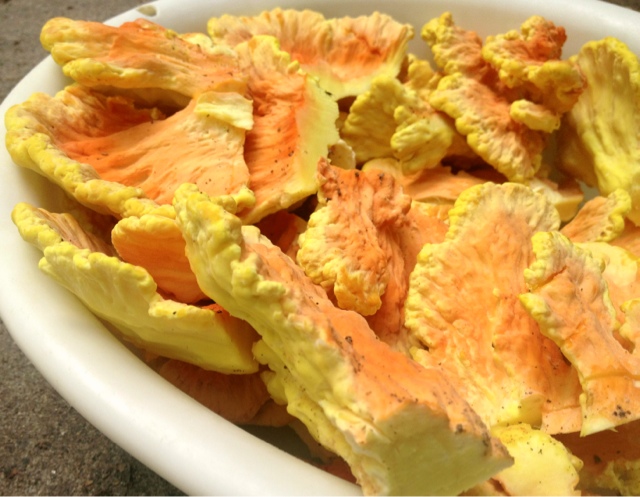
And was rewarded for the effort by this orange and yellow beauty. Arriving like clockwork every August, although this year on the opposite side of the woods, the sulfur shelf, chicken-o-the woods, Laetiporous sulphureus finds its way to our table. 

She found it and harvested at exactly the right time, leaving some for me to see, and in that 18 hours the little flies and black beetles had made their way to it. We cut another bunch and left the rest to nature.

Tomorrow we load the tiller, our other things, one cat, ourselves into the van. Rex will be upset, in fact he very much expects us to move to his homestead. But we cannot.  At least not now. That arouses many feelings in him and us, all of which would get a hell of a lot more complicated should we, like a clockwork orange, just do the "good" thing. 


Machines In The Garden

It's early morning. I am somewhere in Ohio, maybe three hours from Youngstown, where I am to pick up our van from the price gouging repair station. I'll then drive back to Minnesota to get Betsy, our cat, and this 1989 GardenWay Troybilt Horse. Then we'll drive back to New York. It's crazy, I know, but Betsy needed more time with her ailing father and I repaired this tiller that can be put to good use on the farm. 


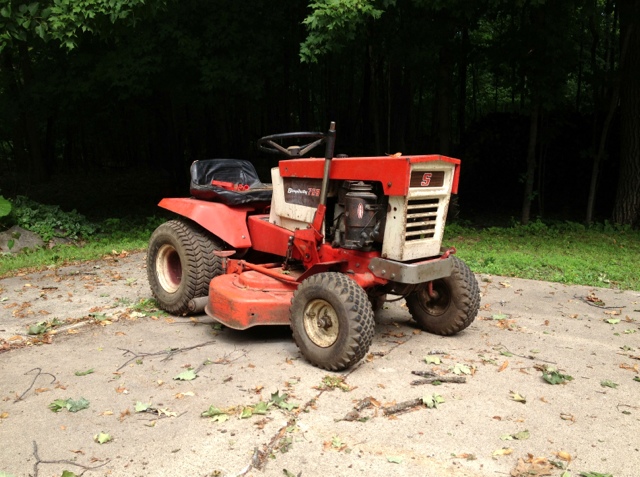
Maybe next time I'll grab this machine, which is not yet fully repaired. Cuts grass, and clover, and maybe even cover crops.