mushrooms

Woodland Orange


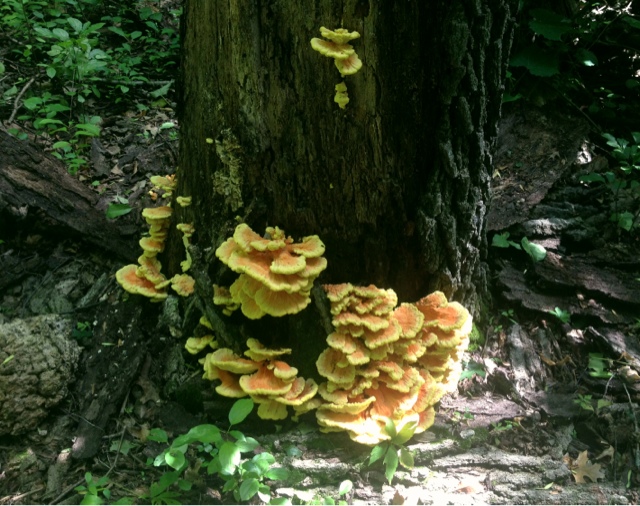
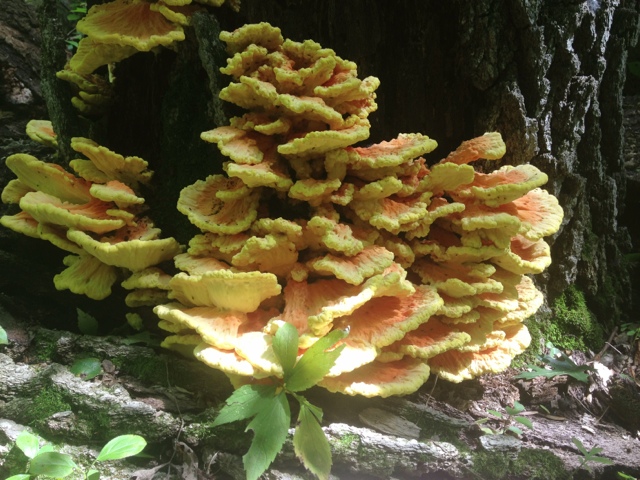
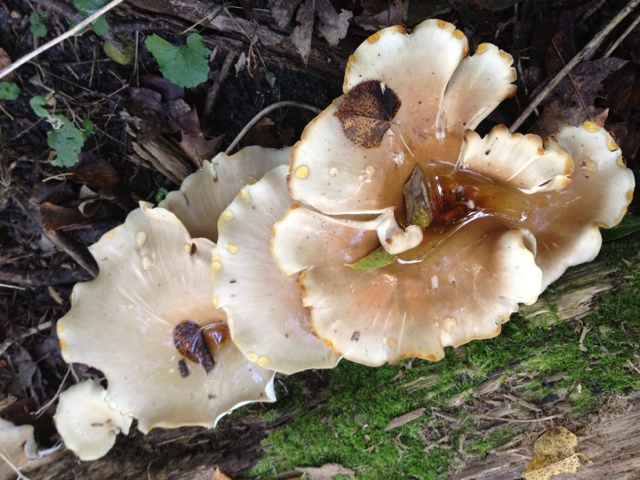
For three days I've been spotting an unusual orange deep into the middle slough woods, but it was early, rainy, and the mosquitos had finally blossomed. On the fourth day I traveled down the Alwin trail looking to take some photos and confirmed what I tried to dismiss -Laetiporous sulphureus.


Not only is this appearance unusually early, it is also in an unlikely location. The log has been down for years, is partially decomposed, covered in moss, and completely surrounded by water. Because I didn't act quickly, the mushroom received a couple of rain soakings, but it was completely bug free -a benefit of its island location?

Our two woodland sloughs have been steadily filling with more and more water, often independent of rainfall. It is an unusual occurrence that we feel may be connected to the partial filling of the gravel pit adjacent to the west side of the property. Rex was concerned that this change would raise the water table, and his concern appears to have been legitimate. In the back slough, nearly every tree has died -there is one old, large ash surviving the inundation. All the shrubs that were green in prior years are grey. The trail that was always accessible along the western edge is now completely submerged and invisible so that a new path will need to be cut much closer to the property line.

We do not want the trees in the middle slough to die off from inundation or fall in a storm because of soggy soil. The increased sunlight will advance an army of buckthorn well positioned on the south slope and already making headway in the middle slough. If it does not begin to drain we are likely to dig a drainage, or rather enhance the drainage that already exists. Any action of this magnitude will have consequences, but we cannot consider our woodlands as anything but altered or unalterable -it is a place completely transformed.


The Warm Welcome


This is what I think of when I feel the chill of autumn.


Or maybe a string of pearls -the puffball, or rather the giant puffball, Calvatia gigantea, growing in the back woods among the hog peanut.


These are the things of late September and early October.


 Not basil!


 And green as can be green beans!


 Eggplant that simply won't quit.


And tomatoes that continue to produce -only now beginning to show the wilted leaf of cooler nights.


The vegetable garden here is as green as my beach farm plants were in late July. A rarity, maybe? Not the norm, say some. The coming five days are looking to be quite autumnal -blue skies, cool air, days in the lower sixties, nights in the lower forties. This should bring an end to the vegetable patch, and not a moment too soon as the garlic seed is on its way, and more front lawn needs to be tilled under. But wow, what an exquisitely long growing season.


When People Ask Where The Good Food Is


...I usually tell them its right outside.


Four heirloom tomato plants have produced more than most any I had ever planted at the beach farm.


I've been looking forward to the German Stripe, the latest to size up and ripen.


Japanese eggplant, 'Kyoto,' have been exceptionally prolific.


I put my green bean seeds in a little late, but still, they are producing now. 


Although my broccoli starts were a failure. Too late, as always.


But I was saved by this guy (sorry to say that I lost his name with a piece of paper) and Anderson Acres. You see the sign, to the left, that says start your fall garden. Yes! Getting starts together at the right time in summer is challenging given busy summer schedules and difficult weather. Hardly any garden business has starts available at this time of year, probably because there isn't much market for it. I'm so glad to have found them at the Minneapolis Farmers' Market in stall 311.


I bought a handful of these lettuce starts, broccoli, cilantro, parsley, and basil.


The fall lettuce.


Betsy's dill, the pickler that she is.


Our local hardware gave away (really, for free) many vegetable starts in July, most well past their prime. I focused on those sturdy sorts that do well in cooler weather -chard and kale. Small and weak when planted, they are now doing fantastic. We eat them every day.


A four pack of heirloom peppers from Shady Acres (whose stall Anderson Acres occupied at the farmers' market) has become quite a bounty of peppers. I've never had such luck. One plant has eight large peppers!


And they're beginning to turn red.


Of course, there are still tomatoes ripening.


These "cherry," or is it "grape," have been fantastic. The name I believe is 'Juliet' -a little sweet, little tart, and meaty -that is the key for me. I do not like watery small tomatoes that pop when you bite into them or crack after heavy rains. These I pick and eat right there in the garden.


With more to come.


The woods has not produced its usual bounty this year, except for the morels early on. Maybe we've missed them, having been so busy with work on the house and field. Of course, we'll keep looking.


Off Season Woods

Summer is the off season in the woods. This is because the field and home require attention while the weather is right, but also because mosquitos own the woods at this time of year. There is, however, one draw and that is mushrooms. 


There had been an explosion of Jelly fungus on cut logs downslope near the north wetland. It has, by now, yellowed with age, but still a fascinating fungal mass. Mosquitos be darned, in the woods with the camera I took a stroll to see what else was going on.


 A mysterious white fungus or mycelium between two logs.


An incredibly striking red slime mold on upright cut log faces. Anything this red within the green understory grabs your attention.


The channel connecting the north wetland to the southern, great wetland runs with rain water. We cleared this area of most garlic mustard two months back and the Jewelweed is beginning to take off. Now, let me get out there and clear those branches.


Recent storms haven't been terribly windy. Still this large limb, about two feet in diameter at the base of the break came down. It's Basswood, Tilia americana, not the strongest of trees, and prone to hollowing of the stem at height. One nearly came down on me as I walked the woods in March. Just pop and drop! Lucky for me I was distracted by the sound of running water which altered my path. A minute later I watched the large, single stem tree break about 12 feet up and fall over onto the path I was about to walk.


In the back woods I find another Basswood down (that's three this year alone). Those that have fallen are the oldest of the Basswood in our woods and two have been large, multi-trunked trees. Basswood can be easily identified by its multi-stem growth habit -its the sure fire way to ID the tree in winter, when young, or with similarly barked trees. We're not big fans of Basswood trees, largely because of their weak wood and propensity to fall without notice (a local woman died under this tree species recently). Incidentally, the tree reminds me of my former position in an architecture lab where basswood was the model building wood of choice. I'll take oaks, ash and maples over bass any day.


The back swale hasn't had time to drain down with all the recent heavy rains. It appears this area will be wet year in and year out and I should rethink my attitude towards it. Several years of heavy rains have kept the soil water logged and the trees standing in water that aren't already dead are only hanging on by a thread. When cold weather comes we may have to tackle some of the larger standing trees, leaving woodpecker stumps that won't fall immediately, but when they do they shouldn't take anyone out.


Open Season Fungus

These morels were brought to us by our hunter. He foraged them from our woods after a couple hours of chainsaw work clearing old timber fall on the trails. We dried them for future cooking.

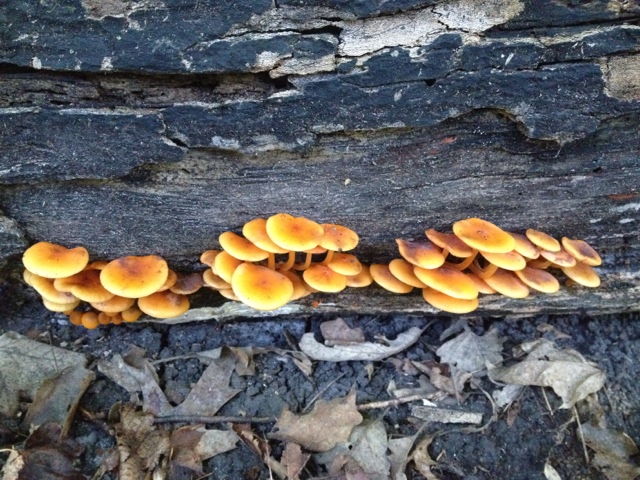
Now that it is raining, mushroom season opens in earnest. Oysters and jelly fungus are appearing, and soon enough there'll be chickens on oak timbers.

Dissolution


We arrived in Minnesota early Sunday afternoon after two days of driving and two nights of miserable lodging. It's hard to imagine making this drive anymore after a dozen years of doing so, twice annually, and it's quite possible this will be our last. Rex's ability to take in oxygen is at its limit as is the machine's ability to provide it. He is slowly suffocating to death. We like to imagine his lungs will finally give out under the influence of morphine and heavy sleep, but one can't know. 

His days are filled with an anxiety of breathlessness and jokes mustered around such a condition and a general disposition lighter than one might expect. Every now and then he makes it to his Estonia grand, orchestrating his nimble, digital memory. We cook and although he passes on most lunches, he eagerly takes in dinners under the magical influence of prednisone. We are lucky for his nine to five caregiver, Patsy, whom he listens to as much as she patiently listens to him. The dissolution of age will come for us all, gradually or quite suddenly. It is best to have a plan.


The best indicator of Rex's declining health was the gradual but evident retaking of the trails by plants and fallen timber. Many have become impassable with tangled windfalls and occasional widow-makers, the soft padding of chips disintegrated into soil, the buckthorn and even trillium growing center trail. There was considerable flooding this spring and the smaller marsh became the smaller pond, it's overflow draining underneath this bridge. The rain fell so long and heavy that pond waters rose high enough to float the bridge, dismantling it, and nearly over washing the driveway forty feet beyond. In other words, the woods is a mess and in need of a chainsaw samaritan who will work for cord upon cord of wood. Do you know one in the Twin Cities area? Email me.


The moisture and cool, darkened understory has produced a good crop of mushrooms, like these corals and those below.


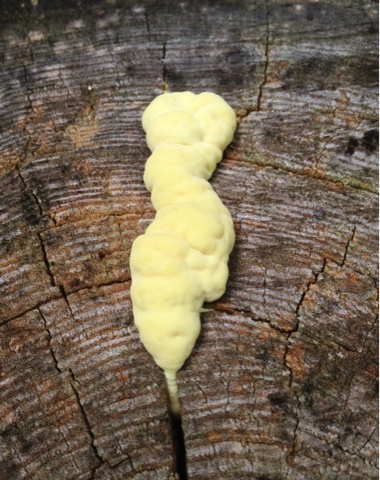
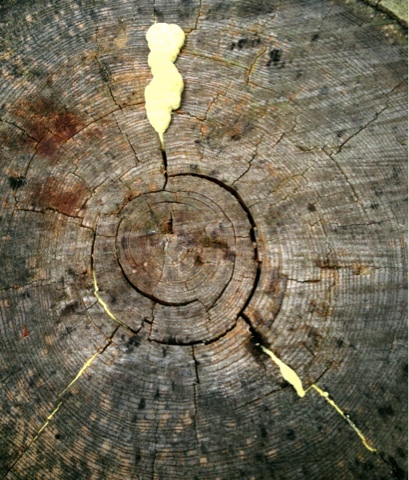
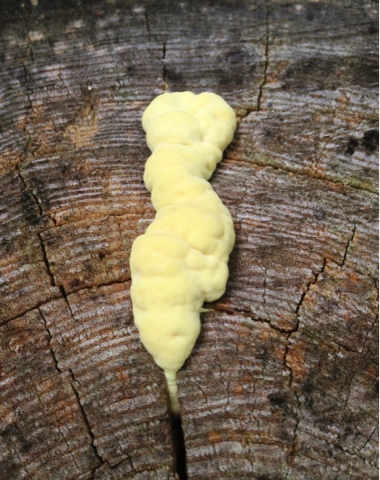
Ductifera pululahuana or the White Jelly (Roll)


Last year's unharvested chicken, the ghost chicken.


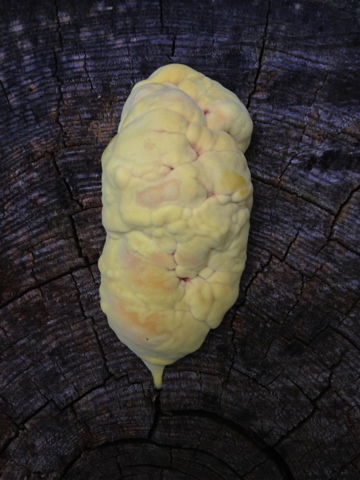
Right alongside the driveway, growing on a strategically placed, chainsawed oak stool, is this summer's small but wanted chicken.


A day later it looked like this.


And the day after that, we harvested.


Dissolution


We arrived in Minnesota early Sunday afternoon after two days of driving and two nights of miserable lodging. It's hard to imagine making this drive anymore after a dozen years of doing so, twice annually, and it's quite possible this will be our last. Rex's ability to take in oxygen is at its limit as is the machine's ability to provide it. He is slowly suffocating to death. We like to imagine his lungs will finally give out under the influence of morphine and heavy sleep, but one can't know. 

His days are filled with an anxiety of breathlessness and jokes mustered around such a condition and a general disposition lighter than one might expect. Every now and then he makes it to his Estonia grand, orchestrating his nimble, digital memory. We cook and although he passes on most lunches, he eagerly takes in dinners under the magical influence of prednisone. We are lucky for his nine to five caregiver, Patsy, whom he listens to as much as she patiently listens to him. The dissolution of age will come for us all, gradually or quite suddenly. It is best to have a plan.


The best indicator of Rex's declining health was the gradual but evident retaking of the trails by plants and fallen timber. Many have become impassable with tangled windfalls and occasional widow-makers, the soft padding of chips disintegrated into soil, the buckthorn and even trillium growing center trail. There was considerable flooding this spring and the smaller marsh became the smaller pond, it's overflow draining underneath this bridge. The rain fell so long and heavy that pond waters rose high enough to float the bridge, dismantling it, and nearly over washing the driveway forty feet beyond. In other words, the woods is a mess and in need of a chainsaw samaritan who will work for cord upon cord of wood. Do you know one in the Twin Cities area? Email me.


The moisture and cool, darkened understory has produced a good crop of mushrooms, like these corals and those below.


Ductifera pululahuana or the White Jelly (Roll)


Last year's unharvested chicken, the ghost chicken.


Right alongside the driveway, growing on a strategically placed, chainsawed oak stool, is this summer's small but wanted chicken.


A day later it looked like this.


And the day after that, we harvested.


Clockwork Orange


“But where I itty now, O my brothers, is all on my oddy knocky, where you cannot go. Tomorrow is all like sweet flowers and the turning vonny earth and the stars and the old Luna up there. ... And all that cal.” -from A Clockwork Orange, by Anthony Burgess

While I was racing across the soul numbing scape of exurban housing, corn and soy, Betsy entered the woods, no doubt to escape, and found what we didn't because we hadn't been entering the woods, a woods crazed with fallen trees and the high business of mosquitoes. 

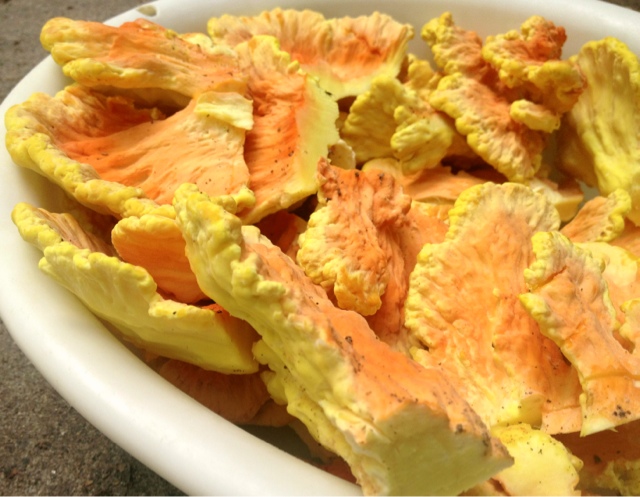
And was rewarded for the effort by this orange and yellow beauty. Arriving like clockwork every August, although this year on the opposite side of the woods, the sulfur shelf, chicken-o-the woods, Laetiporous sulphureus finds its way to our table. 

She found it and harvested at exactly the right time, leaving some for me to see, and in that 18 hours the little flies and black beetles had made their way to it. We cut another bunch and left the rest to nature.

Tomorrow we load the tiller, our other things, one cat, ourselves into the van. Rex will be upset, in fact he very much expects us to move to his homestead. But we cannot.  At least not now. That arouses many feelings in him and us, all of which would get a hell of a lot more complicated should we, like a clockwork orange, just do the "good" thing. 


Autumnal


There has been a heavier heart this big woods trip. Rex likes to say that there are only two things in nature -chaos and chance. I like to say that the only thing between civilization and chaos is maintenance.

From the very first day, we've been at work on the house as rot has set in. We stem the tide and wait for next summer. 

The air has been cool, and I have seen the leaves changing, day to day. 


This morning, Rex and Betsy left at 5:30 for the Mayo Clinic. I left for breakfast around 6:45 and saw Autumn's first mist on the marshlands.

The trails have not been worked, and have not been walked. There's no greater sign to the changing of things in the woods. Oak wilt has taken out more of the red oaks, and old falls have not been sawed. Nettles grow, obscuring the path for the first time in my decade of coming here.

Indian Pipe appears ghostly for the first time.

The bridge is missing planks, and most have rotten through. It is now dangerous to cross the marsh unaware.


The chicken, laetiporous, the one focus from the changes afoot.


Chicken, Day 4


Ellen has been encouraging me to eat the young chicken. This is good, because we're leaving in a day or two.

I haven't checked this morning to see if the mushroom people collected my laetiporous yesterday, but I suspect they honored my sign. After all, we supplied them with their purple ribbon chicken two summers back.


Good Intention


Had me writing up posts of Maine while we're here in Minnesota. After all, the images are processed and uploaded, just need to find a coffee shop, two hours, and some words to wrap those up.

But the truth is I've been on the roof every day since Saturday removing rotted siding and sheathing. My arms are tired, possibly too sluggish to type. We've two more dormers to do and that should carry us through Sunday.

This is how vacation posts, even ones full of plants, get pushed into another season. I have been mobile posting pictures of my mushroom expeditions over at prairie woods (sorry, mobile no linky, stupid google -link in right side bar). This morning I found the beautiful beginnings of a laetiporous. With luck we'll harvest before the mushroom people arrive to collect for the Fair (again, sorry, a link would be useful here). This chicken is mine!


Now We're Onto Something


We've had a few showers over the last four days. It's August and cooler, and this speaks of mushrooms.

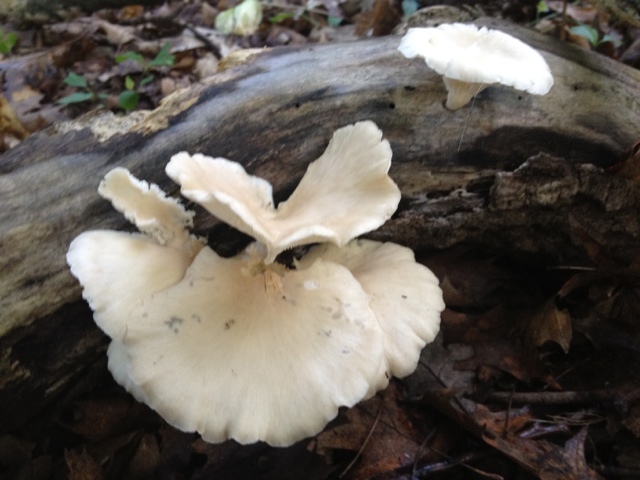
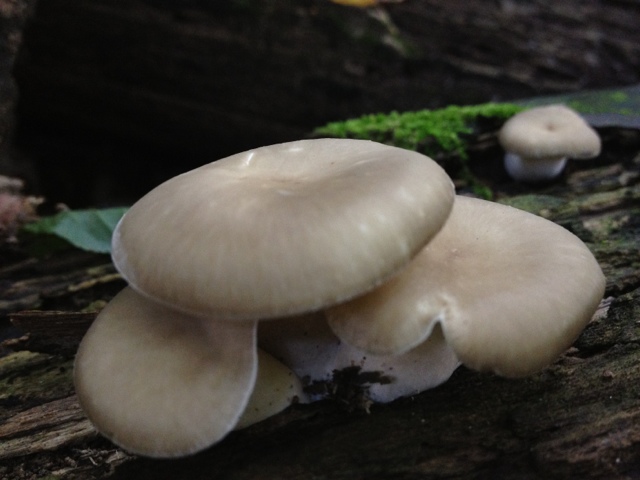
The oyster Betsy found the other day was eaten last night. It was robustly flavored, and while people often have difficulty describing the flavor, I dare say it often smells like raw oysters at its ripest.

I hit the trails this morning (it awakens the constitution) and spotted several new growths. And, as hoped for, the grand prize of Rex's woods -the chicken, possibly L. cincinnatus.

Now we wait and watch daily as it grows. Pictures of each day's growth posted right here, in anticipation.

It's A Start


There's not much in mushrooms in the woods, but there is a stirring. The corals are on the way out, but others are poking up, including some oysters too small or aged for picking. We'll keep a look out.

A Beautiful Day


Fall back on a beautiful day. Crisp air, slight breeze, blue skies, the scent of fallen leaves, and the yellowed and tawny leaves of the beech tree. The beech is the reason I go to High Rock Park on Staten Island, and mushrooms the excuse. Today there simply were no mushrooms, but a few small, pale yellow caps, and a strange, large white wood mushroom that smelled, to me, spicy, verging on anise. Marie took samples. This was our second trip to High Rock, and I was high with hope to find some edible mushrooms. We did find an old, large hen of the woods, and a minute after that, a tick of the woods. Pants into socks, but nothing to eat.

We did see lots of these Striped Wintergreen (or the much more fun Spotted Pipsissewa), Chimaphila maculata down near what I call dead tree pond.

These are the seed capsules of the same plant. Marie says the seeds are as fine as dust.

Moss, always respectable.

So we didn't have much luck with mushrooms, but we did stumble into Pouch Scout Camp, where I was awed by the range of reds of all the oaks surrounding the large pond, known as Ohrbach Lake. It's a little odd, but G. maps does not show a pond in that area in maps or terrain view. But there it was, isolated and beautiful. Save Pouch Camp.

Hungry and unprepared, we ate some Staten Island pizza at a place called Francesca's. Marie had some wine, Vince and I cokes. Military History channel was on the tv, displaying as many dead soldiers as it could muster between our cokes and that last slice. Readers from Staten Island, send us in the right direction for lunch -we were at the mercy of the road to the Verrazano.

I delivered Vince and Marie to their place and off I was to the beach farm to plant some garlic.
Late in the day it was warm, a touch balmy. The air had stilled, and I had some cloving to do at the picnic table with scale, garlic, and notepad. The soil is nothing like my upstate plot, soft and friable, but with small stones and occasional chunks of concrete. The dibber dibbed, and I planted 100 or so cloves, drank my still hot coffee (thank you real thermos), thought about where next year's vegetables would go given the greater space commanded by the garlic. Tomatoes will stay put, and the haricot vert will be in this year's garlic/broccoli bed. Herbs are staying put, as will the pea/cucumber trellis. But where will I experiment with the allium vineale? Still unknown.

I harvested my first ever cauliflower -the one I planted near the compost hole. Grew twice as large and twice as fast as the others. Still, so late in the season, it was not a big head -maybe 6 inches across. Yet it tasted so good, and sweet, that I ate most of it before Betsy got home, leaving just enough for her to taste. So good.

Some broccoli are producing side shoots and I like how they purple. They are also very sweet. I ate all that I picked, which isn't very much as much of broccoli has yet to head up and probably won't so late in the season. There were also many snap peas, some of which I snacked on while planting garlic, but left most because of the early dark that afflicts all outdoor activities at this time of year.

I stood enjoying the warm blanket of air, the white noise of waves in the distance, coffee in hand. How I wished my agricultural practices could all happen right here, at the beach farm. I was reminded of my roots on Long Island, two landscapes at my core -the red oak woods and the beach, and the atmosphere of life near the ocean. Then I thought of our eastern farm lands, changing from potatoes and cabbage to sod, then to grapes, but more often than not -to homes.


I went home, as the moon rose, to make meatballs of lamb and red cipollini onions mixed with diced dry sausage and fennel.


Fowl Of The Woods

Rex said it had been dry for the last month after the record wet of spring and early summer. There wasn't much in the way of mushrooms, but at least there were no mosquitoes to hasten our search. I had great hopes of finding something to eat, but mostly there was disappointment. A few notable wood rotters:


There were spent chickens everywhere. Guess we were just a couple of weeks too late.


Puffballs


The old adage that you find only when you are not looking is particularly true for mushrooms. I found this puffball, probably Calvatia gigantea, while portaging our kayak in a field of crabgrass.

At home, the next day, I was to eat my first puff, which are usually more rounded.

It's mildly suggestive, no?

The underside shows its almost non-existent stem.

And the inside -how wonderful is that.  The odd shape of this puffball is responsible for the hole.  Usually these are solid all the way through.

One website suggested peeling the distinctive, outer layer. But peeling it was like peeling a hard-boiled egg when the shell won't let go. Probably unnecessary. I then sliced it.

This mushroom is a must eat. Not so much for the flavor, which is a good, mild woodsy taste, but because of its texture when cooked -it becomes almost creamy, almost. Amazing.


High Rock Mycorrhizal


I had only been to Staten Island's Greenbelt twice. Once, a several years ago and then again this past spring for a late winter workshop on trail maintenance. Neither visit was comprehensive, leaving the vast majority of the trails unexplored. This time, I was going because I thought that woods of High Rock would be a good location to find edible mushrooms. And because it was mushrooms, I asked Marie and Vince to come along. 


High Rock Park is a hill landscape, only 90 acres, with a mature canopy of mixed red maple-sweetgum, oak-beech, and oak-tulip communities. The trees, the minimal understory, and abundance of leaf litter that I saw last March suggested to me that this would be a great place to find mushrooms. And, it was. Not steps from the parking lot, not steps from the entry road, there were mushrooms exploding through the leaf litter. 

The mosquitoes were more noticeable than usual, and that mixed with increasing humidity created the muggy, itchy feeling no one enjoys. After dousing ourselves in a deetless repellent that choked with the scent of hair spray, we were on our way. The red in white trail, the yellow trail, and then the green -all are good. The woods beautiful, the trails wide. Because of the hurricane, downslope trails were blocked by fallen trees, but generally easy to maneuver (I believe I belly rolled over one trunk).

Chicken

?

??

The large vernal pool (year round pond?).

Stinkhorn.

Bolete?

Boletus.

Myco-humorous.

For lunch, we drove to the greenbelt nature center. Afterward, we went off on the trail behind the center. There was little in the way of mushrooms in those woods until the forest changed to upland dry oak with an ericaceous understory (huckleberry?), not unlike those near the edges of the Long Island pine barrens. Here, we also found mushrooms, although with less frequency and variation than at High Rock.

Now that I've traveled more of the trails at the Greenbelt, I think I have learned to avoid the lowland woods if I wish to stay out of the bramble and briars, which are less interesting, and remind me too much of the suburban, disturbed nature in which the better woods are embedded. They also harbor more poison ivy, and with all the trees down, we had to limbo the vine more than once.  Moses Mountain, a unique or strange, small yet steep-sided hill feels like a vegetation-covered monument to construction debris (turns out, it is just that -thanks Robert Moses). At road crossings, garbage abounds, speaking more of a teenage hangout and trash thrown from cars than of a fine woodland park. And if it's mushrooms you are seeking, the lowlands also appear less fruitful. 

We decided that High Rock demands another trip, in autumn, but, I think, I can let the rest go. My mind has already started drifting towards another borough, another park: Van Cortlandt, where I am slated to pick up the trail work again this fall.