tomatoes

The Spoils of Summer

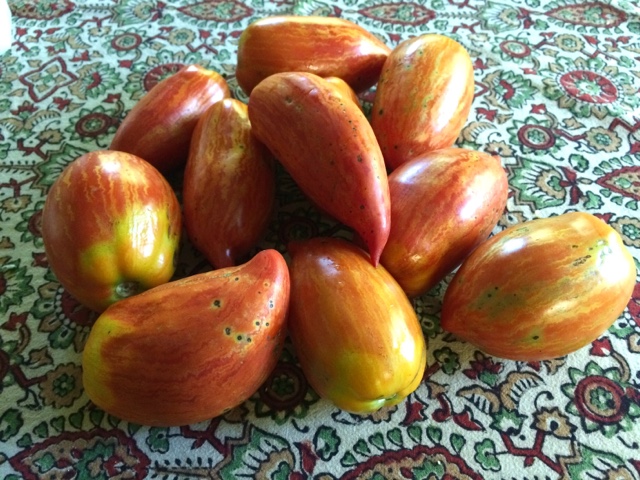
Now that I've figured out to successfully grow bell peppers, I tend to be at a loss for what to do with them. This means I eat them raw quite a bit. August is high season for eggplant which continues until the frost. The tomato plants have the look of late September, nearly caput, and even the fruit have taken on the scabs of blight. Below my beloved speckled roman paste tomatoes. Despite heavy blight, they still produced, if a bit more unsightly.


Pulping


My favorite heirloom Roma (speckled Roman, above), have been pulped in the sloppy strainer contraption I bought several years ago. It's been a terrible year for tomatoes, so humid and damp that blight set in well over a month ago. It's been a very good year for green beans and potatoes, broccoli and basil. The fall cauliflower and Brussels are floating giant leaves but no sign of anything edible yet. 

Soon we leave for a weekend in Milwaukee to hang an exhibit. I'll be showing photographs, a first. I'll post the information when it's all set up. In the meantime, check out my Instagram feed (you can find it here), from which I've harvested, maybe even pulped, the exhibit's images. 


Garden Report

Potatoes are waning but they're still impinging on the herb bed. As the sun lowers and the potatoes die down, the herbs should reclaim their full sun. In the back left, really tall milkweed.


As the garlic comes out over the last few weeks, the fall brassicas have been filling in. These are brussel sprouts, the first planted, into the space previously occupied by garlic 'Xian.' I've never grown these before, but have planned it for years. Notable this season is a lack of cabbage moths -not complaining!


Eggplant fruit coming on now.


Green beans, from purple to roma, prolific and easy as ever.


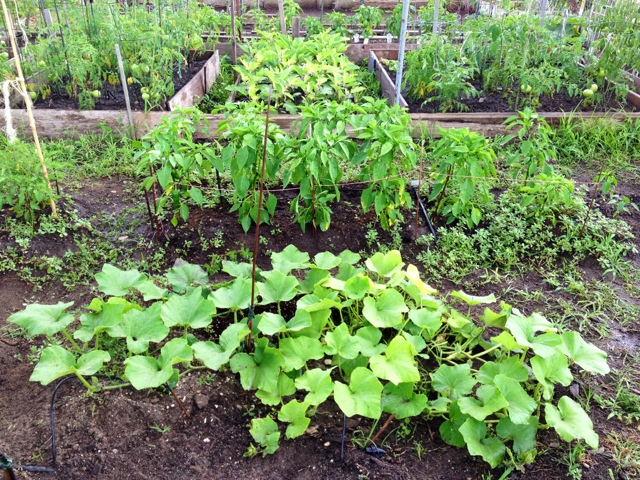
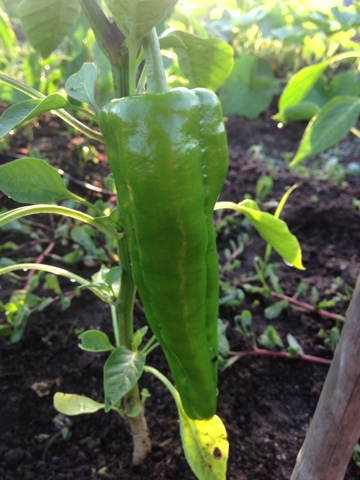
All peppers are fruiting, some large. Only difficulty is that the plants can hardly hold their large fruit and that I shouldn't be so lazy as to try to break a pepper off the plant instead of going for the pruner. What happens? Well, I break the whole pepper plant in half.


In complete opposite of last year, all our tomatoes are suffering blight. Could have come in on our purchased compost, or maybe because we planted in last years potato and eggplant beds. Hard to avoid poor rotation in a compact garden. Next year I think these beds will be garlic and the garlic beds will be tomatoes. All that can be done now is watch the tomatoes try to outgrow the blight.


More brassica as the Porcelain garlic 'Music' has come out. As two more varieties of garlic are harvested over the weekend, even more brassica will go in. Above is kale started from seed in the greenhouse.


These giant pompoms, hydrangea actually, were moved from the south side of the house last year. We planted them in a great arc around the curving lawn-driveway. They are quite garish, but they keep the plow truck and other skiddish drivers from driving over the lawn and garden in summer and winter (thanks to the long lasting dried flower sepals), and maybe they keep the deer at bay. Maybe.


And we've finally started digging into the soil for new potatoes. Above: Kennebec russet, Pontiac, and Yukon Gold. Thanks to the quantity of compost and straw they came out with little soil and easy to clean.

I've been very busy with many things, from door and sill replacement, old deck removal, job searching and applications, studio building projects, contractors and everything I can't stand about some of them, photographing, studio painting, my class Landscape into Art which runs on the twenty third of July, a bit of socializing, gallery going, and even a music festival in a corn field last weekend. Blogging has had to take a back seat to all this (as well as taking quality photos for them), but rest assured -I was able to plant half of my milkweed over the septic drain field and beyond yesterday. Progress.


Summer Solace

One of the benefits of getting to one's vegetable garden first, before summer's work begins in earnest, is not having to think about the garden at all when you are knee deep in summer's work. It grows itself, mostly, with an intensity only paralleled by the solstice's long day. 


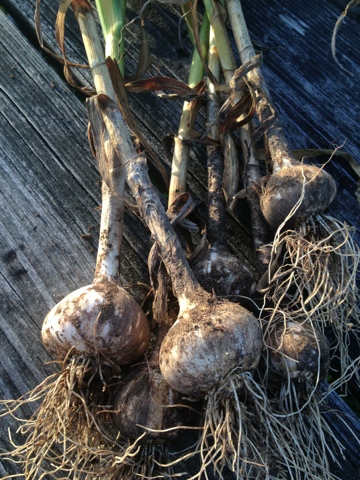
One of the beauties of growing garlic is that it's harvest hardly coincides with any garden task other than weeding. By now, the first of the garlic is near completely exhumed (briefly hesitated to dredge up this word), and like any darkling, it mustn't be cast into the bright light. The first pulling is in the shade of the porch, but the full harvest is likely to be dispatched to the cellar. Here, in the midst of harvest, is Xian, a Turban strain, and one of the best for flavor and earliness. Turban's lodge, or fall over, as a way of telling unsuspecting gardeners that they need help -getting out of the ground.


At about the same time sizeable beaks are swirling above the Asiatic strains -here Asian Tempest and Japanese. These will be harvested next, not long after the Turban strains, and sometimes before.


Meanwhile the Porcelain strains have had their scapes (flowering stalk) cut, ready to be pickled or grilled or sauteed or...just don't leave them in the fridge too long before doing something with them. Behind the Porcelain are the Rocambole (shorter in the middle) and Purple Stripe. 


The French Grey shallots have also been pulled. I find that the height of the crabgrass is a useful indicator for timing the shallot harvest. Left behind are the Artichoke and Silverskin strains, those hardy bulbs that we use through next winter and deep into the following spring. 


When the the crabgrass first sprouts, it's the best time to get your peppers in, but I didn't heed the crabgrass this season. No, I put the peppers in a couple of weeks early -listening to the lambsquarters maybe. They're doing fine anyways, although I do think they are showing a little too soon.


Broccoli? Yes! And from seed no less. In spring? Yes! And no cabbage moths to boot. A quick, small-headed variety seed-started on May one and hardly two months later boom -broccoli. Go figure. I've got some of those very same starts in their deep cells holding back growth inside the greenhouse. They'll be put into the garlic beds as they clear.


Green beans? Not so fast. I seed-started these in the greenhouse on May one and planted them out a two or three weeks later. Nice flowers, no beans yet.


Cucumbers before June 21? Why, yes. I purchased a cell pack of four Spacemaster cukes from Shady Acres and planted them in pots raised well off the ground.


They won't ever reach the ground, that's why they're called spacemaster. They do put on an impressive display of cucumbers and have produced a handful of medium sized eaters before the solstice. I've seeded my own, too, to replace these after they give up.


Tomatoes, well that's asking a lot, isn't it? But among our six strains (of three varieties -plum, grape, and, uh, heirloom beefsteak?) these grape tomatoes, called Red Pearl, are way good producers.


In fact the deer are warming up for BBQ season by snacking on our Speckled Roman plum tomatoes. I grew these at the Beach Farm, and deer aside, expect them to do really well here.


Dill, cilantro, basil, and at the very bottom, cutting lettuce. In the background -common milkweed that has grown in this spot for eons, or at least since this house was built, so maybe the late nineties. Infringing on their bed are the potatoes. They are so big they require their own post. Look for that.


Vegetable Early June


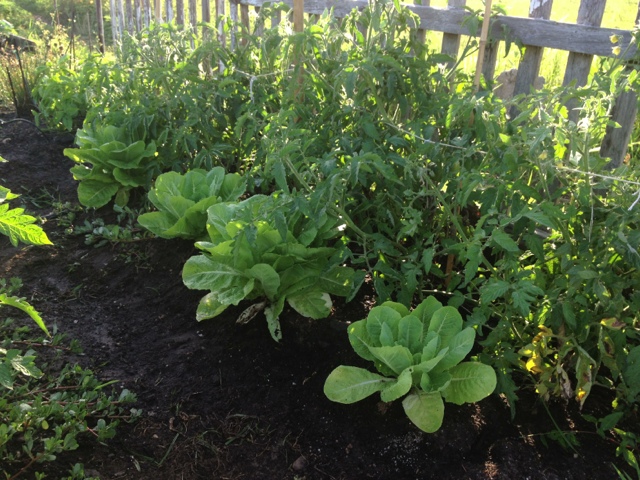
The vegetable garden, June 4. Peas growing in the same bed with broccoli and recently planted romaine lettuce. I had so many lettuce starts that I plunked them into nearly every bed. The next bed is green beans and a spot for upcoming chard seedlings. Third row has eggplant, peppers, and a basil patch. The following two rows are Red Pearl grape tomatoes (same as last year and magnificent), five Speckled Roman paste tomato plants, and four heirloom types that includes Striped German and Brandywine and two others I cannot recall. Our starts were from Shady Acres Herb Farm or started in our own greenhouse.


The curving garlic bed is new this year (well, tilled last November). The garlic is doing well although a little tightly planted. Doing really well is the Chesnok Red -a Purple Stripe variety. This one is said to do very well but I couldn't have said that in the past.


Here are our potatoes -five varieties including russets, golds and reds. They grow several inches each day. I am about to add compost to "hill up" inside the framed bed. More garlic to the right, and French Shallots as well. To the left is our herb bed that includes basil, dill, cilantro, parsley, thyme, oregano, arugula and cutting lettuce. I'm anticipating a productive garden and feel better about its organization over last year. When the garlic is harvested around late June, early July, I will add our late summer-early fall crops of broccoli, cauliflower, brussel sprouts, and kale. In the background are cucumbers in pots, a remnant bed of dead nettle and common milkweed, and the curving hedge of hydrangea that we transplanted from the south side of the house last year.


The Apple's In The Bag


We harvested many large green heirloom tomatoes before the freeze.


A brown bag, three overripe apples, two days, and ripe! Grandma taught me the trick, but I don't know if she understood that it was the ethylene gas put out by ripening fruit that spurs further ripening. Apples pump out a good amount, and at the right time for green tomatoes. If you want to keep your fruit from ripening, you should keep them away from other fruits, especially ripe ones.


The Warm Welcome


This is what I think of when I feel the chill of autumn.


Or maybe a string of pearls -the puffball, or rather the giant puffball, Calvatia gigantea, growing in the back woods among the hog peanut.


These are the things of late September and early October.


 Not basil!


 And green as can be green beans!


 Eggplant that simply won't quit.


And tomatoes that continue to produce -only now beginning to show the wilted leaf of cooler nights.


The vegetable garden here is as green as my beach farm plants were in late July. A rarity, maybe? Not the norm, say some. The coming five days are looking to be quite autumnal -blue skies, cool air, days in the lower sixties, nights in the lower forties. This should bring an end to the vegetable patch, and not a moment too soon as the garlic seed is on its way, and more front lawn needs to be tilled under. But wow, what an exquisitely long growing season.


When People Ask Where The Good Food Is


...I usually tell them its right outside.


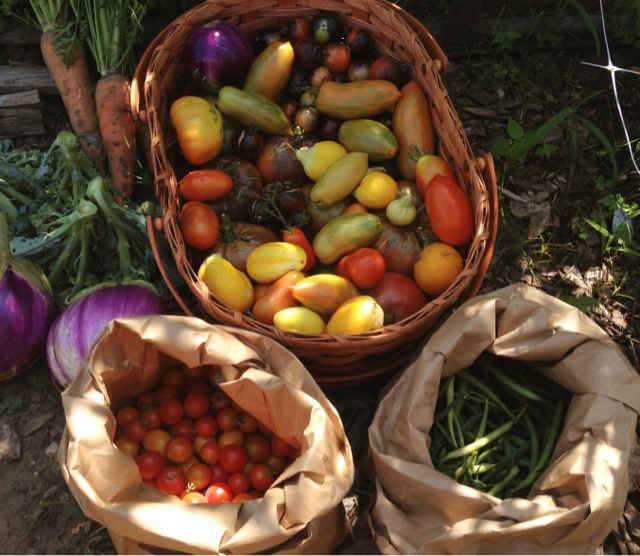
Four heirloom tomato plants have produced more than most any I had ever planted at the beach farm.


I've been looking forward to the German Stripe, the latest to size up and ripen.


Japanese eggplant, 'Kyoto,' have been exceptionally prolific.


I put my green bean seeds in a little late, but still, they are producing now. 


Although my broccoli starts were a failure. Too late, as always.


But I was saved by this guy (sorry to say that I lost his name with a piece of paper) and Anderson Acres. You see the sign, to the left, that says start your fall garden. Yes! Getting starts together at the right time in summer is challenging given busy summer schedules and difficult weather. Hardly any garden business has starts available at this time of year, probably because there isn't much market for it. I'm so glad to have found them at the Minneapolis Farmers' Market in stall 311.


I bought a handful of these lettuce starts, broccoli, cilantro, parsley, and basil.


The fall lettuce.


Betsy's dill, the pickler that she is.


Our local hardware gave away (really, for free) many vegetable starts in July, most well past their prime. I focused on those sturdy sorts that do well in cooler weather -chard and kale. Small and weak when planted, they are now doing fantastic. We eat them every day.


A four pack of heirloom peppers from Shady Acres (whose stall Anderson Acres occupied at the farmers' market) has become quite a bounty of peppers. I've never had such luck. One plant has eight large peppers!


And they're beginning to turn red.


Of course, there are still tomatoes ripening.


These "cherry," or is it "grape," have been fantastic. The name I believe is 'Juliet' -a little sweet, little tart, and meaty -that is the key for me. I do not like watery small tomatoes that pop when you bite into them or crack after heavy rains. These I pick and eat right there in the garden.


With more to come.


The woods has not produced its usual bounty this year, except for the morels early on. Maybe we've missed them, having been so busy with work on the house and field. Of course, we'll keep looking.


Lawn Of Plenty


It was about mid-May when I decided to carve five small rows into the front lawn for this year's vegetable patch. It is the sunniest, flat space on the land here. In the distance, the driveway and a hedgerow of Hydrangea arborescens -a solution to coarsely articulated snow-plowing and a mass of foundation plants in the way of a future house project. Seven weeks from the day the tiller expressed itself, the vegetables are taking advantage of our long, northern days.


My first round of green beans didn't arrive, quite possibly because I didn't water the seeds enough or maybe due to three year old seeds. They were all French beans, ones that trialled well, hmm -three years ago. So I bought new seed from the big box (so many home projects!) and planted those. Meanwhile it had been raining heavily for a few days -that's when some of the old seeds showed up, 'Velour,' I think. So far no problems with bunnies -or deer, raccoons, hedgehogs, and whatever other vegetable munching varmint one can have. So lucky -that's all it is.


One four inch pot of flat leaf parsley has become eighteen by twelve inches of parsley -use it daily.


One four inch pot of cilantro has become two feet by twelve inches of cilantro -makes a nice pesto!


The garlic is still green, but I know well enough to start harvesting them. As these go, their rows fill with herbs, green beans, and eventually those brassicas I fully intend to start one of these days...


Four pepper plants from a cell pack of four heirloom varieties. This one set fruit super early.


A cell pack of Japanese eggplant have provided us with an orb -not the usual thin and elongated fruit. What gives? I do prefer the way less seedy elongated varieties. Oh, Japanese eggplant doesn't always imply elongated fruit? These are 'Kyoto,' a round eggplant, and I ashamedly renounce my ignorance!


One four-cell pack of, hmm, I forget the name, but cucumber. I do recall it saying compact, and this one is definitely compact. We grew them in pots, elevated off the ground in metal pot stands that happened to be here. A couple of things to point out: these four plants in two pots have been productive for their size and have not succumbed to mildew. They have yet to reach the ground and have many flowers per vine. I recall googling the variety at the nursery, Shady Acres! Ahh, they have a plant list- It is Spacemaster. Pick them pickle size for best flavor.

A word about Shady Acres. Heirloom. That's the word. Seriously, Minnesota has some catching up to do when it comes to organic garden supplies and heirloom vegetable starts. It is very difficult to find what I came to expect -even at Larry's on the corner in Brooklyn (Best Deal on Bloodmeal!). I edify every nursery I come into contact with, including Shady in regards to fertilizer choice. I heard about Shady Acres from my neighbor who is busy trying to grow Minnesota's largest pumpkin, and was grateful for the recommendation -they carry heirloom vegetable starts. For me this means they have a variety of tomato beyond Rutgers, Beefsteak or Early Girl for the person who simply didn't get to starting his own.


Potatoes. They grew incredibly tall, so high that they could no longer be soil-mounded. Then a week of heavy thunderstorm rains, about seven inches in all, ensured that they would lay flat until they turned back up toward the sun, which they have, albeit more prostrate than before. They have been flowering for a few weeks now, with new potatoes sure to be available soon. I've decided to wait on those, aiming for the bigger potato of the future.


The tomato plants are some of the healthiest I've grown. Again, an heirloom variety pack from Shady Acres provided the starts. Ours have been in the ground for about five weeks, have grown over thirty inches tall, and some are producing tomatoes. We also have a grape variety, four plants in total. We won't get a ton of tomatoes out of four heirloom plants, but this year required low input, experimentation, and observation.


What is remarkable is the health of each plant. No visible disease, no wilt or cankers, no blossom end rot (can we thank high Cal-Mg soils?), simply robust plants. Look at that impressive stem. It helps to be gardening in a spot that has yet to see any vegetable growing. We haven't had any Colorado potato beetles either, so here's to hoping that our little clearing is protected by the woods and wetlands that surround it.


Lastly, the bug-eating army of amphibians can't hurt. And what of the pansies? It hasn't been a very warm summer so far, but plenty of days in the lower eighties. Here it may be that pansies just won't quit.


Return To The Beach Farm


We made a bee line for the beach farm not long after we returned from Minnesota. August weeds had become September's monster and the order among the tomatoes had decomposed into a fermentative morass.


Anthracnose, Bacterial Speck, Late Blight, and the Wilts had infected tomatoes in the new plot. Any large tomato was infected, none of which were edible.


Many lay rotting on the ground, split, fermenting in the warm sun, fizzing spittle and stinking of solanaceous putrefaction.


Tarry-looking specks and alien pods grew on some tomatoes making them rather unappetizing.


Fortunately there were eggplants that only lacked for water.


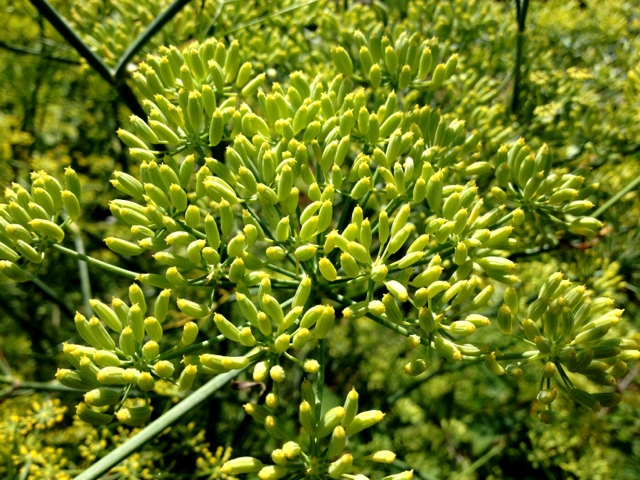
And the chard that I did not pick. Cooler weather will inspire harvest. Of course, the fennel is a monster. I'm leaving it for the enjoyment of the creatures and my occasional nibbling of flowers.


Speaking of nibbling, there has been a good amount on the tomatoes in the lowest reaches, so it was no surprise to see this bunny making his rounds on a quiet afternoon.


 Despite all the disease, our mid-July planted, retail Roma starts, produced a bumper crop of little tomatoes.


On Sunday, quite a beautiful day here in the city, I processed enough tomatoes through the mill (Norpro) to make 8 quarts of tomato juice and pulp. Perfect.


Beach Farm Bye Bye


By the time you read this we'll have completed our 1250 mile drive, in our twenty two year old van with cat in tow, to Hennepin County, Minnesota. I'll blog from there when I get the chance -there's been a lot of rain there, so I'm expecting August mushrooms. Also, I got a replacement Olympus XZ-2, just days before the price went back to $599 (double what I paid, but then I had to buy it twice!). Today was the first day the camera got out of the house and I am very happy to be able to occasionally disappear into photography during our time in Minnesota. 

It's hard to believe our two plots were all garlic only three to four weeks back. I haven't seen the beach farm since then, when all the garlic was pulled and buckwheat seed planted in the newly empty space. 

Our new plot is kinder to warm weather vegetables than it was cool weather garlic.


I've let the bulbing fennel bolt. Just haven't been around for a proper harvest.


I'm amazed at the size of the Swiss chard stems -like baseball bats, believe me they are bigger than they look here. The leaves are gigantic and we can't harvest them fast enough. The weather has been chard perfect. These were started from fairly old seed, too. Good to know not to throw those out too soon.


Let the cilantro bolt -that is the plan. Took me years to figure out how to cultivate cilantro and the answer is to plant seed, hope for the best, and should it sprout and grow then allow it to self seed and it will hardly ever require replanting.


Some lettuce has bolted and I'm wondering if it will seed itself and true.


I wanted the other plot to rest after years of cultivation, so I planted what amounts to probably too much buckwheat. It's growing like mad now, necessitating a weeding along the edges of the row of vegetables I planted three weeks ago.


On one end, basil.


On the other, Japanese eggplant.


And the middle? Sweet peppers.


Without much tending other than a few applications of organic fertilizer 5-5-5, they seem to be doing okay. Some have begun flowering and fruiting.


 The sea of buckwheat should grow another foot or two.


And threatens to swamp a random tomato plant and the row of vegetables. Buckwheat is a vigorous grower, used not only as a green manure when turned it, but also to keep weeds in check by shading them out. Of course, some eat the seeds and some the flowers. Not me, however, not me.


We have some green tomatoes, although all my neighbors have red. After all, we planted in July, after the garlic was lifted, and hope tomatoes will be ready when we return from Minnesota.


Nothing special this year (general 'plum,' 'beefsteak' and 'cherry') as I bought only from Larry's, although there may be an heirloom or two in the plots that have volunteered from the prior year.


Nice Peppas


It's been said at the garden that I have the best peppers this year. This pleases me. You know, as I've said earlier this spring, this is the year I dedicated myself to growing better peppers. So far so good, but what's different? 

My neighbor grows everything very well (a little miracle goes a long way, wink wink), but this year his peppers are not taking off as usual. This may be the case around the garden. It was, as you remember, inundated with sea water for several hours during Sandy. 

One of the first things I added to my plot this spring was gypsum (calcium sulfate). Calcium is always needed in our sandy, acidic soils, but then gypsum also has the ability to mitigate the salt overload I had expected from sea water. I didn't add any where the garlic was already growing, however, and the peppers there are a fraction of the size (although seeded at the same time, I planted these in the garden two weeks later). Both have had a couple of doses of organic 3-4-3 fertilizer and the hydroponicist's cal-mag solution plus Fertrell 3 fish and seaweed.

Well, whatever the reason, so far it appears we will get some nice sweet reds and hot green New Mexico chile this year. Can't wait (and I hope we're not in Minnesota when they're ready)!


Tomatoes are also doing pretty well. I moved the bed and tried to avoid strains that last year all too easily succumbed to verticillium wilt, yet there is still some signs of it on lower leaves. We have a few green tomatoes and again I am hoping we'll be in town to eat them. 

I'm impressed with Johnny's 'Jericho' romaine -I seeded it late, most never got planted and croaked in the tray. These were tiny things when I planted them after June one. We'll be eating some tonight.

I picked up some runty, but low (ahem) cost cauliflower starts from Larry's. My burlap "grow bag" was a bust, so I used its remains as a weed barrier and mulch around the cauliflower. Today I seeded a small bed of last year's favorite French green beans (Nickel, Velour). All the remaining garlic has been pulled and sized up nicely without any skin rot to speak of (all thanks to that fine, sandy soil). Today I turned over a neighboring plot, full of weeds for years, and seeded it with buckwheat only to be told that it belonged to another "school." The schools hardly plant anything and when they do no one returns to care for it. But you know what, I may get some more real estate down there after all.


Missing The Beach Farm


When garlic harvest is done, Betsy and I will be able to pay some attention to the Beach Farm. I miss it. I stopped in on Monday for twenty minutes to pull the garlic grown there. I was pleased to see our tomatoes, lettuce, and even peppers were well on their way even though I've paid no attention. The drip system was never installed since Sandy took out the system. Incidentally, our Orbit automated timer survived saltwater inundation. I should write them a letter! 

 Tomatoes and lettuce in their new locale. You can see the mish mash of drip hose.

Peppers I swore to do well with this season. So far so good for not even trying.


Sprechende Sauce


The "Speckled Roman" saucing tomato -perfect. Maybe the juiciest long (roma, plum, saucing, paste or whatever we're calling them) tomato I've ever grown. Good flavor, good looking and moderately productive.
Through the saucer. Great tool, but the mesh is made of nickel or maybe zinc-plated steel, or, in other words -a rusting tool. Recommendation is to oil it, but I'm not fond of that. Little hard to clean the screen too, but I can say with confidence that this tool will put the screen pan my mother used to use, that I now own, out of business.


Return To Garden


It took me four days to get to the beach farm after our return to NYC on Sunday. When I did, it would have been hard not to be disappointed by the giant eggplants (although beautifully colored), the mildew beaten cucumbers (hardly a leaf in sight), the swollen French beans, or the dropped husks of rotten tomatoes.

So I set to work to get things back in order. Tomatoes were picked, green beans picked or pulled, broccoli cut (horribly full of harlequins and cabbage worms), lettuce, fennel, and brassica seedlings planted, and carrots plucked from the soil.

All in all a good haul. Then I left, unsure when I will be able to return.

The herbs are at their peak. All the flying creatures love the seed fennel. Only the Thai basil is seriously flowering.

Stunning and powerfully-flavored.


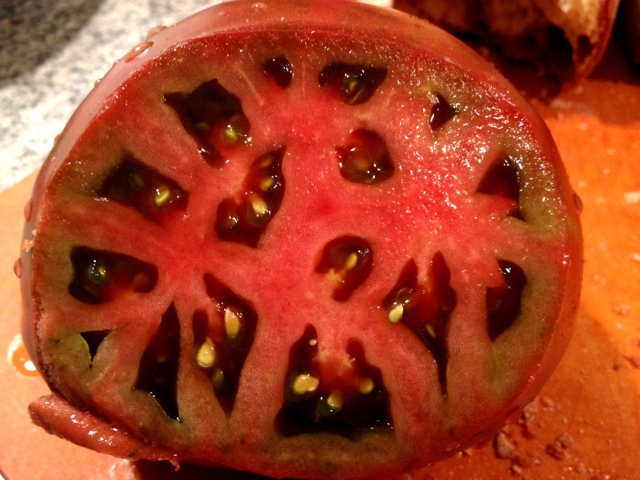
And I had tomatoes for dinner. My first this season, just as everyone else begins to tire of them. Black Russian still favored over Black Krim.