growing shallots

Summer Solace

One of the benefits of getting to one's vegetable garden first, before summer's work begins in earnest, is not having to think about the garden at all when you are knee deep in summer's work. It grows itself, mostly, with an intensity only paralleled by the solstice's long day. 


One of the beauties of growing garlic is that it's harvest hardly coincides with any garden task other than weeding. By now, the first of the garlic is near completely exhumed (briefly hesitated to dredge up this word), and like any darkling, it mustn't be cast into the bright light. The first pulling is in the shade of the porch, but the full harvest is likely to be dispatched to the cellar. Here, in the midst of harvest, is Xian, a Turban strain, and one of the best for flavor and earliness. Turban's lodge, or fall over, as a way of telling unsuspecting gardeners that they need help -getting out of the ground.


At about the same time sizeable beaks are swirling above the Asiatic strains -here Asian Tempest and Japanese. These will be harvested next, not long after the Turban strains, and sometimes before.


Meanwhile the Porcelain strains have had their scapes (flowering stalk) cut, ready to be pickled or grilled or sauteed or...just don't leave them in the fridge too long before doing something with them. Behind the Porcelain are the Rocambole (shorter in the middle) and Purple Stripe. 


The French Grey shallots have also been pulled. I find that the height of the crabgrass is a useful indicator for timing the shallot harvest. Left behind are the Artichoke and Silverskin strains, those hardy bulbs that we use through next winter and deep into the following spring. 


When the the crabgrass first sprouts, it's the best time to get your peppers in, but I didn't heed the crabgrass this season. No, I put the peppers in a couple of weeks early -listening to the lambsquarters maybe. They're doing fine anyways, although I do think they are showing a little too soon.


Broccoli? Yes! And from seed no less. In spring? Yes! And no cabbage moths to boot. A quick, small-headed variety seed-started on May one and hardly two months later boom -broccoli. Go figure. I've got some of those very same starts in their deep cells holding back growth inside the greenhouse. They'll be put into the garlic beds as they clear.


Green beans? Not so fast. I seed-started these in the greenhouse on May one and planted them out a two or three weeks later. Nice flowers, no beans yet.


Cucumbers before June 21? Why, yes. I purchased a cell pack of four Spacemaster cukes from Shady Acres and planted them in pots raised well off the ground.


They won't ever reach the ground, that's why they're called spacemaster. They do put on an impressive display of cucumbers and have produced a handful of medium sized eaters before the solstice. I've seeded my own, too, to replace these after they give up.


Tomatoes, well that's asking a lot, isn't it? But among our six strains (of three varieties -plum, grape, and, uh, heirloom beefsteak?) these grape tomatoes, called Red Pearl, are way good producers.


In fact the deer are warming up for BBQ season by snacking on our Speckled Roman plum tomatoes. I grew these at the Beach Farm, and deer aside, expect them to do really well here.


Dill, cilantro, basil, and at the very bottom, cutting lettuce. In the background -common milkweed that has grown in this spot for eons, or at least since this house was built, so maybe the late nineties. Infringing on their bed are the potatoes. They are so big they require their own post. Look for that.


Our Vegetables

My attitude about garlic growing is considerably more casual than in previous years. So far these varieties have shown excellent progress without more than a dose of blood meal and liquid fish fertilizer. The French grey shallots have done exceedingly well with little maintenance but the occasional weeding.


In fact, since the top photo was taken, they have lodged -meaning it is near to harvest and hardly any different from the time frame of my 2012 upstate New York growing experiment. These will be cured on the porch.


Very few interesting things going on with the garlic. They are taller, lankier than my Long Island grown garlic, although these were planted from my own LI grown heads. Each variety made the transition, so far, from coastal New York to Minnesota pretty well. There has been one interesting thing -the strange appearance of dead flies on some of the leaf tips.


They seem glued in place. Has another creature done this? Saving them for later? Or has the garlic done them in? No answers, yet.


About a month and a half ago I planted potatoes. They appear to be doing exceptionally well, with each rain adding another few inches in the last three weeks. No Colorado Potato Beetles yet and I can't keep enough soil on hand to mound up!

Of course, we put tomatoes, peppers, and eggplant in two weeks back. They were planted in 14-inch wide strips tilled into the front lawn -the only place sunny enough for vegetables. So far no creature has come to eat. I'm wary of adding green beans knowing how well rabbits take to those tender seedlings. Deer have not browsed, although we do have a resident raccoon living in a big, old maple in the woods about 75 feet from the garden. So far she's only been good for digging up a single, just-planted spud and harassing Betsy by tipping over her newly planted coleus.


What About The Garlic?


 Some of you may be wondering what has happened to my garlic farming since the move.


It has been put on hold until we can get established. However, Betsy did hastily plant some garlic in the front yard last October and it appears to be doing exceptionally well with little work on my part.


The French Grey Shallots are doing very well, as are most of the garlic varieties. 

I will only have enough for our kitchen this season and will need to decide soon what I plan to do for the next. We do not have agricultural land here in the woods. In fact, the front yard is becoming our vegetable plot since it is the only flat land that receives enough sun for summer produce.


Last Tuesday


This came after, when the friends arrived, yet I put this first because, in some fashion, we are traveling out of sequence. This day was a week ago, the day garlic harvest started in earnest.


I pulled most of the French grey shallots, so healthy and green I questioned my timing. This year, my timing is rattled by a cool spring, new plot, and my greatest offense -traveling right in the middle of harvest season. The garlic you see is a Turban strain known as Xian, and I have very little of it. While the harvested garlic plant has very little odor, the naked shallots are pungent as can be.


The Asiatic strain 'Japanese' was completely harvested last Tuesday. I was comfortable harvesting these even a little early as the Asiatic strains tend to demand it or they lose their skins. However, this last week turned out to be exceptionally dry, and another week in the ground would have probably done no harm and sized them up some. A word about sizing-up garlic by delaying harvest: a day or two isn't going to do much, you really need to wait at least four days, or more if possible to really notice a difference. Keep your eyes on the weather and wait another week if it remains dry and the leaves are still quite green.


Of course, since the temperatures have remained below 85 degrees F (probably less at the beach farm), the lettuce continues to produce. The only issue has been the lack of moisture, and my unwillingness to heavily douse the rows because of their proximity to the garlic.


These heads, Romaine and Iceberg, were pulled last Tuesday, before this past dry week, and currently live, roots and all, in my fridge.


The rig, for gas pipelines, encroaches, and was closest last Tuesday.


Evening At The Beach Farm


The iceberg is shaping up.


And the romaine ready to go.


I have only a few Artichoke garlic this season, but some are sizing up nicely.


I only planted a handful of French Grey shallots, and they looked pretty meek in early May. Now they've come into their own and are looking strong and healthy, but I'll have only enough for my cooking.


From this angle the new plot looks garlic-full, if a little sparse. See the shallots at the edge, right side.


Some of this season's Creole strains, "Creole" on the left and "Pescadero" to the right. Always a challenge to grow, and even more so to grow large, these plants happen to be shaping up as well as any I've grown. Dare I say the best, yet, based on their stem size. Now, to avoid the Creole curse -witches' brooming.


From this point of view, you can see how much garlic didn't survive the spring season. All that space is now planted with bulbing fennel, lettuce, swiss chard, and parsley. After the Turban and Artichoke strains are harvested, tomatoes and peppers will be planted in their place.


Over in the other plot we have the tangle of high season. Hidden in this mass is the nearly ready Asiatic strain "Japanese," but also Rocambole "Russian Red" and "Killarney Red," Asiatic "Asian Tempest," Porcelain "Music," "Georgian Fire" and "German Hardy," Purple Stripe "Chesnok Red" and Marbled Purple Stripe "Siberian."


Now the harvest game, contemplating the right moment for harvest and then seizing it. Expectations are for a season later than usual, which is good because I will be away in sizzling Florida for 10 days come late June. I do expect to have the Asiatic, Turban and hopefully the Artichoke all harvested before I depart.


And of course, there are scapes. I will be plucking them over the next few weeks, first the Turban and Porcelain, then the Rocambole and Purple Stripe. I may just keep some on the plants for the visual, but also to see how that affects size and longevity of storage.


So we grilled our first trimmings, but couldn't drum up too much interest from our guests.


As the sun settled down, I took a good, long look at the two gardens, then harvested romaine, ruby red, and one iceberg lettuce head. Although I am not growing a substantial amount of garlic this season, I have enough to offer and it's looking quite good. I am excited to bring it to market via Hudson Clove, and will probably offer labeled bundles as I have in seasons past. The cure will take place in the studio where there is more than enough room for this quantity of bulbs and the humidity and temperatures are the best of any option.


Field Hands


The farm is at the beginning of full summer swing. All around tomatoes and peppers and eggplant are being planted, tractors are buzzing, and I well believe that there is an implement that vacuums up Colorado Potato Beetles. It has been running nonstop. We have been knocking ours into a cup.


The farm isn't much to look at these days. My white clover has become a central strip of billowing mounds of green. Crabgrass is the predominate weed, particularly at the base of each garlic plant. Meanwhile, Smartweed, Lambsquarters, Dogbane, Sorrel, and a variety of unknown grasses grow an inch an hour.


The peas are high, tasty, abundant. We eat what we can.


I was able to finagle a tractor to disc the cut rye and field pea cover crop. It must be done again, but I was happy to get this project moving. This is the field that will be planted in November and I am determined to have it in better shape than the current field. I picked up an additional twenty bags of lime (for a total of sixty 40lb bags) which I hope to get spread this week. Finally, I also picked up my order of 50 pounds Buckwheat seed, which I also hope to get in this week. The Buckwheat will be turned in August.


Betsy has not been to the farm and probably for good reason. When she does come by there will be much weeding to do. I did the general clearing and soil loosening with our small, sharp hoe and she followed with hands and knees. It takes two people about one hour to clear each forty by three foot row. The work is tedious, yet I cannot be too sure at what point you can let the weeds go. If the garlic will be harvested within 10 days and the weeds are below six inches, I leave them, otherwise they must be pulled. Visiting one day a week from mid May through June is hardly enough to keep a field this size weeded. There will need to be a new weeding paradigm next season.


 My farming neighbor brought a flame weeder. While it didn't seem all that productive for row crops, it did make some sense for the rapidly filling Saffron bed. The Crocus are dormant, so I could flame the weeds without harming (I hope) the corms under the ground. The weeds were do moist from all the rain we had been having that torching the row took longer than I thought. Not only that, it appears to me the grasses will be right back in a week or so. Ultimately, flame weeding does not appear to be a productive weeding practice.


Ocean side gin and tonics in classy plastic cups after a long days work completely justified.

Now that the weeding is done we move onto harvesting over the next three weeks. We've already harvested the Turban and Asiatic varieties. The shallots are completely ready and have been for at least a week (I was waiting for them to lodge -it never happened). They will be harvested this coming Thursday or Friday.  After those will be the Artichoke strains.


Rain Date


This post describes my June sixth trip to the garlic farm in anticipation of the heavy rains from Tropical Storm Andrea.


I went to Agway to pick up another load of lime and to place my buckwheat order, changing my normal path to route 24 through Flanders. Long Island's famous Big Duck was moved along this road sometime during my adult life, but I remember it moving several times since I was a kid. Long Island was known for potatoes and duck farms, two industries not as common around here these days. Our duck was built in the 1930s and its moniker became architectural terminology to those in the field -a building in the shape of its product is known as a 'duck.'


The trees in the area have finally come into their summer greens and the field grass is just beginning to reach upwards.


The crop  is looking a little better than weeks prior, a general greening up, with the Silverskin strain showing the most improvement. I do not know if this is because I fed them with a calcium-magnesium and Fertrell 3 mix, because it was warming up and drying out, or all of the above. However, the Turban and Asiatic strains generally look poor, making it difficult to identify when to harvest. They are browning down now, but the bulbs are not up to size, nor have fully developed cloves. Given the proximity to harvest, the coming rains will not be all that welcome.


This is the saffron crocus, from green to brown in a month's time. Soon the weeds will completely conceal the crocus and I have no time to hand and knee this plot. These crocus require dry, or at best well-drained, summers and they are not going to get that here. I made this choice when I was under the impression that the Trust would rent Hudson Clove land on the North Fork where there is quick-draining sandy soil. The soil here, Bridgehampton Silt Loam, is a nearly powder fine silt loam that holds water moderately well if not nearly as much as clay. I think for the crocus to survive, I will need to affect the soil drainage significantly. I will also look into digging them up for summer storage and then replanting in late September.


Working a field requires the skill of observation. I have that in droves, but I'm now trained on signs of standing water like never before. Earlier on I had seen indications of moving water, puddles in walking rows, and the tell-tale smoothing of soil where water had stood. In other words, I had seen the micro, the after-effects, but not the big picture, the macro. It wasn't until Cornell had suggested soggy soil as a factor in my unhealthy garlic that I began to notice how thin the cover cropping was adjacent my center rows. The low weed count in this area became another obvious indicator of standing water. Then the contour of the land revealed itself as a pronounced 'bowl'. A new problem, or rather an old one, that now needs to be addressed.


Knowing that rain was on its way, and being early June, I pestered my farming neighbor to mow the cover crops planted last December. The grass was going to seed and the peas were in flower. We were probably a week or two late on this, but it is easy to lose focus when so much else needs to be done. Apparently this pea cover should be mowed down by late May because that is when it has fixed the most nitrogen in the soil. As for the rye, just cut it before it sets seed for added organic matter. Sometime next week, my neighbor will disc it in.


This was the radar while we were out in the field. Hudson Clove's first season on Long Island was book-ended by two tropical storms -Sandy at the start and Andrea toward the finish. How rare on both ends.


I wrapped it up a little earlier than usual, although only ten rows were weeded, as the rain clouds approached. I left before dark.


May Garlic


Ahab's Maggot


I'm now visiting the farm at two week intervals, primarily for weeding -picky, on your knees weeding. I've been lucky, its been cool and dry so that major weeding has been unnecessary.  I bought three hoes in February so that I can work like a real farmer and Saturday I used them. But as I said before, these hoes are brutal. I decapitated a handful of garlic because of slightly mistaken gestures. The cuts are clean, off with their heads! clean, and what remains must be dug out. I'm not clear on the reason, but these hoes have three sides of the blade razor sharp so that even mere side swipes cause injury. Even though I was able to weed the entire plot in 3 hours (that is how long it took me to weed last year's plot at a quarter the size), it is time to retire these hoes from intra-row duty. Next visit it's all hands and knees. 


I was taken by this enormous (so large that it wouldn't fit in my camera) cherry right beside the farm gate.


And happy to see the pea greens I planted two weeks ago had all come up, each and every one. Let the FFSA (friends and family supported agriculture) begin. These are for salads and stir-fry.


The other reason for my visit of course is the health of my rows. Above is a good example of unhealthy garlic. The leaf curl is the primary indicator (yellowing leaves, secondary) of acute disease.


Digging up garlic now shows that last November's planted cloves are gone or nearly so. In my field, some were eaten by the maggots, but most were used up by the growing plant which by May are growing on their own. Notice how large the stem is -this would have been a nice sized bulb.


Look inside the red circle to see what I believe is a young maggot. Onion maggots have several generations a year and right now we are between generations. In looking for samples to send Cornell, I found some pupae and some very small maggots, but few flies or mature maggots like I found two weeks ago.


What concerns me is that the next generation will be ready just as the garlic begins forming its cloves -what we call the bulb, and a feast for that next generation. The thought is dispiriting.


Then I notice the light over the wheat field, the way it plays off the budding trees. I make my way to the field's edge. The sky is not the dirty blue of Brooklyn, not even the sharp blue of a winter's day. 


I look to the northeast where a new farmer, Frank, (two Franks? Long Island generates the most Franks) discs his field. He is not alone. Their voices carry on the wind -I hear them with perfect clarity, yet they sound diminutive, far away. That same wind carries the perfume of ocean-side convalescence.

 
How bad can things be, really, given the beauty all around? It is easy to take myself too seriously, to allow a fatalism to take root. Though the force of circumstance is insistent, I cannot allow it to take away all force from myself.


And I go about hoeing my rows, culling the culls, bagging the samples, spraying fish and kelp, and then planting the heirloom onions.


I quit at sundown to drive back to Brooklyn, passing through the Hamptons now filling with its seasonal inhabitants; the restaurant lots filled this Saturday evening. At Riverhead I detoured north toward the Sound, to drop a large brown paper bag filled with smaller bags of culled garlic at the doorstep of Cornell's Horticultural Research Laboratory. It was dark, nobody was around, and that felt rather comfortable. Although I had traveled the North Fork route time and again since the days I was free to drive a car, many times at night, I was struck by the darkness and the stars.


Snow For The Farm


The minor snow that has fallen on eastern Long Island will be helpful at the farm during the colder days and nights ahead. The turban varieties, ever eager to grow, were the first to sprout in early December and will benefit from a layer of insulating snow. The rest still underground, but not too deeply thanks to light soil and vigorous root growth, will also benefit from the 32 degree blanket. It wouldn't take much time to bring freezing temperatures several inches below ground with several days of hard freezing temperatures and no snow cover. Garlic is tough, however, and regularly survives much lower than the twenties and teens. Although, surviving it isn't exactly needing it, so I'll take the snow.


December Farms


Two Sundays back I threw business to the wind. I drove out to the farm, I spent the money, I saw what's what. The radar told me that, despite the clouds, rain would be limited at most, and the thermometer was nothing less than a balm. I was concerned about weather stations reporting a lack of rain; less than a 1/16th in over a month. I was troubled by my inaction as it came to mulching the rows. I had little purpose, but a desire to get out to the farm.


It had rained, and by my unofficial gauge (a mixing pail) it had rained nearly an inch. I was quite surprised by the puddles in the walking rows, too, as it reveals a soil less porous than expected. The tilled beds were quite well drained, however, and I will work to keep water moving in the wet rows.

My single bale of straw, provided gratis by Larry of J&L Nursery, had since Black Friday to prove its field worthiness. It failed. Light to moderate winds had scattered sixty percent of the straw. On my way out to the farm, I stopped at a roadside nursery, now briskly selling trees and wreaths, but had been scouted for straw bales in early October. I decided not to purchase any, as they appeared quite seedy, some sprouting grass, and the evidence in the field left me feeling vindicated.

Several 'Tuscan' bulbs had sprouted above soil. This isn't a surprise. Some were sprouting at planting time, one month ago, so they've just continued on given the mild temperatures. I worry that we'll have another winter like the last, a winter where cold tolerant plants simply continue to grow, then get shocked by sudden dips to 20 degrees. This farm location favors the warm-tolerant garlic varieties -Turban, Creole, Silverskin, Artichoke, yet I do hope we find a balanced winter, with enough freezing air masses moving over the area to treat the other varieties to some cold. My prediction? It's unlikely.


I had planted the French Grey shallots first, in early November. I checked them several times since, and was quite surprised to see a number of them poking out of the ground, including this one -completely out. Shallots are planted shallowly so that their tips align with the soil surface. Many had risen to half or more an inch above the soil. What was going on? A nosy fox or crow? Geese? I saw little in the way of foot prints. I walked the rows to ensure that each had enough soil to cover them.

Afterward, I took to my neighbor's field where I had witnessed him planting a crop of garlic the weekend before Thanksgiving. Many of his planted garlic were up above the soil line, as if planted carelessly. I wondered what had happened here -giant white cloves lay sideways along each row.

I had hoped, but was one week too late, that I would be able to cut some saffron to take home. Benefiting from the warm and moist days, Crocus sativus has had time to sprout leaves and grow roots despite having sprouted in the studio before setting roots in soil. This forty foot row of three hundred will be uprooted late next summer and replanted in a new location, all part of the circumstance of a small acre and required cover cropping.

After lunch, I had little left to do, but attach a few of my remaining row markers. I took advantage of this gracious lull by walking the acreage -something I had been timid about previously, but then, I was also so busy planting. The blue pipes are new, our future irrigation system, and I followed them across the acres. I was lucky- my acre cornered at one of these heads. 

There was much to see in the other farmer's fields -cover crops like oats, greens and kale, brussels and cabbages. My favorite were the corpses of gourds, shattered and filled with rain water.

My journey terminated here, where black compost met a new cover crop. As I approached the compost piles, a tractor made its way over to me. It was Scott, the farmer (and writer -new book just out) who manages the adjacent farm. We chatted about this and that, particularly the problem with his garlic. What's that? Whole rows of garlic have popped up from the soil? Apparently the roots grew so vigorously over the last month, with the soil dry and loose, that those roots pushed the lightweight cloves right out of the soil! 

I was lucky though, wasn't I, for planting more deeply than most. Only my shallow-planted shallots had come up. It's wise to roll the beds (if one has that equipment) so that it uniformly firms the soil over the clove. I do not have this equipment, and hope that my garlic stays put! It may be a while, too long really, before my next visit to the farm in late January.


A Call To Shallots


It was a little after five a.m. when I woke to the sound of birds. I'd forgotten this. I was surprised by the portability of sound riding on air moving fluidly through aluminum screened wooden portals. City windows are closed windows; they keep out bird calls as much as enduring nightmares of shut-eye thievery. Here I was on the edge of the woods, bird calls the early morning trash cans clanging, and I rose, dressed, and was out of doors in as brief a time it takes me to relieve myself and park on the couch by eight a.m. on any ordinary day.

A clump of French Grey shallots, Allium oschaninii, just before harvest. When they are near ready, the plant leaves will "lodge." This is fancy terminology for falling over. Notice how the bulb tops are near the surface. Despite planting close to the surface, the shallots appeared to pull down deeper into the soil. When we pulled away the crab grass along with an inch of soil during the last weeding, the shallots were again near the surface. If the weather remains completely dry, lodged shallots can remain in the soil for some time.

Shallot harvesting is much like garlic in that you will need a shovel to loosen the roots and soil before pulling in all but the loosest soil. Don't be surprised by the earthworms that like to roost in the roots.

Each single shallot planted will become a cluster of 6 to 10 new shallots. There appears little to predict shallot size other than great soil. After pulling, shake out the soil and lay the clump aside. Do not rinse them -water is to be avoided. The new shallots will be naked, but will, in time, form a tough skin.

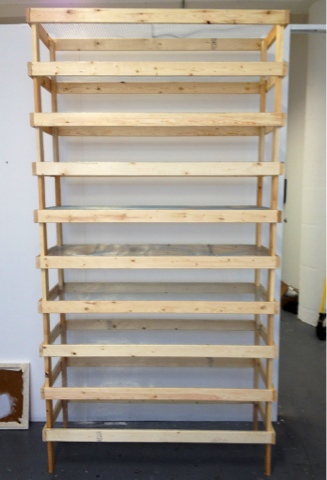
We built custom racks to transport and cure our shallots. The curing can take 3 to 4 weeks, with humidity the greatest factor. Cool, dry, air flow -that's always best.

After 5 days, they'll look like this. 


Nice Rack


And they stack. Over the last day Betsy and I worked on a design for both transporting and curing our 1200 French grey shallots. I finished assembly today. The beauty of this design is that they can be stacked, taking up little floor space and can also fit in the van at harvest. The pine boards are 1x3s and the mesh 1/2-inch. Materials cost - $34.

I'm teaching a drawing class at Sarah Lawrence College up in Bronxville over the next couple of days. After my last class, I will head up the Taconic speedtrap to settle in to a night of couch sleep. The next morning I wake to harvest, load up these very racks, and return to Brooklyn before the elevator operator heads home for the weekend. I do not want to carry 10 racks of shallots up four flights of stairs. Who would? There the shallots shall rest for a month's time, curing, building its tough outer skin. You need that in NYC.


Full Tilt


Yesterday was probably the first day I felt less in control of my little, upstate garlic farm. Postponed from Monday to Tuesday thanks to the never-ending rain, we (yes, Betsy came along for the first time) arrived at our plot full of weeds. I had been there only 18 days prior, with 3 solid hours of weeding behind me, and yet the weeds were lush, large, and looming. But there was something else, the shallots, French Grey, had gone prostrate, completely, as if a wall of water had plowed through. I wasn't expecting this, and as far as I knew, there was another month to go before harvest.

Prostrate French

Plantains, grass and clovers

But this has been no ordinary season, and so I put the idea that something was wrong out of my head. Shallots will fall over when they are near ready. They should begin to yellow or brown, but this May's copious moisture has kept them in the green. It is confusing to witness, it looks like damage, but all said, appears a combination of warmer than average winter and spring temperatures and several inches of May rain. Now, please, please, less rain, so that these shallots can dry down some in there beds before I remove them. It's so early that I have yet to prepare a location to cure them, and will be unlikely to do so. Have you seen the seat of my pants flying by?


Rows demand weeding more than any other planting methodology

Fortunately I had Betsy along with me. Betsy the weeding magnate, born closer to the earth than lumbering fools like myself, 90 degrees bent, back aching and angry at such angles. While Betsy weeded, I weeded as well, but then took stock of the state of our garlic, disposed of the weak, inspected damage that appeared to be caused by the nibbling of roots, counted scapes, but cut none, consulted with the property owners about their barn, none too soon to be remanded to the earth. Will it come down in time?


Growing things at a distance is a game of sorts, a gambling man picking his dates like another picks horses or numbers. This date, yes, that's the lucky one; my bet an investment in gas, tolls, and time. Part educated guess, part luck, it is a game I like to play, but sore to lose; I want to be right, and for the crop to be a success, I need to be right, or close to it.


But then there are moments, say, when I see that the blue in the Italian Purple rocambole is quite similar to the blue of the spruce across the way, or the pleasure in a well-weeded row, or the marvel of quantity.


We strung up the shallots, fooled into thinking it wasn't near harvest time. It is.

 And left scapes alone, fully aware I would need to be back soon.

Late, I disrobed for full tick check. Lucky I did; inside the shirt, approaching the scruff of my neck. I think it found me at the edge of the woods. Betsy was all clear.

We sped off, later than usual, marveling at the Hudson River scenes as I kept a wary eye for suicidal deer and the law. My next visit will be soon, a week's time, 7's a lucky number.