coeymans sativum
The Great Scape
The word 'scape' is derived from the Latin word for stalk -scapus. It is the flowering stalk that rarely sets flower. Let a few go to see what they can do. You will still get garlic from those left or forgotten.
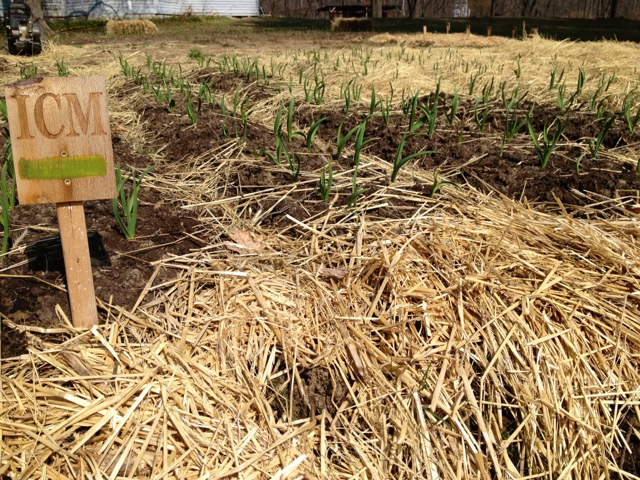
Allium sativum var. Turban 'Tuscan' were harvested on scaping day. They are the earliest of the early, and should be pulled after the bulbs size up, but before the plants lodge (fall over). Mine were partially lodged, but I think no worse for the wear. It is with a touch of sentimentality that I look at these empty rows. Not long from now this field will be harvested.
A Call To Shallots
A clump of French Grey shallots, Allium oschaninii, just before harvest. When they are near ready, the plant leaves will "lodge." This is fancy terminology for falling over. Notice how the bulb tops are near the surface. Despite planting close to the surface, the shallots appeared to pull down deeper into the soil. When we pulled away the crab grass along with an inch of soil during the last weeding, the shallots were again near the surface. If the weather remains completely dry, lodged shallots can remain in the soil for some time.
Shallot harvesting is much like garlic in that you will need a shovel to loosen the roots and soil before pulling in all but the loosest soil. Don't be surprised by the earthworms that like to roost in the roots.
Each single shallot planted will become a cluster of 6 to 10 new shallots. There appears little to predict shallot size other than great soil. After pulling, shake out the soil and lay the clump aside. Do not rinse them -water is to be avoided. The new shallots will be naked, but will, in time, form a tough skin.
We built custom racks to transport and cure our shallots. The curing can take 3 to 4 weeks, with humidity the greatest factor. Cool, dry, air flow -that's always best.
After 5 days, they'll look like this.
Full Tilt
Yesterday was probably the first day I felt less in control of my little, upstate garlic farm. Postponed from Monday to Tuesday thanks to the never-ending rain, we (yes, Betsy came along for the first time) arrived at our plot full of weeds. I had been there only 18 days prior, with 3 solid hours of weeding behind me, and yet the weeds were lush, large, and looming. But there was something else, the shallots, French Grey, had gone prostrate, completely, as if a wall of water had plowed through. I wasn't expecting this, and as far as I knew, there was another month to go before harvest.
Prostrate French
Plantains, grass and clovers
Rows demand weeding more than any other planting methodology
Growing things at a distance is a game of sorts, a gambling man picking his dates like another picks horses or numbers. This date, yes, that's the lucky one; my bet an investment in gas, tolls, and time. Part educated guess, part luck, it is a game I like to play, but sore to lose; I want to be right, and for the crop to be a success, I need to be right, or close to it.
But then there are moments, say, when I see that the blue in the Italian Purple rocambole is quite similar to the blue of the spruce across the way, or the pleasure in a well-weeded row, or the marvel of quantity.
We strung up the shallots, fooled into thinking it wasn't near harvest time. It is.
And left scapes alone, fully aware I would need to be back soon.
Late, I disrobed for full tick check. Lucky I did; inside the shirt, approaching the scruff of my neck. I think it found me at the edge of the woods. Betsy was all clear.
Measured In Distance And Time
It's hard to believe it was over a month since I last visited the garlic farm upstate. Is it because it has been so warm, the changes all around are less visible without the physical reminder of cool giving way to warm?
Upon seeing your work, only once in a month, you approach the field with a sense of apprehension and excitement. At first, taking it all in, quick judgement is made. Looks weedy, but not too weedy, Rocambole cultivars are too small, Porcelains strong, this is a small field, yet it's too big.
It's only when you get down into it, begin weeding, do I really know what's going on. The tallest garlic, by far the Porcelain cultivars, are just short enough to be straddled during weeding. I must weed rows in opposite directions or weeds are missed. Straw works well to inhibit weeds, but those that do make it force you to rout around looking for the hidden. Crab grass in the unmulched beds is sprouting strong now and is difficult to dispatch at such small size. I will need to be smarter about row widths and plant spacing for cultivation at the new farm.
On the right is Allium sativum ophioscorodon var. Porcelain 'Breezy Point.' I named this formerly nameless garlic after the neighborhood just west of the Beach Farm. The variety name Porcelain indicates beauty and fragility, but these are some of the strongest growing garlic available -it's no wonder Porcelain cultivars are the choice of northeastern farmers.
The French Grey shallots, Allium oschaninii, are doing quite well, having gone from one shallot to several in 7 months. I like this math.
If I could find one bug on the garlic, this is certainly one that I would choose.
Weeding a plot this size by hand always takes about three hours and I am pretty thorough. I ran out of straw and so chose not to mulch the three Silverskin rows. Of course, this is where the crab grass sprouts are making headway. I ran the hoe along the outer edges, making sure not to nick the stems or sink deep enough to cut into the bulbs. In between I ran the hoe on its corner.
At the end of the day it's hard not to want to sit and stare at the field, even one this small. I typed into the phone my notes about each variety and cultivar and then it was time to head back to Brooklyn. I have to remind myself that this is an experiment in work, distance and time. The longer it takes, the less likely it is to succeed.
Late Freeze Upstate
Incidentally, a brief discussion about the weekend's late season nor'easter at wunderground.com. They are also the first official source (beside me, haha) to mention that we are in a short-term moderate to severe drought condition. The garlic farm area weather forecast for the next 5 days:
Garlic Green
The march of garlic.
Griselle, or French Grey Shallots. They are spidery and prolific, I very much enjoy these.
Tuscan, a turban variety will harvest early. I am growing these at the beach farm as well.
All garlic is doing better upstate than at the beach farm. There are several reasons for this:
- Colder weather kept the garlic from sprouting last December-January.
- There has been much more rain and even some snowfall upstate.
- Geese didn't eat the fertilizer or smash the leaves while doing so.
- The soil is practically pure compost.
This row, which you can see has only some compost mixed in, contains some corn gluten too, but also the menacing sprouts of crab grass. May weeding will be rough. It took me about four hours to weed this month, while last month took about three. Next month? The straw definitively held down the weeds, but made weeding those that did sprout much more difficult.
Thankfully, fearful that it would be cold, I brought my trusty thermos filled with hot, hot coffee.
The sun occasionally came in and out, warming my rear as I weeded. It wasn't all that cold, and I never needed more than my t-shirt and windbreaker. These are a porcelain variety and are most vigorous.
The blue-tinged leaves of this rocambole are beautiful.
Everything else is looking quite good. Some varieties are a little small, but again, this is due to the original seed stock. Although some farmers sell at seed-stock prices, their product fell short of seed quality. In this case the quality issue was smaller sized bulbs and cloves. The healthiest garlic grows from the largest seed stock. Large seed stock garlic is more difficult to grow because it requires a certain amount of care and attention that, at scale, translates into higher prices. In the garden it is easy as pie.
Around 5 o'clock it was time to head back to Brooklyn. The plot seemed quaint, diminutive even, despite four hours perpendicularly bent. Old straw and rain made the mulch warm to the touch, my nose close to spring's sweet decomposition. I don't recall who said that farmers' do not aestheticize the land, do not pull up from work to notice the sunset; those are the ideas of poets.
Next week I will be meeting with the Peconic Land Trust in regards to participating in their farm program. One full season of small-scale growing incomplete, I can hardly imagine what scaling up ten times will mean.
Summer In March
I sit in my van, watching thunderheads rise to the west and the northeast over minor mountains, venti ice coffee in the holder, bottle of water at my side.
I broke a sweat today, felt the burn of the sun on my neck as I pulled the smallest of weeds and sprouts of grass from each garlic bed. All the garlic and shallots are up and growing. Half the straw mulch had blown to other gullies and beds. I replaced it as it appears to keep the soil cooler and moist on these hot March days. It will be in the 80s later in the week. No rain in sight but for these steaming vents blowing up over the mountains.
I applied corn gluten meal to rows both empty of straw and full of it. Seems to make no difference to its application. I am at the right time with it -warming, dry days ahead, early spring, just as the weeds begin to sprout. And garlic enjoys a spring hit of nitrogen that corn protein has in spades.
I received a speeding ticket on my way up to the farm this morning. Not a soul on the Taconic Parkway, I was lost in thought, and didn't even see the cop who pulled out in front of me, forcing me toward the shoulder. He asked why I was speeding and I said I was not aware if it. I was dreaming as one can do on a lonely highway. I hope it's not one of those 300 dollar fines. Twenty five years of driving and never a speeding ticket. Until now. I'll take the Thruway back because 70 is apparently okay west of the Hudson River.
The Last Straw
It's been awful warm in New York City up until just a few days ago. But, be not concerned, there's snow upstate -where it belongs. I left early, as early as I could after attending a Christmas soiree the night before. Slowing me down, a pit stop at Columbus Circle to load up a crate I built to ship my art to Iowa. The drive was welcome, with little traffic, and thoughts moving rapidly from art to garlic to travel and back again.
It was cold at the farm, maybe in the upper twenties to low thirties, but the sun was warm, especially near the dark soil. Pockets of ice were common and the raised beds that had not seen the sun yet were still hard as concrete.
Two varieties had sprouted well above the ground -Allium sativum ophioscorodon var. Purple Stripe 'Colorado Purple', and var. Turban 'Tuscan'. Generally speaking, sprouting hasn't been much of a problem.
Straw was added to most of the rows, but about 15% were left naked. I simply ran out of straw bales that I considered worthy of mulch. The straw-less beds will be an experiment. How many more weeds will be in those without straw; how will it affect the vigor of each head of garlic? We'll see.
I did have three bales, the cheapest bales, that were sitting plot side that I just couldn't use. The picture above tells you why -full of grain seeds all too willing to sprout! If I had more time I would've made the 40 minute journey to the Agway somewhere south of the farm to pick up an additional two bales. But again, not doing so forced my hand to experiment. Someone will ask -what will happen if I do not use mulch? And I will be able to tell them from experience.
On my way in, just off the Thruway, I noticed this house and barn (two, actually) for sale. I got to thinking, if not dreaming, for the minute I pulled to the side of the road.
Soil Test Redo
I've sent in two new soil tests. One for the beach farm -I've never had it tested and am mostly curious about the pH. And, since we're getting it tested, may as well get the metals analysis too. The "upstate" sample is a redo of the garlic plot now that 8 yards of compost have been added. I am hoping it ups the pH and I am also curious about the compost's effect on the metals numbers -any dilution?
Post Haste
Six a.m., morning after my opening, I headed upstate for the planting of the final rows of cloves that missed their planting date due to a freak October snow storm. Traveling up the Taconic, most leaves fallen, except the russet and burgundy of oaks, there were road crews, and piles of woodchips, and snowy hummocks.
On site, I made my way around the house. The first thing to catch my eye was a deer hoof print next to a small hole.


Thanks to Daylight Savings Time, and Congress, I hadn't adjusted to the new darkness at 5:30 pm. I went in for dinner, only to come out again around 9 pm to plant the remaining four rows by moonlight, cloves' dim glow against the black soil.
Walking the rows I spotted more holes, although no more hoof prints. I found the garlic cloves sitting beside the holes, unscathed. I wondered whether the animal responsible for digging with uncanny accuracy knew that this was garlic but thought it worth trying for anyway. I wondered how the animals could even know that something was there to be inspected. And if they can know that much, can't they know that it is stinky garlic -something they don't like and shouldn't waste the effort digging up just to toss aside?
Yet, there was a part of me pleased that they had done so because it satisfied an urge I always have to dig up what I have already planted to see what's happening. Maybe other animals have the same urge? Check out the root growth on that clove -a purple stripe variety, cultivar "Chesnok Red." The leaf sprout is about one half inch long, but the roots have grown down more than double the length of the clove in three weeks. It has been replanted.
Rose At Dawn
I had cracked 50 heads and sorted 450 cloves of 'Silver Rose' garlic the night before -all to be planted in these three beds. 'Silver Rose' is a silverskin softneck -very long storing. There are those who make much of the difference in flavor amongst the varieties and cultivars of garlic, but, to me, the major difference amongst varieties is long, mid, or short-term storage. This alone is reason enough to plant the different types. After that, we can discuss hot or sweet, robust or mild, easy or hard to peel.
The finished rows. The top left was left unplanted, beds unmade.
Not bad, eh? The work was done, I left by 9. Now, when to get back to finish the job?
The Curious Dibbler
Back ten days. Garlic planting. Sunday, clouds still hanging onto the mountains. Rise as if it was a Sunday, bit later, then get started by 9 am. Lots to do, and who knew whether I could get it all done in one day?
Signs were attached to their posts first, then planted. Do not mess up the organization.The sun poked through the clouds as I experimented with my hastily made dibber.
Four cut lengths of broom handle, then pointed. The addition to the right measures from the last dibbing.
Heads were cracked at night, then sorted, weighed, counted, boxed and labeled. Remaining heads are to be planted at the beach farm, remaining cloves to be eaten. These are a turban variety called Tuscan.
After dibbing, cloves are wedged between index and middle fingers, root side down.
Then pushed down into the 5-inch deep hole.
Care is taken to keep the pointy top up while pushing the clove in. Since the clove is curved, it naturally wants to slip onto its side on its way to the bottom of the hole. Make sure this doesn't happen.
Labeled and planted, the majority of the rows are ready for bone and blood meal, raking over the planting holes, and a watering in. I will mulch the beds later. By sundown, I had all but 18 rows completed. I decided I would wake early to plant four of those rows (500 cloves) before my departure at 9 am.
The Human Plow
In good farm fashion I rose early for the day's work. I took the truck to the compost facility for my last load, stopped only by this freight train on my return.
Enormous amounts of rain had fallen in the region since mid August. Puddles formed in the tire tracks.
You can see here what a mess the tractor made of the lawn.
Soil limed, compost spread, now I am set to make the beds.
But not before I jump on the ol' wheel horse one last time to till it all in.
Each bed is roughly twenty inches wide, set to accommodate two rows of garlic planted eight inches apart. Despite the wet soil, I cross-contoured the rows so that they hold water and soil in place.
I had hoped to have the soil test results before this day, but ESAC did not come through until two days later. As it turns out, our soil has a very low pH of 5. This has all kinds of implications, the most important being how acidity affects soil bound minerals like iron, aluminum, and magnesium. I've all kinds of books on soil sitting on my shelf, unread, until now never needing to fully understand the chemistry of soil. Soil particles are charged positively or negatively. Compost is useful because it binds certain metals. Lime raises the pH, but not all limes are created equal. Aluminum is abundant and toxic to plants, but is locked up at neutral pH. Zinc is a trace mineral necessary for growth, but too much is a bad thing. Cadmium is related to zinc on the periodic table, is a byproduct of smelting, is found in phospate fertilizers.
The likelihood of finding perfect soil is slim, and I will do the best that I can with what has been given. I've added three inches of compost to the top soil, added lime with more to come. Our lead was only twice background and way lower than even the most stringent residential standards. Mercury was at background levels. Arsenic was extremely low. Our Cadmium levels were twice what my bagged Farfard compost tested at three years ago, but little information exists on standards for soil cadmium. Chromium was lower than the bagged compost. Copper was low and zinc appears high (62) until you compare it to Canadian agricultural standards (200ppm).
Here's a head ringer: Commercial fertilizers may be responsible for a large portion of the heavy metals in your yard or agricultural field. Whether it is from bagged and dried sewage sludge like Milorganite, straight up bagged synthetic N-P-K, or micro-nutrient fertilizers, you may be adding cadmium, lead, zinc, copper, chromium, arsenic, and what else to your yard or field every year. Even liming can have industrial waste-product origins. Did you know that burnt tires are a source of zinc for micro-nutrient fertilizers? Check out this lengthy EPA report. I am all for reporting on bag or box what extra components are built into our fertilizers. I use "organic" fertilizers, but even those are not excluded from the problem. Many mineral fertilizers are the by-products of industrial or mining processes. And many toxic metals are mined along with those nutritive minerals. Oy.
Weekend Farmer
The first thing I noticed was a bale of straw that had sprouted. S'pose it's good to wait two weeks, given a little rain, before spreading your straw. Happens to be the five dollar bale, which means you get what you pay for and I won't be using these cheaper bales. I once used uncomposted horse manure for a soil amendment and I paid for it with a year of weeding out oats.
The landowner, Andrew, lent me his pickup truck so I could pick up a few loads of compost from the town compost facility. Nice guys, low price. But again, I got what I paid for -this compost is made mostly from leaves and pine needles. The man at the booth sold me on the unscreened -he said it was better composted. But, after getting it home, I realized that it was full of pine cones that then needed to be removed or they will interfere with bulb development. In the end it is hard to argue with 8 yards of compost for 64 dollars, but next time I will take the screened.
The dumping, one cubic yard at a time.
Two yards of compost in the back of a pickup is a little daunting at first. But I got my rhythm down, and the whole bed was empty in about a half hour. I tried to shovel some of it to where it was needed, but that wasn't possible everywhere.
A four cubic yard pile that could have been eight. I lost an hour trying to find a place called tractor supply in search of lime. The last load, then, needed to wait until first thing Saturday morning.
The sun finally set low enough to stretch out beneath the clouds that hung on to the Catskills all weekend.
In the neighbor's field, raking shadows, and an invitation.
To the deer. We'll soon find out how much interest, or hunger, will drive them to taste garlic. They are abundant here, very, and can be seen day and night.
The G Train To Coeymans
The G train -that's the Garlic train. And Coeymans -that's a neighboring town and I like how it sounds. Say it with me - Kwee-minz. I suppose you could go as far as Koo-ee-mahnz, but then everyone would know you ain't from round here.
Upslope, view towards neighbor, and possible future growing location.
The soil on site is a near-perfect sandy loam. Not one stone, nearly zero grubs, and plenty of earthworms. The site has a triangle of large trees surrounding it, all which sent roots into the open expanse. I severed those with my spade. Sorry trees, this is farming, small time as it is.
Fortunately I didn't sever this young turtle who caught my eye as he traversed the newly tilled plot. After I put it in the woods, it looked at me sidelong. I also had neighborly run-ins with a hawk, white-tail deer, and a fox. And several ticks. I will not enter the woods again to search for mushrooms. Repeat.
The cultivar tags, color-coded to identify variety. As insurance, the plot will also be mapped. I bought straw at Agway, then bought more at a local grower. Price difference? Fifty percent less at the local grower. Lesson learned. An old woman came out to collect the money, saying that this might be the last year they hay and straw. It's a lot of work she said, and they were nearing 80. I think I will go get some more.
I asked her to explain the difference between hay and straw, even though we understood in general that hay feds animals and is weedy and straw is bedding and is less weedy. Straight from the farmer: straw is the remaining dry stems of cultivated grains (oats, barley, rye) that have been threshed for their seeds. Hay is most often grass (rye, timothy) although sometimes legumes (alfalfa, clover). It tends to be greener than the drier straw, and, not threshed, it has many seeds (that we will later call weeds). And so it is that we buy bales of straw to mulch our garlic beds.
Up next: my visit with Professor Cheng of the ESAC at Brooklyn College.