garlic

Garden Report

Potatoes are waning but they're still impinging on the herb bed. As the sun lowers and the potatoes die down, the herbs should reclaim their full sun. In the back left, really tall milkweed.


As the garlic comes out over the last few weeks, the fall brassicas have been filling in. These are brussel sprouts, the first planted, into the space previously occupied by garlic 'Xian.' I've never grown these before, but have planned it for years. Notable this season is a lack of cabbage moths -not complaining!


Eggplant fruit coming on now.


Green beans, from purple to roma, prolific and easy as ever.


All peppers are fruiting, some large. Only difficulty is that the plants can hardly hold their large fruit and that I shouldn't be so lazy as to try to break a pepper off the plant instead of going for the pruner. What happens? Well, I break the whole pepper plant in half.


In complete opposite of last year, all our tomatoes are suffering blight. Could have come in on our purchased compost, or maybe because we planted in last years potato and eggplant beds. Hard to avoid poor rotation in a compact garden. Next year I think these beds will be garlic and the garlic beds will be tomatoes. All that can be done now is watch the tomatoes try to outgrow the blight.


More brassica as the Porcelain garlic 'Music' has come out. As two more varieties of garlic are harvested over the weekend, even more brassica will go in. Above is kale started from seed in the greenhouse.


These giant pompoms, hydrangea actually, were moved from the south side of the house last year. We planted them in a great arc around the curving lawn-driveway. They are quite garish, but they keep the plow truck and other skiddish drivers from driving over the lawn and garden in summer and winter (thanks to the long lasting dried flower sepals), and maybe they keep the deer at bay. Maybe.


And we've finally started digging into the soil for new potatoes. Above: Kennebec russet, Pontiac, and Yukon Gold. Thanks to the quantity of compost and straw they came out with little soil and easy to clean.

I've been very busy with many things, from door and sill replacement, old deck removal, job searching and applications, studio building projects, contractors and everything I can't stand about some of them, photographing, studio painting, my class Landscape into Art which runs on the twenty third of July, a bit of socializing, gallery going, and even a music festival in a corn field last weekend. Blogging has had to take a back seat to all this (as well as taking quality photos for them), but rest assured -I was able to plant half of my milkweed over the septic drain field and beyond yesterday. Progress.


Lawn Of Plenty


It was about mid-May when I decided to carve five small rows into the front lawn for this year's vegetable patch. It is the sunniest, flat space on the land here. In the distance, the driveway and a hedgerow of Hydrangea arborescens -a solution to coarsely articulated snow-plowing and a mass of foundation plants in the way of a future house project. Seven weeks from the day the tiller expressed itself, the vegetables are taking advantage of our long, northern days.


My first round of green beans didn't arrive, quite possibly because I didn't water the seeds enough or maybe due to three year old seeds. They were all French beans, ones that trialled well, hmm -three years ago. So I bought new seed from the big box (so many home projects!) and planted those. Meanwhile it had been raining heavily for a few days -that's when some of the old seeds showed up, 'Velour,' I think. So far no problems with bunnies -or deer, raccoons, hedgehogs, and whatever other vegetable munching varmint one can have. So lucky -that's all it is.


One four inch pot of flat leaf parsley has become eighteen by twelve inches of parsley -use it daily.


One four inch pot of cilantro has become two feet by twelve inches of cilantro -makes a nice pesto!


The garlic is still green, but I know well enough to start harvesting them. As these go, their rows fill with herbs, green beans, and eventually those brassicas I fully intend to start one of these days...


Four pepper plants from a cell pack of four heirloom varieties. This one set fruit super early.


A cell pack of Japanese eggplant have provided us with an orb -not the usual thin and elongated fruit. What gives? I do prefer the way less seedy elongated varieties. Oh, Japanese eggplant doesn't always imply elongated fruit? These are 'Kyoto,' a round eggplant, and I ashamedly renounce my ignorance!


One four-cell pack of, hmm, I forget the name, but cucumber. I do recall it saying compact, and this one is definitely compact. We grew them in pots, elevated off the ground in metal pot stands that happened to be here. A couple of things to point out: these four plants in two pots have been productive for their size and have not succumbed to mildew. They have yet to reach the ground and have many flowers per vine. I recall googling the variety at the nursery, Shady Acres! Ahh, they have a plant list- It is Spacemaster. Pick them pickle size for best flavor.

A word about Shady Acres. Heirloom. That's the word. Seriously, Minnesota has some catching up to do when it comes to organic garden supplies and heirloom vegetable starts. It is very difficult to find what I came to expect -even at Larry's on the corner in Brooklyn (Best Deal on Bloodmeal!). I edify every nursery I come into contact with, including Shady in regards to fertilizer choice. I heard about Shady Acres from my neighbor who is busy trying to grow Minnesota's largest pumpkin, and was grateful for the recommendation -they carry heirloom vegetable starts. For me this means they have a variety of tomato beyond Rutgers, Beefsteak or Early Girl for the person who simply didn't get to starting his own.


Potatoes. They grew incredibly tall, so high that they could no longer be soil-mounded. Then a week of heavy thunderstorm rains, about seven inches in all, ensured that they would lay flat until they turned back up toward the sun, which they have, albeit more prostrate than before. They have been flowering for a few weeks now, with new potatoes sure to be available soon. I've decided to wait on those, aiming for the bigger potato of the future.


The tomato plants are some of the healthiest I've grown. Again, an heirloom variety pack from Shady Acres provided the starts. Ours have been in the ground for about five weeks, have grown over thirty inches tall, and some are producing tomatoes. We also have a grape variety, four plants in total. We won't get a ton of tomatoes out of four heirloom plants, but this year required low input, experimentation, and observation.


What is remarkable is the health of each plant. No visible disease, no wilt or cankers, no blossom end rot (can we thank high Cal-Mg soils?), simply robust plants. Look at that impressive stem. It helps to be gardening in a spot that has yet to see any vegetable growing. We haven't had any Colorado potato beetles either, so here's to hoping that our little clearing is protected by the woods and wetlands that surround it.


Lastly, the bug-eating army of amphibians can't hurt. And what of the pansies? It hasn't been a very warm summer so far, but plenty of days in the lower eighties. Here it may be that pansies just won't quit.


What About The Garlic?


 Some of you may be wondering what has happened to my garlic farming since the move.


It has been put on hold until we can get established. However, Betsy did hastily plant some garlic in the front yard last October and it appears to be doing exceptionally well with little work on my part.


The French Grey Shallots are doing very well, as are most of the garlic varieties. 

I will only have enough for our kitchen this season and will need to decide soon what I plan to do for the next. We do not have agricultural land here in the woods. In fact, the front yard is becoming our vegetable plot since it is the only flat land that receives enough sun for summer produce.


A Good Blanket


Raking leaves. This is a thing now, a must do thing. So why not do it when it is unseasonably warm in March? No good reason. Although the top inch of the soil is a mushy, slippery mess, underneath that top layer it's frozen solid. Except near tree trunks. There I find I can dig a little, but there's no good reason to.


 And, there's this.


But, also this. It took me too long to identify this garlic mustard. Shame on me. Visibly green before the snow had fully melted and the soil still completely frozen must have thrown me. It's the only thing growing out there, well, besides the garlic in our little plot and the duckweed in the swale.

Seventy degrees F on Sunday, a high temperature and highly unusual, possibly a record. I sat on the front porch steps in the evening swatting away mosquitoes. Yes (you say No). Yes. Thankfully, yesterday afternoon, a cold front came in. Twenty four degrees F when I rose this morning, and with St. Patrick's luck the mosquitoes had no warm places to hide. Our little pot of gold.


A Typology Of Scapes


The short-stemmed, rumpled and long-beaked Asiatic (Asian Tempest). 


The double twisting, pretzeling Porcelain (German Hardy).


A variation on the Porcelain (Music).


The three quarter looped Purple Stripe (Chesnok Red).


The corkscrew, double-looping Rocambole (Russian Red). 


And the occasional oddity such as this: the double scaping plant. This Porcelain 'German Hardy' has produced two scapes. But wait, you might say -it was probably a double clove!


But no, say I -they're both coming from inside the same leaf sheath. Only at harvest will the mystery be solved.

There are scapes produced by the Turban and Creole varieties, of which I have no current photos. There are also scapes produced by the Marbled Purple Stripe variety, but they tend to look just like the regular Purple Stripe. And sometimes, just sometimes, an Artichoke or Silverskin will push up a scape of relative insignificance.


An Elephant In The Room


The elephants are sending up scape, but no one is talking about it -yet. I will be surprised if this one, and the others like it, planted along the fence line isn't clipped by a passerby. The beauty of the elephant is its extended display from unique bulb and beak, to papery spathe's slow peeling, then a stellar explosion of white, lavender, or purple (I believe purple, but surprise me). In the meantime, I head out to the beach farm to check on the status of scapes, but mostly to harvest and plant more lettuce.


Garlic Shank Potatoes


Fridays have become a kind of domestic day this semester, often abetted by the promise of rain or cold. Things missed or avoided during the hectic work week are tackled, sometimes. A blog post, push harder on those taxes (they are complicated by farming), cook a little. Clean? Heck.


Beef shanks from Lowland Farm sprinkled with some of Hudson Clove garlic. Into the pan went the remaining braising sauce, frozen, from the two weeks prior pork hocks.


On garlic, I've come around to narrowing my choices for variety on the farm. Silverskin strains are in. They are small-cloved and less vigorous in the field, but they hold into the spring. Sure, some desiccate and some soften, but I've always managed to keep plenty well into May. I do this without any special storage conditions. Of course, fifty five to sixty degrees F and forty to fifty percent humidity would be ideal, yet I've kept mine in the studio where the humidity was glued to twenty five percent and the temperatures fluctuated from 70 through 90 this winter. I decided a month ago to bring them home where it was cooler with shifting levels of moisture. Still, most of the garlic has not sprouted or dried out. In other words -this is garlic to grow.


I learned something new about potatoes this winter. I had made the decision to buy only organic potatoes because conventionally grown are systemically treated with pesticides and fungicides. To keep prices in check I had been buying organic red, gold, and russets in three or five pound sacks. Here's what I learned -I shouldn't buy large quantities of potatoes beginning mid February because they'll sprout almost immediately. Shouldn't come as a surprise as garlic has a similar tendency, although I'm not at all familiar with the change of conditions required to promote potato budding and rooting. One bag of organic red and another of organic russets from two different farms (Colorado and California) sprouted within days to a week, so from now on, unless I will use them immediately, I will only buy individual potatoes after February.


So what to do with ten pounds of sprouting reds and russets? Against all proper advice, I think I will plant them at the beach farm. I've propped them in a window and will make a bed for them soon. The only concern is that these are not certified seed potatoes. Much like garlic, it is not common practice to grow potatoes from seed. This isn't because they do not produce seed, as is the case with garlic, but because potato seeds are highly erratic hybridizers, producing an incredible range of potato characteristics from sexual reproduction. This is a great trait if your a potato, but lousy if you are a farmer. So, like garlic, potatoes are propagated vegetatively.

Planting potato tubers is reliable and convenient but it also increases the chance of introducing disease organisms to the soil. Certified seed stock potatoes are grown and harvested, a selected lot then shipped off to a warmer climate (often Florida) and grown out for disease inspection all before the spring planting season. A farm's potatoes can be certified seed stock only if a great percentage of those potatoes growth-tested show no signs of significantly harmful diseases. When you plant store bought, organic food potatoes (conventionally grown potatoes may have been treated with growth inhibitors), there is always a risk of disease. I've discarded any damaged tubers and will plant only the healthy looking ones. No matter where you get your potatoes, there is always risk of disease. Let your level of caution be your guide.


Winter's Edge


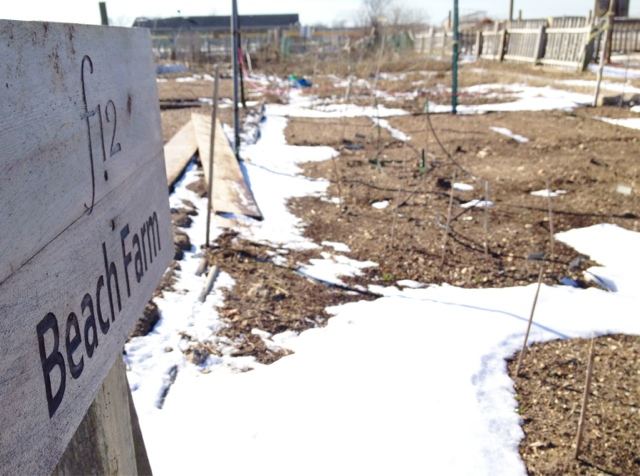
Last Saturday, when the temperatures reached the high fifties, I made it a mission to get to the Beach Farm. I hadn't been in three months. The snow was still high in spots, bare ground in others. It was fun to think of how the wind and rain and objects colluded to mold the snow that had fallen.


Here, snow over a foot deep, sits in layers, a story of our winter's weather, a glacier on the rise.


And everywhere signs of November-planted garlic.


In the cool blue shadows, Allium sativum.


Where the sun has done its work, early garlic is proud.


Scanning the mounds and valleys, a pattern emerges.


Everywhere, garlic surmounts the crunchy snow.


 Upon quick inspection the crocus looked so neat, so orderly. Why?


Huh? Frost bitten? No.


Rabbits! Trimmed every set of leaves to the exact same height. Never even gave it any thought, the little buggers. Crocus sativus, tasty to rabbits with little to eat in the cold of winter. Good for rabbits, but not so much for next autumn's saffron.


Last of the Potatoes


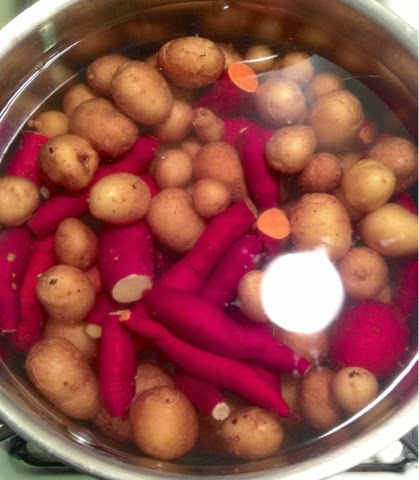
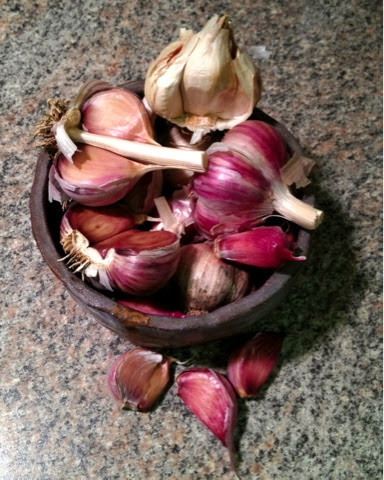
I'm boiling the last of my Amagansett grown potatoes and a handful of sweet potatoes given to me by a farmer out at the barn. They'll be softened by the boil, then tossed in a hot pan with olive oil. Towards the end I'll put some butter on and chopped garlic. I've noticed my Artichoke variety garlic has gotten downright buttery raw, now. So good. The one at the top of the bowl is Artichoke. It's important to know how garlic changes as it sits, sometimes for the better, sometimes for worse. 


Garlic Seed Stock For Sale


I have nearly two hundred of the highest quality, organically grown, seed-sized garlic bulbs for sale. Because I decided to scale back my production this coming season, yet my garlic seed was already on order, I paid for 2 times more garlic than I can plant. Now, I am offering this garlic seed for sale to you at my cost. I will not put this garlic for sale on my culinary garlic site, Hudson Clove. If you are interested in planting garlic, but haven't ordered any (you will find most sources have long ago sold out), send an email to nycgarden@gmail.com with the strain and quantity you are interested in. I will email you back. Late October into November is the ideal time to plant garlic in our area, so you will receive your garlic exactly at the right time. $3.50 per bulb plus shipping if necessary.

I will receive additional varieties and strains later in the week and will add those to this list. Expect to see a few Artichoke (Lorz, Red Toch) , Silverskin (Nootka Rose, Silverwhite), Asiatic (Asian Tempest, Japanese), and Rocambole (Killarney Red). Below are photographs of the bulbs for sale, the strain, variety and quantity. 


Georgian Fire, Porcelain varietal (20 bulbs)


German Extra Hardy, a Porcelain varietal (17 bulbs)


Chesnok Red, a Purple Stripe varietal (26 bulbs)


 Russian Red, a Rocambole varietal (28 bulbs)


 Siberian, a Marbled Purple Stripe varietal (60 bulbs)


Xian, a Turban varietal (7 bulbs)


Hudson Clove Live


The online garlic store is now open. Whew! Here you can buy an eleven bulb "gift bundle" or five varieties by the quarter pound. Please note that USPS shipping prices are quite reasonable if you are purchasing less than three pounds for shipment anywhere in the USA, but rise dramatically if your package weighs more and ships to any state south or west of the Appalachians. This new postal service pricing was a surprise to me and quite confounded my Paypal shipment price calculations. If you live far from the Mid Atlantic and you see a ridiculous price for shipping, you will save money by finding alternate sources in your region. Also, one final word on shipping: If Paypal doesn't utilize your current shipping address, please email me on the day of your order with your current shipping address. I can circumvent the Paypal shipping address it forces you to use and get the box out to you. Ok enough about all that.

You can also visit Hudson Clove on Sunday, September 29, at this autumn's first New Amsterdam Market near the old Fulton Fish market. Here, you will be able to buy garlic priced by the pound, one bulb or thirty, and mix varieties.  If I do not sell out at the September 29 market, I will return on October 27. Also, I was asked to return Sativum ? Sativum to Bartertown at the Dumbo Arts Festival on Saturday, September 28, in where else but Dumbo, Brooklyn. I will not be selling garlic, but will be offering free raw tastings, garlic education, and loose cloves to take home.


Beach Farm, MidWinter, Post Sandy


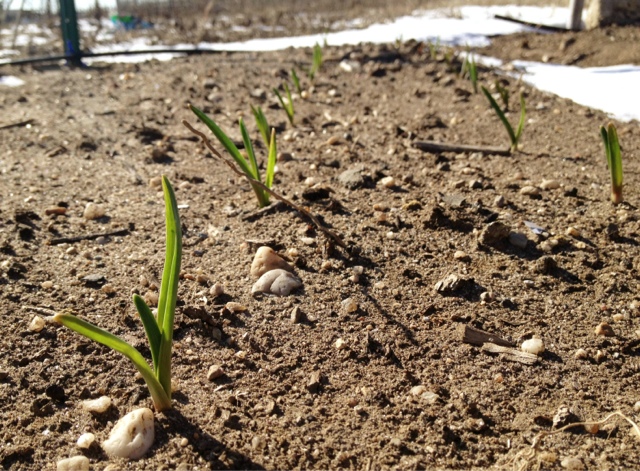
What a cheerful sight it is to see those over eager, warm-weather loving garlic varieties popping up so neatly in their rows. It warms the heart in the face of the cold winds and disarray. It's somewhat ironic that the warm weather garlic is the variety most likely to sprout and deal with the cold.


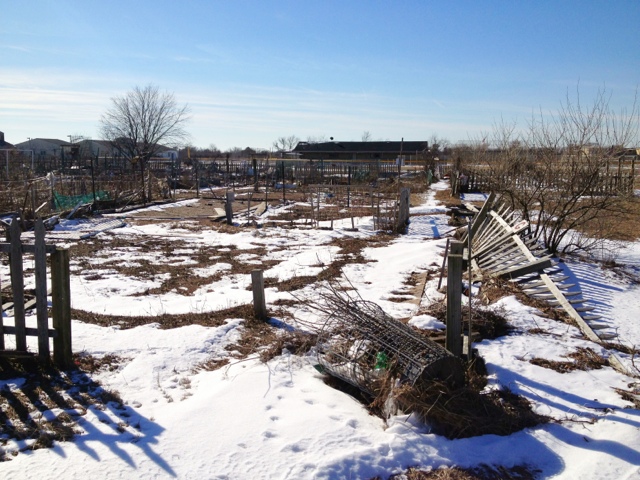
Ft. Tilden looks not a wink different from the days after the storm, except the Johnny on the spots dropped, well, on the spot. The garden has not seen any kind of improvement from park staff or gardener. We have yet to receive our contract, but should gardening here be on for the year, I doubt that much will be done that isn't out of the gardeners' initiative and that's how it should be. A little ownership, a little pride. Many things are needed, starting with a cleanup of so much crap. The fencing all around needs lifting or shoring. That can bring us to where we were before the storm. I'd like to see a compost corral instead of the useless compost bins. An incredible improvement would be some kind of pergola over at least part of the picnic area so you can take a shady break -but this is maybe out of the scope of the garden's core identity. Too luxurious.


Over at Floyd Bennett Field gardens, they're battling a natural gas pipeline regulating station to be built just down wind. You can read all about that on Karen Orlando's blog Outside Now.


Nearer Than Eden


I am usually the only one at the beach farm at this time of the year, but this Sunday I was not alone. There was FEMA and the Red Cross, National Park Rangers from other states, sanitation workers, police, hovering copters, a ready fire department, and Wolf.

As I pulled into the lot I saw him moving slowly toward the garden, cigarette dangling from his lip. His restless and sweet autistic grandson with him as always, but given the cold wind, he remained in the car. Wolf thinks about planting his garlic now, although the work will wait until the new moon of early December. He planted this superstition in my mind last year, and I thought of it as I planted thousands of garlic cloves at the farm through dark nights of November's new moon.

Under Wolf's watchful eye, I turned over the garlic bed once again. It had settled under the inundation, now a stone's throw from its prior glory. In s-curves and coils on the surface, earthworms lay dessicated. As I turned each spade full, we scanned the soil for life, marveling at a termite, a wireworm, and two grubs. I brought a sack of alfalfa meal from the farm to rake into the bed, then, showing off the wheel dibble, marked rows for one hundred eighteen cloves of eleven strains from eight varieties and a handful of French grey shallots.

Afterward, I pulled the fennel seed from our plot, convinced that it would spread all over despite salt water inundation. In fact, the old plants were sending out new shoots -no matter the salt, no matter the season.

The crusty presence on top of the soil is salt. Sandy was a dry storm, for us, and it hasn't rained all that much here since the inundation, certainly not enough to wash the salt down through the soil. Sunday's strong northwesterly winds set grit to my teeth and left a mouth full of brine, reminding me of the hazards of bare soil. I collected a sample to send to a university that has begun testing soils for contaminants likely to have been present in the waters around the metropolitan area. Hydrocarbons, PCBs, sewage, et cetera, et cetera. I think we'll be clean, or at the least, cleaner than some.

As I left the blustery beach farm, I stopped to ask a NPS ranger what he thought would come of the garden. He said that he didn't know, that he was from another state and was only here to help out. He said the Park is a mess, in disarray, and they've a lot to do. Of course. We know that the NPS has, at best, mixed feelings about our little messy paradise. It has crossed our minds that the destruction and possible soil contamination could be reason enough to shut the garden down. I know some gardeners may not be coming back any time soon -they've lost their homes, so what's to garden for? Others will be back, if not until spring. Men like Wolf and myself are already back, turning our beds under the whopping of copters, planting our cloves to the electronica honking of a hundred lifting geese, all within the aura of disaster.


Bargain Basement


I'm looking to clear out the three or four hundred bulbs I have left as we gear up for planting this November. These bulbs are the smaller, less than perfect bulbs culled from those I sold previously. They will also be unlabeled. Mixed varieties, $6.75 by the pound. Interested, visit  Hudson Clove.


Shameless Self Promotion


A couple of events I have going on over the next month, this September, that you may want to check out.

The first is GO, on Saturday and Sunday September 8 and 9, from 11 am to 7 pm. Go is a Brooklyn-wide open studio weekend and nomination opportunity for inclusion in a Brooklyn Museum exhibit this winter. Since this open studio is borough-wide, there are probably a couple of thousand studios to visit. Bushwick has the BOS, Gowanus has the GOS, Dumbo has the DAF, the Brooklyn Navy Yard has its BNYarts. Why not go to a new neighborhood and see something different? See the art in your neighborhood and then come to Sunset Park!

Sunset Park has several artist studios to see between 39th Street and 32nd Street (the Chashama space is way way down on 59th Street). We have a bike rack in our building (55 33rd St.) and the D/N/R stop is a short distance away at 36th Street and 4th Ave. We also have a diverse, bustling community upslope (we're on the waterfront) that everyone should visit. Explore Sunset Park's 5th and 8th Avenue for a Chinese lunch or Mexican dinner. See Greenwood Cemetery, just a few short blocks away. Go bowling, make a day of it!

If you register on the GO site, you can nominate up to 3 artists for the Brooklyn Museum exhibit once you have visited at least 5 studios. It's easy, and we'll all have instructions as to how.


AND...

I was invited to participate in a project at the Dumbo Arts Festival on Sunday, September 29. Artist Heather Hart is putting together a project called Barter Town (Trading Post X: Tomorrow-morrow Land). I will have a booth where I will be displaying and discussing anything and everything about (yep, you guessed it) garlic!

I have a well-preserved specimen of Allium sativum ophioscorodon var. porcelain, roots to bulbils, that I planted in Minnesota last September. I will have varieties on display, seed stock versus food stock, immature bulbs, bulbils, American elephant garlic and Chinese elephant garlic, and more, and will try to answer any question you may have about garlic. Since this is Barter Town, no money or promises of money may change hands. Nothing will be for sale. You may barter your time, your email (for Hudson Clove updates), or your patience!

Of course, there are lots of other things to see in Dumbo normally, and certainly during the DAF. See the gorgeous glass-shrouded carousel, get chocolate, eat ice cream under the Brooklyn Bridge, crap -go to Starbucks.

It's autumn in New York City. Get out and enjoy it. I'll see you there.


Honey Garlic


This humble, dirty head of garlic is amazing. It's an Asiatic varietal called 'Japanese,' with at most 5 cloves per head and creamy yellow flesh. I harvested nine plants yesterday at the beach farm, nine plants which were given to me for free because other cultivars I purchased were quite small. These too were small, but I'm so glad that they sent them. Ahead of my satisfaction, I ordered a good quantity (although sale quantities are limited by most farmers) for next year's crop. It will take a few years to get these up to good numbers.

One head detached from its stem at harvest and was grilled. The cloves will begin to bubble through the skin -that's when you know they are ready. Grilled garlic has the consistency of a baked potato, but the flavor and sweetness are completely different. And this garlic, this garlic, tasted, to my palette and those I shared with, like clover honey! A distinct floral note above the starchy sweetness. I was blown away.

I highly doubt that this cultivar would produce the same after curing and I suspect it would be robustly garlic-flavored. But green, fresh from the ground, unbelievably like honey.


First Fifty


It was a hot, high dew point day, the kind you happily fight traffic to make way to the ocean, the kind we've been having lately. The wind was strong off the ocean, and welcome.

I did have purpose, other than cooling off, and that was to harvest the Turban and Asiatic variety garlic. They had mostly scaped, and were browning leaves at a rate that made me nervous given the imminent threat of rain. We've had quite enough rain over the last several weeks, and good garlic prefers a week or so of dry down before harvest. It had only two days, and that was going to be enough.

I won't give the reason, although I suspect it had something to do with the decayed outer wrapper, that had almost every root bundle the home of an earthworm or two. Can you see him, dead center.

It is normal for the outer wrapper to decay in the final month of growth. The wrappers of garlic are all leaves. As the leaves dry down above ground, they decay around the bulb, underground. We do not want the garlic in longer than necessary because of the potential to lose more wrappers as more leaves dry down. The wrappers offer protection to the bulb in storage. If the splitting you see above became more severe, perhaps in several wrapper layers, it would invite moisture, soil, and disease. So the early bulbs need to be pulled when they need to be pulled, especially if rain is forecast. We heart our wrappers.

Incidentally, we had these mushrooms sprouting, all over, just underneath the soil line. At first we thought, we hoped, that they were puffballs, but I've come to the conclusion that they are immature stinkhorns, which seem to really like our wood chip paths.

A posed picture. The whole affair at the beach farm is a practice run and coal mine canary for our upstate garlic harvest. We should be about two weeks ahead at the beach farm, and now I know to ramp up my attention, as I've only been visiting the upstate farm once a month until now.

Well, the storm materialized to the northwest, and although threatening, never actually wrung any serious moisture on the beach farm.

As the clouds built, I did a cursory cleanse of the lettuce. Lettuce needs washing, and washing again. A snail and a worm or two figured out I was growing the stuff. The snails prefer the bib, the green and black 'pillars the romaine. Me -I'd rather eat snails with my lettuce. Watch out snails.

The first fifty. No, it has little odor once it begins dry down, but the soil drops and scatters. I'm still looking for a cure site for the next 1950 bulbs. I've got lots of ideas, some prime, some less so. The living room? Less than prime, but air conditioned which the bulbs take to quite well. There's a barn where I'm growing upstate, but right now that barn is up in the air -although I got wind that maybe the masons are coming to pour a foundation on my next visit. Well, I don't think I could ask. I need to find a local spot and I think it's entirely possible, with some fans, and a dehumidifier, and some luck.


Rain Salad


I'm afraid I am a little behind in my posting. These images are from last Thursday. I will be heading back to the beach farm today to consider pulling out the earliest garlic, some of which you see below, after the best we seem to get in a run of dry days.


Now the peas are growing. When it's good for peas, it's not so much for tomatoes, but the tomatoes are in and should be just fine when the sun comes out.

Good for peas is also good for lettuce.


And also good for fennel.

Which is fattening up nicely now, alongside all the warm-weather weeds.

I fixed this tear in the irrigation system, should it ever be needed.

I've harvested the Allium vineale, or field garlic, as it was starting to mold on the stems and probably would not size up any more.

I also test pulled one of my Turban cultivars, Tuscan -ready.

But I am not ready for an unexpected onslaught of locusts, err, grasshoppers. The young were everywhere, all over, ready and waiting.


A Tale Of Two Garlics


Two weeks back I bought garlic at a Cortelyou farmers' market stand. I talk about that here. I went back to the market to buy Rhubarb today and saw that the two prime farmers were selling green porcelain garlic, out of the field maybe a month or so ahead of schedule. One of the farmers was selling the very same garlic you see on the right. At the food co-op, I bought the "USA" grown garlic you see on the left. It was refrigerated, which means it will sprout shortly, but I wanted a more garlicky flavor than I was getting out of the white bulbs I bought two weeks ago. 

I know that refrigerated garlic stores long, as long as it never comes out of that 35 degrees, but I can't say from experience how long it will last before sprouting. So I now have a test specimen. 

There are three significant differences in the look of these two garlic bulbs. The roughness, the roots, and the longer cut of the stem of the reddish garlic on the left, and the smooth, root-scooped, short and clean stem of the white garlic on the right. Today at the farm market I confronted the man at the register about the source of his white garlic. You would expect him to say that it was theirs, and he did. Do you want it, he asked. I said no, but also that the scooped roots are a common practice of Chinese processors. He again stated that they were theirs, stored from last year. 

Nearby in his stand were the porcelains you expect to see at this time -green leaves attached and bright white bulb. As I said in my former post, there are garlic varieties that will store this long in good conditions -Silverskin and Creole (neither look like the one on the right). Now that the season is running again, I hope to see these cheap whites disappear. 

I turned over and over whether or not I should go to the market manager. I didn't. I like that farmer and maybe I am completely off-base. Any market manager should know whether or not this produce is in season, and should be able to spot an imposter. So, for now, I leave it to them and the customer.


Garlic To Leeks With Greens In Between


These are the scapes of Allium vineale. They were tender enough to snack on raw, which I did, but most were chopped to flavor roast turkey.

I was impressed with the bulb size at about an inch. I've left the remaining vineale to size up. At this size there is a woody stalk at the center of the bulb.

The butter lettuce on the left and romaine on the right. Best grow fast lettuce, tomatoes are on your heels.

The cima di rapa, or rabe, is also growing fast. Eating rabe will put sand in your gullet. The leaves seem to have the magic ability to capture grains of sand deep into the leaf axil -soaking doesn't always get it. The answer is cultural -I think a mulch to keep down splash up is necessary.

Ahh, the elephant garlic. Just four 'cloves' pulled from a Fairway purchase were planted last fall. Elephant garlic is not really garlic, but a leek (Allium ampeloprasum), which explains its mildness as a garlic.