tomato

Lawn Of Plenty


It was about mid-May when I decided to carve five small rows into the front lawn for this year's vegetable patch. It is the sunniest, flat space on the land here. In the distance, the driveway and a hedgerow of Hydrangea arborescens -a solution to coarsely articulated snow-plowing and a mass of foundation plants in the way of a future house project. Seven weeks from the day the tiller expressed itself, the vegetables are taking advantage of our long, northern days.


My first round of green beans didn't arrive, quite possibly because I didn't water the seeds enough or maybe due to three year old seeds. They were all French beans, ones that trialled well, hmm -three years ago. So I bought new seed from the big box (so many home projects!) and planted those. Meanwhile it had been raining heavily for a few days -that's when some of the old seeds showed up, 'Velour,' I think. So far no problems with bunnies -or deer, raccoons, hedgehogs, and whatever other vegetable munching varmint one can have. So lucky -that's all it is.


One four inch pot of flat leaf parsley has become eighteen by twelve inches of parsley -use it daily.


One four inch pot of cilantro has become two feet by twelve inches of cilantro -makes a nice pesto!


The garlic is still green, but I know well enough to start harvesting them. As these go, their rows fill with herbs, green beans, and eventually those brassicas I fully intend to start one of these days...


Four pepper plants from a cell pack of four heirloom varieties. This one set fruit super early.


A cell pack of Japanese eggplant have provided us with an orb -not the usual thin and elongated fruit. What gives? I do prefer the way less seedy elongated varieties. Oh, Japanese eggplant doesn't always imply elongated fruit? These are 'Kyoto,' a round eggplant, and I ashamedly renounce my ignorance!


One four-cell pack of, hmm, I forget the name, but cucumber. I do recall it saying compact, and this one is definitely compact. We grew them in pots, elevated off the ground in metal pot stands that happened to be here. A couple of things to point out: these four plants in two pots have been productive for their size and have not succumbed to mildew. They have yet to reach the ground and have many flowers per vine. I recall googling the variety at the nursery, Shady Acres! Ahh, they have a plant list- It is Spacemaster. Pick them pickle size for best flavor.

A word about Shady Acres. Heirloom. That's the word. Seriously, Minnesota has some catching up to do when it comes to organic garden supplies and heirloom vegetable starts. It is very difficult to find what I came to expect -even at Larry's on the corner in Brooklyn (Best Deal on Bloodmeal!). I edify every nursery I come into contact with, including Shady in regards to fertilizer choice. I heard about Shady Acres from my neighbor who is busy trying to grow Minnesota's largest pumpkin, and was grateful for the recommendation -they carry heirloom vegetable starts. For me this means they have a variety of tomato beyond Rutgers, Beefsteak or Early Girl for the person who simply didn't get to starting his own.


Potatoes. They grew incredibly tall, so high that they could no longer be soil-mounded. Then a week of heavy thunderstorm rains, about seven inches in all, ensured that they would lay flat until they turned back up toward the sun, which they have, albeit more prostrate than before. They have been flowering for a few weeks now, with new potatoes sure to be available soon. I've decided to wait on those, aiming for the bigger potato of the future.


The tomato plants are some of the healthiest I've grown. Again, an heirloom variety pack from Shady Acres provided the starts. Ours have been in the ground for about five weeks, have grown over thirty inches tall, and some are producing tomatoes. We also have a grape variety, four plants in total. We won't get a ton of tomatoes out of four heirloom plants, but this year required low input, experimentation, and observation.


What is remarkable is the health of each plant. No visible disease, no wilt or cankers, no blossom end rot (can we thank high Cal-Mg soils?), simply robust plants. Look at that impressive stem. It helps to be gardening in a spot that has yet to see any vegetable growing. We haven't had any Colorado potato beetles either, so here's to hoping that our little clearing is protected by the woods and wetlands that surround it.


Lastly, the bug-eating army of amphibians can't hurt. And what of the pansies? It hasn't been a very warm summer so far, but plenty of days in the lower eighties. Here it may be that pansies just won't quit.


Return of the Beach Farm


We lost a number of tomatoes on the vine because we weren't there to pick them, the weeds are tall and deep green, verticillium has done its damage to the heirloom tomato plants, only one green bean has sprouted, the volunteer butternut squash (where did that come from?) spread to every corner of our little plot. All the result of our benign neglect. But look at the harvest! There were still tomatoes to pick, and a butternut squash, and the peppers -they've really produced!


The pepper plants are tall, bushy, full of flowers and peppers. The sun scald is on the wane.


Bountiful sweets and hots.


The neighboring plot I cleared and planted with buckwheat looking a little weak. Shorter, thinner, paler, and flowering sooner than expected. Also, not one bee in sight. 


The buckwheat flower is said to be highly attractive to bees, so either there's no bees around or these flowers aren't the sh*t. When I visit the garlic farm tomorrow, I'll be on the lookout for bees. Soon both the beach and garlic farm's buckwheat will be cut.


First tomatoes plucked. Black Krim, Black Russian. Both excitingly delicious.


And the green New Mexico chiles were pan roasted, dry, and blended with farmer market tomatillos for mildly medium hot salsa verde.


The Early Tomato


It's those golden flecks that turn me off to the hothouse or row tunnel tomato. Fully field grown tomatoes have them, but somehow they appear more pronounced in the store tomato, the early tomato, the hydroponics tomato. I don't think it's an indication of a terrible tomato, just a sign to its origins. 

Well, I bought some anyway to go with our copious leaves of basil from the beach farm.


The Last Tomato?


I'm heading out to the beach farm for what probably is the last visit this October or even November. The Fed wants us to remove all items this year so they can straighten the paths, or at least that is what they're saying. My wood and net tomato cages will come out, then. The tomato beds will be on the opposite side next year. If I grow garlic at the beach farm, it will grow where the tomatoes did these last two years.

This last tomato, Black Russian I believe, is still quite firm. They were rotting awfully fast during those last weeks of August into September. Fruit flies were abundant. I ate the second to last yesterday and found it perfect.

Indigo Rose Tomato


These are my beach farm grown "Indigo Rose" tomatoes. Many have asked how they taste and the answer is okay. They are plenty juicy, and maybe this is killing some of the flavor. They do have a very pleasant acidity and little in the way of sugar. I will grow them again and toss them with "Sungold" cherries for color and sweetness.

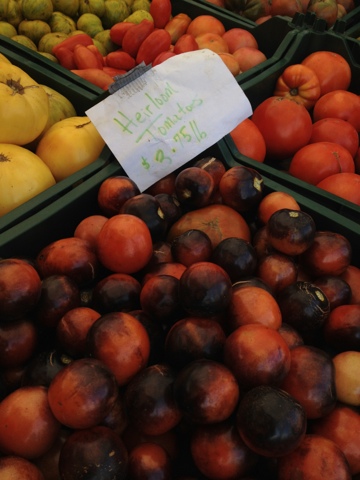
More than one farm was selling these at the Grand Army Plaza Saturday market. They all labeled them heirloom. Seems anything not looking like a dull red tennis ball is an heirloom these days. But for the record -these aren't heirlooms, unless your grandfather is a university in Oregon.


Love Apple


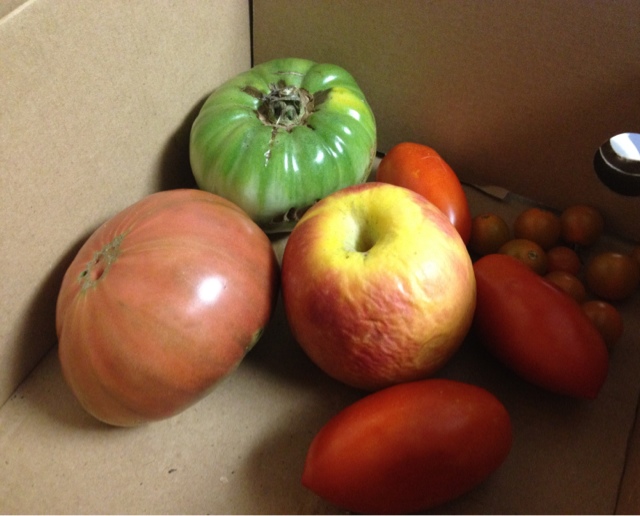
I picked two green tomatoes: a Black Krim and a Pineapple (or is it Hillbilly?). The Krim had the faintest faint of color, hardly color. The other, a tomato yellow and pink when ripe, was nowhere near ripe -super green, but large! We traveled with them in a shoe box.

When we arrived in Minnesota, I found a ripening apple and put it in the box. Now, after 36 hours, the Krim is ready and the other has only one small spot of yellow on top.

The application of ethylene gas is common commercial practice to aid ripening of fruit. In fact, when fruit ripens, it naturally produces ethylene. Placing a ripe apple in a box or paper bag with your green, but mature, tomatoes will speed up ripening. It may even ripen a completely green, immature tomato, although it won't improve it's quality.

If you pick tomatoes at what is known as the "breaker" point, an apple will speed up its ripening. If the tomato is already "turning," meaning it has up 30% coloring, you won't need the apple because the tomato is now producing its own ethylene gas. Just put it in a bag to speed it along. If your tomato was immature when picked, like my Hillbilly/Pineapple, it may ripen with an apple, and why not try -it can't be any worse than a grocery tomato in wintertime. Or, eat fried green tomato.


A Tale of Two Tomatoes


About the tomatoes -all other problems aside, I must report that I completely eliminated blossom end rot from my tomato patch this year. It was a dastardly problem last season, particularly bad in the roma tomatoes, affecting nearly half the crop. What is different this year? I planted them same type of tomatoes in the very same beds using the very same drip system for irrigation. But, I did have the soil tested, which led to important information about my plot. First, I found that my garden soil was acidic, somewhere near a high 5 pH. Second, I found that I had more lead than I wished, somewhere near 100 ppm.

The first thing I did was lime the beds in February to bring up the pH. Lime is high in calcium and has other trace elements, all useful for tomatoes suffering from blossom end rot which is often described as a deficiency of such. Liming also helps locked up minerals become available -it's all part of a neutral soil program (see this). 

The second thing I did was add 25 pounds of granulated fish bone meal into the beds in March. I had read that the EPA was using fish bones to remedy soils high in lead (in short: the lead binds to a mineral in the bones, creating a new, insoluble mineral). My thinking was that their fish bones couldn't be any fancier than ordinary fish bones, and how much could it hurt anyway. Fish bones are also high in calcium and trace minerals, again, useful for the tomatoes suffering from blossom end rot.

And today, not one instance of blossom end rot in my tomato beds. This should suffice as evidence of a solution, but we also had contrary situation nearby to underscore our results.

Just outside our plot we planted our extra tomatoes. The soil is the same as ours, of course, but didn't receive any amendments this winter. Almost all of the roma type tomatoes look like this. Blech -I'll never go back.


Last Chance Redux


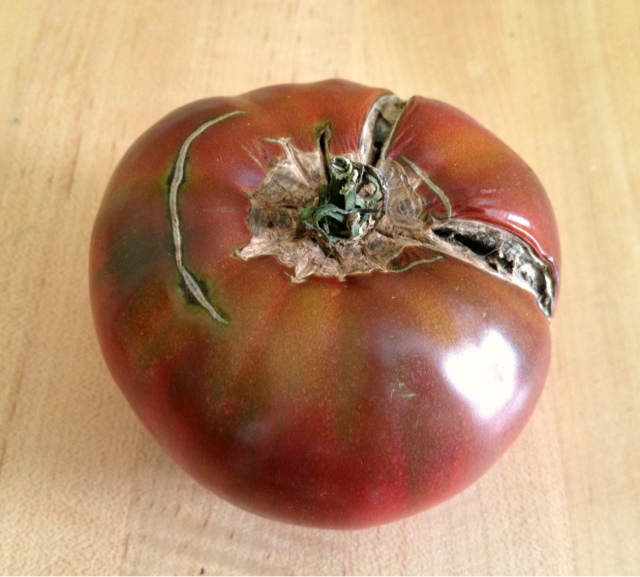
Remember this from the other day? Cracked tomatoes. What comes with cracked tomatoes is diluted-flavor tomatoes. Thanks a lot rainstorms. Incidentally, the Black Russian tomatoes had more flavor than the Black Krim. I figured them for the same. Figured wrong.

We had to harvest anything near ripe, anything with even the faintest blush of color, because we are a day or so away from leaving town. I even took two really large but totally green fruit. August is a terrible time to leave the vegetable garden, but it's the best time to get away.

Finally we discovered what the 'Indigo Rose' tomato looks like ripe! It's gorgeous, really, with a red bottom and black-purple top. Taste? The jury's out, as I'd like to try more than one and not after too much rain, but it was mildly tart, with an almost green tomato flavor. Fun fact: This tomato has been hybridized as a high anthocyanin tomato. Anthocyanin is responsible for the dark coloring, and only appears on the top where the fruit receives direct sunlight. It appeared to me that this tomato was a cross between a more or less "wild" or "old world" tomato and a more highly bred tomato thanks to the dark coloration that recalls other nightshades. Turns out this is true.

The 'San Marzano' tomatoes are doing excellent, although the vines are not quite as large as last season.

I seeded these a month ago. After three weeks of not sprouting, I gave up on them -too hot for romaine seeds I said. Then, on the day I transported the seed tray to the beach farm, there they appeared. A week later they look like mini-romaine. I should have seeded more!

The carrots are up and well, while Larry's leftover broccoli isn't too shabby. My starter tray brassica -the prized purple cauliflower and Romanesco broccoli, are barely surviving the onslaught of cabbage worms. The cauliflower has been transplanted into the beds, new irrigation lines trained on them. I poured some fish juice onto the small Romanesco sprouts in hope that it energizes them into out competing any worms that evaded the two finger pinch.

Basil, green beans. Successive plantings of green beans saves us from overload. Smart. Should've been doing this all along. Vacationing, however, means picking fancy French filet beans too late. French beans don't tolerate being over-sized, whereas their American counterparts are pretty comfortable with it.

And here our box of tomatoes, most eaten that night, the rest given away. Tomorrow we leave, cats in tow, for Minnesota and all that awaits us there. I'll be scouting for old-fashioned manual farm tools, studying tractor implements, and keeping my eyes on the woods in search of mushrooms -it's been too long. It was near this time two years ago that I found the large Laetiporous cincinnatus. This time, we eat.


Decamp


As we prepare to take off for a few days camping on the coast of Maine, we must make sure the garden is fit to survive a week's neglect. It was hot at the beach farm yesterday, the wind from the west, and had only an hour to make sure the irrigation was still in good order, the fruit picked, biggest weeds pulled.

Good luck fall broccoli and cauliflower, lettuce and fennel seedlings. Placed at an intersection of several irrigation sprayers, these will need to toughen up while we are away. 

Indigo Rose they call it. Lots of them, none near ripe. 

These are called Speckled Roman, but I would've called them Jupiter.

All sorts of little red orbs plucked lately. Notice the flocking on the back one? That's the Velvet Tomato, its vine a blue gray fuzz. It's taste is mellow, more sweet than tart, but not real sweet.

The first planting of French beans. Nickel, in the middle, has started producing. The flavor is the best so far, a floral note over the green bean. Velour on the left, producing heavily now, a touch bitter green in flavor, and good looking. Easy to pick because they're easy to see, the purple pods also stick to the vine, running the risk of pulling out the weakly-rooted plant.

Maxibel and Soleil have finally begun producing. Soleil is looking more healthy now, sizing up, although still small compared to the others. Maxibel has good flavor, second to Nickel. Soleil hasn't produced enough yet to be well-considered.

Rabbit bites. The rabbit like the green bean tops, but not the beans? Excellent.

Too many cukes on the dancefloor. When we get back I will need to thin these.

Visited by several swallowtails now. They love fennel.

A minor haul, which is good, because these don't travel. Gave most away.

Summer travels in a paper bag. A hot car, sun light, and a plastic bag are deadly.


Potential


Finally, there's little to do in the garden, but look around and wait. The weeding is low, the summer planting all done, spring's harvest complete. To eye the garden without a sense of work is a relief.

It has been a galloping year with the beginning of a distant, small farm, two solo painting exhibits, teaching, the day job, and somehow the notion that all this can be blogged. The beach farm an island, now, away from all those activities, its potential transferred from sea into air into mind at most a loping amplitude. 

So, we watch tomatoes.

Milano plum.

Speckled Roman.

San Marzano.

Indigo Rose (black, blacker, blackest. Ripe?)

Pineapple, Hillbilly, or Brandywine I cannot say.

Black Krim.

Black Russian.

Beam's Yellow Pear and yellow wilt.

Miniature White cucumbers.

Milkweed that survived the whack job.

Those that did not.

Foeniculum vulgare. The sweetest young greens you can imagine.

White eggplant.

Larry's leftovers broccoli (I can never take all that he has, but would if I could).

A small patch of Nantes carrots.

And our small patch of the ocean.


Botoxato


What is it about these greenhouse heirloom tomatoes? I began seeing them last year at Fairway, although these were at Amagansett Farm Stand, which is hardly a farm stand, but an overpriced food trend outlet for summer residents and weekend trippers.


There they were, on the first day of open season summering, looking enough like the real thing from a distance to draw you in, but up close have a disturbing mix of right shape, wrong skin. Is it just me or do you feel somewhat (but not completely) repulsed by hothouse heirlooms? Is it more of a purist's stance than anything to do with the qualities of such a tomato?


It's All Happening


The snap peas are a little slow this year.

And the chard? It keeps on giving -this is last year's chard!

When the chives are flowering, there should be some lettuce ready.

Not quite on this row of bib and romaine.

But this bed, yes, much to harvest.

And not a moment too soon.

Because the stinkhorns are up and when the stinkhorns are up -it's time to plant tomaduz.

And they are more than ready, they're past due (giving many away).

Look at that -cereal, bananas, and tomato roots. I will use boxes again -they work.

Twelve tomatoes into the cima di rapa bed...

and into the bib lettuce bed.


Including this most attractive plant -the velvet tomato.

All in all, quite a harvest -15 heads of lettuce, bunches of cilantro, a bag of mustard greens, a bag of chard and rabe, and the early scapes of Turban and Asiatic garlic.

This is our second snail. Why? Wood. A neighbor has framed out his beds, and I left a pile of wood over winter. Snails and slugs need cool, dark hiding places, and wood provides.

Bulbing fennel is up and making bulbs.

And Marie's strawberries -delicious.

A few notes on cima di rapa, broccoli rabe: Our rabe was flowering almost as soon as we put it in. I don't think it should, and I think I planted it out too late. Stems were tender at first, but, much like pea shoots and tendrils, if they are hard to snap between the fingers, they won't get any better cooked. A tough stem stays a tough stem. An early harvest is best, and repeats may not produce the tender stems.

On tomato beds: This year I placed fish bone meal on all the beds. I also limed the garden this winter after I had the soil tested. The pH was low. I'm hoping these two efforts keep in check the blossom end rot that my plum tomatoes suffered last year.


On Your Mark, Get Set, Tomato


I rose too late on Tuesday to get out for the biweekly meeting of volunteers cleaning the wasted woods of Prospect Park. I actually miss it. Mostly because of the social aspects of a great group of people in an unsavory cleanup environment, which can lead to some clever humor. Well, I had an hour to kill before work, and behind on my tomato seeding, I chose to knock it out that morning.

I had no pots and little in the way of paper tubes, but many cereal boxes.  I am a little distrustful of recycled chipboard, a mystery concoction from far away lands, but went for it anyway. Each was large enough for three or four seedlings. I particularly enjoy the barilla box with the single mezzi rigatoni on its end, wide and deep with the little window on its side for viewing root developments (wink).

Outside, on their bake sheet, I filled each box with the planter mix -a mix of composted wood, peat, and perlite. There may be a more earth-friendly alternative, but I haven't found it locally. All in all, about 50 tomato seedlings to be. I can only plant about twelve, so I will be handing out the rest to friends and gardeners. I do have a few interesting new varieties this year -Velvet Leaf, which is more about the foliage than the 2-inch red tomato, and another called Indigo Rose which is really leaning toward a black-green tomato. Hillbilly and Pineapple are both intended to replace my beloved German Striped which I have difficulty locating. Black Krim is, I'm assuming, much like the Black Russian that I also seeded. Speckled Roman is a long roma-type with yellow-orange striations. A Yellow pear type as well, along with several others I grew last year. I think it will be a good year for tomatoes.


Hurricane Haul


 It was eight am. No stop, no tolls.

 Tilden was wide open, with just a few characters hustling toward the shore.

But I went for these. The german stripe has been a disappointment this year and there was no way I was going to allow these two fall to the storm. Bad picture, good fruit. I also picked one that had the slightest blush of yellow on the bottom, where the germans start to ripen first. The remaining greens were left to fend for themselves, including a new flush of brandywine and black russians.

These were my second concern. Plums are determinate, meaning they set fruit in one or two flushes. I had hoped flush one had ripened, but I was forced to pick them a pale blush. I left the greens knowing a strong gale may drop them from the vine, much as what seemed the earthquake had done the other day. Truly, a mysterious pile of greens under the bush the morning after the quake.

I hate picking fruit before ripe, and there are camps on the practice of picking, I know. I would have left these another week.

The haul. Several carrots, a pile of semi-red plums, green beans of course, a few eggplants, mysterious and small self-dropping poblanos, parsley, basil, and those two giant striped germans. The basket is always full.

In other beach farm news...It's about to be a tropical storm. We expect some flattening. We expect to pull the green beans after the storm. They will be replaced by surviving broccoli starts.

This is the broccoli I purchased last week in Maine and planted this past Wednesday. I decided not to tent them despite the cabbage moths fluttering around. The gale will whip the tent and the tent will whip the broccoli to tatters. They can flatten and survive better on their own.

The cukes were pulled on Wednesday, and now that the wind is about to blow it appears the right decision. In their place, newly planted snap peas, which have not risen yet, and are hopefully waiting out the storm.

Incidentally, next to the flowering cilantro are all the carrot thinnings I attempted to transplant. While they looked pretty sickly at first, they now appear well-adjusted and healthy.

This one is healthy too thanks to the feast of parsley and carrot tops. It appeared that this swallowtail had just emerged, and was clinging without much movement to the fence post. Good luck little buddy.


Peak Produce


I had managed to get my camera to work this one day by banging the lens on a table. You will notice on every picture a blurry streak, center left, and a general sense of focus on the wrong objects. To get the images off the card, I needed to unscrew all the tiny screws from the case and yank on the plastic. Somehow, this made the camera stay on for download. It's getting bad folks. What's a blogger without photos?

Morning view towards the green beans, carrots, and bolting cilantro. Green beans are full tilt.

Glow worm (or Black Swallowtail caterpillar) on the carrots.

The haul. Somehow the picture makes it look like less. 

Still getting a good amount of blossom end rot on the paste tomatoes. Although we did just harvest the original flower sets which seemed unaffected by the b.e.r. There are quite a few tomatoes on these plants. One plant has maybe 40 tomatoes on it, all green, and with hope, will overcome the b.e.r.

The recent super rain forced many of our tomatoes to crack and burst. Their skin is the only defense against tomato raiders. Many insects find the flesh delectable, including little ants. I placed this in the sun, then hosed it out, appearing to rid it of buggers. This is one of the last two black russians, and there was no way I was going to lose it to ants. I cut out the crack and will eat it tonight. Delicious.

By the way, I consider ants a clean insect. If ants brought food to my table, I would thank them and eat.