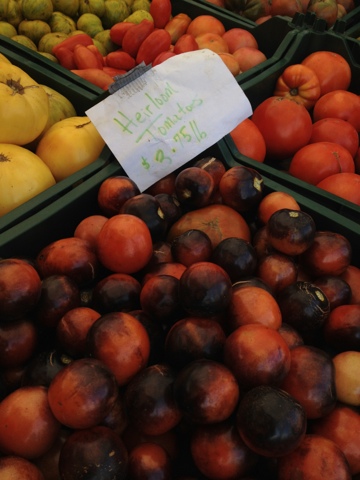
farmer's market

Farmers' Market Prospects


Entirely strange way to enter Prospect Park, and having done so felt its soft transgress.


Above, I spied a white redbud. I wasn't aware of this expression.


Departing the carriage road for the market, so many bins of vegetable scraps. I wish I was making my own compost and I do miss the city's free stuff (to which this does not contribute).


There were nettles (and hops), and many things free should you take the time to hunt and pick them.


Like ramps, which I grabbed, for spring's pasta with all things green. 


And quite a deal on lilac bunches at ten dollars for nearly as many branches; so one for us and one for grandma's Mothers' Day visit.


Group Hog


If you've been following lately, you know that I made the decision to eat only humanely raised and slaughtered meat from now on, or for as long as I can find a way to pay for it. If that proves difficult, I will simply need to eat less meat. So, like anyone searching for something these days, I hit the Internet looking for farms. After digging through the densely packed Eatwild site for New York or New Jersey farms that were both within reasonable driving distance from Brooklyn and had a whole hog price that was within my price range, I emailed three. Of those three, only one contacted me, and that was Lowland Farm. Located in Warwick, NY, the farm is under a two hour drive and their whole hog prices were bested by only one of my picks, a farm that is 2 to 3 hours drive farther from us than Lowland. It didn't hurt that my favorite hard pear cider is produced in the same town, just up the road.

Jason, the farm manager, emailed me almost immediately, and immediately I began to ask questions. I was fortunate that in less than a month hogs were going to the slaughterhouse. Some farms do not slaughter midwinter at all, and my guess is that a winter slow down enabled Jason to spend additional time answering so many questions. Once I had a basic understanding of the process, I enlisted five additional households to share the hog, because who has room in their apartment freezer for 150 pounds of meat? Of course, enlisting five households also meant tending to several different needs and wants and questions. But Jason stood up to that challenge and once we settled on a cut and cure list, I sent it, along with a $300 deposit, to the farm in Warwick, and then we waited.

Mid-February their hogs traveled to Pennsylvania for the slaughter. A farm the size of Lowland has USDA rules to follow, including the required use of a USDA inspected facility. If there is any weak link in farm to table, it's the slaughterhouse. As you might expect, it's not an open process, although Jason did what he could to reassure me that it was as humane as one might hope given the killing of several animals in a single day. The slaughterhouse is also the processor, which means they butcher, cure, package, and freeze the meat. I can't say that I am entirely unhappy with the processing, but some things were left to be desired. For instance, the curing process is the conventional model of salt, sugar, and nitrite. Another is the processor's habit of not providing the unusual cuts, such as the feet, the cheeks, and even the leaf lard. I am told it is cost prohibitive for the processor to scald the pigs, so that skin is not provided on any cuts. I am curious what happens to these parts if they do not get sent back to the farm, and even more curious about the parts we do not request. We could work around the cure issue by requesting only fresh cuts, leaving them to be cured or smoked by us. Of course, I don't have a smoker or the knowledge to cure meats, but I don't require my ham or hocks cured and there's much you can do with fresh belly. However there is little we can do to receive those parts we find desirable, like skins for Chicharrón, braciole, or a succulent shoulder roast.

There is no way to know the weight of your hog until pickup, so in order to get a handle on the tally I had to devise a price schedule based on the averages given to me by Jason. One thing that must be understood when buying whole animals is that we pay for part of the animal that we will never eat. Our tally is based on the hanging weight, the weight of the whole hog after evisceration. Our hog, at 237 pounds hanging, was fifty pounds heavier than the average. For us, that amounted to roughly eighty pounds -or $360. Now before you holler about that, understand that this price is always included in the cost of any meat, whether it is bought by the cut on farm, at your butcher, or at the grocery store. On top of this cost, I added gas and tolls to our groups tally, bringing our per pound price to $7.06.

Now, if you are inclined to buy only ribs, ground pork, or shoulder, you could spend less buying only those cuts if the farm has them in the freezer. When you buy the whole hog, you pay the same price for ground pork as well as thick-cut loin chops, loin roast, cured ham, bacon, and tenderloin. Not only is the price equalized when buying this way, but we are also guaranteed those cuts. Consider, as well, if you were to purchase pork at a NYC Greenmarket, where the $7.06 we paid per pound comes in lower than nearly any cut, including ground pork. While I am sure there is a great magnitude New Yorkers who don't think twice about the cost of pasture raised meat at Greenmarket, I feel confident stating that cost is the single largest roadblock to buying humanely raised meat. If you want different cuts, buying the whole hog is the lowest cost way to do it.

Saturday, the first of March, was pickup day. The weather was warm, hovering around freezing, and the sun was bright. I was excited to see the farm, to step over the notion that this kind of participation is merely nostalgic or cute. Me and Dino, one of our group, left Brooklyn at 8:30 am, crossing the Brooklyn Bridge, virtually without traffic, heading to the Willis Avenue Bridge, then up the Deegan toward I 95 southbound and the GWB. Once over the Hudson, we headed up route 4, then 208, clearly taking the scenic route. We arrived at the hills, farms, old homes and weekenders of the New York-New Jersey Highlands in under two hours. Pine Island, that agricultural deposit, sat below, in the Walkill River valley, due northwest.


Slowly cruising the farm road toward the Lowland store, we passed several cows eyeing us with curiosity.


We parked adjacent to a stone wall boundary, just to the side of the pig barn. Behind the wall, bee boxes.


Inside, manning the store was a friendly gentleman (I've forgotten his name) who managed to carry out three very heavy boxes, each filled with cuts of frozen pork. Here, we discovered our hog's hanging weight (237 lbs), wrote a check for the balance, and packed the van. There was really no sound place to eye through the boxes, to unpack them, considering all that was there and the sense, too, that you want to get your frozen meat to its destination as soon as possible. A check-list would be useful here and I've suggested that to the farm manager. As it turned out, I had no idea our order was missing the much desired leaf lard and cheeks until we divided the cuts at our distribution point. I emailed Jason later that day, and he apologized, offering to provide us with a credit for these on my next visit to the farm.


I thought it may be difficult to see the young pigs, but that didn't turn out to be the case. I enjoyed seeing them, and their surroundings, but didn't think twice about eating the hog that two weeks prior was rummaging around this very same space -a long stone barn with timber beams and billowy straw. When we entered, the pigs, most only 16 weeks old, scurried as fast as possible to the farthest reaches of the barn, but within a minute or so they came scampering back to check us out.


A full sized hog, not unlike the one which gave its life for us.


The young and mature are separated by fencing, but they interact in ways you undoubtedly will find cute.


The young hogs scampering towards us after some apples were thrown into the pen.


______________________________________


My counter top collection of different cuts. The ground pork, to the left, is considerably darker than the pork I've purchased at our local co-op. The hock, to the right edge, will be used for a spectacular and unconventional osso buco sometime in the future. The one point five inch thick center loin chops, bone-in, we had Sunday. Juicy, but a milder pork taste than my preferred dark meat cuts. I need a recipe! Bacon, to the back, is cut twice as thick as your average store bought, but not too chunky -just right. Each slice has a nice balance of fat and meat. Betsy and I have not had bacon in our refrigerator for years; now we have three pounds. For my taste it is a little too salty eaten solo, but sits well once you fit it into a sandwich. We generally do not salt our food much, so whether or not there is too much salt is hard for us to judge. I would prefer genuinely smoked bacon, not salt, brown sugar, and nitrite cured -but this is standard practice, and we are unlikely to find a processor who will do otherwise at this price.


The jowl is huge, several pounds, cured, and tender beyond my expectation. I frequently buy guanciale, an Italian specialty bacon, but use very little at a time. A jowl this big encourages thicker slices. Although not at all cured like guanciale, the taste it adds to foods is phenomenal. I cut it into smaller chunks and placed it in the freezer.

Everyone received certain cuts, but then we haggled over what remained -the tenderloins, loin roasts, additional chops, bacon, and hocks. A breakdown of the 29.5 pounds of pork our house received:

-Shoulder roast of several pounds
-Fresh ham of several pounds
-Four 1.5 inch thick loin chops
-About three pounds of ribs
-One large shank
-Very large cured jowl
-Three pounds of cured, sliced bacon
-Five pounds of ground pork

I am quite happy with the quality and service I received from Lowland and I look forward to building a relationship with them. If you do not have a car, you can always visit NYC Greenmarket to find pasture raised meats. There are butchers in town who also carry pasture raised meats, including Harlem Shambles in, you guessed it, Harlem and Fleisher's in Park Slope. Undoubtedly there are others, too, and as always there are the local co-ops and organic meats at Whole Foods and other large stores. But, if you want to connect directly with a farm, see the animals, and save a few dollars, there's no better way than to buy straight off the farm.


February Farm Market


I go to the farmers' market in the depths of winter for the apples. I haven't purchased a grocery apple in a dozen years. Fuji is my go-to, winter apple .


Carrots, mounds of carrots -purple, yellow, and the obvious orange. I buy them all. If they were organic, I would appreciate them even more. The two organic farmers who sell at Grand Army in winter do not sell winter carrots.


Here's another reason. Flowers. Outside. In winter.


There are many more meat farmers at Grand Army this winter, but I do not partake. The price is usually out of my league. Ground pork at this stand was on sale, $6.50 -down from $9.50. I partook. Since my decision to buy only humanely raised and slaughtered meats (which usually means capital O, organic), I've been buying meat at the co-op on Cortelyou. We are definitely spending more, but we are still eating meat because I buy only the lower cost cuts, and the co-op keeps prices down by not sourcing hyper local and not using the smallest producers. Buying this way has limited my options just a bit too much.

A little over a month ago I decided I wanted to buy from a local, small producer of pasture raised meat. A whole steer would have been biting off more than I could chew, so I sought out a farmer raising hogs as well. When you buy a whole hog, the price is multiplied by the post-slaughter weight, what is called the "hanging" weight, which means you will pay for weight you do not eat. This is usually about 40 pounds, or put another way -about $180. Add to this my cost of gas and tolls for pickup and delivery, and the cost goes up another $60.  The remaining 140 pounds of hog will be butchered, divided into cuts, frozen fresh or smoked, labeled, and sent back to the farm.

I found six households to go in on the whole hog because who can afford $1000 for hog? More importantly, who can fit a hog in their urban freezer? Each household will receive about 28 pounds of cuts, and each will receive ham roast (smoked or fresh), shoulder roast, several ribs, several loin chops (1 inch thick), belly bacon (smoked or fresh), and ground pork. Based on the prices in the picture above, these alone should drive the cost well over each household's $170 investment. The remaining cuts, which include the tenderloins, extra bacon, ribs, and loin chops, hocks, smoked jowl, cheeks, ears, tails, organs, and leaf lard, will be haggled over by the group. We'll all meet at a central, Brooklyn location so the extras are divided as fairly as possible. I think we will see a price of about $7 per pound for all cuts, which is less than I pay for a pound of ground pork at the co-op.

Of course, the decision to do this goes beyond cost, but to do better, to treat animals and the land as best as we can. I do expect better flavor, but that is not my primary motivation. If all goes well, this will be our model, and possibly expand to include another six households to bring down the pickup and delivery costs even more. Maybe we'll venture into steer territory too, but let's not put the cart before the ox.

Update: I corrected the math above, bringing down the price a bit.


Out Of The Woods


After a nearly four week visit to Minnesota, we've finally made it back to Brooklyn, leaving my father-in-law behind, in his house in the woods. It gets harder every time, for him and for us, to stay and to go. Winter is a hardship, yet it also puts a hold on nature's aggressive reclamation of his works, and its own. The apparent stasis, only more white or less, is an assurance against his decline, putting mortality on the table just long enough to consider your own strategy for facing it.
________________________


I've made a few resolutions, not the New Year's type, but a generally longer lasting set of conditions upon which I live. It's a small list, targeted and specific.
  • Grow and eat my own vegetables whenever possible.
  • Buy vegetables at farmers' markets and our local co-op only.
  • Buy only meat that I can be reasonably assured has been humanely raised and slaughtered.
  • I will not drink any more soda, except the soda in my occasional gin and tonic.
  • Only buy organic potatoes
  • No more canned tomatoes

The first one is obvious, what more can be said. I think everyone who can, ought to. I also want to support our local farmers. As I made my rounds at the Grand Army Plaza market today I found too little produce available, especially organic. We've become so accustomed to all vegetables all the time, and I'm okay with that. So I think that we, including our government, need to encourage local farmers to make whatever investments necessary to get more local produce during the winter. Consider the California drought that has the potential to disrupt our food supply, particularly our winter greens. More investment in hoop houses and storage facilities would go a long way to increasing produce availability, particularly on those farms in the southern area of the local radius.

Meat. This has been on my plate a long time, but I cannot look at another image or read another story of disgusting, inhumane slaughter practices. If you haven't seen Food Inc., find it on Netflix streaming. I love pork, but I can't buy chops from pigs slaughtered by crushing them to death a hundred at a time. The label 'organic' is reasonably well understood in terms of feeding and health, but USDA Organic label says nothing of the way the animal has been slaughtered. Since corporations know how valuable the organic label is to the buyer, they have been working to drive the prices down and they do this by applying practices from non-organic production. My point is that USDA Organic isn't enough, but it's a sign post that can lead you in the right direction at the grocery. When possible I would rather buy meat raised locally, even if not strictly organic, as long as I can be reasonably assured that the animal was treated well in life and in death.  Buying the whole animal is the best way to keep the prices down and nobody I know can store the whole animal so that splitting among 4-6 couples seems to be the best practice. If anyone wants to go in on a whole pig with us, send me an email. 

Soda? Sure -I drink it. We were raised on this stuff. I should be 600 pounds. But I am not, and I want to keep it that way. Bloomberg and I can agree on this: we can cut out soda. 

Organic potatoes? I like to eat these whole, and when I do, they are a nearly perfect food. I grew some potatoes this past year on the farm and learned a good amount of what it takes to produce them. If you buy good quality seed potatoes, your biggest problem is going to be Colorado potato beetles. What do they do? They eat all the leaves, removing the capacity for the plant to grab the sun and turn it into tuber. The number one problem of organically grown potatoes is diminished yield due to these pests. Diminished yield drives up the cost to the buyer. Stores don't like high-priced potatoes, especially conventionally grown, so to keep yield up potato growers use lots and lots of chemicals, some systemic (meaning that the whole plant contains the toxins). Yield drives the cost difference between organic and conventional potatoes. Organic growers have little in their arsenal to fight the tenacious potato beetle, so we accept lower yields and higher prices. I refuse to eat systemically treated potatoes any longer and will buy only organic. This was really hard to accept today at the farmers' market because I also love to buy the different varieties that have become staples at the market, yet only the conventional growers had great variety. I didn't buy there, but found organic Yukon Gold at the co-op and organic purple sweet potatoes for $1.99 per pound. If you haven't had these smaller, sweet, intensely colored, eat the whole thing, sweet potatoes, you're missing out.

I've just used my last can of tomatoes. Canned tomatoes? Yes, now I will only purchase glass or BPA-free aseptic packaging (i.e. Pomi) although I'm sure I'll read something negative about the latter type someday soon. Since I've always been disturbed by the hidden chemistry of packaging and products, glass wins. I'll try not to break any.


Despite my new conditions, I lack an unreasonable rigidity. Notice that I am only talking about buying, not eating. When I am at a friend's house, I will not scour his pantry to ensure I am eating organic potatoes. When I am out at a restaurant I will not require inspection of their meats. These things are what I plan to do at home. While the list is small I feel that if I ensure that these conditions are met, the attitude will spread on to other things, organically.


Season's End


In the early light of an autumnal morning, the iris reblooms. The van preloaded, we had time for a visit to the farmers' market on Cortelyou for carrots and kale and breakfast before market. 


 The new display, where garlic was bundled in threes and labeled.


Gigantism of elephant garlic and minute French shallots at the lower reaches.


It was slow at first, at least in our corner, but then after noon things picked up.


We received dozens of complements on the Hudson Clove display and a photo was always being taken. Must be the artist in me that creates a display more visually stimulating than the product itself. We sold out some varieties, and nearly sold out others. What remains will direct this November's planting -varieties that didn't move will be be shifted out in favor of those that sold well, while retaining all varieties.

We will not return to the Thanksgiving New Amsterdam Market because we simply do not have enough to warrant the stall expense. I encouraged people to buy enough for the holiday, explaining that we would not be back and that they should expect their garlic to last through then. This came as a surprise to many. I also sold a good amount of seed garlic to gardeners who just happened by and saw the sign. Folks growing in Westchester, Connecticut, Long Island, the Catskills, and even central Vermont! I do still have some left if any one is interested -I may put up a sign at a couple of community gardens in the area. I'd hate to eat such large and plant-able bulbs.

I have one more trip, possibly an emotional visit, out to the old Amagansett field to collect my sacks of lime, hand cart, and tools. Then over to the barn to collect remaining garlic and racks that I left behind, sell my French Shallots to a farmer who intends to grow them. I will stop at Agway to return the extra lime and a bag of Harmony fertilizer I will not use (the garden has an abundance of Phosphate) while picking up blood meal and potash for the garlic. Sometime between this weekend and the next I will plant the coming season's garlic and then all can be put to rest for the winter. I am looking forward to that, the quietude of winter, as we re-establish our studios in a new location and get on with other business.


Turning The Corner


Today I signed the document terminating my relationship with Industry City. It was a stressful and sour experience. I'm not sure how to communicate the psychological burden losing one's studio space is. I haven't been able to work in months. 

I arrived at Columbus Circle looking for some coffee, but the line was out the door. I had time to move along to the next only two blocks from the first. On approach I saw the shelters typical of a farmers' market at the triangle in front of Lincoln Center. I had no idea. 

The farmers' market always picks me up. The exhilaration of shopping, the cornucopia of colors and textures puts me right where I want to be. Hell, it's food, right -that's where I want to be. I bought apples (a customer implored me to buy Winesap but after the first bite I thought the skin was leathery) and an heirloom wheat baguette. Turning the corner, the scent of rosemary.


Top of the Food Chain


Scenes from last Sunday's New Amsterdam Market...

We arrived early, maybe we were the first. A beginner's move. The tables were not ready so we spent some time standing around. Although trying to avoid the mad rush of setup while tourists and early birds ask questions, it ended up so anyway. 


People had lots of questions. Some folks appeared utterly dumbfounded by the sudden visual of garlic choice. I saw only one handlebar mustache. Several people took photos of our spread. I mean a lot of people did; hardly a moment went by without a full frame or phone camera. Business was decent, and we made our minimum, but speculated on lower than hoped for sales. For one, the Atlantic Antic and Dumbo Arts Festival were on. Another reason -few go down to the Seaport area so you don't get any incidental traffic. I think the NAM brand has been hurt by the discontinuation of weekly markets. And finally, we didn't bundle.

Well, we did at the Dumbo Arts Festival the day before, and we sold all of those, then made a few more. I had contemplated making tagged bundles of three (something other respected people agreed was wise), but I simply didn't have the time. People like labels, so we ended up bagging individual bulbs and labeling those during each sale -messy, fussy, and slow. We have enough garlic to attend the October 27 market, so if we do I will make tagged bundles of three in addition to the full variety bundles.


We sold maybe 20 percent of the elephant garlic and hardly any of the French shallots (I'm gathering folks do not cook with shallots all that much) and I'm now looking for a bulk buyer. The most popular selling garlic was the Marbled Purple Stripe (people were excited about its stinging, raw heat) and the Artichoke (juicy, sweet and light-bodied with little to no heat). Many people just bought one or two heads and wondered whether we would be back at the end of October. My pitch was the long haul, but some people didn't want to have garlic lying around -they wanted me to hold onto it until they were ready for more. Ahhh.


Market feels like the terminus of a year's activity, like an exhibition of one's finished work. I've learned enormously about myself, at least as much as working the land and growing garlic. I've developed more informed opinions on agriculture and the challenges of the small farm. I understand physically, emotionally, and intellectually what I am capable of achieving in this arena with little resources at my disposal. I've met several committed members of the agricultural community, including activists working tirelessly for local agriculture. And I've been witness to the legions of nameless, faceless workers who do the strenuous labor of providing for our enormous and fickle appetites. Finally, I thank everyone who has supported my project with kind words and purchases. 

Now, in the twilight of this year's work, I must decide how to proceed.


By The Bundle


Excitement is ramping up for New Amsterdam's Market. They believe it will be their biggest yet as anticipation has mounted over the long, marketless summer. Yesterday I built table-top, shallow produce "crates" to display my garlic. I will laser-cut signage today. But how to handle the fray? Should I have bags at the handy for people to drop their choices into or should I bundle their choices after they select them, or both? Maybe I should pre-bundle and tag so that the buyer knows what they are getting. Or should I just tag bags for each variety they purchase (although this could lead to a lot of brown paper bags)? I am stumped on the best way to handle the transaction. I believe education is part of what I am offering, so it goes that the buyer should be able to have labeled garlic at home, but labeling each and every bulb would be ridiculous. This leads me to the prospect of bundling by threes and labeling, but still priced by the pound. But what of the soul who only wants one of each or even just one of some?

We have only one two by six-foot table, with a bench behind us of the same thirtysix-inch height. If a buyer comes to the display and starts grabbing unlabeled garlic, but then wants it labeled, things could get confusing awfully fast. This leads me to the brown bag option -pre-labeled brown lunch bags at the foot of each variety crate. The buyer can drop each variety into its respective bag, which we will weigh and they will pay, placing all in a larger paper and handle bag. Seems overly fussy, no? So I come back to pre-labeled bundles of three. For those who want it all (and who doesn't?) I could have pre-labeled one-of-each variety bundles. Hmmm.

The fussy labeling and bundling is a lot of work. It seems unlikely that I will be able to bundle all my bulbs for sale before September 29 and I sorely understand that every label strung and knot tied is lost time and money. If you were to approach a produce table with seven varieties of garlic that you may want to buy, what would you find valuable?

I am doing the Dumbo Arts Festival again this year, under artist Heather Hart's Bartertown project. This time around I'm considering my barter project on the order of Work For Cloves. I'll have folks on a leisurely art stroll come to my booth to tie and label bundles for barter of loose garlic cloves. I've never been much of a Tom Sawyer, so the event should be rather amusing. How many can we get done that day? How many people want to participate in the local food system? How many people will work for cloves?


Suffering A Sea Change


Mayor Bloomberg has announced his plan to combat the effects of rising seas on our urban population and infrastructure. Applause for having a plan, but I want to point to a couple of things.

In NYC, most of us who live on the water do it because its a splendid place to live, but for most of our history the waterfront, if it was occupied at all, was occupied by industry and shipping. The damage to it by flooding was often less critical than it is to the residential and retail space that have replaced it. It is clear, however, that if we didn't build on the boundary of the sea and the land, there would be little to spend billions defending against. The sea and the land are always in flux, giving and taking, and if you want to build something permanent in this space, you best design adaptive structures and infrastructure. All I can say is that we, not the sea, are our own worst enemy. We build directly on the sea, we cause a phenomena that results in sea rise, destroying a generally storm-resilient coastline, and then aim to build a way to protect ourselves from the monster we created. An old, but decent overview of shoreline protection awaits you here.

________________________


Mayor Bloomberg insists that hydraulically fractured gas be kept out of the city's water supply regions. Why? Because he agrees that the risk of polluting our clean water supply is simply too high. Yet he then proposes that the city's response to human-caused global warming is to pump way more gas into the city because it has been considered less harmful to the climate. New pipelines are coming in at every angle, including through the Jamaica Bay Wildlife Refuge and Gateway National Recreation Area. Where is this new gas expected to pipe in from? Of course, it's the fracked states of the Marcellus Shale and maybe one day from our own State of New York. I don't believe in a double standard. If it's too risky for us in the city, it's too risky for everyone.

___________________________


Just a month ago I had a meeting with New Amsterdam Market. I reached out to them last December because I thought their model of bringing high quality, local foods to New Yorkers best matched my farming practice. Their offices were flooded by Hurricane Sandy and they had to relocate, so they were late in responding to my interest. As it so happens, the other reason they took so long to respond to my letter was that they are effectively being removed from the Fulton Fish Market. Yes, as it turns out, the City of New York (which means Bloomberg and Quinn) has envisioned the South Street Historic District, a waterfront, with new development of the residential, retail, and commercial kind. In fact, this plan is embedded in Mayor Bloomberg's plan to protect NYC from future sea level rise! What? Yes, it's true. Even a plan to protect the city from future flooding is an opportunity to develop public spaces with private dollars. Whereas a market with little infrastructure could tolerate occasional flooding, a new mall, hotels, residences and closed food markets will be a disaster to clean up after a flood. It simply makes little sense unless you view it through the lens of big money. As a consequence, this year New Amsterdam isn't having its regular markets. That's just great since they welcomed me to join their market to sell my garlic!


Indigo Rose Tomato


These are my beach farm grown "Indigo Rose" tomatoes. Many have asked how they taste and the answer is okay. They are plenty juicy, and maybe this is killing some of the flavor. They do have a very pleasant acidity and little in the way of sugar. I will grow them again and toss them with "Sungold" cherries for color and sweetness.

More than one farm was selling these at the Grand Army Plaza Saturday market. They all labeled them heirloom. Seems anything not looking like a dull red tennis ball is an heirloom these days. But for the record -these aren't heirlooms, unless your grandfather is a university in Oregon.


A Tale Of Two Garlics


Two weeks back I bought garlic at a Cortelyou farmers' market stand. I talk about that here. I went back to the market to buy Rhubarb today and saw that the two prime farmers were selling green porcelain garlic, out of the field maybe a month or so ahead of schedule. One of the farmers was selling the very same garlic you see on the right. At the food co-op, I bought the "USA" grown garlic you see on the left. It was refrigerated, which means it will sprout shortly, but I wanted a more garlicky flavor than I was getting out of the white bulbs I bought two weeks ago. 

I know that refrigerated garlic stores long, as long as it never comes out of that 35 degrees, but I can't say from experience how long it will last before sprouting. So I now have a test specimen. 

There are three significant differences in the look of these two garlic bulbs. The roughness, the roots, and the longer cut of the stem of the reddish garlic on the left, and the smooth, root-scooped, short and clean stem of the white garlic on the right. Today at the farm market I confronted the man at the register about the source of his white garlic. You would expect him to say that it was theirs, and he did. Do you want it, he asked. I said no, but also that the scooped roots are a common practice of Chinese processors. He again stated that they were theirs, stored from last year. 

Nearby in his stand were the porcelains you expect to see at this time -green leaves attached and bright white bulb. As I said in my former post, there are garlic varieties that will store this long in good conditions -Silverskin and Creole (neither look like the one on the right). Now that the season is running again, I hope to see these cheap whites disappear. 

I turned over and over whether or not I should go to the market manager. I didn't. I like that farmer and maybe I am completely off-base. Any market manager should know whether or not this produce is in season, and should be able to spot an imposter. So, for now, I leave it to them and the customer.


Hood Wink?


I picked this garlic up at the green market today. Frankly, I'm surprised at how little the farmers have at this time of the year at our local market. And doubly frank, I was surprised to see garlic being sold so late in the season. Can some varieties store this long? Yes, but I didn't see any at the cream of the crop market in Union Square on Saturday.

I bought some, happy to have farmer garlic, now that I dislike buying from the grocer so late in the season (it usually is sprouting at this time of year thanks to long term refrigeration). It was exceptionally cheap, 3 for 2 dollars or 66 cents each. The laws of supply and demand dictate that garlic at this time of the year should be coming in at $1.50 or more per bulb. Another curiosity. I asked the representative what kind it was and he deferred to another. She said it was elephant garlic. Imagine my puzzled look.

When I got home I turned them over to realize that the roots had been scooped out. Do some local farmers do this, I do not know, but it is well known that this is the methodology of growers in China. I've never seen it done to U.S. grown garlic, and certainly not farmer market garlic. Now looking closely, the soil appeared smudged on, as if by muddy fingers, as in after the fact, to make it look, err, farmy.

Am I wrong? Don't know. NYC Greenmarket has a rule against this, although nationwide, not all farm markets do (Minneapolis Farmers' Market comes to mind). If you have the right conditions for storage, you can grow and store certain varieties into May, but I'm skeptical that this farm has done that.


Farmers' Market Relativism


I went to the Union Square Greenmarket last wednesday, the day that Keith Stewart opens his vegetable stand. Why Keith Stewart? Because of the nature of the press and maybe the quality of his garlic, his is the one most often reviewed as the go-to garlic, much like Tim Stark's heirloom tomatoes next door. Entering his stand I expected to see a variety of garlic available, but there was only one -a rocambole. The sign on the basket said 'large rocambole -$1.75 each." I would buy just one to taste how different, how much better, it was than the others. Buying only one -that was my mistake.

About a month ago I placed an order for 3 lbs of rocambole and porcelain garlic from a Pennsylvania grower. The price was table, but I was expecting seed. The website processed my order and I sent the check, but three weeks later I received my check back with a note: "order in July next time." Oh. Normally I would, but your site processed my order and never mentioned that you were sold out. I will not go back to them, but I am also out 3 lbs of seed garlic with rows at the ready.

Stewart's rocambole was starting to look more like seed and less like a taste test. Except Stewart's stand is only there once a week, and I knew waiting a week would be risky. He had plenty large rocambole last week at a price that was more than competitive with seed farmers' prices. A typical seed pound costs $19, on average, and then there is the shipping cost -usually $10.95 for 1-4 lbs. For twenty bucks, I could get eleven of Stewart's large heads with fifty cents change to jangle my jaunt. That same eleven would cost me $38 dollars (2lbs) from a seed farmer, plus shipping, without knowing at all how large they would be.

So I impatiently waited till this windy, rain-soaking day to head over to Union Square. I was tempted to go first thing in the morning, but studio work took priority, and I arrived around 1 pm. I bee-lined for Stewart's stand, half fearing that he would not be there due to the weather. This week's basket sign proclaimed "Colossal Rocambole -$2 each." Argh, what else comes in colossal? Shrimp.

Large on the left and colossal on the right

Now two dollars each and decidedly smaller than last week, I learn the ropes of produce marketing. The passing of one week means smaller, more expensive produce. I buy ten, digging deep to grab the largest of the rocamboles. When I make it to the young lady at the scale, I ask her what cultivar this rocambole might be. She says she doesn't know, beyond rocambole, so I offer German Red or Spanish Roja, voice upturning suggestively. She then says it is Italian. At which prompt I offer Italian Purple (incidentally, two of the missing 3lbs). She then blurts "purple, they are purple!" I thank her, walking away somewhat convinced that these rocambole's are Italian Purple.

Genetic testing has laid bare the DNA of many of the common culitvars and guess what -most are exactly alike. In other words, rocambole 'German Red' is 'Spanish Roja' is 'Italian Purple'. Variation in physical traits amongst distinct varieties are explained as environmentally influenced, not indications of genetic distinction. It is also likely that many of the same garlic cultivars have been continually renamed by different growers in different regions. In fact, the garlic I grew last season has been renamed by yours truly because the seed I bought was sold to me un-named. After determining it to be a Porcelain variety, based on the size and number of cloves, I needed a cultivar. Now it's 'Breezy Point.'

I went to all the stands to check on their garlic. Nothing was competing with Stewart's rocambole, but I asked one farmer what his large, but open-cloved variety was. He commanded "German stiffneck." But I belabored, what variety -porcelain, rocambole? He asserted that he knew nothing of those names -just German stiffneck. I was left to wonder why the varieties and or cultivars are not so important amongst many farmers. Is garlic just garlic to most consumers, so it must be to farmers?

I left his stand while he looked on disappointedly that I did not buy after wasting his time. I was off to buy cameo apples -large, sweet-tart and almost fifty percent cheaper than Honeycrisps. Apples are the one fruit that I will only buy in-season, usually direct from growers. I cannot stand the waxy finish on long haul apples and I hate stickers. Also on sale are two kinds of pears for eighty cents a pound. I bought two (last week I bought too many).

I then stopped to buy some elongated purple shallots a farmer had labeled Tropea Shallots. They are not shallots at all, but red onions, Allium cepa, Cipolle di Tropea, Red Long, Red Torpedo, etc. etc. The Calabrian Cipolle di Tropea is D.O.P., and given their climate, I am sure those taste far better than what I will grow here. But that won't stop me from trying.


May As Well Be June


About 8:30 am today, walking to Cortelyou to see what's at the farmers' market. I chose a different route for the trip south -I stayed my side of CIA. From full concrete yards to an interzone full of gardening misdirections, I inhaled the scent of hose water on hot mornings. I walked lazily, camera in hand because there's always something that catches my eye. I hesitated, though, this morning to photograph -same laziness? The breeze was coming in off the ocean, the way it can on summer mornings. The interzone, part concrete -part yard and garden gave way to full on yards. My camera was unleashed.

This shade "garden" adjoins a long abandoned house and yard.

Misstep?

I turned left, looking for a pizza place that's supposed to be good. I didn't find it. I head for the farmer's market. Along the way I notice Vox Pop, the coffee shop, has closed due to owed back taxes -they're taking donations. Today's market had more flowering plants than vegetables. No ramps, but youngions and garlic greens. I bought three bunches for $7. I bought some boneless turkey thigh at Di Paola and a scone from the baker -I was hungry. Then I made my way north, back to my house, via Ditmas Park.

Its awfully lush out there, for May two. May as well be June.

But the pleasantness of Ditmas Park's sidewalk and strips gave way to all kinds of detritus. Left out on an over-warm spring night -unfinished meals in food containers, human feces and wipe, and this bag which startled me because I thought there was an animal inside.

But then there was this. Creepy, or just a kids night out on the strip, cut short by bedtime?


I moved on.

Porch-top container garden.

Too much, overwhelming.

While I generally don't like shrubs for strip plantings, I do like rugosas and their heady scent.

Shrub sculpting -where yew meet azalea.

What I wouldn't give for a small, lush lawn, forget this huge lawn, for my bare feet on a warm day like today. After, bbq.

My own front yard garden is June lush, despite it being May.


A Walk To The Farmers' Market In The Month Of November


My bounty. I got there late and the farmer consistently with the most produce had only pumpkins and parsnips left. The carrots I got at another stand, stunted ones, 2lb, $2. Apples, lots of apples. And cider. I also got porgies, which reminded me of my childhood fishing expeditions.

My street, facing Coney.


Scarlet supreme.


That proud oak on Albemarle.


This maple attracted me. Much is said about the strength of trees planted out in the open, yet their size and symmetry often disguises weakness. This one was probably damaged heavily in the tornado of 07, and now loses limbs in winds many trees could tolerate. A community of trees is quite protective, keeping winds at their tops, their thinner trunks and upright branches more flexible under heavy winds. While the beauty of that proud oak grown in the open is obvious, a more subtle beauty is present in a community of trees, swaying in concert, under the winds.


Red Japanese maple ever more red.


What's this, a blooming azalea on Westminster?


Felt a little strange, but I was compelled to enter a driveway of the residence to get closeups.


Damp, dark trunks and golden leaves.


Fruit loops.


With all the warm colors of autumn, this pale blue-green juniper simply lept at me.

Last Sunday, lifted, the raking low light, the saturation of color, the dampened bark of trees, the scent of carbon decay, the humid air of spring, I wore shorts and a jacket, on sidewalks stained with tannins, viewed grasses colored naturally by the season, sensual completely, emotionally charged connection to the world, in Brooklyn, on the streets, amongst houses and cars and people.

Late November and early December are the most Romantic months. Get out, on a moist day, enter the woods, the park, the shore, give in to it. Beautiful.


Eww, It's Earful


Ahh, the bountiful supply of sweet corn. We bought some two weeks ago from this same vendor and barbequed it along with a boneless turkey thigh from DiPalo's Turkey. So sweet, it was like eating Corn Pops. We decided to give it another go.


But each and every ear had one Corn Ear Worm, Heliothis zea, inside its husk. Green, black, brown, or pinkish- one worm for every ear. The moth lays one or several eggs on the silk tassel. But generally you won't find more than one worm inside the ear because, apparently the young cannibalize each other.


If you're used to buying conventionally grown corn from the supermarket, it is unlikely you've seen many of these. You know how they sell those shucked corn ears in the plastic wrap, with the ends cut off? Yep, often corn ear worm damaged. That's how they make something that makes people go 'eww' into something that looks like a time saver!


If you remove the husk, the worm wants to escape. It has already made corn meal out of this ear tip.


The farmer selling this corn at the Cortelyou Farmer's Market is not an organic farmer. Organic farmers may use pheromone traps or BT sprays, but these have only limited usefulness. Apparently the female moth can lay up to two thousand eggs in her life time and two generations can survive one season. Food for us is food for all, including worms, so cut off those corn ends and lets get grilling.


Bucka Ding, Bucka Ding, Bucka Ding Dang Doong.

Cortelyou Bounty


I've got it good. If I want to stroll to a Farmer's Market on Saturday, I can walk through Prospect Park. If I want to stroll to a Farmer's Market on Sunday, I can walk through Ditmas Park -a neighborhood, not a park, but may as well be a park with houses. Seven years ago, when I moved to my neighborhood, on the opposite side of Coney Island Avenue from Ditmas, I wasn't aware of these luxuries.


On my walk, someone growing front yard corn.


On the way back, someone growing gobs of Black-eyed Susan, Rudbeckia hirta, cultivar unknown.


This weekend's bounty cost $16.05. Included are 4 orange and 4 red carrots, 1 red onion, 6 blue potatoes, 2 red potatoes, 3 white eggplant, 2 purple globe eggplant, 2 poblano peppers, 1 head of garlic, 2 ears of corn, 2 zucchini, and 1 heirloom tomato. We also got some turkey, cost 2.99lb and comparable to the Fairway turkey I bought a couple of weeks ago.