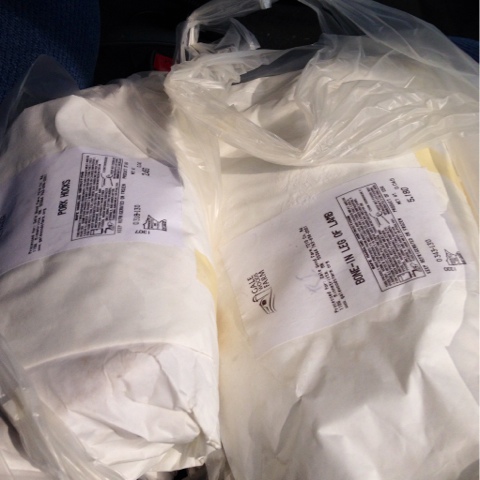
Minneapolis has a farm within its park system, Gale Woods Farm.
They raise cattle, sheep, pigs, and chickens, in addition to a number of crops. They expose school groups to farming and offer volunteer opportunities. The park is about 15 minutes from our place.
You can buy pastured meats at a fraction of the NYC price (5 lb leg of lamb -$36). As far as I know this is unique to the region, is hardly known even to locals, and is a great resource in a region that has not quite made pastured meats accessible to the urban population. Food is generally more expensive in the Minneapolis region than it is in NYC, variety is dismal, international foods are harder to come by, and produce is not well-stocked or good looking. There is a grand farmers' market in Minneapolis, but it's a drive into downtown. Fortunately, smaller markets are popping up including one in our town despite the fairly short season.
Not far from the place they call Bush Terminal, looking out on the Upper Bay, a park has been materializing over the last five years. Ever. So. Quietly.
It's not obvious, or even apparent, how one will be able to get to there. The design encompasses a seawall, a grove of trees, a few steep mounds, and maybe a sports field.
Impatient, I didn't want to wait for the girl to move out of this best view of the new park. She and some friends were hanging out, far from typical public or domestic settings, where the street meets the bay. While I'd like to be the first person to step foot in this park, I suspect these kids will get there first.
It was Chinese New Year, so we went to Flushing, Queens (my first neighborhood, just newborn) to explore several dumpling and hot pot houses for lunch. My mother was surprised to hear me call Flushing Chinatown, then had to explain to her that the place we lived over 40 years ago is not the place she remembers. We were so full after the second place (a mall food court that blows mall food court experiences you've had out of Flushing Bay), and so many restaurants that return trips are warranted. I might add, if you're at all like me, once you eat in a Chinese community, you will resent having to go back to your corner takeout.
When LaGuardia's patterns take planes over Flushing it's at first disconcerting, and ultimately colludes with the taller buildings, Chinese printed signs, and busy sidewalks to create a more cosmopolitan feel than you might expect. You do feel as if you could peg the bottoms of the lifting, slow moving planes with a handball. The image above, made with an iphone's 4mm lens, pushes the plane farther away than it really is. It takes getting used to, but less so inside the Queens Botanical Garden.
I've intended to visit QBot for some time, ever since the construction of their new administrative/visitor building. It's LEED platinum certified, possibly the greenest building in NYC, and all that may mean zilch to a wayward polar bear. But to this guy, it's the only serious reason to visit this underfunded garden.
The three dimensional water feature -used to recycle runoff, process gray water, achieve modest outdoor cooling, for irrigation, and as a visual design element is the heart of this building. Systemic water, a merging of liquid functionality with the designed landscape is hardly common and it makes my heart beat a little faster.
There were problems, of course, but all told these appear to be born of staff shortages or design quirks that can be addressed with some attention. The larger garden lacks a coherent design, lacks interest and given the resources poured into this new building and parking garden, it would serve Qbot to find a way to build a master plan that revisions the garden following these examples. They'll never be NYBot or even BBot, so be Qbot and give us a reason to travel to Flushing by offering something completely new, something so 21st century.
I think it's reasonable to keep people off green roofs. We want people to see, yes, but there should be a way that doesn't impact the plants.
Mounded roses in a ringed circle?
An excess of funny, CNC machine-carved statuary?
Maybe a master plan that merges eco sensitivity with Chinese design, given the neighborhood in which Qbot resides? Many of the great eco-design landscape projects of late have been in China (Quinhuangdao Beach, Shanghai Houtan Park, Crosswater Ecolodge, etc. etc.). Qbot lacks space, but couldn't they access some of the wasted land of Flushing-Corona Park? Surely Flushing Creek (or what's left of it) could be cleaned and greened. Were you aware that many of NYC's early plant nurseries were this side of Flushing Creek (true -I've got maps)? Perhaps a China-NY partnership could help pay for such appreciation of the value of a growing Queens (Flushing soon to be the largest Chinese community outside of China) community. Could be awesome.
But until my grand scheme comes to pass, we should revel in Cornus sanguinea, Winter Flame Dogwood. Brilliant on a gloomy day.
The new lakeside is open for 4 hours each weekend day from Oct. 20 through November. I headed out last weekend during the pinkest of all events -a breast cancer walk-a-thon in Prospect Park.
My approach.
The stone near the drum circle.
No one was around.
Low, dappled light and asters.
Strong bones.
Imagine the ducks here.
For reasons unknown to me, the paved path doesn't move continuously along the waters edge. One must go around an area with trees and shrubs to get to the other side.
Which makes me wonder why this "path is built into the planting behind the wall. Is it because they know people will tramp back here or do they not know?
I am glad they retained the WWI monument. I'm not a fan of the structure, but I'm fond of the statue.
Evocative of the great death and misery of WWI, its deco-gothic figures are haunting in the way few war memorials allow.
On the other side, the "indoor" rink. Minimal, airy, yet hard-edged. An outdoor rink sits beside, but the whole affair sinks back into the landscape. Some will have trouble with its blunt angularity, but the whole building complex, from lakeside, does not overwhelm.
There are lawns.
Construction is nicely executed.
And Abe finally has a place that doesn't feel like a back alley.
And, yes! They finally fixed the stairs that lead to Abe. The easiest job has taken years.
These urns were updated, restored, repaired, recast? However, they're new.
But not these, just down the path.
Turning back, a view toward "Music Island" where music is no longer made.
I imagine this a view of what Prospect Park must've looked like in the 19th century. We are lucky to have it so late in the game.
Between chaos and order there is only maintenance. And what plans has Prospect Park Alliance or Parks for maintaining its new jewel? Some staff who were tying wire to a hole cut in the chain link mounted on the slope of the music grove spoke frankly -there's little chance of this holding up as far as they can tell.
An obvious point of departure: The nicely detailed fencing is hardly barrier to those eager to head out onto the peninsula.
It beckons, a vanishing point leading your eye to a place all your own. Leap that fence, hangout unmolested by the strollers; drink 40s, smoke, enjoy what nature intended. Let's get the clean up and restore volunteer group ready.
On my way out of the park, I found the swarm of pink had grown. I could see them marching way across the lake as well as before me. I imagined they circled the park entirely. They beat drums, danced, whistled, and carried signs.
And the stone that was painted to resemble the autumn leaves had been turned pink (ish).
And I made my way out of the park, passing through the muck below the lake.
The vernal pools are formed in depressions matted with a forest's worth of leaves.
Over the last few years I've made some fuss about parks in these pages and have suggested that one of the best ways for folks to experience nature, to satisfy the need to connect with it, is not only to have a visual experience, or even to sport in our fields, but to actually workwith it. I had been wondering how one can get into our parks to practice, participate, work with the stuff of parks. The rule around here is that you cannot really touch, prune, collect, harvest, pull any growing thing in any of our city parks. That's a lot a nada.
But my inclination, a gardener's inclination, is to do those very things. My thinking had completely changed the way I see the direction of future parks, to the point where I had actually proposed to The National Park Service a park in the form of a farm. Of course, as far as I could tell, they had no idea what I was talking about, and acted as if I never sent them that 8 page proposal.
So I needed a more conventional way of working with nature in our parks, but at the same time, I had rejected the idea of working for Parks or any of the various alliances that service them. Enter the New York New Jersey Trail Conference. What's that? From their website:
"The Trail Conference is a nonprofit organization with a membership of 10,000 individuals and 100 clubs that have a combined membership of over 100,000 active, outdoor-loving people."
What do they do? In short, they create, map, and maintain hiking trails in New York and New Jersey. I own their maps, which are the best, printed indelibly on Tyvek. As it happens, they are organizing more actively in New York City these days. Just think about all the trails in all the parks we have between the five boroughs. The NYNJTC has trail building expertise, they have standards for blazing (trail marking), they can organize labor to get things done in ways Parks cannot always seem to manage. I like a small organization.
Volunteers discuss what was learned on the trail.
Through their work, NYNJTC frames the way we perceive nature and landscape and that is something of which I am deeply invested -through my painting, photography, and even this blog. So it only made sense that I would finally take the dive, commit some of my free time to urban trail projects. Of course, I want something in return, and that is to learn as much as I can about building sound trails, boardwalks over wetlands, bridges over ponds, or stone steps. And maybe I wish for some influence too -the trail should go this way, towards these plants or that vista, how about building a trail in this or that park, or planting these plants in that location.
I love beech trees as they hold onto their ghostly leaves throughout winter.
I also get to visit parks I would be less inclined to for a variety reasons and get to know them intimately. For the coming three months I will be working on trail rerouting and restoration, boardwalk building, and stone step construction in Van Cortlandt Park, which I have never visited. Last weekend I attended a trail maintenance workshop at High Rock Park, also previously unvisited, and part of the Staten Island Greenbelt. Make some time for this park. It's wonderfully hilled with vernal pools in a mixed red maple-sweetgum, coastal oak-beech, and oak-tulip tree forest. In winter, early spring and late fall you can see the ocean as never before from its trails. Isn't that something?
A larger vernal pool, filled enough to be draining over the roadway on which I stood.
...Community gardens should be made into NYC Parks. This is the only permanent solution to city-owned lots that have the potential to be sold for housing. Although history has shown us a few fools to suggest it, land under the Parks sign shouldn't be looked at for development. As NYC parks, they could incorporate Olmsted's democratic ideals with community gardens' democratic aesthetics. More and more I question the passive use of parks and wonder what more active involvement in parks would be like. Is the community garden as park the seed of some larger civic park landscape? If you can bear my undeveloped thoughts and unclear writing, consider what I said on this theme a couple of years ago in this post. If there's one thing I've learned in three years of blogging -editing!
I won't hesitate to admit that an art project in the form of a garden can seem, um, just like a garden. Where is the art in a garden? One judging these things must be open to the possibility that it is there, in the details, in the signs, in the context, in the attention, in the act, in the doing, in the being, in there, wholly.
Most of the grown food was to be donated to local pantries in the Rockaways (there are several). It was only going to be in place for one year, and unlike many of the plots -it was going to be well maintained. In general, I was interested in placing this form of interacting with nature in the context of Park (capital 'P' intended). Parks for looking, parks for strolling, parks for throwing balls around -what about parks for gardening? Seems a stretch? Maybe not so much? My proposal was 8 pages long, but I won't drag it out here. You probably get it now, or don't.
On a more personal level, I found this garden to be beautiful, if a bit forlorn. Mostly it is the light, diffused by the salt haze air, washing out the green of weeds. I wanted to do something, to return with purpose, to grow a deeper connection to the place, not simply be a spectator. I wasn't certain how my formal sensibilities would alter the feeling of the place, positive or negatively. I did want to find out.
Below is the rather administrative response to my project. I never applied for a plot in the manner requested by the park (paperwork still on my desk), having sent my proposal directly to one of the head administrators, after having a conversation with her on the phone.
Gardent Rant has had a series of guest posts this August. Slow time for gardeners and garden writers I suppose. I like this addition, it's refreshing. One guest rant, by Shawna Coronado, was on food-production over grass production. It garnered a lot of comments as would be expected. I've never done this before, but I am dragging my comment over here as a post. Why not?
"I should know better than get into this fray, no doubt easy target for high rant comments.
The home lawn is the product of hundreds of years of aristocratic pastoral idealism emulated by the poor and the middle class. Its an abstraction, easily retired should some other symbolic landscape satisfy our dreams. Historically, "Western" culture has only one alternative, that's the peasant's landscape, a landscape of work and need, farm and potager, medicinal herbs and shit-house flowers.
It is clear to me why you would find resistance amongst ordinary people. Your not only knocking the symbol of their family progress, your asking them to now also build a landscape that symbolizes work and actually requires work. A lawn says no work, it says I've come along way, despite the work that goes into keeping it.
Today we are proposing "natural" landscapes and potagers as an alternative to lawns. Its an interesting dichotomy -almost like Gothic (Romantic) versus Classical. The verdancy of the Gothic versus the desert restraint of the Classical. Isn't it odd how the lawn has become the desert of the northern temperate climate?
And as Lawrence of Arabia said when asked why he liked the desert: "Its clean."
I'd like to add to that, its easily maintained, so much so that sheep could do it. Afterward I can sit on it, lay on it and make love on it. The pastoral ideal is very powerful.
If you are to truly overcome a nation of lawns, your solutions cannot be just words [and gardens]. You must present powerful images that speak of progress, of betterment to the ordinary citizen. Remember that a lawn is not just a water sucking chemical bath. Its much much more than that to a person. Its the cloak of a king, one so big it surrounds his castle."
There it is. I am so curious about our future. What new aesthetic will emerge from these challenges? Paul Shepard advises that wetend to think that our landscape abstractions shape the environment, but the truth is that the environment shapes our abstractions.
The city was built on the work of the plough. Without it, there would be no city. City thinking now portends a future where the work of the plough is physically and functionally merged with city. This may not be entirely new, but the proposed scale of it is. Is it a fantasy of the educated class? Is it a tangential symptom of a secular chiliasm?
The environment is shaping our response to it and our representation of it. The move to local/urban farming is as much about undermining huge corporate farms and their commodity factory orientation as it is about the environment. Where is the political revolution that attends this? Or is it as the old song goes, the revolution will not be televised -or downloaded.
Am I not privy to the goings on? Or is it all a faddish response to feeling out of control of one's well being? I gather that time will tell. In the mean time, I'm considering not growing vegetables next year and I intend to continue to support my regional farmer.
My first article about the Highline was written in May from a desk in Connecticut -an abstract vision of what it could mean. I think most of what I stated then stands true, but being on the Highline this week has muddied those thoughts with physicality and experience.
Plants
Upon ascending at Ganesvoort St, my first inclination was to survey the plants. Honestly, I barely took my eyes off them, or at least that is my memory of the experience. For any gardener, maybe, it's difficult for the Highline to be anything but about the plants. I still think, in this day, that it takes a lot of confidence to put this kind of planting together. Salute to Mr. Oudolf.
These copper-toned Coneflowers grew on me.
Billowing masses of Aster just before bloom, nicely placed amongst a prominent section of rail.
While Birches were common, I was surprised to find this pine hiding behind them.
For those of us with small gardens, it's pure luxury to indulge in masses of grasses.
Simple beauty.
Look at that, Leadplant.
Polyganum or Persicaria, depending on which side of the bed you woke today.
This plant's common sibling, Smartweed, returns every year to my garden to fill in the blanks.
Ahh, the Pickerelweed I spotted in Maine last week, but still a bit different.
I was glad to see one Sassafras. I think it will be happy to get some afternoon shade.
Crazy Aster, purple then yellow.
Expected to see Quaking Oat Grass. Not expected to see it used in moderation.
I did think there would be more varieties of milkweed. I saw some Orange Butterfly Weed, Asclepias tuberosa. I picked up one of these three weeks ago at Gowanus Nursery in Red Hook.
In fact, there was lots of Sumac. Its nature its to form dense mats. I wonder how this will play out here. Are there barriers underneath?
I almost bought this plant when I was looking for Milkweed. I hesitated. Its a type of Aster.
I love the rich color of this Sedum.
A patch of Heuchera tolerating the dry shade behind the hotel.
Nearby, this leg, complete with banded ankle.
I saw two gardeners on my visit. One was hand picking every fallen leaf on the gravel. The look of the gravel cover is both good and appropriate for the Highline, but the organic debris will spoil its appearance in a few years unless it is meticulously cleaned. How long can they keep this up?
Another gardener was dead-heading some Knautia. I stopped to ask her if she was responsible for dead-heading the whole line. She said no, that there were 8 gardeners and all the plants don't get dead-headed anyway, the grass for instance. I suppose I wasn't wearing my gardener shirt. I then asked her if they will let weeds fill in the blanks. She said in some areas yes, for instance Queen Anne's lace and Ailanthus because they grew here before. I was amazed at the Ailanthus, but to each their own.
Architecture
The whole of the Highline is extremely well put together, having the qualities of a professionally made private garden. Its designers, James Corner Field Operations with architecture firm Diller Scofidio + Renfro and plant designer Piet Oudolf are all at the top of their field.
Never before have I seen such a clever device for keeping pedestrians on path. Sure the willful can step into the plantings, but this uneven surface naturally inclines people to move towards the center. The threat of tripping unglamourously and skinning ones knees while chatting up your friends keeps your feet and eyes coordinated with the path's edge. No idle threat, it actually works, and you will trip if you do not pay attention.
I really like concrete, so I really like the pavers and their raised edges.
Straight runs did not create the opportunity for uneven edges, forcing them to resort to traditional barriers.
There is a new intimacy with small buildings that feels more meaningful than with the large.
A large quantity of people just watching cars zoom to the vanishing point of a framed picture window. Is it like watching a campfire? Are they moved into deep thought by the repetition and linear motion. This space is like an eddy in a river, catching and holding people.
I know this hotel has won prizes, and context is important, but I don't think it would have much going for it were it not for the Highline. Everything about its form that is interesting is built in relationship to the Highline.
An interesting section of rail.
In my prior article about the Highline I suggested the possible feeling of trespass as we walk on the rail line, but this did not come to pass. While the rail was present, it was typically pushed to the side for obvious reasons. In fact, I lost the sense that I was on a train trestle shortly after emerging on deck. The new gray-green timbers under the old steel rail presented a sense of artifice, not adaptive re-use. I wished they had used the old creosote timbers (yes, they smell) or at least stained the new treated timbers a dark color to emulate the old tracks. But in the final analysis, this project is not about history and not so much about elevated train trestles.
Project Runway
At the northern terminus, pedestrian traffic flows. There is only one or two benches to capture passers-by. The northeastern view is a broad expanse looking to 23rd Street's massive London Terrace. The advertising seems to sit in the landscape. The scale of the distant buildings suggest that they sit on the same ground plane as you do.
The foreground is activated by pedestrians similar, oddly, in scale to the advertisement.
Some stop to photograph the Empire State Building (and the advertising).
Point out other architectural points of interest (this is NY after all).
Primarily it is a parade ground, NYC's most fashionable promenade. Most come in groups or couples, taking in the sights, chatting it up. Further down they are snagged by benches, chairs or the eddy where they hang out, talk, drink, and eat. Currently dogs are not allowed, and I saw one couple's wee poodle chased off the line by park security. Yet its only a matter of time for these beasts -even the signage says, "atthis time dogs are not allowed." It was a coup to even get this rule put in place. Everyone knows that fashionable parading begs for a cutesy canine. I think, eventually, this will override other concerns.
The kid in all of us, maybe, wants to do this -find the hidden rail and balance beam it.
These tow-headed children put themselves in a position to discover something. I envied that freedom, but stayed pathside. I found few people actually engaging the plants. Most were looking outward or forward. Maybe its the motion of the crowd, the linear path keeps you on the move. Would it have mattered if the planting was rose bushes and lavender to the average Highline visitor? As a plant person, I was more involved with them than the space beyond. Although I was interested in how the two-sided planting softens the experience of the promenade and the world beyond.
There was a moment when I stopped to speak to the gardener dead-heading the Knautia. In all about 1 minute, people started gathering around her and I. Not to say anything or do anything, but as if suddenly they were given some silent permission to discover. Fascinating.
This passed weekend I went on a tour of the future Fresh Kills Park. I had lots of questions, or I thought I did, but most of my questions could be better answered by scientists. So instead, I enjoyed the view. You too can go on a tour, so sign up here. It lasts about an hour, but the whole adventure will take you longer. Especially if you arrived via MTA bus.
Funny thing about traveling somewhere new, like Staten Island, you never know when your stop is coming or has gone. Now I've done it, now I know, but there was some anxiety there for awhile. I took the S79 from 4th Ave and 86th Street in Bay Ridge, Brooklyn. It seems like a short trip on the map, but it takes about 45-60 minutes with all the stops. It is nice to go over the Verrazano with your monthly metro card instead of paying 11 bucks for the toll. So one bus ride to the Eltingville Transit Center makes Fresh Kills Park a fairly easy adventure for Brooklynites.
We were picked up in this NYC Parks van for the tour. Yes, you're primarily in the van, but you do get out on two mound tops. The roads are bumpy, make for dreams of anti-shake cameras.
Fresh Kills was the 20th century landfill for NYC brought to us by Robert Moses and our unstoppable ability to produce trash. These are shovels left over from its hay day. I hear one will remain for roadside display.
This is one facility amongst several, designed to process and refine the gases produced by the anaerobic breakdown of the trash.
In every way, Fresh Kills is a technological landscape. Its imported skin of soil conceals 50 years of mounded and compressed trash. You can find a description of the cap system on the Fresh Kills Park website. It's as artificial as Central Park, but in a monolithic way. In its current state, it is both ecologically simpler and technologically more complex than Central Park. Settlement of waste, gas production and capture, liquid leachate capture and treatment, water testing, not to mention the capping technology. After 30 years, the time frame for constructing this park, we can show the states that are taking our trash the ins and outs of topping it with a park.
This facility with the two stacks in the distance is the burn-off plant. You've seen them wherever there's petroleum refining -they've got the fire on top. When the gas collection system is down, gas will be rerouted to this facility for combustion.
This photo (click on for larger size) shows the twin stacks of the burn-off plant in the middle ground. Hard to see, but deep in the distance is lower Manhattan and Jersey City. Up close is one of the many gas well heads in a field of weeds and grasses. This view is from South Mound which may be called South Park later on.
Here are many grasses growing around the well head at the peak of the mound. I asked why so many wetland grasses appear to be growing on the sides of the mounds (and in this case, the top) when the information states that everything is designed for good drainage so that water does not collect and permeate the barrier. It's possible I don't know my grass from my ass, so maybe those aren't wetland grasses. Its also possible that the barrier and growing medium are holding water above the trash mound, saturating the soil in spots. But I am just guessing here -scientist needed.
Looking south-southwest towards West Mound. That hill is where the remains of the World Trade Center attacks were taken, further complicating an already complex space. It is said that a earthen memorial will be built there.
On our drive to the other mound, we passed the tidal creek. Our tour guide was eager to point out the Osprey nest.
On the North Mound, looking east, you can see the East Mound still being capped. Imagine how much fill and soil it takes to cover these mounds. To the right is the gas burn-off stacks we saw earlier from the south. Again, click on the photo for a larger image.
To the north is the William T. Davis Wildlife Refuge, a small parcel of tidal marsh and some woods that will essentially be absorbed into Fresh Kills Park. I tried to visit the refuge last year, while locals on the tour and our tour guide suggested it was highly overgrown and in disuse.
Looking west you see the Arthur Kill and industrial New Jersey. But that is rendered lovely as it hovers above a field of Queen Anne's Lace. The previously capped mounds are all to be re-covered by another 2 feet of residential-grade topsoil, so that all vegetation you see will be destroyed. Much of the vegetation I saw at the park, while attractive as a whole from a distance, were weed species like mugwort, knotweed, q.a. lace, and phragmites.
Other landfills have been made into parks, such as Flushing Corona Park -once a dilapidated ash dump, but it's the scale of the systems in this new landscape that make it interesting. It is a laboratory for ecological concerns and brown-field re-development. It is both in-place as a series of large mounds situated in post-glacial moraine landscape and out of place as a series gas well-heads on stepped mounds of unforested expanse.
Most importantly, Fresh Kills Park shouldn't lose its history to it's new park-i-ness. Yeah, sure -it's a great redevelopment of a 50 year eye and nose sore, but if we forget how we got here, while we pay billions to ship our trash to far away states that one day will say no more, we will back into the same old place with garbage up to our ears.
It's an island surrounded by the cooling breezes of NY Harbor which, I might add give you all the easy feeling of being at the beach, minus getting in.
It partly belongs to the National Park Service with rangers and everything, including historic forts.
It's a historical landscape, with a 92-acre National Historic Landmark District and New York City Landmarks Preservation Commission Historic District.
There are acres of lawns -in the sun and under huge trees. Because the island has been underused, the grass is quite nice, even under the trees.
Many of the big trees are labeled (who did that?).
There are historic homes you can simply walk into, doors are open.
You can bike around it.
You can walk around it.
There are no dogs -so no poop, relax in the grass without giving it a thought. Walk in the grass with your shoes off.
You can get as close as possible to the Statue of Lib without actually going to its island.
There are NO CARS.
There are lots of birds to see
It's quiet in the mornings, very peaceful.
What does it need?
Lose the helicopters. Constant helicopters. This has been a plague on our ears since the middle nineties and has gotten worse every year. Governor's gets tons of low-flying helicopters overhead. Lose em!
More real bathrooms, less porta potties with excellent real estate.
Ferry service from Brooklyn all the time, not just on event days!!
Bring in the cooks from Red Hook soccer fields to add to the jerk chicken food stand (tasty, inexpensive) in the Nolan Park area and you may just get a foodie crowd.
Get busy with revamping the facilities for even more things to do. To keep up with what's going on, the island has a blog.
Set up a kayaking/canoeing dock if there isn't one already. The Metropolitan Waterfront Alliance is on it -City of Water Day.
Have it open to the public more often: Governors Island will be open every Friday, Saturday and Sunday from May 30th through October 11th. On Friday, the Island is open from 10 AM to 5 PM; on Saturdays and Sundays, the Island is open from 10 AM to 7 PM.
NYC bought this parkland for a dollar. Imagine if we built a simple water's edge promenade on the Brooklyn waterfront, forget the piers, the real estate development, all the trouble and used some of that dedicated BBP $350 million for hourly ferry access, 7 days a week, and other recreational support services on Governor's Island, which is just yards away from Brooklyn. Who needs Brooklyn Bridge Park underneath the the Brooklyn Heights Promenade, when this first class park is just another few feet away. Wouldn't that be a better return on our initial dollar investment?
There has been one major park in all of New York City that has managed to go from waste land (or structure) to park land in 10 years, that is the High Line. Recent money donated has given the completion of the new parkway a boost. In fact, as the New York Times pointed out, "This could be the friendliest public/private venture ever attempted in New York City." With a total cost of about $150 million, the High Line has created a stir at under half the cost of the proposed Brooklyn Bridge Park. Of course, no one can complain about the private capital connected to the High Line, as that it is of its essence. While the city owns most of the High Line trestle and NYC Parks appears to have some role to play, it is not a stretch to view this parkway as a privately funded and maintained park with public access.
As a public/private partnership, it makes the most sense that this new parkway has a dual personality -its public and private function. In this sense it is the most viscerally dual-purpose, built landscape that I can think of. On the one hand it is a high fashion, high design plinth for the the viewing of NYC architecture. On the other, it is a lowly, industrial structure, re-visioned as a metaphor for a car-less NYC. One aspect serves the vanity of private institutions and developers' dreams, the other serves the public imagination of a future NYC.
The High Line is an elevated parkway connecting destinations and residential neighborhoods, not unlike Vaux and Olmsted's original NYC parkways designed for horse, carriage, and pedestrian strolling. Unlike Robert Moses' parkway system (connecting parks throughout the region via the gentler travel of non-commercial road traffic, with screen plantings designed to provide a serene, bucolic driving experience), there is only modest screening provided by the planting design. In fact, this new parkway functions as a platform for taking in the sights of lower and midtown Manhattan, auspiciously relying on the local architecture. Imagine it as a stroll through a sculpture garden, but the sculptures are the size of buildings. If you live or work in one of these new buildings, you can take the step back to appreciate how wonderfully your own starchitect designed sculpture resides in the New York landscape. If you do not, you can stroll the High Line, panoramistic foldout in hand, ready to identify any building seen in the growing architectural landscape. This is the essence of the private High Line.
On another level we have the romanticization of the railway ruin. Functioning and defunct railways have been seen as picturesque components of landscapes for decades, and their minimal infrastructure is easily incorporated into park designs. The ruins have hosted many parkways throughout the country, mainly as part of the rails to trails initiative. In Paris, the Promenade Plantee created a formal garden from an elevated railway. Many cities are now looking at conversion of their dilapidated high rail. In our own city, Gantry Plaza State Park had, less than fifteen years ago, incorporated industrial rail into its park design. The incorporation of rail into park design, then, is nothing new as landscape design needed to make sense of the wasted, post-industrial landscapes -often the only new space open for park development in our urban centers. What is new, however, is the attitude of an elevated railway park in NYC.
The primary public aspect of the High Line is its manifestation of the changing attitude towards street vehicles and traffic. It does this by anticipating the elimination of the vehicular traffic below, rather ironically through the preservation of the conduit for a mode of vehicular traffic previously considered too dangerous to keep at street level. It allows us to walk along what most of us recall as the unsafe terrain of train tracks and in doing so, gives us a glimpse of a future where walking on the street is possible and safe. The High Line removes vehicular traffic from the urban experience in an apolitical, non-threatening fashion high above the streets, out of sight and mind of the political body of racing vehicles below. In fact, the elevation of the High Line mimics the sense of civic idealism to which it speaks while, to the speedster below, perhaps it's the floating spectre of a return to biological speed.
There will be those who lament the loss of an urban "wild" space. They may have disdain for the "high design" approach. I sympathize with the sentiment for the tangled, messy spaces and the sense of discovery they contain. Yet I won't harp on it, that debate is over, it is built. I think the planting design looks good and the hardscape is nicely textured. I have noticed, however, the lack of what every overpass in this city has come to acquire -the protective chain link fence. Will it grow one in the future? I think we can all hope not.
This landscape offers the kind of close-quartered plant and hardscape experience that I expect to require high-maintanence. Time will tell how well-suited the plants are to this environment, but I am willing to give the High Line designers the benefit of the doubt. This park experiment has been well-funded, and that usually means better care for plants and hardscape. In fact, managing the horticulture and park operations will be a horticulturalist formerly of the Brooklyn Botanical Garden. How well the High Line is maintained and at what cost, in conjunction with how much use or abuse it gets will be instructive for any future, parkway proposals.
As we watch the collapse of the American auto industry, and entertain the idea of a city free of personal automobiles, what new urban landscapes will we dream up? Look out Broadway, your next.
The first section of the High Line has been completed, from Gansevoort Street to 20th Street, and is projected to open in June 2009.
Photographs rarely feel as if they capture what you can see. This image of the grassy knoll I described in a previous post comes close. I knew a whacking was coming, seed heads were fully formed. I took this photo a few nights ago. This morning it was whacking time, by NYC Parks not DOT.
As a gardener, I am often aghast at what it takes to put a park together. Politics, of course, so many different constituencies. But then its the astronomical sums too.
Original construction cost of Central Park was about $14 million from 1858-73 (roughly $225 million in today's dollars). Central Park contains 843 total acres, including 136 acres of woodlands, 150 acres of water and 250 acres of lawns. Prospect Park, covers 585 acres and includes a 60 acre lake, cost $5 million (roughly $87 million in today's dollars) to construct.
The proposed, and somewhat begun, Brooklyn Bridge Park will have 85 acres including 6 piers and 1.3 miles of waterfront. The estimate for the entire budget, or today's estimate -we know what happens to those, to build Brooklyn Bridge Park is 350 million dollars. This is massive spending for a park that is, from what I've seen so far, a much less ambitious design than Central or Prospect Park. In today's dollars, it would have been possible to build both Central and Prospect Park for less money. Somehow, Parks and Recreation Commissioner Adrian Benape sees this park as "a bargain."
What we get is a park that operates primarily as a plinth for the viewing of lower Manhattan, an interface for harbor activities, and concessions. Should this area be a park? Of course. Are we getting our money's worth? I don't think so.
Take the north end of Brooklyn Bridge Park, years ago re-configured into a public park where it was once a run-down, old NY kind of a hangout. There was a time when no one would accept a park in this location, if not only for the incredible amount of rattle and thrum from the trains on the Manhattan Bridge.
As city parks go, it's quite popular -people are sprawled out on the grass in warm weather, wedding photos are taken, tourists photograph the bridges, dogs are walked, little kids are bicycle-trained. The crowds accept the noisy racket of NYC and embrace the waterfront. The thematic embrace here is a bold revision of the city's infrastructure as a naturally sublime backdrop for leisure and a long overdue acceptance of the desire to near ourselves to water. The pleasure here comes from the calming of the watery middle ground as the Manhattan Bridge's massive, dark underbelly and rumbling incite.
The Brooklyn Bridge operates on the level of a functioning ruin in the landscape. Overshadowed by its slightly newer neighbor, the bridge incorporates engineering history into the schema of the picturesque sublime. The park grounds, benches, pathways and railings are all bland. There are hints of an ecological influence in its native planting. Only the massive stone ampitheater and kayak-launching beachfront under the Manhattan Bridge give us bold moments; a sort of big brother to those significant, original moments at Gantry Plaza State Park in Queens.
Touted for the new addition is the view of the palisade formations of lower Manhattan. Yet, much of what I get from the view of the lower Manhattan skyline I already receive on the Brooklyn Heights Promenade, along with its quaint nostalgia for old New York. The low viewpoint offered from the piers has the effect of bringing us to the foot of the Emerald City, looking up, and if your me - wondering who's behind the curtain of Wall Street.
The sketch below, from the Urban Strategies Inc. website, proposes something of interest. It appears to add something new to the context between the bridges and I hope it survives the process. A fear of infant tourists falling into the sea might just divert this design proposal to the trash bin.
A park with this bold budget should have a bold design. Not only formally, but conceptually. A park that incorporates new conceptions of our relationship to nature. A park that gives us more than the plinth effect. I think it is telling that the park is named after the Brooklyn Bridge. After all, that's the part of the park that we know has a heart. That's also the part that is essentially finished and functioning as it should.
Last weekend (the hot one, not the wet one) the weather was for sprawling and strolling. So I strolled. All the way to the Farmer's Market to buy ramps, via the Midwood trails.
Prospect Park is amazing in a city filled with really good parks. We've seen a lot of restoration and it looks great. Yet I've always been let down by what I perceive to be lax maintenance and re-construction in the southern end, around the lake. This area is not only my entrance to the park, but one of my favorite places.
A woman pushing a stroller around a large muddy puddle.
The north side of the lake shows a restoration moving forward, defeating the phragmites and restoring plantings along the shore. The remaining perimeter appears unmanaged as we encounter compacted earth, belgian blocks falling into the lake or overwashed by it, trash littering the phragmites colonies, and muddy disintegrating pathways.
The lake sits in a large basin which extends out to the paved park drive. Rain water collects at the pathways. At the base of Lookout Hill there is erosion carrying soil deposits over the roadway. In both areas there needs to be an investment in rebuilding the pathways above grade and re-configuring drainage patterns.
This decrepit staircase leading to the Concert Grove should be fixed. Why has it been like this for years? The under-privileged staircase leads to a really sweet spot in the park that is rather under-used. Why? Disrepair like this is the visual cue that lingering here won't be pleasant. The grove has park benches, seasonal plantings, as the name indicates -large plane trees, a pavilion, and a statue of Abe Lincoln. Yes, thank you ghost of Robert Moses, the woefully ugly Wollman Rink is there as well, but not too visible from the benches.
Walk through the Concert Grove and you may notice the staircase on the left leading up the slope. Take the staircase up and not 50 feet from it you'll find the desire line on the right leading back down to the Concert Grove. Desire lines are a product of poor design and human will. I'm not sure which came first, the staircase or the foot path. Either way, plant in a way that interferes with the desire to avoid the staircase.
As I strolled up the East Drive, I see a family eyeing the Audubon Center. There is black chain link fencing between them and their destination. The horse trail appears to head in the direction they want to go, but they have strollers and are hesitant to get stuck in the gravelly sand. They ask me how to get down there. I tell them to walk up East Drive and they'll see the ramp that allows them down to the Audubon Center. Yet I know that they may be easily confused; it will feel too far as they overshoot their destination, then backtrack.
When people see their destination, yet the designed pathway to it is perceived to be out of the way, people begin to make their own path. The park management response is to create obstacles to this instinct -the chain link fence.
The photo above shows you the entrance to the ramp which takes you to the boathouse, crossing over the horse path, from East Drive. It is a poor solution to the problem, which is this: the Audubon Center is not meant to be approached from the East Drive. This is because the Boat House was built on top of Olmstead's design along with a number of other classical-styled buildings in the park. The McKim, Mead, and White period created a number of "destinations" in the park out of sync with the Olmstead design.
I finally made it to the area known as Midwood. It's been under restoration, and generally looks good.
It has a lacework of trails that can be disorienting to anyone unfamiliar with its meandering. Not a stone's throw away people by the hundreds are sprawled on the grass in barely any clothes paying little attention to those around them. However, in the woods, somewhat wary are the eyes of the few whose paths you cross. The wood isolates, and few bask there as they do the field.
When you come upon the aging Rick's Place sign you feel as if there is a history here you couldn't possibly know. Was he murdered here, did he just hang out here, or both. Maybe he planted trees or watched birds here. The old sign adds to the feeling of stumbling on a ruin, a ruin of one man's habits and preoccupations.
Midwood and its neighboring Ravine are the closest thing Prospect Park gets to the Ramble of Central Park. Like its Central Park cousin, it's filled with desire lines.
I exit the woods and make my way to the farmer's market at Grand Army Plaza. On my way back, I take to the road.
This is one of my favorite parks. Its a "viewing" park, closed off by fencing all around.
As you exit the subway, dip below the overpass, you will encounter this grassy "knoll" (really, bridge embankment). Its mostly grass, a few huge dandelions, honeysuckle on the fence, and a few plane trees (or as I call 'em, sycamore).
Because of the dip below Ft. Hamilton Pkwy, the view is one looking skyward. A snippet of our pastoral ideal, a heavenly meadow skirting the sacred grove. A park, minus the shepherd, and therefore the tall grass. A simpler life, one of discourse, philosophy, idleness, and lovemaking.
Its at its prime a few times throughout the year. In winter it fills with garbage, to be expected. The DOT comes with weed wackers (mecha-sheep), decimating the grass several times each year. Looking nasty for about three weeks, it then bounces back. I wish they would let it go to seed, brown, or whatever it would do. Its lovely when the grass is 24 inches tall and waving in the breeze. Where much is said about our cut lawns, little ever about tall grass.
After reading on the subway today a rather pessimistic article in the New Yorker "Talk of the Town" about the state of environmental affairs in the well-heeled, industrialized world in a good and bad economy and watching the NOVA special on the dissapearing ice caps and glaciers last night, I see how bad we need the dreamers of the world. A little post on green roof possibilities in Green Perspectives perked me up as I imagined these spaces as sanctuary for birds and other wildlife.
Below is an excerpt from the 1994 NY Times Magazine article by Michael Pollan on the subject of the native landscape movement. I came across it in a comment by Susan Harris of Garden Rant under the post Pollan Takes On The Great American Lawn. Although Pollan's article goes on to describe other complications (xenophobia) of the nativist movement, he also touches on some aesthetic themes I've been thinking about for some time, and my focus here is on these.
The quote:
"Environmental pretensions aside, the esthetic of the natural garden would appear to represent an extreme version of the 18th-century picturesque-gardening style, which was the first to maintain that gardens should closely resemble "natural landscapes." It turned out, though, that the natural landscape the picturesque designers strove to emulate was one they found not in nature but in the 17th-century landscape paintings of Claude Lorrain and Nicolas Poussin. Although today's neopicturesque garden designers claim to be emulating actual natural habitats, they too seem to rely on an artistic model. Instead of landscape painting, however, these gardens aspire to the condition of a contemporary nature photograph, an Eliot Porter, say, or an Ansel Adams. Whenever I visit a natural garden I can't help thinking I've walked into the pages of a Sierra Club calendar."
The first "natural picturesque" landscape design that comes to this Brooklyner's mind after reading the above quote is Prospect Park in Brooklyn, NY. When I look at Prospect Park, designed by Olmsted/Vaux, I see emulation of the picturesque, in this case its the picturesque, trancedentalist realism of the Hudson River School style, an American offshoot of the European, largely English, picturesque. Vaux was English, Olmsted had studied in Europe, both well known to Andrew Jackson Downing, the son of a horticulturalist and progenitor of the Hudson Valley's Romantic-Picturesque architectural style out of Newburgh, NY. All three would have been well acquainted with the work of the Hudson River landscape painters. Inherent in the work of all these 19th century landscape practitioners are romantic elements that I cannot ferret out of new native landscape design.
Fallkill Falls, Prospect Park
Kindred Spirits by Asher Durand, 1849
In defense of Pollan's assessment, I hazard that one reason landscape projects of so many current day "natural" garden designs resemble picturesque forms is that most suburban, domestic landscapes already emulate that form. Designers retool the familiar formal structure with meadow instead of lawn and native woodland understory plants instead of the typical azaleas and pachysandra.
Maybe today's natural gardens are not at all "neopicturesque" as tagged by Pollan, but instead are neo-realist. It was the Realist painters of the 19th century that imagined what was actually there, as opposed to artful conventions and idyllic representation. Of course, Realism was not at all real or virtuous, yet the pretense disturbed many taste-makers, artists, and critics. It was also no coincidence that this realist painting rose alongside, and was influenced by, the invention of photography.
Gustave Courbet's Young Ladies of the Village, 1852
Asher B. Durand's Interior of a Wood, 1850
In the words of Kenneth Clarke, landscape painting "was the chief artistic creation of the 19th century," but the burgeoning process and product of photography (see William Henry Jackson) began a process that eventually pushed painting away from verisimilitude. By the time we see the work of the photographer Ansel Adams, 1902-1984, we see that 19th century romantic landscape eulogized in the stone monuments of the American West. Eliot Porter, 1901–1990, strikes me somewhat like J.J. Audubon with a camera -his interest was almost taxonomical. Pollan is correct to see in Porter's photographs a dialogue with our current conception of landscape "naturalism" because taxonomy is necessarily put into the service of ecology. What Pollan rejects is the photographic conventions represented by the work of Porter or Adams as a model for designing parks and gardens. More precisely, he rejects the notion that our relation to nature as represented by gardens should be mediated by pictures at all. The garden, itself, is the mediating space.
Ansel Adams' Gates of the Valley, 1938 Book cover of Eliot Porter, 1987
Photography supplanted painting as the choice medium of landscape imagery in the 20th century, but for many photographers the beauty of natural scenery became all too common and suspect -as did the photograph as a means of representing truth. New themes in landscape photography rose out of this: human changes to the landscape, machines in the garden, the overwhelming tide of waste and spoil, beauty and the brown field, and the mundane. Photographers who come to mind are Robert Adams(b. 1937) and New Topographics, Mark Klett(b. 1942) and the Rephotographic Project, Robert Glenn Ketchum(b. 1947), Richard Misrach(b. 1949), Edward Burtynsky(b. 1955), and many others.
If designing "natural" landscapes has been shaped by 20th century photography, then what of the work of these mid-late century photographers? They turn the American wilderness and Old World pastoral conventions on its head, but where does that leave landscape architects and garden designers? After all, they need to create landscapes that attempt resolve the crisis highlighted in the work of these photographers without resorting to old forms.
For many, the ecological restoration landscape -a landscape garden version of the photographic "realism" alluded to in Pollan's essay, has been the answer. Ecological parks and gardens, landscapes of verisimilitude, are a reaction to the conception of a spoiled landscape. I am not as sour on this movement as Michael Pollan may be (or was in 1994). It offers a new motivation for developing new parks in and around our cities. If our conception of urban parks was only 19th century picturesque strolling (Central Park) or 20th century athletic leisure (countless athletic fields, Flushing Meadows-Corona Park), we would find it hard to develop new parks within the limits of available urban land. Ecological-restoration offers motivation for the building of new parks in niches previously undesirable for park development.
There are fifty-one Forever Wild parks throughout New York City. Although NYC Parks chooses to call these "preserves," most are anything but that. These parks are created or "restored" out of spoiled but not yet "developed" regions in each borough. A majority of these parks are on the waterfront, an outgrowth of the decline in commercial shoreline activity, the public enjoyment of water, and a concern for sea level rise and storm surge attenuation. Consider the possibility that a park can function for the public outside of the context of individual or group pleasure, as a protective formation for the public good that also happens to provide habitat for migrating species, strolling, and ecological awareness.
Yet, we shouldn't fool ourselves into thinking we're about to restore nature to a "pure" state in any park. Restoration gardens and parks are created out of a set of intellectual and financial limitations and should only be taken on with humility. Added to the garden is an understanding of our role in changing ecosystems and an awareness of the value of the system to our own needs, beyond accepted forms of aesthetic pleasure.