landscape

Interview With Painter Joe Noderer, PT 1

Interview With Painter Joe Noderer, PT 1

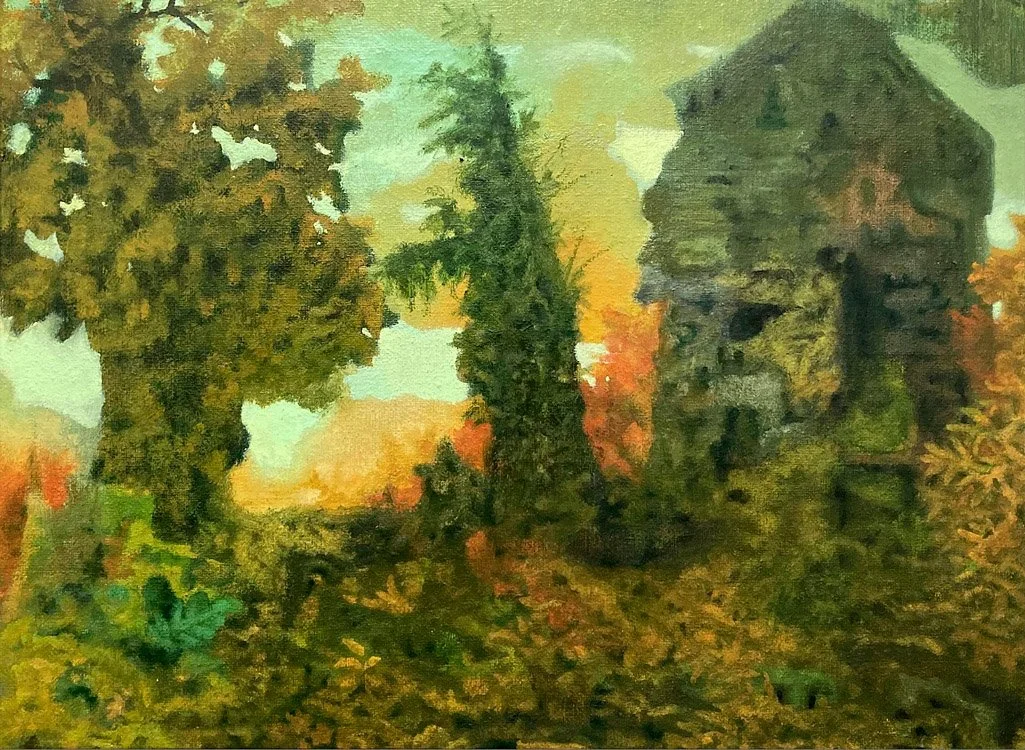
I first met the painter Joe Noderer on Instagram -then, after a couple of years, on a Google Meets for this interview. Social media creates an environment where finding interesting artists is easier yet also may have you wading through a massive amount of less interesting art. Joe is one of the most interesting landscape painters of our day. An idiosyncratic painterly language, links to artists working long before him, and work untrammeled by judgement or environmental despair are key to this distinguished painter. Read on to find out how Joe came to practice painting near Pittsburgh, PA, how he forged his career early on, learn about his influences and what concerns him today.

Read More

Interview With Painter Joe Noderer, PT 2

Interview With Painter Joe Noderer, PT 2

Earlier on I mentioned going to the Carnegie. There’s the Museum of Natural History and then the Museum of Art; they’re connected but also distinct. As a kid, I don’t remember going to the fine arts aspect, but I remember going to the natural history part quite a bit. Because, like any kid, I liked dinosaurs. Anything else there -the hall of minerals, the geologic stuff, the dioramas there, are out of sight. They are from the golden age of dioramas. Those contained worlds were very influential to me and that makes a lot of sense [when] looking at my work and that idea of a window.

Read More

Interview With Painter Joe Noderer, PT 3

Interview With Painter Joe Noderer, PT 3

In your later, shall I say "bearded portraits,” I draw visual connections ranging from Ole Peter Hansen Balling's John Brown to Goya’s Saturn Devouring his Son. What do you think about all that?

You’re not reaching too far with “Saturn Devouring his Son.” That’s definitely an image I saw when I was a teenager. When we see that painting, now, there’s an element of goofiness to it. But there’s also a blunt, downplayed, but in that way believable, violence to it with the mutilated corpse he’s holding. I’ve always been drawn to that kind of grizzliness.

Read More

Landscape Into Art


I'll be teaching my summer intensive course Landscape Into Art this week in the perfectly pastoral hills of Bennington College between the Green and Taconic Mountains. As I arrived the breezes whipped up, the temperature about 78 degrees, the skies blue. Tomorrow, eleven students arrive ready to have fun, work hard, and be challenged. It's an intense week. We make art, we read, we challenge each other to try new ideas, to push beyond our limits, and then we eat together. 


A Walk Around The Block


Across the road (it's wrong to call it a "street"), a stand of Quaking Aspen, Populus tremeloides. These are roughly forty feet tall, and maybe thirty years old. The trees grow in clonal stands, suckering off roots from the initial seedling. These stands can go on for hundreds or thousands of years if fire burns through at supportive intervals. The bark color can vary depending on the region, but in our locality they trend toward the white of a Paper Birch.


Our five mile walk around "the block" takes us by several properties with horses. That tells you something about the nature of the neighborhood (please don't feed the puns). The lots are large, generally over ten acres, many with rolling meadows and wetland basins (but little standing water). Taxes are high (but not by New Jersey standards), and there are probably property tax credits for agricultural uses ("Green Acres"). When you are this close to the city and agricultural, you need resources, you need to make the land "productive" or you will pay. The pressure to change the zoning is real and looming. Another post, another day, about what I call the development shadow.


Given such low-density zoning in this part of the "city," you'll find fairly long views often punctuated by a fairly large house.


You may also find a property named to conjure up salad dressing.


There's a little, err Long, lake, a remnant of a much longer lake, hemmed in by two fingers, one of which is a pronounced esker. In the distance, two blue ice-houses.


In winter we can walk (or drive) on the lake. In the distance you can see the road cut, traveling up the esker at its junction with the other ridge that encloses this body of water.


On this side, three fifths around the block, more horses and a varied, glacially-sculpted terrain.


The late sun gives glow to tilled acres and woods alike.


The cedars that grow on open, upland sites burn with the setting sun.


As do red houses.


To the northwest, some fields open to cultivation and livestock.


More rare, a field's infrastructure. This was dairy country awhile back.


Now, an attempt at viticulture.


To the west of our place, a partially-filled, old gravel pit has become a horse boarding operation. Rex had questions about how the open pit affected the hydrology of the area, and now that it is filled, more so. From what I've seen, and what I read, we have a complex hydrology, to be expanded in a later post.


Along the county road at dusk, about a half mile from our place, a stand of last season's weeds.


_______________________


On March 1, 2015 I will discontinue posting on NYCGarden. You can continue to read my posts here.


The Art Of A Week


Ten days back I arrived at Bennington College's bucolic campus to teach my master course Landscape and Meaning for Art New England. Over the course of five days I watched the fields shift from tall meadow to cut hay, then rolled into yodels for ungulate fodder. You could say nature was converted to culture before my eyes. Above, a sixty thousand dollar view (education included).


Sunday arrival and orientation.


There was a twelve-hour ice cream bin, but I did not partake. I did think it looked awfully like a tray of watercolors. The food was designed by a corporate service for college kids and as it happened -I ate like one. Probably my only weekly weight gain since I chose to eat quite a bit differently last winter.


On the final evening the students bring the week's work to exhibit in the main arts building. We had only four students but they had more than enough work to fill the enormous wall. And they worked beyond the limits of painting -there were nearly 200 pages of reading, hour long discussions morning or afternoon, and one student even wrote a two page essay.


The final critique, Saturday morning. Only brave people sign up for a course titled Landscape and Meaning where the description contained words like conventions and interrogation. My students were open, inquisitive, focused and productive. A teacher could hardly ask for more.


I cannot teach meaning, but I can provide context and cultural attitudes, we can view our works through the perceptive lenses of Marxism, Feminism, and social or cultural geography. We can tap into the deep well of literature and its criticism for parallels to our project. Why paint the land and if we must, how? Not easy questions, but then the class was just a beginning, a seed.


High Time For High Line


There has been one major park in all of New York City that has managed to go from waste land (or structure) to park land in 10 years, that is the High Line. Recent money donated has given the completion of the new parkway a boost. In fact, as the New York Times pointed out, "This could be the friendliest public/private venture ever attempted in New York City." With a total cost of about $150 million, the High Line has created a stir at under half the cost of the proposed Brooklyn Bridge Park. Of course, no one can complain about the private capital connected to the High Line, as that it is of its essence. While the city owns most of the High Line trestle and NYC Parks appears to have some role to play, it is not a stretch to view this parkway as a privately funded and maintained park with public access.

As a public/private partnership, it makes the most sense that this new parkway has a dual personality -its public and private function. In this sense it is the most viscerally dual-purpose, built landscape that I can think of. On the one hand it is a high fashion, high design plinth for the the viewing of NYC architecture. On the other, it is a lowly, industrial structure, re-visioned as a metaphor for a car-less NYC. One aspect serves the vanity of private institutions and developers' dreams, the other serves the public imagination of a future NYC.


The High Line is an elevated parkway connecting destinations and residential neighborhoods, not unlike Vaux and Olmsted's original NYC parkways designed for horse, carriage, and pedestrian strolling. Unlike Robert Moses' parkway system (connecting parks throughout the region via the gentler travel of non-commercial road traffic, with screen plantings designed to provide a serene, bucolic driving experience), there is only modest screening provided by the planting design. In fact, this new parkway functions as a platform for taking in the sights of lower and midtown Manhattan, auspiciously relying on the local architecture. Imagine it as a stroll through a sculpture garden, but the sculptures are the size of buildings. If you live or work in one of these new buildings, you can take the step back to appreciate how wonderfully your own starchitect designed sculpture resides in the New York landscape. If you do not, you can stroll the High Line, panoramistic foldout in hand, ready to identify any building seen in the growing architectural landscape. This is the essence of the private High Line.


On another level we have the romanticization of the railway ruin. Functioning and defunct railways have been seen as picturesque components of landscapes for decades, and their minimal infrastructure is easily incorporated into park designs. The ruins have hosted many parkways throughout the country, mainly as part of the rails to trails initiative. In Paris, the Promenade Plantee created a formal garden from an elevated railway. Many cities are now looking at conversion of their dilapidated high rail. In our own city, Gantry Plaza State Park had, less than fifteen years ago, incorporated industrial rail into its park design. The incorporation of rail into park design, then, is nothing new as landscape design needed to make sense of the wasted, post-industrial landscapes -often the only new space open for park development in our urban centers. What is new, however, is the attitude of an elevated railway park in NYC.


The primary public aspect of the High Line is its manifestation of the changing attitude towards street vehicles and traffic. It does this by anticipating the elimination of the vehicular traffic below, rather ironically through the preservation of the conduit for a mode of vehicular traffic previously considered too dangerous to keep at street level. It allows us to walk along what most of us recall as the unsafe terrain of train tracks and in doing so, gives us a glimpse of a future where walking on the street is possible and safe. The High Line removes vehicular traffic from the urban experience in an apolitical, non-threatening fashion high above the streets, out of sight and mind of the political body of racing vehicles below. In fact, the elevation of the High Line mimics the sense of civic idealism to which it speaks while, to the speedster below, perhaps it's the floating spectre of a return to biological speed.

There will be those who lament the loss of an urban "wild" space. They may have disdain for the "high design" approach. I sympathize with the sentiment for the tangled, messy spaces and the sense of discovery they contain. Yet I won't harp on it, that debate is over, it is built. I think the planting design looks good and the hardscape is nicely textured. I have noticed, however, the lack of what every overpass in this city has come to acquire -the protective chain link fence. Will it grow one in the future? I think we can all hope not.


This landscape offers the kind of close-quartered plant and hardscape experience that I expect to require high-maintanence. Time will tell how well-suited the plants are to this environment, but I am willing to give the High Line designers the benefit of the doubt. This park experiment has been well-funded, and that usually means better care for plants and hardscape. In fact, managing the horticulture and park operations will be a horticulturalist formerly of the Brooklyn Botanical Garden. How well the High Line is maintained and at what cost, in conjunction with how much use or abuse it gets will be instructive for any future, parkway proposals.

As we watch the collapse of the American auto industry, and entertain the idea of a city free of personal automobiles, what new urban landscapes will we dream up? Look out Broadway, your next.


The first section of the High Line has been completed, from Gansevoort Street to 20th Street, and is projected to open in June 2009.

Thoughts on a Stroll Through Prospect Park


Last weekend (the hot one, not the wet one) the weather was for sprawling and strolling. So I strolled. All the way to the Farmer's Market to buy ramps, via the Midwood trails.

Prospect Park is amazing in a city filled with really good parks. We've seen a lot of restoration and it looks great. Yet I've always been let down by what I perceive to be lax maintenance and re-construction in the southern end, around the lake. This area is not only my entrance to the park, but one of my favorite places.


A woman pushing a stroller around a large muddy puddle.

The north side of the lake shows a restoration moving forward, defeating the phragmites and restoring plantings along the shore. The remaining perimeter appears unmanaged as we encounter compacted earth, belgian blocks falling into the lake or overwashed by it, trash littering the phragmites colonies, and muddy disintegrating pathways.

The lake sits in a large basin which extends out to the paved park drive. Rain water collects at the pathways. At the base of Lookout Hill there is erosion carrying soil deposits over the roadway. In both areas there needs to be an investment in rebuilding the pathways above grade and re-configuring drainage patterns.


This decrepit staircase leading to the Concert Grove should be fixed. Why has it been like this for years? The under-privileged staircase leads to a really sweet spot in the park that is rather under-used. Why? Disrepair like this is the visual cue that lingering here won't be pleasant. The grove has park benches, seasonal plantings, as the name indicates -large plane trees, a pavilion, and a statue of Abe Lincoln. Yes, thank you ghost of Robert Moses, the woefully ugly Wollman Rink is there as well, but not too visible from the benches.


Walk through the Concert Grove and you may notice the staircase on the left leading up the slope. Take the staircase up and not 50 feet from it you'll find the desire line on the right leading back down to the Concert Grove. Desire lines are a product of poor design and human will. I'm not sure which came first, the staircase or the foot path. Either way, plant in a way that interferes with the desire to avoid the staircase.

As I strolled up the East Drive, I see a family eyeing the Audubon Center. There is black chain link fencing between them and their destination. The horse trail appears to head in the direction they want to go, but they have strollers and are hesitant to get stuck in the gravelly sand. They ask me how to get down there. I tell them to walk up East Drive and they'll see the ramp that allows them down to the Audubon Center. Yet I know that they may be easily confused; it will feel too far as they overshoot their destination, then backtrack.

When people see their destination, yet the designed pathway to it is perceived to be out of the way, people begin to make their own path. The park management response is to create obstacles to this instinct -the chain link fence.


The photo above shows you the entrance to the ramp which takes you to the boathouse, crossing over the horse path, from East Drive. It is a poor solution to the problem, which is this: the Audubon Center is not meant to be approached from the East Drive. This is because the Boat House was built on top of Olmstead's design along with a number of other classical-styled buildings in the park. The McKim, Mead, and White period created a number of "destinations" in the park out of sync with the Olmstead design.


I finally made it to the area known as Midwood. It's been under restoration, and generally looks good.


It has a lacework of trails that can be disorienting to anyone unfamiliar with its meandering. Not a stone's throw away people by the hundreds are sprawled on the grass in barely any clothes paying little attention to those around them. However, in the woods, somewhat wary are the eyes of the few whose paths you cross. The wood isolates, and few bask there as they do the field.


When you come upon the aging Rick's Place sign you feel as if there is a history here you couldn't possibly know. Was he murdered here, did he just hang out here, or both. Maybe he planted trees or watched birds here. The old sign adds to the feeling of stumbling on a ruin, a ruin of one man's habits and preoccupations.


Midwood and its neighboring Ravine are the closest thing Prospect Park gets to the Ramble of Central Park. Like its Central Park cousin, it's filled with desire lines.


I exit the woods and make my way to the farmer's market at Grand Army Plaza. On my way back, I take to the road.


Shepard on Shepherd

Deep down my left sidebar I have a list of books that have been important to the development of my ideas about landscape, nature, the garden, and us. There have been few more informative to my way of thinking than Paul Shepard. I picked up Man in the Landscape a half-year ago. As with another book of his I read a year earlier, its slow going at first, with fits and starts. The enormity of his understanding seems to be condensed into every sentence. Its easy to spend minutes unpacking them and since I do most of my reading on the subway, you'll see me holding the same page for multiple stops.

My training in art and my interest in landscape makes some of his ideas familiar territory, but his books read like a guide to the missing link. How does a fish eye evolve to a human eye and how is the woods like the under sea? What kind of God would a pastoralist dream up? What are the roots of class structure? And then I leap to new thoughts about the Venus of Wilendorf or what it may have been like for the first man to see another man "flying" on horseback (think -Tatars invading on horseback in Tarkovsky's Adrei Rublev), or why we wish never to die.


I'm still involved with chapter three, "The Image of the Garden." The quote below is the final paragraph from chapter two, "A Sense of Place."

"My point is that their origin is inextricably associated with a surplus agriculture, that cities tend to grow beyond what the local agriculture will support, and that there is an urban attitude toward nature which is insular, cultivated, ignorant, dilettante, and sophisticated. At the same time, by virtue of the very polarity in the landscape that cities create, they contain and educate and produce men who retreat to nature, who seek its solitude and solace, who study it scientifically, and who are sensitive to its beauty. The very idea of a sense of place is an abstraction, a sort of intellectual creation like sex or climate or fashion, which is impossible except in a world of ideas whose survival depends on the city. The dilemma is that those who yearn for the warm garment of landscape security are already deflowered. They can only go back so far. They can regain the hunter's, pastoralist's, farmer's nonverbal responses, limited to an extent by their self-consciousness; but the yearning is thrust upon them in any case, for they were all children once and they had wild ancestors and they dream and to some degree all have premonitions of special places."

http://upload.wikimedia.org/wikipedia/commons/5/58/Rumunia_5806.jpg

New Front Yard


Yesterday I planted a new front yard. I had this insight to share, a definition of a garden: A garden is a place that has easily-dug soil. That's it.

But its not a garden until this is true. What I did yesterday -not a garden. Not even now. But a front yard with new plants. If you have to work as hard as I did with a shovel and a maddox, its not a garden -yet. You have to make it one.

Together with two, at one time three others, we drove to the Red Hook Nursery District and then our local J & L. Five shrubs and 25 perennials later, but emptied-handed when it came to the desired tree, we took on another passenger and headed to J & L. There they saw it -the perfect weeping cherry tree. Nothing attracts a new yard builder like a weeping cherry tree in April. They had one in back, full-flowered branches weeping nearly to the ground. I could tell it was in a pot too small for its 2.5 inch caliper. As I tried to steer them back to the younger, more spindly cherries, they gravitated back to their desire. Sold!

The tree was some of the worst pot-wound, root-bound I've ever dealt with. I hacked until I worried, then planted the sucker. They were watering in at 9:30pm. What a day. Today I am shot.


I am always concerned when anyone wants to plant a tree three or four feet from their house. But the desire for what they see now is so strong, it overcomes rationality, its an emotional decision. After all, there are so many others on the block and they are fine, right? And the neighbors, they love it. It got lots of looks, and even a few comments. Nothing pleases like a cherry tree in April.


Should Vertical Be Your Thing...


VERTICAL GARDENS
March 28 – May 23, 2009
Opening: Saturday, March 28, 6-8pm
at Exit Underground


EXHIBITION // PROJECTS // EVENTS // ABOUT CONCEPT PLUS //SUPPORT // INFORMATION

A project of SEA (Social Environmental Aesthetics) , Vertical Gardens is an exhibition of architectural models, renderings, drawings, photographs and ephemera that depict or imagine a vertical farm, urban garden or green roof. It features over 20 projects, both imaginary and real, by artists and architects that envision solutions for building greener urban environments. The past decade has seen a greater emergence of green roofs and vertical gardens created by artists, designers, architects and urban gardeners to combat the lack of flora in the city. Buildings around the world — from the Musée du Quai Branly in Paris, to the Queens Botanical Garden in New York — have embraced green walls or roofs for all their economical, environmental, and aesthetic values. Vertical farms and gardens are also being envisioned as new ways to feed local and organic foods to city dwellers. Largely based on the principles of hydroponics, vertical gardens would also be mostly self-sustaining because they would capture large amounts of natural sunlight and water, and could use wind as an energy source. In a country where cities are suffocated by high rises, cement and industrial materials, where can green space exist? As this exhibition demonstrates, one possible answer is “up.”These and other urban parks and gardens provide areas for socialization and recreation; a location for a city farm or community land-trust; an outlet through which hundreds of people can learn about farming and agriculture; and the addition of much needed plant and animal life to the otherwise concrete jungle.

FEATURING PROJECTS BY:
Abruzzo Bodziak Architects; ATOPIA; Bob Bingham and Claire Hoch; Patrick Blanc; Bohn & Viljoen Architects; Dickson Despommier; Evo Design with Mica Gross; Todd Haiman; Haus-Rucker-Inc.; Edmundo Ortega and Dianne Rohrer; Claude Boullevraye de Passillé; Oda Projesi; Rael San Fratello Architects (Virginia San Fratello and Ronald Rael); Naomi Reis; Roomservices (Evren Uzer and Otto Von Busch); SITE (Denise MC Lee, Sara Stracey and James Wines)
Also featuring photographic documentation of existing buildings containing vertical farms, gardens or green roofs, including those by Hundertwasser; Renzo Piano with Chong Partners and Stantec; Emilio Ambasz & Associates; Humpert Wolnitzek; Chad Oppenheim Architecture and Design; Musson Cattell Mackey Partnership, Downs/Archambault & Partners, LMN Architects; Scandinavian Green Roof Institute; Conservation Design Forum of Chicago and Atelier Dreieitl of Germany; Enrique Browne and Borja Huidobro with Ricardo Judson and Rodrigo Iturriaga; and others.

CURATORS
Papo Colo, Jeanette Ingberman, Herb Tam and Lauren Rosati

PUBLIC EVENTS
2day/earthday -A FREE two-day event celebrating Earth Day 2009.

99.44 Picturesque or Notes On Michael Pollan's "Against Nativism"


Below is an excerpt from the 1994 NY Times Magazine article by Michael Pollan on the subject of the native landscape movement. I came across it in a comment by Susan Harris of Garden Rant under the post Pollan Takes On The Great American Lawn. Although Pollan's article goes on to describe other complications (xenophobia) of the nativist movement, he also touches on some aesthetic themes I've been thinking about for some time, and my focus here is on these.

The quote:

"Environmental pretensions aside, the esthetic of the natural garden would appear to represent an extreme version of the 18th-century picturesque-gardening style, which was the first to maintain that gardens should closely resemble "natural landscapes." It turned out, though, that the natural landscape the picturesque designers strove to emulate was one they found not in nature but in the 17th-century landscape paintings of Claude Lorrain and Nicolas Poussin. Although today's neopicturesque garden designers claim to be emulating actual natural habitats, they too seem to rely on an artistic model. Instead of landscape painting, however, these gardens aspire to the condition of a contemporary nature photograph, an Eliot Porter, say, or an Ansel Adams. Whenever I visit a natural garden I can't help thinking I've walked into the pages of a Sierra Club calendar."

The first "natural picturesque" landscape design that comes to this Brooklyner's mind after reading the above quote is Prospect Park in Brooklyn, NY. When I look at Prospect Park, designed by Olmsted/Vaux, I see emulation of the picturesque, in this case its the picturesque, trancedentalist realism of the Hudson River School style, an American offshoot of the European, largely English, picturesque. Vaux was English, Olmsted had studied in Europe, both well known to Andrew Jackson Downing, the son of a horticulturalist and progenitor of the Hudson Valley's Romantic-Picturesque architectural style out of Newburgh, NY. All three would have been well acquainted with the work of the Hudson River landscape painters. Inherent in the work of all these 19th century landscape practitioners are romantic elements that I cannot ferret out of new native landscape design.

Fallkill Falls, Prospect Park


Kindred Spirits by Asher Durand, 1849

In defense of Pollan's assessment, I hazard that one reason landscape projects of so many current day "natural" garden designs resemble picturesque forms is that most suburban, domestic landscapes already emulate that form. Designers retool the familiar formal structure with meadow instead of lawn and native woodland understory plants instead of the typical azaleas and pachysandra.

Maybe today's natural gardens are not at all "neopicturesque" as tagged by Pollan, but instead are neo-realist. It was the Realist painters of the 19th century that imagined what was actually there, as opposed to artful conventions and idyllic representation. Of course, Realism was not at all real or virtuous, yet the pretense disturbed many taste-makers, artists, and critics. It was also no coincidence that this realist painting rose alongside, and was influenced by, the invention of photography.

Gustave Courbet's Young Ladies of the Village, 1852


 Asher B. Durand's Interior of a Wood, 1850

In the words of Kenneth Clarke, landscape painting "was the chief artistic creation of the 19th century," but the burgeoning process and product of photography (see William Henry Jackson) began a process that eventually pushed painting away from verisimilitude. By the time we see the work of the photographer Ansel Adams, 1902-1984, we see that 19th century romantic landscape eulogized in the stone monuments of the American West. Eliot Porter, 1901–1990, strikes me somewhat like J.J. Audubon with a camera -his interest was almost taxonomical. Pollan is correct to see in Porter's photographs a dialogue with our current conception of landscape "naturalism" because taxonomy is necessarily put into the service of ecology. What Pollan rejects is the photographic conventions represented by the work of Porter or Adams as a model for designing parks and gardens. More precisely, he rejects the notion that our relation to nature as represented by gardens should be mediated by pictures at all. The garden, itself, is the mediating space.


Gates of the Valley
Ansel Adams' Gates of the Valley, 1938


Book cover of Eliot Porter, 1987

Photography supplanted painting as the choice medium of landscape imagery in the 20th century, but for many photographers the beauty of natural scenery became all too common and suspect -as did the photograph as a means of representing truth. New themes in landscape photography rose out of this: human changes to the landscape, machines in the garden, the overwhelming tide of waste and spoil, beauty and the brown field, and the mundane. Photographers who come to mind are Robert Adams (b. 1937) and New Topographics, Mark Klett (b. 1942) and the Rephotographic Project, Robert Glenn Ketchum (b. 1947), Richard Misrach (b. 1949), Edward Burtynsky (b. 1955), and many others.

If designing "natural" landscapes has been shaped by 20th century photography, then what of the work of these mid-late century photographers? They turn the American wilderness and Old World pastoral conventions on its head, but where does that leave landscape architects and garden designers? After all, they need to create landscapes that attempt resolve the crisis highlighted in the work of these photographers without resorting to old forms.

For many, the ecological restoration landscape -a landscape garden version of the photographic "realism" alluded to in Pollan's essay, has been the answer. Ecological parks and gardens, landscapes of verisimilitude, are a reaction to the conception of a spoiled landscape. I am not as sour on this movement as Michael Pollan may be (or was in 1994). It offers a new motivation for developing new parks in and around our cities. If our conception of urban parks was only 19th century picturesque strolling (Central Park) or 20th century athletic leisure (countless athletic fields, Flushing Meadows-Corona Park), we would find it hard to develop new parks within the limits of available urban land. Ecological-restoration offers motivation for the building of new parks in niches previously undesirable for park development.

There are fifty-one Forever Wild parks throughout New York City. Although NYC Parks chooses to call these "preserves," most are anything but that. These parks are created or "restored" out of spoiled but not yet "developed" regions in each borough. A majority of these parks are on the waterfront, an outgrowth of the decline in commercial shoreline activity, the public enjoyment of water, and a concern for sea level rise and storm surge attenuation. Consider the possibility that a park can function for the public outside of the context of individual or group pleasure, as a protective formation for the public good that also happens to provide habitat for migrating species, strolling, and ecological awareness.

Yet, we shouldn't fool ourselves into thinking we're about to restore nature to a "pure" state in any park. Restoration gardens and parks are created out of a set of intellectual and financial limitations and should only be taken on with humility. Added to the garden is an understanding of our role in changing ecosystems and an awareness of the value of the system to our own needs, beyond accepted forms of aesthetic pleasure.


Trash in the Garden


I've gotten complacent, I just let it sit like fallen leaves. Unless its a telephone book or newspaper circular flattening some bulb shoots or something of that nature. I used to clean it up regularly, but now only so often. It keeps coming, never ceases no matter the season. But its in winter that I let it be the longest. It mostly blows in (infernal wind!), but I can tell a tossed bottle of beer or drug baggy from the blown trash. Bottles are more common in warm weather.


I live on a short, little-respected block. Two buildings on it, mine and the neighbor's. The neighbor's fronts the intersecting block so that the side of their house becomes a no-man's land of mostly dog-shit, no fault of their own. The opposite corner, mine, stands without entry or sentry and becomes a good place to toss bottles. But the whole garden fills up. I am reminded of Jonathan Letham's Fortress of Solitude:

"A fair question, actually. Did the renovators think this was Park Slope? Or what? Why should Dose have to carry them? Abraham and Dylan was one thing, but some of those brownstoners, David Upfeld, Isabel Vendle, the Roths, wouldn't look him or Junior in the eye, seemed to begrudge their place on the street. Upfield, out there each day in his Red Sox cap and handlebar mustache, picking litter from his yard. Glaring at PRs on crates in front of Ramirez's store, like they were ever going to quit tossing bottle caps and empty packets of plaintain chips in his forsythia."
pg. 461

Something else entirely? I dunno. I've gotten accustomed to the winter flower, the bleached colors of clinging trash. In the front yard, you gotta be cool. Or lazy.

How This Article Hurts My Brain or The Savannah Hypothesis


Garden Rant picked up on a story from the Boston Globe Ideas Section titled, "How the City Hurts Your Brain." I do not disagree with the idea that we need to immerse ourselves in natural habitat. I would like to make the point that most of what this "Ideas" article is attempting to drive home, through simplified science, we already understand intuitively.

Some things I need to go on about:


"The brain is a wary machine...The mind is a powerful supercomputer...easy to short-circuit..."
I really don't like the consistent "mind as machine" analogy in this article. Its not even about philosophy or a mechanistic view of nature, but more like writing as if the reader really couldn't understand it any other way these days -oh God, aren't we so like machines nowadays. Lets leave the mechanistic ideas in the 20th century- haven't we given enough to our dear machines already.


"Imagine a walk around Walden Pond..."

This is artful. The evocation of Walden Pond without any mention of our nation's most famous nature hermit, Thoreau, who brought to the fore the idea of the poetic, transcendant escape from urbanity? Just mentioning Walden Pond, sans Concord no doubt, evokes our landscape escape fantasy. And Emerson? C'mon. Of course, Emerson owned property outside of the city to escape to.


"It's not an accident that Central Park is in the middle of Manhattan...They needed to put a park there."
At least the article mentions Olmsted (though forgot Vaux) -someone who actually envisioned our cities with a more complex environment. Marc Berman, the psychologist the article quoted (above statement), is right, but not for the reason the article implies. By no means did Manhattan look like it does now; it grew up around Central Park and with it. Which, incidentally, had many farmers and gardeners and an African American community living within its future bounds before construction. Ultimately the siting of the future park was an administrative, government decision.


"...research has demonstrated ... the mental demands of being in a city -- makes people more likely to choose chocolate cake instead of fruit salad..."
How do we account for all the overweight people in the countryside and the overall fitness of those in cities. Nature makes us slimmer? No, but exercise does, and I sure do walk a lot in the city. So I guess we eat chocolate cake -so what, we walk it off.

"...found less domestic violence in the apartments with views of greenery."
How many times do we need to say that correlation is not causation? Couldn't there be some other factor involved in higher domestic violence rates that also correlates with less trees, grass, and parks outside our windows and doorsteps?

"...most urban greenspaces are much less diverse. This is due in part to the "savannah hypothesis, which argues that people prefer wide-open landscapes that resemble the African landscape in which we evolved."
And finally, my favorite -the "savannah hypothesis." Not to put too fine a point on it: BUNK. Its obvious why people like low-clipped lawns today: clear sight lines, clean for laying, sitting, soft underfoot, and you can kick a ball around, etc. The deeper connection we have to the lawn has more to do with miming the tastes of European aristocrats of the last few hundred years. The aestheticized, pastoral landscape was born out of the estate home with its view of the shepard, his flock and the grass -grazed short by sheep. Central Park's Sheep Meadow puts it in name. Economics don't trickle down, but aesthetics sure do. Let us thank ingenuity for the IRON SHEEP, our lawn mower, or we'd be listening to bleats all day. The lawn is the image of order in the landscape, with its clear sight lines and simple aesthetics. I don't think many people are conscious of the roots of their landscape aesthetics, but mime them anyway.


The savannah landscape has unclean sight lines to any pleistocene man, who's greatest enemy may have been a low-stalking lion or hyena, it caught fire often, and who knows what else - so its no front lawn. Another point I'd like to make is that wealthy aristocrats had great landholdings and would have farmland, grazing land, and wooded lots for hunting, logging, etc. While we can mime the lawn aesthetic, we cannot maintain the forest that stood beside it on our little plots -its one or the other and we've largely chosen the other to our detriment.

Below is a quote from Henry Miller's Tropic of Capricorn (beware *# language). After about one hundred pages of manic ranting:

"...The city grows like a cancer; I must grow like a sun. The city eats deeper and deeper into the red; it is an insatiable white louse which must die eventually of it is inanition. I am going to die as a city in order to become again a man, therefore I close my ears, my eyes, my mouth.

"Before I shall have become quite a man again I shall probably exist as a park, a sort of natural park in which people come to rest, to while away the time. What they say or do will be of little matter, for they will bring only their fatigue, their boredom, their hopelessness. I shall be a buffer between the white louse and the red corpuscle. I shall be a ventilator for removing the poisons accumulated through the effort to perfect that which is imperfectible. I shall be law and order as it exists in nature, as it is projected in dream. I shall be the wild park in the midst of the nightmare of perfection, the still, unshakable dream in the midst of frenzied activity, the random shot on the white billiard table of logic, I shall know neither how to weep nor protest, but I shall be there always in absolute silence to receive and to restore. I shall say nothing until the time comes again to be a man. I shall make no effort to preserve, no effort to destroy. I shall make no judgements, no criticisms. Those who have had enough will come to me for reflection and meditation; those who have not had enough will die as they lived, in disorder, in desperation, in ignorance of the truth of redemption. If one says to me, you must be religious, I shall make no answer. If one says to me, I have no time now, there's a c*#t waiting for me, I shall make no answer. Or even if there be a revolution brewing, I shall make no answer. There will always be a c*#t or a revolution around the corner, but the mother who bore me turned many a corner and made no answer, and finally she turned herself inside out and I am the answer.

"Out of such a wild mania for perfection naturally no one would have expected an evolution to a wild park, not even I myself, but it is infinitely better, while attending to death, to live in a state of grace and natural bewilderment. Infinitely better, as life moves toward a deathly perfection, to be just a bit of breathing space, a stretch of green, a little fresh air, a pool of water. Better also to receive men silently and to enfold them, for there is no answer to make while they are still frantically rushing to turn the corner.

"I am thinking now about a rock fight one summer's afternoon..."


After this passage, Miller turns to reflect on his childhood, calmly. Its an intense shift, all turning on a park, a wild park.


Thoughts on a Winter Landscape

New Hampshire in the winter-time is beautiful, but it is more than that. It goes deeper, because it struck me today that New Hampshire in the winter-time is the landscape that I would draw as a child. It is a dream, the essential winter landscape. It is snow covered evergreen boughs, white birches in a field of snow, crystal night skies with bright stars and moon-light to read by. Homes glowing with incandescence, chimney stacks with lazy smoke, snow-covered trails that invite walking, wind high in the hemlocks, icicle-fringed rooftops, glistening snow crystals floating on air. This is the winter scene I drew as a kid, the stuff of dreams and Currier & Ives prints.

My daily commute


Its Winter, Let's Act Like It

Here in New Hampshire we are having a winter. I am here for a residency, working on my art and even blogging a bit. As a matter of fact, I learned of the ease of blogging right here in NH, in summer of 2007. A friend, a writer, Tayari Jones, showed me the ins and outs of such things that very summer. So blog in hand, I'm here for the winter -really, meaning gimme some winter. Oh, the generosity.

The southerly view, out my studio window


Mountain Laurel outside the library -at night

Day and a Half Hike

Last weekend my wife and I went to the New Paltz area for a couple of days of hiking. The weather couldn't have been more perfect. The Shawangunk (pronounced Shon-gum) mountain chain, located between the Catskills and the Highlands, may be the most interesting and diverse ecological niche in the northeast and only 2 hours from NYC.
Many hikes travel along or have views of rockface.

Moss, lichens, ferns, shrubs, and trees grow on the ledges.

Rivers of brilliant red blueberry bushes lined the top of the mountains and the distant valley appears like the sea. All this near Sam's Point.


Along the path, red blueberry bushes mingled with this white-seeded plant which I think is Pearly Everlasting, or Anaphalis margaritacea.

Dwarf Pitch Pine Plains around Lake Maratanza, near Sam's Point. Trees are around 5 feet tall.

Looking west from Sam's Point at sunset