In your later, shall I say "bearded portraits,” I draw visual connections ranging from Ole Peter Hansen Balling's John Brown to Goya’s Saturn Devouring his Son. What do you think about all that?
You’re not reaching too far with “Saturn Devouring his Son.” That’s definitely an image I saw when I was a teenager. When we see that painting, now, there’s an element of goofiness to it. But there’s also a blunt, downplayed, but in that way believable, violence to it with the mutilated corpse he’s holding. I’ve always been drawn to that kind of grizzliness.
That figure doesn’t look too threatening to me. If that figure wasn’t holding, and implied to be eating, another human being, I would certainly think it was strange, but wouldn’t be afraid of it. It reminds me of watching horror movies, when I was a kid, with my dad. You know this is fake, going into it, but there are gross things that happen. Like Dawn of the Dead, everything’s garish, the zombies are blue, the paint -there you go, the blood is bright red as paint. Yet there’s still a visceral, disgusting fear and terror to those things and I think that I saw that in that Goya painting. Then you can get into the irrational -that being something that just isn’t as aggressively off-putting as something that is bloody. He’s going for something like that. And the same for those paintings of witches, all that irrational belief in superstition or the occult. That has stuck with me for a time.
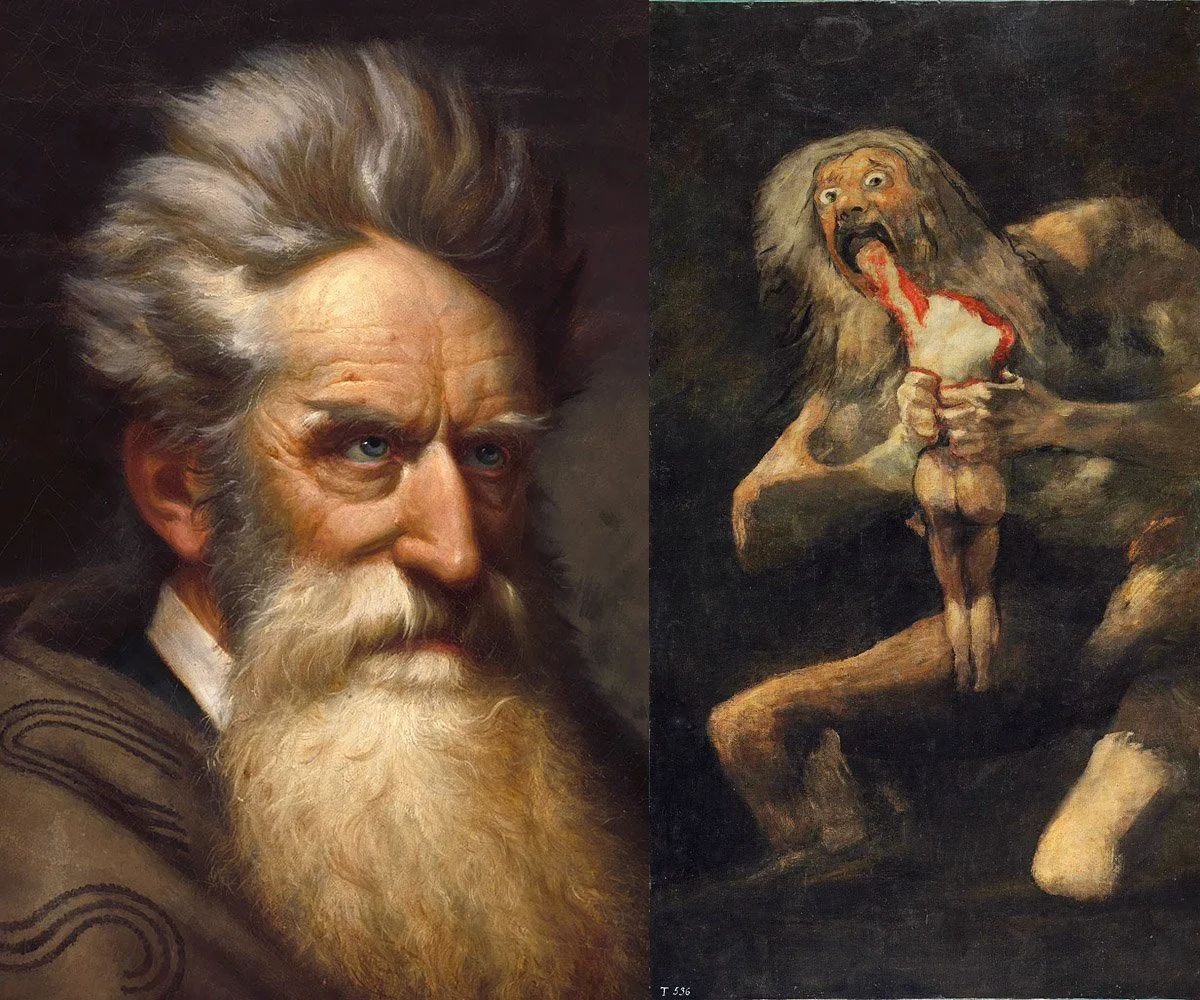
L: Ole P.H. Balling, John Brown (Detail), 1872 R: Francisco Goya, Saturn Devouring His Son, 1819-23
John Brown, he’s an interesting person. He’s a person, an era, I’ve been drawn to for awhile. There’s that connection to the hillbilly, you mentioned, just formally. Painting facial hair or hair that is unkempt is way more satisfying as a painter of primarily natural things than is someone who has a nice haircut and no facial hair whatsoever. I live pretty close to rural areas, here, and folks that remind me of... [laughs] the stereotype of the hillbilly, visually speaking. It's more that I see the bearded people as symbolically representative of my home and the land, here.
It is, technically, Appalachia.
Yeah. There’s a love-hate relationship with that. I have this critical remove from my education. I think, on the one hand, I like that, I need that -the everyday, which in this area, often kind of looks like that [my portraits]. I mean, I exaggerate it a bit, of course. But I also need that kind of criticality; one can be both.
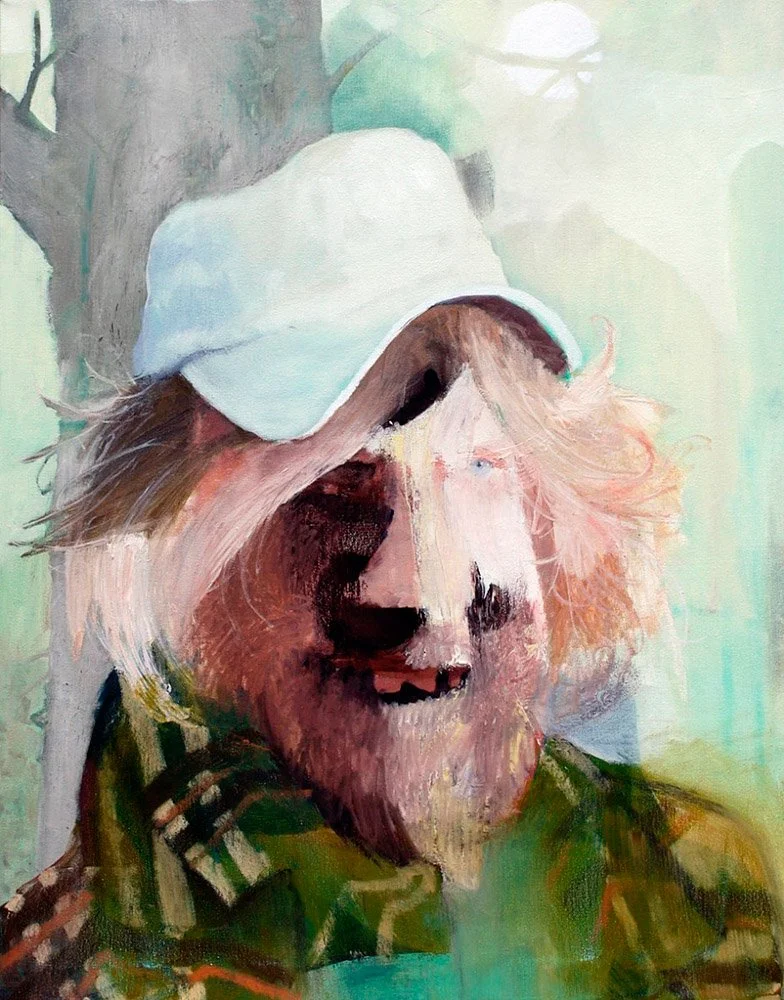
Some Fair Spring Morn, Oil on Canvas, 24 in x 30 in, 2014
Is there a sense of self-portraiture in it?
Yeah, definitely. That’s part of the reason why I struggle with portraits. I don’t have a problem making myself look unusual or deformed or whatever in a painting. I can be pretty objective about it. I wouldn’t want to hurt someone’s feelings if they had an expectation of a portrait being painted of them.
Would someone ask you for a portrait? [laughs] Has that happened?
No, not really. I would like to do that and I’ve painted a few portraits of people, but it never feels good to do it. I never feel like I’m letting loose and doing what I want to do. Whenever someone who maybe hasn’t asked, but might want a portrait, that is what they want. They know they’re not going to get a photographic portrait of themselves.
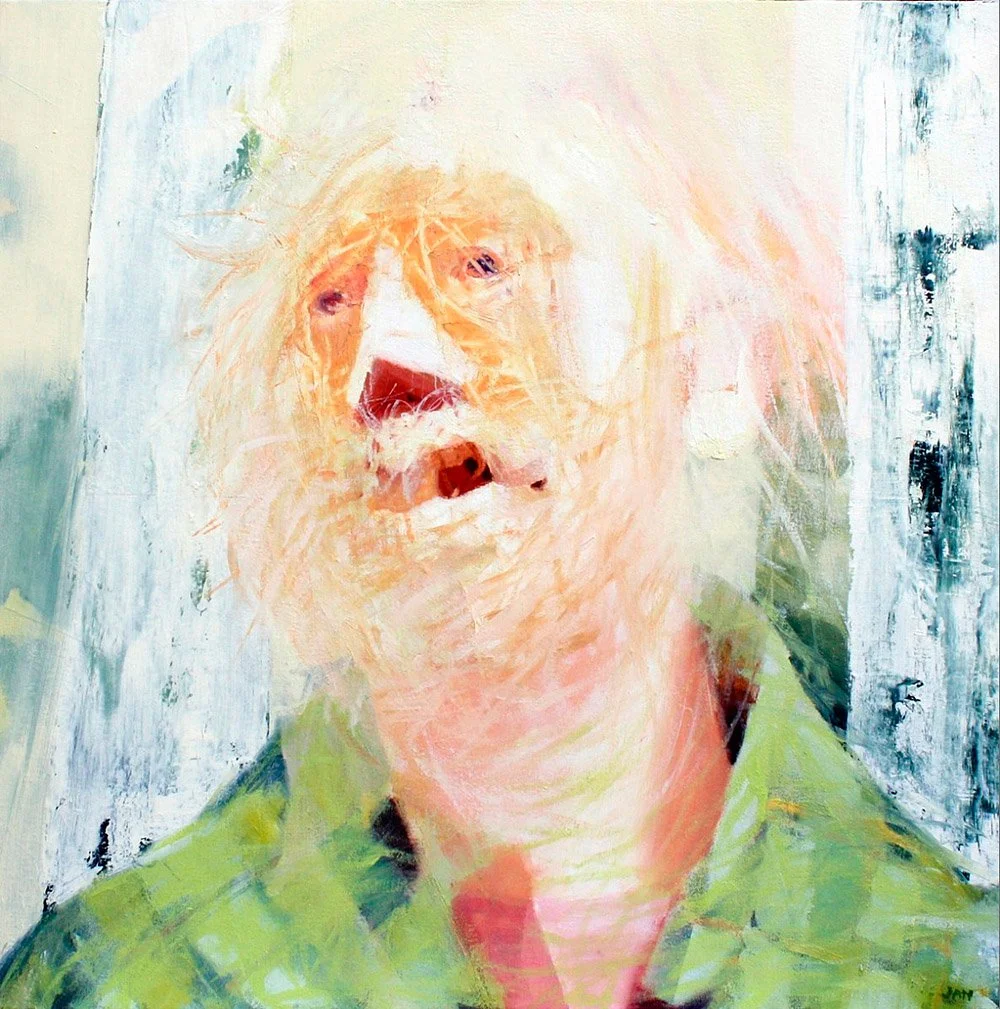
Horse Hill Waugh, Oil on Canvas over Panel, 24 in x 24 in, 2016
From Thoreau to Ted Kaczynski, the retreat to nature has been a consistent counter-cultural impulse in the U.S. What do you think of the “lone man in the wilderness” concept? I’m not really catching much from you about the wilderness man; I’m not sure that that is relevant. Does this idea interest you?
It used to. I was very interested in mountain men for while. At the time, when I was getting into that stuff, I was swept away by the romance. I didn’t think at all about how it was connected to the destruction of the environment, expansion of corporations, all that stuff. I was just looking at what I saw was a harmonious balance between man and nature, but specifically for Americans. Now I think it is synonymous with the destruction of nature, consuming things, the displacement of peoples. But with mountain men, that happened here or there, folks were just heading out west to be alone and commune [with nature]. I realize now that my view of that was very romanticized, very inaccurate, and certainly something I wouldn’t want to put out in terms of an image of “better days.”
That’s not where you’re coming from.
No, but I was drawn to those things just [from] growing up here.
The influence of that mythology.
Yeah, for sure. There’s a connection to nature, there. I was influenced by those things, but now, when I tap into that, it has less to do with mountain men or the frontier. Those were a way for me to get back into this. All that stuff, like the film Jeremiah Johnson, the big resurgence of that stuff around the time of the bicentennial. I was born a few years later, but I grew up with people who were very influenced by that time period. There’s a lot of visual evidence of that here. By way of that stuff, I found my way back to images of home. I guess I had to go through it, conceptually.
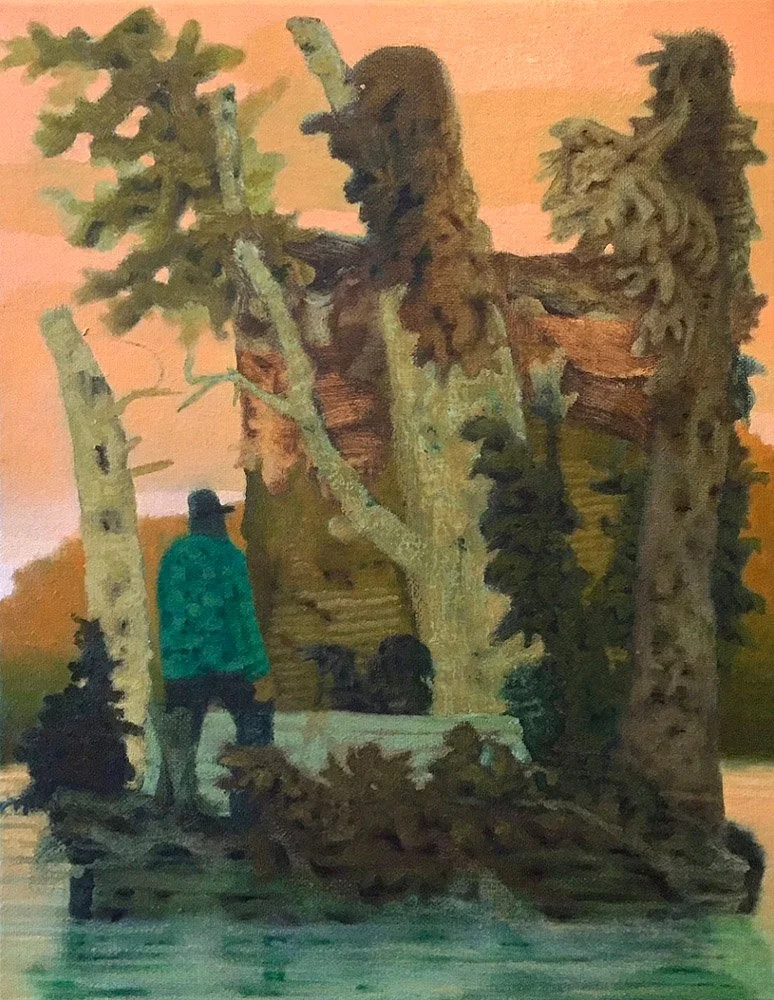
Older Boggy Lite, Oil on Linen, 11 in x 14 in, 2019
I had the same impulse -I got to get across this country, I got to see it and participate in it. There’s some suspicion or skepticism about that and I think that’s reasonable. These ideas come full circle to the original displacement [of native peoples] and nation building, when I think about the people I associate with those [western mountain] places, now, which can be white supremacists on compounds, Ted Kacynski, Ruby Ridge -to me, that’s the mountain men now.
We just went up north for a couple of days and it was like Trump this, Trump that. Just sign after sign -big, hand-made signs saying “Love America, Vote for Trump.” This is really unfortunate because we’re in this beautiful environment. This is a place that you should expect more harmony. I’m sure there are pockets of that, but it seemed like the impression one would get from the folks living out in nature is that they are a bunch of angry conservatives. I know that’s not true, but it does seem like you have to contend with that now.
It’s complicated since we are all dealing with a set of stereotypes and mythologies. Our conception of nature is formed in cities where ideas are different and social or cultural norms are different. Out there, in the country, ideas they form about cities are just as wrong.
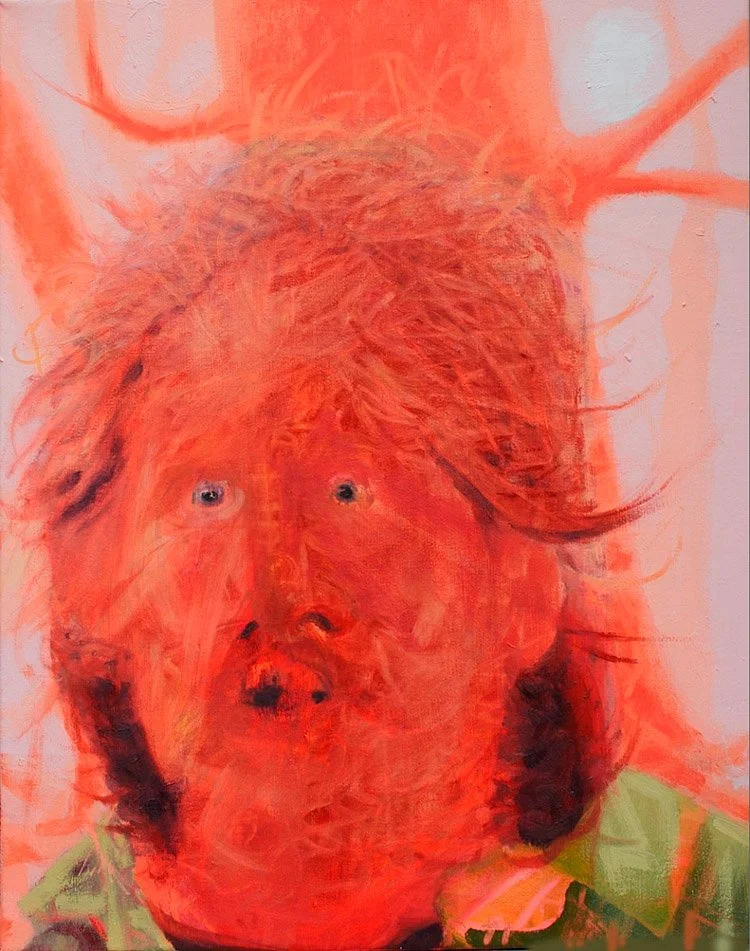
Horse Hill, We Hardly Knew Ye, Oil on Canvas, 16 in x 20 in, 2017
But it does play into the artwork, to some degree. I do not look at your work and think this is representative of that. It does seem a bit of a critique, the portraits. Maybe that’s putting it too academically.
I know what you mean. I think that is part of why I am drawn to them; it is because they do make me uncomfortable. They tap into different feelings than I usually tap into when I’m making my work, which are usually harmonious, good feelings. A lot of the portraits started out, honestly, to be critical of people here. People who are backwards. But I don’t think that it is fair or right to project that onto people. That’s why they are often filtered through self-portraits because, really, that’s what it is anyway.
You are a part of it, in maybe not an obvious way, but you are born of the same place.
I can love it, its backwardness, or I can be really irritated by it and think I should have stayed in Chicago where there is more of an arts culture.
By making it your image, you are implicating yourself in being the thing that you are criticizing.
Yeah, it’s good to hear that may come across. I’m still working on that with the portraits. Because the complexity needs to come across, not just be out-rightly critical.
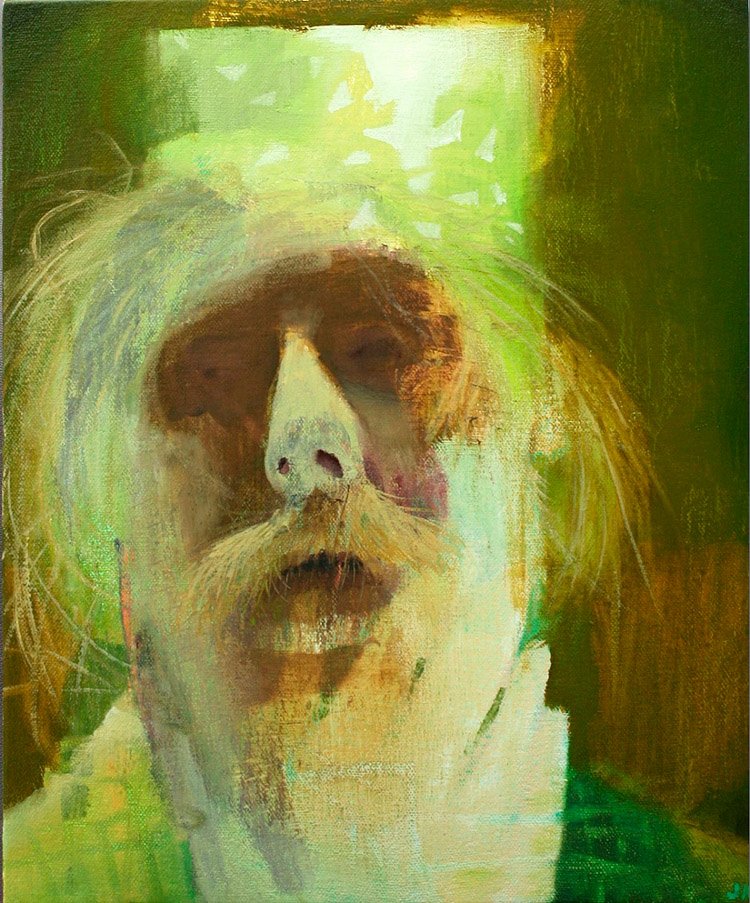
Old Jonah, Oil on Canvas over Panel, 10 in x 12 in, 2015
What happens to your work after you finish it? Do you have an outlet for them?
Not currently. I was showing at Linda Warren Projects, in Chicago, but she closed her doors awhile ago. It’s the place that I consistently showed. I was lucky, right out of grad school, I got a show in her back room, the start-up place. That went well and she said “How would you like to have a show in the main gallery next year?”
Yeah, I would. [Laughs]
Yeah, exactly. Right out of school like that? There’s no way I’m gonna say no. That’s an interesting thing, too, because my experience was different than a lot of people. I started showing right out of grad school. I also had to work, I wasn’t selling and making all my ends meet, but I didn’t have to hoof it.
You weren’t applying to shows?
No, not really. Honestly, Instagram, visually at least, is my primary outlet just as far as getting things out there [now].
Do you sell work that way?
I’ve sold a few things, here and there, with it. If someone wants to buy something they are free to ask. I think my Instagram does say they’re for sale, but I don’t put a price on them. I don’t even wonder about it, unless somebody asks.
Linda had a sense of what she could get for something at her gallery. She had a clientele and had been in business for awhile. I was really lucky to connect with Linda because she is such a strong supporter of her artists. Without that person, without that guidance, I don’t know. Plus, that was in Chicago, this is Pittsburgh. I sold a painting to someone a couple of years ago, in Brooklyn, NY, and I’m sure they are used to seeing, if not paying, high prices. There’s so many different contexts that it’s hard to come up with one...it’s almost a case by case, I imagine.
Should a painting be the same price in Pittsburgh as it is in New York City? If you don’t have a facility in New York, say.
Why not? Assigning a monetary value is just that. I don’t believe that things that cost a lot are more worthwhile than things that don’t. In fact, I probably think the opposite. It’s a struggle because I kind of cut my teeth selling things through a gallery and I could get a couple thousand bucks for a painting.
Is that after her take?
Yeah, and that’s nice; I am not going to lie. But at the same time, maybe because of my upbringing, I don’t always attribute value to money. I think of it more as, if someone is interested in my work, if they’re getting something out of it, if it moves them, as corny as that sounds, that’s more important to me than making a buck off of it. Because I am fine, I am making money. I actually don’t think I would like to just make money through my paintings and just paint all the time, just be an artist all the time.
I sold a few paintings through Instagram; intentionally putting them up for sale and pricing them to help support BLM. I felt that was the best way to do it, because the money was going almost entirely to an organization that I think is doing good. The people that bought them wanted to support that organization and they wanted my work, so they were supporting me. It just felt great; it was a significant amount to give to an organization, wasn’t a loss on my part, and a person is getting a piece of mine. Why not let that be how I sell things? That’s possibly good enough.
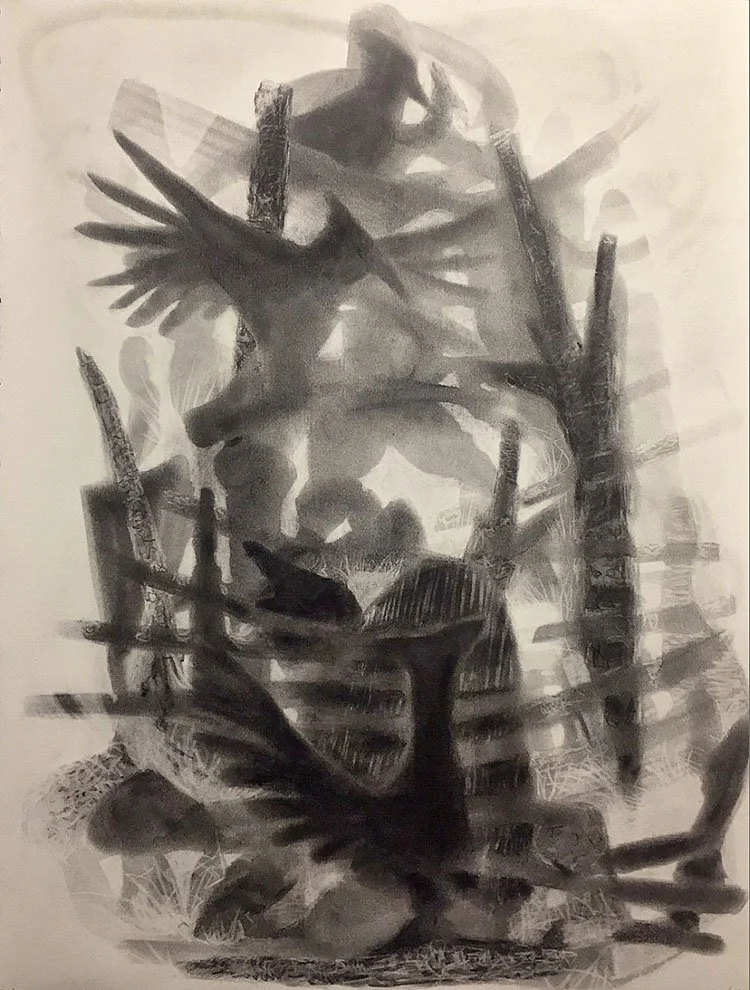
Sherman Maggie's Dream of the Jays, Graphite on Paper, 22 in x 30 in, 2018
After moving back up here, I had to take a look at how I define myself. I feel more like myself, in terms of how I approach thoughts like that, than when I lived in Chicago. There’s a reality to being here that I didn’t have there. I don’t want to work at Trader Joes for the rest of my life, but there is something, I get a lot out of work that isn’t artwork. I need that to a certain extent.
When Justice Ginsburg died, her quotes started coming out and one of them was about how she needed to be a mother to create the space for her law work. That one demanded the other and made the other one possible; it made the enjoyment of the other one possible.
Yeah, I think that’s true. On days off, I can’t wait to get in here and paint. I’ll paint sometimes after work. It definitely helps me appreciate it more that I don’t work as much in that field. When I teach, that’s the closest I get to feeling as if there is a seamless connection. I was teaching two nights a week at PCA, prior to the pandemic, so that has changed a little bit. I have been doing that less; just started doing that once a week, yesterday. That’s good enough for me, that little bit. I still get to share insight with people and get that genuine connection and help people at PCA. That’s enjoyable to me, as enjoyable as painting. For me I need to have both, not just one of those things.
What’s the future look like for you?
I have as show in Chicago in spring of 2022, at the Riverside Art Center. Judith Mullen reached out a few months ago to ask if I’d be interested in a show there. Otherwise I don’t really know, especially now with everything going on. I’m waiting to see how we’re going to move forward. So I’m just going to keep doing what I’m doing.
____________________________________________
You can see more of Joe's work by visiting is website, josephaaronnoderer.com, and keep up to date by following him on Instagram @josephnoderer. This interview was originally published at Rosalux Gallery.