Was there a particular exhibition that had a profound impact on you as a young artist?
Earlier on I mentioned going to the Carnegie. There’s the Museum of Natural History and then the Museum of Art; they’re connected but also distinct. As a kid, I don’t remember going to the fine arts aspect, but I remember going to the natural history part quite a bit. Because, like any kid, I liked dinosaurs. Anything else there -the hall of minerals, the geologic stuff, the dioramas there, are out of sight. They are from the golden age of dioramas. Those contained worlds were very influential to me and that makes a lot of sense [when] looking at my work and that idea of a window.
When I was in undergrad, I really liked figurative painting. I really liked Lucien Freud, Jenny Seville. Who I loved the most was Odd Nerdrum. I remember going to New York and seeing a show of his work at Forum Gallery. I was just beside myself with wonder -it was great, but I have a different opinion, now.
He was popular then [nineteen nineties].
Oh yeah, sure. He was writing all that stuff on kitsch. He’s a goofball, but he could definitely make a handsome painting. Seeing them in person was important because he was essentially doing Rembrandt-type stuff. It was like, wow, these paintings have all this depth, on top of the content. At the time I was being a little reactionary; I was into academic figurative painting and almost everybody else was into more avant-garde stuff that I didn’t feel comfortable doing myself because I didn’t know enough.
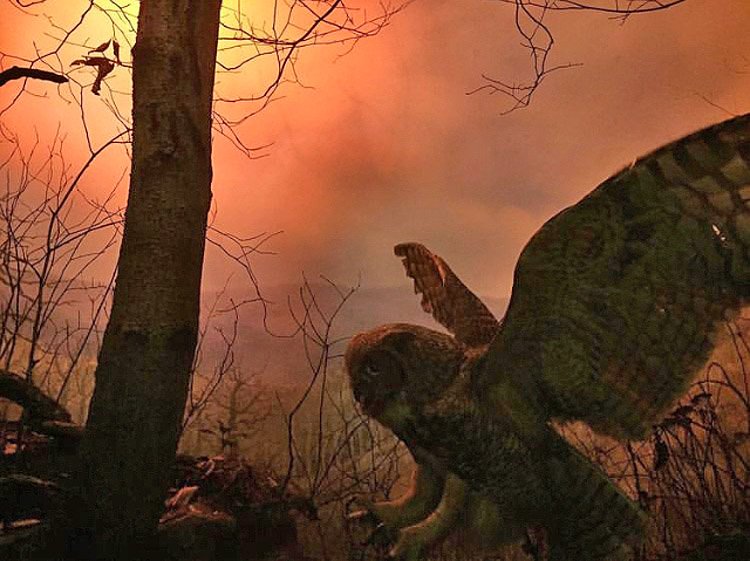
Screenshot, IG Post, Joe Noderer, Carnegie Museum of Natural History Diorama (Detail), 2020
That Burchfield show, at The Whitney, about ten years ago. I love Burchfield. He’s so Midwestern. There’s an undercurrent of darkness to his work that I think exists in regions like this.
He was in Western New York. Gloomy -lot of clouds from the Lakes.
Yeah, and he lived in Ohio for a long time before that. Seeing that show in person was great. I don’t think, prior to that, I had seen any Burchfield in person because they are famously sensitive to light and they stay put. So that was just mind-blowing for me. I also saw a pretty great Lucien Freud show in Ft. Worth -that was pretty eye opening too.
Do you think about this work when you are making your own work?
Burchfield I do. I have plenty of his books around. The Burchfield Penny Museum is only about three hours away, in Buffalo. I think about Burchfield in terms of I don’t what to be derivative of, more so than anything else. I think my paintings are pretty different from Burchfield.
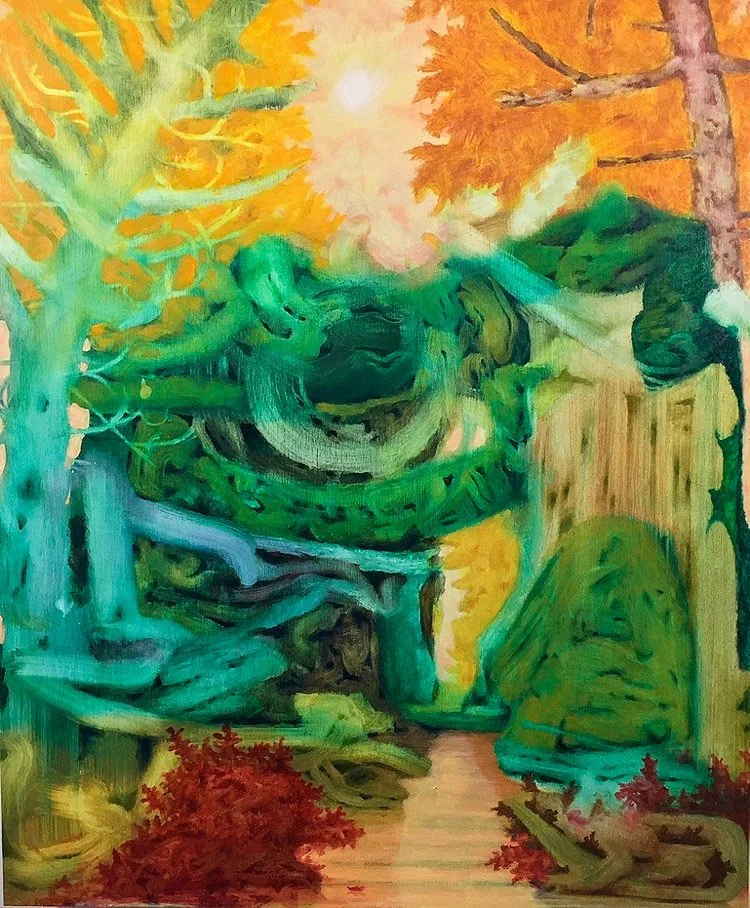
Hell's Hollow, Oil on Panel, 18 in x 24 in, 2018
Freud I don’t think of, consciously. One of the things I was blown away by, at that show, was how the closer you got to those paintings, they completely fall apart into material but you do not have to get to far away from them and they feel as real as you. I still have a hard time understanding how that’s possible, to be honest. I don’t really like Freud as much, anymore. Once you find out about people, you’re like, “These people aren’t that great.” [laughs] But that was one of the first times I had that experience.
Viullard -there’s a few of his paintings at the museum in Chicago where I would go pretty frequently. That’s a similar thing, but his stuff is way weirder than Burchfield or Freud.
What contemporary artists are you looking at now?
Alessandro Keegan is an awesome believer in painting. He’s into the occult and spirituality. He’s up front about it and makes really great work that is connected to that. It’s not corny, cheesy, sensational or anything like that and I think that’s pretty impressive.
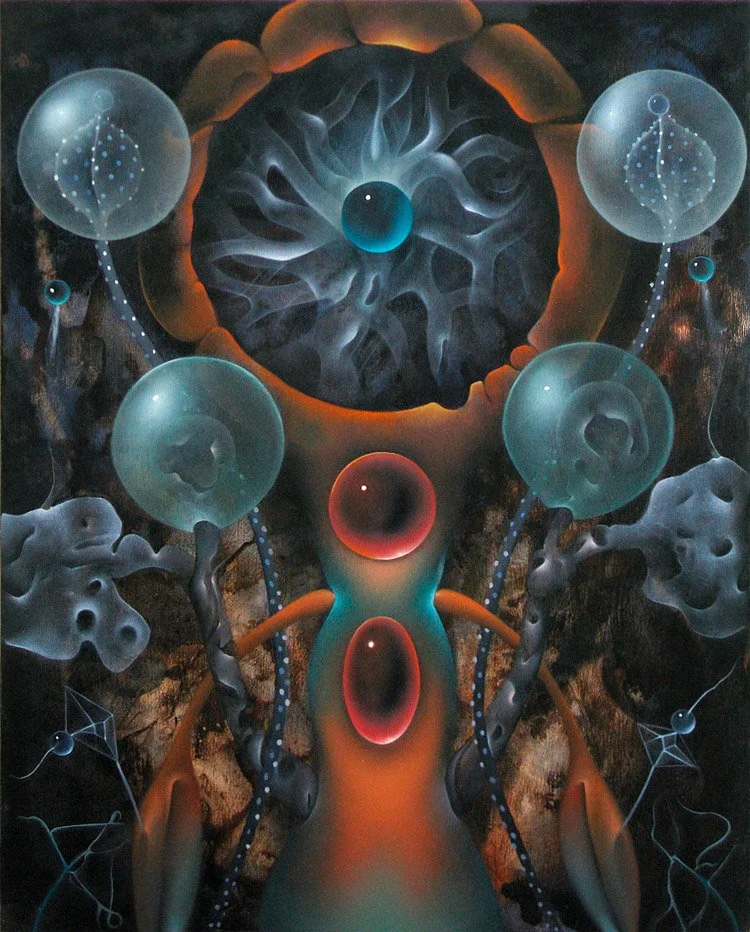
Alessandro Keegan, Inky Bloater, Oil Over Walnut Ink on Wood, 24 in x 18 in, 2017
Where did you study art, if you did at all?
Undergrad school was in Pennsylvania. I went to the Tyler School of Art.
In Philly?
Yeah, near Philly.
Did you go to grad school?
Yeah, in Chicago. Although, before I went to SAIC, I lived in New York very briefly.
What year was that?
It was February, 2002, and I probably left in 2003 [Laughs]. It was one of those...a really rude awakening. I really did not like it there.
Why did you go to NYC?
Before I graduated from Tyler, I did the Yale Norfolk Residency and met a lot of people there that lived in New York and we got along really well. I decided I was going to save up some money and move to New York. Went to Philadelphia, got my stuff, and then moved back to Pittsburgh. I lived with my folks, worked and saved money. I saved about two thousand dollars and then I moved to New York in February.
It was the winter after September 11th. It was probably the worst time to move to New York for lots of reasons -that being the primary one. It was a complicated time. I moved from Pittsburgh, from a relatively ideal setting, to New York. It was a lot of anxiety, really stressful, on top of the fact that there was a miasma of total terror and fear and anxiety -all those things left over, just still hanging. Not even left over, just hanging in the air from nine eleven.
I visited some friends in Philadelphia while I was living in New York and they were living, to my eyes, just the best life and I didn’t see them as making any kind of huge sacrifice, artistically, by living a more comfortable life. I realized that part of the reason I moved to New York was that I thought, you know, that this is the place -the center of the art universe in America. And you know, I really don’t like my day to day life, I feel terrible all the time, but it’s worth it because I am in New York and it’s going to lead to something. So that trip to Philly made me see that I didn’t have to live in New York if I didn’t want to.
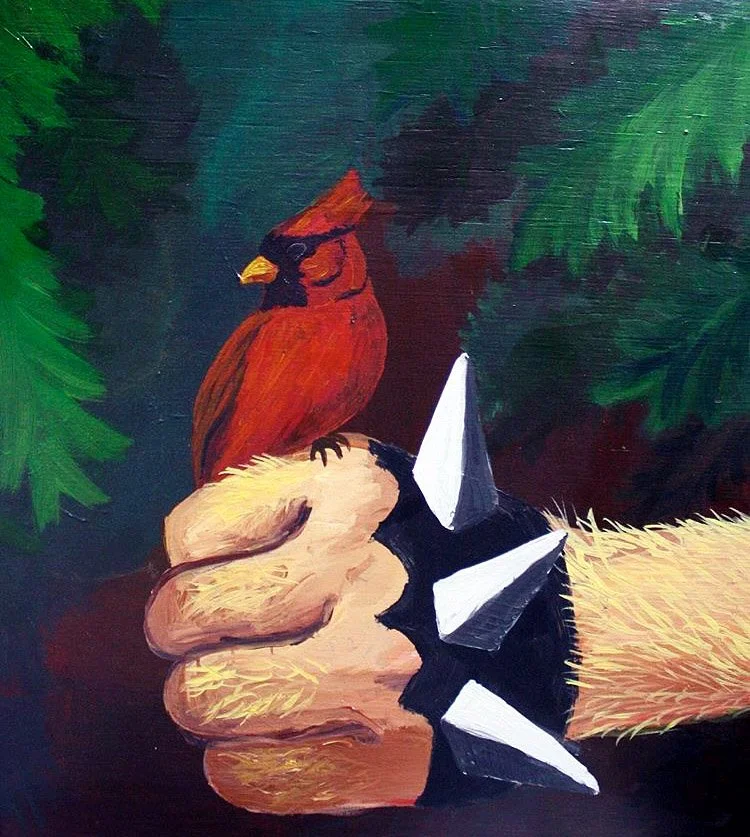
Night of the Demon; Friend to Beast and Bird, Acrylic on Panel, 24 in x 30 in, 2004-05
Part of my reason for moving to New York is that I wanted to get into grad school and I thought it would be a great place to be making work to then apply to grad school. I assumed that I would get into at least one of the grad schools that I applied to. Didn’t get into any grad schools because the work wasn’t true to my nature. I was making stuff that I thought would fit into Yale or even SAIC or...
The “important” schools [laughs].
Yeah! Exactly, the important schools.
Everybody applies to Yale, whether they want to go there or not [laughs].
Yeah [laughs]. That’s the truth.
So I got all the rejection letters and that was tough, but what happened was that I kept making work; I kept painting. But then I started making these paintings that I really, really felt connected to and that was a pretty formative experience. When I am making a painting I am trying to be relatively intuitive; I’m trying not to think too much about what it might mean or what I am trying to say with this painting. I’m trustingthat I’m making it and I’m influenced by what’s going on and that influence will come out and will show in a way that is more saturated than if I were to set out with the idea of this or that. That practice of just sitting down, painting, listening to music, getting lost in a painting -that’s where that started, actually.
I wasn’t painting for an application or for anybody, since I didn’t have any kind of prospects lined up for showing, really just painting, in large part, for myself. Although I lived with two other people who were artists and I had a lot of artist friends -they saw what I was doing. It wasn’t like no one knows I paint. The experience was just about me and the painting. I can’t imagine how awful things would have been if I had gotten into grad school with that work I was making, initially, for grad school.
How old were you at that point?
In my twenties, twenty-three or so.
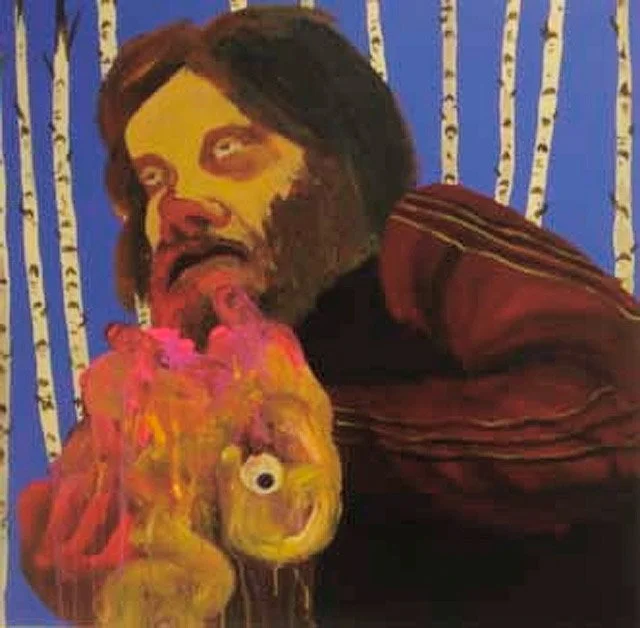
Jogger, Acrylic on Wood Panel, 32 in x 30 in, 2004
There was a lot of struggle when I was twenty three. Questions like, “what am I doing; what worth does it have, who am I in my work and how do I choose a direction?” Do you have a memory for what you worried about, artistically, back then?
All my friends who were making art there were painters, but they definitely were kind of conceptual. They had gone to Cooper or Pratt. I didn’t know anyone from the New York Studio School, which maybe would have been an easier fit. When I think too much about being intelligent or defending something I’ve done in a painting, I get suffocated. I mean it’s intellectual to some extent, but for me it’s about connecting to my experience and just connecting to my environment. Again, not that thought has no place in that, but it’s not the primary reason for making the painting to begin with or there is no end goal, proving some sort of point, necessarily, about painting. So knowing that about myself, but trying to be a “smart person” in my paintings -that was very stressful.
That time in your life, whatever you do, but certainly as artists, your mind is way more open to influence, even influences that don’t fit, and it pulls you into a kind a void. And if you’re lucky, or whatever, maybe luck has nothing to do with it, if you survive all that you get to come out on the other side, which I say is over 35, whatever, maybe over 40, I don’t know what age it is, it’s different for everybody, where who you are remains in tact, despite all that.
Yeah.
To me, that’s an arc of an art education. So what brought you to Chicago, SAIC?
I had been to Chicago as a kid and thought it was a pretty cool place. I had been told, when I was in undergrad, by one of my professors, Richard Cramer, who unfortunately has passed away of complications due to Covid-19, that Chicago would be a good place for me to check out; check out the Hairy Who. At that time I was making work that was a little more graphic, in terms of being kind of flat, and really composed, but it was also inspired to some extent by cartoons and comics. So I can see why he would say that now. At the time, I was just a kid, and I thought more about what was happening in New York as important versus what was happening in Chicago. So I just didn’t know much about Chicago.
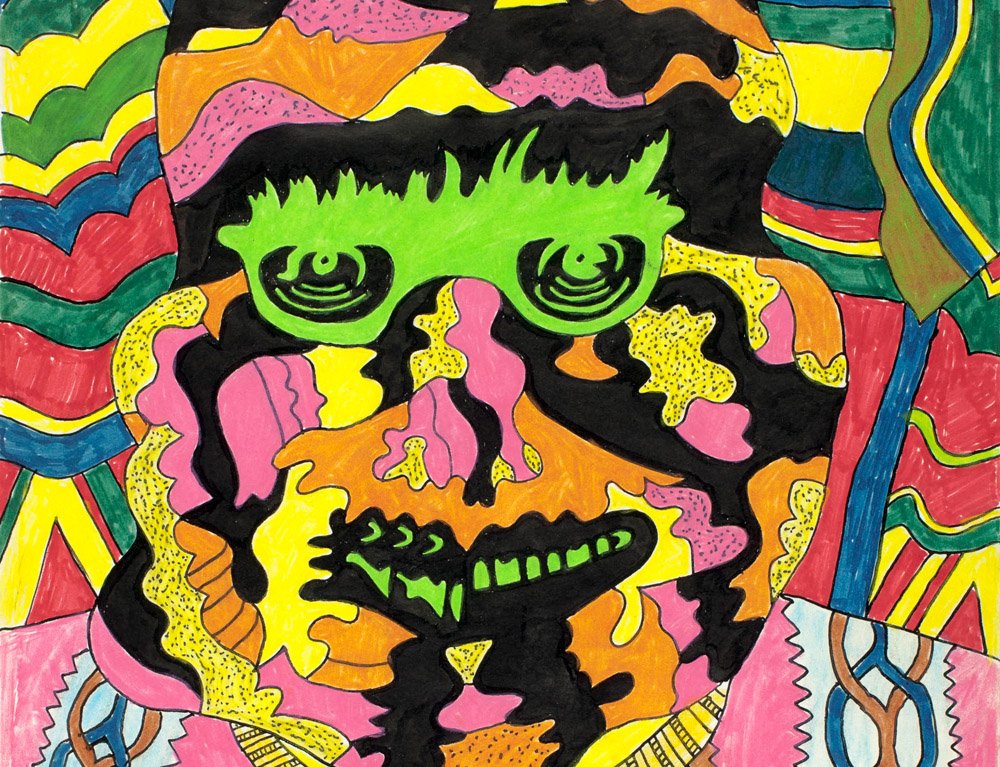
Kurt Wirsum, Youdue, c. 1966
Even though the way I approach my paintings has changed, that current stayed intact. A lot of color, relatively stylized figures, but also not a presumptive attitude about art, which is what those folks [Hairy Who] were known for. They were smart; really intelligent people reacting to the high brow stuff in New York and on the West Coast.
So, the second time I applied for grad schools, I got an interview at SAIC. I went and got along with Dan Devening and Judith Geichman, the folks that interviewed me, and they were interested in where I was coming from.
I also applied to Yale and got an interview there too, but when I went it was like, “You don’t belong here, Joe.” When I was at the interview, they asked me who I was looking at and I mentioned Martin Kippenberger. Based on what I had to say about Kippenberger, which was mostly all formal, not conceptual at all, which is an enormous part of the approach, if not the entire thing, Kurt Kauper, who was one of the interviewers, said flat out, “I don’t think you understand Kippenberger.” It was pretty intense, he was right, but no one had ever been that blunt with me or it had been awhile. That was a pretty intense environment to be in anyway; I was interviewing at Yale and I was sweating bullets.
Yeah, it’s that kind of environment.
So when he said that, he was right. It made my stomach sink, and I also knew I wasn’t getting into Yale, but that made the interview at Chicago, which came after that, just feel more right, more natural. We got along. I was making these paintings on acrylic panels that I put together from wood at Home Depot -they were really poorly made. I wasn’t thinking about that conceptually, I was just making something to paint on. Dan said something about how the supports look like shit, and that’s got to be on purpose. It wasn’t on purpose, but I understood what he was saying.
So it just seemed like a good fit. Chicago, in a lot of ways, reminds me of Pittsburgh -a big, blue collar city. After getting to know Jim Nutt and Karl Wirsum, and other folks that work at the school, it seemed like the right attitude. They were serious, but not too serious, fun but not too much fun.
So, why did you move to Texas?
I was living in Chicago. I was teaching and working in a woodshop. Chicago was stressing me out. My parents had recently moved from Pittsburgh to El Paso, Texas, and then to Austin to be with my sister because of the grandkids. Work was drying up in Chicago and me wanting to be there was drying up. I initially wanted to move back to Pittsburgh, but part of that was to be closer to my family. Since they had all just moved to Texas I thought maybe I should consider moving to Texas. I found a job, there, teaching at the art institute. I have to admit I was definitely into the idea of moving to “the West.” Not the west coast, but the frontier west.
A romantic notion, maybe?
Yeah, for sure. Lot’s of people in Chicago were like, “If that’s the only reason you are going there, you shouldn’t go. Don’t move to Texas for that reason. ” But I did. So I moved there for a change. I liked that Austin was small, like Pittsburgh, but also that it seemed healthier than Pittsburgh -it is healthier than Pittsburgh. Coming from Pittsburgh, New York or Chicago, that seemed refreshing, although talk to anybody I knew down there and they’d say all I complained about was that it wasn’t old enough or decrepit enough [laughs].
So I started working from pictures that were of Pittsburgh or South Carolina, which reminded me a lot of the Pittsburgh area with the tangly growth.
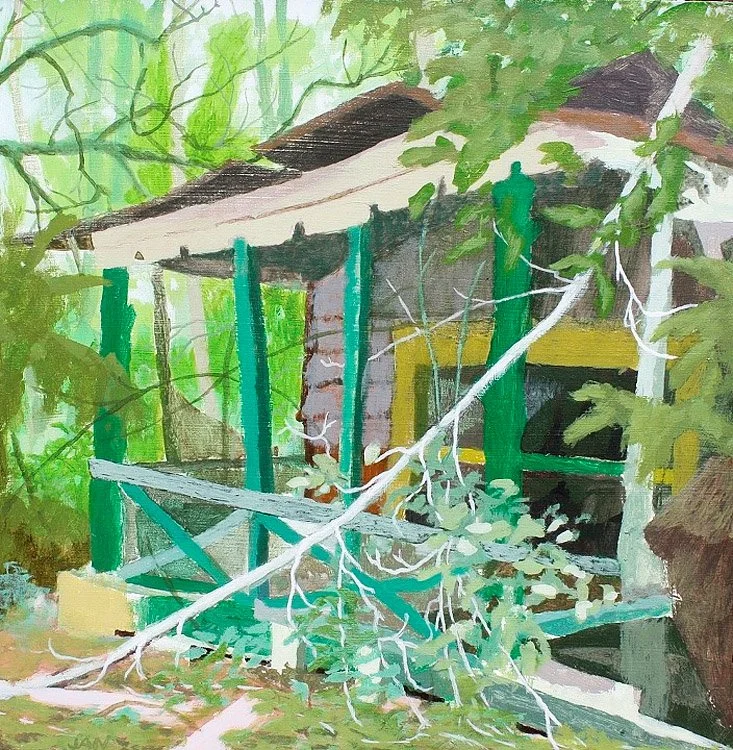
Untitled, Acrylic on Wood Panel, 12 in x 12 in, 2011
When was this?
That was 2009 through 2014.
So you went somewhere new, but you were thinking about where you were from and you were looking for notes of that in things that were in Austin. You then made a decision to go back home to Pittsburgh. I read in an interview that it was a bit of a challenge for you to go back home, even though you had wanted to. I don’t think your work is nostalgic, but I think, to some degree, you have dealt with nostalgia.
Yeah, a lot.
Can you talk about nostalgia, going back home, the pain it involved, and how that manifested in your work?
Towards the end of grad school, I was feeling a strong desire to move back to Pennsylvania, to Pittsburgh; wasn’t able to, and I moved to Texas. I was looking at things that reminded me of the Pittsburgh area, to work from, and that were also related to family. So, when I worked on paintings from photos of South Carolina, those were all family vacations that were impactful on me, visually, and made its way into my art. I realized I missed family or that feeling of belonging that I feel here [Pittsburgh], because I grew up here and had a lot of experience with people who have lived their whole lives here.
My uncle passed away in 2012 and we came up here for that. That was obviously, emotionally, a very heavy time. He was my mom’s only sibling and she was pretty upset and I missed my uncle. We came up in June or July, a beautiful time to be up here, but also very emotionally intense. While I was up here I began taking some pictures of things that I’d like to paint when I got back to Texas. After I got back to Texas, the more I was making these paintings based on stuff from Pennsylvania, the more I thought, “Why don’t I move back to Pittsburgh -why am I doing this -it’s weird.” My parents moved back up about a year before I did, so there were all these things pointing me in the direction of going back which was something I wanted to do for at least a decade.
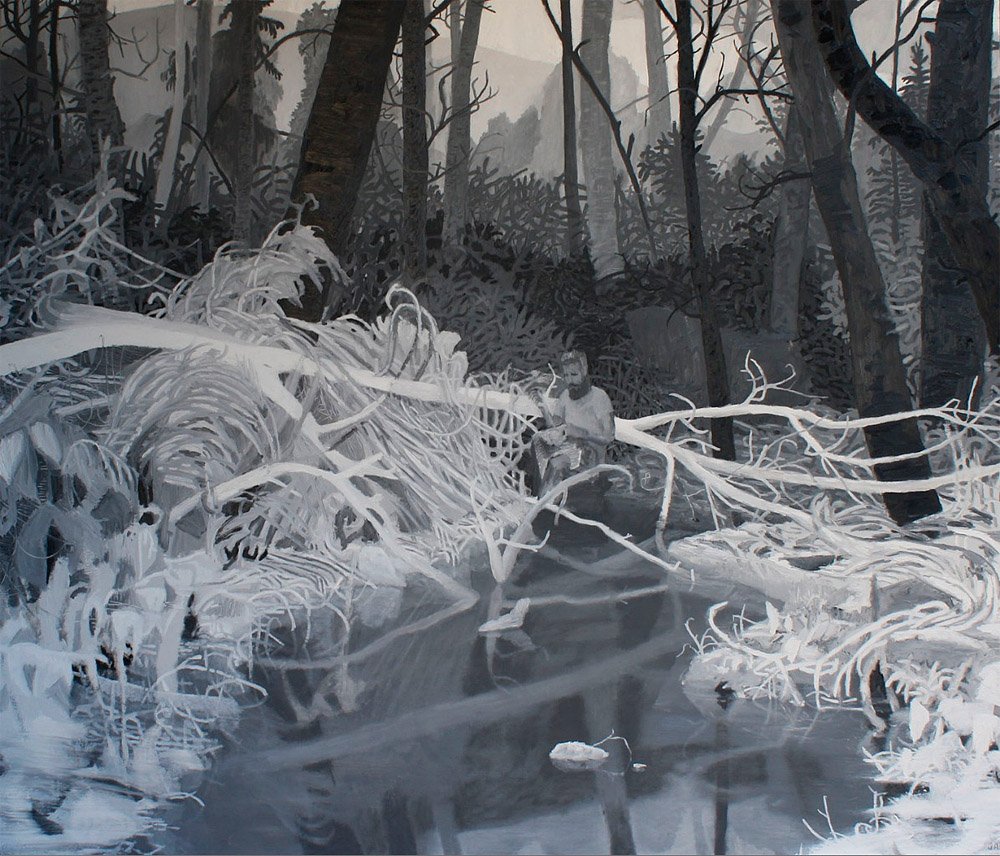
Big Mingo Gap, Oil on Canvas, 48 in x 56 in, 2013
When I got here [Pittsburgh], it was April or so. It was early spring, which here is dark, not warm, it’s wet, there’s barely any green although you know it’s on its way. That had a pretty profound effect on me emotionally, just like it did growing up. On top of the fact that I had suffered some losses; leaving people behind in Texas; not sure I was doing the right thing by moving [in] with my parents and not knowing what I was going to do. Found a job at a grocery store, no teaching had popped up, even though I made inquiries. I had to ask myself a lot of questions, had to change my perception of myself, I had to adapt.
What did that mean to you -to change your perception of yourself?
In Austin I thought of myself as an artist and a teacher that had come from Chicago. I was showing at a gallery in Chicago, regularly, every two years or so. My view of myself in Chicago was all art-based, painting-based. When I moved to Texas, that’s how I presented myself and that was the world I fit into. When I came up here [Pittsburgh] I just had a show and I had one more coming up, but beyond that, it was almost like a secret. I was working at Trader Joes and nobody here knew or cared about my experiences in Chicago or Texas. To some extent I had to be okay with painting or art-making as somewhat secondary to being a son. My mom had been diagnosed with breast cancer and I painted along with that. That put things into perspective quite a bit when there was the very real possibility of her death. I took myself out of a bubble; popped that bubble pretty hard.
But the thing is that once I got over that shock, it’s more in line with my nature, anyways, to exist in that middle ground. It was ultimately a good, but difficult, thing for me to have done. It was good because it helped me be a little bit more objective about home in a way that has improved my relationship with it, as well as changed the atmosphere of my work so that it might be less nostalgic. I’ve always, inadvertently, skirted nostalgia in my work, but now that I am here, I am painting what’s here. It feels like it is almost impossible for there to be nostalgia in my work, which is good because I was never comfortable with that.
I don’t think your work or landscape, itself, is a nostalgic enterprise, absolutely. It really depends on what you are going about.
Prior to that [the move home], I was being nostalgic. I was missing Pittsburgh or Bethel Park and seeking out things that reminded me of it.
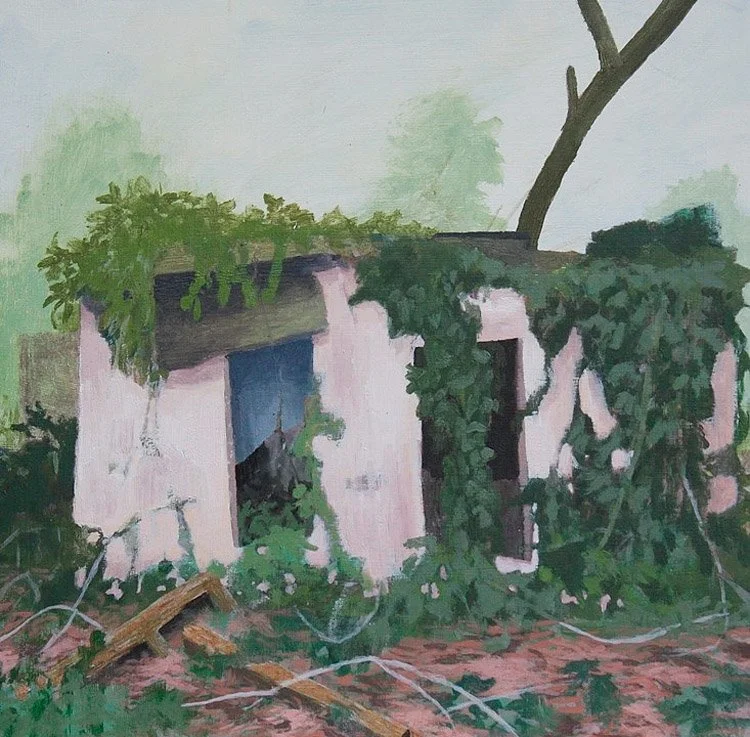
Pink Motel, Oil and Acrylic on Wood Panel, 12 in x 12 in, 2010
In the online catalog for the 2012 exhibit “Tenses of Landscape,” which included some of the Austin work, you stated that “Reacting against... sameness has become essential to my work. I find the unique things (older buildings, trees, alleys/garbage) much more valuable than things that seem to be increasingly built to replace them.” You go on to say that these unique, old things remind you of painting.
So the question is what painting things is, or could be, in relation to your statement? The other thing I wondered, in the sense of reacting against the sameness of contemporary architecture, is whether you are reacting against a certain kind of art at that time. It’s kind of a tricky discourse because nobody wants to be reactionary, right? And yet, I know that people see [often incorrectly] that an artist making landscape is working against a contemporary art culture.
Can we have a dialogue about that -is there something to say about that?
Austin being a newer place, I was definitely talking about that sameness. I really didn’t like the architecture there. It was right for people who didn’t have a problem with putting this thing up or that thing up. It’s flat so there is no issue with expanding. Having been in older cities, prior to that, I saw Austin’s architecture as a visible byproduct of “new” culture, throwaway culture.
By looking at other things, I was definitely choosing those. By painting those things and putting them in shows in Chicago and Austin; I felt that by valuing them, by taking the time to paint them, I was giving people an alternative to what was happening.
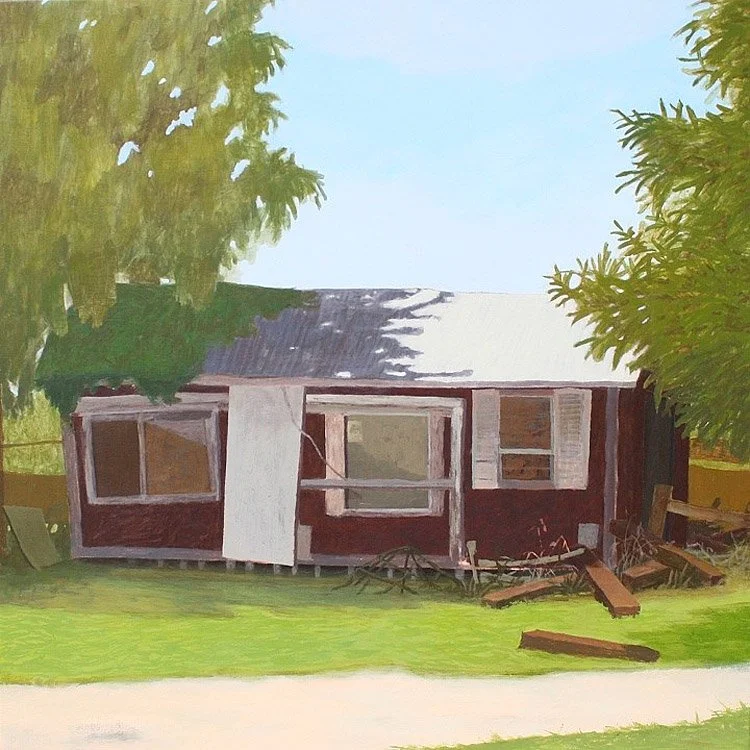
Store II, Acrylic on Wood Panel, 24 in x 24 in, 2010
In general, I don’t know what’s going on [in contemporary art]. What I could say is, as you mentioned, I'm being pretty blunt about wanting the paintings to have an expressive quality. Maybe that is something that people don’t say even if it is something that they want; they don’t throw it out there.
I think at the time, because I saw myself as an artist-teacher, I was thinking more about reacting to, or having a dialogue with, contemporary art, but now I don’t see it the same way. Because my role has changed, which is good. It’s made my work better because it is more direct. I think less about how it is going to fit into what’s going on, as if I know what’s going on.
I think the idea of expressiveness is a challenge because the academic life, and to some degree the commercial life that may come after it, tries to work that out of us. There are a lot of artists that work from that place, but hesitate to talk about it because [talking about it] it has been trained out of them.
That was definitely part of my experience in grad school. I had a group of friends in school who were not so much making expressive paintings, but they believed in the act of painting. The thing that united all of us was the tradition of painting and trusting, even though it was hard, that something of relevance was going to come through because we’re making paintings now, in the world. Whereas other folks in the [grad] program, or the advisors, weren’t into expressiveness, in the literal way you think of it, like a Frank Auerbach painting, unless you had a conceptual reason for doing it.
Do you think that was a function of their disability to entertain what I think is conceptual...a way of thinking about what painting is or could be -that’s conceptual, right? How you conceive of painting and what it can do.
Sometimes I am not sure if expressiveness is the right word. I think of them as expressive paintings, but maybe more in terms of being emotive, having a mood, an atmosphere. There’s a certain amount of texture to them, not a lot of flat, plain painting. That kind of texture, or implied texture, is something I consistently like across the board, whether its music, actual landscape, or other people’s work. There’s the evidence of my hand, there, because I use my fingers to move things around. There are fingerprints, so they are literally hands-on.
I can’t help but to think of Frank Auerbach, or Kirchener, when I think of expressive. But who I really think of as an expressive painter, who has been a big influence on me, is Delacroix. Historically speaking, his work is not expressive -it’s Romantic. He’s bold, his stuff has a lot of color, his compositions are very active. It’s an experience to look at one of his paintings; you look all around, you get really close, you get really far. That’s the kind of quality that I like to have in my work. Formally speaking, you could call my paintings expressive; there’s a lot of movement in them that is generated by me making expressive marks to begin a painting and then building on them from there.
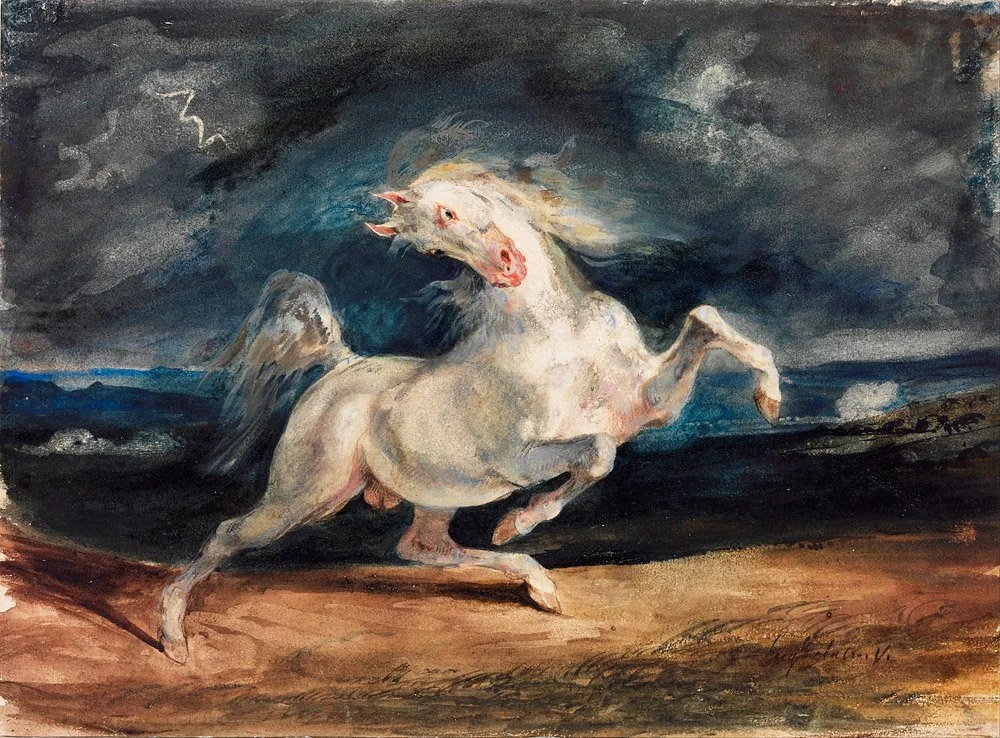
Eugene Delacroix, Horse Frightened by Lightening, Watercolor, 1824
Do you think it’s the sense of the natural world, the architecture, whatever it is, having a quality of languid animation -I say languid because your work isn’t wildly frantic. It’s sort of a dripping animation; even the inorganic feels organic.
Yeah, that’s how I see things when I look around. That’s what’s here. Even power-lines, hills, and houses -there’s a lot of, visually speaking, movement here. If I were living in Chicago, in Logan Square, I wouldn’t really get much -there would be a lot of horizontal and vertical. We get a lot of different visual stimulation here. On top of that, we have a lot of nature, pretty intense seasonal changes, all those things come together. Maybe expressive of emotion, or of feeling, maybe that is a better way to frame things when we are talking about painting because that [expressive] is such a loaded term. That’s why people don’t say, “I wanna make expressive paintings.” [Laughs] If somebody told me that, like one of my students, I’d be a little wary until I saw what they wanted to make and then that wariness might change.
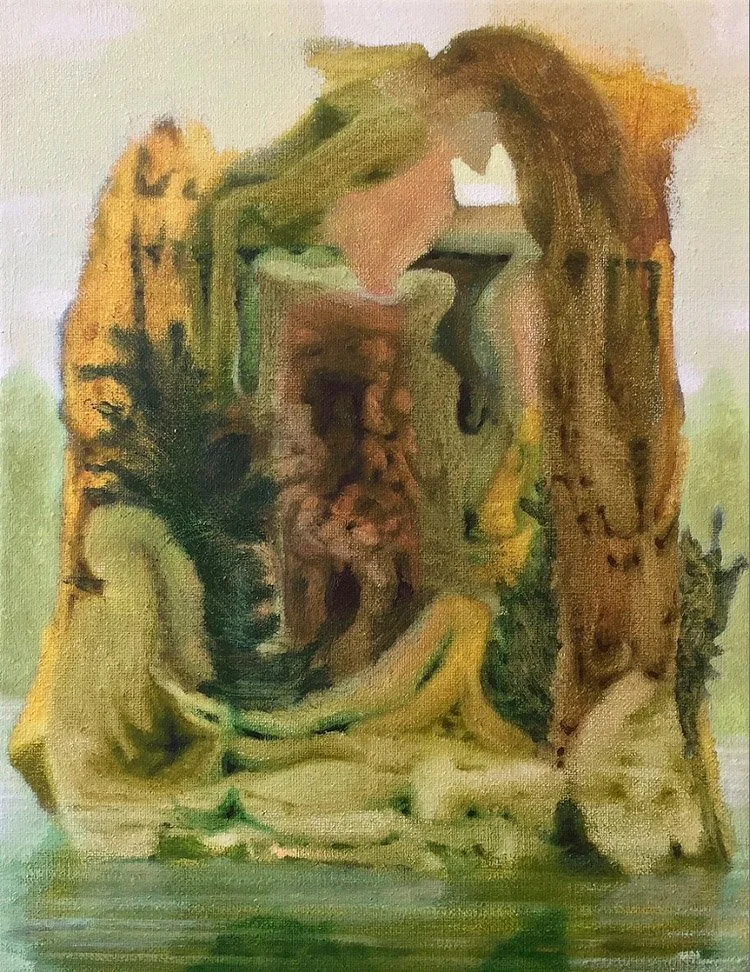
Acanthus Island on the Mon, Oil on Linen, 11 in x 14 in, 2019
I find Symbolist impulses entwined with American Regionalism, Burchfield’s manic mysticism hybridizing with Redon’s macabre irrationalism in your work. There is also a current of later German Romanticism and, in some paintings, a compositional resemblance to deChirico’s Archaeologists. What do you think of these combinations I put together?
I think they’re good.
There was a specific image that you made and I thought, “why does this painting remind me of de Chirico?” A lot of your paintings have an internal aspect; they mind the boundary of the canvas edge. “The Archaeologists,” he had a series of them, are like that, where they look like a still-life. Your painting is like that -it’s portraiture, it’s landscape, it’s still-life -all at the same time.
I had to look that picture up because I know de Chirico, but I was always really turned off by Surrealism, although he is kind of a proto-surrealist. I am still wary of it, but I think there were some really good things that came out of it.
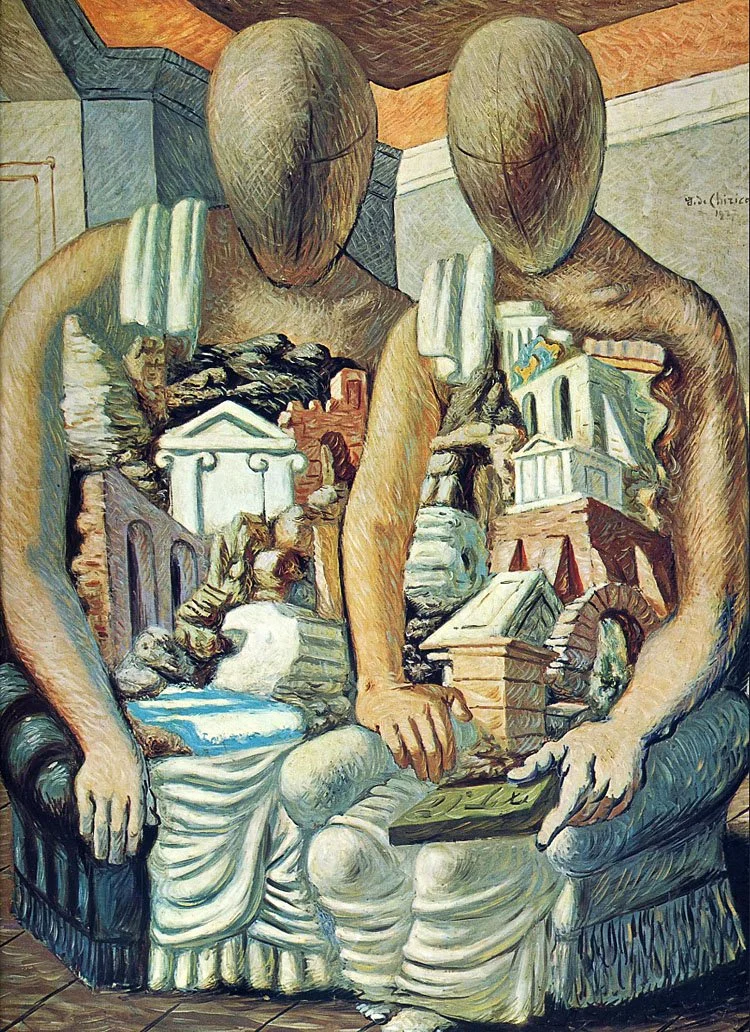
Giorgio deChirico, The Archaeologists, 1927
With “The Archaeologists,” once you brought that up, I instantly saw the subject matter and its relationship to the edges. I’ve become increasingly aware of the edge; how what I am making interacts with that. I’m looking at this one right here [on the studio wall], it definitely has that kind of still-life aspect where it looks as if it’s an object existing in a space. It’s a painting of a possum chewing on someone’s hand and arm. The possum and the arm have become like one thing. The exterior is just color.
The idea is that I don’t always want what I am making to look as if it’s a snapshot, or a window is a better way of putting it, out onto a larger reality. It’s like a way to make the experience of a physical thing rather than a picture of the environment in which you or I would feel a certain way. I’m taking that idea and trying to get at making a new thing out of those parts.
I think of them sculpturally, not all the paintings, but the ones you’re referring to. I look at it and think, “Why is there all this empty space?” To get the idea across of this thing being three dimensional, like an impossible still-life. Why not just try to make an impossible still-life? It would almost make more sense if they were sculptures.
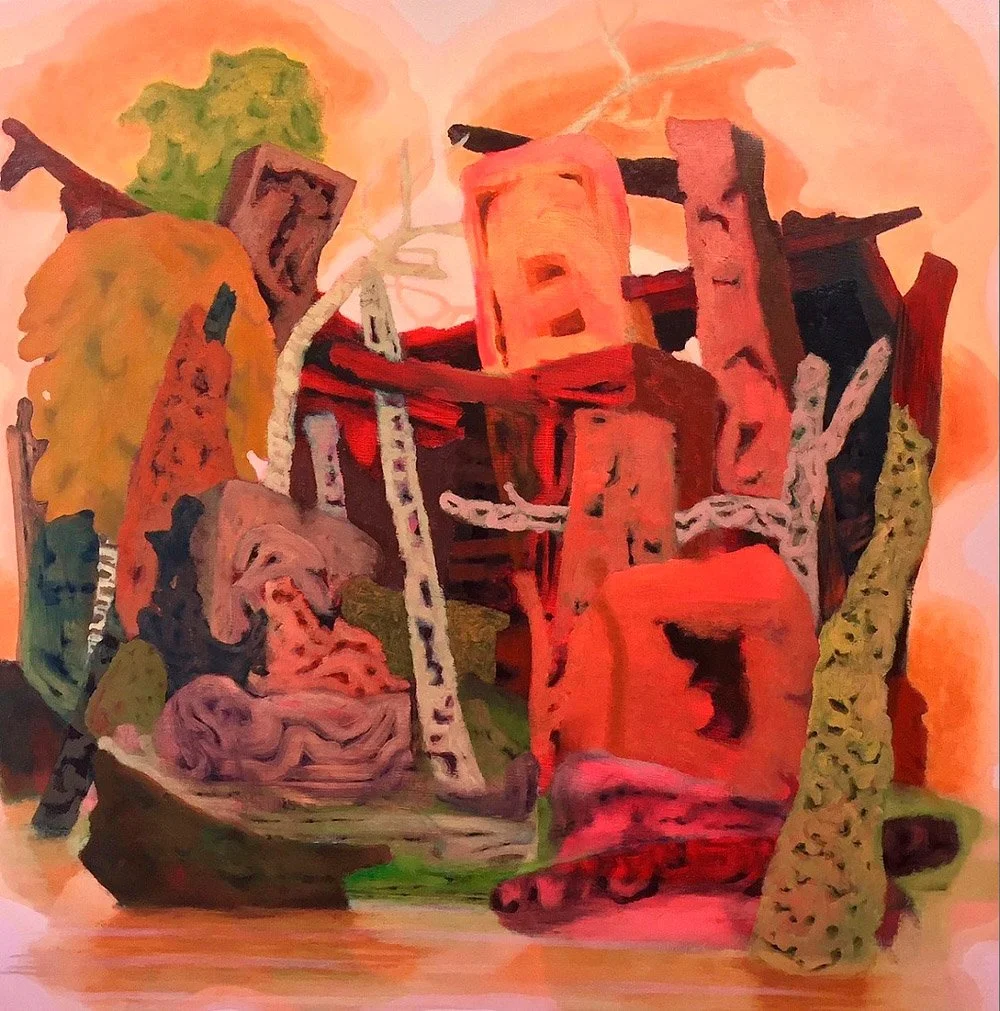
Bingham's Vision, Oil on Panel, 24 in x 24 in, 2018