asters

The Transplant


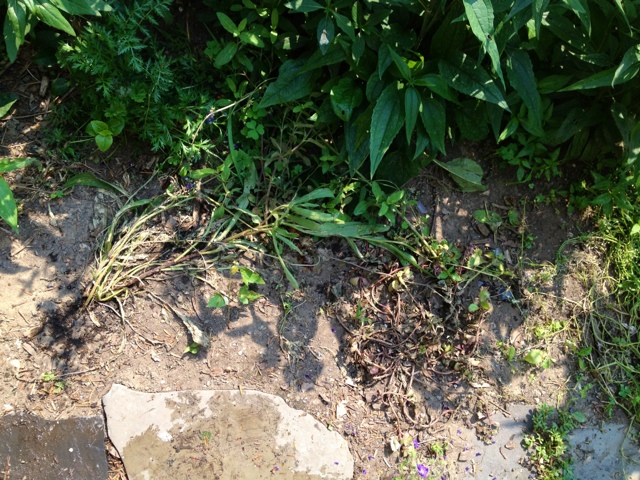
There is a patch between the curving drive and the yard, on the north side, where Rex's dogs used to reside. The dogs, Trixie and Elmo, passed away years ago. Last autumn, Betsy flew out of LaGuardia with a box of bulbs, roots, stolons, and rhizomes in her carry-on. She planted them here, among the old dog pens. This spring we sold the chain link pens to a woman tending goats, or was it pigs? 


As it turns out, this is a very prolific location, maybe the most fertile in the yard. The plants that grow here are a hodge podge of Lamium, Creeping Charlie, Jewelweed, Milkweed, Bellflower, Virginia Wetleaf, and smattering of Lambsquarters, clover, grasses, and other weeds. These surround the remaining dog house, one that is hard to part with because it was so lovingly crafted to resemble the human house it shared land with at Rex's old place.


This is the canopy of a single Jewelweed, Impatiens capensis.  I say canopy because it is built like a tree and is beginning to shade out the transplants.


Just look at the size of that stem, maybe three or four inches in circumference. To the right is a Maximilian sunflower, Helianthus maximiliani, carried to Brooklyn from southern New Mexico, and now to Minnesota. To the left is one of two Bleeding Hearts, Dicentra eximia, holding their own under the shade of the giant Jewelweed.


I'm happy to see what I know is an aster growing among the Milkweed, but I cannot tell if it is the weakly growing Anna Potschke or the more aggressive New York Aster. I'll take either, but would love to see Potschke do well here since it suffered so much in Brooklyn.


The Milkweed, Asclepias syriaca, grows strong here and like common Milkweeds everywhere, it appears rather randomly wherever it prefers. I suppose that's what makes it a weed to the farmer or landscaper. I hope gardeners appreciate it. I've seen some spectacular specimens in yards here -they are quite sculptural, exerting considerable presence. We are planning on a wildflower meadow over the septic drain field and will likely transplant some of these to that location.


Each lily transported from Brooklyn have made this home. They are all doing quite well, as they had in Brooklyn (people's sticky or damaging fingers aside). I may miss the bloom, or part of it, as I will be away in New York City for a presentation in late July and then in Vermont for the first part of August teaching my course Landscape Into Art.

When I am there I will pot up some rather large specimens that could not be, nor should have been, crammed into a box. Roots trimmed, watered heartily, I will leave them for the week while I am in Vermont, and then, on my return to Brooklyn, pick them up for the return trip to Minnesota. I do not look forward to this drive, haven't for years now, but the plants, their care, and the stowaway creatures that will make the van a home for the trip will make it a more interesting ride.


House Beautiful


The landlady recently ordered the removal of our tree pit asters. She can't really do that, I mean, landlord's don't own the tree pits, do they? But her team of slow-moving, low paid handy men have all day. These were the guys who sprayed herbicide to do in the weeds around our garden a month ago (and garden plants are still dying a slow Monsanto-engineered death). Meanwhile, in 99 degree weather, another was painting the house with a roller and bucket. So many guys, but the dump never gets less dumpy.

Betsy worked hard in nasty dog and cat turd studded tree pits to make the asters orderly. I then lifted Chrysanthemums from the other beds to fill the street side. Asters are a great choice. They naturally grow under trees, are tough, don't require anything but rain, and they flower with buzzing activity in the fall that warms your heart. So far, dogs (and their owners) have resisted filling these with new turds. It doesn't look like much now, but it would, in time. Got to give it time. 

Last year's asters were self-seeded into the tree pits by wind.


Ahh, the newly-painted siding. I'm not cherry picking, it all looks like this.

All the new plants mashed by the painter's boots.

I had a run in with the landlord's daughter. She complained that the cat dander was working up her asthma as she left our building. I said that it could easily be the carpet in the foyer and staircase that smells like a thousand wet dogs. She couldn't agree, and in fact, said that given our rent, I should keep my complaints to myself and, of course, I am always welcome to leave. 

I do not like having the rent held over me to shut me up. The landlord can raise the rent if it's needed to keep maintenance up -everyone understands this, but a landlord has some obligation to maintain their building -at least the common areas. New tenants came in last year and their rent is nearly 50% more than the previous tenant, but those new tenants will attest that little has been done to improve the place. So the complaint that we don't pay enough to do some upkeep feels rather hollow. 

We hear you, we can always leave -so we're looking.


Trimming Asters


I've noticed on my stat reports that quite a few people have viewed my blog while searching for, no -not for the mysterious killing squirrels in the rain*, but for trimming asters and pruning asters. I've discussed more than once pruning asters in June, but never mentioned what to do with them come November. I wouldn't want anybody to leave empty-handed, so what can be done now that most asters have quit blooming?

You do not need to cut the asters back until late winter/early spring. But you may prune back the dry stems now if you prefer the neater look of cut perennials. Just cut them a few inches above the ground. There are many types of asters, of course, but all may be cut back after flowering is over. New England and New York Asters and their cultivated counterparts will form clumps which may eventually need to be divided. You can do this in spring. Plants such as the Smooth Aster will form fluffy seed heads that will self-seed whichever way the wind blows. If pulling asters in spring is not your style, cut those back before they go to seed. By the looks of my asters, now is entirely too late!

*actual search that somehow landed here.


Trimming Your Aster


I learned awhile back about clipping asters from a neighbor who's own always seemed to be completely under her control. I wouldn't have ever known if I hadn't spied her cutting them. 

Each year the time to consider clipping might be different. This year, it's quite early. I've clipped my taller asters, those above 16 inches, back to about 13-14 inches. No matter the height, consider reducing clipping back by 15-20 percent. Doing this will promote more flowering, as clipping can with so many plants, because you cut the dominant growth tips (apical meristem), allowing many side stems to grow. Aside from bushier plants with more flowering buds, it also keeps the plants a bit shorter, and less likely to flop as far when heavy with flowers in the fall.

You can be graceful or rough about the clipping. I tend toward the middle.

All the asters that are quick to get tall get this treatment. This includes the New England asters, the perennial sunflowers, and even goldenrod -Solidago.

This aster, at 8 inches tall, isn't grown enough for clipping. Maybe in late May or early June. Here in New York City, I wouldn't clip after late June. At that late date, you will weaken the plant, invite disease, and limit formation of flowering buds. So to be safe, clip early when the plant reaches 16 inches or more.


For The Bees


I stepped out this morning on my way to the studio. From the stoop I noticed a youngish man with a little dog. The guy was looking, somewhat transfixed it seemed to me, at the asters. This struck me. I had to ask.


Do you like those asters? "I'm looking for my bees. It seems your flowers are the only thing going right now."

Oh.

"I keep bees about two blocks from here and I like to check out where they're collecting"

Oh. The truly interesting thing that he told me is that, a year ago, he was afraid of bees -ran away from them. One class later, and he's scouting his bees in the neighborhood.

He then asked me if I had any goldenrod. I do, but it's passed, I said. Although they are asters too, I added. In fact, almost everything you see here blooming is an aster, and the bees do flock to them, while they do not seem to have much interest in the blooming chrysanthemums, although common flies well do.

Then, after small talk of moving, flooding basements in the neighborhood, the beach farm, and what have you, we went about our business. I'm glad to see the garden has some unrealized value to people around the block.  Of course, I see the bees, but I figure them for on their own, not part of a honey operation, an apiary. Awesome.


Front Yard Finale


The front garden as it now stands.

I'm curious about the chrysanthemums that are darker in the shade. Those to the right are in sun, those to the left get much less sun because they are behind the rose.

The pink gaura is blooming again, one here, one there.

It's a long wait for the pineapple sage, Salvia elegans. First bloom the last week of October.

These asters are having their moment.

Hidden within the blast is another type of aster.

The bees love these.

The butterflyweed, Asclepias tuberosa, is finally sending off it's seeds like so many baby spiders.

Boltonia, another aster really, is the last to bloom. Just this week it has begun, one by one.

The Aster 'alma potschke' is wrapping up its season, along with the Eupatorium. Much like me, who's thinking about forgetting the garden for awhile. I think I'm ready for winter. Bring it on.


Bloom City


Front garden asters and max sunflowers -unfortunately cut in bulk by a greedy admirer.

The self-seeded borage.

Now that the heat of summer has passed, the path's alyssum looks good as new.

New Dawn's hips finally orange.

Side yard max sunflowers.

Eupatorium and aster together.

Honey bees hot for 'Alma Potschke.'

Asclepias tuberosa seeds.

The garden has been colonized by Snakeroot, formerly Eupatorium rugosum, now Ageratina altissima.

The under-appreciated individual flowers of Sedum.

The other asters -these more pointy-petaled and later blooming.

The gerbera daisy blooming in its pot.

White Gaura still gliding through the air.

Monkshood, Aconitum napellus (probably).

A look under the hood.

The unstoppable 'Sheffield's are now in bloom.

Other plants are still in bloom -the goldenrod, the phlox, the lily turf, the shrub rose, the honeysuckle, and even 'New Dawn.' It could be said the front garden has matured, and with it I have become aware of the movement of time, the passing of years, its inherent clockwork. It is both designed to take less of my time and I have less time for it. Yet I am comforted by the appreciation of so many passers-by, lending their presence -a certain kind of care all its own.


Aster Creature


I'm not ashamed to name the Asters as some of my favorite plants in the garden. They do most of what I ask, including surviving overcrowding, heat, wind, drought, and massive infestations of bugs that help to mottle and yellow their leaves all while continuing to put out new growth in preparation for fall flowering.

Please, click on these photos for a closer view. The black dots, no doubt, are bug poop.

This is Aster 'Alma Potschke.' It survived multiple transplants last year, then a clobbering by a baseball bat, and this year a garbage pail toss. Now the pests.

These are the critters. A quick glance might yield you aphids, but one really must get close for these. Their backs look somewhat sculpted and lacy, with stripes. The nymphs, which are everywhere, do not have this feature and are clearly spiny. My quick internet search yields the Chrysanthemum Lacebug or Corythucha marmorata as a possibility, in the family Tingidae or Lace Bugs. It seems these pests are named for the nursery trade plant group they prefer to infest. But they aren't touching my mums, and seem to love asters.

So far the Lace Bugs haven't touched my newly planted showy goldenrod, Solidago speciosa.


December Bloom


These asters are just opening up.


Last of the Sheffield.


Still going strong, the Salvia elegans.


No bloom but just as cool, the milkweed silk and seeds ready to see the breeze.


Of course, the late and long blooming other asters.

Align Center

The hard to put down Sedum, keeps reblooming since August.


And the effervescent max sunflower, blooming much later in the side yard than in the front.

Goings On In The Garden


The Aster Potschke is blooming full.


Someone or something smashed my Salvia elegans. When I stuck my hand in there to pull it up a cat jumped out and I got stung by a honeybee (all over the aster which had gone down with it). I had to tie up the sage and aster, wait for the sting to settle down.


All the activity startled this mantis out of protective hiding.


Kiss My Aster


I got this New England Aster, 'Alma Potschke' in Maine in September of '08. I left it and another variety in their pots until this spring. Not a good idea -I don't think the other made it. But this one is hanging on and I am excited because it is adding a new color to my autumn aster season. I love my asters, from the blue Eupatorium to the Solidago, to the Boltonia, to the Maximilian Sunflower. If I raised plants to sell, I'd raise asters!

Been All They Can Be


The whole sorry mess. I am thankful for today's rains. But the sogginess makes blighted plants look miserable. At times like this, one must be decisive!


Therefore the 'Black Russian' on the left has been turned in on itself to be removed sometime this week. It was producing no more fruit this season but made great strides up to this point. The 'Milano Plum' on the right was the first to blight and is looking pretty lousy.


But it keeps on producing new green growth free of blight. Then, sets of plum tomatoes and so it stays.


Somewhere in there are two 'Bella Rosa' plants that are still producing despite being ill.


These two are likely to mature before frost.


But the beans have been all they can be.


In their stead, a broccoli 'Calabrese' from last spring. How's this for broccoli growing: plant seedling in a gallon pot in spring, summer over in a semi-shady location, water little, pot-up in autumn and fertilize. See what happens. I'll let you know.


What really matters now? The Asters!

Changing of the Season

Its time for the Autumn flower show. Matched only by the late spring show. Its dominated by blue-purple-pink- and yellows with a smattering of scarlet and fuschia.


I pruned my Russian Sage a bit late. So its now just starting to bloom. Bees love it. Beneath the sage is Sedum having its second flush of flowers. Behind the sage its Pink Phlox and Black-eyed Susan.


This is last year's Pineapple Sage, Salvia Elegans. Not only did it survive our cold winter, it's quite healthy, although growing much slower than in warm-winter areas. Its leaves are so wonderfully fragrant, I'm tempted to snip them and use them in tea. I won't though, the soil is not for such things. I'm looking forward to scarlet flowers in a few weeks.


Behind the salvia is Boltonia. It has survived this year's Aster blight (my name) and is flowering nicely. This one always needs support. It's grown through and tyed to a metal chair frame we found on the street.


Behind the Boltonia are Maximilian Sunflowers, grown behind the metal chair frame for support. These guys got the Aster blight early and they are now seeming to overcome it with new green growth. My hypothesis is that the Aster blight is somehow exacerbated by pruning back. I prune them back one or two times to keep their height in check. I do this for all the Asters, including the sunflowers, boltonia, and goldenrod.


This is Aster 'Monch' and it's having its worst year. Weak, blighted, and spindly, it seems like it just won't emerge again next year. Always a reliable show from late July through October, I want to do what I can to bring it back to health. I'm wondering about plants that host diseases and therefore make bad neighbors. I'm also wondering about plants that actively disrupt the growth of neighboring plants. My garden is notoriously crowded.


The solid day of rain we had has helped everything out. Remember, I do not water. Hardy, natives like the Eupatorium were even beginning to look poor. Even the Aconitum (not shown) was wilting. Not anymore -the Aconitum has popped up and the Eupatorium has begun to bloom its cool blue-purple haze.


I pruned out the dwarf spirea's spent June flowers a few weeks ago and it's now in a full re-bloom.


The Orange Butterfly Weed, Asclepias tuberosa, I purchased a few weeks back is now parting with its last flowers.


However, as a milkweed, it's sporting these cool pods.


Grandma's rose is blooming once again, maybe its fifth this season.


The white Phlox, my God, blooming since last year I think!

Thy Plight With August Blight


As with trash pails and Boston Ivy, the New Dawn rose wants to go in new directions.


The Maximilian sunflowers blighty as ever in the front yard -but not so much at the side garden.


Something I have yet to spot has been munching Grandma's rose, and along with that -yellow mottled leaves.


This spot under the New Dawn, always poor at this time -blechhh.


The large (for my yard) aster bed has hit its end. This spot has long frustrated me and this year's cold frame placed here made it worse. And then there's my upstairs neighbor's air conditioner -condensing on this spot all summer.


The poor aster, blighted more than previous years.


Yellow leaves, spots, blackened tips, but somehow keeps on.


Two Garden Problems

My front yard garden has a combination of two problems this year.


One is that neighborhood kids often toss their football or baseball into the plants. If that doesn't break stems, the whacking around with a bat in the dark does. I planted a new aster last autumn, bottom center, that has only one stem left. The fern also took a beating. Its hard to see the damage in the photo below, but same problem. Football lands on delicate Boltonia stems and breaks or bends them. Fortunately Boltonia, and asters in general, are resilient to this type of damage. I straighten them out by running twine horizontally and the plant rests on the twine.


Problem two has been the general health of all the asters this year. They are blighted and fungal. All the asters including the pink-purple, fall-flowering types and the yellow-flowered goldenrod and maximilian sunflower have been affected, although this one below is the worst. I don't remember the variety, but the leaves are usually a bigger, healthier blue-green.


The asters are tough, they can survive this unhealthy year. But they don't look so good in the garden. The main reason may have been all the rain of June. Yet part of the reason, really only part, is that my plants are a bit crowded. Another reason is the stress of the heat reflected off the apartment house and sidewalk. Its tough in that 24-inch slice of earth!


Aster 'Monch' has begun to bloom. Its a much smaller plant this year, with speckled, ratty leaves. I wouldn't do without it, though.

Divide to Multiply


The first question any gardener should ask is "Do I have any plants that can be divided?" as not all plants can or should be. Herbaceous perennials are the plants we tend to divide. Shrubs like roses, hydrangea or even lavender and rosemary are multiplied via cuttings and that is a topic for another day. Also, certain plants, while herbaceous perennials, just don't allow division, such as Oriental Poppies. In time, through some trial and error, you'll learn which plants cannot be divided.

Here in NYC, I like to divide in mid-March to early April and then again in late October to early November. I don't like to stress the plants too much by doing it on sunny, warm days. Choose days that are cool and cloudy with rain on the way or do it right after a good rain. The rain and lack of sun will help the plants settle in with a minimum of stress. If you're on top of things, technically you can divide any time of year except when the ground is frozen. But why tax the plant when its putting energy into flowering or when it most needs its roots to pull up moisture? Do it early, do it late, but avoid it in summer. A general rule is to divide summer/fall bloomers in early spring and spring/summer bloomers in mid-autumn.

How do we identify if a plant can be divided? We have to look carefully at the plant. A series of questions may help determine its divide-ability:

  • Is the plant an herbaceous perennial?
  • Has the plant been in your garden for over 2 years?
  • Has the perennial gotten quite large in that time?
  • Does it look like it is crowding itself or has it died back in its center?
  • Are their little clusters of leaves and stems growing on the outside of the main clump?
  • Does the plant look overgrown yet seem to be under-performing with less flowering?


If you can answer yes to most of those questions, you can divide the plant.

At this point, take your shovel and slice into the dirt around the plants perimeter, keeping the shovel a few inches from the plant. On your last slice, lever the plant and its soil-bound roots up from its hole. Take the clump in your hands. Shake off some of the soil, remove dead leaves and stems and divide!

Sounds simple, right? It is mostly. Except that there are different kinds of root and stem systems. So each requires a different kind of attention. If you just pulled every perennial you wanted to divide in half and replanted it, you'd probably have some success with that. But its useful to know which have spreading root systems, which are clump forming, and which are rhizomatous.

Plants with spreading roots are common to our gardens, such as Chrysanthemum, Aster, and Yarrow. I find these the easiest to multiply through division. After digging up the plant, you will see stem-like roots shooting in all directions. Some of these roots will have a stem and leaves with fine roots growing from a node. You can separate this new plant from its parent.

Sometimes these spreading roots are what we call stolons. Stolons are near-soil-surface stems that run horizontally. New roots and stems form at the nodes of the stolon. Cut the stolon that has some roots and developing stem and leaves from its parent plant and boom!, new plant. Above ground stolons are sometimes simply called runners. A good example of a plant with runners is strawberry.

Rhizomatous plants, like Iris, are divided with attention to its tuber-like rhizomes. An Iris sends roots out from the underside of the rhizome. As the plant grows, its rhizome gets bigger, branching in a manner that looks like fresh ginger at the grocery store. The Iris has a leafing node, usually at the end of a branch of the rhizome. If you have a rhizome with multiple leaf nodes and roots along the branching rhizome, it can be divided. Break or cut the rhizome up so that each leafing node has some rhizome and some roots. Also, discard any rotted rhizome.

Clumping roots require that you split the plant into parts. Sometimes you will do this simply by pulling it apart( as in the case of sedum or some chrysanthemums), sometimes you have to cut the plant (as in the case of a large hosta or some yarrow) into parts with a knife or sharp pruner after shaking the soil free.

Ultimately you want a division to have enough roots to establish the new plant, and either young leaves or leaf buds. In general, you want to plant these divisions as you would any new potted perennial. Keep it well watered until it appears healthy and growing.

This process will become easier as you pick up on the similarities between different perennials in your garden. Of course, I am available for a hands-on how-to. Just click on the Garden Coaching link at the top right of the page. Good luck Ellen!


Below are some photos of three plants I divided this spring: Aster, Yarrow, and Chrysanthemum.
These methods will work for many plant divisions and the work is in identifying which method you need for the perennial you want to divide. I will add more photos and descriptions as I divide more plants this season.

Aster:

Fall blooming Asters tend to be clump growers. Some spread by runners or stolons, but this one here does not. I divide it every 3 or 4 years or simply as I need to control its size.


Dig up the aster and remove from its hole or do it in place, digging out the division afterward.


Find the clump's center and try to push your shovel through it. You may need the force of your weight on the shovel for it to cut through. The clumps can be surprisingly dense and tough.

Once through, the hard work is done.


You now have two where you once had one. Plant them as you would any perennial and give em a drink.

Yarrow:

The yarrow I have grows like mad. Every year I need to chop it up and give some away. Yarrow has a web of roots under the soil and a somewhat horizontal, woody stem at soil level from which the fleshy parts (leaves and roots) of the plant grows.


Be careful then when digging yarrow up as its possible to break its fleshy parts from the woody parts (although you can often just replant the roots with success). Shake the soil from the roots.


I choose to use my by-pass pruners (Felco no. 2) to cut the main woody stem. You can also use a sharp knife or even break it if you must.

Here is the woody stem cut by the pruners. You can see the roots and leaves growing from it. As long as the leaves above also have roots below, your division should grow easily.

Now I have two. And I could have had more if I wanted to cut the plant into smaller sections of leaves and roots. Plant and water in.


Chrysanthemum:

Chrysanthemums don't have the woody central stem of yarrow, but has fleshy, near soil surface stems or stolons that extend out from the "mother" plant. When you dig up a mum, its a good candidate for cutting or simply pulling it apart and replanting as you need. Make sure there are roots to go with your leafy stems.

Chrysanthemums also make little "new" plants on the exterior of the main plant. You can simply pull these out. Toss the ones you don't want, but plant any leaves that have attached roots to create new plants elsewhere in the garden.

In two years these will become full sized perennials.