Garden Report

Potatoes are waning but they're still impinging on the herb bed. As the sun lowers and the potatoes die down, the herbs should reclaim their full sun. In the back left, really tall milkweed.


As the garlic comes out over the last few weeks, the fall brassicas have been filling in. These are brussel sprouts, the first planted, into the space previously occupied by garlic 'Xian.' I've never grown these before, but have planned it for years. Notable this season is a lack of cabbage moths -not complaining!


Eggplant fruit coming on now.


Green beans, from purple to roma, prolific and easy as ever.


All peppers are fruiting, some large. Only difficulty is that the plants can hardly hold their large fruit and that I shouldn't be so lazy as to try to break a pepper off the plant instead of going for the pruner. What happens? Well, I break the whole pepper plant in half.


In complete opposite of last year, all our tomatoes are suffering blight. Could have come in on our purchased compost, or maybe because we planted in last years potato and eggplant beds. Hard to avoid poor rotation in a compact garden. Next year I think these beds will be garlic and the garlic beds will be tomatoes. All that can be done now is watch the tomatoes try to outgrow the blight.


More brassica as the Porcelain garlic 'Music' has come out. As two more varieties of garlic are harvested over the weekend, even more brassica will go in. Above is kale started from seed in the greenhouse.


These giant pompoms, hydrangea actually, were moved from the south side of the house last year. We planted them in a great arc around the curving lawn-driveway. They are quite garish, but they keep the plow truck and other skiddish drivers from driving over the lawn and garden in summer and winter (thanks to the long lasting dried flower sepals), and maybe they keep the deer at bay. Maybe.


And we've finally started digging into the soil for new potatoes. Above: Kennebec russet, Pontiac, and Yukon Gold. Thanks to the quantity of compost and straw they came out with little soil and easy to clean.

I've been very busy with many things, from door and sill replacement, old deck removal, job searching and applications, studio building projects, contractors and everything I can't stand about some of them, photographing, studio painting, my class Landscape into Art which runs on the twenty third of July, a bit of socializing, gallery going, and even a music festival in a corn field last weekend. Blogging has had to take a back seat to all this (as well as taking quality photos for them), but rest assured -I was able to plant half of my milkweed over the septic drain field and beyond yesterday. Progress.


Land O'Milkweed

I will, one day, get to planting these. Just another day of siding, and another day of painting the siding, and then one more for the door, save at least another five for the deck, and just one or maybe two for the steps. Maybe then I'll get to planting these. But only after I dig around the outbuilding and install the groundhog barrier, and dig a trench for the drainage tile, lay the tile, and machine the fill until it slopes nicely, and once done I can excavate the gravel so it can be reapplied in layers, each compacted, so the concrete floor that also needs to be poured won't crack, which would be a shame because we cut two inch foam and placed it all around, or at least we will in August, but not before the exhibit is hung. I ought to make more work for that show, and I did say I would take my photos to the printer for printing, and there's framing, then, but after that I can plant these milkweed. Although it won't be in July, because the show, you know, but also the class I teach, in Vermont, and the lecture to give, and the prep for each. September is a good time to plant these, the fall -yes, but only after the electricity and heating is put into the outbuilding, because it wouldn't be sensible to frame for insulation in September if there is no heat to insulate, but after that I can get to planting these milkweed, well before it freezes. Could it wait just a bit more, because the brick walkway needs to be laid, especially before that freeze. Is it time to blow the leaves? Well that mustn't wait, and after all, with the cleared leaves there will be a clearing in which to plant these milkweed, so that will be a good time to get to these. Will there be a freeze? Oh, well I should get the garlic in, and wrap up the last of house painting, and who wants to work stiff-fingered in the cold? It'll best be done, as soon as can be, but first I need to put up the walls and install the lights, because what is a shop and studio without walls or lights? After that I can probably get to planting these milkweed. You know, it's been warmer, later, more often than not, so I'll get to these on a nice fall day, a warm afternoon, but only if there's nothing left to do that needed to be done, more so, anyway, than planting the milkweed.


No Small Potato


Potatoes grow fast and huge, here. The frame can hardly contain them.


A couple of days back I went out in the morning to find one third of the potatoes flattened. Raccoon? Deer? Owl flapping its wings? Coyote maybe? Don't know, but I had to string them up to get them off the surrounding plant beds.


We hardly, if ever, consider potato flowers. These are light, light purple. Most of the others are white. They're nice to see, and appreciate, floating above the dense bed of green.


Summer Solace

One of the benefits of getting to one's vegetable garden first, before summer's work begins in earnest, is not having to think about the garden at all when you are knee deep in summer's work. It grows itself, mostly, with an intensity only paralleled by the solstice's long day. 


One of the beauties of growing garlic is that it's harvest hardly coincides with any garden task other than weeding. By now, the first of the garlic is near completely exhumed (briefly hesitated to dredge up this word), and like any darkling, it mustn't be cast into the bright light. The first pulling is in the shade of the porch, but the full harvest is likely to be dispatched to the cellar. Here, in the midst of harvest, is Xian, a Turban strain, and one of the best for flavor and earliness. Turban's lodge, or fall over, as a way of telling unsuspecting gardeners that they need help -getting out of the ground.


At about the same time sizeable beaks are swirling above the Asiatic strains -here Asian Tempest and Japanese. These will be harvested next, not long after the Turban strains, and sometimes before.


Meanwhile the Porcelain strains have had their scapes (flowering stalk) cut, ready to be pickled or grilled or sauteed or...just don't leave them in the fridge too long before doing something with them. Behind the Porcelain are the Rocambole (shorter in the middle) and Purple Stripe. 


The French Grey shallots have also been pulled. I find that the height of the crabgrass is a useful indicator for timing the shallot harvest. Left behind are the Artichoke and Silverskin strains, those hardy bulbs that we use through next winter and deep into the following spring. 


When the the crabgrass first sprouts, it's the best time to get your peppers in, but I didn't heed the crabgrass this season. No, I put the peppers in a couple of weeks early -listening to the lambsquarters maybe. They're doing fine anyways, although I do think they are showing a little too soon.


Broccoli? Yes! And from seed no less. In spring? Yes! And no cabbage moths to boot. A quick, small-headed variety seed-started on May one and hardly two months later boom -broccoli. Go figure. I've got some of those very same starts in their deep cells holding back growth inside the greenhouse. They'll be put into the garlic beds as they clear.


Green beans? Not so fast. I seed-started these in the greenhouse on May one and planted them out a two or three weeks later. Nice flowers, no beans yet.


Cucumbers before June 21? Why, yes. I purchased a cell pack of four Spacemaster cukes from Shady Acres and planted them in pots raised well off the ground.


They won't ever reach the ground, that's why they're called spacemaster. They do put on an impressive display of cucumbers and have produced a handful of medium sized eaters before the solstice. I've seeded my own, too, to replace these after they give up.


Tomatoes, well that's asking a lot, isn't it? But among our six strains (of three varieties -plum, grape, and, uh, heirloom beefsteak?) these grape tomatoes, called Red Pearl, are way good producers.


In fact the deer are warming up for BBQ season by snacking on our Speckled Roman plum tomatoes. I grew these at the Beach Farm, and deer aside, expect them to do really well here.


Dill, cilantro, basil, and at the very bottom, cutting lettuce. In the background -common milkweed that has grown in this spot for eons, or at least since this house was built, so maybe the late nineties. Infringing on their bed are the potatoes. They are so big they require their own post. Look for that.


Damsel

In distress? I hope not. We love our dragonflies, a larger relative of the damselfly. They fly around eating all kinds of insects, sometimes landing on our shoulder, and sun themselves in the morning on the side of the house. Since damselflies are diminutive compared to their larger cousins they can easily go unnoticed. Because they are particularly fond of the arching leaves of our garlic, I see them quite readily. Today I took a close look and found that they came in three colors.


Blue


Green 


 And pink.

There are roughly 5000 species in the insect order Odonata of which Damselflies and Dragonflies belong. A good way to tell the difference between the two, other than size is the way they rest. Dragonflies rest with their wings spread while damselflies rest with wings together and parallel to their body. Each has incredible visual acuity -80% of their brain is used for visual analysis (the giant eyes). They are also incredible fliers able to fly quickly forward, backward, and hover. Few insects that can make you feel like you live in a magical environment, but these do (butterflies being another), especially when they arrive by the hundreds.

Having plenty of Odonata species means that your wetland habitat is relatively unpolluted. This year we have had an unusually late start to the mosquito season, not having seen any until about two weeks ago. The control agent who tests our wetland found no mosquito larva in middle May -again, highly unusual. What this means is less pesticide spraying in the area that undoubtedly kills Dragons and Damsels as well as mosquitoes and what else. I do not know if the Bt drops, made by helicopter, kill Odonata species as well as mosquitoes in the larval stages. Quick searches suggest no, but maybe inconclusively.


Vegetable Early June


The vegetable garden, June 4. Peas growing in the same bed with broccoli and recently planted romaine lettuce. I had so many lettuce starts that I plunked them into nearly every bed. The next bed is green beans and a spot for upcoming chard seedlings. Third row has eggplant, peppers, and a basil patch. The following two rows are Red Pearl grape tomatoes (same as last year and magnificent), five Speckled Roman paste tomato plants, and four heirloom types that includes Striped German and Brandywine and two others I cannot recall. Our starts were from Shady Acres Herb Farm or started in our own greenhouse.


The curving garlic bed is new this year (well, tilled last November). The garlic is doing well although a little tightly planted. Doing really well is the Chesnok Red -a Purple Stripe variety. This one is said to do very well but I couldn't have said that in the past.


Here are our potatoes -five varieties including russets, golds and reds. They grow several inches each day. I am about to add compost to "hill up" inside the framed bed. More garlic to the right, and French Shallots as well. To the left is our herb bed that includes basil, dill, cilantro, parsley, thyme, oregano, arugula and cutting lettuce. I'm anticipating a productive garden and feel better about its organization over last year. When the garlic is harvested around late June, early July, I will add our late summer-early fall crops of broccoli, cauliflower, brussel sprouts, and kale. In the background are cucumbers in pots, a remnant bed of dead nettle and common milkweed, and the curving hedge of hydrangea that we transplanted from the south side of the house last year.


Woodland Orange


For three days I've been spotting an unusual orange deep into the middle slough woods, but it was early, rainy, and the mosquitos had finally blossomed. On the fourth day I traveled down the Alwin trail looking to take some photos and confirmed what I tried to dismiss -Laetiporous sulphureus.


Not only is this appearance unusually early, it is also in an unlikely location. The log has been down for years, is partially decomposed, covered in moss, and completely surrounded by water. Because I didn't act quickly, the mushroom received a couple of rain soakings, but it was completely bug free -a benefit of its island location?

Our two woodland sloughs have been steadily filling with more and more water, often independent of rainfall. It is an unusual occurrence that we feel may be connected to the partial filling of the gravel pit adjacent to the west side of the property. Rex was concerned that this change would raise the water table, and his concern appears to have been legitimate. In the back slough, nearly every tree has died -there is one old, large ash surviving the inundation. All the shrubs that were green in prior years are grey. The trail that was always accessible along the western edge is now completely submerged and invisible so that a new path will need to be cut much closer to the property line.

We do not want the trees in the middle slough to die off from inundation or fall in a storm because of soggy soil. The increased sunlight will advance an army of buckthorn well positioned on the south slope and already making headway in the middle slough. If it does not begin to drain we are likely to dig a drainage, or rather enhance the drainage that already exists. Any action of this magnitude will have consequences, but we cannot consider our woodlands as anything but altered or unalterable -it is a place completely transformed.


The Growth of Things


A peaked appearance in April has transformed into very strongly growing garlic in May. What changed? I removed the rotting straw, spread blood meal, then soaked it with liquid fish dissolved in water. Scapes are beginning to form on the Asiatic strains. Looks like we will have a strong harvest this season.


 Meanwhile, the potatoes that I planted a few weeks ago have gone from this on May 27 to...


...to this on May 31. All that energy stored in those tubers, very long days of our northern latitude, and some good luck conspire to quickly grow some incredibly tall taters 'round here. To the left is the herb bed which has not been as rapid of a grower, thyme excluded. To the right, more garlic -freebies given to me by the supplier due to smallish seed bulbs they shipped to me.

Garden Architecture


After 15 years, this greenhouse of redwood and polycarbonate, has finally come out from under tarp and mouse droppings. It was purchased for my project at Socrates Sculpture Park in Long Island City, Queens, in 2001, assembled amidst the acrid haze of September 11, and the structure became a refuge during a very dark time. The company, Gardenhouse, generously donated their profit by giving the structure to my project at their cost.

Our site, formerly Rex's dog pen, was excavated last fall and filled with Class 5 gravel (a mixture of 1 inch or less rock, sand and some clay), hand compacted by me this spring, and laid with the cheapest concrete pavers from a preferred regional box store. Redwood is great for this kind of structure because it really doesn't warp and is one of the best rot-resistant woods. The polycarbonate held up well, but I hosed down the panels last fall and the hard water left spots inside the double walls. Oh well, still have a greenhouse! 


Because thunderstorm winds are a concern, Betsy made L-shaped pins from two-foot long, 1/2 inch rebar which holds down anchoring straps at seven points along the perimeter. As they rust, the pins will bind to the soil which provides extra grip. Also around the perimeter, I laid landscape fabric and 2 inch granite gravel dug from nearby "landscaping" in anticipation of high speed rain runoff from the 45-degree pitched roof, weeds, and the little boost of rock's heat retention. The brick edging is an unfortunate compromise.

I am renovating a portion of our front porch deck so that I could use the old, long cedar planks as framing for our raised herb bed. After ensuring the rusty screws and nails were out, I ripped the boards on the table saw to cut out the rotted sides. The heart of these boards are perfect, so if you are looking for free raised bed material I would look for a deck carpenter in your area. Our boards haven't been treated in at least sixteen years, if ever, and each had a nice coating of algae and lichen. Still, I placed the up-side out and the underside toward the planting. You could do the same if you are concerned or unsure about the treated nature of free, old deck boards.


After building the first raised bed I rather liked the structure over the hastily made front yard vegetable beds of last year. I had potatoes to plant and thought a raised bed would be easiest for "soiling up" mid season. I tilled, built the two side walls out of 14 foot old cedar deck boards, added humus from the base of a giant old oak tree that spits out a fine, peaty substance from a portal 5 feet up its trunk, then added the rotting straw that covered the garlic beds, and finally several cubic feet of compost. I left the 40-inch end boards off so I could run the tiller through to mix these ingredients in. 


I dug a trench and planted the potatoes at about 12 inch spacing, covered the potatoes, then dug the center trench and so on. In a raised bed with rich soil I am anticipating that I can tighten my spacing. Don't take my word for it, however, see Rodale's 7 Ways to Grow Potatoes.


The greenhouse, nearly completed (still rocks for the back and side, one vent operator to install and some window cleaning). We moved our New Mexican Opuntia and Agave inside the greenhouse, mostly to avoid the cold rains, but also to get them more sun than the house could provide. The front of the greenhouse will be tilled and seeded for grass, then stepping stones or maybe brick walkway from the garage pad to the door. 


Inside the greenhouse, on a quick-built table made of cedar taken off the house last fall, are starter trays and cold-stratified milkweed seeds of seven varieties. I am generally two weeks behind on most projects, so these got started a little late, but milkweed enjoys warm soil sprouting (you'll notice even well-established plants are some of the latest to come up). The milkweed seedlings are sprouting and now share the table with summer vegetable seedlings and strong-looking starts purchased last week at one of our area's better unique and heirloom variety vegetable nurseries -Shady Acres.

If you are thinking of a free-standing greenhouse like this, I'd like to offer some considerations. Make sure you have a solid base to build on that is level as these greenhouses won't piece together well if they are bent out of form by off-level pads. Make sure you place it in a sunny location! Don't laugh, if you build in fall or early spring it could be quite sunny, but not from May through October. Do consider wind and overhanging branches. Gardenhouse says it can withstand a wind load of 85 mph. Why chance it? Make sure to anchor it in some fashion, put it in an area that provides a windbreak yet doesn't allow a large limb to come down on it (note that home insurance usually doesn't cover structures like these). Finally, if you have lots of paper wasps, they will love to explore your new greenhouse as a fine place for their nests of stinging motherf$#ers. I was stung four times last year, mostly because I put my hands near a nest I could not see. Paper wasps are very observant and will watch you as you get close. They will leave you be if you do not get too close, but if you do, in a flash one or more will drop on you and leave its painful stinger. In short, you may have to spray a long term pesticide on the rafters, as difficult as that decision is. Wear a mask, cover your skin and eyes, because it's hard to avoid getting doused when spraying up into a pitched roof. Don't forget places like under a table. The long term stuff should last all season, meanwhile you can use clear sealant to close up gaps that allow creatures in, and with some luck, the next year you will not have to spray.


Local Compost


Local composting sites are great, whether they are municipal or commercial. For eighteen bucks you can buy a cubic yard (3 feet by 3 feet by 3 feet deep), but you'll need some practical transportation. In my case, I fill three old recycling containers (16 x 24 x 16 inches) and throw them into the ol' van at the high cost of shoveling, my back and nine bucks.

The low cost is the primary benefit, but there is also the virtue of steaming compost over bagged, soggy stuff that is shipped hundreds of miles or more. Local composting also encourages municipalities to pick up leaves and grass clippings and provides a location for people and landscapers to drop off small tree trimmings, drop, and brush. And late to the game but ever increasing, is a supply of compostable food scraps supplied by food purveyors and municipalities.

My criticism of local compost is that it is often too woody, given how much of it is made from shredded or chipped local brush and tree trimmings. Another complaint I have about compost brought in, meaning not made by ourselves, is that I consider it inactive. When I compost at home, the pile is teaming with visible and invisible organisms. This activity is what provides the compost its boost when given to the garden. Bagged compost is often a cold, soggy mess that needs to be re-inhabited by organisms already present in your garden. The local pile, steaming and faintly scented of ammonia, doesn't have the larger organisms of my home pile. It is, in other words, a less complex ecosystem.

So, every compost has its virtues and those virtues are context sensitive. If you live in an urban environment, bagged compost may be the way to go. In the sub or ex urbs, local compost can be trucked in by the yard and is the most cost effective especially if you extract the delivery charge (usually around $75). Whether in the city, burbs, or country, you can often find a nursery that makes an artisanal batch, bagged and at a fairly high price.

All told, the best compost is extremely local, it is your own. Now, I've got to get that new pile started.


Ephemeral Woods


The first wave of ephemeral flowers is waning, including the last of the Bloodroot, above, now replaced by a single, giant leaf for capturing the diminished sunlight of the greening woods.


Now, Wood Anemone, Anemone quinquefolia, can be seen in clusters, although not always in flower.


Here, a pink-hued Wood Anemone flower next to the inflorescence of Pennsylvania Sedge.


 And here, in white.


I am most excited to find large patches of Cutleaf Toothwort, Cardamine concatenata, on the northeast facing slopes, under the dying oaks and growing sugar maples.


I've become critically aware of the value of dying trees and fallen timber to the continuity of all life within the woods.


A tree growing for over a century dies (I've counted rings). The loss of leaves allows sunlight and additional moisture.


Maybe the tree is blown down in a violent summer storm or felled by constant gusts behind a strong winter cold front. As it falls, its massive, dense wood contorts and dismembers younger trees on its way down, creating an even bigger hole in the canopy.

Seeds that have moved via wind, runoff, or even more so by insects and small animals may be well placed, lying in wait for this opportunity to sprout. But you didn't notice because all that concerned you was the giant that came crashing down. A couple of years or more later, the presence of the fallen giant less prominent, there in the clearing is something new.


Findings


I'd like to tell you what kind of Oak this impressive bark belongs to, but in age, among oaks, it is a challenge without leaves. No matter, this old, large oak is anchored near a clearing made by wind of storms and pressure of fungus and disease.


On the bark of a giant that had fallen last summer, I place garlic mustard just pulled. I keep it off the soil so that it properly desiccates, a lesson learned a year ago. Now committed to the project of eradicating the weed, I think of it as gardening, a task with its own time, that I can accomplish while out photographing the woods, searching for mushrooms or ramps, or completing some other woodland project. Away from fallen logs or large stones, I make piles so the mustard remains obvious to me later, as I check on its desiccation or dispose of it. Officially known as Garlic Mustard, Alliaria petiolata, I've pulled enough acreage of it now to refer to it as "skunk mustard," because its garlic-onion odor reminds me more of that mammal's funk. Click here for a concise and useful journal article on all things problematic with garlic mustard in North America.


This upland spot was (still is?) an oak and sedge stronghold for quite some time. Now cleared of its main shade oak, what may grow in these changed conditions? Its slopes are partially covered with Pennsylvania Sedge, Carex pensylvanica, and some Virginia Waterleaf, Hydrophyllum virginianum. I found these native strawberries, Fragaria virginiana growing in patches, too. A straight line trail runs through this location, with plenty of soil disturbance from quadrupedal hooves and nosing through leaves and soil for food. Maybe I could intervene beyond pulling weeds by giving some complementary plant a foothold. We tend to avoid plants consumed by deer and in this way we consume them by exclusion.


While pulling skunk mustard I stumbled upon this snake, a common Eastern GarterThamnophis sirtalis. Its reaction to my sudden presence was no reaction at all.


As I continued to hover, pushing my fingers into the dried leaves to pinch-grab below the prostrate brassica stems, concern took over. I let it be, moving on around a tree to grab more mustard.


Then I spotted two more, one with coloration slightly dull compared to the other, sunning themselves near their burrow. My leaf rustling was too much antagonism and the one to the right took off. Minnesota isn't known for its snakes, although I am happy to see them here in our woods. Along with our frogs and salamanders, they are an important indicator of the land's well-being.


It's been very dry so far this spring (and despite constant snow cover, the winter was short on snow). In our new climate reality, we anticipate extended dry periods along with excessive rains from thunderstorms. Because of the lack of runoff from non existant spring rains, I was able to navigate the entire small wetland, plodding across acres of dried, sun-bleached naples yellow grasses. I witnessed the garlic mustard making inroads into the wetland as well as an arm or two of Creeping Charlie, Glechoma hederacea. I also spotted considerable patches of Stinging Nettle, Urtica dioica growing among the garlic mustard, but also several feet farther into the wetland. There is a tree, likely an ash, rooted at the edge of the wetland but fallen into it that has continued to send up branches along its trunk. Under the tree's crown there is a muddy circle where only the plants, above, are growing. At first glance I thought "Marsh Marigold?" Maybe not. Thoughts?

I did make a soggy-footed attempt into the great wetland on the south side. I wanted to see the willows -the first pale greening of spring, up close, but I didn't make it far enough in to be truly rewarded. Underneath those grasses were channels and ponds of water still draining from a much larger supply of slopes than the little wetland to the north. I did see evidence of Swamp Milkweed, Asclepias incarnata, about twenty five feet from the wood's edge. The exploration of the wetlands, our sunny places, compels me to engineer a boardwalk (literally -cut logs, debarked and placed longitudinally, with boards run lengthwise between them). Future projects.


Closer to the house, on the dry slopes bloom Bloodroot, Sanguinaria canadensis. Maybe these can be planted in the clearing among the wild strawberries?


There have been many sightings of hawks, vultures, eagles, sandhill cranes, turkeys of course, and others to make seeing the more common birds seem, well, common. Yet the first robin of spring was worth pausing for, as well as bluejays and cardinals hanging together.


And while squirrels aren't on anyone's favorites list, they have yet to cause us any trouble, likely because their habitat is still largely intact. They do not come toward the house and didn't mess with last year's garden. This bounding fellow has a red head, feet, and tail. I wonder if it this one, from last fall, or a relative.


The Woods Today

Back in NYC I might take a walk from time to time, but more often than not it was for the purpose of getting somewhere that I might find myself on a walk. Today, after gaining some ground on research for my (other, new) summer course Shipwreck of the Minotaur at the Mayapple Center for the Arts and Humanities, I chose to take a walk through the woods with some purpose in mind, but mostly to get out of doors for an hour. I did need to check on the sap buckets, as cooler weather has extended our sap season, and also to check on my Easter day's garlic mustard eradication project around the back slough.


I've kept my eye on the Tradescantia spp. that I transplanted from Brooklyn last year in a new garden where the old lilac used to dwell. It looks to have survived. The same garden is now home to the old Brooklyn 'New Dawn' climber rose (a rose that has seen four different yards over its years), a sedum I found growing here in the woods, Dicentra eximia from Brooklyn too, and whatever else was growing there that we've decided to allow (and hopefully not that horseradish I did my best to dig out).


In the front yard, all varieties of garlic are now soaking up the sun. Incidentally, these are not German Hardy, but an artichoke variety, possibly with 'giant' in the name, that were shipped gratis, likely because of poor size thanks to drought and fire in the garlic seed producing region. There are as many commas in that sentence as garlic in this row, but my point is that the sign is a stand in.


I headed into the woods, although the wind made for a biting chill and a hazardous walk through the ready-to-fall. So much dead wood squeaking and creaking like a brig on the open seas, I hesitated to pause for the earliest of ephemerals like Virginia Waterleaf, Hydrophyllum virginianum or the mystery plant, below, that caught my eye as I hiked off path to navigate a significant enlargement of the water line in the back slough.


I was motivated to get back to the slopes of the slough to check on the garlic mustard that I chose to spray with a low percentage mix of glyphosate and water last Sunday. Spring is the time to deal with garlic mustard, particularly March and the earliest of April. Virginia Waterleaf, ramps, some rosa species, a few asters, and other early, less pernicious weeds are coming up and I have no desire to affect those in the act of ridding the woods of garlic mustard. In these zones hundreds, probably thousands, of garlic mustard seedlings are sprouting from the seed bank. It was not an easy decision to spray, especially within a yard of the slough's water line. And I am frustrated to report that after six days the results were not significant. Most leaves were mottled, but the plants were not in the state of distress I would have expected. I've considered that I may need to apply a second course, although I am not happy about that. It was necessary to do so, even with a much higher percentage of glyphosate, on the buckthorn "hedge" growing alongside the garage pad. What I have to consider is the compression of the wet soil in spring. It appears to me the less foot steps, the better, especially after the frost heave has done such a nice job of loosening, aerating, and draining the soil surface.


In the past I thought garlic mustard didn't do well in flooded soil, and maybe it won't if the slough remains flooded. However, what I've seen is that in early spring the ice melts and freezes and this heave extracts the garlic mustard from the mucky soil. It then floats, roots and all, in the spring melt water, preserved in a cool water bath until conditions improve. At the water's edge the leaves and stems of garlic mustard are bluish gray to the deepest purple and often hard to spot against the dark water. The garlic mustard a foot or two away, on drier land, have some purple to the stems, but the leaves are quite green. So green, in fact, that it is a little painful to pull or spray at this time where you find yourself longing for the green of spring.

So what happens to this water's edge garlic mustard? Does it die? I don't think so. Many of the plants, some of which I simply scooped out of the water and some which were easily pulled from the muck, had the biggest roots. Garlic mustard is a biennial, so last year the seedlings emerged and grew strong, despite the waterlogged soil, and this year they are ready to grow and set seed. I'm not willing to wait for the sake of observation, yet I am sure many will escape my vision or reach, and I will be a witness to their success.

As I make my way around the slough, eyes to the ground, I think much about what good the garlic mustard could be doing. What species make use of it for cover or for food? Does it stabilize the soil on the wooded slopes? Is balance achievable? Is garlic mustard simply symptomatic of a woods so degraded by other culprits (err, humans, for instance)? In other words, how necessary is the work I've begun, and am I causing more harm than good? And, you know, I like questions.

If you would like to see more photographs of the woods, follow me on Instagram @frankmeuschke where I post regularly under the hashtag #thewoodstoday.


Pushing Spring


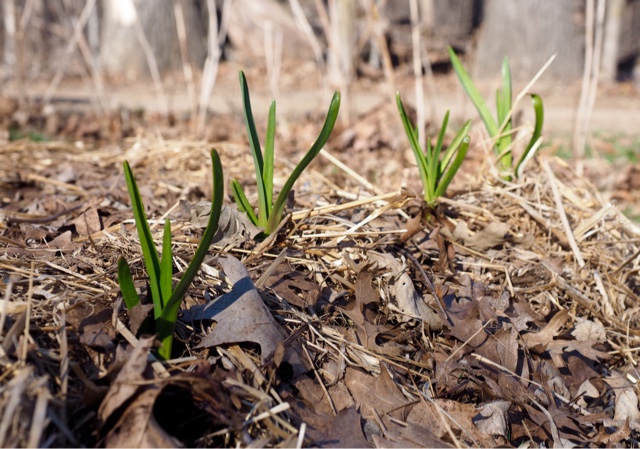
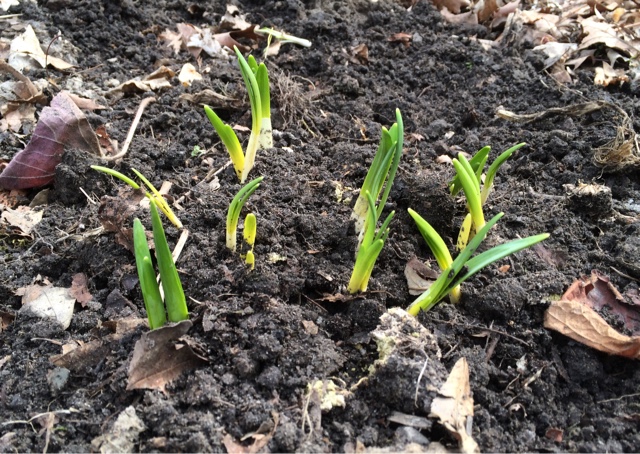
I was beginning to be concerned. After all, I planted my garlic this season just before Thanksgiving. In New York that is nothing, but here? My concern was relieved by the sudden growth pushing past the straw and leaf mulch about a week ago. Below is the Turban variety 'Xian.'


Today I have two tasks. While tending to the fire which boils down the maple sap I've collected (15 gallons so far), I am preparing the bed and laying pavers for the floor of the greenhouse. I need to get the greenhouse up as soon as possible so that I may sprout this year's milkweed seedlings inside it. 


While pounding stakes for the level lines I spotted some bulbs pushing up through the tangle of nettle. I dug them out and placed them into a new garden near the driveway. Didn't think I'd get any gardening in today, but I think this counts. And what luck,  just miles to our south, some areas received seven to ten inches of snow two days ago. 


The Boy's Winter


I was wakened by the subtle flash and rumble that, not more than a minute later, became the brilliant glare and shattering crash of this year's first post midnight, pre dawn thunderstorm. The rains came, soaking what would normally be earth frozen forty inches, give or take. The birds had been arriving for over a week, vees of geese are seen and heard, while the prehistoric calls of sand hill cranes are heard, all traveling northerly. Comb-playing chorus frogs have made their seasonal debut and chipmunks have ascended from their dens. The grays and pale orange-reds predominating the woods are often punctuated by intense, moisture-activated greens. Most lakes have lost their ice and those that haven't remain only a stormy-green skim coat of icy slush. Most of all, even by last year's early spring standard, the trees have been budding strong and flowering early. The silver maples of the middle slough have been fully in flower for over a week. This is El Nino in the Midwestern north.

It should still be winter by calendar, averages, and tradition and this post should be timely. It is not, however, by fact and experience. Winter is over before its time and this is its eulogy.


Strong winds raked snow and desiccated grasses across the large wetland, leaving easy access for bipeds like myself.


This winter's fluctuating temperatures created a nearly constant stream of runoff from the little wetland which pooled at the northern end of the large wetland. It was a popular watering hole for all the Big Woods' animals.


Freezing and thawing of the pool made for unique ice crystals.


The dead trees of the large wetland, killed by higher water or blight.


Orange lichens on the south side of the trunks.


Wet feet is not a problem for Red Osier Dogwood, Cornus sericea.


Its branches a brilliant red in the sunny open of the wetland.


A protective structure for warm season nesting.


An unknown plant, possible weed, growing in the center of the wetland.


A rare view of the house from the wetland.


The earliest sign of approaching spring -emerging buds of shrub willows.


Stratify This


This winter I've proposed a landscape project for Franconia Sculpture Park's program. Materially, the artwork will be made of milkweed, Asclepias species, sourced from the northern tier. I don't want to say too much more about the form this planting will take as the jury is still out. I do, however want to share with you the process for stratifying milkweed seeds. It's an easy and fun thing to do should you want to get a jump on milkweed for your yard. You may, of course, plant seeds in fall and the damp, cold climate will do all the work for you, but what fun is that?


It's important to source your milkweed seeds regionally because they will be best adapted to your climate extremes. My project's seeds were purchased from Prairie Moon Nursery, a Minnesota based native seed company. Like many perennials (plants that come back each year), Milkweed requires a period of cold and damp to break dormancy of its seed. This process is known as stratification. 


First you will need sand. It's possible that any sand will do, but I bought this very fine, washed sand at the big box. The fifty pound paper sack (which leaks all over, keep it outside) was under five dollars and I used only a fraction of it.


You must dampen the sand and the first thing you will notice is how the water percolates through it just as it does at the beach. If you'd rather go to the beach than the box store, I recommend bringing a coffee can with you for your seed stratification needs. 


You'll also need some kind of sealable bag, ziplock type or even a baggie. There shouldn't be any free water in the bag after dropping in the sand. Add the seeds and label. I wrote the start date, how long they should be stratified, and the quantity of seeds. And since it is easy to forget about them, I put an alert on my phone to remind me to check in 28 and 30 days.


Here they are -seven varieties of milkweed ready for the refrigerator. If all goes according to plan, I will be potting these seeds in deep cell trays come late March. Afterward, the trays will go into the greenhouse, ahem, the as yet unbuilt greenhouse leaning against an oak tree in the back yard. All in good time. By May they should be ready to plant in our Monarch Park over the drain field and quite possibly at the sculpture park forty five minutes to our north and east.


Pileated's Favorites

We have several dead oaks that are among the pileated woodpecker's favorites. This one, however, will be coming down soon. It has been dead and rotting for years and is too close to the driveway. But no worries, there are plenty more as the big trees continue to be lost to storms and disease.


As it lifts off we get a rare view of the white stripes of the upper wing.