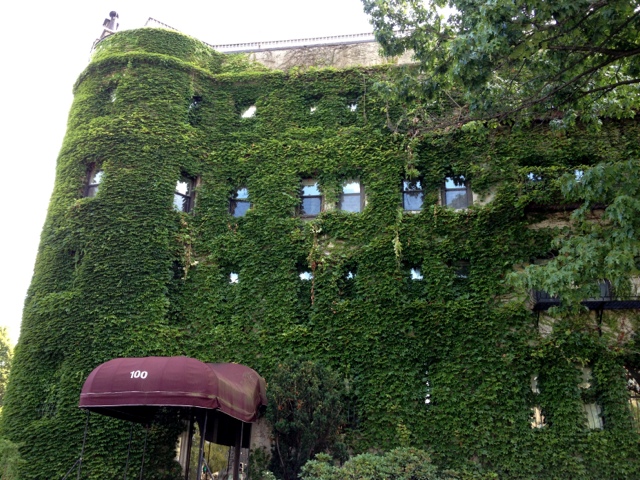
Boston Ivy has little "suction cups" or disks that attach to the surfaces. They do not "root" the way an
English Ivy roots into structures -all the roots of Boston Ivy are underground. It is possible that
these roots could work their way into your masonry foundation, although they are likely to run along the wall as opposed to working their way through sound masonry. Of course, the question is -do you have a sound foundation?
Others worry that the vines are highways for insects. In fact, that is true for, say, ants. But those ants don't need a vine highway to get to your kitchen sugar or fat. They'll make their way through all the other holes and highways into your apartment. I cannot say I have ever had insects making their way in via vines. I have had ants in my place, but on the north, ivy-less side of the house
(the bedroom! Old Halloween costume. Another time).
You might
read on the web that the ivies produce an acid at its attachment points, etching the masonry, which slowly deteriorates your building. I cannot verify this claim, although decaying plants can produce
humic acid and that could have some, albeit little, impact on your mortar.
The fact is that atmospheric gases, such as
carbon dioxide,
sulfur dioxide, and
nitrogen dioxide, probably weaken masonry structures more than the humic acids derived from plant decay.
Carbonic acid,
nitric acid, and
sulfuric acid are common components of rain water in industrial areas. As these acids accumulate in the wet areas of masonry, they react with the carbonates in the mortar, creating salts which accumulate and crystallize as the water evaporates. The crystallization of these salts creates what is known as
spalling -the flaking off of pieces of masonry or stone.
Brownstones are made with a type of
sandstone and are especially susceptible to spalling.
It seems to me that people who complain that Boston Ivy's grip is so strong that it will pull masonry off buildings are confusing correlation with causation. The day a building owner goes to yank the Boston Ivy off the wall is the day he realizes that his wall is deteriorated, then blames the ivy, not our industrial society.
If you're the type to worry about masonry maintenance, it's just best that you do not plant any ivies on or near your buildings. If you have a wood-sided home, you may want to keep it clear of ivy for the sake of painting and other wood maintenance issues.
But, do not plant any large shrubs or trees next to your home either -and we're talking closer than 20 feet. Boston Ivy is an easy target, but a poorly placed tree will send roots into your masonry foundation and shade your woodwork as well as any vine.