I often find myself frustrated by artists who’ve taken on landscape later in their career, but if I am honest, that may be nothing more than professional jealousy. It seems it is all to easy to forget that landscape doesn’t belong to me, or anyone, but for a few hundred years has been a symbolic entity that artists can tap, turn over, reproduce or renounce.
Although Opie says shots are unplanned, or there is little preparation, or it’s all in her head, what materializes is always passed through her razor sharp filter. In her exhibit, Rhetorical Landscapes (2020), she presented photographs of the Okefenokee Swamp adjacent to floor-standing screens displaying animated magazine clippings. Opie frames these swamp photographs in terms of the Trump administration’s undermining of climate goals, rising seas, and its effect on these southeastern U.S. swamps, but there is more to it than that.
Trump’s rhetoric made use of the swamp image, commonly understood as a murky waste, dark, mysterious, where dangerous creatures lurk just beneath the surface. In doing so, he leverages the symbolic power of landscape to transport and amplify fear across heterogeneous social, geographic and cultural terrain. In pointing to the swamp, Trump reveals he is the very swamp he’s invoked. That Opie pictures the Okefenokee, as opposed to other swamps, appears logical given the American association, however incomplete, of the nation’s malignancies with historically rebellious southern states. In these two ways, Opie’s swamp landscapes function as other landscape images have before—representative, or in service, of a nation’s identity.
This meaning is turned on its head when the swamp continues to be seen as mysterious, misunderstood, and threatening but is also threatened. A landscape that holds this (threatening/threatened) and other dualities (land/sea) suggests the swamp’s metaphorical potential as representative of queer identity. This interpretation is supported by Rhetorical Landscape’s exhibition design in which the swamp photos are hung on the outer wall, apart from central, free-standing kiosks of animated collage that are representative, and a critique, of American culture at large. Looking at the work this way is intriguing and a refreshing break from the critique of landscape as long-ago exhausted and forever a social hieroglyph of the capitalist-imperialist enterprise.
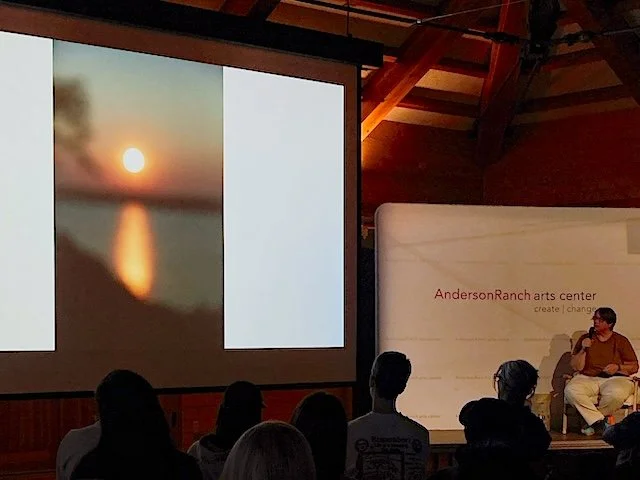
Opie speaking at Anderson Ranch Arts Center, 2025
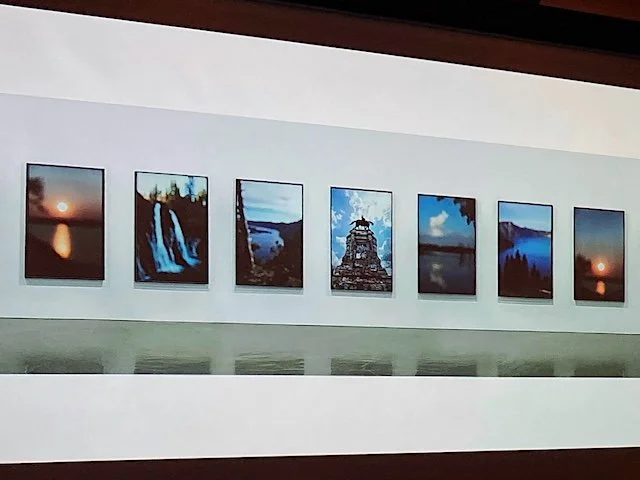
Opie considers her out of focus sunrise/sunset photographs abstract and uses them (and others) to bookend in-focus photographs of Civil War monuments in southern states. She indicated that the book ending and “splits” shown in her other landscape images refers to division and duality. The blurring in these images may be a way to question the American promise purportedly evoked by 19th-century landscape paintings of awe-inducing places like Niagara Falls (Opie also photographed Niagara, blurred).
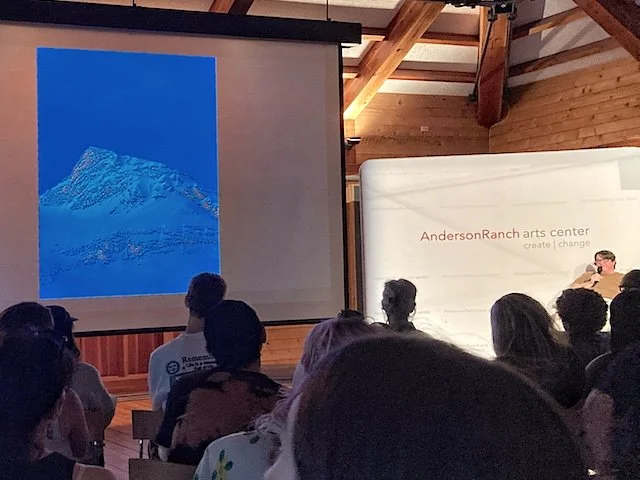
More recently, Opie has been photographing mountains in Norway. She intimated this flirt with beauty was tinged with guilt. Beauty, like landscape, is overloaded. Rather than beauty, could this work be about the pleasure inherent to the experience of calming, blue tonalities. Isn’t there room for calm—especially after four years of Trump and two of Covid? Whenever we speak of guilty pleasures, there is always the sense that the judgement by others is entirely unfair to the pleasured.
Although described as a critique of the Catholic Church, I found Opie's most recent work “Walls, Windows and Blood” her most abstract and engagingly ambiguous. Her "Blood Grids" compellingly capture the textures, colors, and light inherent to painting, but by fracturing the original whole, the photographs create incredibly intimate moments with the physical work unlikely to be had in a crowded museum. I can only imagine the pleasure she had in arranging these pieces. Her process reclaims the artistry of, and becomes a spiritual union with, those original artists who had little choice but to serve the power of the Church.
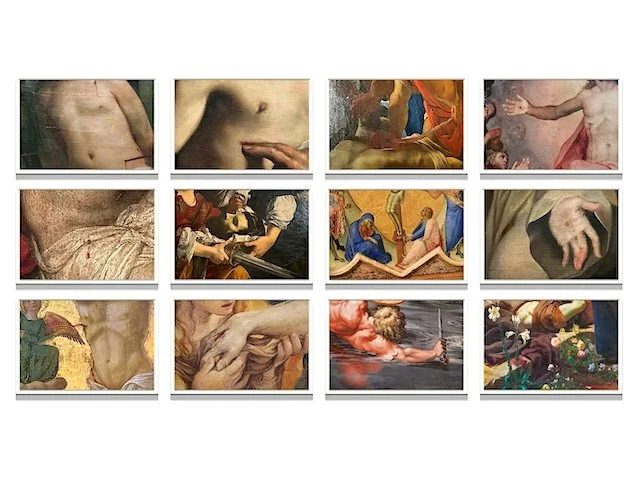
Blood Grids
Simultaneously, the modernist grid Opie uses to structure the assemblage of photographs ties the historical violence of the Catholic Church exacted across the globe to the universalist, global enterprise of aesthetic Modernism. In a manner homologous to the power of the Church, Modernism has had an unassailable authority over artists creative output and, although not bloody, for some generations, has been an oppressively misanthropic and homogenizing force. Although the Opie’s grid speaks to the rigidity of Church doctrine, the images capturing the Church's fetish for flesh and blood undermines an excess of Modernist rationality. Opie's subversive gesture is the simultaneous binding and contrasting of these forces, not quite canceling each out, but rather holding them in a revealing, dynamic tension.