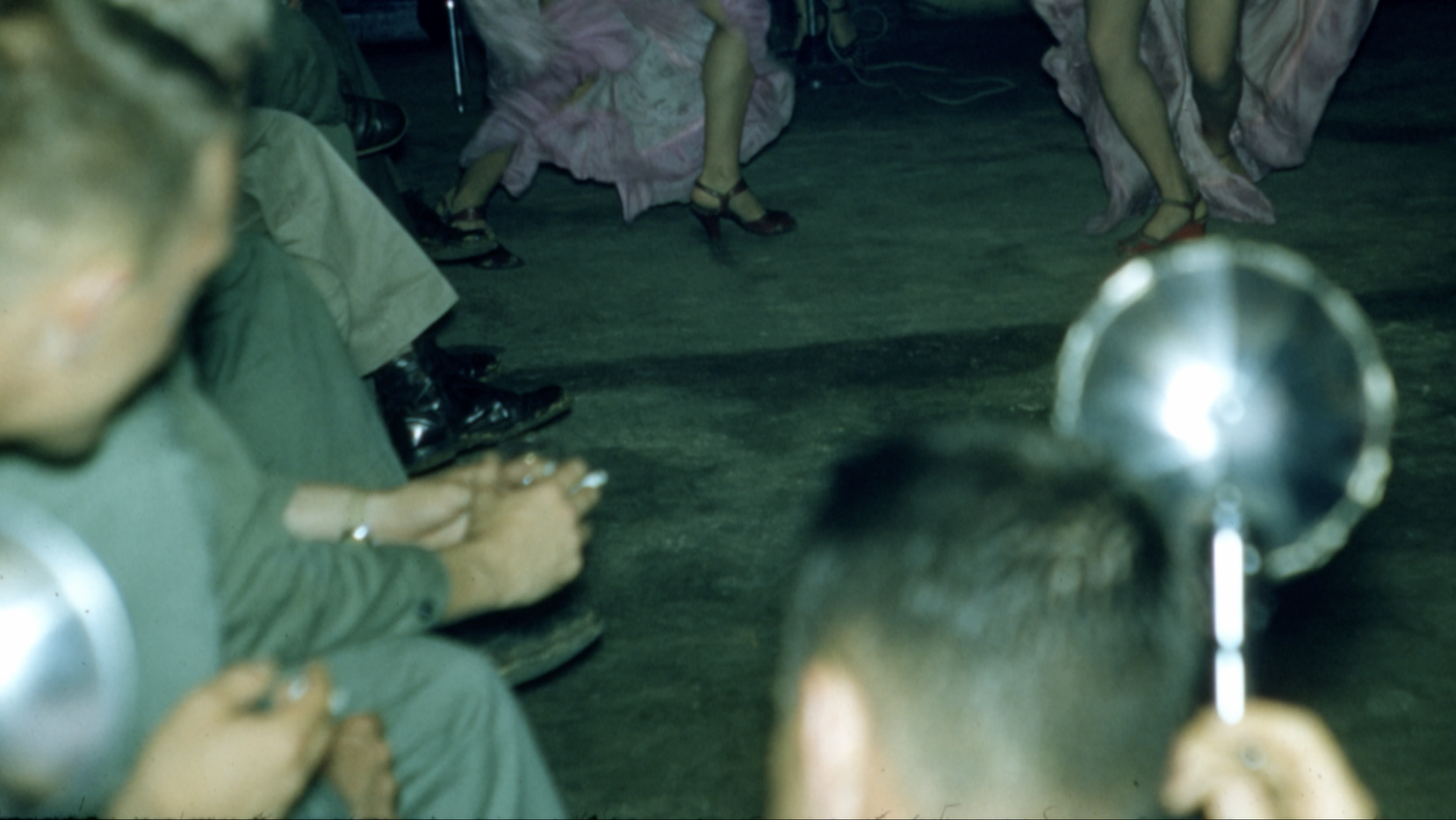
Our Cave 우리의 동굴, (film still) 16mm and Super8 to HD, color, sound, 22 min. 30 sec., 2024, Choi Heehyun
A Reflection on the Gift and Burden of the Camera
Inquiries into the photographic or filmic image’s hold on reality have been the focus of art since Dada, yet the work of the artist Choi Heehyun, who uses a camera, its processes and products, does more. It challenges us to consider the photographic image as a gift and burden, not only in the moment a photograph is made and shown, but across time. Her work is deceptive in its simplicity. It is quiet, minimalist in atmosphere, and delivers the air a viewer needs to breathe. In that space lies the ambiguity needed to find one’s own path to the artist’s questions.
Birds
Choi frequently takes us back in time to the beginnings of and precursors to chemical photography. Early on, in works such as Birdsaver Report Volume 2 (2021), she took interest in the phenomenon of bird strikes on plate glass windows and barriers. A simple reversal of the words “plate glass” exposes a thread running from her work to the glass plates of nineteenth-century photography.
When a bird strikes plate glass, we presume it sees open sky behind glass barriers or, in windows, the reflection of blue sky. Without skepticism, the bird flies full speed into the glass and strikes it head on, stunning or killing it. Using the frequently cited story that people viewing the Lumière brothers’ film of the moving train, The Arrival of a Train at La Ciotat, were so frightened by the novel moving image that they ran from the screen in fear, Choi proposes that the “screen” or “image” operates on human perception just as plate glass does on a bird.
Those who teach photography have likely encountered a similar phenomenon. The student misinterprets the photograph as the object the image rendered, not what it is—a photograph. Given this misunderstanding, it is easy to see how the photograph becomes a medium that can take, capture, and even preserve the thing it has rendered. This fallacy props up all kinds of bad ideas, such as a recent citizen petition submitted to the Colorado Parks and Wildlife Commission proposing a fee for anyone who photographically “takes” from public lands.

This Isn't What It Appears 이것은 보이는 것과 다르다, (film still), Super8 to HD, color, sound, 19 min. 34 sec., 2022, Choi Heehyun
This isn’t what it appears to be
Choi questions the enigma of the image—what it does to our brains and emotions, often without our full awareness—and then she follows this with a challenge. What if the image hasn’t rendered a truth? What if there is so much unknown that we cannot find truth in an image? Inescapably, we are lead to ask why we photograph at all, what is the purpose of photography, where does it lead us, and how did we get ourselves into this mess? Countless photographs continue to work on us long after photographers are able to speak for them, long after those rendered can speak, and are often found in the hands of a public completely divorced from the original photographer and subject. Choi does not only ask what photographs can do in the present, she asks what all photographs can do to all of us at any time.
The title of her 2022 film, This isn't what it appears to be, is taken from the words scrawled on the back of a found photograph of a Korean woman performing a sword trick on a masked American soldier. We presume the floor on which these two figures act is a stage. We might say the stage is another form of plate glass. A cloth laid over the soldier’s face becomes a tool of self-deception or a masking of “reality.” The soldier is the audience and the body to be performed on. We presume the Korean woman will plunge a trick sword into his chest. Like a magic trick, the sleight of hand, or a Magritte painting, none of this is what it appears to be. What was real in that moment, whether this truly happened, remains unknown. We can surmise, presume, assume, read histories, inform ourselves, but we cannot fully know the reality behind the image.
Still, many viewers will take this image at “face” value. They will see the insidiousness of American occupation. They will see the subjugation of Korean women under U.S. power, and by inference, Imperial Japanese power. They will view the image and be quick to ascribe power to one subject over the other. Undoubtedly, this is something Choi has considered, yet her work is invested in a deeper question inherent to the photograph: what is this, really? What had it done for the person behind the camera, the intended audience, the people in the image, its future audience, and Choi, a Korean woman working within an American institution, one who thinks deeply about how images function and the mutability of truth. There isn’t a clean answer.
The burden
Although her work can be viewed through the construct of post-war Korean identity or can speak to questions of historical subjectivity, her work appears to emerge from a place outside contemporary cultural time. We are moving headlong into a culture with technologies that easily deliver images, moving and still, that may or may not be artificially generated. More than ever we need to ask not whether these images depict the “real,” but what effect they have on our brains and emotions, why we engage them, how we react, and what effect they have collective humanity. Will we become the bird that strikes plate glass? Might we be stunned, recover, then wonder what had happened? Can we learn, if we survive, that we suffered a perceptual break with reality? Or will we smack into it with such force that the result is death?
The gift
In Choi’s 2025 video, The Wedding Chest, the bojagi—its rich color, sheen, and minimal pattern—wraps a camera. It becomes a gift. Most gifts are given and received without explanation, so that what was considered, intended, and transferred to another can be difficult to decipher. Was the gift perfunctory, careless? Did the gift communicate the charged relationship of the giver and the receiver? What went unsaid in the presentation and reception of the gift? If a photograph, a film, or the camera itself present like a gift, is there a responsibility to communicate intention, or should the gift speak only for itself? Between the gift-giver’s silent intention and the recipient's charged imagination is the turbulent space of imperfect communication. It is precisely within this misunderstanding that the photograph or the film exists. This space only widens as art becomes artifact. Much like the bojagi, passed from grandmother to mother to daughter, intention and meaning are transformed by new generations of recipients.
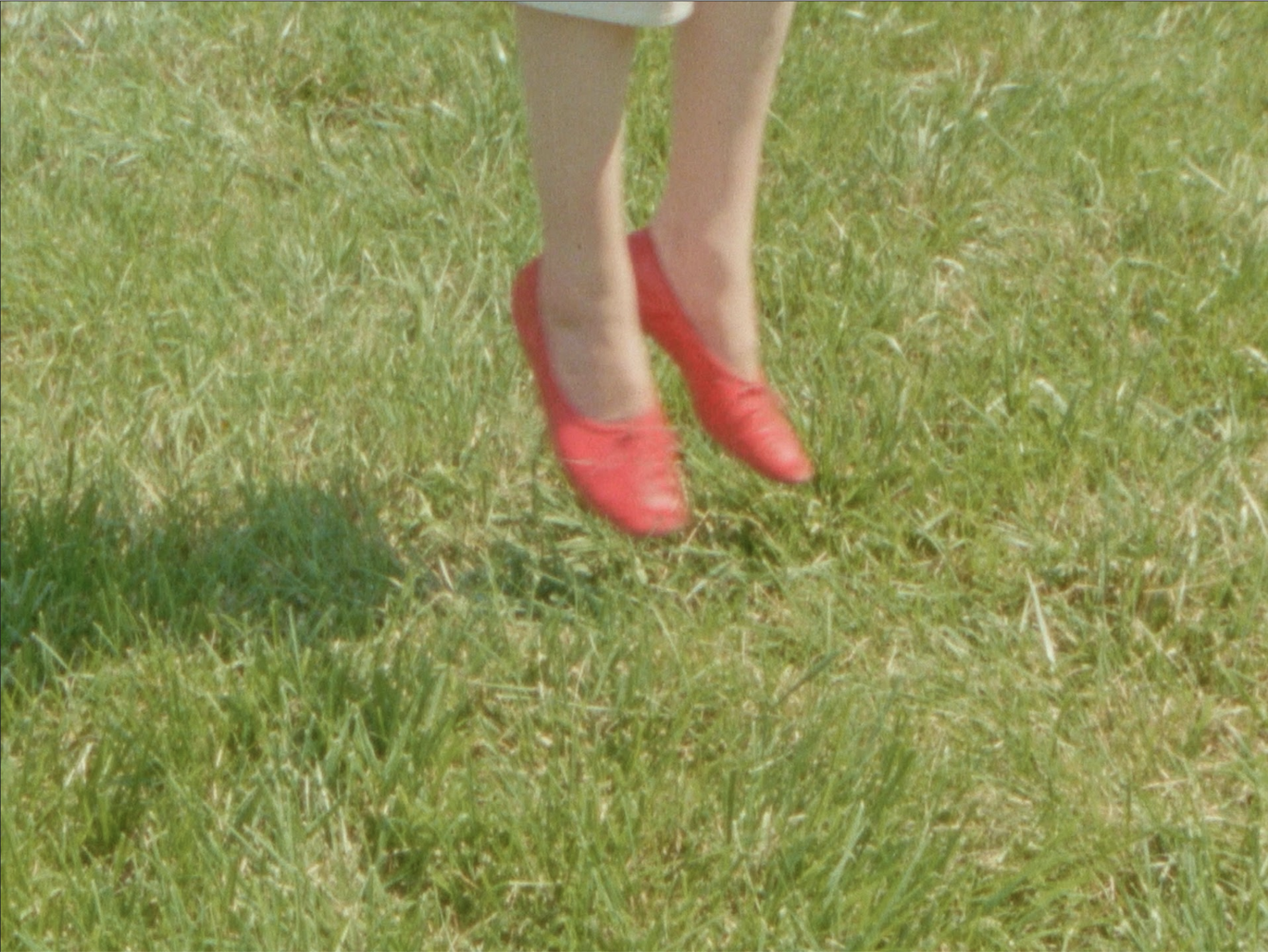
Neolttwigi 널뛰기 (film still) Super 8 to digital, color, silent, 3 min. loop, 2025, Choi Heehyun
Taking flight
In her 2025 film, Neolttwigi, Choi presents a historical image, made by a Japanese photographer during Imperial Japanese occupation, of a Korean, childhood game that gave flight to young women. In the game, one young woman offered her own mass and kinetic energy to allow another young woman to fly, while a third centered on the fulcrum stabilized the whole. The plank used in the game is both a platform and a tool of leverage. Placed on a fulcrum, the plank has the unique ability to give flight. Once in the air, still subject to gravity, the young woman descends. In falling back to the earth, her potential offers the other young woman flight in return. The reciprocity in the image is endearing and powerful with the potential to function as a fully feminist image.
Choi leaves behind the Japanese photographer’s intention, re-imagining the historical image by extracting the beauty of reciprocity and flight. In her film, the fulcrum and plank are replaced with a camera. On either side of the camera-fulcrum is a woman. The camera as plank becomes a device that offers those subject to it flight and the ability to transcend the earthly, social and psychological gravity that has fixed them to soil, social position, and state of mind. Both figures, situated on either side of the camera, are Choi who often uses herself as subject. Although the camera appears to have become a tool of her own transcendence, it could also be a tool of solipsistic performance. In works such as A motionless movie and Eagles, created around the same time, the artist begins to question the camera’s potential for liberation where anyone is constantly subject to its gaze.
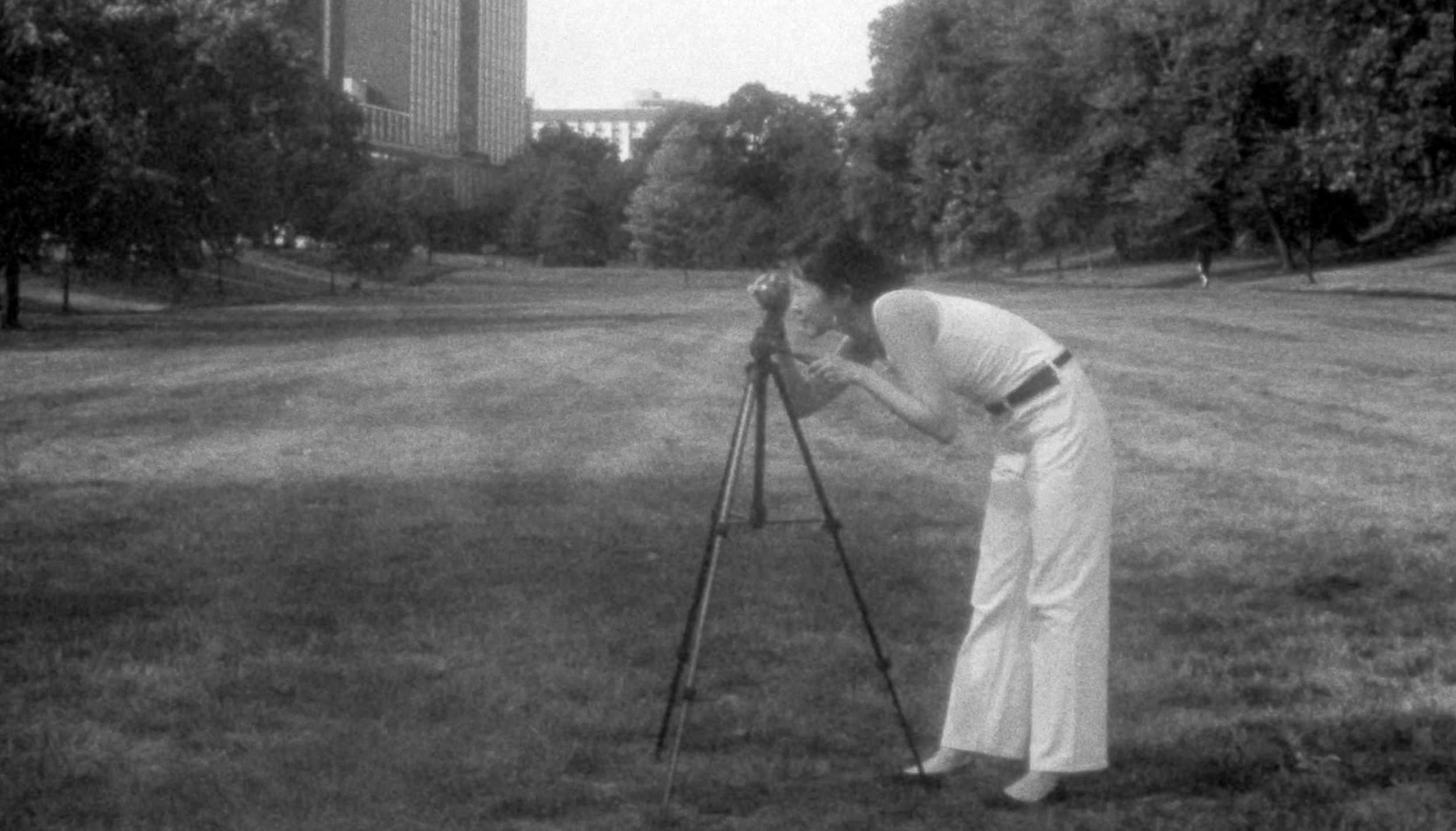
Our Cave 우리의 동굴, (film still), 6mm and Super8 to HD, color, sound, 22 min. 30 sec., 2024, Choi Heehyun
Time is black and white
When I come across contemporary black and white photography, I am reminded of the Poussinistes and Rubénistes, two factions in one of art’s oldest academic debates, one which still vibrates deep within the bowels of Western culture. The Poussinistes argued that drawing, composed of line, form, and composition, was the expression of intellect. The Rubénistes countered that painting, composed of color and light, claimed primacy for emotion and nature. In the 17th-century Academy, many believed that the highest form of art must be composed of thought, not emotion. This concept, as much as photographic convention, maintained the supremacy of black and white photography for decades beyond the introduction of color processes.
Consistently, though not exclusively, Choi uses black, white, and gray tonalities via older camera technologies. On the surface, black and white film creates a quiet, contemplative thoughtfulness that is equally a means to move the eye, hold it, and dispel it, much the way black and white media function in drawing. Her choice lends an air of seriousness that would be suspect if it didn’t also produce the suggestion of time and timelessness.
Timelessness should not suggest it is always current, but that the work reaches across time to locate the quandaries and questions that interest Choi. The use of black and white film, the preference for Super 8 and 16mm, and even the image of the artist’s vintage cameras place the viewer into an experience outside of contemporary time. Although the film technology evokes another time, Choi isn’t interested in memory or nostalgia. In contemporary clothing, she appears as a time traveler who has arrived in an image evocative of a past moment to speak to us in the present. As people who hold their truth pass on, as we collectively forget what was once known, the artist locating herself at another point in time points to the process of unknowing.
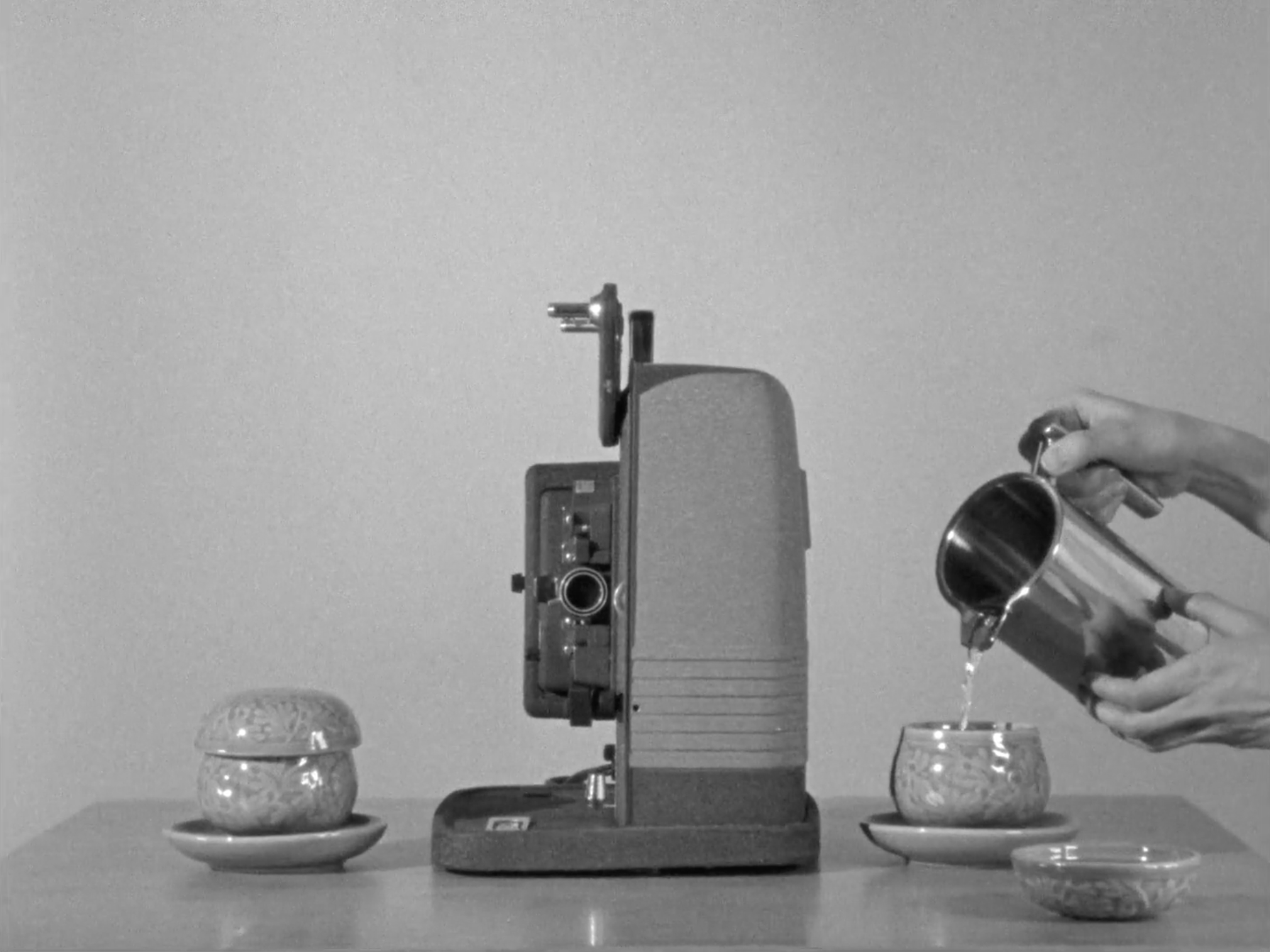
A Dark Room 칠실 (漆室), (film still), 16mm and Super 8 to Digital, b&w, silent, 9 min. 51 sec., 2025, Choi Heehyun
Inspiration
The photographer, or the millions of surveillance cameras, are often thought of as taking away a right to privacy. Just as the Colorado proposal that submits that a photographer takes natural resources from the public and the nineteenth-century notion that, in rendering an uncanny likeness, the camera stole the soul of its subject, it is clear the camera as a device for theft has been with us since its inception.
Choi has traced the device’s linguistic history from its roots in the Greek kamara, a vaulted room, to Latin camera, meaning a chamber or vault, to the camera obscura—a light-proof room or box with an aperture—and finally to the device for recording light on glass, paper, or film. When the camera is aimed at a person and the photographic process is activated, they become a chambered subject rendered with light. In this there is the sense of capture or caging the subject and light.
Across literature, architecture, art, theology, and mysticism, light has long been seen as a manifestation of the divine and linked directly to the concept of the soul or spirit. What happens when light is captured, when the spirit of those rendered has been chambered? The word spirit, as well as inspiration, has its linguistic roots in the Latin word spirare, to breathe. Artistic inspiration was once understood as the divine breath rushing in to forcefully displace human breath. In the early days of photography, with its long exposures, a subject may have been asked to hold their breath. The photographer exhales to steady even today’s advanced cameras. In both the photographer’s and subject’s breath, we find an obstructive force that must be released. In the absence of human breath, the divine spirit can rush in and give life to the image.
Is the life of a photograph or film and the space between artifice, the subject, and its reception a question of the spirit? Across her practice, the artist has had a recurring concern with the bird, yet Choi has never indicated what it represents. This is intentional—her work does not function on symbolic terms. Still, in the void of understanding, I projected onto her image of the bird, making it a signifier of the spirit. In that leap across a divide that cannot be bridged, we find that the estranged image is the artist’s concern.
Choi Heehyun presented her work to the Anderson Ranch Arts Center and local community as part of her term as artist-in-residence, October 2026.