Taking Out The Trash


Our pails, a silent sentry, as instructed -three feet apart, at the intersection of the woods, road and drive. A hawk, circling high overhead, issues its gritty reeeeeeeahh. The road, here, is quiet and I am noise.


Downslope, down road, toward the late autumn sun, down low.


Removing the trash and recyclables is a journey by any New York City standard. I, for one, was fond of dropping my trash right out the window into the pails below, but not here. No, trash removal has several steps, one of which is rolling the bin down slope, toward the culverted passage between one wetland and the other, then upslope to the road.


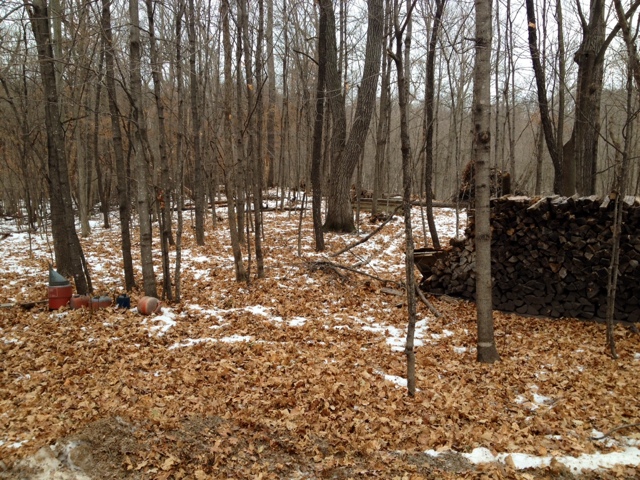
To my mind, it is cold out, for November, maybe six degrees F, yet the empty-handed return along the tenth-of-a-mile drive frees my senses for seeing, and I found myself trailing farther down slope, into the wetland, along a deer trail.


The wet lowlands contain the most attractive sites on this land, but the green season mosquitoes chase me out too quickly. In the white (or brown) season, I take time.


The drainage opens up, like a park, onto the wetland, the edge of which is favored by deer, coyote, turkey, and me.


Although the ground has yet to freeze, the wetland is firm enough for walking. I've explored its perimeter, before this moment, in December or January.


The wetland is, by its nature an amphitheater, a concavity, surrounded almost completely by upland elevated fifty to a hundred feet above the occasional water line. On its western flank is the headland of an esker that carries southward to frame lakes that were at one time deeper and larger. Our (Rex's) house sits on land that was likely a small island or peninsula, long ago, near this lake's northern boundary.


Recent heavy rains have been quickly eroding the steeply sloped land to the northwest and northeast, washing out sediment that fills the small wetland due north of house island. Soil and organic matter have been filling this basin for thousands of years. Trees have taken root in drier spells, then were soaked out in wetter ones. Water enters the large wetland at three points -east, north, and west, converging, then heads south toward a pinched outlet that funnels the water to a small, nameless pond, then farther on to Dutch Lake, and finally into Harrison Bay.


The cattails (I haven't yet identified the predominant species) have exploded into their fat and furry season, regal and rough. Finally, my camera and fingers are beat back by the cold and I head back into the woods.


The bones of the land are most clear in winter. 


Two Kinds Of Night


In the dim and deep grey-blue of early morning I saw the beast ambling along the tree line and thought myself silly for thinking two people could be running out there. Six points, eight? I flicked on the light, startling the animal then twisting its neck backward and up to come to terms with the sudden contrast. We stood absolutely still for a minute, then I turned out the light. He trotted across the creaking snow and I laid back in bed to wait out the last half hour before the four-thirty alarm.


Arriving home after two hours of airport, three hours of airplane, two hours of subway, and nine-point-five hours of work, under the red-yellow street lamps, a temperature fixed above fifty, a coat unnecessarily heavy for coastal, Mid-Atlantic December, I surveyed the garden. A rescue had taken place; a reader, a Hudson Clove customer, Toby, had come at some point to do the digging, the bagging, the carrying, and replanting in a new garden and I thought, good, one less thing.

I have since extracted the climber rose, climbing hydrangea, and my grandmother's tea, all hastily spaded and ripped from the earth, delivered to their temporary garden in Williamsburg, but not without acknowledging the irony of saving on the purchase of new plants by driving 2500 miles to attempt their relocation.

There are still several plants in the garden and they are free for the taking. Email me: nycgarden@gmail.com.


In The Beginning


God created the heaven and the earth. And the earth was without form, and void; and God said, Let there be compost, to replenish the earth; and then God said, But you must choose it, and make it in all seasons, and you must site it appropriately, for ease of doing it, and for aesthetics of sight and scent. And God commanded it, so it was done, there, behind the wood pile.


The Animals


In the absolute dark of early morning, along the tree line, coyotes were illuminated by headlights. Two hours later, as the light began to swell, deer browsed the leaf litter where Rex's bird feeder had been strung, and squirrels scamper about playfully all day, while various birds make appearances (although less so since the feeder has come down). 


Turkeys are plentiful, crossing the yard dutifully every day, but are hard to approach on the squeaky, newly fallen snow. 


The Animals


In the absolute dark of early morning, along the tree line, coyotes were illuminated by headlights. Two hours later, as the light began to swell, deer browsed the leaf litter where Rex's bird feeder had been strung, and squirrels scamper about playfully all day, while various birds make appearances (although less so since the feeder has come down). 


Turkeys are plentiful, crossing the yard dutifully every day, but are hard to approach on the squeaky, newly fallen snow. 


Supper


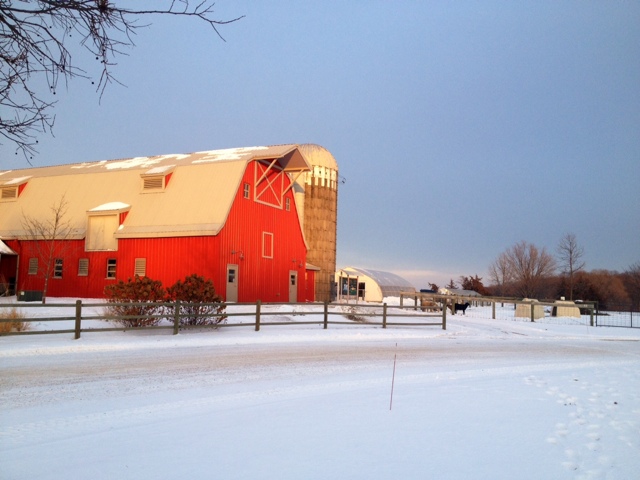
In the upper Midwest, and probably other regions, dinner is called supper and lunch is often dinner. For supper, then, I made the 15 minute, thirty mile per hour drive through town and then out of it, curving west, at thirty-five miles per hour, then forty-five, until just over the Dakota rail trail. Slowing down for an acute right, gassing it uphill, past the Gale house, the event barn, the market garden (frozen as it is), yielding left, toward the visitor center. One other car, facing west, shared the lot. Over packed, snow-covered gravel, a soft left at the chicken coop, pushing the glass entry door, an unfocused hello and then scope the upright, glass door freezers. 

All of two shelves empty. A sign reads pork is coming in on the fifth of December. I tally four roasting chickens, five "Frenched" racks of lamb, a single leg of lamb steak, copious beef liver and tongue, eggs, a head or two of cauliflower and romanesco broccoli, a basket of onions, garlic, and of all things, late-frost tomatoes. 

I pick out two whole chickens, a leg of lamb steak, one onion, one garlic (although I have plenty back at the house), cauliflower and broccoli. Before leaving I ask how long this can possibly last, to which the startled clerk replies, oh, we have no intention of going anywhere. It is hard to fathom this attitude of permanence, but I will work on it.


Supper


In the upper Midwest, and probably other regions, dinner is called supper and lunch is often dinner. For supper, then, I made the 15 minute, thirty mile per hour drive through town and then out of it, curving west, at thirty-five miles per hour, then forty-five, until just over the Dakota rail trail. Slowing down for an acute right, gassing it uphill, past the Gale house, the event barn, the market garden (frozen as it is), yielding left, toward the visitor center. One other car, facing west, shared the lot. I shuffled over packed snow-covered gravel, a soft left at the chicken coop, pushed the glass entry door, projected an unfocused hello and then scoped the upright, glass door freezers. 

All but two shelves empty. A sign reads pork is coming in on the fifth of December. I tally four roasting chickens, five "Frenched" racks of lamb, a single leg of lamb steak, copious beef liver and tongue, eggs, a head or two of cauliflower and romanesco broccoli, a basket of onions, garlic, and of all things, late-frost tomatoes. 

I pick out two whole chickens, a leg of lamb steak, one onion, one garlic (although I have plenty back at the house), cauliflower and broccoli. Before leaving I ask how long this can possibly last, to which the startled clerk replies, oh, we have no intention of going anywhere. It is hard to fathom this attitude of permanence, but I will work on it.


The Cold Room


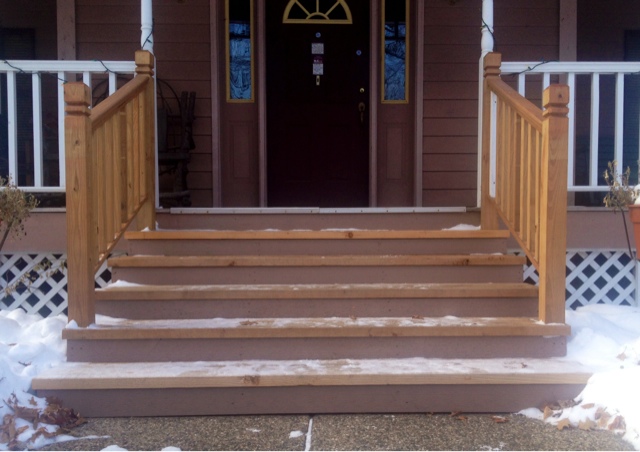
The time has come for my father-in-law, Leroy "Rex" Alwin. By design he stationed himself on the other side of this door, in line with his new steps, the very steps he passed over, unaware, one last time, in the cold and dark of this early morning. 


The silence, now, of a house without oxygen pumping, lungs coughing, only the dull tock of compartmented clocks and whoosh of mechanical air. The wind in the cold room appeared to express all that was worth expression in this moment.


The UnBecoming (of a) Garden


When I announced to my landlord that we would be leaving, he could barely contain his joy. It was not so much in regard to our departure as it was the opportunity to share the news with the landlady. The rent shall be raised! Hallelujah! Praise be to God! And that garden, enough! Her disdain for the garden means that this garden plot will be no more, as he wasted no breath to tell me that as soon as we depart, the garden will be filled with concrete.

So the plants you see here, and so many others, will not make it without me, unless someone comes to rescue them this week. Transplant is usually no big deal around here at this time of the year, but the weather is about to turn significantly colder at night, freezing these out and making it harder to identify what is what. That said, the ground is unlikely to freeze and most should be just fine.


Russian sage is a a tricky transplant, although I succeeded well enough last year. It's fuzzy calyx never loses color, the wispy leaves, pungent odor, drought tolerance and also a bee's delight, are plenty of reasons to plant it.


Gaura, still blooming, is also drought tolerant (I have a lot of those). A great plant.


An aside, the petunias started flowering again this October. 


They are unlikely to survive the coming freeze.


Asters, so many asters. Why do without them in autumn? This one doesn't self seed,  is easy to keep in check and is loved by flying insects.


The climbing hydrangea will be coming with me, eventually. 


I cut it back hard a few mornings back and will suffer the cold this week to prune its roots. Along with the climber rose 'New Dawn' and my grandmother's tea, it will rest in a trench covered with wood chips at a friend's in Williamsburg until I can take them to Minnesota.


Plants I have available:

Dwarf spirea (pink flowers, chartreuse foliage)
Everblooming shrub rose (magenta flower)
New England and NY Asters, (blue-purple flowers)
Yarrow (yellow flowers)
Tradescantia (blue-purple flowers)
Snakeroot (white flowers)
Daylily (orange, orange-burgundy)
Geranium (the real one, pink and blue flowers)
Phlox (pink and white flowers)
Sedum (different kinds, large, small, pink flowers)
Primrose (yellow flowers)
Coneflower (pink, maybe white)
Heuchera (copper and mahogany leaves, white flowers)
Dicentra Eximia (pink flowers, lacy blue green leaves)
Goldenrod (non-spreading variety, yellow flowers)
Chrysanthemum (Korean type, apricot flowers)
Sage (deep blue-purple flowers)
Culinary sage (pale purple flowers)
Hosta
Liriope (Purple flowers, blue berries)
and many others.

If you are interested, email me: nycgarden@gmail.com. You may have to do this on your own, but I will tag the ones I plan to keep if I cannot be present to help out.


Dept. Of Phooey


Below is a screenshot of a photo I opened in Preview and uploaded to Blogger. To my eyes, the color difference is night and day. Yes, yes, I signed up for the annoyingly necessary Google + and changed my photo settings to "please Google, do nothing to them." Yet still, Blogger is uploading lamer versions of photos. Maybe there is Wordpress in my future...


Autumn Oak


On Wednesday I was teaching my architecture students how to visualize within Photoshop, importing base images, adding found textures to planes, tweaking them with exposures, levels, brightness or what have you to give a convincing sense of light and space. Then I caught the sliver of light, in the cleft between the pull-down projector screen and a wall, a space which mirrored the architectural slit between A.M. Stern's high class money and Donald Trump's trash money, an aperture that sharply focused the park as a luxury, a painting, as it so often is, an image of security and status. Olmsted was a genius.


I am employed at an institution, just one block from the park, where it is seen fit to salary its presidential figurehead at one million, six-hundred thousand dollars a year, it is reasonable to renovate the figurehead's floor every five years, where the handbook unashamedly stipulates that deans and their superiors have all drinks paid at social and business functions, but cannot see to provide students who are mortgaging their futures at forty thousand a year with the proper staffing and equipment, nor offer any incentive to keep good people on their staff, and doesn't wish to consider the financial pressures of life in this city. The College has become part of the problem. Yesterday, I resigned.

_________________________


Last weekend, on my roundtrip to Boston, across the oak-filled coastal New England landscape, I was struck by the intensity of color of the oaks this autumn. I thought there was something unusual going on, and maybe there is, but I figured it a local phenomenon until I caught these oaks on Broadway. They are simply brilliant this year! I've always felt oaks were somewhat drably colored in the autumn, -russet, maroon, sienna and ochre. Yet not this year, not at all.


Shift


I haven't had much to say, lately, if only because I'd say the same thing, repeatedly. Things are moving along in the way that leaves slowly shift from green to russet or snow pack gives way to the dark earth. In two months time I should be getting settled in our new home. My wife is working on the internet issue, ahead of our arrival. Later this week I announce my resignation at work.


Announcing one's intention to leave NYC arouses subtle forms of defensiveness. If you've ever done so, you know what I mean. Leaving anything unsettles the shifting sands that conceal our doubts and talk of it is treated like a contagion -don't spread that shit around, just get out of here!


This is particularly prevalent in the art world of NYC, where proximity to finance and media underwrite the conceit of prominence, but on a personal level it's just the matter of whether or not your presence will help fill out an exhibit's reception, whether or not your support is localized. I understand, but it isn't worth the sacrifice.


Finally, when leaving one is tempted to do all enjoyable things one last time, but I've come to regard this as nullifying as much as it is virtually impossible. So, now, I see those who must be seen, and continue with my responsibilities, and attempt to finish paintings that should be dry before they get packed.


Have Garden, Will Travel


What is one to do with a garden full of plants when moving in the dead of winter? Certain plants can be given away, but one gets attached to others. My large-ish Hydrangea petiolaris, Grandma's tea rose, the iris, Dicentra eximia? I can dig out almost any plant in my garden at almost any time for transplant here, but they need to travel. Far. To a frozen earth zone. It will already be below freezing in a week's time there, it may never freeze here.

Some cuttings will fly in Betsy's suitcase on this Tuesday's trip, although it may well be too late for them. Mulch will be applied. Others will need to be nurseried until they can be collected, driven, and replanted. This may very well be in the heat of summer. Not ideal, but I've been lucky before.

It would seem, at the moment, that moving plants should be of the least concern for anyone leaving their position of ten years, moving twelve hundred miles away from friends, family, a network of colleagues, packing an apartment and two art studios, and going about shutting down one's life infrastructure (bank accounts, utility accounts, mail, and all else). The plants, then? Really?

Yes. Consider it a way to carry forward a piece of myself, something familiar, all component to an identity built over a decade in one place. I will not see the neighbors from the garden as they pass, but the plants will remind me of them. I will not be able to smell the sea or listen to the cacophony of the fall migration, but the plants will suggest it. The plants become a memory bank, or rather a trigger to it. They help establish myself in a new place. This is nothing new to me. I have perennial sunflowers from my garden in New Mexico, and fifty year old iris and roses from my Grandmother's house, and asters and primrose from a field in Maine. If this summer's herbicide spraying didn't kill them, I will move Mayapple saves, transplanted from Van Cortlandt Park, and Seaside Goldenrod from a pier in Red Hook.

When we move there are always things we are eager to leave behind. These things go without saying, all the better to help the forgetting. Carrying forward and leaving behind is inventive, recombinative action. We aim to change, so we change something.


Chrysanthemum (your choice, could be Dendranthemum) 'Sheffield Pink' is the jazz hands of the autumn garden. A few stolons of these will travel, but might not survive Zone 4b.


I have many asters, I cannot even recall which is which any more. Rooted cuttings will travel. New York Asters are good within Zone 4-8.


'Alma Potschke' will travel, although it has not done well for me here (NE Asters suffer disease), Zone 4-8.


Gaura blooms long, is graceful, but I have a hard time believing it will travel well. Maybe. Unlikely to survive zone 4b.


Clever aphids, so well-matching the colors of the lily stem, won't travel. The lilies will, however, be shipping out with Betsy on Tuesday.


The autumn red leaves of primrose will travel. Zone 4-8.


Heuchera, or Coral Bells as above, will travel. Zone 3-9.


Well, no, not these. Although we can bag up the begonia for winter storage.


Hmm. The 'New Dawn' climber is a beast. It's blooming again and can tolerate some shade, in this case, underneath the Zelkova. It will get pruned hard, and will travel, but when? May need to be nurseried until warmer weather returns.


The shrub rose? Sure, it blooms forever, but I've never gotten attached to it, so it won't travel.

Today I will head out to inventory the garden. Some plants will be missed, it is mid autumn after all. And soon, very soon, a plant giveaway will be necessary. Interested? Email me: nycgarden@gmail.com


Autumn Opus


Two weeks ago Betsy and I went up to Saugerties to walk around Opus Forty, sculptor Harvey Fite's dry laid stone project at the base of the Catskills. We had been by before, but always too near closing time or on the wrong day so that we never had the opportunity to wander around. If you go, plan to spend about an hour or two, and by all means, go in the autumn.


The frog pond. See below.


The museum has little to offer, but the video is worth it, if only for its ancient VHS quality.


Gettysburg


I visited Gettysburg for a new project. Below are some images from the first two days.


I arrived in the evening on Saturday, van camping at a state park in the hills to the west. In the morning, I opened my eyes to this.


The map, marked up as I explored, indicating forest or field.


Sandy Beaches


Life is more interesting at its boundaries, and here both a boundary between the sea and the land and the sports field and the dunes. The redistribution of dune sand, nearly two years ago, was quite a blow to the shoreline ecosystem GNRA is intended to protect. Keeping people off the dunes is a full time job, so the Fed made the right decision when it put up a tall chain link fence instead of trying to police the summer hoards. Now, autumn brings quiet to the dunes and beach, so I took some time after tomato picking to check in on its recovery.


Virginia Creeper, Parthenocissus quinquefolia, growing across the dune.


Solidago sempervirens, the hardiest of Goldenrod, tolerating salt and wind, drought and flood, poor soil and nearly zero nutrients.


It is hardly considered a garden plant, but its structure, succulent leaves, yellow autumn flowers, and downy late autumn seeds are perfect for the garden.


And insects love it.


In fact, ecologists recognize Seaside Goldenrod for attracting native bees and predatory insects.


The dunes, prior to Sandy, were easily 8 feet above the concrete walkway.


These are now beginning to rebuild with the help of snow fencing and simply keeping off.


I'm always impressed with plants that colonize sandy beaches. Is this because I had the darnedest time trying to grow vegetables in our Long Island sand when I was a teenager?


Cakile edentula, (American) Sea Rocket.


Kali turgida, I think, creating its own dune.


When we leave Brooklyn for another place, one likely known for draining water, not containing it, I know I will miss the beach and tidal marshes, even the scent of muck, the most. Appreciate, respect, and protect it.


Beach Farm Virtue


The beach farm is winding down, and quite frankly, so am I. I've been lucky to visit about once every two weeks. My cover crop of buckwheat has grown, flowered, gone to seed, seeded, and sprouted once again. No harm, but folks are beginning to whisper into cupped hands. I have not planned for garlic, nor an autumn crop of cool weather greens. A volunteer sunflower has appeared, its presence among the tattered buckwheat welcome and self-sustenance a virtue.


Japanese eggplant, preferred by this cook, continue to produce into the cooler days.


They take quite awhile to begin, and then decline slowly toward the freeze.


I've harvested all the tomatoes fit to harvest. 


The bigguns mostly look like this, although, I did get a few worth ripening at home with only cosmetic issues, namely -black spots. We'll eat those this weekend, before Betsy returns to Minnesota on Tuesday.


The fennel is home to several swallowtail pillars. 


And the chard, grown from seed several years old, is still quite good. 


The Portrait


If you've ever wondered "what does this guy look like?" or have thought that I'm am just a bit anonymous (like they did), this post is for you. A couple of Fridays back, a New York photographer named Ben Hider, came to take my picture. He sent me a link to some of the shots, from which I selected the two below (all photos courtesy Ben Hider). Despite the mid-day, overhead sun, harsh shadows and my self-conscious avoidance of any lens, I think he did a bang up job.

Ben has been a customer of Hudson Clove for three years running, and last autumn he asked if he could take some shots of me out at the Amagansett farm. For one reason or another, that never happened, and of course this year I am growing in the Rockaways, and the garlic has been harvested. Good enough, said Ben, and he made the journey anyway, first on the A train from the Financial District where he is the official photographer of the New York Stock Exchange, and then a bus from the last A station. We spent two hours chatting and maybe twenty minutes on either side of the lens. 


Harvesting hundreds of small Roma tomatoes and on the phone answering silly questions about life on Saturn and what I could do with a paper clip that isn't clipping paper (these are creativity questions and I dislike them). Why? I (and another) was being focus-grouped. That lasted about 24 hours, after which I excused myself, having little to say about a Unilever shampoo from a gardener's perspective. Had they read this, they could've saved us all some time. Had I remembered that experience, I could have simply said no.


I even smile when asked nicely.