purple loosestrife

All That Gutters Is Gold


A friend of mine in Boston is in the market for a house. He invited me to see one that he is considering; to give it my critical "fixer's eye." I'll spare you my assessment, but I did name all the plants in the yard -garlic mustard, Japanese knotweed, and day lily. 

His broker invited us to the open house of a 1.3 million dollar home on the other side of Dedham. The home had a waterfall that could be turned on or off, rockface inside the house, and so many levels and quarters I hardly knew where I was. But it also had purple loosestrife blooming in the gutters. That, my friends, is a serious plant. And if you're serious about selling your home, I highly recommend weeding the gutters. 


Cardinal Matters


I never did post the cardinal flower images from my Carmans River trip last August, so this post from my other blog will do double duty today. Minnesotan wetlands do not get the attention they deserve, certainly not from NewYorkers (how could we know?). I've hardly delved into their living beauty, but in short...


I'm well aware of the disdain (see Garden Rant) and the rhetoric (see Michael Pollan) around native plants, ecosystems, and plants termed 'invasive'. I've tried to understand both positions over the years.

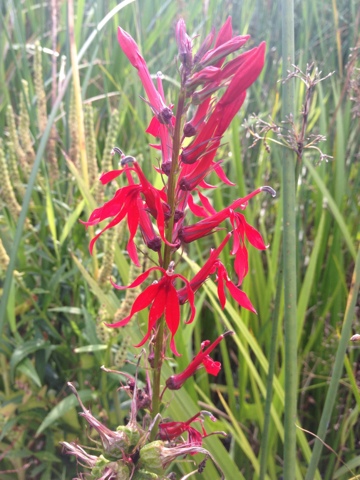
As I look upon this cardinal flower, Lobelia cardinalis, I immediately, emotionally respond to its presence. I wonder if I'm the only one who has noticed this stand amongst the grass and cattails.

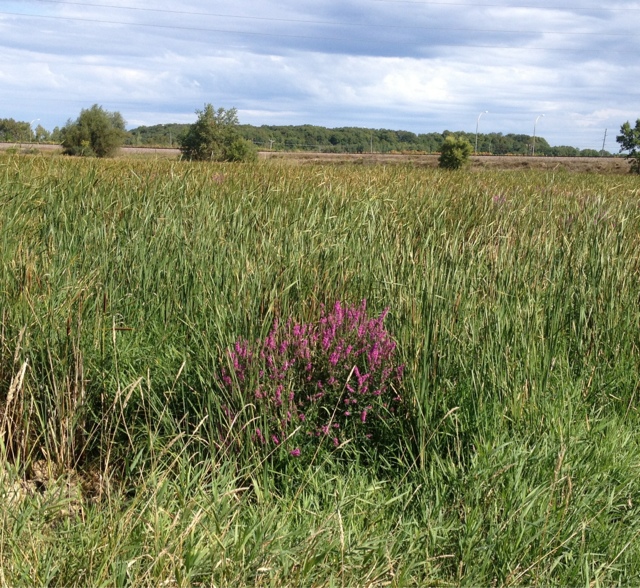
On the other hand is purple loosestrife, Lythrum salicaria. It's pale purple wands are pretty, especially so en masse, which is often how one finds it, but hardly stunning. Is this a learned response? If purple loosestrife was a native plant, would I espouse it's regal nature?

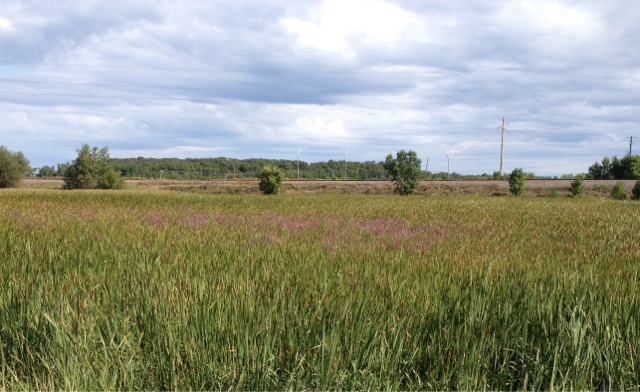
I do not know. What I do know is that seeing cardinal flower marsh-side is rare, yet finding purple loosestrife is becoming exceedingly common in Hennepin County ditches, wetlands, and cloverleaf water basins.

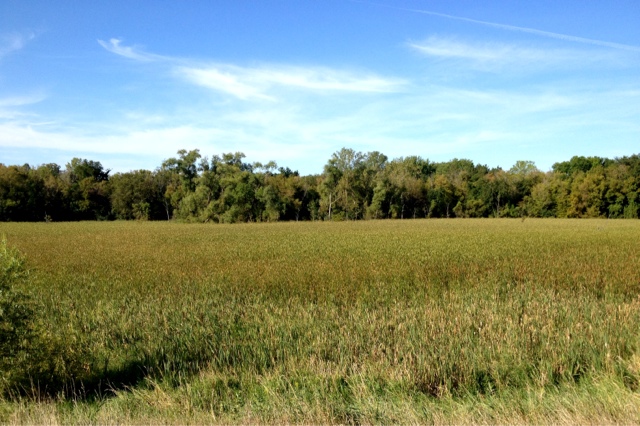
Rex likes the purple loosestrife, he says it's pretty where the marsh is just a wash of green. He believes the loosestrife cannot outcompete the cattails and rushes. But I doubt that, as evidenced by New York State's marshes and wetlands. Those must have once looked like Minnesota's, but now many are nearly a monoculture of purple loosestrife. After bloom in July and August, the wetland becomes a wash of dismal brown, whereas Hennepin County wetlands offer a kaleidoscopic interference of green and gold.

I'm not sure people care all that much. Like Rex said, loosestrife is pretty, and it's spread appears incremental, hardly noticeable. Minnesota government has policy, it is labeled invasive, it is illegal to harbor it on private property (this is where tongues tingle with politi-lingual fascism). Yet maybe, maybe, an appreciation for rarified things in life is an elitist affair. And maybe humanity has a thing for the strong, aggressive, and adaptable.

Maybe.


Lythrum Asylum


I noticed that a gardening neighbor has recently planted some purple loosestrife in her front yard. Again, the cheshire cat sits smiling at me. Anyone I've mentioned it to has asked if I have confronted her about it. Of course not. I'm not that confrontational, and I like these neighbors -they garden! But it is also that I am more interested in the problem perplexus than just snootily ratting out my neighbors.

I do wonder where she got it. I like to imagine she pulled it from the roadside on a trip upstate, but isn't it more likely she purchased it or got it from a friend? Since last year, the sale of Lythrum salicaria, or Purple Loosestrife, has been banned in two of the 4 counties of Long Island -Nassau and Suffolk. Why only them? Maybe because these areas have not seen much of an invasion yet and feel that it is still possible to protect ecosystems from our magenta menace. Yet, it is here in the city and in Suffolk and Nassau that I have most frequently seen purple loosestrife in private and public gardens. And now in my neighbor's.

It surely looks good in the landscape right now. Her one plant does what my New England Blazing Star can't seem to do on its own -delicately fire magenta spires through the air. On the other hand, this siren should be seen for what it is.

"Then with heavy heart I [Odysseus] spoke to my comrades thus : `Friends it is not right that only one man, or only two, should know the divine decrees that Lady Kirke has uttered to me. I will tell you of them, so that in full knowledge we may die or in full knowledge escape, it may be, from death and doom. Her first command was to shun the Seirenes--their enchanting notes, their flowery meadow. I alone was to hear their song, she said. You for your part must bind me with galling ropes as I stand upright against the mast-stay, with the rope-ends tied to the mast itself; then I shall stay there immovably. And if I beg and beseech you to set me free, you must bind me hard with more ropes again.’

The Odyssey, Homer

New England Wildflower Society


Two weekends ago I visited the New England Wildflower Society's Garden in the Woods in Framingham, Massachusetts. I got there pretty late, maybe about 4:30pm, but they were open until 7 pm. It was nice to get out of the city, and I went on that rare type of day this summer -the cool kind, before the intense heat of last week. I stepped out of my van and I felt my blood pressure drop.

The Garden in the Woods actually contains a number of gardens, linked by trails that can be somewhat confusing to navigate -but we figured it out along the way (we had a map). There are also woodland trails not part of the garden proper, but connected to it. I saw many plants in flower, all quite beautiful, but it has taken much too long to put this post together, and so will give my best impression of brief.

Many of the plants were tagged, and there were different opportunities to learn what one is looking at. For instance, the "What's Blooming Now" sign board at the trail's beginning, but you can't take that with you, and the garden couldn't possibly tag every plant specimen, so it is that I have not identified many of the plants I found interesting. That said, I will try to find them on the internet. I should also point out that the NEWS website goes pretty deep, with a lot of information should you want to find information about particular native plants.

After parking, you approach the visitor center and nursery. There's plenty to buy, including sandwiches. I saw on their website that goldenrods were to be on sale ($5) the weekend I went, and, since I had killed my seaside goldenrod last year (moving it in fall), I thought this a perfect opportunity to buy a new one, or two. I bought a Bluestem, S. caesi, and a Showy, S. speciosa. These sit sadly, unplanted, in the side garden until I figure out where to put them or the heat breaks -whichever comes first.

The nursery had a lot of other plants -most are well-known garden perennials. They do sell some native perennials and shrubs that are hard to find at our common nurseries, like Threadleaf Ironweed,Vernonia lettermanii or New England Blazing Star, Liatris scariosa var. novae-angliae both of which I picked up because that's what plant people do in the face of plants new to them. If you are looking for rare native plants or those in quantity, look to their Nasami Farm -that's their major nursery operation.

The plant that was everywhere and eminently garden worthy is Black Cohosh, or Cimicfuga racemosa. Brilliant spires shooting above dark foliage.

One of the first gardens we stopped for was the 'idea garden.' Most of what we found here was this charming little garden shed with a planted roof. Notice the plant baskets on the fence line.

Pitcher plants in a basket.

On the other side, flowers.

As we walked downhill, we spotted this young deer prancing back and forth. I wondered how much deer damage there is in the Garden in the Woods.

The lily pond. Islands show different plant communities. Educational, but I didn't like the effect.

Along the pond trail, Slender Blue Flag, Iris prismatica.

I believe this is Cardinal Flower, or Lobelia cardinalis. This is one where I couldn't find a tag, but was well reminded of the plants from my Nissequogue canoe trip last summer.

The stems of the above are flattened, with ridges -not unlike celery.

Friend Steve in the meadow. Our timing landed us in between the two floriferous periods, and so it appears mostly green.

Although this plant is intriguing, I do not know what it is. Any ideas? *Desmodium paniculatum -thanks Steven Ziglar!

Nope, its not Purple Loosestrife, Lythrum salicaria. This specimen, however, was just a few feet from the former. Purple Loosestrife is listed as invasive by the Massachusetts Invasive Plant Advisory Group which is a comprehensive body of interested parties. Like the cheshire cat, it appears when you least expect it, smiling as if to say that even here, amongst the native plants of the New England Wildflower Society native plant gardens, I will appear -deal with me. "The proper order of things is often a mystery to me. You, too?"

And as if to reinforce the cat's position, a jail pops up. Beyond the absurdity of plants being held in jail, it's the unfortunate, misplaced metaphors like this that allow certain nay-sayers to harp on what they suggest are Nazi sympathizing, anti-immigration purists amongst a community of invasive plant policy supporters. As far as I can tell, nothing could be further from the truth. This kind of comparison only works in the mind, on the internet, in print, on paper. In the field, amongst scientists, the comparison loses traction. So the 'Plant Jail' has to go because it is a stupid visual pun that underestimates our intelligence and gives ammunition to those who'd rather look the other way than pull a few plants from a palette of thousands.

Okay, back to the fun stuff. Field of Asclepias tuberosa, or butterfly weed.

The large leaves and berried umbels of Umbrella Leaf, Diphylleia cymosa.

Have no idea, but was near the education center and rain garden. *Spigelia marilandica -thanks Ellen and Steven!

I believe this is a cultivated aster, Stokes Aster, Stokesia laevis.*Nope, sorry Frank, that's Barbara's Buttons or Marshallia grandiflora -thanks again Steven!


If you're ever in eastern Mass or anywhere near Boston, it's worth a trip. I wouldn't look to the Garden in the Woods as an example of great garden design, but more as a palette of plant choices that can inspire design. It's worth mentioning that the staff were very helpful and friendly even though I was purchasing plants at the last minute, never letting me sense that they were itching to go home. They even watered my plants with compost tea before I loaded them into the van. Now to get those in the ground.


Much Strife at City Hall!


Wutz this? A giant Purple Loosestrife at City Hall Park? NYC Parks?!


Wait, there's another one.


Yet another...


Some more in "Millennium Park" across the street; flowers mostly spent.


How 'bout this patch?

What is disturbing about the City Hall Park loosestrife is that they're either willfully planted by professionals or not recognized by professionals. City Hall Park was renovated and re-planted in 1999. And this is odd, NYC Parks website lists it as a blooming plant of July in Manhattan, leaving it out of the other boroughs. Is there a dedicated loosestrife constituency in Manhattan that demands its August purple?

This morning I was thinking that I do not see purple loosestrife much in private gardens; maybe only three times in the last 5 years. As I thought this I walked passed a lovely garden in Ditmas Park where those magenta spikes gave another plant away. Loosestrife looks wonderful in just the kind of casual garden beds that I admire, and it does so in August, when all else seems to be failing. As I've said before, and I think this to be the case for many gardeners, Purple Loosestrife doesn't seem to elicit a gardener's rage. Probably because its an invasive of wild lands, not a weed of gardens. We look at it and at worst say it's too bad we can't plant one.

Its easy for us to deduce that most new wetland invasions will be spread via the wild plants, not those from our garden. Lord knows there's millions of them out there already, having spread all by themselves. I was in the Mohawk Valley last week and saw entire wetlands dense with magenta-purple -an amazing sight. It's also easy to say the noose is already around our necks, may as well be hanged.

I don't get much opportunity to get close to wetland loosestrife, usually seen racing by in a car. But the City Hall Park plantings allowed me total access for these ID pictures. As always, click on the photo for a larger image.


Whorled and stemless leaves.


The stem itself is square. New side stems shoot out from the leaf axils.


The brown seed capsules after flowers are spent. The wetlands aren't as pretty after the magenta is gone.


A few seed capsules.


The capsule broken open, you can see many tiny seeds. It is said that one mature plant can produce a 2-3 million seeds.


Young Purple Loosestrife.

Preaching On The Loose


Not long ago I made a post with this photo of what I thought was Purple Loosestrife. Planted near a town center, on a wetland edge, along a road, near a parking lot in a town with many gardeners and less than a quarter mile up river, near the Stony Brook Grist, a preserve dedicated to native plants and habitats.

I grew up on Long Island. I didn't see nor hear of purple loosestrife until I went to college in the Hudson Valley, where I was in awe of its August beauty in the wetlands and roadside ditches. I didn't know what I was looking at. That was 20 years ago.


Without any doubt, it is purple loostestrife -key identifier, the lanceolate leaves whorl at 90 degrees to the previous set. Someone recently planted these -by the looks of it, in the last couple of years along with some catnip.


Long Island has been relatively clear of purple loosestrife, a plant that has been around since the mid-19th century. Why? Some say its because another invasive wetland species, Phragmites australis, outcompetes it in brackish wetlands.


This little planting of loosestrife is about 25 feet from Stony Brook's brackish estuary. Alongside this estuary is a mixture of native plants, but also plenty of mugwort. If you travel a short distance upstream, which is easy to do when the tide is coming in, you will find fresh water and a perfect roost for the millions of seeds loosestrife is capable of producing.

To me, this is not a story about a plant. It's a story about people still uneducated, still planting these plants. That means that information is not getting out. That also means those gardeners who are sick of hearing about invasive plants have not heard the end of it. While we are enlightened and free individuals able to make our own choices, solving big problems requires individual and collective action. To people it's just a plant choice, but to some ecological systems, it's a disaster.

In 2007, Suffolk County government passed a "do-not-sell" list. While many of those invasive plants have a phase-out period, such as japanese barberry -2014, most weedy plants (i.e. plants we don't plant much anyway) have been banned in 2009. Maybe its a poorly updated site, but a quick google search pulled up at least one wholesale LI Nursery still selling purple loosestrife.

I drove out to Bridgehampton to see my brother's place of work. On the way, I passed two, what do you call them -wedding halls, with extravagant plantings and a white fences. Both had masses of purple loosestrife blooming away. It's August, they look gorgeous at a time when much doesn't here on Long Island. So do the happy brides.