Starts with the exercise bike. Seventy minutes later, clean up, feed the cat, and bag the garlic scapes. Subwayed to Columbus Circle and then 45 minutes with a subway barber named Nina. Aim for the middle-of-the-block corner deli for a salad and coffee before the 12:30 phone reference interview for a former student. He never called. One peeyem, conference call with Associate Dean and other stakeholders to express concerns and problem solve regarding upcoming fabrication lab expansion. Hightail to the subway, downtown bound -Union Square. On the platform I get an email congratulating me on meeting the enrollment requirement for my summer class Landscape and Meaning at Art New England -it runs! Subway comes, D train to Herald Square, up-ramp transfer to the NQR for Union Square.
Exit among the hoard of Greenmarketeers, then enter the luxuriously cool lobby of 200 Park Avenue South, up eleven flights to the offices of the Skowhegan School of Painting and Sculpture to aye, pick up my Carrie Moyer print, bee, drop off my alumni donation, and cee, enjoy the company of the fine women who work there. Textzz-zz. Gotta go! Down, now, back through the refrigerated front lobby, to look for Marie who had come all the way to Union Square from Harlem. Why, in such heat? It was yesterday evening's three variety scape harvest from the remotely urban corner of NYC near the ocean to this on the verge chef, definitely author, forager, gardener, blogger and taste-maker extraordinaire. Hand off complete, we shot the sh#t in the exquisitely cooled foyer of 200 Park Avenue South for ten or fifteen minutes, walked toward the Greenmarket, and then I was off to the New York Studio School to meet an old Skowhegan colleague and painter, get a tour of the facility, meet the people that needed to be met, do my sloppy impersonation of an elevator pitchman, shoot the sh#t once again, and then cross wise to the West Fourth subway station for the ride home, where I now sit typing, but no sooner than it took to photograph the opening elephant garlic in the garden, carry in a muffler and pipe for our van, and throw some onions, sausages, and tomato in a pot that may churn into something that looks like dinner.
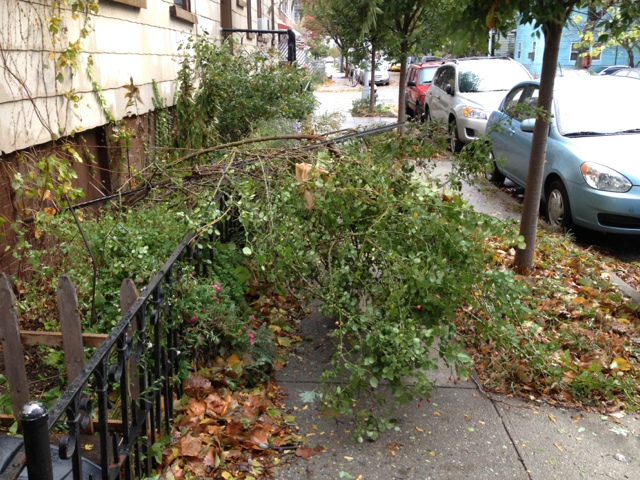
We fared quite well in Kensington, Brooklyn. If only that was the case for us all. We know there are problems all over the city and region. Sirens blaring all morning. Fire a big concern. Not only did Breezy Point inundate, at least 50 homes burned down in wind driven electrical fires. Rockaway Park may still be burning in places. All subway tunnels flooded. Fourteenth street power station had a major substation explosion. Transformer explosions all night all across the region - many thought it was lightning, but there wasn't much in the way of thunderstorms in our area.
We took a walk around the neighborhood, where most everything seems in order. Except for our new dawn rose, which was in flower again, and fallen over. We knocked it back hard to get it up against the house again, at which time we got caught in one of the hard, cold rain squalls affecting the area.
I spoke with Larry, our local nurseryman. He left Breezy Point yesterday morning. He thinks his house is east of the fires, but he's not sure. He is sure that all of the peninsula had been inundated. I'm wondering about getting out there, but that seems unlikely and even unreasonable at this time.
If you are wondering "when is that last or first frost date here in NYC," below are two maps, courtesy of the wonderful people at Cornell University, of first and last frost dates of the New York State season. These frost dates are "roundabout," so it is always wise to follow the weather when thinking of planting tender plants or deciding whether or not to harvest those last few tomatoes. Any given year we can push or pull these frost dates. Looking at those dates tells me we in NYC are very lucky indeed.
Well, its autumn in NYC. I've been busy. This morning was the first in a while that I was able to get into the garden and see all that is happening there. That post to come later.
There are a few things I've been working on. One is my art website, made in the oldest version of iweb and uploaded this week. Took me more than a year to do it. I will add the link (oh, horror- my full name!) to my side bar should you ever want to see what painting or project I am up to. There may be bugs to be ironed out, but you know this.
I did some consulting for the National Park Service regarding artist-in-residence programs recently, and was also named a Future Leadership fellow by National Arts Strategies, who partnered with NYFA. The fellowship entitled me to a full day executive class at the Brooklyn Museum on financial management for non-profit organizations. It was taught by a great teacher, Greg Reilly, Ph.D. from the University of Connecticut School of Business. He made it real simple for us arts folks.
I've also been involved curating an exhibit of painting, drawing, and sculpture called 'reaganography'. The opening next sunday and the card image is below (click on that image for a larger view). The gallery is in Greenpoint, Brooklyn and is called NoGlobe.
Tis late August. The full size tomatoes are ripening now. This photo is actually the second harvest. Last week's went to my friendly cat feeder-tomato waterer. The plums are 'Milano', the slicer is 'Bella Rosa' and all are just this side of ripe. The center 'Sungold' cherries have been unloading shirt-basket-full numbers for a month now.
But along with the harvest is the typical late August blight. Yellow dots and shriveling leaves announce its arrival. The hardiest of tomato plants will produce right through it. Last years cherries and Brandywines did. This year the Milanos are most blighted, followed by the Sungold, then the Bella Rosa, the late riser Orange Pixie and finally the Black Russian. All now have the leaf blight in various stages of succumb. Its okay, my 'food security' barely depends on them.
I have been harvesting steady supplies of green beans. About 1 pound every 6 days or so, plus those I snack on while out in the garden. These above were last nights pickings stirred up with some boiled red potatoes, red onions, and a splash of vinegar.
Some more in "Millennium Park" across the street; flowers mostly spent.
How 'bout this patch?
What is disturbing about the City Hall Park loosestrife is that they're either willfully planted by professionals or not recognized by professionals. City Hall Park was renovated and re-planted in 1999. And this is odd, NYC Parks website lists it as a blooming plant of July in Manhattan, leaving it out of the other boroughs. Is there a dedicated loosestrife constituency in Manhattan that demands its August purple?
This morning I was thinking that I do not see purple loosestrife much in private gardens; maybe only three times in the last 5 years. As I thought this I walked passed a lovely garden in Ditmas Park where those magenta spikes gave another plant away. Loosestrife looks wonderful in just the kind of casual garden beds that I admire, and it does so in August, when all else seems to be failing. As I've said before, and I think this to be the case for many gardeners, Purple Loosestrife doesn't seem to elicit a gardener's rage. Probably because its an invasive of wild lands, not a weed of gardens. We look at it and at worst say it's too bad we can't plant one.
Its easy for us to deduce that most new wetland invasions will be spread via the wild plants, not those from our garden. Lord knows there's millions of them out there already, having spread all by themselves. I was in the Mohawk Valley last week and saw entire wetlands dense with magenta-purple -an amazing sight. It's also easy to say the noose is already around our necks, may as well be hanged.
I don't get much opportunity to get close to wetland loosestrife, usually seen racing by in a car. But the City Hall Park plantings allowed me total access for these ID pictures. As always, click on the photo for a larger image.
Whorled and stemless leaves.
The stem itself is square. New side stems shoot out from the leaf axils.
The brown seed capsules after flowers are spent. The wetlands aren't as pretty after the magenta is gone.
A few seed capsules.
The capsule broken open, you can see many tiny seeds. It is said that one mature plant can produce a 2-3 million seeds.
I'm always suspicious of alarmism or overly emotional pleas. I think that is why I appreciate the site, CatskillMountainKeeper.org, for keeping its cool about a hot topic. I've followed the story loosely for a couple of years, and now its coming to a head. I should tell you.
Parts of New York, Pennsylvania (the first oil state), Ohio, and West Virginia have a geological zone called the Marcellus Shale region. Deep down in this zone is natural gas. As you know, carbon fuel prices went through the roof. This enabled companies, like Halliburton, to invest in developing new extraction technologies. One of those is hydraulic fracturing also known as fracture stimulation or "fracking". The process is simple. Drill a well. Add a lot of water, sand, and a cocktail of chemicals into the plumbing under extremely high pressure. This will fracture the shale deep beneath the ground, releasing the gas and a few other impurities. The gas is shipped to a facility to refine it, then its piped to electrical plants and to us, for use in our stoves.
Read this for a brief overview of NYC water supply system Read this for an overview of the Marcellus Shale in PA and NY. Read this for the Catskill Mountainkeeper overview of gas development in NY. Read this for all kinds of issues via Propublica. Read a blog all about it from PA.
Energy companies have already targeted Pennsylvania and are now eyeing New York. Much of the shale they are looking to drill is in the watershed of NYC. If my opinion mattered more than a hill o beans, I'd say just don't do it. But we got lots of rural land owners looking at energy salesmen waving dollars in their faces. In the upstate economy, that carries some good weight. State lands are open for drilling, but as far as I know, surface drilling on state park lands is a no-no, although this process uses horizontal drilling technology. There's lots to think about here, but ultimately we're talking about trading NYC's water purity for natural gas. Are we that desperate?
The current NYC administration is against the drilling. They've proposed 1 mile buffer zones around our drinking water supply. But this is unfair to all those who live and drink outside those zones. If it's not good for NYC, it's not good for all of NY.
Oil and gas prospecting wastes are essentially exempt from U.S. national environmental laws. Read the EPA pamphlet.
A Statement from Halliburton on your right to safe drinking water: The U.S. Congress has recognized that fracture stimulation has been regulated for decades by the states and is essential for future development of America's energy supplies. When passing the federal Safe Drinking Water Act (SDWA) in 1974, and then amending it in 1980, Congress created a program to monitor disposal of wastes injected underground. Congress made clear it never intended to regulate well stimulation activities under the SDWA(my italics). Congress reaffirmed this position in 2005 when it clarified that fracturing stimulation is exempted from the SDWA, except where diesel is used in the fracturing fluids. That same year (2005), Halliburton was the first to introduce an industry-leading advancement – continuing to improve a technology it first commercialized in 1949 – by introducing diesel-free liquid gel concentrates into its suite of well stimulations fluid systems (what a coincidence!) and helping operators move to higher levels of environmental performance. All I can say is WTF?
I've been planning on exploring Forest Park for some time and finally I had the chance to do it. It was a warm day, yesterday, so the idea of walking through a shady forest enticed. I drove to Park Lane South, where there was ample street-side parking, then stepped out and felt a cooling breeze emanating from the woods. Ahhh.
click on it for full size
After crossing the boundary, the first thing I like to get is a map -where am I going? Fortunately, there was a park map on the park drive. I took a photo of it, as I am prone to do when I do not have a printed map, and used my camera screen to view it. On this day, it really helped.
The beginning of the trail. At this point, I had no idea how confusing the trail system would be. All was well, the trail was soft underfoot. I wore open-toed shoes (beware, missed roots had me tripping over myself on some trail parts).
As the title suggests, the LIRR actively runs through Forest Park. To boot, so does Jackie Robinson Parkway, Myrtle Ave, and Metropolitan Ave. I was never able to get fully away from the woosh of vehicles.
Not long into what I believed to be the blue trail, the fencing to isolate the train tracks is completely blown out. On the left -looking north, on the right -looking south. I found myself at this location on the blue and yellow trails.
I also found this fresh campfire site. Makes you think about those who may live in or near the park.
So I am walking along on what I think is the blue trail and suddenly I've merged with the bridle trail. I wanted to avoid this, but I could see no way to stay off as the blue trail is gone as far as I could tell. The bridle trail is good for walking, but beware - I ran into many riders galloping their horses.
Its at this point that I am beginning to learn something about Forest Park. It has obvious, distinct spur trails that the map doesn't show. The trails are well worn and I guarantee will confuse. This intersection above was easy to navigate, but many were not. I passed tens of intersections that were not mapped on the orange, blue, or yellow trail. But by far, the blue trail had the most. So, I would say that Forest Park is an excellent place to come and discover your trail map reading skills, learn how to use your compass, or hone your woods navigation skills. No chance of really getting lost since you are bounded by the city, but ample opportunity for confusion and decision making.
The park was not in good shape. Lots of downed trees, bare areas, weedy zones. In fact, it reminded me so much of where I grew up, I felt psychologically transported 40 miles east to the hummocky oak landscape of my youth. I grew up on the eastern side of the Harbor Hill terminal moraine which extends all the way through Jersey. Forest Park sits squarely on one of its high points.
Part of the dilapidated walking path, which may be the orange trail in between Park Lane South and one of the park drives. Something about these lamps, duct-taped up and leaning into the trees, that says uncared for.
The blue and yellow trail were mostly clear of poison ivy, but the Orange trail had it in many spots, like this large patch.
All in all, I was underwhelmed by my Forest Park experience. I hiked all the trails, barring the orange along the Jackie Robinson Parkway, in about two hours.
I do wish that people you pass on the trail would show the courtesy of acknowledgement. Out on wilderness trails, if you pass someone, general etiquette is to say hello. Here in the city I know we have different attitudes about acknowledging those in close proximity. With that in mind, I argue that it is more valuable to acknowledge when hiking in highly populated areas. Its just creepy to pass someone on a trail that only warily eyeballs you or worse, doesn't even look. Passing lone men out in the woods, especially in a place with so many desire paths, can put a person at dis ease that could be well assuaged by a hello, a smile, or even a simple nod. I will manage one of those three if I pass you on a woods trail in the NYC area. Hope you do the same.
Despite my complaints, I did make some discoveries...
I've been seeing this everywhere I go recently and Forest Park had a lot. Obviously a berry, like rasp or black. But neither of those...
It's notable for its bright orange berry (before it goes red I think) and its hairy/thorny sepals.
I spotted a couple of these, but cannot ID them. Five petaled, St. Johnswort-like yellow flowers; trifoliate leaves, astilbe-like; maybe 2 feet tall in the woods. Anybody?
I did find a few patches of fern on the yellow and blue trail.
On the blue trail, just passed 'The Gully,' this dangerous looking plant was trailside. It had spines on its stem and spines at the axil of each set of leaves. They were sharp. The leaves are pinnately compound. The stems were green, the whole plant green. It looked like a weed to me, but hard to say. It grew in a patch that looked as if it may become large shrubs or small trees some time in the future. My only guess is Aralia spp., but I didn't see any flowers or berries. I'm not sure Aralia has those axil spines. Anyone???
In two locations I spotted garden iris.
Tulip trees were present, especially on the yellow trail.
This fungus I found on the orange path, near the park drive. Anybody know this one?
On the yellow trail, not far from the train tracks, this big black beetle crossed my path. I couldn't take a good photo, she was moving fast. I take it for a she, because it seemed to be depositing eggs in the soil every few inches.
This was the prize, made the whole trip worth it. Indian Pipe. I've never seen it on Long Island before, although it most certainly grows here.
Before I go where it is I am going, I must admit to saving two kittens. Oh, alright, it wasn't me but my wife. One was left on a porch in Maine and the other bounded out of the Maine woods, two years apart. One is black, the other white (ish). When Pinky (cause she was rather pink then) was young, she was scrawny, with sick eyes and ears. Life in the woods. Could've been owl meat.
When Pinky was young she liked to hide in the housplants. A rare moment of peace between the two.
So what's this I see through the tomatoes, fence, and vine? Is it that time again? I usually only see the survivors, 6 months old maybe. This one, this one is awfully young to be on its own.
Over the fence I go to see this little being. Scruffy for sure, one eye closed, giant ears. Its laying amongst the vines, hiding to its best ability. My watering in the garden seemed to chase it out from underneath the cold-frame -a rather perfect cat shelter. You see, I get lots of cats in the garden. It is my greatest pest. What is pestilent about cats? Mostly wet cat shit. But also cat spray and hair on the vegetable plants. I can smell the poop, but I cannot see it until its too late, on or in my shoe. Seriously, its worse than squirrels, insects, and tomato robbers combined.
We have a fierce crowd of cats in the neighborhood. Most are not owned, officially. Our own two cats have ragged dopelgangers out on the street. Cat fights are heard daily. Cats are lounging on car hoods like greasers. This one above was mewing like crazy, like it was looking for something, or some cat. I thought it may have been the kitten's mother. Just ahead of it was another, bigger gray cat.
Chicken bones, ham bones, fish bones, and other detritus are often left in front of my apartment (the unowned, you know) for the cats to eat. Cat food in cans and also dry food, sometimes tuna are left in front. People feed them like they might pigeons, but find them cuter, if not touchable. There is one neighbor, two houses down that has a slew of cats show up at his gate daily for their feast. The cat above is one of that crowd. The gray tabbies I call them. They follow him around when he walks his dog.
Oh, look who it is: the mewer, the bigger gray, and the kitten. Family reunited I suppose. They are lounging at my neighbors, inches from my side yard garden. I don't know if that kitten will make it, its rough out there.
The cats really like my garden. At different times there are different cats laying in the perfectly protected spots. Its like a halfway house for delinquents. Some months the garden belongs to white fright, other weeks ol' blackie no ears shows up (a real frankenstein), then there's splotches always hiding behind the New Dawn rose. The gray tabbies, a clan, a gang, they got class, but they're also on the dole.
Our cats, sometimes life is dull for them, but do they know how good they got it? So bourgeois.
The last three days I have been dealing with a cat puke fest. Its tough to figure out who's doing it, but I did yesterday. Three days of it is a bit much, especially for Zoe (black) who is known as puss, cause she always has one on. She's shedding like mad despite my brushing her, which they both love. Some of her puke has had a lot of hair in it. I suppose she wants me to put in the air conditioner. Which I have no plan to do so I hope she stops soon. Why do they always puke on the rug? Excuse me, I grew up with dogs and know little bits about cats. Oy.
There's been some webiverse ado about the death of Smith & Hawken. Like all good funerals, you get to sharing your memories. My first rooftop gardening job, I was 24 years old, a bit cocky that I knew about this field. It was my first day, dropped on the terra-cotta tiled roof of the client we called "The Masterson's", near park, East Side -can't remember exactly where, family of actress Mary Stuart Masterson, whose garden we later built.
My boss left me on that roof to construct Smith & Hawken teak furniture. I assembled the furniture and waited for his return. In those days, as there were no cell phones, when we needed to communicate, we needed to hit the street to find a working pay phone -often enough a good part of our day, next to finding parking. When he returned, I was told the furniture was the wrong model. I'd have to disassemble the furniture, put it back in boxes. Ugh. The job got better, but was always incredibly physical work. There's a lot of glory in the visage of roof gardens, but not much said about how much work goes into it, 'cept here at 66squarefeet.
If I told you we had to carry 3" caliper trees to the roof of a 5-floor walkup, that probably wouldn't mean much. But I think carrying 200 40lb bags of potting soil up 5 flights of stairs carries some weight. Back then we didn't use (was it the frugality of our boss?) those convenient hoists I see being used all the time now to lift gypsum board into apartment buildings. When we were building a deck, each piece of everything needed to be hauled up. Often there was no freight elevator, but if there was, it was often in some ridiculously distant corner of the building. When we got to the apartment, they always seemed to have a white carpet! But no matter, shoes off, masonite down, paper down, everything taped, dirt, trees and plants carried through.
A bulk of our summer business was maintenance -showing up to fix something, sweeping, watering, deadheading, painting, lots of electrical, cleaning fountain slime and whatever else. I found this aspect the most boring, but much easier than hauling the garden to the roof!
New York was at the tail end of 6 years of recession when I began doing this work. I started at $8 and hour, boldly making it to $10 by August of that year. New York was a different place back then, I lived alone in Williamsburg, right near the subway. I could survive on 10 bucks an hour, pay my college loans, save some even, although not without taking extra jobs and working lots of overtime. But even with all that, I still managed to find time to paint at night, hang out, whatever. There was NOTHING to do in Williamsburg then! Wealth was very concentrated in certain neighborhoods of Manhattan. I could buy fresh baked Italian bread at Sparacino's Bakery (been many things since it closed)for 75 cents. How things have changed in 15 years. So thanks 'death of Smith & Hawken' for sending me down memory lane.
I think the broccoli 'calabrese' flowers are quite nice with their blue-green foliage.
Its ugly out there. I needed to hack back the New Dawn climber rose (on the left) to let light and air to the plants beneath. Now there's sort of a New Dawn grotto.
But my Allium sphaerocephalon is beginning to blush.
It's egg shape appeals to me over the globe-shaped kind.
My Sidalcea, I believe 'party girl'.
I'm not that happy with the look of the front yard this year, but compared to 4 years ago...
There has been one major park in all of New York City that has managed to go from waste land (or structure) to park land in 10 years, that is the High Line. Recent money donated has given the completion of the new parkway a boost. In fact, as the New York Times pointed out, "This could be the friendliest public/private venture ever attempted in New York City." With a total cost of about $150 million, the High Line has created a stir at under half the cost of the proposed Brooklyn Bridge Park. Of course, no one can complain about the private capital connected to the High Line, as that it is of its essence. While the city owns most of the High Line trestle and NYC Parks appears to have some role to play, it is not a stretch to view this parkway as a privately funded and maintained park with public access.
As a public/private partnership, it makes the most sense that this new parkway has a dual personality -its public and private function. In this sense it is the most viscerally dual-purpose, built landscape that I can think of. On the one hand it is a high fashion, high design plinth for the the viewing of NYC architecture. On the other, it is a lowly, industrial structure, re-visioned as a metaphor for a car-less NYC. One aspect serves the vanity of private institutions and developers' dreams, the other serves the public imagination of a future NYC.
The High Line is an elevated parkway connecting destinations and residential neighborhoods, not unlike Vaux and Olmsted's original NYC parkways designed for horse, carriage, and pedestrian strolling. Unlike Robert Moses' parkway system (connecting parks throughout the region via the gentler travel of non-commercial road traffic, with screen plantings designed to provide a serene, bucolic driving experience), there is only modest screening provided by the planting design. In fact, this new parkway functions as a platform for taking in the sights of lower and midtown Manhattan, auspiciously relying on the local architecture. Imagine it as a stroll through a sculpture garden, but the sculptures are the size of buildings. If you live or work in one of these new buildings, you can take the step back to appreciate how wonderfully your own starchitect designed sculpture resides in the New York landscape. If you do not, you can stroll the High Line, panoramistic foldout in hand, ready to identify any building seen in the growing architectural landscape. This is the essence of the private High Line.
On another level we have the romanticization of the railway ruin. Functioning and defunct railways have been seen as picturesque components of landscapes for decades, and their minimal infrastructure is easily incorporated into park designs. The ruins have hosted many parkways throughout the country, mainly as part of the rails to trails initiative. In Paris, the Promenade Plantee created a formal garden from an elevated railway. Many cities are now looking at conversion of their dilapidated high rail. In our own city, Gantry Plaza State Park had, less than fifteen years ago, incorporated industrial rail into its park design. The incorporation of rail into park design, then, is nothing new as landscape design needed to make sense of the wasted, post-industrial landscapes -often the only new space open for park development in our urban centers. What is new, however, is the attitude of an elevated railway park in NYC.
The primary public aspect of the High Line is its manifestation of the changing attitude towards street vehicles and traffic. It does this by anticipating the elimination of the vehicular traffic below, rather ironically through the preservation of the conduit for a mode of vehicular traffic previously considered too dangerous to keep at street level. It allows us to walk along what most of us recall as the unsafe terrain of train tracks and in doing so, gives us a glimpse of a future where walking on the street is possible and safe. The High Line removes vehicular traffic from the urban experience in an apolitical, non-threatening fashion high above the streets, out of sight and mind of the political body of racing vehicles below. In fact, the elevation of the High Line mimics the sense of civic idealism to which it speaks while, to the speedster below, perhaps it's the floating spectre of a return to biological speed.
There will be those who lament the loss of an urban "wild" space. They may have disdain for the "high design" approach. I sympathize with the sentiment for the tangled, messy spaces and the sense of discovery they contain. Yet I won't harp on it, that debate is over, it is built. I think the planting design looks good and the hardscape is nicely textured. I have noticed, however, the lack of what every overpass in this city has come to acquire -the protective chain link fence. Will it grow one in the future? I think we can all hope not.
This landscape offers the kind of close-quartered plant and hardscape experience that I expect to require high-maintanence. Time will tell how well-suited the plants are to this environment, but I am willing to give the High Line designers the benefit of the doubt. This park experiment has been well-funded, and that usually means better care for plants and hardscape. In fact, managing the horticulture and park operations will be a horticulturalist formerly of the Brooklyn Botanical Garden. How well the High Line is maintained and at what cost, in conjunction with how much use or abuse it gets will be instructive for any future, parkway proposals.
As we watch the collapse of the American auto industry, and entertain the idea of a city free of personal automobiles, what new urban landscapes will we dream up? Look out Broadway, your next.
The first section of the High Line has been completed, from Gansevoort Street to 20th Street, and is projected to open in June 2009.
The answer is no. I will not grow snap peas, or probably any peas again in my side garden.
First, growing them was easy. Sprouted no problem, seedling support no problem, transplant no problem, growing in pots no problem.
So what is the problem?
Beyond the minor cover, don't cover when cold nights threatened -its that I just don't get my effort's worth out of the few plants I could grow. I need a row of snap peas, not four planters!
That said, they were tasty. Nutty, sweet, green -definitely better than grocery-bought. The photo above -the latest harvest.
The plants are still producing, but by God -its time they moved on so the tomatoes can go in, the tomatoes for chrisake! What kind a world is it where tomatoes are waiting on peas, peas in a tomato's world!!
"Murray McBride of CSS and the Cornell Waste Management Institute was quoted. A little alarmist, with some significant misquotes - we are not in fact offering free soil testing, though we have gotten four calls as of yesterday inquiring about such a service… but generally not quite as sensational or inaccurate as we feared, but a bit too much for our taste. We are in the process of writing a letter to the editor with hope that we could turn this into a learning moment."
The Cornell Waste Management Institute has a page regarding soil quality. I will link to this permanently on my resources listing.
I am sad that I will miss the high point of our summer flower season while I am away. But the rocket and irises have put on a good show before I am to go.
Can you tell the difference between the nursery purchased mother on the left and its offspring, on the right. The offspring is huskier in every way, including leaf width, petals, and overall plant size.
I will miss the spirea blooms, which in so many ways is not the reason to enjoy this plant.
This iris is taking its sweet time. Warmer weather would open this guy right up, but we're looking at a three day time lapse between these two shots. Amazing color, isn't it?
Both these plants are in the family Asteraceae. I usually clip them back in early June so that they don't get too tall. This year, maybe because all of the rain, I need to clip them now. The aster below reached forward because I had my cold-frame over its spot until about a month ago.