tomato disease

Pulping


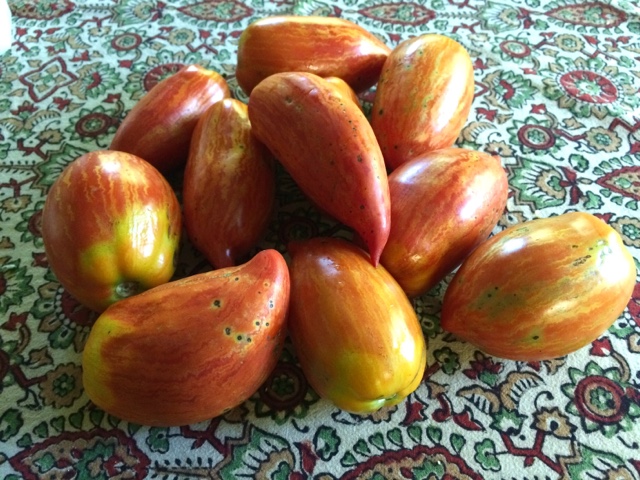
My favorite heirloom Roma (speckled Roman, above), have been pulped in the sloppy strainer contraption I bought several years ago. It's been a terrible year for tomatoes, so humid and damp that blight set in well over a month ago. It's been a very good year for green beans and potatoes, broccoli and basil. The fall cauliflower and Brussels are floating giant leaves but no sign of anything edible yet. 

Soon we leave for a weekend in Milwaukee to hang an exhibit. I'll be showing photographs, a first. I'll post the information when it's all set up. In the meantime, check out my Instagram feed (you can find it here), from which I've harvested, maybe even pulped, the exhibit's images. 


Garden Report

Potatoes are waning but they're still impinging on the herb bed. As the sun lowers and the potatoes die down, the herbs should reclaim their full sun. In the back left, really tall milkweed.


As the garlic comes out over the last few weeks, the fall brassicas have been filling in. These are brussel sprouts, the first planted, into the space previously occupied by garlic 'Xian.' I've never grown these before, but have planned it for years. Notable this season is a lack of cabbage moths -not complaining!


Eggplant fruit coming on now.


Green beans, from purple to roma, prolific and easy as ever.


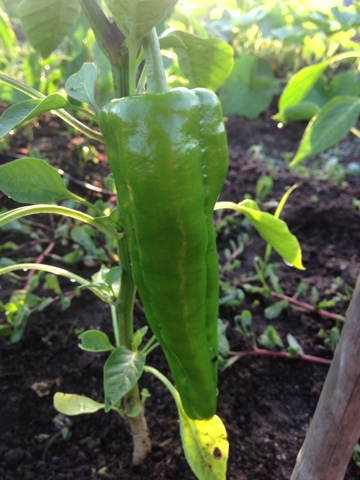
All peppers are fruiting, some large. Only difficulty is that the plants can hardly hold their large fruit and that I shouldn't be so lazy as to try to break a pepper off the plant instead of going for the pruner. What happens? Well, I break the whole pepper plant in half.


In complete opposite of last year, all our tomatoes are suffering blight. Could have come in on our purchased compost, or maybe because we planted in last years potato and eggplant beds. Hard to avoid poor rotation in a compact garden. Next year I think these beds will be garlic and the garlic beds will be tomatoes. All that can be done now is watch the tomatoes try to outgrow the blight.


More brassica as the Porcelain garlic 'Music' has come out. As two more varieties of garlic are harvested over the weekend, even more brassica will go in. Above is kale started from seed in the greenhouse.


These giant pompoms, hydrangea actually, were moved from the south side of the house last year. We planted them in a great arc around the curving lawn-driveway. They are quite garish, but they keep the plow truck and other skiddish drivers from driving over the lawn and garden in summer and winter (thanks to the long lasting dried flower sepals), and maybe they keep the deer at bay. Maybe.


And we've finally started digging into the soil for new potatoes. Above: Kennebec russet, Pontiac, and Yukon Gold. Thanks to the quantity of compost and straw they came out with little soil and easy to clean.

I've been very busy with many things, from door and sill replacement, old deck removal, job searching and applications, studio building projects, contractors and everything I can't stand about some of them, photographing, studio painting, my class Landscape into Art which runs on the twenty third of July, a bit of socializing, gallery going, and even a music festival in a corn field last weekend. Blogging has had to take a back seat to all this (as well as taking quality photos for them), but rest assured -I was able to plant half of my milkweed over the septic drain field and beyond yesterday. Progress.


Lawn Of Plenty


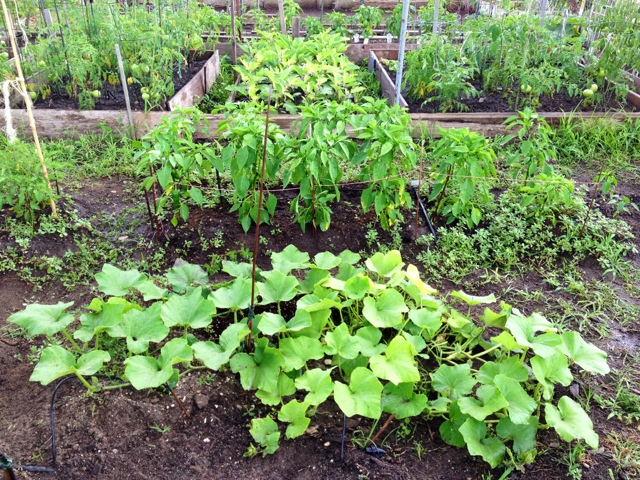
It was about mid-May when I decided to carve five small rows into the front lawn for this year's vegetable patch. It is the sunniest, flat space on the land here. In the distance, the driveway and a hedgerow of Hydrangea arborescens -a solution to coarsely articulated snow-plowing and a mass of foundation plants in the way of a future house project. Seven weeks from the day the tiller expressed itself, the vegetables are taking advantage of our long, northern days.


My first round of green beans didn't arrive, quite possibly because I didn't water the seeds enough or maybe due to three year old seeds. They were all French beans, ones that trialled well, hmm -three years ago. So I bought new seed from the big box (so many home projects!) and planted those. Meanwhile it had been raining heavily for a few days -that's when some of the old seeds showed up, 'Velour,' I think. So far no problems with bunnies -or deer, raccoons, hedgehogs, and whatever other vegetable munching varmint one can have. So lucky -that's all it is.


One four inch pot of flat leaf parsley has become eighteen by twelve inches of parsley -use it daily.


One four inch pot of cilantro has become two feet by twelve inches of cilantro -makes a nice pesto!


The garlic is still green, but I know well enough to start harvesting them. As these go, their rows fill with herbs, green beans, and eventually those brassicas I fully intend to start one of these days...


Four pepper plants from a cell pack of four heirloom varieties. This one set fruit super early.


A cell pack of Japanese eggplant have provided us with an orb -not the usual thin and elongated fruit. What gives? I do prefer the way less seedy elongated varieties. Oh, Japanese eggplant doesn't always imply elongated fruit? These are 'Kyoto,' a round eggplant, and I ashamedly renounce my ignorance!


One four-cell pack of, hmm, I forget the name, but cucumber. I do recall it saying compact, and this one is definitely compact. We grew them in pots, elevated off the ground in metal pot stands that happened to be here. A couple of things to point out: these four plants in two pots have been productive for their size and have not succumbed to mildew. They have yet to reach the ground and have many flowers per vine. I recall googling the variety at the nursery, Shady Acres! Ahh, they have a plant list- It is Spacemaster. Pick them pickle size for best flavor.

A word about Shady Acres. Heirloom. That's the word. Seriously, Minnesota has some catching up to do when it comes to organic garden supplies and heirloom vegetable starts. It is very difficult to find what I came to expect -even at Larry's on the corner in Brooklyn (Best Deal on Bloodmeal!). I edify every nursery I come into contact with, including Shady in regards to fertilizer choice. I heard about Shady Acres from my neighbor who is busy trying to grow Minnesota's largest pumpkin, and was grateful for the recommendation -they carry heirloom vegetable starts. For me this means they have a variety of tomato beyond Rutgers, Beefsteak or Early Girl for the person who simply didn't get to starting his own.


Potatoes. They grew incredibly tall, so high that they could no longer be soil-mounded. Then a week of heavy thunderstorm rains, about seven inches in all, ensured that they would lay flat until they turned back up toward the sun, which they have, albeit more prostrate than before. They have been flowering for a few weeks now, with new potatoes sure to be available soon. I've decided to wait on those, aiming for the bigger potato of the future.


The tomato plants are some of the healthiest I've grown. Again, an heirloom variety pack from Shady Acres provided the starts. Ours have been in the ground for about five weeks, have grown over thirty inches tall, and some are producing tomatoes. We also have a grape variety, four plants in total. We won't get a ton of tomatoes out of four heirloom plants, but this year required low input, experimentation, and observation.


What is remarkable is the health of each plant. No visible disease, no wilt or cankers, no blossom end rot (can we thank high Cal-Mg soils?), simply robust plants. Look at that impressive stem. It helps to be gardening in a spot that has yet to see any vegetable growing. We haven't had any Colorado potato beetles either, so here's to hoping that our little clearing is protected by the woods and wetlands that surround it.


Lastly, the bug-eating army of amphibians can't hurt. And what of the pansies? It hasn't been a very warm summer so far, but plenty of days in the lower eighties. Here it may be that pansies just won't quit.


Return To The Beach Farm


We made a bee line for the beach farm not long after we returned from Minnesota. August weeds had become September's monster and the order among the tomatoes had decomposed into a fermentative morass.


Anthracnose, Bacterial Speck, Late Blight, and the Wilts had infected tomatoes in the new plot. Any large tomato was infected, none of which were edible.


Many lay rotting on the ground, split, fermenting in the warm sun, fizzing spittle and stinking of solanaceous putrefaction.


Tarry-looking specks and alien pods grew on some tomatoes making them rather unappetizing.


Fortunately there were eggplants that only lacked for water.


And the chard that I did not pick. Cooler weather will inspire harvest. Of course, the fennel is a monster. I'm leaving it for the enjoyment of the creatures and my occasional nibbling of flowers.


Speaking of nibbling, there has been a good amount on the tomatoes in the lowest reaches, so it was no surprise to see this bunny making his rounds on a quiet afternoon.


 Despite all the disease, our mid-July planted, retail Roma starts, produced a bumper crop of little tomatoes.


On Sunday, quite a beautiful day here in the city, I processed enough tomatoes through the mill (Norpro) to make 8 quarts of tomato juice and pulp. Perfect.


Nice Peppas


It's been said at the garden that I have the best peppers this year. This pleases me. You know, as I've said earlier this spring, this is the year I dedicated myself to growing better peppers. So far so good, but what's different? 

My neighbor grows everything very well (a little miracle goes a long way, wink wink), but this year his peppers are not taking off as usual. This may be the case around the garden. It was, as you remember, inundated with sea water for several hours during Sandy. 

One of the first things I added to my plot this spring was gypsum (calcium sulfate). Calcium is always needed in our sandy, acidic soils, but then gypsum also has the ability to mitigate the salt overload I had expected from sea water. I didn't add any where the garlic was already growing, however, and the peppers there are a fraction of the size (although seeded at the same time, I planted these in the garden two weeks later). Both have had a couple of doses of organic 3-4-3 fertilizer and the hydroponicist's cal-mag solution plus Fertrell 3 fish and seaweed.

Well, whatever the reason, so far it appears we will get some nice sweet reds and hot green New Mexico chile this year. Can't wait (and I hope we're not in Minnesota when they're ready)!


Tomatoes are also doing pretty well. I moved the bed and tried to avoid strains that last year all too easily succumbed to verticillium wilt, yet there is still some signs of it on lower leaves. We have a few green tomatoes and again I am hoping we'll be in town to eat them. 

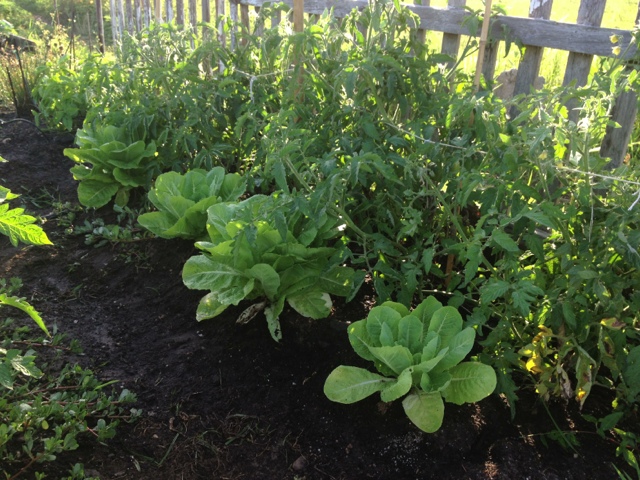
I'm impressed with Johnny's 'Jericho' romaine -I seeded it late, most never got planted and croaked in the tray. These were tiny things when I planted them after June one. We'll be eating some tonight.

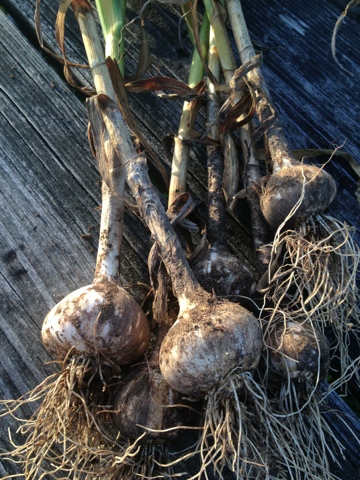
I picked up some runty, but low (ahem) cost cauliflower starts from Larry's. My burlap "grow bag" was a bust, so I used its remains as a weed barrier and mulch around the cauliflower. Today I seeded a small bed of last year's favorite French green beans (Nickel, Velour). All the remaining garlic has been pulled and sized up nicely without any skin rot to speak of (all thanks to that fine, sandy soil). Today I turned over a neighboring plot, full of weeds for years, and seeded it with buckwheat only to be told that it belonged to another "school." The schools hardly plant anything and when they do no one returns to care for it. But you know what, I may get some more real estate down there after all.


A Tale of Two Tomatoes


About the tomatoes -all other problems aside, I must report that I completely eliminated blossom end rot from my tomato patch this year. It was a dastardly problem last season, particularly bad in the roma tomatoes, affecting nearly half the crop. What is different this year? I planted them same type of tomatoes in the very same beds using the very same drip system for irrigation. But, I did have the soil tested, which led to important information about my plot. First, I found that my garden soil was acidic, somewhere near a high 5 pH. Second, I found that I had more lead than I wished, somewhere near 100 ppm.

The first thing I did was lime the beds in February to bring up the pH. Lime is high in calcium and has other trace elements, all useful for tomatoes suffering from blossom end rot which is often described as a deficiency of such. Liming also helps locked up minerals become available -it's all part of a neutral soil program (see this). 

The second thing I did was add 25 pounds of granulated fish bone meal into the beds in March. I had read that the EPA was using fish bones to remedy soils high in lead (in short: the lead binds to a mineral in the bones, creating a new, insoluble mineral). My thinking was that their fish bones couldn't be any fancier than ordinary fish bones, and how much could it hurt anyway. Fish bones are also high in calcium and trace minerals, again, useful for the tomatoes suffering from blossom end rot.

And today, not one instance of blossom end rot in my tomato beds. This should suffice as evidence of a solution, but we also had contrary situation nearby to underscore our results.

Just outside our plot we planted our extra tomatoes. The soil is the same as ours, of course, but didn't receive any amendments this winter. Almost all of the roma type tomatoes look like this. Blech -I'll never go back.


Rain Farmer


The weather was, well you know -wet. I left the studio for the bus at 4 pm. I got home at 5 pm. I jumped in the van and hit traffic on Ocean Parkway, but still made it before 6 pm. Above, Solidago sempervirens at Jamaica Bay's edge.

I only had so much time. Why was I so committed to planting mesclun mixes, radishes, and arugula in the rain anyway? Because of the letter from Ranger Thaddeus T. that says we must cease gardening on November first. November first? C'mon. Well, my protest is performance, because I well knew that was the end date. Is it silly? Yes. The best way to get good gardeners into these plots is to get a site manager that actually understands gardening. They could then change that silly date to December fifteen.

The garden managers have a never realized dream of tilling the whole acre under every year at season's close. I'm not fond of that idea, but reality is that no one's moving there hardscaping anyhow. They also want to shut off the water -that's the biggest concern, drain the pipes before a good hard freeze. Fine, I say, turn the water off, but let us keep going with the kale, broccoli, and greens. It's usually wet and cool enough to get by without watering at that time of year.

So there's the push to rush those greens seeds in, even though it meant getting soaked in the dim light of an October evening. I planted rather hastily, with crooked rows, and uneven seeding. I was more concerned with the big footprints I was seeing in all my empty patches -the places I seeded cilantro, parsley, and spinach. One really needs fences. Only a knowledgeable gardener suspects a bare patch is planted with seeds at such a late date in a warm season garden gone dismal. But then, why tromp through a garden at all, why not follow the trenches? It's better not to ask.

The old broccoli patch now seeded with different mesclun mixes and arugula.

The bell peppers are having a hard time turning red with all the rain and cool weather.

The collards are beginning to look fantastic without all the 'pillar holes.

Today's semi-ripe tomato haul. There's still another four dozen or so on the vines. Every tomato that rests on the ground has the buckeye rot. If it remains in the air, it has no buckeye rot. Next year -all tomatoes will be off the ground. FYI -the net isn't my attempt at decorating the shoot, although I know you're thinking how fabulous it looks. In fact, it's window screening I had in the van and made a convenient way to carry the tomatoes back home.

Elsewhere around the Ft. Tilden Community Garden:

One of the new gardeners that came in with us has planted Kale, and it's looking good.

My favorite farmer has reaped his amaranth and tackled his corn. This man operates like a real farmer, with two or three seasons of different produce. He planted his corn and amaranth around August one. Before that it was beans. Do you remember this?


Dirt Farm Rocks


We were anticipating anything as we drove to the beach farm after being away for two weeks. The water being shut off was my main concern, but weeds, toppled plants, bugs -who knows. I practically jogged to the plot. When I arrived to see it I had only one thought -dirt farming is awesome!

It must be because I was without my camera for awhile, as I can only find pictures of our beach farm vegetables posted on August 4th. That was 30 days ago, but not that long ago by some standards.

This was our broccoli one month ago.

This is our broccoli today. About 5 heads were five or six inches across.

I brought my mesh and nylon to wrap the heads and was disappointed that they were so large already -I never expected such rapid growth. But the kicker was that there were no cabbage worms -not one. Where did they go? Two weeks ago there were hundreds of worms in all sizes. Have they all morphed to moths, flown away from their childhood patch?

Tomatoes are growing and growing. Because I didn't do the work for trellising, they are spreading horizontally. So it's no surprise that they are showing signs of blight on the lower leaves.

The hot peppers have grown stout -nice.

These Hungarian yellows are very productive.

These sweet peppers are doing well too. I think they are cubanelle.

Here are the eggplants on the left, beans and sweet peppers on the right. In the back, the cucumber trellis.

We weren't around to teach these guys where to go (that's up) and, as is typical, a mildew has formed. We planted three varieties, and 'Salad Bush" has evaded the mildew the best.

The slender Japanese eggplants are producing well.

The Italians are beginning to produce.

The "infill" bush beans are also gearing up. I seeded these wherever another plant succumbed during the first three weeks (recall on again off again watering).

The garden in context.

The 5 broccoli heads and 6 eggplants we harvested. The tomatoes are from the side yard pots.

Speaking of those side yard pots... It really is something else, growing in pots or planters, without a watering system, without endless soil, with the entrenched diseases. I know that I have not set up an ideal growing environment for all that I've tried to grow. However, the cool weather greens have always done well, and the tomatoes always produce -although late and lightly. Some years the beans have done extraordinarily despite small planters, but not this year. The broccoli and snow peas have never been a success.

What I really want in this very public space is a good looking garden, and by this time, with so much outdoor opportunity left, the vegetables in their pots look decrepit. There's little one can do to overcome it, too. I suppose local is going to have to be 10 miles away -not just outside. I'm very excited to have the beach farm and to see it produce so well in a very short time is heartening. Plans are swelling for next season. Swelling indeed.


Brandywine Frankenstein


These are the first and probably only brandywines I'll harvest this year. The cycle of drought and watering led to some cleft with heft. I made a tomato salad -oil and vinegar, salt and pepper. I cut out the coarse ravines. Eaten at room temperature.

One tomato growing note: I had one tomato with blossom end rot this June. I promptly started placing all our egg shells crumbled up on the soil surface. Entirely unscientific, but I must say that despite the droughty conditions, no blossom end rot on any tomatoes since the egg shells went in. For whatever it's worth.


Side Garden Revisited


With all the attention on the farm on the beach, it's easy to forget the garden at home. I haven't been attending to it all that much, now that the worst of the heat wave has passed.

The tomatoes have gotten quite large, and are producing somewhat. I pulled off many of the wilted leaves from the disease that has been affecting them. This makes them look much more attractive, but has done little to stop the upward progress of the yellowing, then browning, of the leaves.

The cosmos are in full flower now, yet leave me wishing they put out a little less greenery. The zinnias are also doing better and are considerably tolerant of the high heat. I grew zinnias in southern New Mexico, and they did quite well at 105 degrees F.

Cosmos.

I trimmed back the borage so that it could do its best to provide a second bloom. It's nothing like the first bloom. I think I know why it is said that borage makes for better tomatoes and beans -it brings in a lot of pollinators. We have much less bees now that the borage is producing so few flowers. I am thinking of scattering seeds at the farm on the beach. If these here don't get producing, I will pull them out in favor of something else.

It's worth noting that our beans have done terrible this year. Producing N-O-T-H-I-N-G. The purple podded beans we planted have not produced one pod! My old blue lake bush seeds were not viable anymore, sprouting only a few plants -and those have only given a few beans. I've noticed less availability in the markets -is this just me? Last year my one container of blue lake bush provided at least 4 lbs of beans over the summer.


Mites


The dry, breezy, hot weather has made a ripe environment for spider mites. Now my tomatoes' got 'em. Not just them, mind you, but the maple tree sprouts 10 feet away, amongst the poles.

Yellow mottling on top.

Webby, detritus-covered bottoms.

I was gonna spray some soap, but then didn't. I fertilized instead, hoping there will be enough plant for both mites and tomatoes. We'll see. I'm lazy when it comes to treatment.


Question


A reader recently sent me these two photos of their young tomatoes. The two images below are of a couple of plants from their container garden in Manhattan.

The question was about the tan spots on the lower leaves.
I think this is simply environmental damage from shifting the tender plants to the outdoors. I think this because the spots are tan, not circular, only on the old leaves, and I do not see other signs of damage. If they follow up, I'll find out if it's continuing to happen- that would change my opinion.

Any ideas?


Been All They Can Be


The whole sorry mess. I am thankful for today's rains. But the sogginess makes blighted plants look miserable. At times like this, one must be decisive!


Therefore the 'Black Russian' on the left has been turned in on itself to be removed sometime this week. It was producing no more fruit this season but made great strides up to this point. The 'Milano Plum' on the right was the first to blight and is looking pretty lousy.


But it keeps on producing new green growth free of blight. Then, sets of plum tomatoes and so it stays.


Somewhere in there are two 'Bella Rosa' plants that are still producing despite being ill.


These two are likely to mature before frost.


But the beans have been all they can be.


In their stead, a broccoli 'Calabrese' from last spring. How's this for broccoli growing: plant seedling in a gallon pot in spring, summer over in a semi-shady location, water little, pot-up in autumn and fertilize. See what happens. I'll let you know.


What really matters now? The Asters!

Church of the Immaculate Tomato

Yes, I am a sinner. My soul besmirched and blighted as my tomato. Pray for us.


The blight as it looks on 'Bella Rosa' -spotted, speckled, and sticky.


The 'Sungold' reaching towards my neighbor's ac unit, desperate for more sun. Its not producing much at all now.


I've watched this one grow up, the survivor in the batch. Favorite spot: in the green beans.


The first 'Black Russian'. Uh, not so black, but good looking. While the least affected by the blight, also the last to produce.


Sliced, perpendicular to the stem. The "black" must refer to the dark recesses. A tasty tomato, but I refuse to judge this variety until I can grow it in a more hospitable situation. I expect to pick just two or three more from the plant before it fully succumbs to the blight and low sun.


Blight Me

The tomatoes' late blight charging forward on all the varieties. To be honest, I cannot remember ever planting tomatoes where there was absolutely no August-September leaf blight.


The Milano Plums have been the hardest hit and should succumb soon. These were determinates. I've harvested about 20 from two plants with maybe another 15 to go.


Above and below, Bella Rosa tomatoes. The blight is starting to hit these hard now. I've harvested three of these tomatoes this season.


These slow-to-ripen tomatoes are good slicers and tart.


The next pick, number four.


Sun Gold cherries, waning now due to blight and less sun. Sweet and thick skinned.


A closeup of the Sun Gold leaves and symptoms.


Even the upright citizen, Orange Pixie is starting to see some blight. But, it has its first ripening tomato and several others should come my way before its demise.


Bella Rosa is still putting on new growth and occasional flowers.


Ahh, the green beans. These bush beans keep producing, although less now than the first flush.

I'm thinking about not planting a vegetable garden next year for a variety of reasons. Or maybe just a snack producer, like a cherry in one pot.

Ripe N Blight

Tis late August. The full size tomatoes are ripening now. This photo is actually the second harvest. Last week's went to my friendly cat feeder-tomato waterer. The plums are 'Milano', the slicer is 'Bella Rosa' and all are just this side of ripe. The center 'Sungold' cherries have been unloading shirt-basket-full numbers for a month now.


But along with the harvest is the typical late August blight. Yellow dots and shriveling leaves announce its arrival. The hardiest of tomato plants will produce right through it. Last years cherries and Brandywines did. This year the Milanos are most blighted, followed by the Sungold, then the Bella Rosa, the late riser Orange Pixie and finally the Black Russian. All now have the leaf blight in various stages of succumb. Its okay, my 'food security' barely depends on them.


I have been harvesting steady supplies of green beans. About 1 pound every 6 days or so, plus those I snack on while out in the garden. These above were last nights pickings stirred up with some boiled red potatoes, red onions, and a splash of vinegar.

This Week In The Side Garden


Things are humming along. Thunderstorm rains have been helpful.


The green beans are producing.


I think I defeated the blossom-end rot that begun a few weeks ago on one 'Milano Plum.'


The Milanos from underneath -determinate, so they're setting over a shorter period.


Even the 'Black Russian' is forming fruit now. Can't wait.


As always, the cherries are producing the earliest. These are 'Sungold,' very sweet and tasty, but the skin is a little thick.


The 'Bella Rosa' is going strong, no sign of the dreaded B.E. Rot. These tomatoes have been enlarging for the longest period, and they seem to keep on getting slowly bigger with no sign of ripening.


And the strange 'Orange Pixie,' now has flowers and is still the most upright tomato plant I have ever grown.

Lycopersicon Lycodelirium


Green tomatoes are growing steadily now. I got my plants in late, maybe early June. In NYC, you can pot up your tomatoes in early May most seasons. This year I chose determinate varieties and those known for compact habits. Last year my tomatoes plants were enormo! This year's vines do seem to have a more open habit and less leaves.

Bella Rosa -the general slicing/salad tomato.

Milano Plum -my saucy tomato.


Black Russian -the interesting and exotic tomato not yet producing. It seems the more heirloom one gets, the more interesting the flower form.


Orang Pixie -the odd cherry tomato that barely made it out of its seedling stage. As a matter of fact, I'm not even sure this is the orange pix, because I didn't transplant it. I think because of its late-comer growth, its soldier-like uprightness, and its all-over neat habit which struck me as similar to the pixie habit as a seedling. Only fruiting will tell...


Sungold Cherry -the standard cherry.


Hopefully more disease resistant than last year's 'sugar sweetie.' But already getting yellow leaves down low.

These are all from John Scheeper's seeds. What I do not like about their seed packets is that they are not unique to the tomato, i.e. all have the same tomato drawing, same growth info. The only thing different is the tomato name and how many days. I'd like the packet to say if it is a determinate or indeterminate vine and disease resistance (VF, V) -for reference, that's really all. Jeepers Scheepers, can you add that much?!