vegetables

Breath

The breath of autumn is now well upon us. It scatters the leaves as well as my mind, and puts the quick into my step. As in life and age, autumn has a way of shifting the unimportant away. In our cold clime that first freeze can be an icy slope. One descends from warmth to frozen in a day or two. No lollygag of a New York City autumn -there is terminus.


The paper wasps have finally crawled deeply into buildings and the ants have long left the work atop their mounds. There is a grasshopper on the garage wall, but no longer in the garden. Flies find their way in as do lady beetles and what remains of the mosquito swarm has descended into the basement stairwell.  A woolly bear and a large wood spider hastened from the unfinished studio. A week ago I heard the frog's last chirp.


Last week we had our first frost, and tonight, should the skies clear, we will have our first freeze. We can now accept bringing in plants, out of sympathy for them, as we do with our pets. Will the lantana come in? Will the begonia tubers be saved? Should I unearth the rosemary and pot it?


Despite better planning, the fall vegetables have not gone as hoped. Cauliflower was a wash, and the broccoli too. Green beans just a week or two too late and nibbled. Brussels sprouts have more leaf than sprout thus far. Spring planted broccoli continues to flourish. Eggplants always do better until they just can't and I have yet to harvest the majority of potatoes.


Although it is nearing winter (it comes earlier here), there are still several outdoor projects to complete. I need to replace a porch balustrade, cedar plank the utility room landing and replace several mossy and rotted plank ends on the porch. There is a window frame to repair -it should not go another winter, but it is on the second floor and I don't prefer ladders. A brick walkway has remained a gravel trench. The gutters continue to fill with leaves -this can wait, but not beyond snowfall. Warmer temperatures are required to apply a second coat of paint to the alcove where siding, sill, and door were replaced by the height of summer. The studio has much remaining, but there is now power and today the concrete contractor is placing the insulation foam. Progress. Should I call the mudjacker for the sidewalk that cants to the house? Is there time? Is there money?


The Spoils of Summer

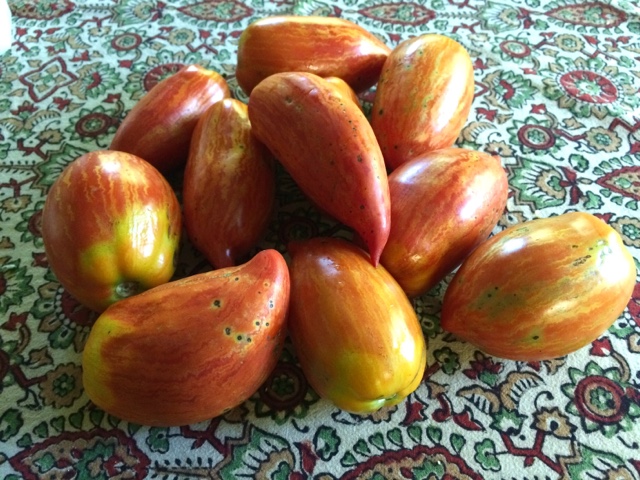
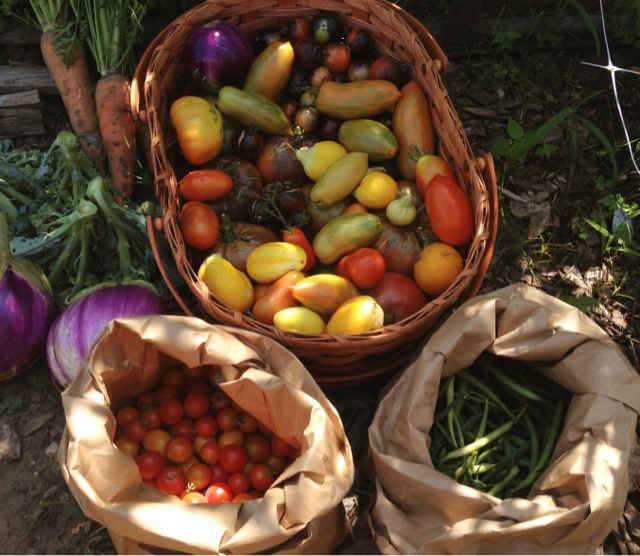
Now that I've figured out to successfully grow bell peppers, I tend to be at a loss for what to do with them. This means I eat them raw quite a bit. August is high season for eggplant which continues until the frost. The tomato plants have the look of late September, nearly caput, and even the fruit have taken on the scabs of blight. Below my beloved speckled roman paste tomatoes. Despite heavy blight, they still produced, if a bit more unsightly.


Pulping


My favorite heirloom Roma (speckled Roman, above), have been pulped in the sloppy strainer contraption I bought several years ago. It's been a terrible year for tomatoes, so humid and damp that blight set in well over a month ago. It's been a very good year for green beans and potatoes, broccoli and basil. The fall cauliflower and Brussels are floating giant leaves but no sign of anything edible yet. 

Soon we leave for a weekend in Milwaukee to hang an exhibit. I'll be showing photographs, a first. I'll post the information when it's all set up. In the meantime, check out my Instagram feed (you can find it here), from which I've harvested, maybe even pulped, the exhibit's images. 


Garden Report

Potatoes are waning but they're still impinging on the herb bed. As the sun lowers and the potatoes die down, the herbs should reclaim their full sun. In the back left, really tall milkweed.


As the garlic comes out over the last few weeks, the fall brassicas have been filling in. These are brussel sprouts, the first planted, into the space previously occupied by garlic 'Xian.' I've never grown these before, but have planned it for years. Notable this season is a lack of cabbage moths -not complaining!


Eggplant fruit coming on now.


Green beans, from purple to roma, prolific and easy as ever.


All peppers are fruiting, some large. Only difficulty is that the plants can hardly hold their large fruit and that I shouldn't be so lazy as to try to break a pepper off the plant instead of going for the pruner. What happens? Well, I break the whole pepper plant in half.


In complete opposite of last year, all our tomatoes are suffering blight. Could have come in on our purchased compost, or maybe because we planted in last years potato and eggplant beds. Hard to avoid poor rotation in a compact garden. Next year I think these beds will be garlic and the garlic beds will be tomatoes. All that can be done now is watch the tomatoes try to outgrow the blight.


More brassica as the Porcelain garlic 'Music' has come out. As two more varieties of garlic are harvested over the weekend, even more brassica will go in. Above is kale started from seed in the greenhouse.


These giant pompoms, hydrangea actually, were moved from the south side of the house last year. We planted them in a great arc around the curving lawn-driveway. They are quite garish, but they keep the plow truck and other skiddish drivers from driving over the lawn and garden in summer and winter (thanks to the long lasting dried flower sepals), and maybe they keep the deer at bay. Maybe.


And we've finally started digging into the soil for new potatoes. Above: Kennebec russet, Pontiac, and Yukon Gold. Thanks to the quantity of compost and straw they came out with little soil and easy to clean.

I've been very busy with many things, from door and sill replacement, old deck removal, job searching and applications, studio building projects, contractors and everything I can't stand about some of them, photographing, studio painting, my class Landscape into Art which runs on the twenty third of July, a bit of socializing, gallery going, and even a music festival in a corn field last weekend. Blogging has had to take a back seat to all this (as well as taking quality photos for them), but rest assured -I was able to plant half of my milkweed over the septic drain field and beyond yesterday. Progress.


No Small Potato


Potatoes grow fast and huge, here. The frame can hardly contain them.


A couple of days back I went out in the morning to find one third of the potatoes flattened. Raccoon? Deer? Owl flapping its wings? Coyote maybe? Don't know, but I had to string them up to get them off the surrounding plant beds.


We hardly, if ever, consider potato flowers. These are light, light purple. Most of the others are white. They're nice to see, and appreciate, floating above the dense bed of green.


Summer Solace

One of the benefits of getting to one's vegetable garden first, before summer's work begins in earnest, is not having to think about the garden at all when you are knee deep in summer's work. It grows itself, mostly, with an intensity only paralleled by the solstice's long day. 


One of the beauties of growing garlic is that it's harvest hardly coincides with any garden task other than weeding. By now, the first of the garlic is near completely exhumed (briefly hesitated to dredge up this word), and like any darkling, it mustn't be cast into the bright light. The first pulling is in the shade of the porch, but the full harvest is likely to be dispatched to the cellar. Here, in the midst of harvest, is Xian, a Turban strain, and one of the best for flavor and earliness. Turban's lodge, or fall over, as a way of telling unsuspecting gardeners that they need help -getting out of the ground.


At about the same time sizeable beaks are swirling above the Asiatic strains -here Asian Tempest and Japanese. These will be harvested next, not long after the Turban strains, and sometimes before.


Meanwhile the Porcelain strains have had their scapes (flowering stalk) cut, ready to be pickled or grilled or sauteed or...just don't leave them in the fridge too long before doing something with them. Behind the Porcelain are the Rocambole (shorter in the middle) and Purple Stripe. 


The French Grey shallots have also been pulled. I find that the height of the crabgrass is a useful indicator for timing the shallot harvest. Left behind are the Artichoke and Silverskin strains, those hardy bulbs that we use through next winter and deep into the following spring. 


When the the crabgrass first sprouts, it's the best time to get your peppers in, but I didn't heed the crabgrass this season. No, I put the peppers in a couple of weeks early -listening to the lambsquarters maybe. They're doing fine anyways, although I do think they are showing a little too soon.


Broccoli? Yes! And from seed no less. In spring? Yes! And no cabbage moths to boot. A quick, small-headed variety seed-started on May one and hardly two months later boom -broccoli. Go figure. I've got some of those very same starts in their deep cells holding back growth inside the greenhouse. They'll be put into the garlic beds as they clear.


Green beans? Not so fast. I seed-started these in the greenhouse on May one and planted them out a two or three weeks later. Nice flowers, no beans yet.


Cucumbers before June 21? Why, yes. I purchased a cell pack of four Spacemaster cukes from Shady Acres and planted them in pots raised well off the ground.


They won't ever reach the ground, that's why they're called spacemaster. They do put on an impressive display of cucumbers and have produced a handful of medium sized eaters before the solstice. I've seeded my own, too, to replace these after they give up.


Tomatoes, well that's asking a lot, isn't it? But among our six strains (of three varieties -plum, grape, and, uh, heirloom beefsteak?) these grape tomatoes, called Red Pearl, are way good producers.


In fact the deer are warming up for BBQ season by snacking on our Speckled Roman plum tomatoes. I grew these at the Beach Farm, and deer aside, expect them to do really well here.


Dill, cilantro, basil, and at the very bottom, cutting lettuce. In the background -common milkweed that has grown in this spot for eons, or at least since this house was built, so maybe the late nineties. Infringing on their bed are the potatoes. They are so big they require their own post. Look for that.


Vegetable Early June


The vegetable garden, June 4. Peas growing in the same bed with broccoli and recently planted romaine lettuce. I had so many lettuce starts that I plunked them into nearly every bed. The next bed is green beans and a spot for upcoming chard seedlings. Third row has eggplant, peppers, and a basil patch. The following two rows are Red Pearl grape tomatoes (same as last year and magnificent), five Speckled Roman paste tomato plants, and four heirloom types that includes Striped German and Brandywine and two others I cannot recall. Our starts were from Shady Acres Herb Farm or started in our own greenhouse.


The curving garlic bed is new this year (well, tilled last November). The garlic is doing well although a little tightly planted. Doing really well is the Chesnok Red -a Purple Stripe variety. This one is said to do very well but I couldn't have said that in the past.


Here are our potatoes -five varieties including russets, golds and reds. They grow several inches each day. I am about to add compost to "hill up" inside the framed bed. More garlic to the right, and French Shallots as well. To the left is our herb bed that includes basil, dill, cilantro, parsley, thyme, oregano, arugula and cutting lettuce. I'm anticipating a productive garden and feel better about its organization over last year. When the garlic is harvested around late June, early July, I will add our late summer-early fall crops of broccoli, cauliflower, brussel sprouts, and kale. In the background are cucumbers in pots, a remnant bed of dead nettle and common milkweed, and the curving hedge of hydrangea that we transplanted from the south side of the house last year.


The Warm Welcome


This is what I think of when I feel the chill of autumn.


Or maybe a string of pearls -the puffball, or rather the giant puffball, Calvatia gigantea, growing in the back woods among the hog peanut.


These are the things of late September and early October.


 Not basil!


 And green as can be green beans!


 Eggplant that simply won't quit.


And tomatoes that continue to produce -only now beginning to show the wilted leaf of cooler nights.


The vegetable garden here is as green as my beach farm plants were in late July. A rarity, maybe? Not the norm, say some. The coming five days are looking to be quite autumnal -blue skies, cool air, days in the lower sixties, nights in the lower forties. This should bring an end to the vegetable patch, and not a moment too soon as the garlic seed is on its way, and more front lawn needs to be tilled under. But wow, what an exquisitely long growing season.


When People Ask Where The Good Food Is


...I usually tell them its right outside.


Four heirloom tomato plants have produced more than most any I had ever planted at the beach farm.


I've been looking forward to the German Stripe, the latest to size up and ripen.


Japanese eggplant, 'Kyoto,' have been exceptionally prolific.


I put my green bean seeds in a little late, but still, they are producing now. 


Although my broccoli starts were a failure. Too late, as always.


But I was saved by this guy (sorry to say that I lost his name with a piece of paper) and Anderson Acres. You see the sign, to the left, that says start your fall garden. Yes! Getting starts together at the right time in summer is challenging given busy summer schedules and difficult weather. Hardly any garden business has starts available at this time of year, probably because there isn't much market for it. I'm so glad to have found them at the Minneapolis Farmers' Market in stall 311.


I bought a handful of these lettuce starts, broccoli, cilantro, parsley, and basil.


The fall lettuce.


Betsy's dill, the pickler that she is.


Our local hardware gave away (really, for free) many vegetable starts in July, most well past their prime. I focused on those sturdy sorts that do well in cooler weather -chard and kale. Small and weak when planted, they are now doing fantastic. We eat them every day.


A four pack of heirloom peppers from Shady Acres (whose stall Anderson Acres occupied at the farmers' market) has become quite a bounty of peppers. I've never had such luck. One plant has eight large peppers!


And they're beginning to turn red.


Of course, there are still tomatoes ripening.


These "cherry," or is it "grape," have been fantastic. The name I believe is 'Juliet' -a little sweet, little tart, and meaty -that is the key for me. I do not like watery small tomatoes that pop when you bite into them or crack after heavy rains. These I pick and eat right there in the garden.


With more to come.


The woods has not produced its usual bounty this year, except for the morels early on. Maybe we've missed them, having been so busy with work on the house and field. Of course, we'll keep looking.


Lawn Of Plenty


It was about mid-May when I decided to carve five small rows into the front lawn for this year's vegetable patch. It is the sunniest, flat space on the land here. In the distance, the driveway and a hedgerow of Hydrangea arborescens -a solution to coarsely articulated snow-plowing and a mass of foundation plants in the way of a future house project. Seven weeks from the day the tiller expressed itself, the vegetables are taking advantage of our long, northern days.


My first round of green beans didn't arrive, quite possibly because I didn't water the seeds enough or maybe due to three year old seeds. They were all French beans, ones that trialled well, hmm -three years ago. So I bought new seed from the big box (so many home projects!) and planted those. Meanwhile it had been raining heavily for a few days -that's when some of the old seeds showed up, 'Velour,' I think. So far no problems with bunnies -or deer, raccoons, hedgehogs, and whatever other vegetable munching varmint one can have. So lucky -that's all it is.


One four inch pot of flat leaf parsley has become eighteen by twelve inches of parsley -use it daily.


One four inch pot of cilantro has become two feet by twelve inches of cilantro -makes a nice pesto!


The garlic is still green, but I know well enough to start harvesting them. As these go, their rows fill with herbs, green beans, and eventually those brassicas I fully intend to start one of these days...


Four pepper plants from a cell pack of four heirloom varieties. This one set fruit super early.


A cell pack of Japanese eggplant have provided us with an orb -not the usual thin and elongated fruit. What gives? I do prefer the way less seedy elongated varieties. Oh, Japanese eggplant doesn't always imply elongated fruit? These are 'Kyoto,' a round eggplant, and I ashamedly renounce my ignorance!


One four-cell pack of, hmm, I forget the name, but cucumber. I do recall it saying compact, and this one is definitely compact. We grew them in pots, elevated off the ground in metal pot stands that happened to be here. A couple of things to point out: these four plants in two pots have been productive for their size and have not succumbed to mildew. They have yet to reach the ground and have many flowers per vine. I recall googling the variety at the nursery, Shady Acres! Ahh, they have a plant list- It is Spacemaster. Pick them pickle size for best flavor.

A word about Shady Acres. Heirloom. That's the word. Seriously, Minnesota has some catching up to do when it comes to organic garden supplies and heirloom vegetable starts. It is very difficult to find what I came to expect -even at Larry's on the corner in Brooklyn (Best Deal on Bloodmeal!). I edify every nursery I come into contact with, including Shady in regards to fertilizer choice. I heard about Shady Acres from my neighbor who is busy trying to grow Minnesota's largest pumpkin, and was grateful for the recommendation -they carry heirloom vegetable starts. For me this means they have a variety of tomato beyond Rutgers, Beefsteak or Early Girl for the person who simply didn't get to starting his own.


Potatoes. They grew incredibly tall, so high that they could no longer be soil-mounded. Then a week of heavy thunderstorm rains, about seven inches in all, ensured that they would lay flat until they turned back up toward the sun, which they have, albeit more prostrate than before. They have been flowering for a few weeks now, with new potatoes sure to be available soon. I've decided to wait on those, aiming for the bigger potato of the future.


The tomato plants are some of the healthiest I've grown. Again, an heirloom variety pack from Shady Acres provided the starts. Ours have been in the ground for about five weeks, have grown over thirty inches tall, and some are producing tomatoes. We also have a grape variety, four plants in total. We won't get a ton of tomatoes out of four heirloom plants, but this year required low input, experimentation, and observation.


What is remarkable is the health of each plant. No visible disease, no wilt or cankers, no blossom end rot (can we thank high Cal-Mg soils?), simply robust plants. Look at that impressive stem. It helps to be gardening in a spot that has yet to see any vegetable growing. We haven't had any Colorado potato beetles either, so here's to hoping that our little clearing is protected by the woods and wetlands that surround it.


Lastly, the bug-eating army of amphibians can't hurt. And what of the pansies? It hasn't been a very warm summer so far, but plenty of days in the lower eighties. Here it may be that pansies just won't quit.


Our Vegetables

My attitude about garlic growing is considerably more casual than in previous years. So far these varieties have shown excellent progress without more than a dose of blood meal and liquid fish fertilizer. The French grey shallots have done exceedingly well with little maintenance but the occasional weeding.


In fact, since the top photo was taken, they have lodged -meaning it is near to harvest and hardly any different from the time frame of my 2012 upstate New York growing experiment. These will be cured on the porch.


Very few interesting things going on with the garlic. They are taller, lankier than my Long Island grown garlic, although these were planted from my own LI grown heads. Each variety made the transition, so far, from coastal New York to Minnesota pretty well. There has been one interesting thing -the strange appearance of dead flies on some of the leaf tips.


They seem glued in place. Has another creature done this? Saving them for later? Or has the garlic done them in? No answers, yet.


About a month and a half ago I planted potatoes. They appear to be doing exceptionally well, with each rain adding another few inches in the last three weeks. No Colorado Potato Beetles yet and I can't keep enough soil on hand to mound up!

Of course, we put tomatoes, peppers, and eggplant in two weeks back. They were planted in 14-inch wide strips tilled into the front lawn -the only place sunny enough for vegetables. So far no creature has come to eat. I'm wary of adding green beans knowing how well rabbits take to those tender seedlings. Deer have not browsed, although we do have a resident raccoon living in a big, old maple in the woods about 75 feet from the garden. So far she's only been good for digging up a single, just-planted spud and harassing Betsy by tipping over her newly planted coleus.


What's Old Is New


One of my present tasks is to attend to thousands of well-kept magazines that my father-in-law left behind: National Geographic from 1918 onward, Life from the beginning to the end, Scientific American from the 1950s onward, Sky and Telescope from then to now, and so on and on. Among these larger lots are a handful of Organic Gardening magazines. Would any of you, readers and gardeners, be interested in one of a handful of lots of Organic Gardening magazine? Here's my pitch:

Old magazines are full of old printing techniques, laughable fashions, advertising with crude, unmerchantable copy, and outdated storylines. However, printing and fashions aside, Organic Gardening is 99.5 percent as fresh today as it was the year it was published. In fact, I leafed through one Rodale Press magazine from the 1940s the other day and was surprised to see the same problems and solutions printed then as you would see today (except their less than thorough take on sewage sludge as a fertilizer). Sure, the hybrid varieties touted then as an improvement may now be thirty years old, but the growing information is solid and the text is short and to the point. It's great to see articles on wild plant foraging, native plant gardening, chicken-raising, pickling, and all the other how-to know-how OG was known for back in the day that is de rigueur today.

Organic Gardening was printed as a half-sized edition of 8 x 5.5 inches. The paper used is nearly newsprint and yellowing from age, although each copy is fully bound and complete. You may notice the musty smell of an old magazine boxed in an old house -it's part of the charm. If you are interested in obtaining a year of OG, drop me a comment and email: nycgarden@gmail.com. It'll only cost you the shipping (USPS, flat rate).


_______________________

On March 1, 2015 I will discontinue posting on NYCGarden. You can continue to read new posts here.


What's Old Is New

One of my present tasks is to attend to thousands of well-kept magazines that my father-in-law left behind: National Geographic from 1918 onward, Life from the beginning to the end, Scientific American from the 1950s onward, Sky and Telescope from then to now, and so on and on. Among these larger lots are a handful of Organic Gardening magazines. Would any of you, readers and gardeners, be interested in one of a handful of lots of Organic Gardening magazine? Here's my pitch:

Old magazines are full of old printing techniques, laughable fashions, advertising with crude, unmerchantable copy, and outdated storylines. However, printing and fashions aside, Organic Gardening is 99.5 percent as fresh today as it was the year it was published. In fact, I leafed through one Rodale Press magazine from the 1940s the other day and was surprised to see the same problems and solutions printed then as you would see today (except their less than thorough take on sewage sludge as a fertilizer). Sure, the hybrid varieties touted then as an improvement may now be thirty years old, but the growing information is solid and the text is short and to the point. It's great to see articles on wild plant foraging, native plant gardening, chicken-raising, pickling, and all the other how-to know-how OG was known for back in the day that is de rigueur today .

Organic Gardening was printed as a half-sized edition of 8 x 5.5 inches. The paper used is nearly newsprint and yellowing from age, although each copy is fully bound and complete. You may notice the musty smell of an old magazine boxed in an old house -it's part of the charm. If you are interested in obtaining a year of OG, drop me a comment and email: nycgarden@gmail.com. It'll only cost you the shipping (USPS, flat rate).


Final Touch


I hadn't been to the beach farm in two months. It was hard to go, out of busyness as much as emotion, but it was time, or rather time was running low, so this past Sunday, blustery, cool, and unfavorable to contemplation as it was, I went.


The buckwheat never got turned under which, in retrospect, appears a good practice given no other fall planting. The tangle of light carbon comes to be an effective mulch, keeping down weeds and shielding the soil from eroding winds. It should be turned under next spring.


In our other, short-lived plot, the unharvested fennel bulbs died back from frost and have since re-animated. I let them be.


Just down the row, under the blackened skeletons of tomato vine, speckled romaine has sprouted. The spring romaine must have successfully self-seeded, something I have yet to see in any lettuce I've sown.


Adjacent to graying, dry fennel stalks and the soggy flesh of decayed eggplant, our parsley is embracing a return to normal temperatures. I pinched some.


From the shed I collected some belongings, a bin, two types of spreaders. I left my wheel dib prototype hanging along with rarely-used garden tools and Wolf's jug of wine.


On this last visit to the beach farm, I was visited by what I think is a young eagle. I missed and will miss the autumn congregation of migratory birds and their electric cacophony. 


Finally, the beach farm was a great place to bbq with friends. I think this post by Marie, of 66sqft, brings it home. We had some great neighbor gardeners -Jimmy, Wolf, Joanna and others. They'll water your garden when you are away, rib you for your weeds, then offer you a cold beer, and they always took heed of my experiments and that is how I earned the nickname: the professor.


Two plots available. I recommend F12.


Beach Farm Virtue


The beach farm is winding down, and quite frankly, so am I. I've been lucky to visit about once every two weeks. My cover crop of buckwheat has grown, flowered, gone to seed, seeded, and sprouted once again. No harm, but folks are beginning to whisper into cupped hands. I have not planned for garlic, nor an autumn crop of cool weather greens. A volunteer sunflower has appeared, its presence among the tattered buckwheat welcome and self-sustenance a virtue.


Japanese eggplant, preferred by this cook, continue to produce into the cooler days.


They take quite awhile to begin, and then decline slowly toward the freeze.


I've harvested all the tomatoes fit to harvest. 


The bigguns mostly look like this, although, I did get a few worth ripening at home with only cosmetic issues, namely -black spots. We'll eat those this weekend, before Betsy returns to Minnesota on Tuesday.


The fennel is home to several swallowtail pillars. 


And the chard, grown from seed several years old, is still quite good. 


Beach Farm Bye Bye


By the time you read this we'll have completed our 1250 mile drive, in our twenty two year old van with cat in tow, to Hennepin County, Minnesota. I'll blog from there when I get the chance -there's been a lot of rain there, so I'm expecting August mushrooms. Also, I got a replacement Olympus XZ-2, just days before the price went back to $599 (double what I paid, but then I had to buy it twice!). Today was the first day the camera got out of the house and I am very happy to be able to occasionally disappear into photography during our time in Minnesota. 

It's hard to believe our two plots were all garlic only three to four weeks back. I haven't seen the beach farm since then, when all the garlic was pulled and buckwheat seed planted in the newly empty space. 

Our new plot is kinder to warm weather vegetables than it was cool weather garlic.


I've let the bulbing fennel bolt. Just haven't been around for a proper harvest.


I'm amazed at the size of the Swiss chard stems -like baseball bats, believe me they are bigger than they look here. The leaves are gigantic and we can't harvest them fast enough. The weather has been chard perfect. These were started from fairly old seed, too. Good to know not to throw those out too soon.


Let the cilantro bolt -that is the plan. Took me years to figure out how to cultivate cilantro and the answer is to plant seed, hope for the best, and should it sprout and grow then allow it to self seed and it will hardly ever require replanting.


Some lettuce has bolted and I'm wondering if it will seed itself and true.


I wanted the other plot to rest after years of cultivation, so I planted what amounts to probably too much buckwheat. It's growing like mad now, necessitating a weeding along the edges of the row of vegetables I planted three weeks ago.


On one end, basil.


On the other, Japanese eggplant.


And the middle? Sweet peppers.


Without much tending other than a few applications of organic fertilizer 5-5-5, they seem to be doing okay. Some have begun flowering and fruiting.


 The sea of buckwheat should grow another foot or two.


And threatens to swamp a random tomato plant and the row of vegetables. Buckwheat is a vigorous grower, used not only as a green manure when turned it, but also to keep weeds in check by shading them out. Of course, some eat the seeds and some the flowers. Not me, however, not me.


We have some green tomatoes, although all my neighbors have red. After all, we planted in July, after the garlic was lifted, and hope tomatoes will be ready when we return from Minnesota.


Nothing special this year (general 'plum,' 'beefsteak' and 'cherry') as I bought only from Larry's, although there may be an heirloom or two in the plots that have volunteered from the prior year.


Peas, Potatoes and Other Growings On


While I was at the farm for reasons garlic, and due to an exceptionally low number of weeds, I spent half my time there filling empty rows with other needs, wants, and experiments.


Pea greens. These multi-colored pea seeds belong to a variety which is known for producing quality vegetation over quality peas. I planted 80 feet of these, or about 2/5ths pound. If they do well, I will bunch and sell if you're interested.


I ordered three varieties of potatoes, choosing ones that I tasted last fall (all farmer market purchases). German Butter, Purple Viking, and Red Maria -all from Moose Tubers, a Fedco Seeds company, and all certified seed potatoes.  I cut them, probably later than is best practice, allowing them to begin suberization (form corky skins) for 36 hours. In retrospect, I should have planted the potatoes whole since I discovered that I had enough for one and two thirds rows and they weren't suberized at planting. I've never planted potatoes before, so this planting falls under experiments.


One row of potatoes. The light stuff all around is alfalfa meal.


I also planted patches of spring greens in all of my short garlic rows. Look at how tiny the Wild Arugula (also Roquette or Selvatica) seeds are. In addition to this, I planted spinach, regular arugula, pac choi (for salad), purple mizuna, and 'Ruby Streaks' Mustard. We were not able to plant at the beach farm this spring, so I decided to have a go with this personal crop at the garlic farm.

As for our tomatoes, peppers, lettuce, and what else, I am waiting to hear about the beach farm's opening. I would prefer to plant those nearer to Brooklyn because they will come into fruit after the garlic harvest and when you want a fresh tomato, a half hour away is way better than two and a half hours.


Season of Seeds


Today I feel well enough to sit at the computer. Three cheers for that. My first task was to go through my seed basket (right beside the computer) to see what was there, what was still viable, and what is missing. I've gotten a lot of print catalogues, and I've perused them. My sole complaint -no one has everything I am looking for. I even went to the strange Baker Creek, some reason thinking they are comprehensive, but nope, they had what I would consider only a minimum of what I expected in tomatoes. I've been looking, over the years, for a source of a German Striped tomato, one hopefully just like the one I bought from the Borough Hall farmers market when I first started planting tomatoes in the side yard. It was by and large my favorite tomato for looks combined with taste, next to the Black Russian, which satisfied my tastes more than even the Brandywine had been able. I have found a couple of sources online, and will order from one of them. I do wish, however, that I could get all my seeds from the same source.

Last year I tried a number of new vegetables at the beach farm. It was a season of experiments, which did not much for the looks of the garden, but I learned a lot. Of tomatoes, Hillbilly and Pineapple performed poorly, although Pineapple may have suffered from my neighbors inconsiderate placement of Italian squash vines. Beam's Yellow pear suffered immediately and irrecoverably from Verticillium once established. I will not plant any of these again. Black Krim was fine, but in my mind, no better than the rather similar, but larger Black Russian. The velvet tomato was interesting to look at with its blue-grey leaves, but everyone agreed -they don't like eating flocked tomatoes. Indigo Rose, the new hybrid, high anthocyanin tomato piqued every passerby's curiosity. Once you learn when it is ready (the bottom must turn red), it becomes an interesting addition to your tomato repertoire. Indigo Rose is an acidic, juicy round tomato, that in my estimation requires the over the top sweetness of a Sungold Cherry to balance it. Cut both up for a mixed tomato salad and the brilliant orange and deep purple commingle well, visually and to your palette. Additionally, the plant was vigorous, completely unaffected by the Verticillium going around the tomato patch, and produced until the first frost. Finally, I was highly impressed with the Speckled Roman tomato I received from Seed Savers. I admit I haven't been expecting much in terms of production from many of the heirloom tomatoes, and even less from heirloom paste tomatoes as they compare to hybrids, but the Speckled Roman plant, just one, outperformed my expectations. The clusters were large, tomatoes at least three inches long, definitely speckled, productive over at least two months, did not succumb to disease, and most important -they were meaty and juicy, which in my experience is lacking in so many paste-type tomatoes.

This year's tomato list looks like this: German Stripe, Black Russian, Indigo Rose, Speckled Roman, Sungold, Bella Rosa, and a couple of others yet to be determined.

Another experiment was growing, on scheduled successive seedings, French fillet beans. Why fillet beans? They are regarded as finer than the "American type," which also means fussy. I found it partly true in both regards. I planted five kinds -three green, one yellow and one purple. All tasted good, with more distinctive vegetal flavors, but one must be attuned to such distinctions. If you are a green bean is a green bean type, then don't bother, because picking the French fillet is part of the art of growing them. These need to be harvested on the early side, never late as they get stringy and seedy once larger than 1/4 inch thick. You may also run the risk of yanking the poorly rooted varieties out of the ground or breaking stems when harvesting because these beans cling heartily to their vines. Be careful, be early, and you will be satisfied as I was with Nickel for the green and Velour for the purple. Soleil was a good tasting yellow, but I felt the plant had low vigor -however, I will try these again. All came from Territorial Seed.

Bulbing Fennel did well in our spring planting, although our farm had been invaded by earwigs which seemed to enjoy hanging out in the branch junctions. Fennel is particularly popular with the swallowtail caterpillars, but neither creature appeared to affect its productivity. The variety I grew last season was Finocchio Romanesco from Franchi Sementi (source: GrowItalian). Our fall planting was swamped by Sandy, so hard to say how that would have turned out. All in all, I think I have some learning to do with bulbing fennel, sometimes known as Florence Fennel, whereas there is little to learn about seed fennel, or wild fennel, vulgare, as it is so easy to grow you suspect you'll never be able to stop it! The young leaves of wild fennel are some of the sweetest leaves you'll ever taste.

Finally, we had great success with lettuce last season. A dry April and wet May led to excellent growing conditions for our spring patch, creating large heads of both Victoria butterhead and Jericho romaine. Jericho did well into June, despite some early season high temperatures. Our lettuce was planted in our tomato beds, well timed to harvest just as the tomatoes were exceeding two feet. The butterhead type did have useless outer leaves and by June, a preponderance of earwigs within those outer leaves. This did not affect the romaine, which we thought was rather tasteless until we realized that it needed some heat to build its flavor profile. The June romaine was fantastic. I seeded again for fall planting, but that was a failure due in part to our yearly departure to Minnesota (hard to care for seedlings) and then again due to Sandy swamping the plants that remained.

Of course, we grew many other plants at the beach farm this last season, including Romanesco Broccoli and Purple Cauliflower -both which were swamped by the storm surge. Last years incredibly warm weather favored the Harlequin Bug, which was also ravaging any  cruciferous vegetable at Fort Tilden. If we are lucky, the storm surge killed some of those very hard to eradicate (hard freezes do the trick, but where have they gone?) bugs. We grew heirloom eggplant, Rosa Bianca, which were slow to take off, but once they did they produced some of the most gorgeous eggplants I've ever seen. Unfortunately, they were highly prone to splitting open, from beauty to beast in one thunderstorm rain -and we had several last summer. I did better with carrots this year, making sure to dig deeply before planting. Now, how to keep them from softening to limp on the way home? Water buckets, pails of wet sand?

Of course, we are not sure what will come of the beach farm this coming season. We are unsure of the state of Ft. Tilden or the greater Gateway National Recreation Area. I am thinking of planting our vegetables in the empty rows of the farm out east, but that will require greater planning and execution than I may be capable of from our Brooklyn roost. It's time to order seeds and worthwhile to remind myself not to get ahead of today. I have an exhibit to mount this weekend in Providence and a bad cold to recover from; so thankful then that there is still enough winter before us to keep this year's farm and garden challenges at bay.


Return To Garden


It took me four days to get to the beach farm after our return to NYC on Sunday. When I did, it would have been hard not to be disappointed by the giant eggplants (although beautifully colored), the mildew beaten cucumbers (hardly a leaf in sight), the swollen French beans, or the dropped husks of rotten tomatoes.

So I set to work to get things back in order. Tomatoes were picked, green beans picked or pulled, broccoli cut (horribly full of harlequins and cabbage worms), lettuce, fennel, and brassica seedlings planted, and carrots plucked from the soil.

All in all a good haul. Then I left, unsure when I will be able to return.

The herbs are at their peak. All the flying creatures love the seed fennel. Only the Thai basil is seriously flowering.

Stunning and powerfully-flavored.


And I had tomatoes for dinner. My first this season, just as everyone else begins to tire of them. Black Russian still favored over Black Krim.


The Seeds Of Summer


Fall crops are best for those vegetables that require cooler air to turn them sweet. But no reason not to give in to lettuce and other greens, too. And I'm giving bulbing fennel another whirl. Good luck finding vegetable starts at any nursery in late July or early August. You have to seed these yourself. And it's just harder to start seeds in summer. It's hot, it's dry, the pests are lying in wait, and you've planned your vacation for the middle of July. It's all too easy to get discouraged.

For me this means that the lettuce seeds just refused to sprout. Too hot is that bed. Ok, fine, 55-60 days says this is early. The broccoli and cauliflower did sprout, but first were ravaged by a digging squirrel and now, what remains, is being gouged by cabbage worms.

I re-seeded the overturned broccoli and these are now up (again) and I flicked the green worms to their jelly graves this morning. What's next? Our camping trip to Maine. Who will be the guardian of our seedlings then? I may just bring them indoors and have our cat sitter sit for them too.