seeds

Stratify This


This winter I've proposed a landscape project for Franconia Sculpture Park's program. Materially, the artwork will be made of milkweed, Asclepias species, sourced from the northern tier. I don't want to say too much more about the form this planting will take as the jury is still out. I do, however want to share with you the process for stratifying milkweed seeds. It's an easy and fun thing to do should you want to get a jump on milkweed for your yard. You may, of course, plant seeds in fall and the damp, cold climate will do all the work for you, but what fun is that?


It's important to source your milkweed seeds regionally because they will be best adapted to your climate extremes. My project's seeds were purchased from Prairie Moon Nursery, a Minnesota based native seed company. Like many perennials (plants that come back each year), Milkweed requires a period of cold and damp to break dormancy of its seed. This process is known as stratification. 


First you will need sand. It's possible that any sand will do, but I bought this very fine, washed sand at the big box. The fifty pound paper sack (which leaks all over, keep it outside) was under five dollars and I used only a fraction of it.


You must dampen the sand and the first thing you will notice is how the water percolates through it just as it does at the beach. If you'd rather go to the beach than the box store, I recommend bringing a coffee can with you for your seed stratification needs. 


You'll also need some kind of sealable bag, ziplock type or even a baggie. There shouldn't be any free water in the bag after dropping in the sand. Add the seeds and label. I wrote the start date, how long they should be stratified, and the quantity of seeds. And since it is easy to forget about them, I put an alert on my phone to remind me to check in 28 and 30 days.


Here they are -seven varieties of milkweed ready for the refrigerator. If all goes according to plan, I will be potting these seeds in deep cell trays come late March. Afterward, the trays will go into the greenhouse, ahem, the as yet unbuilt greenhouse leaning against an oak tree in the back yard. All in good time. By May they should be ready to plant in our Monarch Park over the drain field and quite possibly at the sculpture park forty five minutes to our north and east.


Time And Pasta


I bought what may amount to a few pounds of seed. From Johhny's several individual greens in quarter to one half ounce packages (including the pricey wild arugula and a pound of dwarf peas for the greens), not the usual greens mixes, and German Stripe tomato. From Fedco it's potatoes, in 2.5 lb sacks, of three varieties (blue-white, red-white, and yellow all around), carrots, parsley, cilantro, and some Sun Gold to go with my Indigo Rose tomatoes. From Peaceful Valley, it's a gallon of fish emulsion and another of kelp for foliar feeding (a new thing for me), sweet Italian long peppers and a New Mexico variety (I swear to do better with regular peppers this year), a new timer for the beach farm (the old was Sandy inundated), and maybe a pump sprayer (but not without more research) which simply means I have not 'placed' this order yet. I will probably order Black Russian tomato seeds from my original source -Kitchen Garden Seeds (many other suppliers show smaller, different tomatoes). I've already ordered 300 pounds of alfalfa meal from Agway for the garlic farm.

I recently received a hand me down computer from a video editing and effects lab. My beautiful iMac, circa 2004, G5, white, and still working, simply cannot handle the internet any longer under its final OS. I wanted to get 10 years out of that machine, but I'll accept 8, yet I never imagined it would be the web that would take it down. So, I accepted the offer of a Mac Pro tower (man, it's big), along with a somewhat yellowed Dell monitor. All I had to buy was a keyboard and mouse. The machine has more visual effects software than I can dream to use, including CS5 and 6. It has two drives, one a terabyte. It's a lot of machine, but its been through the ringer, yet I hope to get another two years out of it. These Mac Pros are strong runners, but unfortunately Apple chooses to phase them out by not writing OS updates for them, forcing the small market of professional users to buy again even though these machines could continue on.

Also, I bought a recumbent type exercise bike. Exercise. I could use some. The gadget was relatively inexpensive and it nicely folds up for stow away in our small dwelling. Much (much) cheaper than a gym membership and not ten blocks away on a cold day. I like gyms, just not that one. Also, my gardening this spring will revolve around greens, meals around eating lots of them, because time and pasta are not kind.


Season of Seeds


Today I feel well enough to sit at the computer. Three cheers for that. My first task was to go through my seed basket (right beside the computer) to see what was there, what was still viable, and what is missing. I've gotten a lot of print catalogues, and I've perused them. My sole complaint -no one has everything I am looking for. I even went to the strange Baker Creek, some reason thinking they are comprehensive, but nope, they had what I would consider only a minimum of what I expected in tomatoes. I've been looking, over the years, for a source of a German Striped tomato, one hopefully just like the one I bought from the Borough Hall farmers market when I first started planting tomatoes in the side yard. It was by and large my favorite tomato for looks combined with taste, next to the Black Russian, which satisfied my tastes more than even the Brandywine had been able. I have found a couple of sources online, and will order from one of them. I do wish, however, that I could get all my seeds from the same source.

Last year I tried a number of new vegetables at the beach farm. It was a season of experiments, which did not much for the looks of the garden, but I learned a lot. Of tomatoes, Hillbilly and Pineapple performed poorly, although Pineapple may have suffered from my neighbors inconsiderate placement of Italian squash vines. Beam's Yellow pear suffered immediately and irrecoverably from Verticillium once established. I will not plant any of these again. Black Krim was fine, but in my mind, no better than the rather similar, but larger Black Russian. The velvet tomato was interesting to look at with its blue-grey leaves, but everyone agreed -they don't like eating flocked tomatoes. Indigo Rose, the new hybrid, high anthocyanin tomato piqued every passerby's curiosity. Once you learn when it is ready (the bottom must turn red), it becomes an interesting addition to your tomato repertoire. Indigo Rose is an acidic, juicy round tomato, that in my estimation requires the over the top sweetness of a Sungold Cherry to balance it. Cut both up for a mixed tomato salad and the brilliant orange and deep purple commingle well, visually and to your palette. Additionally, the plant was vigorous, completely unaffected by the Verticillium going around the tomato patch, and produced until the first frost. Finally, I was highly impressed with the Speckled Roman tomato I received from Seed Savers. I admit I haven't been expecting much in terms of production from many of the heirloom tomatoes, and even less from heirloom paste tomatoes as they compare to hybrids, but the Speckled Roman plant, just one, outperformed my expectations. The clusters were large, tomatoes at least three inches long, definitely speckled, productive over at least two months, did not succumb to disease, and most important -they were meaty and juicy, which in my experience is lacking in so many paste-type tomatoes.

This year's tomato list looks like this: German Stripe, Black Russian, Indigo Rose, Speckled Roman, Sungold, Bella Rosa, and a couple of others yet to be determined.

Another experiment was growing, on scheduled successive seedings, French fillet beans. Why fillet beans? They are regarded as finer than the "American type," which also means fussy. I found it partly true in both regards. I planted five kinds -three green, one yellow and one purple. All tasted good, with more distinctive vegetal flavors, but one must be attuned to such distinctions. If you are a green bean is a green bean type, then don't bother, because picking the French fillet is part of the art of growing them. These need to be harvested on the early side, never late as they get stringy and seedy once larger than 1/4 inch thick. You may also run the risk of yanking the poorly rooted varieties out of the ground or breaking stems when harvesting because these beans cling heartily to their vines. Be careful, be early, and you will be satisfied as I was with Nickel for the green and Velour for the purple. Soleil was a good tasting yellow, but I felt the plant had low vigor -however, I will try these again. All came from Territorial Seed.

Bulbing Fennel did well in our spring planting, although our farm had been invaded by earwigs which seemed to enjoy hanging out in the branch junctions. Fennel is particularly popular with the swallowtail caterpillars, but neither creature appeared to affect its productivity. The variety I grew last season was Finocchio Romanesco from Franchi Sementi (source: GrowItalian). Our fall planting was swamped by Sandy, so hard to say how that would have turned out. All in all, I think I have some learning to do with bulbing fennel, sometimes known as Florence Fennel, whereas there is little to learn about seed fennel, or wild fennel, vulgare, as it is so easy to grow you suspect you'll never be able to stop it! The young leaves of wild fennel are some of the sweetest leaves you'll ever taste.

Finally, we had great success with lettuce last season. A dry April and wet May led to excellent growing conditions for our spring patch, creating large heads of both Victoria butterhead and Jericho romaine. Jericho did well into June, despite some early season high temperatures. Our lettuce was planted in our tomato beds, well timed to harvest just as the tomatoes were exceeding two feet. The butterhead type did have useless outer leaves and by June, a preponderance of earwigs within those outer leaves. This did not affect the romaine, which we thought was rather tasteless until we realized that it needed some heat to build its flavor profile. The June romaine was fantastic. I seeded again for fall planting, but that was a failure due in part to our yearly departure to Minnesota (hard to care for seedlings) and then again due to Sandy swamping the plants that remained.

Of course, we grew many other plants at the beach farm this last season, including Romanesco Broccoli and Purple Cauliflower -both which were swamped by the storm surge. Last years incredibly warm weather favored the Harlequin Bug, which was also ravaging any  cruciferous vegetable at Fort Tilden. If we are lucky, the storm surge killed some of those very hard to eradicate (hard freezes do the trick, but where have they gone?) bugs. We grew heirloom eggplant, Rosa Bianca, which were slow to take off, but once they did they produced some of the most gorgeous eggplants I've ever seen. Unfortunately, they were highly prone to splitting open, from beauty to beast in one thunderstorm rain -and we had several last summer. I did better with carrots this year, making sure to dig deeply before planting. Now, how to keep them from softening to limp on the way home? Water buckets, pails of wet sand?

Of course, we are not sure what will come of the beach farm this coming season. We are unsure of the state of Ft. Tilden or the greater Gateway National Recreation Area. I am thinking of planting our vegetables in the empty rows of the farm out east, but that will require greater planning and execution than I may be capable of from our Brooklyn roost. It's time to order seeds and worthwhile to remind myself not to get ahead of today. I have an exhibit to mount this weekend in Providence and a bad cold to recover from; so thankful then that there is still enough winter before us to keep this year's farm and garden challenges at bay.


Painted Pea


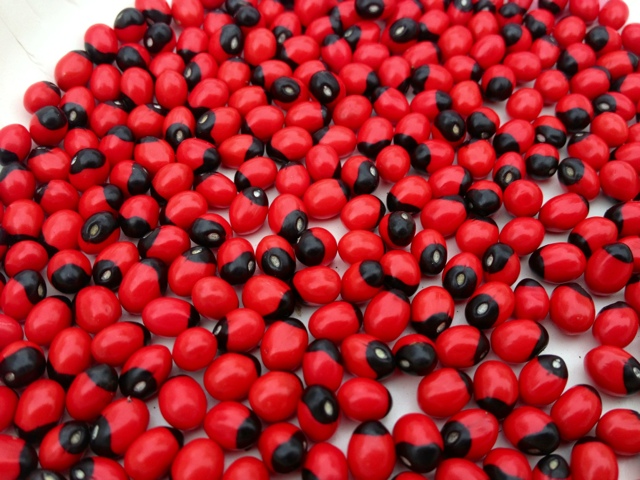
A berry, or rather a pea, and a rather poisonous one, spied on a ratty sump fence the day I arrived in Orlando. Marie asked what it was; a reader, friend, and expert in Peruvian culture suggested Ormosia coccinea and I called it a day. Yet something was nagging at me. A website stated the popular, good luck pea was the seed of a tree and my sump specimen was certainly not a tree. Although maybe it was young, maybe it suckered from so many hacks.

An image search yielded clusters of pods and peas that looked right, but of different species. Not the huayruro of Peru, but Abrus precatorius. A vine, not native, and invasive weed of Florida. That rings true -sump plants tend to be weeds.

Now I'm wondering if jewelry makers would be interested in these striking red seeds. I've already contacted Bonbon Oiseau, although peas may not fit her oeuvre. Would you wear poisonous seeds?


The Stepford Seed


Is it just me, or has someone else shuddered at the Baker Creek Seed homesteading nostalgia? The wholesome youth of its proprietors, the relentless use of their own family in marketing images, and the explosive growth of the company into nostalgia-based, thematic retail outlets coalesces into enough discomfort that I shy from buying.


I suppose there is little more American (Americana?) than this strange concoction of business, entertainment, and family. The Times mentioned the weirdness of Baker Creek a few years back, but came around by the end. In fact, I only found myself looking at their website after a link was given to them in the excellent NYTimes story on the vegetables of East New York (no weirdness there). In this article they mention the hybridizing going on in some of these gardens. And isn't that a point worth pondering? I don't see us going forward by selling backwards. In fact, although I grow mostly heirlooms now, I often drop varieties because they do not stand up to disease or are generally unproductive. Hybrids that reap the taste and texture benefits of heirlooms while improving health and vigor of the plant wouldn't be turned away by this gardener.

Finally, don't get me started on banjos, fiddles, and harmonicas at farmers' markets. I like Blue Grass as much as the next, but I don't need it with my cabbage.


The Bad Seed

The difficulty of getting garlic bulbs for seed purposes spawned my initial idea to grow enough garlic to get seed quality garlic out to Mid-Atlantic gardeners. Much of the trouble with garlic supply, I now believe, is due to the high prices farmers are asking. They are pushing the limits of their quality control in order to pull in as much as possible from this high dollar crop. Over a certain number, quality garlic is hard to handle. Additionally, there are terrible pests of garlic and since farmers can only know their own field well, when they pull  from neighboring farms to compensate for the demand, they risk spreading these pests around the country. I've gotten mostly good seed and some lousy -all at very high prices. Read on to see how this seedy saga plays out...


August 15:

The American Midwest has been struck with a garlic growing disaster. Many farms lost their entire crop. No, it wasn't the drought (although that affected many), but another weather-related problem. It's called Phytoplasma and is spread by the leafhoppers that were incredibly abundant at an earlier date than usual this year. Many seed outlets (like Seed Savers Exchange) that source from Midwestern farms have had to relay that their seed cannot be fully trusted, yet it is still offered for sale! I sourced some seed last year from a Midwestern farm. This year I did not due to spotty performance in the field.


September 22:
I received my replacement garlic tonight, in a large white, red and blue priority box. I picked it up, felt a rolling, a ba-dumping. Upon opening the box I found a single layer of newspaper covering yet another pile of loose bulbs, except, unlike the last time, this large box had considerably less bulbs so that they were free to roll around while traveling across the country. Really? I mean after the complaint and the return of 70% of my three hundred dollar order, you really just put a piece of newspaper on top and call it fixed?

Really, they did. I sorted the bulbs, pulling out the dented, bruised, nicked and gouged. Nearly 25% of them, and I also feel shorted on the weight. There may be enough customers out there, but I ordered a lot -15 pounds of high-priced garlic! And to mention that I sent the offending bulbs back at my cost after being double charged for shipping the first time. Yet all that would have been healed had they just put a little extra effort into that box traveling cross country in planes and trucks with turbulence and bumps.

So I sent another email, understanding that I'm testing the farmer's patience, stating that there was again damage, attaching some photos of said damage, and that I would be willing to pay two dollars more a pound to get my seed bulbs in perfect shape. And left it at that.

To compound the grief, I also received another order, for a similar amount from another farm out west, just yesterday. While the box was packed well and tight with newspaper and bulbs in paper bags, there was a considerable amount of gouge damage on those as well! Sharp, bias cut stems the culprit, must have happened in the warehouse or packing.

Took photos, sent them to that farmer, to which she replied today that she would make it right. Given was the very same reason provided by the other farm. Hot and dry in the barn and a newbie in the ranks. Hot and dry makes the wrappers fall off, while the newbie throws garlic around like its the cheap stuff at the grocery store.

I received seed from both these farms last year and all was perfectly well. So what's going on this year? I can't say, but here's what the second farmer did: she offered to replace five pounds of the damaged garlic even though I only lost four pounds. Yes, thank you -you're telling me that my business is important with something of value, not just words.

Meanwhile, the other farmer is now blaming it on NYC postal workers' uncharacteristic rough handling. I say, if you know (or even think) that to be the case -protect your merchandise with better packaging. I explain this in another email. The farmer says they will ship out another 2 pounds to make up for the damage that day, but also that no one has ever complained of this problem.

October 1:

I sent out an email to the above farmer because I had not yet received the replacement. Priority boxes tend to move pretty fast, and at least 10 days had past. The farmer said she had sent it long ago. I asked for a tracking number, she said there was none. The final email said she would issue a refund check. Honestly, I have no idea what is going on over there, but I get the sense that there is chaos, that the business model of garlic seed is under stress that I cannot see from my vantage point.

September 29:

After my day informing the garlic curious public about the differences in garlic at the Dumbo Arts Festival, I headed up to Saugerties to visit (for the first time) the Hudson Valley Garlic Festival. Garlic Festivals are sprouting up everywhere these days, for better or worse I cannot say. This one's been around for awhile. I thought I should check out the product and pay a visit to one of the founding members of NY's Garlic Seed Foundation, David Stern.

After attending his lecture, which provided the basics for gardeners, I made way to the GSF tent to ask some serious questions. I let them know that I was growing commercially, albeit on a small scale. My first question: how do I find garlic seed I can trust? To make this long story short, the answer was almost unequivocally -you can't. In fact, this crowd behind the table seemed at best cynical about the prospect. When I said that I bought retail-priced seed from Pacific NW growers, I was practically laughed at. Then told I shouldn't have. Most of these guys had never heard of these Pacific North Western farms. Why would they, they're in the farming business, and what farmer would spend 20 bucks a pound for seed. In fact, they're unsure about getting 9 bucks for their own garlic seed.

On their table was a book I've read, well-known as the "garlic growers bible" written by Ron Engeland. Now, I was well aware that his farm was no longer his farm, and that it was now in the hands of another owner, another nameless owner. Although this made me uneasy, I still bought nearly 45%, of my seed from this farm. After all, this is the farm that wrote the garlic grower's bible, their prices are very high, and they farm in a quarantined county of Washington State. So I pestered Mr. Stern when he emphatically stated that I should not buy from that farm in Washington. Why not? But also, hey, you've got that farm's book on your selling table!

Well, says he, that farm is sourcing from all over and you can't trust it. Their business is apples now, and by the way, what are they charging for garlic seed anyhow? What?! I wouldn't ever pay that much, and certainly not from them. So, I ask, what happened to Mr. Engeland, the author of the "bible?" He sells irrigation equipment. Oh.

Back, then, to the question of who can be trusted. I pester Mr. Stern, director of the Garlic Seed Foundation, about who to buy seed from. He answers that the foundation's website has a list of seed suppliers. I counter that it also says at the top of their pages to beware the Bloat Nematode which has been found all over New York State. So who can I trust? What about here, at the festival? I've seen lots of lousy looking garlic here and hardly a few who's product looks reputable as seed. He sent me to a couple of farms, one of which had sloppy product, and the other a farm that only sold Spanish Roja. The Roja looked decent, but the farmer said he had problems with Fusarium Wilt, the disease which happens to mimic both the symptoms and timing of Bloat Nematode.

After engaging in a long conversation with that farmer, I felt convinced enough to buy a couple of pounds, although I am shrinking away from that confidence now as I read all the agricultural extension reports about the dreaded nematode. I then visited another farmer who kindly labeled his two types of garlic as seed or table. I returned to the Garlic Seed Foundation to inquire with Mr. Stern about his attitude toward that particular farm which, incidentally, proudly displayed the logo of the Garlic Seed Foundation on his banner. Stern said he doesn't know, or is not familiar with that farm. So I mentioned that he was a member of the foundation he directs, to which he replied that this fact is meaningless, membership in his organization has no bearing on the quality of the product. Oh.

Wow. So where to go now? I went back to speak with that farmer. He, as convincing as any, said his seed was good, but no farmer would ever guarantee their garlic and neither would he. I understand this point, and I bought three pounds. Mind you, this NYS "seed" is going for $8-10 a pound, nowhere near the retail price of Pacific NW seed I find in web-based catalogues. I am beginning to separate price alone as an indicator of quality. New York farmers would like everyone to think this way, but I also sense frustration in not being able to accept selling "seed" garlic for 20 bucks a pound. In fact, they're mad about it, yet can't seem to meet whatever mysterious profile is expected in order to command those high prices. Still the nagging question -which farms can you trust for seed?

Finally, I return to the Garlic Seed Foundation one last time. I engage another farmer behind the stand about varieties and storage lengths. She said that at one time she tried to grow all the varieties, but soon after gave up and settled on the same two varieties everyone grows -Porcelain and Rocambole, but mostly Porcelain. I mentioned that I would be growing on Long Island, which has a different soil and climate profile than upstate. She asks where, and I name the farm near which I grow and the farmer who works it. At once, Mr. Stern appears and casts doubt on the whole affair: "That land has nematode," he hollars.

I let him know that the farmer informed me of the problem he had after buying seed from a Canadian source (often it is claimed that Canada was the vector for the nematode). He never indicated that there was any nematode issues on the land that I am leasing, or that it has even been farmed in the last 10 years. In fact, this farmer had told me that he recently bought seed from Mr. Stern at $9 a pound, a price he had a hard time swallowing. I started to wonder if there were issues between these two farmers, or maybe all of them.

Mr. Stern also sold seed stock to Johnny's Seeds for $9 a pound. You know them, the seed catalogue based in Maine. He seemed angry that they resold his garlic at a high price of $18 a pound. He also said he wouldn't deal with them any longer since Johnny's had knowingly distributed nematode infested seed to customers and never issued any statements to the fact. I do not know if this is true, but it's what he said.

I feel like I visited the garlic seed kitchen and found a mess. After seeing the mess, doubt has been cast on every corner of production -the soil, the seed, the integrity of farmers. Garlic's inability to produce true seed is a curse on its cultivation. With less than half my seed in my possession, and only a month to go before planting, my idea seems more speculative than ever. I've been culling out bad cloves or bulbs from all the seed I receive. Only a sharp eye and beginner's luck are in my corner now.

October 3:

I received a box of garlic from another seed source in the Pacific Northwest. Fifty percent was just what I was expecting, good-sized clean garlic. The other 50% were too small for me to call seed, and the largest among them were beginning to dessicate. They were, however, clean and undamaged. The price for 10 pounds of Spanish Roja garlic is over $205 dollars, but the bulbs look like they will not produce good sized bulbs. Meanwhile, I'm culling out the bad cloves from those sizable Roja bulbs.

October 4:

I received my replacement supply from the Pacific Northwest farmer who offered to replace 5 lbs to my 4. They far exceeded my expectations. Not only did they put in a nice note, they bagged each bundle and, this is hard to believe, individually wrapped each and every extra bulb in newspaper! But they didn't stop there -this farm offered me a bag of Romanian Red cloves to try out. This is a farm that I will continue to deal with and their prices are exactly the same as all the other farms. I will send them a warm letter.


October 6:

I unwrapped each individually-wrapped replacement bulb today and, as would be expected, each was in perfect condition with all wrappers intact. Shipping loose bulbs is never a good idea at this price. Meanwhile, I've pretty much decided that 100% of the remaining bulbs from the first farm cannot be used. They are shrinking at an incredible rate in their almost wrapper-free condition. Now I believe that they may have not been grown well since Porcelain varieties are known to store fairly long. I am now debating whether or not to eat the cost of this loss $(236) or begin emailing the farmer (who already was tired of dealing with me) that I want my money back. Not good.


I'm also waiting on new seed, the final and largest component of this year's stock, from the farm that David Stern of the Garlic Seed Foundation warned me against, but only 5 months too late to be of value.

October 9:

I am concerned about the dessication of the German Hardy bulbs, both the undamaged originals and the replacements. The damage conversation pushed this problem to the back burner, but it is still a month to go before planting and the bulbs are shrinking fast. I emailed the farm, said that I simply cannot plant these bulbs as my prior year's experience tells me these will fail in the field. I did not ask for my money back, but simply opened the door so the farmer would have the chance to offer it. That's what they did. I now have ten pounds of shrinking seed garlic to consume or toss.

Still waiting for the bulk order from Washington State.

Update: October 11

Received seed from the final source and most look good. There was physical damage to some artichoke varieties and gouges on some cloves of the Purple Stripe variety. Japanese, much sought after and sold only in limited quantities, had some moldy cloves and physical damage. I sent an email with pictures to that farm. Given the quantity of seed I ordered from this farm, the damage I consider minor.

Still waiting for a refund from the earlier farm who sent damaged bulbs multiple times.


Sizing Up Garlic


All garlic growers separate their harvested garlic into two categories: table (food) and seed. To qualify as seed stock, harvested garlic must be physically perfect with large clove and head size, show no signs of disease, mold, rot, or damage throughout the growing season and in storage. Some states regulate garlic seed stock, refusing import (e.g. Idaho) as part of disease quarantine efforts. New York State does not regulate its garlic production and has no seed stock certification process.

Table quality garlic can be as perfect as seed quality, but it is not required. Table garlic is smaller (sometimes quite small), can be found with damaged wrappers, sometimes a soft clove or two, and may have disease that does not affect its edibility. If you grow table garlic, your concerns are yield, so you will toss the obviously sick, and sell the rest. If you are a seed grower, one diseased bulb (white rot, bloat nematode) can terminate a field's seed.


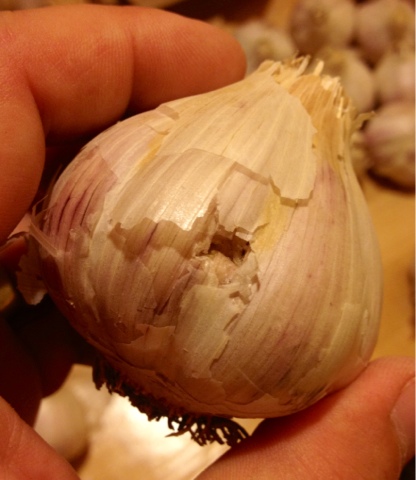
The garlic on the left is high-quality seed stock garlic purchased from Oregon, the garlic on the right is high-quality table garlic purchased at NYC Greenmarket. If you feel tempted to plant that  farmers' market garlic (it is big and beautiful after all), don't. Several of the diseases in NYS  fields will remain for years once they are introduced, and many can be hosted by any allium species in your garden.

When you buy from a farmer touting seed garlic, you enter a trust with him or her that they're honest about the health of their fields. They cannot know everything, and healthy looking garlic can harbor disease, but that farmer should be observant and resist selling anything as seed that has come from a field showing signs of the worst diseases. New seed in the field will be quarantined until it reproduces year after year with no disease. Old seed is trusted seed and a seed grower will be wary to ever run down his or her supply.


These are two seed stock quality bulbs from Washington state. Porcelain 'Georgian Crystal' on the left and Rocambole 'German Red' on the right. At 3.5 plus inches, it is arguable that these are too big. Giant bulbs have less flavor and may be more difficult to cure successfully for long storage, but no matter, you won't eat these -you'll plant them.

The best seed bulbs run from 2 to 3 inches across. Farmers' observation has long proven that the smallest bulbs and small cloves will produce weaker plants. They will grow, but less vigorously, and you will find small cloves on small bulbs at harvest time. Last autumn I planted garlic seed of the same cultivar from two different sources. One delivered medium-sized bulbs with medium-sized cloves. Another delivered giant bulbs with large cloves (the one you see above left). Both were sold as seed.

The soil and cultural conditions were consistent row to row. Yet, this image shows the difference between the two. The garlic on the left is nearly twice as large as the garlic on the right. The plants look healthier too, a deeper green with thick-stalked scapes. They are the very same cultivar grown in the very same soil -the only difference was bulb and clove size.


Germinate This


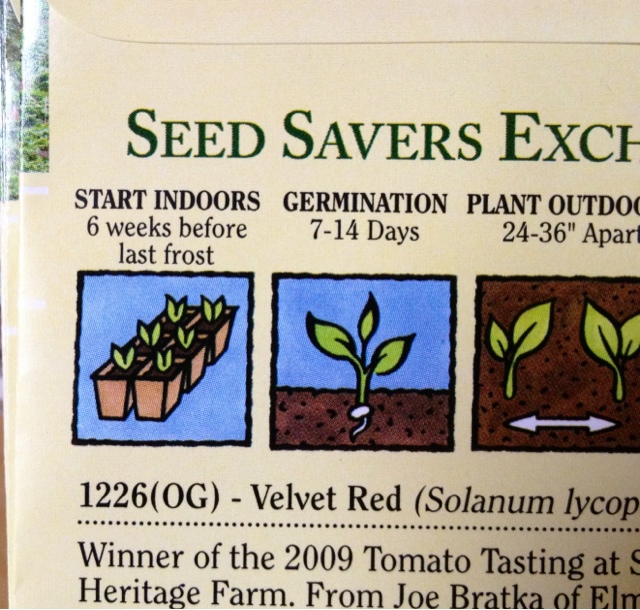
All of my seed packets for tomatoes, from several different sources, say to plant the seeds indoors 6-8 weeks before last frost. Now, this year that could hardly make any sense, but even in normal weather years, if I was to put my tomatoes in starter mix in February I would have skinny ass tomato seedlings by April Fool's Day. And yes, I would be a fool for following those instructions.


I would not plant my leggy tomato seedlings out in the garden at the beginning of April. I still go for a not completely conventional May 15 plant date depending on how the cool weather crops are fairing. When those are done, the tomatoes can replace them as late as May 30 (the old-time conventional date). They will grow rapidly with the soil activity up because it has warmed properly. Even when the air temps are warm, the soil may still be cool, and your tomatoes will languish. Same reason you shouldn't put your cucumbers seeds or pepper starts in before May 15. I'm not saying you shouldn't try, but if you're new to this, best stick with matching your seed starting dates to real world planting dates.


I will begin seeding my tomatoes this week. Meanwhile the broccoli rabe and fennel will need to be transplanted to the beach farm (where it is significantly cooler). The lettuce I got in a bit late, so those seeds are just popping up now. With warmer weather approaching, those tomatoes seeds should sprout and grow pretty rapidly in their little pots. I will have to keep them in check to hold off planting until May whatever.


Januworry


I make an effort, a rather minor one, to keep the seed tray small. Catalogues aren't as exciting when there is no room to grow. This year, I focus. Brassicas for the fall in the garlic beds. Tomatoes, tossing out the less than stellar, trying new varieties. Herbs: cilantro, basil, fennel seed (yes!), and parsley. Snap peas and cucumbers in their place. One or two eggplant.

There is no room any longer for peppers in my life. Greens? Oh, I did buy some head-forming lettuce. Where will that go? And carrots? I know what I did wrong last year, but where? Oh, yes -the bed of weed garlic! That's where the carrots can go. Vineale is pulled in late spring.

Did I say focus? I bought 5 varieties of french filet beans. Why? Something or other about outdoing myself. I've always had success with bush beans, so when someone says that filet types are too much work, I need to see for myself. Three greens, one yellow, and one purple.

But where will they go?

The orchestration, the choreography, of a small plot is no small affair. It is a complex logistics dividing space and time, condition against condition. City gardeners know this, where limitations are posed by outlying parameters, not one's will to turn more and more soil.

The seed tray holds the future, but it is the worry of January.


Yeah, It's Cold


And I've decided not to order any new seeds. Really. I want different things, but then, who am I kidding. I'll have hundreds of seeds going out of date in the coming years. So, I'll plant what I got. I did, however, get a couple of free seed packets from my irrigation supply order from Peaceful Valley Farm Supply. I requested leeks and carrots. In season, undoubtedly I will pick up some starts from one of our Brooklyn nurseries. I may even head on over to the Brooklyn Botanical Garden, after one of our many snowfalls this winter, to photograph and buy some of their many seed packets on display in the gift shop.

All in all, I am dissatisfied with the mail order/online process for seeds this year. Hmm. Either they are too highly priced (Scheepers), too complicated (Fedco) or just too slow (one site said 45 days to process orders!). I also got caught up in wondering where the seeds actually came from and whether or not I wanted seeds selected in or for a northern climate (Johnny's, Fedco).

Yep. I've got enough seeds. I'd rather spend my time doing something else. This week I plan to build a custom seed starting tray out of scrap materials at work. And dig the cold frame out from under the snow. And dream of even better irrigation.


Seeduction


I received my first seed catalog. Like clockwork. I looked through it, glancingly, overwhelmed. Already? I am not ready to think about choosing what to put in the little beach farm. Every new offering seems to be sweeter, milder, faster growing, longer fruiting, more resistant, the new standard. Ack! As if growing new vegetables wasn't enough, we must also pursue new varieties of the same old vegetables. Which, of course, we want to do, especially to replace those that didn't perform. But wait, weren't those varieties described as solid performers, good for the beginner, reliable, easy to grow, disease resistant, standard in home gardens, widely adaptable, heat-resistant and cold-tolerant? Sometimes it is hard to see these descriptions for what they are -marketing.


Bella Rosa, two seasons back.


First things first, then. What seeds do I already have? Ahh. Look at that, a whole pile of packs.

I have Kitchen Garden Seeds (Scheepers), but they do not date their packs. Yes, yes, I could've dated them, but didn't, and now I will try to germinate them. I've a bunch from past years: Black Russian, Orange Pixie, Sungold Cherry, Bella Rosa, Milano Plum -all tomatoes, then Sugar Ann Snap Peas and Salad Bush cukes. 

Black Russian, two seasons back

I've a ton of Page Organic Seed (The Page Seed Co., based in Greene, NY) packs I got for next to nothing (maybe nothing?) at J&L last fall. If it's hard to think of vegetable seeds in autumn, it surely is worth doing so if your nursery has a supply they really want to get rid of. No one wants to store seeds nor sell last year's lots. I have new packs of Brandywine, San Marzano, Roma Bean, Wax Bean, Kentucky Pole Bean, Swiss Chard, Wisconsin cukes, Bloomsdale spinach, Cherry Belle radishes and Acorn squash. On top of these, a bunch of open packs from different sources and of questionable viability.

So, what will I order new? White or yellow cukes, Pak Choi, leek, turnip, white radish, carrot, poblano and red sweet pepper. Something else? Probably, but our 122 square feet is hardly enough room for a fraction of these. I wonder if we will find a way to expand? 


2008 pea seedlings near the cold frame.


Weekly Vegetable Update


Broccoli 'Calabrese' looking good, hoping it doesn't get too warm too fast. The two largest are the over-wintered ones.


'Sugar Ann' snap peas putting out flowers now. I have to keep myself from just eating the vine!


The asian greens mix and Italian arugula have true leaves now, I've tasted them all.


Oh the tomatoes. I fish fertilized again today and do hope the burning you see isn't from the feeding. All but the 'Black Russian' tomato are overcoming the previous burn. I'm still holding out for it though. Basil 'Genovese' in there too. J & L around the corner is already selling 18 inch bush tomatoes, complete with flowers.

I must remember, because I certainly forgot, to seed the 'Salad Bush' cucumbers and cilantro 'slow-bolt (yeah, right)'.

Urban Farmer -Wasssss Dooowwwwnnn!


My tomato seedlings have been getting stockier, reaching up to the lid of the cold frame. Yesterday morning I stepped out to see that at least two of the varieties had fried tops.

When you go to the nursery, its easy to imagine that all the seedlings are all that the nurseryman started. But only the best make it to the tables and racks (if not, you just walk away, right?). At home, starting just a few seedlings, the pressure is on to get it right.


So was the culprit the cold temps two nights ago? It never got down to freezing that night and the seedlings were in the cold-frame with a bottle of warm water. Was it the diluted fish fertilizer I put on them a few days ago? Its hard to imagine that the 2-4-1 diluted liquid did them harm and why some yet not the others? The sun is getting stronger and despite low temperatures, in the cold-frame greenhouse its quite warm. The tomato tops are close to touching the polycarbonate. I suppose the culprit really was my carelessness, but I think all but one will recover.

Then there's the orange pixie problem. I started two of those in February with all the others. But they never passed an inch tall, stunted, wierd. Both fried in the cold-frame. This week a new one I seeded in a tp tube has sprouted and looks considerable healthier, although it is having trouble shaking its seed pod from its cotyledons. I've been tempted more than once to try to pull it off like a sweater stuck on its arms and head. The pixie is supposed to handle pots and planters well.
We'll see if it ever gets there.

I will move the tomato seedlings out to the ground during sunny days, cold-frame at night and rainy days. I hope I can get a good run out of my snap peas before I have to clear the way for these tomatoes!

Phyto Photo Philia

Tomato and basil seedlings inside the cold-frame.


When they sprouted, I was away in Philadelphia. It was a really warm weekend and I had plastic wrap draped over their seed beds. In 36 hours these guys were pale, leggy and curved under the plastic. My response was to get these guys out into the cold-frame as soon as possible. The bright light, occasional sunshine, and cooler night temperature kept stem length in check. They also started to develop their first set of leaves and stouter stems.


Now their stems are purpling and growing the fine hairs of maturity.


So far no sprouting of the arugula, or greens mixes. Its only been a couple of days.


Training the snap peas


I have broccoli starts in a variety of places, including these two: a perennial pot and wooden planter.


Last, but certainly not least, the over-wintered spinach. Looking good, but soon to be outnumbered by the sprouts of this spring's spinach.


I Really Should Be Working


broccoli, tomatoes, basil

When did any day become solely about mundane gardening and posting?

Today I took out the watering can. That's it then, the official beginning. A new neighbor who saw me about asked if I was planning the garden. Planning?, I questioned smugly, I've already started. Peas right there, they survived the freeze last night and a ground assault by squirrels! Oh, who do I think I am?

I planted new pea seeds into the planters today since I learned they can be grown on top of one another. Also, squirrels! So on goes the mesh.


I planted spinach seeds in the spinach planter where some spinach has over-wintered.


The broccoli that I over-wintered is starting to get stout-stemmed.


And should I want to destroy something this year, it'd be this Yew tree that puts shade on the vegetable garden. The veggies need more sun, particularly in March and September. I secretly hoped the snow would weigh this guy down to his demise.


Compromise? Landlord, please take those dead trees we call telephone poles out of the front yard and I can put the veggies there, grow enough for the neighbors to share. Then the Yew will be a welcome shade giver to an area re-designated for perennials!


Sorry, webiworld, crocus on the march!

Cloud Cover

Its late, I left work and what does the Columbus Circle CNN super screen say, oh its 37 degrees F. Hmm, seems kind of cloudy up there. Now Brooklyn, off the subway, hmm... I can see that its cloudy now. Doesn't feel that cold. Wind not much to complain about. Moon barely visible behind nature's row cover. I think its gonna be alright. 

Oh, hell. I got some plastic, just lay it over the peas. So thats what I did. But I think the clouds are staying and my intuition says no deep freeze. But I did pull in the tomato seedlings from the cold-frame. They've been living outside through the day and I pull em in at night if its going to freeze. They're toughening up this way, after their super growth spurt this past weekend on the warm windowsill.

Please Don't Freeze The Peas

Will it really freeze to 25 degrees F tomorrow night? Will the Sugar Ann Snap Peas hold up to this despicable, lone, one night, monstrous temperature drop? Shall I protect them with plastic sheets or leave them be? Oh, peas, you cause me such pains before I've even eaten you!

Oh, yes, I see the quince buds a swellin at the north end of Cadman Plaza Park. And the winter jasmine's pre-forsythia yellow blooming too.

A Pot to Pea In


I put the peas in their pots, outside, cold or not. It was chilly yesterday, cloudy, rain threatening, but I decided that if I wait too long, it will be warmer than they like. So in they went. In vegetable gardening, it is often tempting to be cautious, to fear failure because we have only one shot for getting it right this year. But really, it doesn't matter, its not like I'll starve. Its an experiment to learn, to know by doing. So in they go.


If you look closely, you can see the TP tubes under the pea plants. Apparently pea seeds like to be planted directly into the garden, but I didn't do this. In order to protect the plant while planting them, I peeled off the paper tube on the lower portion, but kept it together on the upper portion. This seemed to work out fine.


Broccoli starts have been getting bigger, all have well-developed sets of leaves. I think they will go into their planter by this weekend. Right now, however, they will remain in the cold-frame day and night. Behind you can see the failed "winter-sown" broccoli. Better luck next time. The great advantage of starting seeds in your window is that they sprout quickly and you can get a jump on the season. Winter-sown will work, but there is not much of this jump.