Garden

Breath

The breath of autumn is now well upon us. It scatters the leaves as well as my mind, and puts the quick into my step. As in life and age, autumn has a way of shifting the unimportant away. In our cold clime that first freeze can be an icy slope. One descends from warmth to frozen in a day or two. No lollygag of a New York City autumn -there is terminus.


The paper wasps have finally crawled deeply into buildings and the ants have long left the work atop their mounds. There is a grasshopper on the garage wall, but no longer in the garden. Flies find their way in as do lady beetles and what remains of the mosquito swarm has descended into the basement stairwell.  A woolly bear and a large wood spider hastened from the unfinished studio. A week ago I heard the frog's last chirp.


Last week we had our first frost, and tonight, should the skies clear, we will have our first freeze. We can now accept bringing in plants, out of sympathy for them, as we do with our pets. Will the lantana come in? Will the begonia tubers be saved? Should I unearth the rosemary and pot it?


Despite better planning, the fall vegetables have not gone as hoped. Cauliflower was a wash, and the broccoli too. Green beans just a week or two too late and nibbled. Brussels sprouts have more leaf than sprout thus far. Spring planted broccoli continues to flourish. Eggplants always do better until they just can't and I have yet to harvest the majority of potatoes.


Although it is nearing winter (it comes earlier here), there are still several outdoor projects to complete. I need to replace a porch balustrade, cedar plank the utility room landing and replace several mossy and rotted plank ends on the porch. There is a window frame to repair -it should not go another winter, but it is on the second floor and I don't prefer ladders. A brick walkway has remained a gravel trench. The gutters continue to fill with leaves -this can wait, but not beyond snowfall. Warmer temperatures are required to apply a second coat of paint to the alcove where siding, sill, and door were replaced by the height of summer. The studio has much remaining, but there is now power and today the concrete contractor is placing the insulation foam. Progress. Should I call the mudjacker for the sidewalk that cants to the house? Is there time? Is there money?


The Spoils of Summer

Now that I've figured out to successfully grow bell peppers, I tend to be at a loss for what to do with them. This means I eat them raw quite a bit. August is high season for eggplant which continues until the frost. The tomato plants have the look of late September, nearly caput, and even the fruit have taken on the scabs of blight. Below my beloved speckled roman paste tomatoes. Despite heavy blight, they still produced, if a bit more unsightly.


Garden Report

Potatoes are waning but they're still impinging on the herb bed. As the sun lowers and the potatoes die down, the herbs should reclaim their full sun. In the back left, really tall milkweed.


As the garlic comes out over the last few weeks, the fall brassicas have been filling in. These are brussel sprouts, the first planted, into the space previously occupied by garlic 'Xian.' I've never grown these before, but have planned it for years. Notable this season is a lack of cabbage moths -not complaining!


Eggplant fruit coming on now.


Green beans, from purple to roma, prolific and easy as ever.


All peppers are fruiting, some large. Only difficulty is that the plants can hardly hold their large fruit and that I shouldn't be so lazy as to try to break a pepper off the plant instead of going for the pruner. What happens? Well, I break the whole pepper plant in half.


In complete opposite of last year, all our tomatoes are suffering blight. Could have come in on our purchased compost, or maybe because we planted in last years potato and eggplant beds. Hard to avoid poor rotation in a compact garden. Next year I think these beds will be garlic and the garlic beds will be tomatoes. All that can be done now is watch the tomatoes try to outgrow the blight.


More brassica as the Porcelain garlic 'Music' has come out. As two more varieties of garlic are harvested over the weekend, even more brassica will go in. Above is kale started from seed in the greenhouse.


These giant pompoms, hydrangea actually, were moved from the south side of the house last year. We planted them in a great arc around the curving lawn-driveway. They are quite garish, but they keep the plow truck and other skiddish drivers from driving over the lawn and garden in summer and winter (thanks to the long lasting dried flower sepals), and maybe they keep the deer at bay. Maybe.


And we've finally started digging into the soil for new potatoes. Above: Kennebec russet, Pontiac, and Yukon Gold. Thanks to the quantity of compost and straw they came out with little soil and easy to clean.

I've been very busy with many things, from door and sill replacement, old deck removal, job searching and applications, studio building projects, contractors and everything I can't stand about some of them, photographing, studio painting, my class Landscape into Art which runs on the twenty third of July, a bit of socializing, gallery going, and even a music festival in a corn field last weekend. Blogging has had to take a back seat to all this (as well as taking quality photos for them), but rest assured -I was able to plant half of my milkweed over the septic drain field and beyond yesterday. Progress.


Vegetable Early June


The vegetable garden, June 4. Peas growing in the same bed with broccoli and recently planted romaine lettuce. I had so many lettuce starts that I plunked them into nearly every bed. The next bed is green beans and a spot for upcoming chard seedlings. Third row has eggplant, peppers, and a basil patch. The following two rows are Red Pearl grape tomatoes (same as last year and magnificent), five Speckled Roman paste tomato plants, and four heirloom types that includes Striped German and Brandywine and two others I cannot recall. Our starts were from Shady Acres Herb Farm or started in our own greenhouse.


The curving garlic bed is new this year (well, tilled last November). The garlic is doing well although a little tightly planted. Doing really well is the Chesnok Red -a Purple Stripe variety. This one is said to do very well but I couldn't have said that in the past.


Here are our potatoes -five varieties including russets, golds and reds. They grow several inches each day. I am about to add compost to "hill up" inside the framed bed. More garlic to the right, and French Shallots as well. To the left is our herb bed that includes basil, dill, cilantro, parsley, thyme, oregano, arugula and cutting lettuce. I'm anticipating a productive garden and feel better about its organization over last year. When the garlic is harvested around late June, early July, I will add our late summer-early fall crops of broccoli, cauliflower, brussel sprouts, and kale. In the background are cucumbers in pots, a remnant bed of dead nettle and common milkweed, and the curving hedge of hydrangea that we transplanted from the south side of the house last year.


The Growth of Things


A peaked appearance in April has transformed into very strongly growing garlic in May. What changed? I removed the rotting straw, spread blood meal, then soaked it with liquid fish dissolved in water. Scapes are beginning to form on the Asiatic strains. Looks like we will have a strong harvest this season.


 Meanwhile, the potatoes that I planted a few weeks ago have gone from this on May 27 to...


...to this on May 31. All that energy stored in those tubers, very long days of our northern latitude, and some good luck conspire to quickly grow some incredibly tall taters 'round here. To the left is the herb bed which has not been as rapid of a grower, thyme excluded. To the right, more garlic -freebies given to me by the supplier due to smallish seed bulbs they shipped to me.

Pushing Spring


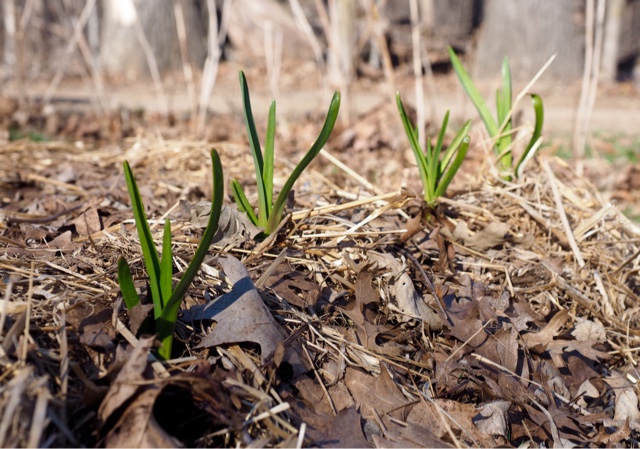
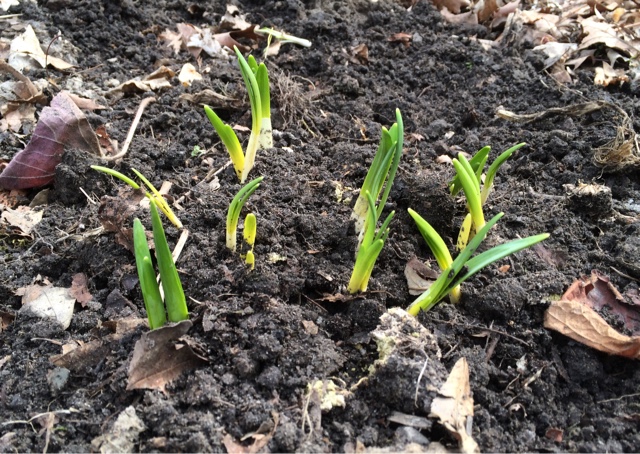
I was beginning to be concerned. After all, I planted my garlic this season just before Thanksgiving. In New York that is nothing, but here? My concern was relieved by the sudden growth pushing past the straw and leaf mulch about a week ago. Below is the Turban variety 'Xian.'


Today I have two tasks. While tending to the fire which boils down the maple sap I've collected (15 gallons so far), I am preparing the bed and laying pavers for the floor of the greenhouse. I need to get the greenhouse up as soon as possible so that I may sprout this year's milkweed seedlings inside it. 


While pounding stakes for the level lines I spotted some bulbs pushing up through the tangle of nettle. I dug them out and placed them into a new garden near the driveway. Didn't think I'd get any gardening in today, but I think this counts. And what luck,  just miles to our south, some areas received seven to ten inches of snow two days ago. 


Time, Luck and Weather


It was a couple of days before Thanksgiving and I still had not planted the garlic. In New York City and region, this would be of little concern, but here, well I was pushing it well beyond ordinary pushing it. 


The week before it had rained, really rained, so much so that our excavation had completely filled with water (a story for another day, if ever). Then, not two days later, it froze for thirty six hours ensuring that the wet earth had become a solid block. Digging was out of the question. The swimming pool, above, became an ice rink.


A week later, the Monday before Thanksgiving, temperatures were climbing, yet again above forty. And the gravel came. It kept coming until there were two hundred tons of gravel, nearly one hundred a fifty cubic yards piled inside and outside the pit. 

Meanwhile, there was garlic to be planted, the Xian Turbans were sprouting, and the cloves would need at least a few weeks without frosted earth to settle in, but what could be anticipated after such a quick, deep freeze just a week prior? I wheeled out the seldom used, 30 year-old Troybilt tiller, filled the always flat right tire with compressed air, set the throttle, lifted the choke, removed the spark plug, poured a cap-full of gasoline into the chamber, replaced and hand-tightened the spark plug, yanked on the chord, bah the the the the, repeat, and then again. Throttle off, fully tightened the spark plug, dropped the choke, throttle on, yanked the chord, then bah buh, buh, buh, buh, buh, pop, and the old Kohler engine was humming.

It wasn't easy to break the semi-frozen, wet earth, nor the lawn which floats above it. The tiller is a beast, requiring strength to maneuver, patience on turns, and knee-jerk restraint as it rockets forward when hitting solid soil. I made several passes, bottoming out at six or seven inches on the lawn's compacted clay bed. I curved these new beds to match the Hydrangea transplanted from the south side of the house to edge the boundary of the lawn and driveway, leaving just enough room for the mower to pass between.


Although our garlic grew pretty well this year, experience told me I wanted compost tilled in, but I wouldn't have anything to do with buying the bagged stuff. The city of Minneapolis collects organic yard waste, which it sells to a composting company that happens to have a site in our area. I think I paid ten dollars for what would easily be well over one hundred dollars of bagged compost. These places are worth their weight in black gold.


I tilled in about two inches of compost and made the most of tight quarters by removing any chance for walking rows (I'll regret this later). In two beds, about five feet by twelve each, I planted roughly 350 cloves, or about 3 per square foot. 


I had more cloves, of course, and tilled a row from last season's planting bed for those.


Although it was the day before Thanksgiving with much to do, I chose to make another trip to the compost facility so I could place something over the indents made when the cloves are pushed in. The soil isn't very soft or deep; I felt this could help to keep the cloves from freezing too soon. 


A light snow had fallen, which can act as an insulating layer, but more was needed.


Out back I had been saving an old hay bale that Rex had stored under the playhouse we gave away last summer. It was just the thing I needed to insulate now that temperatures were plummeting (a week later I placed even more insulation -oak leaves from the woods, and just before the next snowfall).


This is the spot the straw had been laying. Even though the ground all around was frozen three inches deep, this spot was still unfrozen.


In fact, there was a lot of unexpected activity in the heat generated by decaying straw.


Pill bugs, Armadillidiida, also known as wood lice.


And this pale sprout.


Since the week of Thanksgiving we've had more days over thirty two, some well over, than those under it. Most nights have been relatively mild, staying well above twenty eight degrees.  In a year where I've often been behind on what needs to be done and with weather the spearhead of possible defeat, I think I may have gotten lucky getting the garlic in this late.


But I'm not having any luck keeping the turkeys off the mulch.


 It seems they're quite the lovers of gardens.


The Warm Welcome


This is what I think of when I feel the chill of autumn.


Or maybe a string of pearls -the puffball, or rather the giant puffball, Calvatia gigantea, growing in the back woods among the hog peanut.


These are the things of late September and early October.


 Not basil!


 And green as can be green beans!


 Eggplant that simply won't quit.


And tomatoes that continue to produce -only now beginning to show the wilted leaf of cooler nights.


The vegetable garden here is as green as my beach farm plants were in late July. A rarity, maybe? Not the norm, say some. The coming five days are looking to be quite autumnal -blue skies, cool air, days in the lower sixties, nights in the lower forties. This should bring an end to the vegetable patch, and not a moment too soon as the garlic seed is on its way, and more front lawn needs to be tilled under. But wow, what an exquisitely long growing season.


When People Ask Where The Good Food Is


...I usually tell them its right outside.


Four heirloom tomato plants have produced more than most any I had ever planted at the beach farm.


I've been looking forward to the German Stripe, the latest to size up and ripen.


Japanese eggplant, 'Kyoto,' have been exceptionally prolific.


I put my green bean seeds in a little late, but still, they are producing now. 


Although my broccoli starts were a failure. Too late, as always.


But I was saved by this guy (sorry to say that I lost his name with a piece of paper) and Anderson Acres. You see the sign, to the left, that says start your fall garden. Yes! Getting starts together at the right time in summer is challenging given busy summer schedules and difficult weather. Hardly any garden business has starts available at this time of year, probably because there isn't much market for it. I'm so glad to have found them at the Minneapolis Farmers' Market in stall 311.


I bought a handful of these lettuce starts, broccoli, cilantro, parsley, and basil.


The fall lettuce.


Betsy's dill, the pickler that she is.


Our local hardware gave away (really, for free) many vegetable starts in July, most well past their prime. I focused on those sturdy sorts that do well in cooler weather -chard and kale. Small and weak when planted, they are now doing fantastic. We eat them every day.


A four pack of heirloom peppers from Shady Acres (whose stall Anderson Acres occupied at the farmers' market) has become quite a bounty of peppers. I've never had such luck. One plant has eight large peppers!


And they're beginning to turn red.


Of course, there are still tomatoes ripening.


These "cherry," or is it "grape," have been fantastic. The name I believe is 'Juliet' -a little sweet, little tart, and meaty -that is the key for me. I do not like watery small tomatoes that pop when you bite into them or crack after heavy rains. These I pick and eat right there in the garden.


With more to come.


The woods has not produced its usual bounty this year, except for the morels early on. Maybe we've missed them, having been so busy with work on the house and field. Of course, we'll keep looking.


The Notions


This is what a beginning garden looks like. A few old farm implements, an older garden overcome by the shade of growing trees, a tub of transplants waiting for human inspiration, a lawn overrun by creeping charlie, and a trio of notions about how things will come together in the future. The notions: grandma's tea, seaside goldenrod, and Heuchera of Brooklyn.


The Headwaters


Driven to rise early by force of street sweeping law, I headed south to my old place on Friel to see how things have held up. Little has changed in our old building. Still the disrepair and blandness, but now less a garden. 

In autumn of two thousand two this was the sunniest, most pleasant of all the apartment wrecks I had seen in several Brooklyn neighborhoods. I had never considered living in, where? -Kensington? Behind a chain link fence, under the blazing hot sun, there were telephone poles stacked in what would later become the garden.

With the arrival of three Russian Zelkova, sun had been replaced by shade -the light loving garden I had planted then stretched beyond its limit. Change was a force, plants groped for light or gave up, and when we chose to move, some of these plants were boxed for transport on a plane and a few others went to friends. I assume that the rest met a dark end by glyphosate.


The corner piece of a neighborhood has returned fully to the weeds, excepting a few daylily and phlox -stalwarts of the brown brick wall. Gardening is presence. We assert ourselves with the language of plants. For my old neighbors my presence is still felt, now in absence of flowers and a plethora of ailanthus, smartweed, and poke.


_________________


Having made a quick peace with the old place, I moved on down Coney Island Avenue, Avenue J, Bedford Avenue, and the Belt, over the Gil Hodges to Fort Tilden, the beach.


To my eye, beach farm neighbor, Jimmy, has taken over the old plot. This pleases me. Jimmy's a good gardener, fun, conversational, and present.


 It is reassuring that the neighboring plot, adjacent to the west, is still as weedy as always.


And that Wolf has continued on with his tomatoes.


I was charmed by the sight of my old garlic signs used as stakes to support new beds.


______________________


At the moment I have the sensation that this is all I miss of New York City -the ocean, its sandy buffer, the dunes and the salt-enduring flora.


I stood, I sat, for about an hour, alone, but for the gulls.


_____________________


I was reminded at Tilden that I wanted to bring Seaside Goldenrod back to Minnesota, yet I didn't want to risk taking a plant from the sandy roadside of Rockaway Point Blvd -outside the park (but why chance it). I headed to Red Hook, where the cracked asphalt streets and sidewalks can yield many clumps of S. sempervirens.


I found this cluster on a trashy, industrial block, growing below a security cam and above the asphalt. I grabbed my shovel and scraped its roots from the pavement.

I've grown one Seaside Goldenrod, pulled from a Red Hook pier, in my Friel Place garden. It did okay, suffering from an orange rust each year until, finally, it did not return under the shade of the new street trees. Of course, I like it for its air of the beach, its flowers well-loved by bees, and especially because I thought it may do well in a garden covered by sidewalk-salt laden snow.

I do not know how tolerant of cold it will be, after all it is a seaside plant, but indications are that it is growing along the Great Lakes. I am saddened to see it is listed as a non-regulated invasive species in states like Wisconsin and Indiana. Apparently it is making inroads along our salt-encrusted highways. Could it be that a coastal native is problematic, as much so as a day lily, queen anne's lace, and all the others along highways that are among the most highly "disturbed" sites we have? Am I at the forefront of an invasive wave of Solidago sempervirens? Will it be my fault?

In a case like this, I choose a source that supports my endeavor. From the USDA:
"Nevertheless, because seaside goldenrod has a moderate growth rate, a shorter life span than other Solidago spp., a limited ability to spread through seed, and produces seedlings with low vigor, it is not considered an invasive plant."

Additionally:
"It increases the value of wildlife habitat by providing food and shelter for butterflies, birds, and small mammals. The migrating monarch butterfly uses seaside goldenrod as one of its primary food sources in the fall."

This adaptive plant has the potential to spread itself along the corridors of our own ruination. It also provides an excellent bit of habitat in the difficult, salty locations we've demanded. I have attempted to walk the garden plant/native plant tightrope over the years and it appears that Seaside Goldenrod in a Minnesota garden is the net I fall into. A condition of native is always where one chooses to draw the line. At one end is purity (and Michael Pollan's take on nativism's racial and nationalist ideology) and the other end chaos (and the destruction of the beauty we perceive within ecosystems).


Solidago sempervirens, bagged and ready.


The Transplant


There is a patch between the curving drive and the yard, on the north side, where Rex's dogs used to reside. The dogs, Trixie and Elmo, passed away years ago. Last autumn, Betsy flew out of LaGuardia with a box of bulbs, roots, stolons, and rhizomes in her carry-on. She planted them here, among the old dog pens. This spring we sold the chain link pens to a woman tending goats, or was it pigs? 


As it turns out, this is a very prolific location, maybe the most fertile in the yard. The plants that grow here are a hodge podge of Lamium, Creeping Charlie, Jewelweed, Milkweed, Bellflower, Virginia Wetleaf, and smattering of Lambsquarters, clover, grasses, and other weeds. These surround the remaining dog house, one that is hard to part with because it was so lovingly crafted to resemble the human house it shared land with at Rex's old place.


This is the canopy of a single Jewelweed, Impatiens capensis.  I say canopy because it is built like a tree and is beginning to shade out the transplants.


Just look at the size of that stem, maybe three or four inches in circumference. To the right is a Maximilian sunflower, Helianthus maximiliani, carried to Brooklyn from southern New Mexico, and now to Minnesota. To the left is one of two Bleeding Hearts, Dicentra eximia, holding their own under the shade of the giant Jewelweed.


I'm happy to see what I know is an aster growing among the Milkweed, but I cannot tell if it is the weakly growing Anna Potschke or the more aggressive New York Aster. I'll take either, but would love to see Potschke do well here since it suffered so much in Brooklyn.


The Milkweed, Asclepias syriaca, grows strong here and like common Milkweeds everywhere, it appears rather randomly wherever it prefers. I suppose that's what makes it a weed to the farmer or landscaper. I hope gardeners appreciate it. I've seen some spectacular specimens in yards here -they are quite sculptural, exerting considerable presence. We are planning on a wildflower meadow over the septic drain field and will likely transplant some of these to that location.


Each lily transported from Brooklyn have made this home. They are all doing quite well, as they had in Brooklyn (people's sticky or damaging fingers aside). I may miss the bloom, or part of it, as I will be away in New York City for a presentation in late July and then in Vermont for the first part of August teaching my course Landscape Into Art.

When I am there I will pot up some rather large specimens that could not be, nor should have been, crammed into a box. Roots trimmed, watered heartily, I will leave them for the week while I am in Vermont, and then, on my return to Brooklyn, pick them up for the return trip to Minnesota. I do not look forward to this drive, haven't for years now, but the plants, their care, and the stowaway creatures that will make the van a home for the trip will make it a more interesting ride.


Our Vegetables

My attitude about garlic growing is considerably more casual than in previous years. So far these varieties have shown excellent progress without more than a dose of blood meal and liquid fish fertilizer. The French grey shallots have done exceedingly well with little maintenance but the occasional weeding.


In fact, since the top photo was taken, they have lodged -meaning it is near to harvest and hardly any different from the time frame of my 2012 upstate New York growing experiment. These will be cured on the porch.


Very few interesting things going on with the garlic. They are taller, lankier than my Long Island grown garlic, although these were planted from my own LI grown heads. Each variety made the transition, so far, from coastal New York to Minnesota pretty well. There has been one interesting thing -the strange appearance of dead flies on some of the leaf tips.


They seem glued in place. Has another creature done this? Saving them for later? Or has the garlic done them in? No answers, yet.


About a month and a half ago I planted potatoes. They appear to be doing exceptionally well, with each rain adding another few inches in the last three weeks. No Colorado Potato Beetles yet and I can't keep enough soil on hand to mound up!

Of course, we put tomatoes, peppers, and eggplant in two weeks back. They were planted in 14-inch wide strips tilled into the front lawn -the only place sunny enough for vegetables. So far no creature has come to eat. I'm wary of adding green beans knowing how well rabbits take to those tender seedlings. Deer have not browsed, although we do have a resident raccoon living in a big, old maple in the woods about 75 feet from the garden. So far she's only been good for digging up a single, just-planted spud and harassing Betsy by tipping over her newly planted coleus.


The Bad Bath

We're not much for bird baths and although usually filled with rain water, I can't say I've ever seen a bird washing up. I'm going to hazard the assumption that bird baths are a thing out of drier climates. Out of place here and with a swath of moss removed to plant ferns given to us by our neighbor, I reinvented the bath as dish of moss.


Gardening at the Boundary


That day, maybe a week ago, it really came down.


I know nothing about late spring snow. Nothing. When I was a child, in New York, it snowed during our Easter break -it was early April. The day prior was warm, even the day it snowed it was warm, so much so that I was out riding my bike in the street with my brother. Although it was cloudy, the big, wet flake snow came without warning.


This snowfall is different, intermittent pellets and flakes. It was windy too, driving the pellets hard. As is often the case, the snow did not stick. The snow was not the trouble at all. It was the cold that presented itself the following night. 


I woke to find a frost on the little wetland.


 Crystals coated all the leafed out, saturated-looking plants in the early sun.


The parsley I had just planted showed crystallization along its veins (interesting that this happens, no?).


The  cilantro.


The Virginia Wetleaf succumbed (but recovered) to the eight or so hours well below freezing.

____________________

The last frost date for our location is roughly May twenty. I do not think anyone would suggest that the last two months have had ordinary temperatures, we haven't. Since March, we have had days that topped out at 10ºF and 82ºF, although most have been in the forties through the sixties. Our March monthly average high temperature was nearly 46ºF and the April average so far is 59ºF. Daytime temperatures have long suggested I should be growing things that California is having trouble providing. Think twice. I watch the trees and the vegetable gardens. Only this week are the oaks beginning to show the chartreuse of spring and there has been zero garden activity.

Warm air masses, heated by their descent from the Rockies and Great Plains, move in from the south and west, and locally there is sunlight warming the thermal mass of land without the cooling influence of great bodies of water. The day warms nicely. At night, however, without the moderating influence of clouds, radiational cooling is strong. I recall a typical temperature differential in NYC to be about 15 degrees. Here, in Minnesota, I have seen 20+ as the norm. Beyond nightly cooling, there is always the threat of a cold airmass coming down from the north whenever the jet stream decides to do something funky. Minnesota is the common entry point for cold air, it is the reason people think this state is cold. 


Which brings me to another weather detail. I noticed the window box of just planted pansies was bone dry. What? I had watered it in, deeply, just the day before. Hmm. Something unusual had happened -dry air, exceptionally dry air. Two days after the snowfall, and the day of the overnight freeze, our relative humidity had dropped to 12%, twelve percent! Our dewpoint was nearly 1ºF by the late afternoon. Meanwhile, our high temperature was 55ºF and the winds were up. The water simply evaporated. Despite this, the pansies toughed out the freeze and drought, as those in the pot above attest.


The dry air, the sudden cold from the north, the high temperatures, the wind, no rain, and of course, heavy rain are all typical. We live at a climactic boundary with little to moderate each influence. This is the education of a gardener.


What's Old Is New


One of my present tasks is to attend to thousands of well-kept magazines that my father-in-law left behind: National Geographic from 1918 onward, Life from the beginning to the end, Scientific American from the 1950s onward, Sky and Telescope from then to now, and so on and on. Among these larger lots are a handful of Organic Gardening magazines. Would any of you, readers and gardeners, be interested in one of a handful of lots of Organic Gardening magazine? Here's my pitch:

Old magazines are full of old printing techniques, laughable fashions, advertising with crude, unmerchantable copy, and outdated storylines. However, printing and fashions aside, Organic Gardening is 99.5 percent as fresh today as it was the year it was published. In fact, I leafed through one Rodale Press magazine from the 1940s the other day and was surprised to see the same problems and solutions printed then as you would see today (except their less than thorough take on sewage sludge as a fertilizer). Sure, the hybrid varieties touted then as an improvement may now be thirty years old, but the growing information is solid and the text is short and to the point. It's great to see articles on wild plant foraging, native plant gardening, chicken-raising, pickling, and all the other how-to know-how OG was known for back in the day that is de rigueur today.

Organic Gardening was printed as a half-sized edition of 8 x 5.5 inches. The paper used is nearly newsprint and yellowing from age, although each copy is fully bound and complete. You may notice the musty smell of an old magazine boxed in an old house -it's part of the charm. If you are interested in obtaining a year of OG, drop me a comment and email: nycgarden@gmail.com. It'll only cost you the shipping (USPS, flat rate).


_______________________

On March 1, 2015 I will discontinue posting on NYCGarden. You can continue to read new posts here.


Two Kinds Of Night


In the dim and deep grey-blue of early morning I saw the beast ambling along the tree line and thought myself silly for thinking two people could be running out there. Six points, eight? I flicked on the light, startling the animal then twisting its neck backward and up to come to terms with the sudden contrast. We stood absolutely still for a minute, then I turned out the light. He trotted across the creaking snow and I laid back in bed to wait out the last half hour before the four-thirty alarm.


Arriving home after two hours of airport, three hours of airplane, two hours of subway, and nine-point-five hours of work, under the red-yellow street lamps, a temperature fixed above fifty, a coat unnecessarily heavy for coastal, Mid-Atlantic December, I surveyed the garden. A rescue had taken place; a reader, a Hudson Clove customer, Toby, had come at some point to do the digging, the bagging, the carrying, and replanting in a new garden and I thought, good, one less thing.

I have since extracted the climber rose, climbing hydrangea, and my grandmother's tea, all hastily spaded and ripped from the earth, delivered to their temporary garden in Williamsburg, but not without acknowledging the irony of saving on the purchase of new plants by driving 2500 miles to attempt their relocation.

There are still several plants in the garden and they are free for the taking. Email me: nycgarden@gmail.com.