michael pollan

The Headwaters


Driven to rise early by force of street sweeping law, I headed south to my old place on Friel to see how things have held up. Little has changed in our old building. Still the disrepair and blandness, but now less a garden. 

In autumn of two thousand two this was the sunniest, most pleasant of all the apartment wrecks I had seen in several Brooklyn neighborhoods. I had never considered living in, where? -Kensington? Behind a chain link fence, under the blazing hot sun, there were telephone poles stacked in what would later become the garden.

With the arrival of three Russian Zelkova, sun had been replaced by shade -the light loving garden I had planted then stretched beyond its limit. Change was a force, plants groped for light or gave up, and when we chose to move, some of these plants were boxed for transport on a plane and a few others went to friends. I assume that the rest met a dark end by glyphosate.


The corner piece of a neighborhood has returned fully to the weeds, excepting a few daylily and phlox -stalwarts of the brown brick wall. Gardening is presence. We assert ourselves with the language of plants. For my old neighbors my presence is still felt, now in absence of flowers and a plethora of ailanthus, smartweed, and poke.


_________________


Having made a quick peace with the old place, I moved on down Coney Island Avenue, Avenue J, Bedford Avenue, and the Belt, over the Gil Hodges to Fort Tilden, the beach.


To my eye, beach farm neighbor, Jimmy, has taken over the old plot. This pleases me. Jimmy's a good gardener, fun, conversational, and present.


 It is reassuring that the neighboring plot, adjacent to the west, is still as weedy as always.


And that Wolf has continued on with his tomatoes.


I was charmed by the sight of my old garlic signs used as stakes to support new beds.


______________________


At the moment I have the sensation that this is all I miss of New York City -the ocean, its sandy buffer, the dunes and the salt-enduring flora.


I stood, I sat, for about an hour, alone, but for the gulls.


_____________________


I was reminded at Tilden that I wanted to bring Seaside Goldenrod back to Minnesota, yet I didn't want to risk taking a plant from the sandy roadside of Rockaway Point Blvd -outside the park (but why chance it). I headed to Red Hook, where the cracked asphalt streets and sidewalks can yield many clumps of S. sempervirens.


I found this cluster on a trashy, industrial block, growing below a security cam and above the asphalt. I grabbed my shovel and scraped its roots from the pavement.

I've grown one Seaside Goldenrod, pulled from a Red Hook pier, in my Friel Place garden. It did okay, suffering from an orange rust each year until, finally, it did not return under the shade of the new street trees. Of course, I like it for its air of the beach, its flowers well-loved by bees, and especially because I thought it may do well in a garden covered by sidewalk-salt laden snow.

I do not know how tolerant of cold it will be, after all it is a seaside plant, but indications are that it is growing along the Great Lakes. I am saddened to see it is listed as a non-regulated invasive species in states like Wisconsin and Indiana. Apparently it is making inroads along our salt-encrusted highways. Could it be that a coastal native is problematic, as much so as a day lily, queen anne's lace, and all the others along highways that are among the most highly "disturbed" sites we have? Am I at the forefront of an invasive wave of Solidago sempervirens? Will it be my fault?

In a case like this, I choose a source that supports my endeavor. From the USDA:
"Nevertheless, because seaside goldenrod has a moderate growth rate, a shorter life span than other Solidago spp., a limited ability to spread through seed, and produces seedlings with low vigor, it is not considered an invasive plant."

Additionally:
"It increases the value of wildlife habitat by providing food and shelter for butterflies, birds, and small mammals. The migrating monarch butterfly uses seaside goldenrod as one of its primary food sources in the fall."

This adaptive plant has the potential to spread itself along the corridors of our own ruination. It also provides an excellent bit of habitat in the difficult, salty locations we've demanded. I have attempted to walk the garden plant/native plant tightrope over the years and it appears that Seaside Goldenrod in a Minnesota garden is the net I fall into. A condition of native is always where one chooses to draw the line. At one end is purity (and Michael Pollan's take on nativism's racial and nationalist ideology) and the other end chaos (and the destruction of the beauty we perceive within ecosystems).


Solidago sempervirens, bagged and ready.


Cardinal Matters


I never did post the cardinal flower images from my Carmans River trip last August, so this post from my other blog will do double duty today. Minnesotan wetlands do not get the attention they deserve, certainly not from NewYorkers (how could we know?). I've hardly delved into their living beauty, but in short...


I'm well aware of the disdain (see Garden Rant) and the rhetoric (see Michael Pollan) around native plants, ecosystems, and plants termed 'invasive'. I've tried to understand both positions over the years.

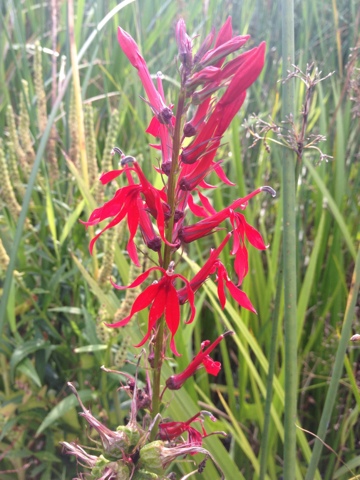
As I look upon this cardinal flower, Lobelia cardinalis, I immediately, emotionally respond to its presence. I wonder if I'm the only one who has noticed this stand amongst the grass and cattails.

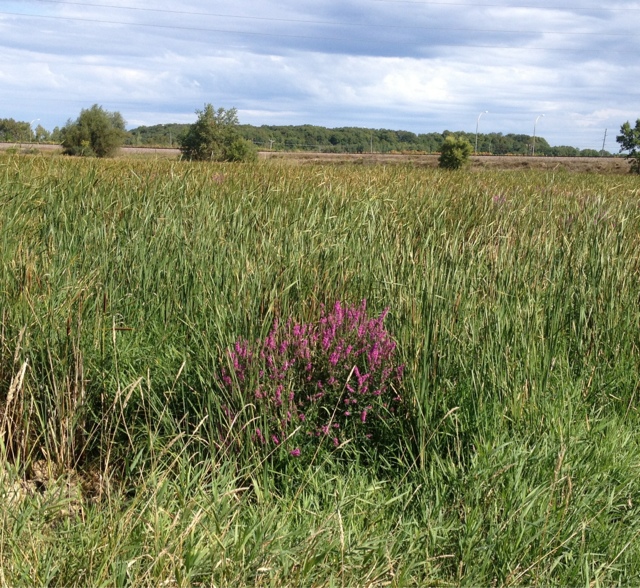
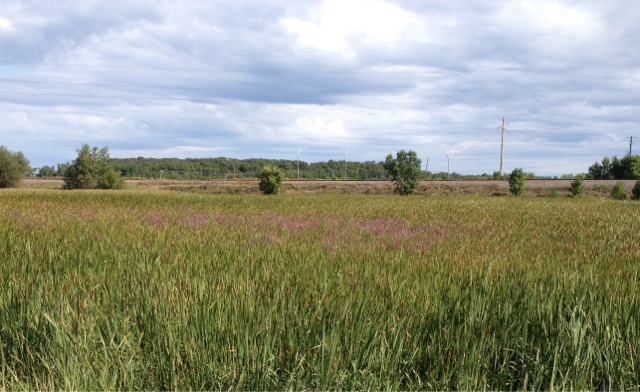
On the other hand is purple loosestrife, Lythrum salicaria. It's pale purple wands are pretty, especially so en masse, which is often how one finds it, but hardly stunning. Is this a learned response? If purple loosestrife was a native plant, would I espouse it's regal nature?

I do not know. What I do know is that seeing cardinal flower marsh-side is rare, yet finding purple loosestrife is becoming exceedingly common in Hennepin County ditches, wetlands, and cloverleaf water basins.

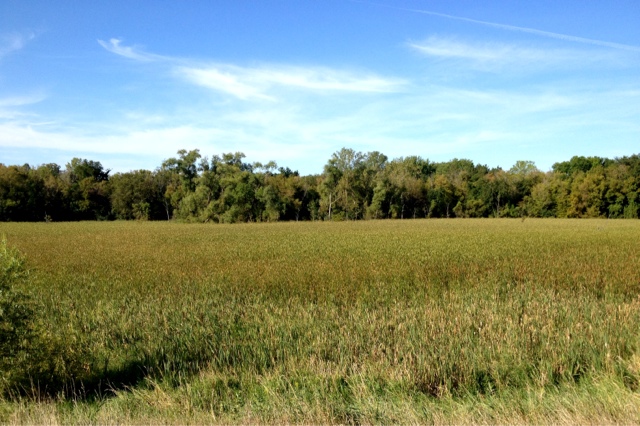
Rex likes the purple loosestrife, he says it's pretty where the marsh is just a wash of green. He believes the loosestrife cannot outcompete the cattails and rushes. But I doubt that, as evidenced by New York State's marshes and wetlands. Those must have once looked like Minnesota's, but now many are nearly a monoculture of purple loosestrife. After bloom in July and August, the wetland becomes a wash of dismal brown, whereas Hennepin County wetlands offer a kaleidoscopic interference of green and gold.

I'm not sure people care all that much. Like Rex said, loosestrife is pretty, and it's spread appears incremental, hardly noticeable. Minnesota government has policy, it is labeled invasive, it is illegal to harbor it on private property (this is where tongues tingle with politi-lingual fascism). Yet maybe, maybe, an appreciation for rarified things in life is an elitist affair. And maybe humanity has a thing for the strong, aggressive, and adaptable.

Maybe.


The Sovereign Nation of Broccoli or Let Them Eat McDonalds


Last night a friend called me, inviting me to Beaver St. to what seemed like a secret rendezvous of people discussing their food sovereignty action plan. The panel of 5 focused primarily on urban farms and gardens, a bit about GMOs and town hall discussions, and touched on healthy food scarcity. I didn't learn much new at this event, but then each panelist was limited to only 10 minutes of introduction to themselves and what they do.

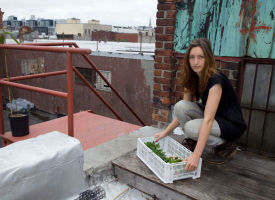
Annie Novak, operator of Rooftop Farms in Greenpoint, was on the panel. My friend whispered to me that she was rated as the hottest organic farmer by Huffington Post readers, beating out First Lady Michelle Obama. Looked it up this morning, and there it was.


#1

#2

#3


#1

#2

#3

Not that that has anything to do with food justice or sovereignty.

Bilen Berhanu, the outreach coordinator for Greenthumb, spoke most interestingly, but briefly, about her years as an Ethiopian child in a major city,  where she first learned of the bloated, hungry bellies of Ethiopian children on tv, via LiveAid!  Ben Grosscup, event organizer and fundraiser for the Northeast Organic Farming Association, or NOFA, spoke about organizing town hall meetings where communities can discuss and create non-binding resolutions on things like banning genetically-engineered vegetable seeds in their towns and whether or not farmers should have a say in the direction of agricultural science. Another speaker, who I will call Ms. Leiner because I cannot recall her first name, came from the south Bronx, which she described, tongue in cheek, as SoBro. Her perspective was from the ground up, activism, fighting to empower the citizens of her neighborhood. For her, capitalism is the problem (along with systemic racism), and this could have been a point of contention amongst the group's participants had they had a chance to argue.

For instance, Ms. Novak is participating in a capital-intensive food project -any rooftop is an excellent flat and sunny locale in these here boroughs, but access to them is a privilege in most circumstances. It takes social privilege or organizational prowess (capital) to gain access and the legal permissions to use this resource. On the street level, we have rubble strewn lots, fenced by chain-link and razor wire, with no obvious contact information should someone have the initiative to plant a vegetable garden. Owners and possible gardeners live in different communities, often have class barriers between them, and different ideas about social justice. Beyond these simple classifications, access and empowerment appears complicated by a large number of factors. The question remains, how do we provide the same quality of food for all people? After the panel, I didn't feel any closer to an answer.

A woman in the audience made a good point about farm land in what she termed "the global south." She said how the disenfranchised have lost the best farming land to corporations who now use that land with intensive practices, shipping all the produce to places like the United States. Our need for low-cost produce has helped prop up social systems where people cannot grow their own food in their own countries. Adding that growing one's own food is one major way to alleviate this social disaster.

This morning I received an email from Christina, who authors Bowsprite: a New York Harbor Sketchbook, and coincidentally, it was all about her visit to hear Michael Pollan speak about his new book, Food Rules (incidentally, I wonder if this will be his last on food for awhile). Anyhow, I put some of the points from the talk below:


I wrote out some points of the lecture for a friend who was working on a tug and could not be there. Just thought I'd send it to you because some of it is funny!

from Michael Pollan's "Food Rules" : 

Don't eat food your grandmother wouldn't recognize: that plastic tube of Gogurt, is it food? is it toothpaste?
Don't eat food that doesn't rot. The bugs want it for a reason!
Avoid food advertised on TV.
Eat food cooked only by human beings, not corporations.
"Who do you know who cooks with high-fructose corn syrup?"

Don't eat food prepared by humans who have to wear a surgical cap.
Eat it if it is a plant, not if it came from a plant.
If it is passed through the window of your car, it's not food.
Don't eat it if it is called the same thing in all languages.
Don't eat cereal if it changes the color of the milk.
Pay more, eat less (as grandmother says, "better to pay the grocer than the dr")
If you're not hungry enough to eat an apple, you're not hungry! (this one made me really laugh)

The banquet is in the first bite (also known as the Law of Diminishing Marginal Utility to those in finance). Eating more gives you more calories, not more pleasure.

Spend as much time eating as it took to prepare the meal.
Rule #55: eat meals. It's so obvious, but it's so hard. People eat bkfast, lunch, dinner, and the 4th meal that lasts all day: snacking. Cut on snacking, eat sit-down meals. Studies found 1/5 of young adults' meals are eaten in the car.

Don't get your fuel from the same place as your car. They are processed corn stations.

Cook. Corporations can never cook as well as you, even if you do not cook well.

Christina asked what I thought of Window Farms. I checked out their website and my initial thought is, "please don't call these farms, at best -gardens." Windows in many apartment buildings and houses are terrible for growing for a variety of reasons. I'll list a few:
  • Light is not constant, and its intensity reduced
  • Temperature near the glass is often too hot or too cold and drafty
  • Poor air circulation often leads to diseased plants
A key photo on their home page is the hanging apparatus in a greenhouse window, which is an entirely different environment from a home.

Another organization Christina mentioned was Growing Power, Inc., which I have heard of and have been inspired by their work. Will Allen, the CEO, recently won a Mac Arthur Fellowship (the genius prize). He's made this transformation look easy!

The battle over food wages on...


99.44 Picturesque or Notes On Michael Pollan's "Against Nativism"


Below is an excerpt from the 1994 NY Times Magazine article by Michael Pollan on the subject of the native landscape movement. I came across it in a comment by Susan Harris of Garden Rant under the post Pollan Takes On The Great American Lawn. Although Pollan's article goes on to describe other complications (xenophobia) of the nativist movement, he also touches on some aesthetic themes I've been thinking about for some time, and my focus here is on these.

The quote:

"Environmental pretensions aside, the esthetic of the natural garden would appear to represent an extreme version of the 18th-century picturesque-gardening style, which was the first to maintain that gardens should closely resemble "natural landscapes." It turned out, though, that the natural landscape the picturesque designers strove to emulate was one they found not in nature but in the 17th-century landscape paintings of Claude Lorrain and Nicolas Poussin. Although today's neopicturesque garden designers claim to be emulating actual natural habitats, they too seem to rely on an artistic model. Instead of landscape painting, however, these gardens aspire to the condition of a contemporary nature photograph, an Eliot Porter, say, or an Ansel Adams. Whenever I visit a natural garden I can't help thinking I've walked into the pages of a Sierra Club calendar."

The first "natural picturesque" landscape design that comes to this Brooklyner's mind after reading the above quote is Prospect Park in Brooklyn, NY. When I look at Prospect Park, designed by Olmsted/Vaux, I see emulation of the picturesque, in this case its the picturesque, trancedentalist realism of the Hudson River School style, an American offshoot of the European, largely English, picturesque. Vaux was English, Olmsted had studied in Europe, both well known to Andrew Jackson Downing, the son of a horticulturalist and progenitor of the Hudson Valley's Romantic-Picturesque architectural style out of Newburgh, NY. All three would have been well acquainted with the work of the Hudson River landscape painters. Inherent in the work of all these 19th century landscape practitioners are romantic elements that I cannot ferret out of new native landscape design.

Fallkill Falls, Prospect Park


Kindred Spirits by Asher Durand, 1849

In defense of Pollan's assessment, I hazard that one reason landscape projects of so many current day "natural" garden designs resemble picturesque forms is that most suburban, domestic landscapes already emulate that form. Designers retool the familiar formal structure with meadow instead of lawn and native woodland understory plants instead of the typical azaleas and pachysandra.

Maybe today's natural gardens are not at all "neopicturesque" as tagged by Pollan, but instead are neo-realist. It was the Realist painters of the 19th century that imagined what was actually there, as opposed to artful conventions and idyllic representation. Of course, Realism was not at all real or virtuous, yet the pretense disturbed many taste-makers, artists, and critics. It was also no coincidence that this realist painting rose alongside, and was influenced by, the invention of photography.

Gustave Courbet's Young Ladies of the Village, 1852


 Asher B. Durand's Interior of a Wood, 1850

In the words of Kenneth Clarke, landscape painting "was the chief artistic creation of the 19th century," but the burgeoning process and product of photography (see William Henry Jackson) began a process that eventually pushed painting away from verisimilitude. By the time we see the work of the photographer Ansel Adams, 1902-1984, we see that 19th century romantic landscape eulogized in the stone monuments of the American West. Eliot Porter, 1901–1990, strikes me somewhat like J.J. Audubon with a camera -his interest was almost taxonomical. Pollan is correct to see in Porter's photographs a dialogue with our current conception of landscape "naturalism" because taxonomy is necessarily put into the service of ecology. What Pollan rejects is the photographic conventions represented by the work of Porter or Adams as a model for designing parks and gardens. More precisely, he rejects the notion that our relation to nature as represented by gardens should be mediated by pictures at all. The garden, itself, is the mediating space.


Gates of the Valley
Ansel Adams' Gates of the Valley, 1938


Book cover of Eliot Porter, 1987

Photography supplanted painting as the choice medium of landscape imagery in the 20th century, but for many photographers the beauty of natural scenery became all too common and suspect -as did the photograph as a means of representing truth. New themes in landscape photography rose out of this: human changes to the landscape, machines in the garden, the overwhelming tide of waste and spoil, beauty and the brown field, and the mundane. Photographers who come to mind are Robert Adams (b. 1937) and New Topographics, Mark Klett (b. 1942) and the Rephotographic Project, Robert Glenn Ketchum (b. 1947), Richard Misrach (b. 1949), Edward Burtynsky (b. 1955), and many others.

If designing "natural" landscapes has been shaped by 20th century photography, then what of the work of these mid-late century photographers? They turn the American wilderness and Old World pastoral conventions on its head, but where does that leave landscape architects and garden designers? After all, they need to create landscapes that attempt resolve the crisis highlighted in the work of these photographers without resorting to old forms.

For many, the ecological restoration landscape -a landscape garden version of the photographic "realism" alluded to in Pollan's essay, has been the answer. Ecological parks and gardens, landscapes of verisimilitude, are a reaction to the conception of a spoiled landscape. I am not as sour on this movement as Michael Pollan may be (or was in 1994). It offers a new motivation for developing new parks in and around our cities. If our conception of urban parks was only 19th century picturesque strolling (Central Park) or 20th century athletic leisure (countless athletic fields, Flushing Meadows-Corona Park), we would find it hard to develop new parks within the limits of available urban land. Ecological-restoration offers motivation for the building of new parks in niches previously undesirable for park development.

There are fifty-one Forever Wild parks throughout New York City. Although NYC Parks chooses to call these "preserves," most are anything but that. These parks are created or "restored" out of spoiled but not yet "developed" regions in each borough. A majority of these parks are on the waterfront, an outgrowth of the decline in commercial shoreline activity, the public enjoyment of water, and a concern for sea level rise and storm surge attenuation. Consider the possibility that a park can function for the public outside of the context of individual or group pleasure, as a protective formation for the public good that also happens to provide habitat for migrating species, strolling, and ecological awareness.

Yet, we shouldn't fool ourselves into thinking we're about to restore nature to a "pure" state in any park. Restoration gardens and parks are created out of a set of intellectual and financial limitations and should only be taken on with humility. Added to the garden is an understanding of our role in changing ecosystems and an awareness of the value of the system to our own needs, beyond accepted forms of aesthetic pleasure.


This Garlic Was Made for You and Me

Have you noticed that our garlic has been grown in China. You will find it at the grocery store, or the corner market, or at the pizza place in boxes labeled "peeled garlic." I guess I have been eating it for awhile. My complaint is that it seems ridiculous to get garlic from China, and by that I mean everyone's garlic -not just a few restaurants that want a special garlic that can only be grown in China, sort of the Prosciutto diParma of China kind of thing. If it ain't coming from China, I guess its coming out of California. Do you remember Gilroy garlic? Gilroy is in California, and thats still pretty far from here. Isn't it one thing to get apples from Argentina in April, but another to get garlic from northern China in late spring? I mean, its not a seasonal issue, just a cost concern. How did this happen? Remember the garlic saves you from a heart attack phase of American Life? I think too much garlic went into making pills and then we started needing huge quantities of tasteless garlic for those pill-popping types trying to stave off that next heart attack. This turned on the global garlic market, maybe. Or was it that Chinese garlic growers were just waiting for a place to ship all that extra garlic they were growing. I don't know if I should care about where my garlic comes from. Or should I grow it myself in pots on the sidewalk, CSA the damn bulb, and what about all that garlic going into the food we eat out or that is processed?! Michael Pollan, TAKE ME AWAY!