politics

Post Post


Is this now a post post journal in accord with our new post truth environment? I admit to being busy with so many different projects that the will to post has been minimal or rather, non-existent. To blog one has to make time or have time, an idea to flesh and flush out, images to give sight to sore eyes, and an editor -always have an editor. Is it that there is nothing new to report? Hardly -there are too many things to report.


The garlic is in last season's potato bed and even more at the neighbor's sheep farm. We may see Hudson Clove return to small sales next year. The bed of herbs is taking in the glories of climate changes that helped create the longest growing season in our region's written history. Depending on one's micro-climate it was possible to grow throughout November. I believe November 19 or so was the first time it froze long enough to do in the cold-sensitive plants and the brassicas lasted into December.

Our lawn has turned completely from grass to creeping charlie. I may use the language of the walking dead to describe it from now on: another area has turned. I could go into a description of creeping charlie, but a visit to Wikipedia should do. Creeping charlie was likely brought to our place, intentionally or otherwise, by my father in law. Our vegetable gardening created bare patches that allowed it to get stronger. The lawnmower chopped it into little bits; each sprouting into a new plant as the weather permits. Last summer and this summer the weather was all too permissive. It spread far and wide and quite literally there is now no more grass. It's also invading the perennial garden and after we had the dumpster removed from the drive, I discovered it growing underneath. Raking leaves is out of the question, unless you want it to spread wherever you move those leaves. My father in law raked and hauled leaves into the woods, over the slope -a good practice, generally. At slope bottom, however, there is now a large colony of charlie that I have low initiative to deal with. I've seen it in the middle slough, too and then again sliding down the slope into the back slough.


While everyone was lining up to buy things on black Friday, I lined up herbs and flowers to prep for a winter indoors. The rosemary was over-wintered in its pot last year and hung in there, but took until mid summer outside to really take off. Much larger and greener than last year, and not so delicately ripped from its summer bed, I hope it will survive once again. Along with lantana, it will be spending the winter in warm, dry, sunny bedroom window.


The pineapple sage wouldn't have made it to bloom if the season hadn't been so extended (although it may have in the greenhouse). There is nothing this red in November around here, poinsettia excluded (we overwintered and oversummered one from last Christmas). I've cut a few branches for rooting and even brought the whole plant in. I will cut it back hard after flowering is complete and see how it does.

Some Siberian cold (often the coldest place on earth) has been dislodged and is making itself felt now. The Army Corp wisely held up the DAPL so at least some of those protesting the pipeline would be inclined to head indoors. The ridiculously warm temperatures gave those not familiar with the Dakotas a false sense of our climate and would have been hit hard by the forty mile an hour winds and zero degree temperatures of the last few days. The cold and wind forced me to bring our agave and opuntia cacti in from the greenhouse. My educated guess is that these can survive zero degree F temperatures as long as they stay dry, but I decided not to chance it. They will also spend the winter in warm, sunny bedroom window.

I, however, will spend the sunny part of days out and semi-out of doors. You'd be surprised how easy it is to get used to 15 degrees F. I just spent 20 minutes outside this morning, sans jacket, to take some photos. It's the fingers one needs to worry about, especially where there's wind. 


Above is the south side of the studio building we've been working on for the last year. I think the temperature inside has stabilized at 34 degrees F despite the 17 degrees F outside and is warm enough to do some interior framing and insulating (where I'll be after this). With the luck of the longest growing season, the grass seed I planted here in early October not only sprouted, but grew in somewhat. Then, in one of the many furious acts born out of every last day above freezing, I tilled it all but a two foot wide grass strip in order to winter plant a native savanna garden from seed mixes I purchased from Prairie Moon.


I also tilled behind the building, on the west side, where I will broadcast a woodland mix of forbs and sedges. I do not expect this to be as easy as my milkweed experiment turned out to be. Disturbed areas like this are perfect for invasive plants (like garlic mustard) to take over, so I have to act immediately. In the greenhouse, towards late winter, I will also seed five inch deep cell trays with many of the grasses and some forbs. These will be planted directly around the building and elsewhere on the land where large oaks have fallen to create sunny openings.

As I look out the window, I see that it is flurrying again. Till next time.



Brave New Habitat

I could hardly believe the words coming out of my mouth -mosquito h a b i t a t. Yet that's what I said to the young lady in hot pink sweat jacket (ahem, hoodie) that loped out of the north (formerly little) wetland after I announced myself with a stern good morning.


The Metropolitan Mosquito Control District makes regular, unannounced visits to our wetlands. I have yet to be unsurprised by their presence or put in other words: they do not knock, call, or in any way let you know they are there (unless you see their truck; in this case it was parked on the road). I asked her to let us know that they would be present by simply knocking on the door, that the woods are dangerous (I hope that didn't sound like a threat :-\) and the mosquito surveyors need to be careful of falling trees, and by all means -please use the trails instead of trouncing the understory. 

This was the second time this spring that I've asked them not to spray because things need to eat and they eat mosquitoes, and even more so -the spray kills indiscriminately. When I ask why they are spraying, this is mosquito habitat (there it is) after all, they toss up the usual suspect -West Nile Virus. To which I've got a handful of retorts, and they then see that I am less than hospitable to this "public service." 

What we have here is a major home to countless frogs and toads, dragonflies that we love, bats, birds, and so much more. Mosquitoes bother the humans, don't get me wrong -I am thoroughly annoyed by them, but there is maybe 20 humans around these wetlands. West Nile Virus is not deeply concerning to me (maybe you, I can't say) but it is to me a "worrying tactic" used to nudge people into being agreeable to spraying. The truth is, or rather my truth is, that I believe they are spraying because mosquitoes are a nuisance and people just wish they were gone. 

Great. Now I am a proponent of mosquito habitat. I probably just broke the Fox News whacko meter. 

The helicopters fly just over the tree line in order to dump BTI, Bacillus thuringiensis subspecies israelensis, into the wetlands. I accept this practice as a compromise measure between myself and the mosquito-agitated public, although it seems an exorbitant use of funds for such spotty coverage. I can't say I've noticed a difference between post-BTI spread periods and untreated periods (but then, I'm biased -science please!).

The spraying of adult pesticides is done via backpack by day and likely by truck fogger at night (you may have seen this in NYC). I've continually asked surveyors to report back to their managers that we do not accept spraying on this land, even if our neighbors do. Apparently we need to get onto some sort of "do not spray" list. I have yet to find out how to do that, but I will, eventually.


O wonder!
How many godly creatures are there here!
How beauteous mankind is! O brave new world,
That has such people in't.

 —William Shakespeare, The Tempest

____________________________________

I've begun posting on Facebook, at MOUND, and if you click the link at the upper left it will take you to my new page. Consider following me there, too, because I have begun using it for all the short form pictures and posts that never make it into this journal.


Solar Gardening


We're looking into solar. 


We belong to a electric utility cooperative. What this means is that we are members of a regional electricity distribution network that buys power from other producers (what they call -upstream supply). As members we have access to an opportunity to participate in a solar garden.

What's a solar garden? It is a small field, an acre give or take, that has been set up with a solar array. The coop pays for the installation of the solar array with member dollars who opt to prepay for their "share" of electricity. Each panel installed in the garden is worth a set amount of annual kilowatt hours. You can pay for your whole home electricity needs or just a portion of its needs. You may purchase 20 years of your electricity outright (and therefore pay nothing more for your monthly usage over that 20 years) or pay a predetermined KwH rate for that 20 year period that averages on par with the conventional electricity rate. In other words, no matter how you pay for it, your electricity rate is flat over 20 years.

The "garden" is shared among any cooperative members who buy in. The electricity is delivered over the cooperative's electric lines already in place. This way you do not need to install any panels on your home, cut down any trees for efficiency, or disturb your roof or even worry about damage (insurance is included in the rate). The panels in the garden are installed in the optimum position for maximum light gathering.

You may be thinking, isn't it cold and snowy in Minnesota for solar power? It is, but we have other advantages. Solar panels are more efficient in the cold than they are in, say, the heat of an Arizona desert. We also have exceptionally long summer daylight hours, so the panels make energy for longer periods than in a place closer to the equator. So, while our efficiency decreases in winter due to lower light levels, we make up for it with our cooler, longer summer days. The panels will be maintained by the cooperative who have so far shown to have first rate service (I've had them over twice for service -I did not pay for this and they were generous and courteous).

I'm very excited by the idea of cooperative electricity. Now, if only the giant upstream producers had less legal pull in the state capitals, we could build more of these solar gardens. As it is, the cooperative must get permission to build the gardens, and does not get to own them outright. The machinations of power are complex, it appears, something I hardly understand enough to discuss. At this time the coop has 50,000 members but there are only 400 solar garden members. This needs to change.


The Buckthorn and The Squill


These are squill, Siberian squill, wood squill, Scilla siberica in the woods. My father in law loved them, and no doubt had many on his old, family property. These escaped from the perennial garden planted in the driveway roundabout and were likely pushed to this spot by a misguided snowplow. They're lovely in spring, and they spread. It's hard to know how to treat them. Is our woods pure? Absolutely not, so why remove something so pleasing to our eyes. To some degree I accept this quandary as part of who we are. How, then, do I pick and choose which "invasion" to sustain and which to eradicate? What is nature? I do not believe it is a world without humanity, but then I do believe that we can be terribly short-sighted.

We have to accept that we are the Earth's most active agent of change and  that we are not in control. Things get out of hand, we lose interest, we cannot manage every outcome. Amid the chaos, there are lovely things and terrible things, there is squill and there is buckthorn. We disparage the buckthorn and admire the squill, while doing little about either or choosing one over the other because it charms us. This weakness keeps us interesting. We despise buckthorn because it is so bland, so visually unpalatable, as much or more than for its aggressive growth. Then, we justify time consuming, expensive, aggressive eradication with ennobling gestures toward native purity.

The radical streak in Nature abhors a museum. We are nature. The way we change the land is nature while we are here, and for some years after. We are the buckthorn and the squill amongst the oaks and the orchids.


Minnesota At Mississippi


At the conjunction of the Mississippi and Minnesota rivers is designated park land. Rising above the Minnesota river is the Mendota Bridge (it is nearly silent and one wonders why New York City Bridges are so darn loud). 


Here, there are some very large trees.


A few are big enough to climb into.


And beavers...


...that may bring them down.


_____________________

This park is the site of an American policy of extermination, named for Fort Snelling, which looms on the bluff above the river floor. The land at the confluence of the two rivers was spiritually significant to the Dakota people, so it became a tragic irony that many of them should have been impounded here, died here, and ultimately expelled from their land under the gun of European Americans. Be vigilant against the concept of savagery as it is too often used to to conceal one's own.


An Inconvenient Truth


To a food corporation, the deep, four-year long California drought is just a supply issue. Do they not want the customer to feel bad or resent them for not supplying us with lettuce? They reduce it to an "inconvenience," but it's so much more than that.

I don't think WF should downplay this serious, exceptional drought in a region that supplies a huge amount of our nation's produce as "a weather issue." The biggest brand name in food responsibility ought to be an educator. I think we're all brave enough to buy our vegetables and think about drought, to consider what it takes to feed us all so well, don't you?

Are you, grocer, brave enough?


Interstellar


Two weeks ago we went to a late showing of the Chris Nolan film, Interstellar, at a three-dollar theater. The take away is manifold, but one thing sticks to my ribs: we are more than corn farmers contented to feed 5 billion people. We have to tackle our fears, (spoiler alert) we have to dive into the black hole if we are going to achieve our promise, and we can't forget who we are (emotional beings) in the process.  


Humanity hates toiling in the dirt, we're intellectual beings, explorers, so get on to it. 


Don't be nostalgic, either -leave our prior existence back where it belongs. When we're in that new place, be in that new place. Don't burden us with longings for home or waste energy trying to recreate it. Our minds are the only thing that make us unique and they are built for adaptation. Adapt.


Don't let climate calamity slide us into a new dark age -get out into the dark.


The Eddings Tide


I was as surprised as anyone when I heard of Amy Eddings', host of WNYC radio, departure from New York City. Not because her decision was shocking, or even that she has chosen to leave the number one public radio station in the nation, but because, and I sense I am not alone in this, she is moving to Ohio. Anyone who has heard my road traveling stories knows well enough that I'm not sweet on Ohio (although they do have the best rest stops between New York and Wisconsin) and I thought, good lord, what will she do there? Where is this Ada? Parents passing, or have already passed? Going home? What?! This morning I decided to discover why and what I found is that there is no one to tell it, but her.

I met Amy once when her program asked me to come up to the station to explain the difference between pea shoots and pea sprouts and concoct a recipe to share with their listeners. A minor connection, really, yet in reading through some of her blog posts I see that her reasons for leaving WNYC and New York City are, at least in general ways, quite like our own. We share (or, maybe I share it with her husband, as we both moved to the home regions of our wives) that sense of insecure longing for some thing or event that validates our decision as the right one. Inescapable to any ambitious person leaving NYC is the thought that they are leaving the game, maybe their ambition has melted away and are putting themselves out to pasture. Yet, what grips my thinking, now, not quite four weeks after arriving, is not what I have lost by leaving NYC, but what I have gained, and how remarkably privileged we are for being able to do so.

NYC can shield our privilege behind crumby buildings, raucous neighbors, dirty streets, and low-paid work that is largely chosen, not inherited. In the context of that great city our income, our utter lack of savings, retirement planning, or insurance made us feel poor, but truly we are rich in the context of the poor. Outside of that city we shed that shielding skin and with considerably less conflict than if we had sold off our far away inheritance to make the best of someone's misfortune, a crumbling house in the gentrifying edge of a community about to be displaced.

So we are now suddenly landowners, suddenly landowner-neighbors, taxpayers, insurance payers, and so on with more house and land than we can justify, or feel completely comfortable with, in a region of homogeneous ethnicity and income. Despite any misgivings, we intend to make the most of ourselves and new home, with hope that we can find an income stream that allows us to stay here, in the upper midwest, or what I prefer to call the northern tier, or north woods, or some such descriptor that doesn't exact such dismal recompense, and continue our creative industriousness.


Autumn Oak


On Wednesday I was teaching my architecture students how to visualize within Photoshop, importing base images, adding found textures to planes, tweaking them with exposures, levels, brightness or what have you to give a convincing sense of light and space. Then I caught the sliver of light, in the cleft between the pull-down projector screen and a wall, a space which mirrored the architectural slit between A.M. Stern's high class money and Donald Trump's trash money, an aperture that sharply focused the park as a luxury, a painting, as it so often is, an image of security and status. Olmsted was a genius.


I am employed at an institution, just one block from the park, where it is seen fit to salary its presidential figurehead at one million, six-hundred thousand dollars a year, it is reasonable to renovate the figurehead's floor every five years, where the handbook unashamedly stipulates that deans and their superiors have all drinks paid at social and business functions, but cannot see to provide students who are mortgaging their futures at forty thousand a year with the proper staffing and equipment, nor offer any incentive to keep good people on their staff, and doesn't wish to consider the financial pressures of life in this city. The College has become part of the problem. Yesterday, I resigned.

_________________________


Last weekend, on my roundtrip to Boston, across the oak-filled coastal New England landscape, I was struck by the intensity of color of the oaks this autumn. I thought there was something unusual going on, and maybe there is, but I figured it a local phenomenon until I caught these oaks on Broadway. They are simply brilliant this year! I've always felt oaks were somewhat drably colored in the autumn, -russet, maroon, sienna and ochre. Yet not this year, not at all.


The Fruit of Trespass


I think these are signs left over from Sandy.


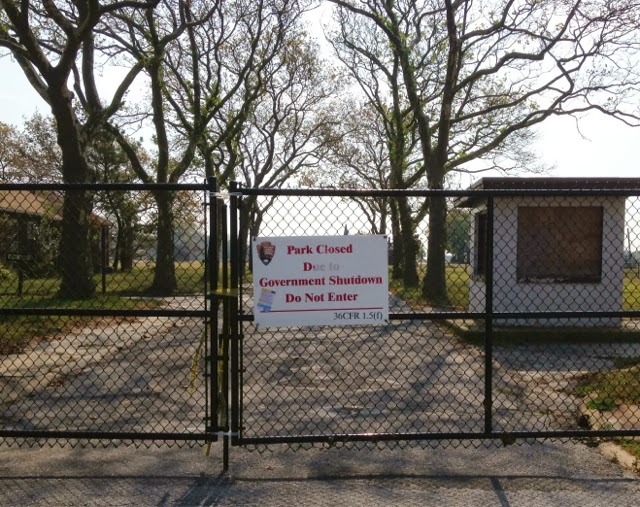
While I planned a beach head incursion, I was surprised to find the side gate wide open. I walked swiftly doing my best invisible. When I arrived at the garden I felt quite exposed, partly because of the removal of the olive shrub near our plot. I expected someone to exit any of the houses within eye shot, sounding the alarm, black SUVs screeching to a sideways halt, handguns drawn. Freeze muthafucka, you're in violation of the will of the Congress of the United States of America!

The doors never opened. It was quiet and balmy, even the geese were sedate. I picked my peppers, lamented the hundreds of lost fruits across the gardens, and checked my saffron crocus (they were not ready). I pulled a few weeds and then headed back toward the gate. As I did an older couple entered, walking their dog. 


These are the peppers of trespass.


Near the gate, a peculiar goat.


I headed for the beach despite the signs admonishing that choice. Bicyclists and runners, a few, came and went. The waters were rough, an extratropical system to the south.


Here, the fence, to keep people off the dune-less shore. Then, a large black SUV sprung from nowhere, stopping short before the sand. I stood doing my best invisible. Then I turned and walked away as an old man approached. I turned to see if the SUV ejected some authoritative gesture toward him, but no, nothing.


The government of NO. 


*Update* I well suppose we're again open for business.

Republican Garden Shutdown Week Two


Republican congressmen who oppose health care initiatives have shut down the government for nearly two weeks. For this reason the site of my only autumn gardening has been locked up and so for this reason these Republicans have said to me and my gardening peers -you will not garden as long as you support health care initiatives. Believe me when I say that many of my gardening peers are likely Republicans but since I do not see them away from the garden I cannot ask them how they feel about the Republican shut down of the garden.

I may have to make a covert trip. Under cover of night? Early in the morning dressed as autumnal haze? Will I be caught? Is anyone looking? It's a real shame about those last of the season tomatoes and peppers, isn't it? I know it's small compared to those who are bearing the real weight of the shut down but that is why it goads me. A fence and 30 extreme Republicans standing between me and a pepper.

I should dig a tunnel.

We went upstate on Sunday to look at properties. We are looking at work space and living space, close and afar. I'd like a more peaceful life, but then who wouldn't? I'd like to get home from work before 10 pm with more than one or two home-cooked meals a week. We work 12 hour days all too regularly. Wages at the college have stagnated since 2009. I take adjunct professor positions to make a little extra (paid for the farm). I do side projects (patio, electrical) to fix the van. I paid off my undergraduate loans this past May, but the studio rent goes up yearly by leaps and bounds.

I've decided to limit my farming to one tenth the quantity of this season. I've cultivated little taste for the driving. The hope is that we'll find space, wherever it is we go, to continue on at a slightly larger scale than this coming season. I will keep Hudson Clove alive and will sell some garlic next August. In lieu of hours of driving and weeding, I intend to refocus my energy on art making and also to say more about art. You may see that writing here (if not by another blog name).

The best news came in the form of an appointment to teach at next summer's Art New England. I will be instructing for one week on a subject of my own desire -landscape and meaning. The remuneration is good for six days' work -two thirds the compensation for an entire semester (15 weeks) and free room and board in lovely Bennington, Vermont.

On October 31 I will leave my studio of the last three years. They say it will take six to eight weeks to return my deposit. Of course it will. My studio mate of the last sixteen months will have to find a space. It's really nice having a friend where I work so I am sad that we will part ways. Believe me when I say that the era of artists renting industrial studios is near its end in NYC. Oh, yes, for the few it will still be possible via personal wealth, financial success in the gallery system, or the pitiful acceptance of renting a windowless 120 square feet for $500 and up a month.

As for our apartment, we are hanging on -for now.


Republican Garden Shutdown


Yeah it's been a hard week. I thought long about what I'd like to do on my day off. I chose the beach farm. It's been two weeks since my last visit and I'm sure to have peppers, squash, and maybe even a tomato to pick. My saffron crocus might be up so I brought paper bags to collect the flowers. But no, the beach farm is closed thanks to a Republican overreach quite grand in proportions. Good luck politicians. Expect your delivery of rotten garlic any day now. 
 
*Update* It's still shutdown.


New Amsterdam Market


In a little less than three weeks I will have my first garlic sale event at New Amsterdam Market. I've never been, so I've been image searching the market to get a sense for the space, tables, and overall aesthetics of the market. I think the pictures give a good sense of the atmosphere. Don't laugh, either, it is that kind of creation. Robert LaValva, the architect of the market, has insisted on designing a sense of place so that all the tables, signage, and what-have-you are identical no matter what the vendor is selling. It's as if the civic space/marketplace has become the product, not only the venue, and the local producer/vendors participate in his work. I get that and I think Hudson Clove's aesthetic sensibility fits well into his scheme as far as I can see from my Google image search.

Now I will make some low-rise pine wood crates to cradle the different varieties of garlic and shallots and maybe a two tier pine tower to display garlic bundles. Should saffron come into play, at a later market, I will need to devise a system for packaging and selling the threads. Maybe you can tell me how much saffron is enough saffron in a package? Marie, ideas?

Finally, you should know that New Amsterdam Market and it's environs are under threat of corporate development. Please read this article in Serious Eats, as it tells you all about it and why New Amsterdam Market is worth saving. The horror of the American suburb is its utter homogeneity, its total fear. Every new mall and false village filled with the same franchises dulls our collective senses. Fearful people who dream of opening new businesses but have little new ideas or the stomachs for risk -they open a franchise. Risk-taking residents try the new Potbelly sandwich instead of Subway. High end or low end, it's all the same, and I hope ingenuity can withstand the forces of homogeneity this time around.


Suffering A Sea Change


Mayor Bloomberg has announced his plan to combat the effects of rising seas on our urban population and infrastructure. Applause for having a plan, but I want to point to a couple of things.

In NYC, most of us who live on the water do it because its a splendid place to live, but for most of our history the waterfront, if it was occupied at all, was occupied by industry and shipping. The damage to it by flooding was often less critical than it is to the residential and retail space that have replaced it. It is clear, however, that if we didn't build on the boundary of the sea and the land, there would be little to spend billions defending against. The sea and the land are always in flux, giving and taking, and if you want to build something permanent in this space, you best design adaptive structures and infrastructure. All I can say is that we, not the sea, are our own worst enemy. We build directly on the sea, we cause a phenomena that results in sea rise, destroying a generally storm-resilient coastline, and then aim to build a way to protect ourselves from the monster we created. An old, but decent overview of shoreline protection awaits you here.

________________________


Mayor Bloomberg insists that hydraulically fractured gas be kept out of the city's water supply regions. Why? Because he agrees that the risk of polluting our clean water supply is simply too high. Yet he then proposes that the city's response to human-caused global warming is to pump way more gas into the city because it has been considered less harmful to the climate. New pipelines are coming in at every angle, including through the Jamaica Bay Wildlife Refuge and Gateway National Recreation Area. Where is this new gas expected to pipe in from? Of course, it's the fracked states of the Marcellus Shale and maybe one day from our own State of New York. I don't believe in a double standard. If it's too risky for us in the city, it's too risky for everyone.

___________________________


Just a month ago I had a meeting with New Amsterdam Market. I reached out to them last December because I thought their model of bringing high quality, local foods to New Yorkers best matched my farming practice. Their offices were flooded by Hurricane Sandy and they had to relocate, so they were late in responding to my interest. As it so happens, the other reason they took so long to respond to my letter was that they are effectively being removed from the Fulton Fish Market. Yes, as it turns out, the City of New York (which means Bloomberg and Quinn) has envisioned the South Street Historic District, a waterfront, with new development of the residential, retail, and commercial kind. In fact, this plan is embedded in Mayor Bloomberg's plan to protect NYC from future sea level rise! What? Yes, it's true. Even a plan to protect the city from future flooding is an opportunity to develop public spaces with private dollars. Whereas a market with little infrastructure could tolerate occasional flooding, a new mall, hotels, residences and closed food markets will be a disaster to clean up after a flood. It simply makes little sense unless you view it through the lens of big money. As a consequence, this year New Amsterdam isn't having its regular markets. That's just great since they welcomed me to join their market to sell my garlic!


Courage and Cowardice


It's been a busy week at school, with late nights and no time to post about my most recent trip to the farm. I intended to do so today, but now I am just too wound up about the shooting I heard minor mention of as I drove into work this morning. Now, of course, as we all do, I see how the worst has come to pass. I cannot possibly write about my pastoral experiences while the innocent lives of children are mourned, made even more devastating by the proximity to the holiday.

I cannot pretend to know what was in the hearts of brutal men, but it is ever more clear that there are those without courage, those who cannot take their own lives without first extinguishing the lives of others; witness to a horror of their own making, they can  finally commit to taking their own.

I could say more, but I haven't the heart. Take courage.

USDApolitical


There isn't one ounce of my being that believes this new USDA garden zone map has been developed for political reasons. I also don't believe that climate change is political, but the pundits have been successful at branding it as such. The climate is ours, all of us, and therefore is not subject to politicking. It is either one way or the other, or variable, but never is it the agenda of individuals. Denying climate data, or screaming apocalypse are political acts, however, because those acts are tools of ideologues and vested interests.

Garden zones? No, those are just the facts, ma'am. Any NYer will tell you, this ain't no zone 6. Can we have a zonal 6 night? Yeah, sure, it's possible, but unlikely. The zone maps deal in averages after all, and I feel confident that my garden's micro zone is closer to 8a than 7b. Temperature data for these maps is collected at several points in any given area and will tend to quash extremes. On average -that is the USDA zone map agenda. To give you, the gardener, a sense of low-temperature averages in one simple product.


The most important aspect of the new map is in the presentation: it's downloadable, it's large, it's state selectable. These are important developments! Now I've taken it upon myself to rebuild, via the magic of a very popular image editing tool, the USDA zone map so that we can see, in proximity and quite large, the tri-state NYC metro region's zonal configuration. If you right click the image and then click open link in a new window, you will be able to see the full-size image. That'll make it easier to locate your place on the map, especially if your location is near a zonal boundary. 

What would be really great, now, is for us to collect garden/temperature data in our NYC boroughs so that we can generate a localized micro-zone map. And mine is 8a or higher.

For  links to the current USDA zone maps, click here.


Mi Caucus e Su Caucus

If I were a candidate for president running in Iowa, I would not be talking about ethics, or business savvy, or trustworthiness. No. I wouldn't bring up manufacturing jobs either. They're not coming back the way we imagine. What would I steer the conversation toward? Farming.

Iowa is American agriculture. An entire third of the state is designated a national heritage area in partnership with the National Park Service. It's soil and climate are ideal. I see too little reason why we are not looking for Iowa made products and no reason why we are not clamoring for Iowa grown produce. Except that Iowa, with the exception of a few forward thinking farmers and producers, is caught in the conventional agribusiness mindset and unwilling to unravel itself.

There are millions in this country willing to pay more for better quality, better agricultural standards, better livestock practices, and better labor practices. Most of us cannot buy pork from Flying Pigs, it's just too darn expensive. We need larger producers who are willing to maintain higher standards, use less additives (salt solutions for instance), enact much better labor practices, and charge 25 percent more (or even more) per pound. I can't afford Flying Pigs bacon, but I certainly can afford higher cost pork and do not think that I am alone.

Why can't Iowa be the heart of grass fed beef (and bison) in this country? Millions of acres of feed corn are waiting to be converted to the more sustainable practice. Consider lamb and goat while you are at it.

I think of all the discriminating Italian markets and other quality grocers who are already selling Iowa produced, value-added agricultural products like la Quercia pork. Check out what they have to say about their farmers and pigs.

Iowa, your state will never be a manufacturing hub, a cultural center, or a financial powerhouse, but you could have a piece of all those things if some visionary leadership was taken. Imagine people looking for that IOWA stamp on the side of cured ham, grass fed beef, or organic produce.

If Iowans can't see it now, they may very well never see it. The Romneys and Gingrichs and Santorums of the world don't care much for these ideas, but I tell you what- they sure as hell know good pork when they see it.

Good luck Iowa.

Pharaoh Won't Read Your Emails


On Friday I went to a program at Cooper Union marking the 100th anniversary of the Triangle Shirtwaist Factory Fire. My wife, Betsy, gave the opening remarks, as she works at CU and happens to be the president of the staff union. The program lasted three hours, a little long, but had a handful of outstanding moments.

My maternal grandmother and all her sisters were teenage seamstresses in this NYC, only one generation removed from the brave young women who went on strike, who took regular beatings from police, thugs, even prostitutes hired by the owners. Despite their struggle, Triangle was never unionized, and never made any safer, and then it burned in less than 30 minutes, while many were trapped inside, killing 146 (mostly women) from smoke inhalation, burning alive, and jumping from the 9th story. Most of the victims were teenage girls and women younger than 23.

I give Betsy a hard time about some union issues and I tend to think this is because I grew up in a union household (I.B.E.W. local 3) and largely wanted to rebel against it. Unions squash ambition I liked to think. Unions demand groupthink I liked to say. I was a member during my early years, forced into it, really, by the circumstances of the hard economy of the early 90s. What jobs were there for artists anyway. A man I used to work with, Walter from Ghana via England, used to ask me why I was a white collar guy pretending to be blue, to which my young shoulders shrugged.

He told me his story, how he wanted to be a finish carpenter in England, and was the rare black man in the carpenter's union there, but they would never let him out of rough carpentry, and eventually left for the U.S., where he ended up being a handyman for my bosses in an electrical distribution warehouse in Manhattan.

But how I seriously digress, and want to steer this back to my point, which is to show you the video I recorded of Cecil Roberts of the United Mineworkers of America, speaking on Friday night. My awareness of him was remote at best, but in seeing him speak, as a union evangelist, I must admit to getting spirited chills.


Christine Quinn Is Right...


...Community gardens should be made into NYC Parks. This is the only permanent solution to city-owned lots that have the potential to be sold for housing. Although history has shown us a few fools to suggest it, land under the Parks sign shouldn't be looked at for development. As NYC parks, they could incorporate Olmsted's democratic ideals with community gardens' democratic aesthetics. More and more I question the passive use of parks and wonder what more active involvement in parks would be like. Is the community garden as park the seed of some larger civic park landscape? If you can bear my undeveloped thoughts and unclear writing, consider what I said on this theme a couple of years ago in this post. If there's one thing I've learned in three years of blogging -editing!