environment

The Woods Today

Back in NYC I might take a walk from time to time, but more often than not it was for the purpose of getting somewhere that I might find myself on a walk. Today, after gaining some ground on research for my (other, new) summer course Shipwreck of the Minotaur at the Mayapple Center for the Arts and Humanities, I chose to take a walk through the woods with some purpose in mind, but mostly to get out of doors for an hour. I did need to check on the sap buckets, as cooler weather has extended our sap season, and also to check on my Easter day's garlic mustard eradication project around the back slough.


I've kept my eye on the Tradescantia spp. that I transplanted from Brooklyn last year in a new garden where the old lilac used to dwell. It looks to have survived. The same garden is now home to the old Brooklyn 'New Dawn' climber rose (a rose that has seen four different yards over its years), a sedum I found growing here in the woods, Dicentra eximia from Brooklyn too, and whatever else was growing there that we've decided to allow (and hopefully not that horseradish I did my best to dig out).


In the front yard, all varieties of garlic are now soaking up the sun. Incidentally, these are not German Hardy, but an artichoke variety, possibly with 'giant' in the name, that were shipped gratis, likely because of poor size thanks to drought and fire in the garlic seed producing region. There are as many commas in that sentence as garlic in this row, but my point is that the sign is a stand in.


I headed into the woods, although the wind made for a biting chill and a hazardous walk through the ready-to-fall. So much dead wood squeaking and creaking like a brig on the open seas, I hesitated to pause for the earliest of ephemerals like Virginia Waterleaf, Hydrophyllum virginianum or the mystery plant, below, that caught my eye as I hiked off path to navigate a significant enlargement of the water line in the back slough.


I was motivated to get back to the slopes of the slough to check on the garlic mustard that I chose to spray with a low percentage mix of glyphosate and water last Sunday. Spring is the time to deal with garlic mustard, particularly March and the earliest of April. Virginia Waterleaf, ramps, some rosa species, a few asters, and other early, less pernicious weeds are coming up and I have no desire to affect those in the act of ridding the woods of garlic mustard. In these zones hundreds, probably thousands, of garlic mustard seedlings are sprouting from the seed bank. It was not an easy decision to spray, especially within a yard of the slough's water line. And I am frustrated to report that after six days the results were not significant. Most leaves were mottled, but the plants were not in the state of distress I would have expected. I've considered that I may need to apply a second course, although I am not happy about that. It was necessary to do so, even with a much higher percentage of glyphosate, on the buckthorn "hedge" growing alongside the garage pad. What I have to consider is the compression of the wet soil in spring. It appears to me the less foot steps, the better, especially after the frost heave has done such a nice job of loosening, aerating, and draining the soil surface.


In the past I thought garlic mustard didn't do well in flooded soil, and maybe it won't if the slough remains flooded. However, what I've seen is that in early spring the ice melts and freezes and this heave extracts the garlic mustard from the mucky soil. It then floats, roots and all, in the spring melt water, preserved in a cool water bath until conditions improve. At the water's edge the leaves and stems of garlic mustard are bluish gray to the deepest purple and often hard to spot against the dark water. The garlic mustard a foot or two away, on drier land, have some purple to the stems, but the leaves are quite green. So green, in fact, that it is a little painful to pull or spray at this time where you find yourself longing for the green of spring.

So what happens to this water's edge garlic mustard? Does it die? I don't think so. Many of the plants, some of which I simply scooped out of the water and some which were easily pulled from the muck, had the biggest roots. Garlic mustard is a biennial, so last year the seedlings emerged and grew strong, despite the waterlogged soil, and this year they are ready to grow and set seed. I'm not willing to wait for the sake of observation, yet I am sure many will escape my vision or reach, and I will be a witness to their success.

As I make my way around the slough, eyes to the ground, I think much about what good the garlic mustard could be doing. What species make use of it for cover or for food? Does it stabilize the soil on the wooded slopes? Is balance achievable? Is garlic mustard simply symptomatic of a woods so degraded by other culprits (err, humans, for instance)? In other words, how necessary is the work I've begun, and am I causing more harm than good? And, you know, I like questions.

If you would like to see more photographs of the woods, follow me on Instagram @frankmeuschke where I post regularly under the hashtag #thewoodstoday.


Winter Mind


Winter has finally come to us. Temperatures below 20 degrees F, snowfall, car doors frozen shut with the last freezing rain, the clinkeling of ice crystals shed at forty five miles per hour. Despite this wintry attitude, we here at PrairieWood have work to do. The new shop is now standing with roof and ceiling. It never occurred to me that I would work into the night, outdoors, at just a handful of degrees above zero, but I did just that last Sunday so that we could get the wiring in before the ceiling closed out our access.

While I've been able to put most house projects on hold until springtime, one thing is still weighing heavily on my mind -the woods. What once went concealed by countless leaves is now made obvious by the contrasting wet bark and newly fallen snow. If I could sum up its appearance in one word, it would be diagonal. What is it about a wood of slanted trees that is so disturbing? Is our sense of order satisfied by horizontal ground and vertical columns of trees? Is the removal of angled wood a goal of a "clean" woods? 

What we need here is a plan, a forest plan, to guide us in the care of these woods. But wait. Why do the woods need our care at all? Isn't that awfully anthropocentric? Couldn't the woods take care of itself as it has for thousands of years?


Why is it so hard to look at the woods and see ourselves in it? We entertain the woods as a medium of passage. We experience the woods, but are not a part of it. Our aim is to be out-of-the-woods. We are beasts of clearings where a few selected trees may stand sentry. Why not the woods? Is it a blow to our ego to be among such large beings? Or is it the inherent danger of a sustained presence in the woods, the mashup of life and limb? Maybe this is the most practical tack, that a life in the woods is a life fraught with falling timber. Even among the trees there is danger. No elderly tree gives way without taking or scarring those around it. The falling of a great old tree reverberates through the forest, destroying the order, remaking communities, providing opportunities for well placed upstarts. 


I've realized how easy it is to make a metaphor of the woods, but the questions are more difficult. In our short time here we've had to ask many, and no answer is quite right. Any intervention is yet another question, or string of questions. We cannot extract ourselves from the story of the woods; people created it and we are living it. 


I regret to speak so abstractly, but somewhere in this line of thinking is a better perspective that may be teased out in writing. I understand intuitively that we have a role in this mess, that we are the aliens among the trees, roadsides, and fields. We cast dispersions on the plants and animals that take advantage of sensitive niches, but were it not for us this would hardly be the case. We are the aliens, the agents of drastic change. We project it onto others (plants, animals) while claiming our place. There would be no buckthorn, no garlic mustard, no barberry or burning bush if it weren't for our own invasive nature. Can we make it right? Can you take it back? Can you undo the done? 


This is a defining aspect of our culture. We invade a place, instigating the consequences that we see all around us and then tell ourselves that it is the others' fault, it is their doing that has created the mess and maybe, just maybe, we'll commit resources to cleaning it up, and it will be ongoing, forever perhaps. The productive citizen looks away; it's just easier that way, isn't it? We can spend a life throwing resources at a problem that traces back to exactly where we stand. Is it rational to label plants and animals invasive and yet completely ignore our responsibility for it? 


In the woods I see the paradigm of our conflict, one as much with the natural world as it is with other human beings. I am left asking you if an answer, one that can never be fully right, is to look away or to commit the resources to try to correct the damage, forever, perhaps. And what to make of the trying, because trying isn't necessarily accomplishing anything other than assuaging one's conscience of total responsibility. 


I don't mean to be melodramatic. It's simply that so much of what appears to ail us today is hindered by our unwillingness to take responsibility, or at the very least, to understand our responsibility. I am not personally responsible for the rampant buckthorn in the woods, but I sure can see how it came to pass and how I've benefited from our ancestral migration to this place. 


Ignorance (in the sense of not knowing, but also ignoring) leads to bad decisions, or self-centered ones, and consequences difficult to ameliorate. For instance, water holds in the middle swale, in the back woods, and leads to ponding, mosquitoes, and to water-logged roots which can bring an untimely death to the trees there, fallen timber, more sunshine, and then faster buckthorn spread. I considered trenching a drainage so that the captured water could drain into the great wetland. Autumn came and I saw that some trees at the center of the middle swale remained green-leafed long after the rest went yellow.


Upon investigation, the bark and leaf, below, spoke. These are silver maple, Acer saccharinum, the fast growing, brittle-wooded tree of wet areas in the Eastern Forest.


I can only guess that silver maples living at the boundaries of its range put the species under pressures not necessarily found near its core. So I came to an understanding of this middle swale. I will not dig a trench to help drain it, yet I will dig deeper into what else is growing, and dying, in this area, and attempt to understand it before acting or, quite possibly, not acting at all.


The questions of how to act and what sustained gestures are both possible and effective, are for our winter mind. What can be done that limits the rampant buckthorn and doesn't undermine the fragile species under threat from its able fecundity? We spent a quantity of time pulling garlic mustard from the drainage stream connecting the northern, small wetland to the great, southern wetland. Our work was effective, but it also appeared to me that there was a significant reduction in jewelweed in the very same area. I'm working on memory, now, but I thought it was more prolific in that region in past years. So I wonder, was it the garlic mustard that reduced the jewelweed population to nearly zero, was it natural swings in population due to unusual temperatures or flooding, or was it our trampling feet that inhibited its seed from sprouting? 


Every action has consequences, so many of which are unknown. I recall how, as a child, certain people were inclined to spray pesticides into the tall oak trees to bring down gypsy moth caterpillars. Our camp director screamed, during lunch, that by God he was not going to allow those trees to die! Our neighbor brought in a pump truck, unannounced in summer time, and sprayed his trees. I am still haunted by the overwhelming bitter smell of the pesticide, the sticky residue dripping from the trees, the dead birds and squirrels on the ground. His trees didn't die, nor did the camp's, but then, neither did the vast majority of unsprayed trees.


Each of us who is responsible for a part of the woodlands at the edge of the prairie has to choose for ourselves whether to act, or look away, to spray herbicides and trample, or do nothing. There is no mandate, we operate independently of our neighbors and yet nature cares little for these arbitrary boundaries.


I am inclined to act, yet feel overwhelmed by the magnitude of what is necessary to be effective. We hesitate to spray herbicide, usually in two or more applications, but pulling is incredibly time consuming, physical and often, incomplete. Should we adjust to the new, simpler woods, make peace with the knowledge that we brought this thicket on ourselves? Could there be a middle ground where buckthorn and garlic mustard and all the others are accepted to a degree, where we do not look away but effectively manage the woods?


*all photos are from October, showing yellow-leafed sugar maples along with the green understory of buckthorn -low growing, young plants spread north while the large shrubs reside on the south facing slope.


Brave New Habitat

I could hardly believe the words coming out of my mouth -mosquito h a b i t a t. Yet that's what I said to the young lady in hot pink sweat jacket (ahem, hoodie) that loped out of the north (formerly little) wetland after I announced myself with a stern good morning.


The Metropolitan Mosquito Control District makes regular, unannounced visits to our wetlands. I have yet to be unsurprised by their presence or put in other words: they do not knock, call, or in any way let you know they are there (unless you see their truck; in this case it was parked on the road). I asked her to let us know that they would be present by simply knocking on the door, that the woods are dangerous (I hope that didn't sound like a threat :-\) and the mosquito surveyors need to be careful of falling trees, and by all means -please use the trails instead of trouncing the understory. 

This was the second time this spring that I've asked them not to spray because things need to eat and they eat mosquitoes, and even more so -the spray kills indiscriminately. When I ask why they are spraying, this is mosquito habitat (there it is) after all, they toss up the usual suspect -West Nile Virus. To which I've got a handful of retorts, and they then see that I am less than hospitable to this "public service." 

What we have here is a major home to countless frogs and toads, dragonflies that we love, bats, birds, and so much more. Mosquitoes bother the humans, don't get me wrong -I am thoroughly annoyed by them, but there is maybe 20 humans around these wetlands. West Nile Virus is not deeply concerning to me (maybe you, I can't say) but it is to me a "worrying tactic" used to nudge people into being agreeable to spraying. The truth is, or rather my truth is, that I believe they are spraying because mosquitoes are a nuisance and people just wish they were gone. 

Great. Now I am a proponent of mosquito habitat. I probably just broke the Fox News whacko meter. 

The helicopters fly just over the tree line in order to dump BTI, Bacillus thuringiensis subspecies israelensis, into the wetlands. I accept this practice as a compromise measure between myself and the mosquito-agitated public, although it seems an exorbitant use of funds for such spotty coverage. I can't say I've noticed a difference between post-BTI spread periods and untreated periods (but then, I'm biased -science please!).

The spraying of adult pesticides is done via backpack by day and likely by truck fogger at night (you may have seen this in NYC). I've continually asked surveyors to report back to their managers that we do not accept spraying on this land, even if our neighbors do. Apparently we need to get onto some sort of "do not spray" list. I have yet to find out how to do that, but I will, eventually.


O wonder!
How many godly creatures are there here!
How beauteous mankind is! O brave new world,
That has such people in't.

 —William Shakespeare, The Tempest

____________________________________

I've begun posting on Facebook, at MOUND, and if you click the link at the upper left it will take you to my new page. Consider following me there, too, because I have begun using it for all the short form pictures and posts that never make it into this journal.


Ramp On

Ramps! I'd forgotten about them, curious as that is because I did have plans to plant them at some point in the future. As with any forage, I questioned my instinct, and kneeled down for a leaf tear. Unmistakable onion scent, however more, um, woodsy, earthy, funky even, with the slightest floral essence.  The taste? Earthy, mild onion and exceptionally sweet (especially after our 30 degree nights). Our ramp is Allium tricoccum var. burdickii, a contested species or variation of the Allium tricoccum found at ramp festivals of Appalachia and farmers' markets of the North American east.

I stood admiring my patch, how wonderful the woods can be, until the creaking timbers above my head urged me on. As I continued my walk I discovered another four or five small patches. A number low enough to recall each without resorting to markers or maps. Consistent preference for slopes (prompting Betsy to humorously suggest it as another origin of its name) and well-shaded, summering sites suggested that they should have blanketed our shady, sloping woods.


The next day, cool and damp after a decent rain, I stepped into a woods of rain softened, pliable leaves under foot. I floated. Squirrels and chipmunks went about their business unaware of my approach, but wary were the ducks that fluttered into flight the moment the chorus of frogs went silent. No matter, I wasn't out in soft shoes and sweater to see the ducks, I was out to collect a few ramps for dinner.

I began to spot more and more ramp colonies, in all corners of the woods, although mostly out back and along the south-facing side slope. They grew under most species of trees, often near the trunk, nearly always on a slope, yet in one instance on a flat near the great wetland. In all cases an abundance of leaf litter, and in none was there any garlic mustard (although prevalent nearby in at least a couple of locations). There are so many patches that I, like a squirrel forgetting his buried nuts, can hardly remember a portion of them. This is for the best, as there is plenty for the two of us, and we must ensure the continuance of the species.


Our ramps belong to the variation burdickii. The common ramp grows in dense colonies, with relatively large leaves, and most strikingly shows red or purple coloration just above the bulb along the lower stem. A variation burdickii colony shows fewer individual plants, has somewhat shorter, more slender leaves, and does not show purple coloration on its all-white stem. Burdickii flowers significantly earlier than its counterpart and is also more likely to reproduce from seed due, in part, to the colony's open habit.

Along with the popularity of ramps in restaurants and home kitchens, they have become abundant at New York area farmers' markets and on foragers' tables. New York State has declared Allium tricoccum var. burdickii as endangered, placing it on its protected native species list. It cannot be legally wild-harvested, although Allium tricoccum is still open to harvesting (for now). Given the rarity of burdickii, it is unlikely that you will find much of it in New York, but if you do, don't harvest.

If you find yourself salivating over a patch of ramps, check for a dense colony habit, then pull away some soil to look for purple coloration on the lower stem. If you're sure you've got the right ramp, only pluck a few whole plants from each colony, or better, just clip a single leaf from several plants. Ramps take several years to mature, and several more if the colony is severely depleted, so please contain your harvest zeal. The bulbs may be four inches below the soil surface, so dig deeply with a long, slender trowel without disturbing or severing several neighboring bulbs. Do not trample ramps or other plants on your way to them and be mindful of seedlings along the edges of the colony. Finally, beware of causing soil erosion on the wooded slopes ramps prefer.

In our woods we will tread lightly, doing what we can to minimize competitors like garlic mustard, Alliaria petiolata, and take a measured harvest. Tomorrow I'll cut a few new leaves to eat with eggs. Sure, I cook, but here's a local chef with the real ramps recipes.


The Backwoods


At the western edge of the land, just before it rises up toward the old gravel pit slash horse farm, there is a topographical depression, what I will call the swale. Although its origin may be artificial, it is one of the more interesting features of the land.


I walked out to the swale to investigate bark-stripping that, as far as I can tell, is only happening here.


Stripped clean from the base well up the tree, with no broken branches, so it isn't deer rubbing or eating the bark.


Several feet away I spotted this mess and a hodgepodge of prints.


Above it, more stripped bark. An animal that climbs, or flies. Hmm, I'm going with climbs as birds at the base of a tree seems to put them at risk of predators. Probably a rodent, maybe a squirrel.


I see hanging material, which at a distance I took for lichen, on many of the upright twigs. On closer inspection I recognize it as the dried remains of duckweed. Ah, an excellent indicator of the depth of the past summer's vernal pool, which looks to have been nearly two feet in places.


Trees fall easily here, succumbing to the wind and saturated soil, a soil made visible by the exposed root mound of a fallen tree. I wonder how it is that it holds much water at all, as it feels crumbly and porous. This, and the spring which emerges from the base of a tree about two hundred feet from here, reveal a complex hydrology that I've yet to fully understand.


Toward the back and upslope lay an assortment of aggregations; what looks to be concrete, dumped by the gravel mining operation that long ago operated just over the property line.


The aggregations have weathered, moss clings to it now, and one day I may make aesthetic use of this waste. 


An old, plastic six-pack in the swale.


Beyond the swale, up and quickly down again to the edge of the large wetland, a sign painted and hung by Rex. It read "American Trash Museum."


This neck of the woods, at the bottom land of a ravine just beyond our property, is full of cast-off appliances. Some go back fifty or more years. The dump exists at an intersection of what farmers would consider three "wastes" -a ravine, a wetland, and a woods. Well, the woods held some value as a woodlot, and the cows could roam them for munching on all kinds of under-growth (which probably helped the buckthorn get a foothold), but the other two were rarely looked upon kindly by farmers and country men. 


Looking southeast you see the wetland. Where there is little to no grasses there's visible snow, revealing where water is most likely to stand in wetter periods. Here the ravine drains its steep-sided slopes.


Up the ravine, littered mostly with old washing machines, but also empty fifty-five gallon drums and five gallon pails of mostly unknown chemicals. If you live in a second-growth forest that once was part of a farm, on or near a farm, you can probably find this kind of dump, or what remains of it. 


At the top of the ravine, a two hundred feet or so off our land, looking toward the adjacent horse farm and the steep incline of the old gravel pit. 


Trash comes in many forms.


And offers its warnings.


Heading back, one of Rex's many brush piles, consisting mostly of fallen branches. There are ten or twelve of these around the woods, and more could be made, should one choose to.


Why Not, QBot?


It was Chinese New Year, so we went to Flushing, Queens (my first neighborhood, just newborn) to explore several dumpling and hot pot houses for lunch. My mother was surprised to hear me call Flushing Chinatown, then had to explain to her that the place we lived over 40 years ago is not the place she remembers. We were so full after the second place (a mall food court that blows mall food court experiences you've had out of Flushing Bay), and so many restaurants that return trips are warranted. I might add, if you're at all like me, once you eat in a Chinese community, you will resent having to go back to your corner takeout.

When LaGuardia's patterns take planes over Flushing it's at first disconcerting, and ultimately colludes with the taller buildings, Chinese printed signs, and busy sidewalks to create a more cosmopolitan feel than you might expect. You do feel as if you could peg the bottoms of the lifting, slow moving planes with a handball. The image above, made with an iphone's 4mm lens, pushes the plane farther away than it really is. It takes getting used to, but less so inside the Queens Botanical Garden.

I've intended to visit QBot for some time, ever since the construction of their new administrative/visitor building. It's LEED platinum certified, possibly the greenest building in NYC, and all that may mean zilch to a wayward polar bear. But to this guy, it's the only serious reason to visit this underfunded garden.

The three dimensional water feature -used to recycle runoff, process gray water, achieve modest outdoor cooling, for irrigation, and as a visual design element is the heart of this building. Systemic water, a merging of liquid functionality with the designed landscape is hardly common and it makes my heart beat a little faster. 

There were problems, of course, but all told these appear to be born of staff shortages or design quirks that can be addressed with some attention. The larger garden lacks a coherent design, lacks interest and given the resources poured into this new building and parking garden, it would serve Qbot to find a way to build a master plan that revisions the garden following these examples. They'll never be NYBot or even BBot, so be Qbot and give us a reason to travel to Flushing by offering something completely new, something so 21st century.

I think it's reasonable to keep people off green roofs. We want people to see, yes, but there should be a way that doesn't impact the plants. 

Mounded roses in a ringed circle?

An excess of funny, CNC machine-carved statuary?

Maybe a master plan that merges eco sensitivity with Chinese design, given the neighborhood in which Qbot resides? Many of the great eco-design landscape projects of late have been in China (Quinhuangdao Beach, Shanghai Houtan Park, Crosswater Ecolodge, etc. etc.). Qbot lacks space, but couldn't they access some of the wasted land of Flushing-Corona Park? Surely Flushing Creek (or what's left of it) could be cleaned and greened. Were you aware that many of NYC's early plant nurseries were this side of Flushing Creek (true -I've got maps)? Perhaps a China-NY partnership could help pay for such appreciation of the value of a growing Queens (Flushing soon to be the largest Chinese community outside of China) community. Could be awesome. 

But until my grand scheme comes to pass, we should revel in Cornus sanguinea, Winter Flame Dogwood. Brilliant on a gloomy day.

And snowdrops and hellebores, too.


On Farm Fracking


Imagine a farm. Do you see an old fashioned windmill? You might. Those old workhorses of farm water pumping have been staples of the American farm scene since the mid-19th century.

Today, farms, particularly those in Iowa but elsewhere too, have been taking advantage of high average winds. Wind farms are often installed on farmlands where they do little to interrupt the practice of farming, take up little space, and as far as I can tell from the towers I've visited, are quiet.

As some of you know, NYS is embroiled in handwringing regarding the institution of horizontal gas drilling using the process of hydraulic fracturing. I need not get into the details here, but suffice to say that it is a process that is heavily dependent on water and chemicals, creates millions of gallons of fluid waste that is salty, radioactive, and chemical laden, creates air pollution in the form of truck traffic, dust, and noxious chemical aerosols from the condensing process, all locally as in -on farm.

Farmers are hurting financially and that is particularly true for dairy farmers in New York State. I cannot blame a farmer for selling the rights to the health of his land for a large lease payment and royalties when so much is not going in his favor. But, at the same time, as a consumer of local farm foods, including dairy, meat, and vegetable, I cannot accept the practice as a solution to our farming problems.

Wind farms and farming are good companions. I do not believe we can solve all our energy problems with wind, but I do believe that wind farms can help sustain farmers. But that should not be all they are doing to grow sustainably. They should be diversifying their product, reaching out to new markets, seeking ways to be more efficient with technology. Government farm bills can be written to aid the smaller farm, and USDA programs for slaughter and packaging could be instituted for the smaller, local, high quality producer. I believe it's time for mid-sized producers of cured artisanal meats and cheeses, adding value to farm produce and feeding the growing interest in local sourcing and high-quality products. Aren't we ready to trade in our Oscar Meyer for la Quercia? We can do this New York, but not if we sell out to immediate gains at future expense.


I will refuse to eat any produce or product that I can reasonably discover is produced on "fracked" land. I know I am not alone on this. We can reasonably assume that fracking on farm land in the southern tier will push up the price of farm land in the Hudson Valley and elsewhere. This will drive up the costs of already higher-priced produce from these regions. The net result, I believe, will be lower consumption of high quality local foods and consequently, less local farming. This is the effect fracking in New York State may have on our access to local, high quality produce, meat, and dairy, to say nothing of the possible pollution of our air, streams, rivers, and estuaries.

Demand to know what the state plans to do when a spill occurs, or flooding rains take out a waste water pond. Demand to know how the waste water will be treated by your local sewage treatment plant discharging into the Mohawk (a Hudson tributary), Susquehanna, or Delaware. Demand to know the safety of drilling waste water brine spread onto your local roads in lieu of road salt (which washes off the road, right?). Demand to know where the millions of gallons of water will come from for drilling. Demand to know who gets priority to water should there be a drought. Demand to know what's coming out of those condenser tanks on your farm.

Yes, we all benefit from cheap gas, in the short term. I do, you do, all of us. Which is why we must get together -we're all in this, to choose another way for the long term health of New York's farmland.

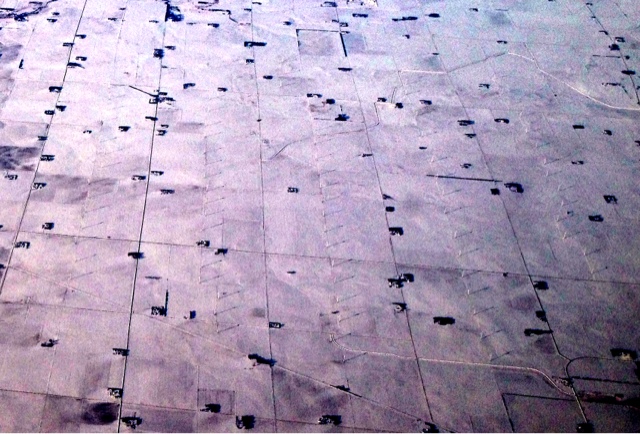
Iowa farms with wind field

The Golden Gooser


I've seen this vehicle around lately, in Prospect Park and Central Park. 

There's a secret war on the geese of New York. He rides in his kayak, and it looks innocuous enough, but it's all about getting the goose.  From whom, exactly, is the pressure coming to extinguish the geese? What is the cost of the man in the kayak versus the cost of leaving the geese in the parks in a time of smaller Parks budgets? Why do we need a 'specialist?' To detach officials from the unpopular destruction of geese? By the way, it has little to do with airplanes -no goose has been gotten at Gateway, where we watch low-flying planes take off every other minute.

Are the birds are striking back? Did you hear of the kayaking gooser that was retired by a swan? Maybe the swans think they're next.


Never Seen This Coming


I would have never imagined this, and wouldn't have known were it not for my sidebar hydrofracking New York news alerts. In an effort to dispose of the salty 'brine' dredged up from the depths of hydro-fracking, energy companies are pitching to counties and municipalities the availability (no doubt for free) of their hard to dispose of, radioactive, chemical-laden, salt water waste product for use on roadways as a de-icing agent.

Can you imagine? And what did one county that has chosen not to prohibit this use give as the reason?

"...they weren't convinced there was a scientific justification for banning brine spreading or did not have sufficient information on the topic to move to prohibit its application." 


You see, this is the difference between us -when I do not have sufficient information, I say I cannot justify the risk, yet they prefer to use the stuff, despite not having sufficient information. In other words, it sounds to me like those municipalities are being forced to drink their own fruit punch, lest they admit to it's poison.


For Peat's Sake


I found this opinion piece in the NYTimes well-intentioned, but silly. I'll start with the laughable notion that anybody is really using peat for ground cover. Dry as a bone, it would blow away at the slightest breeze, it is nearly impossible to wet down with a hose, and it acidifies our soil that already leans that way. You might add some to the blueberry patch soil or your new rhodi bed, but it's hardly a common purchase and hardly something you can "fork."

Oh, wait -yes, the way we really use peat is as the major component of potting soil and starter mixes. Yep, but that wasn't mentioned at all.

If it weren't for the convenience, I wouldn't use peat one more time. Maybe I will use compost, without peat, for starting my seeds next year. If I fill any pots, I can do it with compost. It'll work, it'll be fine. We got used to peat because it holds water well after it has been wetted, is light weight in the sack, and it's ubiquitous in the marketplace. But it's time to stop, not because we must, but because we can. Compost is naturally full of humus, which is just as friendly to seed starting as peat-based starter mixes. I mean, we're not professionals, right? We don't demand 100% germination rates. And can't our potted plants survive a lower water-holding capacity soil mix? Sure they can, we've got drip systems attached. As for weight on our rooftops and terraces? How much more weight is a comparable compost mix compared to fully wet, peat-based planter mix? I cannot say, but we should find out.


Grass Is Stinkier On The Other Side


Yep, I know, Parks -it's cheaper maintenance and it is always green, sort of. But, when the wind blows from the north or northwest, it stinks to high heaven like some kind of chemical bath. It's hard to imagine breathing deeply while playing soccer over this stuff. It's simply rotten.

I walk by this twice a day on my way to and from the train. Several blocks long and no escape from its hard-to-define smell. If you've ever lived with or near wet outdoor carpeting, its that smell. While it may be more expensive, and it may not survive the beating, I love the smell of cut lawn grass. Love it.

So, as I see it, Parks chose between rotten and love, and they went with rotten. Sorry to be so hard, I get your reasons, but there's simply no love there.


Waste Not


Last autumn I was on a garlic seed production research tear. I came across a company in china called Pretty Garlic. Log onto their website to read the mythical origins of pretty garlic -something about a sick girl saved by garlic. In reading their how-to-grow garlic page, I was a little surprised by the frank use of the term "human wastes" as supplement to growing garlic. Right click this screen-capture image so you can read it in full. After reading this, it was easy to see how American farming has been consumed by public relations, because I honestly don't think conventional farms are operating much different here than they are in China.


In the U.S., we come up with all kinds of euphemisms for human waste, so why wouldn't we do the same when talking about sewage-based agricultural products. I believe Biosolid is the preferred term, apparently generated by a focus group or PR campaign some years back to improve the image of sewage sludge.  See the EPA website for their bland assessment of applied sewage sludge products. The FAQ that most concerns me is this one:

11) Are there regulations for the land application of biosolids?
  The federal biosolids rule is contained in 40 CFR Part 503. Biosolids that are to be land applied must meet these strict regulations and quality standards. The Part 503 rule governing the use and disposal of biosolids contain numerical limits, for metals in biosolids, pathogen reduction standards, site restriction, crop harvesting restrictions and monitoring, record keeping and reporting requirements for land applied biosolids as well as similar requirements for biosolids that are surface disposed or incinerated. Most recently, standards have been proposed to include requirements in the Part 503 Rule that limit the concentration of dioxin and dioxin like compounds in biosolids to ensure safe land application. (Italics mine)
I'm not interested in using biosolids or sewage sludge-based compost on my garden mainly for the questions that the above answer dredges up. Questions like: how come we can spread dioxins, currently, on agricultural fields? There are limits for heavy metals contamination in agricultural fields, so wouldn't the annual application of cadmium, for instance, increase the load of contamination year to year? 


Someone can make the argument that it is completely unknown what quantities of heavy metals in garden or agricultural soils it actually takes before human health is affected. I concur. We have no idea. Lead, for instance, is limited to 400 ppm in NYS restricted residential soils (not intended for gardening), but Minnesota limits it at 100 ppm, while background levels appear near 20 ppm. Try to find scientifically studied limits for Cadmium, chromium, aluminum, zinc, molybdenum, mercury, etc., etc.

Last summer I smelled something near awful around my father-in-law's garden. I didn't know what it was until I later spotted him spreading grains of something all around his flowers and shrubs. In detective mode, I searched out the bag he had used and opened it up for a whiff. Yup. Milorganite. Something I had heard of, but given little thought to. Retail-branded sewage sludge from Milwaukee, Wisconsin. 
 My problem with municipal treatment is its catchall process. In other words, anything your neighbor drops down his sink, toilet, or catch basin, finds its way into your treatment plant. Are they really capable of eliminating all the contaminants from that pool? What about industrial wastes flushed into the system?

We do have to do something with all the waste we generate. But what? In the mid-19th century, after several outbreaks of cholera and other infectious diseases, Sir Edwin Chadwick proposed a sewage network for London that included the collection of human wastes for dispersal on farm fields, but this part of his plan was unfeasible and the sewage ended up in the Thames until sewage treatment plants became viable.

In our own time, sewage treatment based products are spread onto farm fields. Some municipalities pay farmers to take their waste. Some municipalities pay private companies (like Synagro) to collect and dispose of the sludge in various ways. Some municipalities create product, like Milorganite, for sale to the public. No matter which way you do it, Chadwick's original idea has come to pass, but a lot more goes into our sewers now than in his day.

What do you think? Have you already spread 'biosolids' onto your garden, knowingly or not?

The San Francisco Public Utilities Commission had in past years delivered free 'organic compost' to any citizen of the city who wanted it. The scandal that ensued was called Chez Sludge because of the involvement, however indirect, of Chez Panisse's Alice Waters, famous for her promotion of organically-raised produce.

In another more horrifying scandal, the backyards of poor black families in Baltimore were covered in sewage sludge in order, said those responsible, to protect the children from seriously high lead levels in their backyard soils. I believe the term for this theory is "Sludge Magic," promoted by a former EPA scientist and USDA official (Read this document). In short - the theory states that once soil contaminated with dangerous levels of lead is mixed with 'highly processed' sewage sludge it is safe for children to ingest. Really? By the way, excuse the low-rent links, as there was no media attention to this story.

If you asked people whether or not they would be inclined to compost their own feces and urine to spread on their vegetable garden, I think many would say they would rather not. Yet, somehow, once it becomes a product, it is then acceptable. Maybe it has something to do with what I call the bologna effect. If you had to make the bologna yourself, you might just not want to eat it, but since it comes in that nice roll at the supermarket, it's not so bad with mustard on bread.


USDApolitical


There isn't one ounce of my being that believes this new USDA garden zone map has been developed for political reasons. I also don't believe that climate change is political, but the pundits have been successful at branding it as such. The climate is ours, all of us, and therefore is not subject to politicking. It is either one way or the other, or variable, but never is it the agenda of individuals. Denying climate data, or screaming apocalypse are political acts, however, because those acts are tools of ideologues and vested interests.

Garden zones? No, those are just the facts, ma'am. Any NYer will tell you, this ain't no zone 6. Can we have a zonal 6 night? Yeah, sure, it's possible, but unlikely. The zone maps deal in averages after all, and I feel confident that my garden's micro zone is closer to 8a than 7b. Temperature data for these maps is collected at several points in any given area and will tend to quash extremes. On average -that is the USDA zone map agenda. To give you, the gardener, a sense of low-temperature averages in one simple product.


The most important aspect of the new map is in the presentation: it's downloadable, it's large, it's state selectable. These are important developments! Now I've taken it upon myself to rebuild, via the magic of a very popular image editing tool, the USDA zone map so that we can see, in proximity and quite large, the tri-state NYC metro region's zonal configuration. If you right click the image and then click open link in a new window, you will be able to see the full-size image. That'll make it easier to locate your place on the map, especially if your location is near a zonal boundary. 

What would be really great, now, is for us to collect garden/temperature data in our NYC boroughs so that we can generate a localized micro-zone map. And mine is 8a or higher.

For  links to the current USDA zone maps, click here.


Corporate Pepper


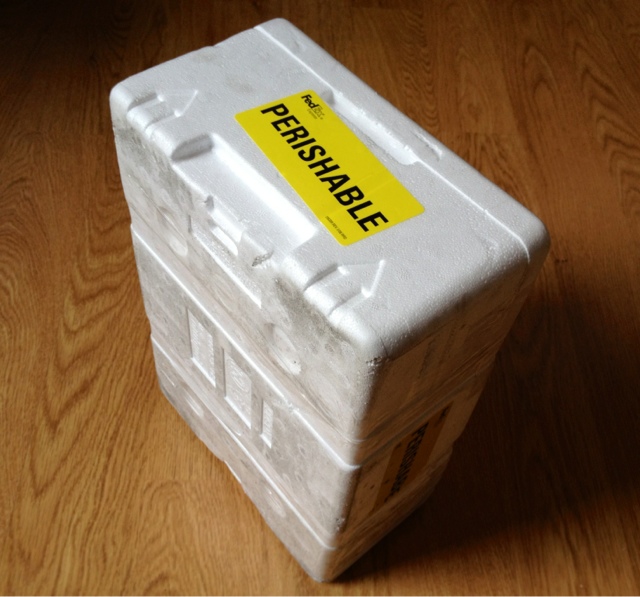
I stepped out this morning and discovered the white foam perishables container on my step. Already -they've arrived. I hadn't informed the Sunset produce representative who contacted me that I had blogged about the episode after I lodged a complaint that their peppers tasted like mothballs. Poor form? Maybe, so I won't be able to relay our exact conversation, but I think I can deliver the gist.

First contact was the rather stiff, corporate kind. The rep called it an 'off-flavor' and appreciated that it was brought to their attention. They wanted to have my number for a phone conversation and the original packaging. I couldn't deliver either, so I forwarded the rep a hi-res photo of the package that I used for the last blog post.

Sunset Inc.'s style of communication became a bit more conversational after I sent them the image. Afterward, I was told they were able to get any important information needed from it so that they could do a 'full product trace.' They did believe the incident was 'isolated,' however, they would be contacting the grower to ensure that 'best practices' were 'occurring at the farm level.' They assured me that no other complaints of this kind had been filed.

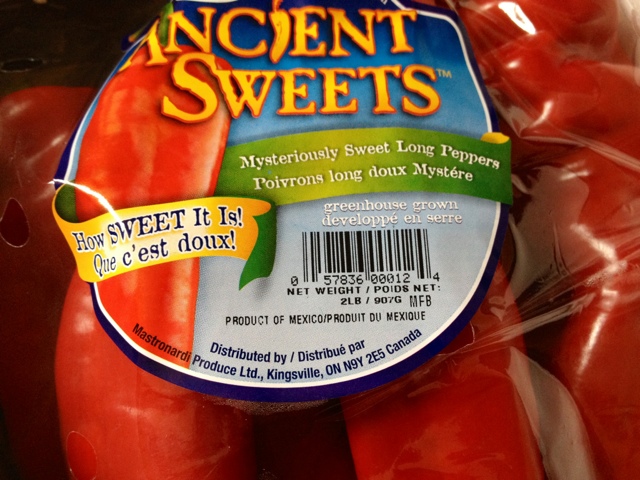
To 'reaffirm my confidence' in their product, they politely asked if they could have my address so that they could send me a complimentary package of Ancient Sweets. I cannot say enough how much that name gets under my skin, but still I said yes. There was no way they were going to send me another mothballed pepper. In fact, they probably have a locker full of the biggest, cleanest, sweetest, bestest long red peppers just for this type of problem. I placed the quarter at the bottom so you could see how large these peppers are. Incidentally, this new bag of peppers was grown in Mexico, not Nicaragua, as my original package had shown.

In the final communication the representative thanked me for 'allowing them to show their gratitude' and apologized for the 'inconvenience' and 'off-flavor.' Their 'Procurement Team' had been in contact with the grower yet found nothing outstanding that would lead to that taste. New peppers are just about out the door of their 'facility' and I should expect them shortly. And the last sentence from the last email regarding my mothballed peppers:

'As a reminder, always wash your produce with cool potable water before consuming.'


Eating Peppers Temporarily Mothballed


Two weeks ago I was shopping at Fairway. I needed red peppers for a recipe I was making that night, but Fairway didn't have any. Hmm, well I was off to Court Street to pick up something else, so I stopped into the Italian grocery and they had this incredible deal on just the kind of pepper I was looking for. If you can believe it, I bought the last two pound bag of long red peppers for $3.99! Almost too good of a deal for me to trust, but then I needed the peppers.

When I began to prepare the meal I tasted the fresh peppers and I thought there was an odd flavor to them, definitely not pepper, although they were highly sweet as the label said they would be. I kept coming up with manure, but the wrong kind of manure. Yet that never satisfied me, what was that flavor?

Two weeks later I decided to use the rest of these peppers. Boy, they sure held up well in the fridge. I chopped one and tasted the bottom tip. Bang! Mothballs! That is the flavor, however much milder than the mothball-flavored candy my grandmother used to have around the house. But truly, mothball-flavored peppers. OK, not going to use those, but I did google just that. I came up with very little, except a vegan blog post from 2007 where the author mentions the very same phenomenon. A modest number of commenters who googled the same found that site and posted their experience.

There appears to be a Canada connection. Ok, out-of-season red peppers, mothballs, Canada. It's funny enough to mention that I took the above photo to post about what a great deal I got on these peppers in Brooklyn and what it ends up doing is illustrating how these incredibly cheap peppers from Nicaragua via Canada taste a hell of a lot like mothballs - naphthalene or 1,4-dichlorobenzene (guys, you know this one -urinal biscuits).

I contacted Sunset and I will let you know what, if anything, they have to say about it.


Glass Act


I received a comment the other day with this info attached. If you live in the Fort Greene area, or you frequent the park, consider lending these civic-minded folks a hand.

"...my organization Broken Window is putting together a clean up of broken glass in Fort Greene Park. We intend to send the glass for recycling at a facility in New Jersey. I would love to ...get some kind of shout-out on New York City Garden, because we are still looking for more volunteers. Thanks so much!
Shana

Lord knows I've been cleaning up the broken glass in my small plot for years. I'm sure they can use all the help they can get. Check it out.


Attention Prospect Park Visitors!


I am now hearing that Prospect Park will be sprayed tonight, after 12:30am (and our neighborhoods after 8pm tonight). If you are sensitive to this sort of thing (or foraging tomorrow), you would want to know this. Despite contacting my councilman, and having received a response, I have no new information from the city on the spraying that would help me understand what the procedure is for application of pesticides (Anvil 10+10). They tell me they do not spray the house. But how could that be? What exactly are they targeting from their truck mounted sprayers? Seriously, it's not cool, New York City.

I have to now hit the internet to find information that the city should be providing. How hard is that NYC? Just a little info goes a long way. Why do you not want us to know more about what you are doing? Because we might disagree? Hmm.


"New labeling precautions for pyrethroid products, with one exception, prohibit applications to blooming crops or weeds when bees are actively visiting the treatment area. "
-suppose its bad for the garden then. You thought you were organic!

Also, pictures of a truck sprayer and hand-held sprayer from the same Mass website:


I imagine the setup is similar in NYC. Notice how they sprayer is mounted to spray up and out, in a "fogging" type of manner. The Massachusetts site says to shut your AC, while NYC tells us not to. Hello -mine is now off. The droplet size is quite small from something like this and is capable of entering your AC.

If you witness the spraying tonight in the any of these zipcodes please report what you see: 11355, 11358, 11364, 11365, 11366, 11423, 11427, 11215, 11218, 11219, 11225, 11226, 11232, 11238, 11691 or 11692.


Here is a link to testimony to a congressional hearing by a doctor on the effects of these types of pesticides. Note that the pyrethroid pesticide she discusses is similar to the pyrethroid they are spraying in our streets. Also note that the ULV designation doesn't mean less, it means lower volume of spray but higher concentration of poison.


OY.

If you are a bee keeper, read this:

Where the risk factors combine to pose a serious risk to bees, you will want to consider one of two options. Beekeepers with one or two colonies can confine their bees during and immediately after a spray. If you choose this method, you will have to confine your bees the night before the spray takes place, and leave them shut in for 24 hours. Before confining your bees, make sure they have sufficient space to prevent overheating - that may mean adding an extra super of empty combs. Remove the entrance reducer, if present, and screen off the entrance with 1/8" hardware cloth. Plug or tape all other holes in your equipment that the bees can use as entrances, and replace the inner and outer covers with a piece of 1/8" hardware cloth stapled over the top of the hive. Cover the hive with two layers of wet burlap, and keep the burlap wet while the bees are confined. Place a sheet of plastic loosely over the burlap during the spray to minimize direct contact with the pesticide, but remove it immediately after the spray. If your bees are in the sun, you must provide shade. A day of confinement is all that a colony can take without suffering damage, especially if it is hot. Beekeepers with more than a couple of colonies will want to move their bees out of the spray area. Be sure to contact the health department in the county where you plan to move your bees to be sure there is no spray program planned for that area.

If you leave your colonies unprotected in a spray zone, observe the entrances for several days after the spray takes place. If you note an unusual number of dead, crawling or dying bees in front of your hives, call your regional DEC office immediately and ask that a Pesticide Specialist sample your bees to determine if the kill is due to the pesticide that was sprayed in your area. Ask DEC for a laboratory assay to determine if the product used to control the mosquitoes is present in your bees. Also, report any confirmed pesticide damage to me, so that I can determine the statewide impact of the spray programs on honey bees.

I have contacted agencies in other states to learn about their experiences with these pesticides. The staff at the Florida Department of Agriculture Mosquito Control Program informed me that they have not had any bee-related problems with Anvil and Scourge when using nighttime, ground applications. Some minor damage to bees hanging outside their hives on hot nights has been noted, but that is all. In a similar vein, colleagues in Missouri have also informed me that they do not experience damage from pyrethroid sprays unless the spray contacts bees hanging out on hot nights. So, that is relatively good news.

You can contact the following New York State Department of Health website for more information on the West Nile Virus, control methods for mosquitoes, and the various pesticides being used as part of the control program: http://www.health.state.ny.us/. You can contact the following DEC website to locate phone numbers for your regional DEC office: http://www.dec.state.ny.us/.

I am contacting the state's county health departments and asking that they restrict any spraying to nighttime applications of Anvil or Scourge. Also, I am asking that they consider focusing on control of larval mosquitoes rather than the adults because larvicides are less toxic to bees. Compounds such as methoprene and Bt are effective against the immature stage of the mosquito, non-toxic to people, and relatively non-toxic to bees. Local community-based programs that focus on the elimination of breeding areas, such as old tires and cans with water, can also have a significant impact on mosquito populations.

Please share this information with all members of your organization.

Sincerely,

Nicholas W. Calderone
Assistant Professor of Apiculture
Department of Entomology
Cornell University
Comstock Hall
Ithaca, NY 14853


OYsquared.


How My Councilman Suffers


Councilman Lander,

Because you are the official voice of our neighborhood, I thought it was worth expressing my dismay at the broad spraying of pesticides in our neighborhoods. Too little info is given. How do they spray? Will they blanket the house, the sidewalk, the trees and shrubs? What of my garden, which happens to be organic until tonight? And I hardly feel, although I am not an expert, that spraying my house and sidewalk will kill mosquitoes that breed in pools of water, sometimes as small as soda caps (i.e. Asian Tiger Mosquito).

We know how mosquitoes breed, so is it really necessary to spray the front yard which may be 50% concrete? What of the backyards anyhow? How will they spray those? Will the spraying be from the air? And because this area is near Greenwood and Prospect Park, how come they are not spraying there? Or are they? And finally, what of the storm drains? I think there's more than alligators breeding down there.

Also, remind me how many people have died from West Nile Virus in NYC? (CDC -4 in 2010) Maybe we should spray motorists as I think they've killed more pedestrians (250?). Sorry, that was too easy.

Thanks,

Frank


NYC DoWTF


Adulticide. That's what they call it. I call it spraying pesticide. From the city:
Will the public be notified in advance about spraying activities?
Residents can learn about adulticiding schedules in advance through public service announcements, the media, the City's website (nyc.gov/health/wnv), or by calling 311, the City's Information Line. DOHMH will provide notification at least 24 hours prior to a spray event.

I found out about tomorrow's spraying in my neighborhood via a local blog, then went here to see for myself. Nowhere can I find exactly how they are spraying which, to me, and maybe parents, would be critical info.

Material Data Safety Sheet for Anvil -one chemical they say will be sprayed.

From the city:

How will the public be notified in advance about spraying activities?
Residents can learn about spraying schedules through public service announcements, the media, the City's website (nyc.gov/health/wnv), or by calling 311, the City's Information Line. DOHMH will provide notification at least 24 hours prior to a spray event.
What health risks are posed to my children from pesticides for adult mosquitoes?
In the amounts used, risks to people and pets are relatively low. However, some people may be more sensitive to pesticides and may want to reduce their chance of exposure by following the suggestions below.
If the City sprays pesticides in an area where I am, what should I do during the spraying?
If pesticide spraying occurs, DOHMH recommends that all individuals take the following precautions to avoid direct exposure to pesticides and to reduce the risk of any reactions to pesticides:
  • • Whenever possible, stay indoors during spraying.
  • • Some individuals are sensitive to pesticides. Persons with asthma or other respiratory conditions are especially encouraged to stay inside during spraying since there is a possibility that spraying could worsen these conditions.
  • • Air conditioners may remain on. But if you wish to reduce the possibility of indoors exposure to pesticides, set the air conditioner vent to the closed position, or choose the recirculate function.
  • • Remove children's toys, outdoor equipment and clothes from outdoor areas. If toys are left outside, wash them with soap and water before using them again.
  • • Wash skin and clothing exposed to pesticides with soap and water.
  • • Always wash your produce thoroughly with water before cooking or eating.
Anyone experiencing adverse reactions to pesticides should seek medical care or call 311 or the NYC Poison Control Center at (212) POISONS (764-7667).


Say It


Don't Spray It.

One day during our visit to Minnesota, Betsy mentioned that a government official had stopped by to inform the residents that mosquito spraying would take place as soon as the weather dried out. They were concerned about a massive mosquito bloom after all the wet weather. Reasonable concern, but then I was concerned about aerial spraying of an unspecified substance at an unspecified time in an unspecified manner. Maybe I was overreacting? 

Two days later, when an extremely low flying helicopter was making neck-twisting passes over our woods and wetlands, I had to wonder what it was they were doing. I couldn't see any spray coming out and there was a good breeze blowing too. Why spray in a breeze and wouldn't we smell the chemical? I thought maybe they were dropping BT pellets, then, which would drop without much affect by the winds. Yet, I couldn't see anything coming out of the helicopter, which was just above the tree line, about 80 feet up. The whole episode left me with more questions than answers, and a certain degree of discomfort.

When I was a child, in the late seventies, we had massive outbreaks of gypsy moths and caterpillars. There was no government control that I was aware of at the time. Spraying, if you chose to do so, was the responsibility of landowners. We lived within oak forests that were highly infested with the moths and caterpillars. We got used to the sound of dropping turds hitting leaves and other surfaces, touching tree trunks moving with highways of caterpillars, seeing certain trees completely defoliated, the egg masses laid on every vertical surface. 

But, none of that excuses what also happened. Overnight, new gypsy moth eradication companies sprouted. Their business model was a tank truck, high pressure pump, and thousands of gallons of chemical pesticide. On summer weekdays, when the neighbors were at work, but school-aged kids were at home and outside, the trucks would show up, unannounced, and begin spraying high pressure jets up into the canopy of oaks. 

We stood there, watching, until the acrid chemical overwhelmed us and we ran inside. When they were done spraying, we went back outside to see what became of it. Amongst the dripping, sticky residue, so unusual on a sunny summer day, what we found were dead squirrels, birds, all kinds of insects, and, of course, dropping gypsy moth caterpillars. I can remember the pungent smell in the spraying's aftermath till this day, partly because it wasn't an isolated occurrence. It happened again and again over the course of three or four years, until neighbors began to realize that the Gypsy Moths weren't exterminating the trees and their spraying was costing them for naught.

Oak trees, Gypsy Moths' favorite, can survive the defoliation. We never lost one tree (all our trees were red oaks), and the oak forest that stood then, stands now, minus the ones cut down for neighbors' house extensions and pools.

So, what's with all the memory lane? I was reminded of all this the day after we arrived home. I sat in the van for a moment and noticed this trap hung from a street tree across the street from our apartment. It's a pheromone trap used to collect moths, which the USDA uses to infer gaining or lowering numbers of Gypsy Moths in an area, year over year. 

I have not noticed an up-tick in gypsy moth caterpillars in our area. Although, a few years ago, on our trip to Minnesota, I noticed a massive regrowth of young, bright green leaves off Highway 80 in Pennsylvania. On our return trip I noticed dead caterpillars everywhere at a rest stop and the attendant there told me they had sprayed. We didn't sit on any benches under the trees.

I googled quite a number of combinations of traps, Gypsy Moths, USDA, and New York City. The best I got was a recent article from a Washington state, local newspaper describing a similar trap and process in use there.