Insects

Milkweed Zoo

Milkweed growing has been a great success for most of the six (or was it seven?) varieties I sprouted last spring. Doing particularly well is A. incarnata (swamp milkweed), A. verticillata (whorled milkweed), and A. tuberosa (butterfly weed). Take a look at those hardy roots on that sixteen inch tall swamp milkweed. The five inch deep cell trays that were terrible for vegetable starting were great for milkweed because I could leave them to develop strong roots without worry about setting them out too late.


I've planted out in the yard and woods a majority of the plants, and all that remain in cell trays are only unplanted due to the continual and relentless mosquito attack this late summer. We've had a highly unusual, severely wet and humid August and September which has had a deleterious effect on some of our vegetables, our studio building progress, and even our mood. It's even bringing on an early, brown autumn as wet Septembers are prone to instigate.

But enough about that. We did have a couple of dry, sunny days, one of which had me near the greenhouse bed of giant Asclepias syriaca, common milkweed in mid August. The milkweed, leaning from height and heavy rains well into our potato bed needed to be put back in its place. Being milkweed and August, I anticipated finding Monarch caterpillars, but there were none. What I did find, however, is a startlingly rich collection of other insects. Some were feeding on the plants while others were feeding on those feeding on the plants, and still some feeding on the litter of those feeding on the plants.


Black-legged Meadow Katydid.


Possibly a Blue Mud Dauber or maybe even a Steel-blue Cricket Hunter, and of course -an ant.


Mating Lady Beetles -likely the good, bad, and ugly kind otherwise known as Harmonia axyridis because they eat plant pests (good), were introduced by us humans (bad), and enter the house by the thousands in autumn (ugly).


And their offspring meeting an ant.


But what of this offspring, with its yellow coloration, different patterning, black legs, and little or no spines? After much digging, I'm going with the Ash Grey Lady Beetle, Olla v-nigrum -I do recall seeing a wine-colored 15-Spotted Lady Beetle earlier this year, submitted to BugGuide and identified. We'll see what the insect community has to say about this guy.


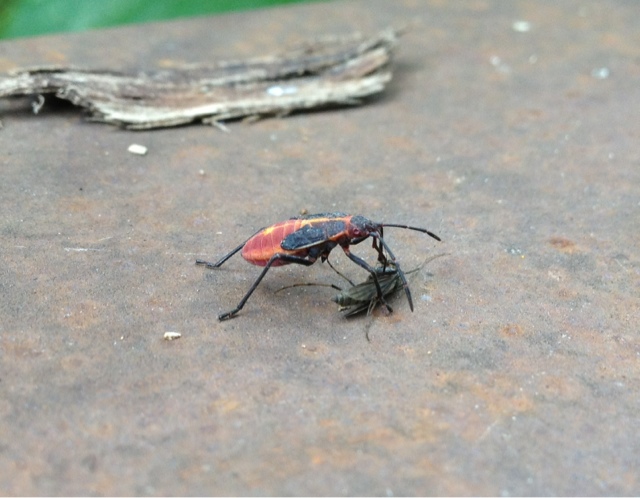
A Large Milkweed Bug, Oncopeltus fasciatus.


Paper Wasps.


Red ant. Which kind? So many kinds...


Flower Crab Spider


Another kind of flower crab -notice the chunky hind quarter? The females change color to match their surroundings.


Yellow Jacket.


Had I spent even more time I would have found even more creatures; frogs, crickets, grasshoppers, moth larvae (Tussock Moth comes to mind). Check out this good post on the merits of maintaining a balanced ecology of the butterfly garden. Yes, we plant milkweeds for the Monarchs, but nature has its own way and we have ours. It's likely better to let nature take its course while we do what we can to better the circumstances of all living things.


I like the moment when the ant meets the paper wasp.


The monarch caterpillars do not seem to be fond of the old, possibly tough, Common Milkweed near the greenhouse and vegetable garden. No, they were found of a young A. syriaca, the butterfly weed (A. tuberosa) and the Swamp Milkweed (A. incarnata). I prefer the last two, myself, for their nicer flower, form, and spread and so it is that these species, butterfly and plant, are in our flower garden.


It was only a matter of hours between these two photos.


Chrysalis still intact, metamorphosis nearly complete, and because it is late in the season, we wait for what some call the "super Monarch" -the one that flies all the way to Mexico and then breeds next year's northerly migrating offspring.


Plenty of nectar nearby.


To kick off the long flight.


When Fruit Flies

Did you bring fruit flies home with those grocery store peaches? Have they multiplied in your compost bin or on other fruit? To get rid of them, place a day or two worth of fruit cuttings in a stainless steel bowl with a large paper towel over the top, leaving about a half-inch or so uncovered on one side. That will be the entryway. Even if you left an 1/8th-inch uncovered with paper towel, they would find their way in. Leave the bowl on the counter top over night. Do not disturb it in any way. The next morning, the earlier the better, grab a ceramic plate with a smooth bottom (so it makes a tight seal against the bowl's rim) and ever-so-gently place it on the paper towel covered bowl. Take the bowl outside, preferably away from the door you exited, and dump the fruit scraps into the compost pile.

Shake your other fruit. Did any more flies appear? If so, eat, can, or freeze fruit those that are over-ripe and repeat the process. Your kitchen should be clear -for awhile. Fruit flies will find fruit no matter where it is, lay eggs, and rapidly a few flies will become a fog of them. If the flies are not laying eggs in rotting fruit, they'll try the counter top compost bin, and lastly the kitchen sink drain. See this link for ten more traps and a way to deal with the drain.

Fruit flies are one of the most studied insects and have been used heavily in biological research. Click on the fruit fly link to read up on them (and their uncanny sex life). Below, one of the more unusual sex life of insects photos I have ever seen, thanks in part to the photographer's insert.


Damsel

In distress? I hope not. We love our dragonflies, a larger relative of the damselfly. They fly around eating all kinds of insects, sometimes landing on our shoulder, and sun themselves in the morning on the side of the house. Since damselflies are diminutive compared to their larger cousins they can easily go unnoticed. Because they are particularly fond of the arching leaves of our garlic, I see them quite readily. Today I took a close look and found that they came in three colors.


Blue


Green 


 And pink.

There are roughly 5000 species in the insect order Odonata of which Damselflies and Dragonflies belong. A good way to tell the difference between the two, other than size is the way they rest. Dragonflies rest with their wings spread while damselflies rest with wings together and parallel to their body. Each has incredible visual acuity -80% of their brain is used for visual analysis (the giant eyes). They are also incredible fliers able to fly quickly forward, backward, and hover. Few insects that can make you feel like you live in a magical environment, but these do (butterflies being another), especially when they arrive by the hundreds.

Having plenty of Odonata species means that your wetland habitat is relatively unpolluted. This year we have had an unusually late start to the mosquito season, not having seen any until about two weeks ago. The control agent who tests our wetland found no mosquito larva in middle May -again, highly unusual. What this means is less pesticide spraying in the area that undoubtedly kills Dragons and Damsels as well as mosquitoes and what else. I do not know if the Bt drops, made by helicopter, kill Odonata species as well as mosquitoes in the larval stages. Quick searches suggest no, but maybe inconclusively.


Garden Architecture


After 15 years, this greenhouse of redwood and polycarbonate, has finally come out from under tarp and mouse droppings. It was purchased for my project at Socrates Sculpture Park in Long Island City, Queens, in 2001, assembled amidst the acrid haze of September 11, and the structure became a refuge during a very dark time. The company, Gardenhouse, generously donated their profit by giving the structure to my project at their cost.

Our site, formerly Rex's dog pen, was excavated last fall and filled with Class 5 gravel (a mixture of 1 inch or less rock, sand and some clay), hand compacted by me this spring, and laid with the cheapest concrete pavers from a preferred regional box store. Redwood is great for this kind of structure because it really doesn't warp and is one of the best rot-resistant woods. The polycarbonate held up well, but I hosed down the panels last fall and the hard water left spots inside the double walls. Oh well, still have a greenhouse! 


Because thunderstorm winds are a concern, Betsy made L-shaped pins from two-foot long, 1/2 inch rebar which holds down anchoring straps at seven points along the perimeter. As they rust, the pins will bind to the soil which provides extra grip. Also around the perimeter, I laid landscape fabric and 2 inch granite gravel dug from nearby "landscaping" in anticipation of high speed rain runoff from the 45-degree pitched roof, weeds, and the little boost of rock's heat retention. The brick edging is an unfortunate compromise.

I am renovating a portion of our front porch deck so that I could use the old, long cedar planks as framing for our raised herb bed. After ensuring the rusty screws and nails were out, I ripped the boards on the table saw to cut out the rotted sides. The heart of these boards are perfect, so if you are looking for free raised bed material I would look for a deck carpenter in your area. Our boards haven't been treated in at least sixteen years, if ever, and each had a nice coating of algae and lichen. Still, I placed the up-side out and the underside toward the planting. You could do the same if you are concerned or unsure about the treated nature of free, old deck boards.


After building the first raised bed I rather liked the structure over the hastily made front yard vegetable beds of last year. I had potatoes to plant and thought a raised bed would be easiest for "soiling up" mid season. I tilled, built the two side walls out of 14 foot old cedar deck boards, added humus from the base of a giant old oak tree that spits out a fine, peaty substance from a portal 5 feet up its trunk, then added the rotting straw that covered the garlic beds, and finally several cubic feet of compost. I left the 40-inch end boards off so I could run the tiller through to mix these ingredients in. 


I dug a trench and planted the potatoes at about 12 inch spacing, covered the potatoes, then dug the center trench and so on. In a raised bed with rich soil I am anticipating that I can tighten my spacing. Don't take my word for it, however, see Rodale's 7 Ways to Grow Potatoes.


The greenhouse, nearly completed (still rocks for the back and side, one vent operator to install and some window cleaning). We moved our New Mexican Opuntia and Agave inside the greenhouse, mostly to avoid the cold rains, but also to get them more sun than the house could provide. The front of the greenhouse will be tilled and seeded for grass, then stepping stones or maybe brick walkway from the garage pad to the door. 


Inside the greenhouse, on a quick-built table made of cedar taken off the house last fall, are starter trays and cold-stratified milkweed seeds of seven varieties. I am generally two weeks behind on most projects, so these got started a little late, but milkweed enjoys warm soil sprouting (you'll notice even well-established plants are some of the latest to come up). The milkweed seedlings are sprouting and now share the table with summer vegetable seedlings and strong-looking starts purchased last week at one of our area's better unique and heirloom variety vegetable nurseries -Shady Acres.

If you are thinking of a free-standing greenhouse like this, I'd like to offer some considerations. Make sure you have a solid base to build on that is level as these greenhouses won't piece together well if they are bent out of form by off-level pads. Make sure you place it in a sunny location! Don't laugh, if you build in fall or early spring it could be quite sunny, but not from May through October. Do consider wind and overhanging branches. Gardenhouse says it can withstand a wind load of 85 mph. Why chance it? Make sure to anchor it in some fashion, put it in an area that provides a windbreak yet doesn't allow a large limb to come down on it (note that home insurance usually doesn't cover structures like these). Finally, if you have lots of paper wasps, they will love to explore your new greenhouse as a fine place for their nests of stinging motherf$#ers. I was stung four times last year, mostly because I put my hands near a nest I could not see. Paper wasps are very observant and will watch you as you get close. They will leave you be if you do not get too close, but if you do, in a flash one or more will drop on you and leave its painful stinger. In short, you may have to spray a long term pesticide on the rafters, as difficult as that decision is. Wear a mask, cover your skin and eyes, because it's hard to avoid getting doused when spraying up into a pitched roof. Don't forget places like under a table. The long term stuff should last all season, meanwhile you can use clear sealant to close up gaps that allow creatures in, and with some luck, the next year you will not have to spray.


May Flowers


It is the season of the oak gall wasp, bungeeing caterpillars, and relentless paper wasps. At night its June bugs bouncing off screens and, tonight, the first lightning bugs. We have been miraculously without mosquitoes -no one's complaining.


In the woods Red Columbine, Aquilegia canadensis, bloom.


It's a bit regal


In its dusty crown.


The first sight of the Woods Geranium, Geranium maculatum, is always a surprise in the shadowy under-canopy.


Geranium grows throughout the woods, but only one here, two there. In the area I call the council circle (laughably and yet to be introduced here) the geranium grow profusely.


Virginia Wetleaf, Hydrophyllum virginianum, has been in flower for over two weeks now.


It's pale purple mass of flowers create glowing, floating dollops wherever it grows (and that is nearly everywhere).


Spring Ephemera


Too much woods and too little time.


I am excited to find ordinary ramps, Allium tricoccum, the kind that grows in dense matts, has larger leaves, and reddened stems in a far corner of the woods, just below the road, next to an ash tree, Virginia Wetleaf and Wood Anemone. I've looked in all corners by this time, and this appears to be the only patch making the common ramp the rarer of the two in our woods!


In other ramp news, this patch of A. burdickii appears to have been chomped by deer with good taste.


At the edge of the north slope, Large-flowered Bellwort, Uvularia grandiflora. Could its wilted appearance be a defense against browsing deer?


According to Illinois Wildflowers: "The presence of this plant in a deciduous woodlands is an indication that much of the original ground flora is still intact." That's good news, but it's not the whole story in our woods. I do think this bellwort is another worth trying to cultivate.


The quantity of Viola species makes identifying them a hassle, at least for busy guys like me. They grow everywhere -in the lawn, in the gardens, in the woods, on the old farm roads and paths. They are lovely. This one might be Northern Bog Violet, Viola nephrophylla.


We have blue, white, lavender, purple and yellow violets growing all around. Above, Downy Yellow Violet, Viola pubescens.


Jack In The pulpit, Arisaema triphyllum, are coming up throughout the woods.


Jack can change to Jackie from year to year, depending on reproductive success in the prior year. According to Minnesota Wildflowers: "Males tend to be smaller than females and have a small hole at the bottom of the spathe which allows pollinators to escape (with their pollen) more easily. Female plants lack the hole and pollinators are more likely to become trapped, better ensuring successful pollination." Pollination leads to the multicolored fruit seen here.


Wood Anemone, Anemone quinquefolia, growing in the drier, upslope woods near the old tractor road. 


In another, forgotten location, a pink variety of Wood Anemone.


I spotted this from across the bridge. Lousy phone photo, but maybe you can help ID it. The leaves are reminiscent of Red Elderberry. It is a pretty weak specimen, looks to be damaged by limb-fall, and is growing under a canopy of cottonwoods.


Walking the old tractor road, pulling buckthorn, I leaned in to pull this one until my vision kicked in to halt me.


A nest of baby spiders, no idea what kind, but possibly an orb weaver type. An ephemeral of another kind -off into the world younglings, and do your good work.


__________________

The greatest, visible threat to the woods and its ephemerals is the invasion of the biennial herb Garlic Mustard, Alliaria petiolata, and the shrub or small tree known as Common Buckthorn, Rhamnus cathartica.


In this fine looking scene it is easy to forget that it is greened with an army of mustard only a week away from blooming. I've begun pulling it out as I walk through the woods, but this process eats time quickly and there is always more mustard to be found! I may have to wholesale cut them back with a weedeater or sickle just to stem the tide. As is so often the case with strong weeds, these break at the root only to regrow. Any gardener knows what happens then -it simply grows back even faster, setting flower and seed on a smaller, harder to pull plant. Garlic Mustard has a 5-7 year seed bank, but it should get a little easier each year.


Garlic Mustard is bad, but nothing in our woods is as challenging as Buckthorn. Every fallen tree is another opportunity for this plant. While this corner has been a Buckthorn stronghold for many years, it really took off after a great White Oak toppled in a bad thunderstorm four years ago. It now grows on the trail as much as to the north and south of the trail.


Buckthorn can become an impenetrable thicket above and below ground. A tangle of fibrous, tough roots chokes out plants below the soil and a dense cover of leaves smothers ephemerals and low growing shrubs from above. Although many young saplings die back in winter, each sprouts new leaves from the lower stem and ground each spring. I hand pull up to 1/4-inch diameter twigs in advancing areas, but in established "groves" larger shrubs and twigs must be dug out, doing further harm to the plants that may have coexisted thus far.

Within the great wetland, large Buckthorn grow on the slightly higher ground occupied by the beautiful Red Osier Dogwood and Pussy Willow. Its seed is dropped by perched birds, which then sprout and overtake the dogwoods and willows. I haven't seen it to go head to head with cattails or get a sure foothold in the ephemeral pond of the back swale. In fact, after last year's flooding, I see many small upstarts didn't sprout this spring. Can we flood them out? If not water, then I love the idea of burning them out, although this would be hard to do safely.

Forestry experts, ecologists, park managers, and many others often discuss the advancing Buckthorn and Garlic Mustard as an ecological issue, a problem of "native" forest habitat. Surely it is, but for me this is a gardening problem. Intellectually, I agree with the experts, but my motivations are less than pure. I simply don't like the look of a Buckthorn monoculture and prefer to be able to see through the woods. I like surprises, yet Buckthorn and Garlic Mustard offer none other than the ability to show up in a previously unheard of location. It may be that ecological problems are more easily taken on when we believe we act for our own interest.


Yard Bugs


There are bugs everywhere, and especially where there are flowers. I could spend all day trying to capture these impatient sitters. Below a few captures.


Just seems like another carpenter bee going up the wall.


Until she turns around and lets you know she isn't all bluster -queen has a stinger and an all black head. She was out looking for a new spot to nest.


Everyone digs lady bugs, and some of us don't discriminate -we even dig ladybird beetles that hail from Asia. This one hides out under the lily leaf.


Crawling up the other side are the young ones and we celebrate them because they are voracious eaters of soft-bodied insects like Aphids.


Don't be afraid.


A Metallic Green Bee, or what I like to call Christmas ball bees, possibly Agapostemon virescens. You may have noticed the very same bee, here on a Tradescantia flower, flying over the Evening Primrose in the first photo.


Frank Meuschke


Stinkbug Winter


What is the longest crocus season I have seen since I've been looking at such things. Nothing to complain about, really, as it has made the ubiquitous late winter flower worth looking for. Mine have been quite spotty, an appearance here, a show of it there.

One other thing to note about this winter, maybe you've experienced it: an abundance of stinkbugs -inside. First it was in a motel room in Naperville, Illinois. They kept popping up to the delight or horror of the cat. Later, at a meeting in Westbury, Long Island, I spotted one crawling on the milk carton provided with our coffee. Just this last Saturday, in a friend's spotless home, northeast of Peekskill, New York, one was hightailing it across the hardwood floor.

I have not researched this. Have you seen an abundance of indoor stinkbugs this winter?


Update: Ok, this probably answers it, now that I've googled it. Please, spare yourself the comments. I had no idea that National Geographic had the kind of reader that would equate a stinkbug in winter with the President, Global Warming, and Nazis. Criminy.


Our Global Butterfly


Yesterday I went to the Museum of Natural History with Betsy, my cousin (Red Hook's PokPok manager/waiter, ask for Jeff) and his girlfriend to see the Our Global Kitchen exhibit. I wasn't expecting much since Betsy reported that a prior exhibit on bioluminescence had little in the way of bio, just a bunch of artificial displays. Honestly, if your up on food, this exhibit isn't for you -you'll hardly see anything new. The most fascinating display was a plastic mock-up of Michael Phelps' breakfast.

Fortunately we paid full price, allowing us the chance to see the butterfly exhibit and even though I wish the museum built a Rose Center-like glass orb filled with tropical plants and humidity, it was worth every penny to spend some time with any Lepidoptera in the middle of winter.

For all the power of an iPhone, I happened upon a weakness: under the Metal Halide type lamps, the phone's sensor whipped up a moire-type effect. Of course, there was the usual darkness induced slow-shutter blurring, but I could salvage several shots. I recognize that I'm becoming more self-conscious about taking shots with a phone -it's so common now that even my mediation feels mediated.


The Bees Of Autumn


It's as if they are out too late, getting drunk on nectar, then pass out at the tap. The next morning they move their limbs slowly, doing so until the sun activates their consciousness, puts the buzz back in their six-legged step.


Fennel Seed, Not Quite


The first cutting came to the studio where it is warm and dry.

But, after a week, I rustled the stems, and I was a little dumbfounded by what fell out.

Gnats. So, naturally I google gnats and fennel, but I found nada. So, my next batch came home with me and was placed in the stove (not doing much cooking lately) on a cookie sheet.
Yesterday afternoon, as I was about to use the oven, I removed the fennel. And, what fell out as it shook? You guessed it. So what gives? My first thought was that the gnats discovered the studio fennel because I left the windows cracked open. My second guess was the more likely, but less desirable, chance that they were already on the green fennel either as eggs or at some stage of maturation.

Anybody have experience with this? And if so, how do you deal? Just shake and shake until gnats no more or does washing before drying take care of them?


A Harlequin Romance


Betsy had a thing for our mustard greens, the weather had been kind to them, and each week there were more leaves to cut. But, on the day we expected to finally pull them, an orgy of Harlequin Bugs, Murgantia histrionica, was near at hand. The warm winter had been kind, given that we are on the boundary of their range (hardly, right?), and this summer the population has exploded.

I'm instantly transported to my grandmother's instructions. A peanut can filled with a quarter cup of pungent liquid and a nickel for every beetle -Japanese beetles, Popillia japonica, on her roses. Not a can in sight, nor any pungent liquids, we pulled the old mustard (an excellent trap crop) and lay them in a wheel barrow, picking up the strays with loose greens. Because they're mating, they often run attached and as much as they do damage, any sensitive being would find smacking them with a brick at that moment a bit hard to manage. No? Well, I brought them far away, sensitive being that I am.

We'll see how my sensitivity works if they come back to devour my purple cauliflower and Romanesco broccoli next month. Harlequin Bugs like Brassicas like broccoli, cauliflower, collards, etc., radishes, mustards, and I hear, even tomatoes. Watch for them.


Good Morning


The day after the storms was so nice, so cool, breezy and pleasant, we had to have our coffee out of doors. The lilies are in bloom -all of them. The landlady surprised me, as I had my head down pulling the smartweed and dayflower, with a good morning. I didn't even know to whom I replied until I looked up. Then the landlord, who breathed "there he is -the gardener." What's going on here, I thought. And then I enjoyed the lilies.


I pulled him off the fennel that I had harvested a few days earlier, at the beach farm. These swallowtail caterpillars like feathery foliage -like carrots or queen anne's lace, but also parsley and maybe cilantro. I've none of this in the garden so I put him on the cosmos -the most feathery I we have. Seems not to his taste as he whirled and whirled around the hundreds of leafy choices, never choosing any, or so it seemed.


Thievery


Given that I garden with such an active colony of carpenter bees, I've become an amateur witness to their behavior. They're fun to photograph, or try, because of their lumbering and hovering (and no stinging).

Carpenter bees are known to some as nectar robbers. When the flower has a deep corolla, they break the sides to "steal" the nectar, technically without trading their pollinating services. That's what makes them thieves, but then there's argument on this point.