Spring
Spring Chorus
You cannot see them, but they are there, near any body of water. They know when you are there, even though they are concealed under leaf litter, and will hush on your approach. If you wait, silently, they will begin playing their combs once again. They are the Chorus Frogs of March. See here for the group experience.
Pushing Spring
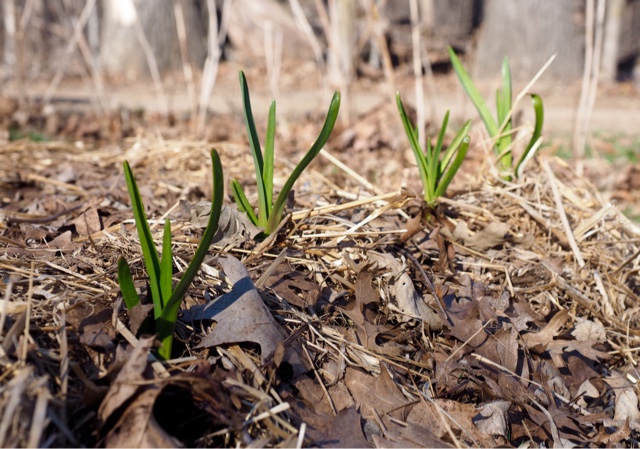
I was beginning to be concerned. After all, I planted my garlic this season just before Thanksgiving. In New York that is nothing, but here? My concern was relieved by the sudden growth pushing past the straw and leaf mulch about a week ago. Below is the Turban variety 'Xian.'
Today I have two tasks. While tending to the fire which boils down the maple sap I've collected (15 gallons so far), I am preparing the bed and laying pavers for the floor of the greenhouse. I need to get the greenhouse up as soon as possible so that I may sprout this year's milkweed seedlings inside it.
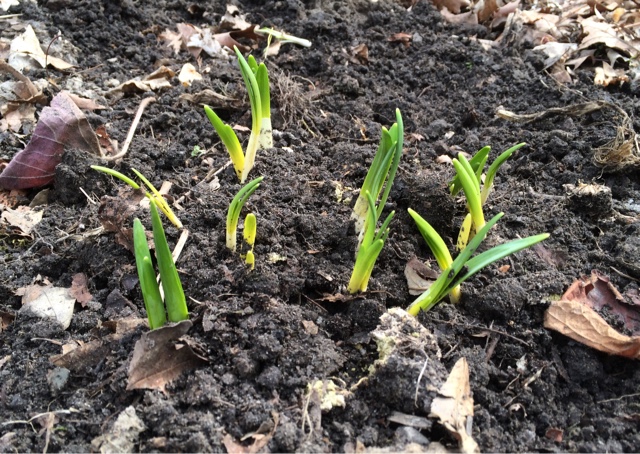
While pounding stakes for the level lines I spotted some bulbs pushing up through the tangle of nettle. I dug them out and placed them into a new garden near the driveway. Didn't think I'd get any gardening in today, but I think this counts. And what luck, just miles to our south, some areas received seven to ten inches of snow two days ago.
The Boy's Winter
I was wakened by the subtle flash and rumble that, not more than a minute later, became the brilliant glare and shattering crash of this year's first post midnight, pre dawn thunderstorm. The rains came, soaking what would normally be earth frozen forty inches, give or take. The birds had been arriving for over a week, vees of geese are seen and heard, while the prehistoric calls of sand hill cranes are heard, all traveling northerly. Comb-playing chorus frogs have made their seasonal debut and chipmunks have ascended from their dens. The grays and pale orange-reds predominating the woods are often punctuated by intense, moisture-activated greens. Most lakes have lost their ice and those that haven't remain only a stormy-green skim coat of icy slush. Most of all, even by last year's early spring standard, the trees have been budding strong and flowering early. The silver maples of the middle slough have been fully in flower for over a week. This is El Nino in the Midwestern north.
It should still be winter by calendar, averages, and tradition and this post should be timely. It is not, however, by fact and experience. Winter is over before its time and this is its eulogy.

Strong winds raked snow and desiccated grasses across the large wetland, leaving easy access for bipeds like myself.

This winter's fluctuating temperatures created a nearly constant stream of runoff from the little wetland which pooled at the northern end of the large wetland. It was a popular watering hole for all the Big Woods' animals.

Freezing and thawing of the pool made for unique ice crystals.

The dead trees of the large wetland, killed by higher water or blight.

Orange lichens on the south side of the trunks.

Wet feet is not a problem for Red Osier Dogwood, Cornus sericea.

Its branches a brilliant red in the sunny open of the wetland.

A protective structure for warm season nesting.

An unknown plant, possible weed, growing in the center of the wetland.

A rare view of the house from the wetland.

The earliest sign of approaching spring -emerging buds of shrub willows.
Stratify This
This winter I've proposed a landscape project for Franconia Sculpture Park's program. Materially, the artwork will be made of milkweed, Asclepias species, sourced from the northern tier. I don't want to say too much more about the form this planting will take as the jury is still out. I do, however want to share with you the process for stratifying milkweed seeds. It's an easy and fun thing to do should you want to get a jump on milkweed for your yard. You may, of course, plant seeds in fall and the damp, cold climate will do all the work for you, but what fun is that?

It's important to source your milkweed seeds regionally because they will be best adapted to your climate extremes. My project's seeds were purchased from Prairie Moon Nursery, a Minnesota based native seed company. Like many perennials (plants that come back each year), Milkweed requires a period of cold and damp to break dormancy of its seed. This process is known as stratification.

First you will need sand. It's possible that any sand will do, but I bought this very fine, washed sand at the big box. The fifty pound paper sack (which leaks all over, keep it outside) was under five dollars and I used only a fraction of it.

You must dampen the sand and the first thing you will notice is how the water percolates through it just as it does at the beach. If you'd rather go to the beach than the box store, I recommend bringing a coffee can with you for your seed stratification needs.

You'll also need some kind of sealable bag, ziplock type or even a baggie. There shouldn't be any free water in the bag after dropping in the sand. Add the seeds and label. I wrote the start date, how long they should be stratified, and the quantity of seeds. And since it is easy to forget about them, I put an alert on my phone to remind me to check in 28 and 30 days.

Bridge, Spring

May Flowers

It is the season of the oak gall wasp, bungeeing caterpillars, and relentless paper wasps. At night its June bugs bouncing off screens and, tonight, the first lightning bugs. We have been miraculously without mosquitoes -no one's complaining.

In the woods Red Columbine, Aquilegia canadensis, bloom.

It's a bit regal

In its dusty crown.

The first sight of the Woods Geranium, Geranium maculatum, is always a surprise in the shadowy under-canopy.

Geranium grows throughout the woods, but only one here, two there. In the area I call the council circle (laughably and yet to be introduced here) the geranium grow profusely.

Virginia Wetleaf, Hydrophyllum virginianum, has been in flower for over two weeks now.

It's pale purple mass of flowers create glowing, floating dollops wherever it grows (and that is nearly everywhere).
Spring Ephemera
Too much woods and too little time.

I am excited to find ordinary ramps, Allium tricoccum, the kind that grows in dense matts, has larger leaves, and reddened stems in a far corner of the woods, just below the road, next to an ash tree, Virginia Wetleaf and Wood Anemone. I've looked in all corners by this time, and this appears to be the only patch making the common ramp the rarer of the two in our woods!


At the edge of the north slope, Large-flowered Bellwort, Uvularia grandiflora. Could its wilted appearance be a defense against browsing deer?


Jack In The pulpit, Arisaema triphyllum, are coming up throughout the woods.

 Wood Anemone, Anemone quinquefolia, growing in the drier, upslope woods near the old tractor road.
In another, forgotten location, a pink variety of Wood Anemone.


Walking the old tractor road, pulling buckthorn, I leaned in to pull this one until my vision kicked in to halt me.

A nest of baby spiders, no idea what kind, but possibly an orb weaver type. An ephemeral of another kind -off into the world younglings, and do your good work.
__________________
The greatest, visible threat to the woods and its ephemerals is the invasion of the biennial herb Garlic Mustard, Alliaria petiolata, and the shrub or small tree known as Common Buckthorn, Rhamnus cathartica.


Garlic Mustard is bad, but nothing in our woods is as challenging as Buckthorn. Every fallen tree is another opportunity for this plant. While this corner has been a Buckthorn stronghold for many years, it really took off after a great White Oak toppled in a bad thunderstorm four years ago. It now grows on the trail as much as to the north and south of the trail.

Within the great wetland, large Buckthorn grow on the slightly higher ground occupied by the beautiful Red Osier Dogwood and Pussy Willow. Its seed is dropped by perched birds, which then sprout and overtake the dogwoods and willows. I haven't seen it to go head to head with cattails or get a sure foothold in the ephemeral pond of the back swale. In fact, after last year's flooding, I see many small upstarts didn't sprout this spring. Can we flood them out? If not water, then I love the idea of burning them out, although this would be hard to do safely.
Forestry experts, ecologists, park managers, and many others often discuss the advancing Buckthorn and Garlic Mustard as an ecological issue, a problem of "native" forest habitat. Surely it is, but for me this is a gardening problem. Intellectually, I agree with the experts, but my motivations are less than pure. I simply don't like the look of a Buckthorn monoculture and prefer to be able to see through the woods. I like surprises, yet Buckthorn and Garlic Mustard offer none other than the ability to show up in a previously unheard of location. It may be that ecological problems are more easily taken on when we believe we act for our own interest.
Bard Of The Woods
We become aware of birds by sound.

The Barred Owl, Strix varia, amongst the trees just south of the small wetland. Perfectly blended with the contrasty shadows and light of the cool season forest -elusive by design.


The Greening

Gardening at the Boundary

That day, maybe a week ago, it really came down.

I know nothing about late spring snow. Nothing. When I was a child, in New York, it snowed during our Easter break -it was early April. The day prior was warm, even the day it snowed it was warm, so much so that I was out riding my bike in the street with my brother. Although it was cloudy, the big, wet flake snow came without warning.

This snowfall is different, intermittent pellets and flakes. It was windy too, driving the pellets hard. As is often the case, the snow did not stick. The snow was not the trouble at all. It was the cold that presented itself the following night.

I woke to find a frost on the little wetland.

Crystals coated all the leafed out, saturated-looking plants in the early sun.


The cilantro.

The Virginia Wetleaf succumbed (but recovered) to the eight or so hours well below freezing.
____________________
The last frost date for our location is roughly May twenty. I do not think anyone would suggest that the last two months have had ordinary temperatures, we haven't. Since March, we have had days that topped out at 10ºF and 82ºF, although most have been in the forties through the sixties. Our March monthly average high temperature was nearly 46ºF and the April average so far is 59ºF. Daytime temperatures have long suggested I should be growing things that California is having trouble providing. Think twice. I watch the trees and the vegetable gardens. Only this week are the oaks beginning to show the chartreuse of spring and there has been zero garden activity.
Warm air masses, heated by their descent from the Rockies and Great Plains, move in from the south and west, and locally there is sunlight warming the thermal mass of land without the cooling influence of great bodies of water. The day warms nicely. At night, however, without the moderating influence of clouds, radiational cooling is strong. I recall a typical temperature differential in NYC to be about 15 degrees. Here, in Minnesota, I have seen 20+ as the norm. Beyond nightly cooling, there is always the threat of a cold airmass coming down from the north whenever the jet stream decides to do something funky. Minnesota is the common entry point for cold air, it is the reason people think this state is cold.

Which brings me to another weather detail. I noticed the window box of just planted pansies was bone dry. What? I had watered it in, deeply, just the day before. Hmm. Something unusual had happened -dry air, exceptionally dry air. Two days after the snowfall, and the day of the overnight freeze, our relative humidity had dropped to 12%, twelve percent! Our dewpoint was nearly 1ºF by the late afternoon. Meanwhile, our high temperature was 55ºF and the winds were up. The water simply evaporated. Despite this, the pansies toughed out the freeze and drought, as those in the pot above attest.

The Peat Land

The squatting tree, a landmark on the way to the western flank of the great wetland, is flowing once more. I don't think I need to explain why it has been given this name. It appears to drain the ephemeral waters of the back swale into the great wetland.

I spot the fluffy white tail of a deer, although nothing more. Probably taken down by coyotes, or scavenged by them, this disembodiment leaves me to reflect on the intimacy of the woods, its sheltering of life and death.

About to cross the once sound, but now quite risky, sawed log, timber beam and pallet bridge. It will need be the first of several woodland structures to be upgraded if we (or any interlopers, coyote included) want to keep crossing with dry feet.

On the other side, more remains.

And nettle, stinging nettle. The western flank of the great wetland is over run with nettle.

It is also a hummocky, low lying peat land of a couple of acres.

Ramp On
Ramps! I'd forgotten about them, curious as that is because I did have plans to plant them at some point in the future. As with any forage, I questioned my instinct, and kneeled down for a leaf tear. Unmistakable onion scent, however more, um, woodsy, earthy, funky even, with the slightest floral essence. The taste? Earthy, mild onion and exceptionally sweet (especially after our 30 degree nights). Our ramp is Allium tricoccum var. burdickii, a contested species or variation of the Allium tricoccum found at ramp festivals of Appalachia and farmers' markets of the North American east.

I stood admiring my patch, how wonderful the woods can be, until the creaking timbers above my head urged me on. As I continued my walk I discovered another four or five small patches. A number low enough to recall each without resorting to markers or maps. Consistent preference for slopes (prompting Betsy to humorously suggest it as another origin of its name) and well-shaded, summering sites suggested that they should have blanketed our shady, sloping woods.

I began to spot more and more ramp colonies, in all corners of the woods, although mostly out back and along the south-facing side slope. They grew under most species of trees, often near the trunk, nearly always on a slope, yet in one instance on a flat near the great wetland. In all cases an abundance of leaf litter, and in none was there any garlic mustard (although prevalent nearby in at least a couple of locations). There are so many patches that I, like a squirrel forgetting his buried nuts, can hardly remember a portion of them. This is for the best, as there is plenty for the two of us, and we must ensure the continuance of the species.

Along with the popularity of ramps in restaurants and home kitchens, they have become abundant at New York area farmers' markets and on foragers' tables. New York State has declared Allium tricoccum var. burdickii as endangered, placing it on its protected native species list. It cannot be legally wild-harvested, although Allium tricoccum is still open to harvesting (for now). Given the rarity of burdickii, it is unlikely that you will find much of it in New York, but if you do, don't harvest.
If you find yourself salivating over a patch of ramps, check for a dense colony habit, then pull away some soil to look for purple coloration on the lower stem. If you're sure you've got the right ramp, only pluck a few whole plants from each colony, or better, just clip a single leaf from several plants. Ramps take several years to mature, and several more if the colony is severely depleted, so please contain your harvest zeal. The bulbs may be four inches below the soil surface, so dig deeply with a long, slender trowel without disturbing or severing several neighboring bulbs. Do not trample ramps or other plants on your way to them and be mindful of seedlings along the edges of the colony. Finally, beware of causing soil erosion on the wooded slopes ramps prefer.
In our woods we will tread lightly, doing what we can to minimize competitors like garlic mustard, Alliaria petiolata, and take a measured harvest. Tomorrow I'll cut a few new leaves to eat with eggs. Sure, I cook, but here's a local chef with the real ramps recipes.
Bloodroot and Other Ephemera


Morning to evening, I always missed open hours.

Another day, I found a group on the north slope, just off the old tractor road.


The Minnesota Wildflowers site helped me identify this one -first reported a couple of weeks ago. It's name is Virginia Wetleaf, Hydrophyllum virginianum, and native to the eastern woodlands of which we are on the very western edge.


Of course, new things are popping up all the time.

All the while the leaves on the trees are a ticking clock that soon strikes shade.
The Buckthorn and The Squill

We have to accept that we are the Earth's most active agent of change and that we are not in control. Things get out of hand, we lose interest, we cannot manage every outcome. Amid the chaos, there are lovely things and terrible things, there is squill and there is buckthorn. We disparage the buckthorn and admire the squill, while doing little about either or choosing one over the other because it charms us. This weakness keeps us interesting. We despise buckthorn because it is so bland, so visually unpalatable, as much or more than for its aggressive growth. Then, we justify time consuming, expensive, aggressive eradication with ennobling gestures toward native purity.
The radical streak in Nature abhors a museum. We are nature. The way we change the land is nature while we are here, and for some years after. We are the buckthorn and the squill amongst the oaks and the orchids.
Say It With Carex

Sedge, Carex pensylvanica, grows in tufts in the woods. While sedges look like grasses from a distance, close inspection reveals their differences. This sedge prefers the broken canopy of a large white oak or disturbed sites like the old farm road in our woods.

The Chorus
I would be lying if I said that I was perfectly at home in our new environment. It took nearly four months for me to use the word 'home' to describe where we return to. It's not that the land isn't beautiful, clearly it is, or that I am not grateful for the house inherited by us, because I am. I think that it's largely the overwhelming change: leaving our home of nearly fifteen years, all of our ritualized attractions, each place taken in to distract from problems or ourselves, to quiet the disquieting internal dialogue. We've left friends and family (although some family is here) and the reassuring comfort they bring. We've removed ourselves from the network of artist acquaintances that, at the very least, gave us the sense we are part of an art "world." Finally, we left our university positions -my wife, adjunct professor at several universities, and myself, university adjunct professor and staff. Like nearly all artists we know, we also must work to pay life's expenses and do the things we want to do. About our move to Minnesota, work is the great, looming question.
At times it feels that it may be easier to land a position as CEO of a corporation than a university professorship. Despite the odds, my wife, with great fortitude, luck, and experience has made it to the final four in a local university faculty search. I acknowledge my bias, but it is well known across a spectrum of university administrators, students, faculty and artists that she is a great professor, artist and role model. She'll be interviewing with several people and giving demonstrations next week. There will be dinners with faculty, lunches with students, campus walk and talks. The whole process is an interview. Although one candidate of four, she may just have a fifty fifty shot at getting the call. If selected, we can move forward here with greater confidence.
If you pray, put in a word for her, us. If you cross fingers for luck, now's a good time to cross 'em. After next week, the months worth of work she has put into this application will be done and we wait. By May, possibly sooner, we'll know.
In the lull I offer the male Western Chorus Frog*, Pseudacris triseriata. singing their greatest hit, "Looking for love in all the wet places..." and the chuckling quack of the Wood Frog, Lithobates sylvaticus, who can hardly take it.
At times it feels that it may be easier to land a position as CEO of a corporation than a university professorship. Despite the odds, my wife, with great fortitude, luck, and experience has made it to the final four in a local university faculty search. I acknowledge my bias, but it is well known across a spectrum of university administrators, students, faculty and artists that she is a great professor, artist and role model. She'll be interviewing with several people and giving demonstrations next week. There will be dinners with faculty, lunches with students, campus walk and talks. The whole process is an interview. Although one candidate of four, she may just have a fifty fifty shot at getting the call. If selected, we can move forward here with greater confidence.
If you pray, put in a word for her, us. If you cross fingers for luck, now's a good time to cross 'em. After next week, the months worth of work she has put into this application will be done and we wait. By May, possibly sooner, we'll know.
In the lull I offer the male Western Chorus Frog*, Pseudacris triseriata. singing their greatest hit, "Looking for love in all the wet places..." and the chuckling quack of the Wood Frog, Lithobates sylvaticus, who can hardly take it.
*The species may be the Boreal Chorus Frog, Pseudacris maculata. There are minor physical differences, like slightly shorter legs, that account for differences in species or subspecies nomenclature of North American Chorus Frogs. They are easy to hear and hard to find, and I'm perfectly okay with being mostly right on this one.
A Subtlety


Colorful catkins decorate the woodland floor.

The earliest and predominant herb is garlic mustard, Alliaria petiolata. Invasive precisely for this reason, getting it's start before the snow has departed, gaining ground in the leafless sunshine of early spring. The woods is an impeccable example of humanity and forest, neither untouched or wholly impaired, unintentionally altered to the benefit of some species over others. Should we remain here, its condition will be the project of my days.


This looks familiar, but I haven't found a good web source for early growth characteristics, Minnesota woodland plants, etc. etc. Only so much time in a day.

Not garlic mustard, but what?

Ahh, something a different, lanceolate grey-green leaves. Asteraceae?

This grass, throughout the woods but primarily on paths, has been up since early March. Clump forming and flowering now, I'm guessing a sedge, maybe Carex pensylvanica.
Understanding what lies underfoot, what calls over the wetland, what tree is more likely to fall is quite a bit of my task now. Despite having visited here for a dozen years, although mostly in winter, I have yet to witness much of what happens. For this reason I temper my big ideas and ambitious projects, settling instead to witness the changes before me. Time is short, yes, but I keep asking myself if the ideas I do have would be any better than what is already there. So I watch, taking in as much as I can, and see my own ideas transformed in the process.
____________________
Understanding what lies underfoot, what calls over the wetland, what tree is more likely to fall is quite a bit of my task now. Despite having visited here for a dozen years, although mostly in winter, I have yet to witness much of what happens. For this reason I temper my big ideas and ambitious projects, settling instead to witness the changes before me. Time is short, yes, but I keep asking myself if the ideas I do have would be any better than what is already there. So I watch, taking in as much as I can, and see my own ideas transformed in the process.
Taking Spring

At the morning table with coffee, I was a bit taken by the sudden appearance of a green tree among the gray. When did this happen?


_____________________
Although only forty something, the breezes were a moist balm. Rain was on the way, the first rain of spring, and likely the first since October. I lingered outside wearing only a sweater. Toms pace the slough casting their garbled opinions. A red squirrel spits its rattling chastisement. Trilling robins blaze high limbs. The dimly lit woods is colored by sound. The animals take spring sooner than we do.
Snow on the Sugar Tree

I woke to collect any sap to come after the prior tipping.

That's when the snow began to fall.

Two hundred fifty six ounces of sap, nearly fluid as water, and hardly sweet.

And the snow continued to fall.

The sap continued to boil, scenting the kitchen with caramelized sugar.

And as the snow began to accumulate

the sap grew thicker and thicker.

Nearing one fortieth the volume, it left the pot for the filter.

When it was over, four inches of snow

and eight sweet ounces of maple syrup.