growing garlic

Post Post


Is this now a post post journal in accord with our new post truth environment? I admit to being busy with so many different projects that the will to post has been minimal or rather, non-existent. To blog one has to make time or have time, an idea to flesh and flush out, images to give sight to sore eyes, and an editor -always have an editor. Is it that there is nothing new to report? Hardly -there are too many things to report.


The garlic is in last season's potato bed and even more at the neighbor's sheep farm. We may see Hudson Clove return to small sales next year. The bed of herbs is taking in the glories of climate changes that helped create the longest growing season in our region's written history. Depending on one's micro-climate it was possible to grow throughout November. I believe November 19 or so was the first time it froze long enough to do in the cold-sensitive plants and the brassicas lasted into December.

Our lawn has turned completely from grass to creeping charlie. I may use the language of the walking dead to describe it from now on: another area has turned. I could go into a description of creeping charlie, but a visit to Wikipedia should do. Creeping charlie was likely brought to our place, intentionally or otherwise, by my father in law. Our vegetable gardening created bare patches that allowed it to get stronger. The lawnmower chopped it into little bits; each sprouting into a new plant as the weather permits. Last summer and this summer the weather was all too permissive. It spread far and wide and quite literally there is now no more grass. It's also invading the perennial garden and after we had the dumpster removed from the drive, I discovered it growing underneath. Raking leaves is out of the question, unless you want it to spread wherever you move those leaves. My father in law raked and hauled leaves into the woods, over the slope -a good practice, generally. At slope bottom, however, there is now a large colony of charlie that I have low initiative to deal with. I've seen it in the middle slough, too and then again sliding down the slope into the back slough.


While everyone was lining up to buy things on black Friday, I lined up herbs and flowers to prep for a winter indoors. The rosemary was over-wintered in its pot last year and hung in there, but took until mid summer outside to really take off. Much larger and greener than last year, and not so delicately ripped from its summer bed, I hope it will survive once again. Along with lantana, it will be spending the winter in warm, dry, sunny bedroom window.


The pineapple sage wouldn't have made it to bloom if the season hadn't been so extended (although it may have in the greenhouse). There is nothing this red in November around here, poinsettia excluded (we overwintered and oversummered one from last Christmas). I've cut a few branches for rooting and even brought the whole plant in. I will cut it back hard after flowering is complete and see how it does.

Some Siberian cold (often the coldest place on earth) has been dislodged and is making itself felt now. The Army Corp wisely held up the DAPL so at least some of those protesting the pipeline would be inclined to head indoors. The ridiculously warm temperatures gave those not familiar with the Dakotas a false sense of our climate and would have been hit hard by the forty mile an hour winds and zero degree temperatures of the last few days. The cold and wind forced me to bring our agave and opuntia cacti in from the greenhouse. My educated guess is that these can survive zero degree F temperatures as long as they stay dry, but I decided not to chance it. They will also spend the winter in warm, sunny bedroom window.

I, however, will spend the sunny part of days out and semi-out of doors. You'd be surprised how easy it is to get used to 15 degrees F. I just spent 20 minutes outside this morning, sans jacket, to take some photos. It's the fingers one needs to worry about, especially where there's wind. 


Above is the south side of the studio building we've been working on for the last year. I think the temperature inside has stabilized at 34 degrees F despite the 17 degrees F outside and is warm enough to do some interior framing and insulating (where I'll be after this). With the luck of the longest growing season, the grass seed I planted here in early October not only sprouted, but grew in somewhat. Then, in one of the many furious acts born out of every last day above freezing, I tilled it all but a two foot wide grass strip in order to winter plant a native savanna garden from seed mixes I purchased from Prairie Moon.


I also tilled behind the building, on the west side, where I will broadcast a woodland mix of forbs and sedges. I do not expect this to be as easy as my milkweed experiment turned out to be. Disturbed areas like this are perfect for invasive plants (like garlic mustard) to take over, so I have to act immediately. In the greenhouse, towards late winter, I will also seed five inch deep cell trays with many of the grasses and some forbs. These will be planted directly around the building and elsewhere on the land where large oaks have fallen to create sunny openings.

As I look out the window, I see that it is flurrying again. Till next time.


Garden Report

Potatoes are waning but they're still impinging on the herb bed. As the sun lowers and the potatoes die down, the herbs should reclaim their full sun. In the back left, really tall milkweed.


As the garlic comes out over the last few weeks, the fall brassicas have been filling in. These are brussel sprouts, the first planted, into the space previously occupied by garlic 'Xian.' I've never grown these before, but have planned it for years. Notable this season is a lack of cabbage moths -not complaining!


Eggplant fruit coming on now.


Green beans, from purple to roma, prolific and easy as ever.


All peppers are fruiting, some large. Only difficulty is that the plants can hardly hold their large fruit and that I shouldn't be so lazy as to try to break a pepper off the plant instead of going for the pruner. What happens? Well, I break the whole pepper plant in half.


In complete opposite of last year, all our tomatoes are suffering blight. Could have come in on our purchased compost, or maybe because we planted in last years potato and eggplant beds. Hard to avoid poor rotation in a compact garden. Next year I think these beds will be garlic and the garlic beds will be tomatoes. All that can be done now is watch the tomatoes try to outgrow the blight.


More brassica as the Porcelain garlic 'Music' has come out. As two more varieties of garlic are harvested over the weekend, even more brassica will go in. Above is kale started from seed in the greenhouse.


These giant pompoms, hydrangea actually, were moved from the south side of the house last year. We planted them in a great arc around the curving lawn-driveway. They are quite garish, but they keep the plow truck and other skiddish drivers from driving over the lawn and garden in summer and winter (thanks to the long lasting dried flower sepals), and maybe they keep the deer at bay. Maybe.


And we've finally started digging into the soil for new potatoes. Above: Kennebec russet, Pontiac, and Yukon Gold. Thanks to the quantity of compost and straw they came out with little soil and easy to clean.

I've been very busy with many things, from door and sill replacement, old deck removal, job searching and applications, studio building projects, contractors and everything I can't stand about some of them, photographing, studio painting, my class Landscape into Art which runs on the twenty third of July, a bit of socializing, gallery going, and even a music festival in a corn field last weekend. Blogging has had to take a back seat to all this (as well as taking quality photos for them), but rest assured -I was able to plant half of my milkweed over the septic drain field and beyond yesterday. Progress.


Summer Solace

One of the benefits of getting to one's vegetable garden first, before summer's work begins in earnest, is not having to think about the garden at all when you are knee deep in summer's work. It grows itself, mostly, with an intensity only paralleled by the solstice's long day. 


One of the beauties of growing garlic is that it's harvest hardly coincides with any garden task other than weeding. By now, the first of the garlic is near completely exhumed (briefly hesitated to dredge up this word), and like any darkling, it mustn't be cast into the bright light. The first pulling is in the shade of the porch, but the full harvest is likely to be dispatched to the cellar. Here, in the midst of harvest, is Xian, a Turban strain, and one of the best for flavor and earliness. Turban's lodge, or fall over, as a way of telling unsuspecting gardeners that they need help -getting out of the ground.


At about the same time sizeable beaks are swirling above the Asiatic strains -here Asian Tempest and Japanese. These will be harvested next, not long after the Turban strains, and sometimes before.


Meanwhile the Porcelain strains have had their scapes (flowering stalk) cut, ready to be pickled or grilled or sauteed or...just don't leave them in the fridge too long before doing something with them. Behind the Porcelain are the Rocambole (shorter in the middle) and Purple Stripe. 


The French Grey shallots have also been pulled. I find that the height of the crabgrass is a useful indicator for timing the shallot harvest. Left behind are the Artichoke and Silverskin strains, those hardy bulbs that we use through next winter and deep into the following spring. 


When the the crabgrass first sprouts, it's the best time to get your peppers in, but I didn't heed the crabgrass this season. No, I put the peppers in a couple of weeks early -listening to the lambsquarters maybe. They're doing fine anyways, although I do think they are showing a little too soon.


Broccoli? Yes! And from seed no less. In spring? Yes! And no cabbage moths to boot. A quick, small-headed variety seed-started on May one and hardly two months later boom -broccoli. Go figure. I've got some of those very same starts in their deep cells holding back growth inside the greenhouse. They'll be put into the garlic beds as they clear.


Green beans? Not so fast. I seed-started these in the greenhouse on May one and planted them out a two or three weeks later. Nice flowers, no beans yet.


Cucumbers before June 21? Why, yes. I purchased a cell pack of four Spacemaster cukes from Shady Acres and planted them in pots raised well off the ground.


They won't ever reach the ground, that's why they're called spacemaster. They do put on an impressive display of cucumbers and have produced a handful of medium sized eaters before the solstice. I've seeded my own, too, to replace these after they give up.


Tomatoes, well that's asking a lot, isn't it? But among our six strains (of three varieties -plum, grape, and, uh, heirloom beefsteak?) these grape tomatoes, called Red Pearl, are way good producers.


In fact the deer are warming up for BBQ season by snacking on our Speckled Roman plum tomatoes. I grew these at the Beach Farm, and deer aside, expect them to do really well here.


Dill, cilantro, basil, and at the very bottom, cutting lettuce. In the background -common milkweed that has grown in this spot for eons, or at least since this house was built, so maybe the late nineties. Infringing on their bed are the potatoes. They are so big they require their own post. Look for that.


Vegetable Early June


The vegetable garden, June 4. Peas growing in the same bed with broccoli and recently planted romaine lettuce. I had so many lettuce starts that I plunked them into nearly every bed. The next bed is green beans and a spot for upcoming chard seedlings. Third row has eggplant, peppers, and a basil patch. The following two rows are Red Pearl grape tomatoes (same as last year and magnificent), five Speckled Roman paste tomato plants, and four heirloom types that includes Striped German and Brandywine and two others I cannot recall. Our starts were from Shady Acres Herb Farm or started in our own greenhouse.


The curving garlic bed is new this year (well, tilled last November). The garlic is doing well although a little tightly planted. Doing really well is the Chesnok Red -a Purple Stripe variety. This one is said to do very well but I couldn't have said that in the past.


Here are our potatoes -five varieties including russets, golds and reds. They grow several inches each day. I am about to add compost to "hill up" inside the framed bed. More garlic to the right, and French Shallots as well. To the left is our herb bed that includes basil, dill, cilantro, parsley, thyme, oregano, arugula and cutting lettuce. I'm anticipating a productive garden and feel better about its organization over last year. When the garlic is harvested around late June, early July, I will add our late summer-early fall crops of broccoli, cauliflower, brussel sprouts, and kale. In the background are cucumbers in pots, a remnant bed of dead nettle and common milkweed, and the curving hedge of hydrangea that we transplanted from the south side of the house last year.


The Growth of Things


A peaked appearance in April has transformed into very strongly growing garlic in May. What changed? I removed the rotting straw, spread blood meal, then soaked it with liquid fish dissolved in water. Scapes are beginning to form on the Asiatic strains. Looks like we will have a strong harvest this season.


 Meanwhile, the potatoes that I planted a few weeks ago have gone from this on May 27 to...


...to this on May 31. All that energy stored in those tubers, very long days of our northern latitude, and some good luck conspire to quickly grow some incredibly tall taters 'round here. To the left is the herb bed which has not been as rapid of a grower, thyme excluded. To the right, more garlic -freebies given to me by the supplier due to smallish seed bulbs they shipped to me.

Pushing Spring


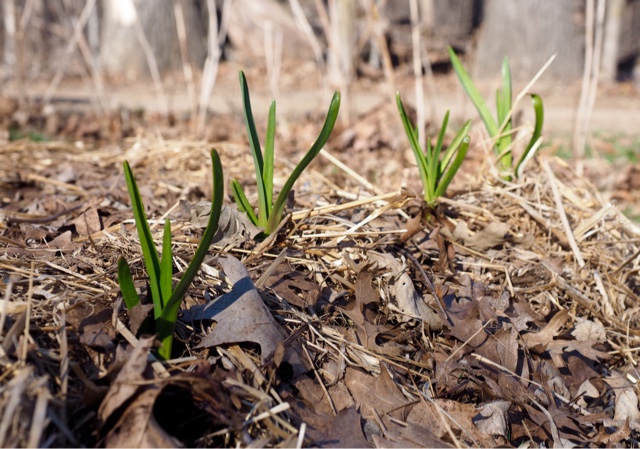
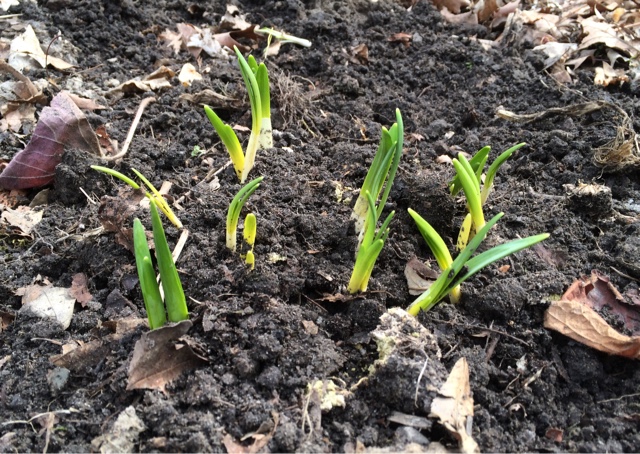
I was beginning to be concerned. After all, I planted my garlic this season just before Thanksgiving. In New York that is nothing, but here? My concern was relieved by the sudden growth pushing past the straw and leaf mulch about a week ago. Below is the Turban variety 'Xian.'


Today I have two tasks. While tending to the fire which boils down the maple sap I've collected (15 gallons so far), I am preparing the bed and laying pavers for the floor of the greenhouse. I need to get the greenhouse up as soon as possible so that I may sprout this year's milkweed seedlings inside it. 


While pounding stakes for the level lines I spotted some bulbs pushing up through the tangle of nettle. I dug them out and placed them into a new garden near the driveway. Didn't think I'd get any gardening in today, but I think this counts. And what luck,  just miles to our south, some areas received seven to ten inches of snow two days ago. 


Time, Luck and Weather


It was a couple of days before Thanksgiving and I still had not planted the garlic. In New York City and region, this would be of little concern, but here, well I was pushing it well beyond ordinary pushing it. 


The week before it had rained, really rained, so much so that our excavation had completely filled with water (a story for another day, if ever). Then, not two days later, it froze for thirty six hours ensuring that the wet earth had become a solid block. Digging was out of the question. The swimming pool, above, became an ice rink.


A week later, the Monday before Thanksgiving, temperatures were climbing, yet again above forty. And the gravel came. It kept coming until there were two hundred tons of gravel, nearly one hundred a fifty cubic yards piled inside and outside the pit. 

Meanwhile, there was garlic to be planted, the Xian Turbans were sprouting, and the cloves would need at least a few weeks without frosted earth to settle in, but what could be anticipated after such a quick, deep freeze just a week prior? I wheeled out the seldom used, 30 year-old Troybilt tiller, filled the always flat right tire with compressed air, set the throttle, lifted the choke, removed the spark plug, poured a cap-full of gasoline into the chamber, replaced and hand-tightened the spark plug, yanked on the chord, bah the the the the, repeat, and then again. Throttle off, fully tightened the spark plug, dropped the choke, throttle on, yanked the chord, then bah buh, buh, buh, buh, buh, pop, and the old Kohler engine was humming.

It wasn't easy to break the semi-frozen, wet earth, nor the lawn which floats above it. The tiller is a beast, requiring strength to maneuver, patience on turns, and knee-jerk restraint as it rockets forward when hitting solid soil. I made several passes, bottoming out at six or seven inches on the lawn's compacted clay bed. I curved these new beds to match the Hydrangea transplanted from the south side of the house to edge the boundary of the lawn and driveway, leaving just enough room for the mower to pass between.


Although our garlic grew pretty well this year, experience told me I wanted compost tilled in, but I wouldn't have anything to do with buying the bagged stuff. The city of Minneapolis collects organic yard waste, which it sells to a composting company that happens to have a site in our area. I think I paid ten dollars for what would easily be well over one hundred dollars of bagged compost. These places are worth their weight in black gold.


I tilled in about two inches of compost and made the most of tight quarters by removing any chance for walking rows (I'll regret this later). In two beds, about five feet by twelve each, I planted roughly 350 cloves, or about 3 per square foot. 


I had more cloves, of course, and tilled a row from last season's planting bed for those.


Although it was the day before Thanksgiving with much to do, I chose to make another trip to the compost facility so I could place something over the indents made when the cloves are pushed in. The soil isn't very soft or deep; I felt this could help to keep the cloves from freezing too soon. 


A light snow had fallen, which can act as an insulating layer, but more was needed.


Out back I had been saving an old hay bale that Rex had stored under the playhouse we gave away last summer. It was just the thing I needed to insulate now that temperatures were plummeting (a week later I placed even more insulation -oak leaves from the woods, and just before the next snowfall).


This is the spot the straw had been laying. Even though the ground all around was frozen three inches deep, this spot was still unfrozen.


In fact, there was a lot of unexpected activity in the heat generated by decaying straw.


Pill bugs, Armadillidiida, also known as wood lice.


And this pale sprout.


Since the week of Thanksgiving we've had more days over thirty two, some well over, than those under it. Most nights have been relatively mild, staying well above twenty eight degrees.  In a year where I've often been behind on what needs to be done and with weather the spearhead of possible defeat, I think I may have gotten lucky getting the garlic in this late.


But I'm not having any luck keeping the turkeys off the mulch.


 It seems they're quite the lovers of gardens.


The Warm Welcome


This is what I think of when I feel the chill of autumn.


Or maybe a string of pearls -the puffball, or rather the giant puffball, Calvatia gigantea, growing in the back woods among the hog peanut.


These are the things of late September and early October.


 Not basil!


 And green as can be green beans!


 Eggplant that simply won't quit.


And tomatoes that continue to produce -only now beginning to show the wilted leaf of cooler nights.


The vegetable garden here is as green as my beach farm plants were in late July. A rarity, maybe? Not the norm, say some. The coming five days are looking to be quite autumnal -blue skies, cool air, days in the lower sixties, nights in the lower forties. This should bring an end to the vegetable patch, and not a moment too soon as the garlic seed is on its way, and more front lawn needs to be tilled under. But wow, what an exquisitely long growing season.


Our Vegetables

My attitude about garlic growing is considerably more casual than in previous years. So far these varieties have shown excellent progress without more than a dose of blood meal and liquid fish fertilizer. The French grey shallots have done exceedingly well with little maintenance but the occasional weeding.


In fact, since the top photo was taken, they have lodged -meaning it is near to harvest and hardly any different from the time frame of my 2012 upstate New York growing experiment. These will be cured on the porch.


Very few interesting things going on with the garlic. They are taller, lankier than my Long Island grown garlic, although these were planted from my own LI grown heads. Each variety made the transition, so far, from coastal New York to Minnesota pretty well. There has been one interesting thing -the strange appearance of dead flies on some of the leaf tips.


They seem glued in place. Has another creature done this? Saving them for later? Or has the garlic done them in? No answers, yet.


About a month and a half ago I planted potatoes. They appear to be doing exceptionally well, with each rain adding another few inches in the last three weeks. No Colorado Potato Beetles yet and I can't keep enough soil on hand to mound up!

Of course, we put tomatoes, peppers, and eggplant in two weeks back. They were planted in 14-inch wide strips tilled into the front lawn -the only place sunny enough for vegetables. So far no creature has come to eat. I'm wary of adding green beans knowing how well rabbits take to those tender seedlings. Deer have not browsed, although we do have a resident raccoon living in a big, old maple in the woods about 75 feet from the garden. So far she's only been good for digging up a single, just-planted spud and harassing Betsy by tipping over her newly planted coleus.


What About The Garlic?


 Some of you may be wondering what has happened to my garlic farming since the move.


It has been put on hold until we can get established. However, Betsy did hastily plant some garlic in the front yard last October and it appears to be doing exceptionally well with little work on my part.


The French Grey Shallots are doing very well, as are most of the garlic varieties. 

I will only have enough for our kitchen this season and will need to decide soon what I plan to do for the next. We do not have agricultural land here in the woods. In fact, the front yard is becoming our vegetable plot since it is the only flat land that receives enough sun for summer produce.


Hudson Clove Open


I've been away for over three weeks, in Minnesota, taking care of the house and to a lesser extent Rex, my father in law. Now, back in Brooklyn, it's time to take care of the garlic. First things first, make a new bundle -The Each and Every Bundle, named as such because it has one of every variety in it -a first!

I did not have a stellar year as yields were down about 45% from the number of cloves planted. Spring time rot is the usual culprit. I have to, finally, ask myself if the humid maritime climate is not the real culprit. The second problem is rot in the curing stage -a dry rot, leaving the bulb an empty wrapper. After Minnesota, I returned to find this the case in at least some of the bulbs.

Problems aside, the store has opened. I have a quite limited supply this season, maybe only twenty five to thirty bundles. Pricing is the same as at last season's New Amsterdam Market, each head is going for two dollars, the labeling of each variety and bundling priced at five dollars, and of course shipping. As practiced, this love affair with garlic has been a financial loser. In fact, garlic growing may be on hiatus this coming season as changes in location are on tap. Like Hudson Clove on FB to stay posted, and as these changes are put into action, I will also keep you informed here.

A big hearty thank you to all those repeat customers who have supported my garlic farming! It's nice to see your order pop up on my mobile banner as soon as the store opens.

The Cure


All the garlic is hung in the studio, makeshift, along the radiator, beneath the window. The leaves are dry and thistle to the touch. The mold on the dried leaves, invisible to my eyes but not my nose, has me sneezing with too much rustling. I wear a mask for bulb cleaning. All appear to be curing well, some already finished, some a week or so to go. Labeled bundles will be available in limited quantities come mid-late August. Hop on over to Hudson Clove to order in three weeks. 


Asiatic 'Asian Tempest' did better than all other years combined. Garlic growing is a fickle affair -one year bad, another year so so, another great. Always something new, always a challenge, always a surprise!


Artichoke 'Lorz' outperformed 'Red Toch,' although grown side by side I think this was just dumb luck. Both strains lost nearly 2/3 of what was planted -the 'Lorz' is larger thanks to a later harvest.


Silverskin 'Silverwhite' did quite well in the poor, new plot that lost so much garlic. They don't look it here, but they are easily double the size of any Silverskin I've grown in prior years.


Famed, difficult Rocambole 'Spanish Roja.' I grew about twelve from last year's surviving bulbs. They did well and I will likely plant these very cloves. I can wait for it, patience. I have a good quantity of 'Russian Red' and 'Killarney Red' Rocambole available for the bundles.


The Garlic Is In


Rocambole "Russian Red" pulled and ready to be tied.


Porcelain "Georgian Fire"


The largest Silverskin I have ever grown. These are "Silverwhite."


All a hanging for the studio cure. Garlic sales open middle August over at Hudson Clove.


The Crispy Season


It has been generally dry for three weeks which has led to rapid dry down of nearly all of the varieties. From too wet one season to too dry another, all varieties could have used some supplemental moisture a week or so ago. Soon these Porcelain will be harvested.


A few scapes are always missed, and they rise up to reveal bulbils -small bulb-like appendages that can be eaten or planted. This and the two below are Rocambole.


The Rocambole "Russian Red" and "Killarney Red" will be harvested today or tomorrow. So will the Purple Stripe "Chesnok Red," and the Creole "Pescadero Red" and "Creole." Soon after will come the Porcelain and Marbled Purple Stripe, and next week the Silverskin.


Ahead Of Myself


By the time you read this I will be probably somewhere on the empty highways of coastal Georgia. Before I could leave for this journey to Florida, I needed to harvest as many of the early varieties as possible. Here we have about three dozen Asiatic 'Asian Tempest,' the fiery hot Korean strain that is often extremely fussy to grow.


Until this season, where I have produced more 'Asian Tempest' than any other strain. They held up to early spring better than most of the occasional bolters (I lost nearly all the Turban 'Xian') and then suffered little of the fits and spasms they've had for me over the years. While they grew well, they never get large, most heads rounding about 1.75 inches in diameter.


I brought some eggplant, peppers, tomatoes, and basil to fill the blanks post harvest. As long as it rains, at least once while I am away, these should do just fine.


The beauty of planting between the standing garlic is that they act to break the constant onshore winds that tend to leave little starts like these prostrate.


The bulbing fennel beginning to, well, bulb.


The chard, which I started from old, old seed at least two and a half months ago and planted sometime in mid May, has really taken off. One plant has a stem, or is it a root sticking above ground that is easily an inch and a quarter or more in the round. I clipped all the large leaves over a week ago and already they are producing very large leaves.


In one glance, Silverskin garlic to the left, Creole garlic, fennel, cilantro, romaine, flat leaf parsley, tomatoes, and then at the farthest right Artichoke garlic. When the Artichoke comes out, if it hasn't already, there are tomatoes sitting in front of our apartment waiting to be planted.


Last Tuesday


This came after, when the friends arrived, yet I put this first because, in some fashion, we are traveling out of sequence. This day was a week ago, the day garlic harvest started in earnest.


I pulled most of the French grey shallots, so healthy and green I questioned my timing. This year, my timing is rattled by a cool spring, new plot, and my greatest offense -traveling right in the middle of harvest season. The garlic you see is a Turban strain known as Xian, and I have very little of it. While the harvested garlic plant has very little odor, the naked shallots are pungent as can be.


The Asiatic strain 'Japanese' was completely harvested last Tuesday. I was comfortable harvesting these even a little early as the Asiatic strains tend to demand it or they lose their skins. However, this last week turned out to be exceptionally dry, and another week in the ground would have probably done no harm and sized them up some. A word about sizing-up garlic by delaying harvest: a day or two isn't going to do much, you really need to wait at least four days, or more if possible to really notice a difference. Keep your eyes on the weather and wait another week if it remains dry and the leaves are still quite green.


Of course, since the temperatures have remained below 85 degrees F (probably less at the beach farm), the lettuce continues to produce. The only issue has been the lack of moisture, and my unwillingness to heavily douse the rows because of their proximity to the garlic.


These heads, Romaine and Iceberg, were pulled last Tuesday, before this past dry week, and currently live, roots and all, in my fridge.


The rig, for gas pipelines, encroaches, and was closest last Tuesday.


A Typology Of Scapes


The short-stemmed, rumpled and long-beaked Asiatic (Asian Tempest). 


The double twisting, pretzeling Porcelain (German Hardy).


A variation on the Porcelain (Music).


The three quarter looped Purple Stripe (Chesnok Red).


The corkscrew, double-looping Rocambole (Russian Red). 


And the occasional oddity such as this: the double scaping plant. This Porcelain 'German Hardy' has produced two scapes. But wait, you might say -it was probably a double clove!


But no, say I -they're both coming from inside the same leaf sheath. Only at harvest will the mystery be solved.

There are scapes produced by the Turban and Creole varieties, of which I have no current photos. There are also scapes produced by the Marbled Purple Stripe variety, but they tend to look just like the regular Purple Stripe. And sometimes, just sometimes, an Artichoke or Silverskin will push up a scape of relative insignificance.


Evening At The Beach Farm


The iceberg is shaping up.


And the romaine ready to go.


I have only a few Artichoke garlic this season, but some are sizing up nicely.


I only planted a handful of French Grey shallots, and they looked pretty meek in early May. Now they've come into their own and are looking strong and healthy, but I'll have only enough for my cooking.


From this angle the new plot looks garlic-full, if a little sparse. See the shallots at the edge, right side.


Some of this season's Creole strains, "Creole" on the left and "Pescadero" to the right. Always a challenge to grow, and even more so to grow large, these plants happen to be shaping up as well as any I've grown. Dare I say the best, yet, based on their stem size. Now, to avoid the Creole curse -witches' brooming.


From this point of view, you can see how much garlic didn't survive the spring season. All that space is now planted with bulbing fennel, lettuce, swiss chard, and parsley. After the Turban and Artichoke strains are harvested, tomatoes and peppers will be planted in their place.


Over in the other plot we have the tangle of high season. Hidden in this mass is the nearly ready Asiatic strain "Japanese," but also Rocambole "Russian Red" and "Killarney Red," Asiatic "Asian Tempest," Porcelain "Music," "Georgian Fire" and "German Hardy," Purple Stripe "Chesnok Red" and Marbled Purple Stripe "Siberian."


Now the harvest game, contemplating the right moment for harvest and then seizing it. Expectations are for a season later than usual, which is good because I will be away in sizzling Florida for 10 days come late June. I do expect to have the Asiatic, Turban and hopefully the Artichoke all harvested before I depart.


And of course, there are scapes. I will be plucking them over the next few weeks, first the Turban and Porcelain, then the Rocambole and Purple Stripe. I may just keep some on the plants for the visual, but also to see how that affects size and longevity of storage.


So we grilled our first trimmings, but couldn't drum up too much interest from our guests.


As the sun settled down, I took a good, long look at the two gardens, then harvested romaine, ruby red, and one iceberg lettuce head. Although I am not growing a substantial amount of garlic this season, I have enough to offer and it's looking quite good. I am excited to bring it to market via Hudson Clove, and will probably offer labeled bundles as I have in seasons past. The cure will take place in the studio where there is more than enough room for this quantity of bulbs and the humidity and temperatures are the best of any option.


Approach Of Summer


I made a mid day trip to the beach farm to harvest lettuce for the coming week and, as it turned out, to head off the growing crabgrass that loves eighty degree days and dry conditions.  I planted some of my remaining romaine and chard, although it is awfully late for these little starts. I expect they will bolt before they size up.


Milkweed grows at the edge of our plot, and I let it for the good it does and the harm it does not.


The garlic is now sliding into its summer appearance (not unlike flower garden in July), a tangle of less turgid, slowly yellowing to browning leaves. Please note the UFO in the upper left, above the neighbor's fertilizer bag.


And, as expected now that June is upon us, the scapes are pushing up, some more advanced than this Rocambole. This Friday I will harvest (and grill) our first scapes of the season.


The earliest of the early, the Asiatic "Japanese" or "Sakura," is cloving. Before this process, spring garlic looks similar to "green onions." These and the "Asian Tempest" will be ready in a couple of weeks.


Some romaine lettuce I've yet to harvest. I will probably take this on Friday. Romaine holds up to the heat well, and I think it makes it taste better.


This is a new type of romaine lettuce, flecked with red on bright green, that I grew from seed. 


It is awfully hard not to harvest these big leaves from the Iceberg lettuce. Inside, the head should form, but I've never grown this type of lettuce before and am not feeling its potential to do so. I may have to harvest this before it wants to bolt.


In the other plot there were three heads of what I mistakenly thought of as bolted lettuce. I pulled them up and threw them on the weed pile. I found another and tasted a leaf, and then it hit me -I've planted escarole! I left the three to wilt on the weed pile, figuring it a wash and left the fourth planted. After all my work was done I tasted a leaf of the still planted escarole, a leaf not all as bitter as expected. I grabbed the wilted from the pile and began to rinse the roots of soil, then pulled the remaining one and did the same, and bagged them all. Within the hour the escarole returned from the wilted dead, completely rejuvenated, the very Lazarus lettuce you see here.


And, in a neighboring plot, the one turned over by its new gardener after I planted peas, potatoes, and greens, there is a growing vegetable mishmash from which I harvested some pea shoots for today's salad.


Green Shift


I do not have any pictures to bolster my observations, and long have I been aware of trees' change from bright, yellow green leaf coloration to the more deep, blue green of summer. It has happened, rather over night, and I think it was two nights ago when we had a three aye em thunderstorm that it tilted in favor of the summer coloration. Just a few days ago Greenwood's trees were still full of spring brilliance, but today they are fully summer green. I have nothing in the way of scientific observation, and I hardly think it requires a storm to push the trees to this state, but did it, can it?

I've gone on about the affect of thunderstorms on plant growth on these pages before, and so it is that the garden plant growth has also skyrocketed since Thursday's early morning storm. Right now, as a storm slowly moves to the southeast, I think again of the benefits of nitrogen fixing lightning, the boost the plants appear to gain. The garlic, given that both storms have traveled over the beach farm, should also look deep green, taller, and more turgid when I visit on Monday.