Compost

Local Compost


Local composting sites are great, whether they are municipal or commercial. For eighteen bucks you can buy a cubic yard (3 feet by 3 feet by 3 feet deep), but you'll need some practical transportation. In my case, I fill three old recycling containers (16 x 24 x 16 inches) and throw them into the ol' van at the high cost of shoveling, my back and nine bucks.

The low cost is the primary benefit, but there is also the virtue of steaming compost over bagged, soggy stuff that is shipped hundreds of miles or more. Local composting also encourages municipalities to pick up leaves and grass clippings and provides a location for people and landscapers to drop off small tree trimmings, drop, and brush. And late to the game but ever increasing, is a supply of compostable food scraps supplied by food purveyors and municipalities.

My criticism of local compost is that it is often too woody, given how much of it is made from shredded or chipped local brush and tree trimmings. Another complaint I have about compost brought in, meaning not made by ourselves, is that I consider it inactive. When I compost at home, the pile is teaming with visible and invisible organisms. This activity is what provides the compost its boost when given to the garden. Bagged compost is often a cold, soggy mess that needs to be re-inhabited by organisms already present in your garden. The local pile, steaming and faintly scented of ammonia, doesn't have the larger organisms of my home pile. It is, in other words, a less complex ecosystem.

So, every compost has its virtues and those virtues are context sensitive. If you live in an urban environment, bagged compost may be the way to go. In the sub or ex urbs, local compost can be trucked in by the yard and is the most cost effective especially if you extract the delivery charge (usually around $75). Whether in the city, burbs, or country, you can often find a nursery that makes an artisanal batch, bagged and at a fairly high price.

All told, the best compost is extremely local, it is your own. Now, I've got to get that new pile started.


Time, Luck and Weather


It was a couple of days before Thanksgiving and I still had not planted the garlic. In New York City and region, this would be of little concern, but here, well I was pushing it well beyond ordinary pushing it. 


The week before it had rained, really rained, so much so that our excavation had completely filled with water (a story for another day, if ever). Then, not two days later, it froze for thirty six hours ensuring that the wet earth had become a solid block. Digging was out of the question. The swimming pool, above, became an ice rink.


A week later, the Monday before Thanksgiving, temperatures were climbing, yet again above forty. And the gravel came. It kept coming until there were two hundred tons of gravel, nearly one hundred a fifty cubic yards piled inside and outside the pit. 

Meanwhile, there was garlic to be planted, the Xian Turbans were sprouting, and the cloves would need at least a few weeks without frosted earth to settle in, but what could be anticipated after such a quick, deep freeze just a week prior? I wheeled out the seldom used, 30 year-old Troybilt tiller, filled the always flat right tire with compressed air, set the throttle, lifted the choke, removed the spark plug, poured a cap-full of gasoline into the chamber, replaced and hand-tightened the spark plug, yanked on the chord, bah the the the the, repeat, and then again. Throttle off, fully tightened the spark plug, dropped the choke, throttle on, yanked the chord, then bah buh, buh, buh, buh, buh, pop, and the old Kohler engine was humming.

It wasn't easy to break the semi-frozen, wet earth, nor the lawn which floats above it. The tiller is a beast, requiring strength to maneuver, patience on turns, and knee-jerk restraint as it rockets forward when hitting solid soil. I made several passes, bottoming out at six or seven inches on the lawn's compacted clay bed. I curved these new beds to match the Hydrangea transplanted from the south side of the house to edge the boundary of the lawn and driveway, leaving just enough room for the mower to pass between.


Although our garlic grew pretty well this year, experience told me I wanted compost tilled in, but I wouldn't have anything to do with buying the bagged stuff. The city of Minneapolis collects organic yard waste, which it sells to a composting company that happens to have a site in our area. I think I paid ten dollars for what would easily be well over one hundred dollars of bagged compost. These places are worth their weight in black gold.


I tilled in about two inches of compost and made the most of tight quarters by removing any chance for walking rows (I'll regret this later). In two beds, about five feet by twelve each, I planted roughly 350 cloves, or about 3 per square foot. 


I had more cloves, of course, and tilled a row from last season's planting bed for those.


Although it was the day before Thanksgiving with much to do, I chose to make another trip to the compost facility so I could place something over the indents made when the cloves are pushed in. The soil isn't very soft or deep; I felt this could help to keep the cloves from freezing too soon. 


A light snow had fallen, which can act as an insulating layer, but more was needed.


Out back I had been saving an old hay bale that Rex had stored under the playhouse we gave away last summer. It was just the thing I needed to insulate now that temperatures were plummeting (a week later I placed even more insulation -oak leaves from the woods, and just before the next snowfall).


This is the spot the straw had been laying. Even though the ground all around was frozen three inches deep, this spot was still unfrozen.


In fact, there was a lot of unexpected activity in the heat generated by decaying straw.


Pill bugs, Armadillidiida, also known as wood lice.


And this pale sprout.


Since the week of Thanksgiving we've had more days over thirty two, some well over, than those under it. Most nights have been relatively mild, staying well above twenty eight degrees.  In a year where I've often been behind on what needs to be done and with weather the spearhead of possible defeat, I think I may have gotten lucky getting the garlic in this late.


But I'm not having any luck keeping the turkeys off the mulch.


 It seems they're quite the lovers of gardens.


Good Humus


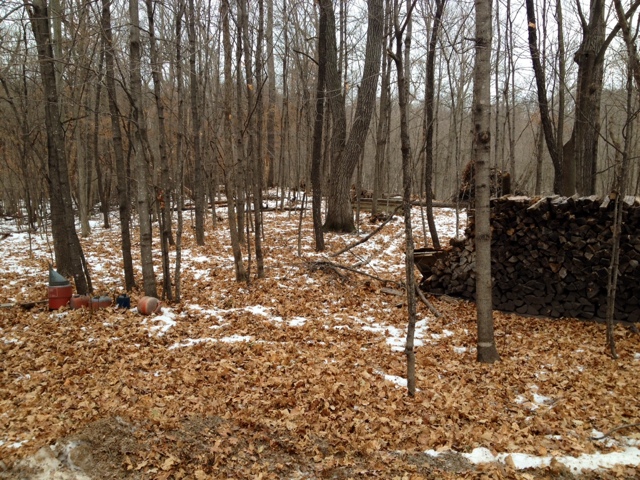
This old sugar tree came down a few years ago. It cracked like an egg where it hit the ground 


Animals have been making use of it for nesting and storing food, notably acorns. Now, it's my turn to get in on the action.


The amazing product of rotting maple wood, fungus, and animal activity is this perfectly brown, soft, but not spongey, humus. I shoveled some over the compost pile to cover newly dumped scraps. The blue-gray stuff is our mineral soil, still frozen as ever, except for what I could excavate from the nearest maple tree (a peculiarity- the soil is not frozen solid among the fibrous roots of the tree). Our soil looks incredibly rich, but its looks are deceiving. Although we expect dark earth to be full of organic matter, here the topsoil is mineral. There is very little humus in these woods, so compost will be key.


In The Beginning


God created the heaven and the earth. And the earth was without form, and void; and God said, Let there be compost, to replenish the earth; and then God said, But you must choose it, and make it in all seasons, and you must site it appropriately, for ease of doing it, and for aesthetics of sight and scent. And God commanded it, so it was done, there, behind the wood pile.


Farmers' Market Prospects


Entirely strange way to enter Prospect Park, and having done so felt its soft transgress.


Above, I spied a white redbud. I wasn't aware of this expression.


Departing the carriage road for the market, so many bins of vegetable scraps. I wish I was making my own compost and I do miss the city's free stuff (to which this does not contribute).


There were nettles (and hops), and many things free should you take the time to hunt and pick them.


Like ramps, which I grabbed, for spring's pasta with all things green. 


And quite a deal on lilac bunches at ten dollars for nearly as many branches; so one for us and one for grandma's Mothers' Day visit.


Raised From The Dead


My new compost project has begun. I am composting our kitchen scraps right in the vegetable garden soil. My goal is to create a living soil from dead plants. Possible problems? Disease -always with the disease, Frank. A good compost pile heats up real nice, my method will not, but then they always say to keep the diseased stuff out of the pile so obviously heat wasn't going to do the pathogens in anyhow. On the other hand, I'm hoping (not very scientific, hope, is it?) that the organisms, micro and otherwise, will take on the pathogens with great enthusiasm. In fact, I am hoping that I am creating an abundant food source for as many microorganisms as possible. Each week's compost (about a gallon) will be dug into a new hole in fallow garden space -especially the tomato zone. As the winter progresses, old spots will be infused with new kitchen scraps. I suppose all that I am thankful for is the opportunity to play around with a good experiment, no care for failure. And, the project gives me a reason to keep going out to the beach farm all winter long.


Queens Of Compost


This is my kitchen compost. It lives in the corner of the side yard garden, is turned maybe once a month, and is full of detritus eaters. I use it around the flower garden. My neighbor hates it, she says it stinks up the air underneath her window. But that happens to be where she keeps her three trash pails. Sometimes we drop anaerobic stink in the pile, but I always bury it, so that it dissipates rather rapidly. Otherwise, the stuff smells like sweet earth. 

Three weeks ago I was at the beach farm and an old Bronco, 80's vintage, pulls up. Inside are three young ladies, clipboards in hands, sunglasses, hats, casual earthy wear. They exit the over sized vehicle, and beeline for the "compost" bins. They take notes. Afterward, they mosey over to me, ask if I am someone I am not, and then I ask what they are, I mean, as a group, what is this group? They inform me that they work for the Department of Sanitation as inspectors of community garden composting and intend to teach proper composting skills.

Then I think: just cause you're all excited about compost, doesn't make it something brand new. Realizing that my ego is too big to allow a bunch of youngins to teach me how to do anything I didn't ask to learn, I inform them that we don't compost properly at this site for several reasons, but maybe they would like to talk to another gentleman, over there, who's worked this acre for many more years than I. I cannot imagine what was said between them, however they departed shortly after, but not before I asked if they found what they were looking for. To which they replied that they would be back, maybe this fall, to teach us how to compost properly.

Can't wait.


Undercover Sludge


On Sunday night I found myself watching the World's Friendliest Boss or whatever it's called on CBS. I can imagine the pitch to the companies, in fact, I can imagine that the companies are beating down the door to sign up for this program. It paints CEOs as ordinary people with problems too (but not too many), sensitive to the workers and their issues, and the workers are generally swell, deserving of more, and working 110 percent. But the real reason companies want to sign up for the show is the enormous amount of free advertising built into the program.  This week's company was Synagro, a producer of "compelling new modes." From their website:

"Synagro works with commercial and community partners to design and execute smart, efficient and integrated solutions to their unique waste capture and conversion needs. Our extraordinary team of technical and regulatory experts leads the field in pioneering systems that redirect the byproducts of civic and industrial growth into compelling new modes for achieving sustainable balance"

Characters in this past episode had at least two times made mention of Synagro's product, the 'new mode,' and that they use it at home on trees and plants and wouldn't you know it -the plants love it. What is their product? They make 'compost' out of the solid residues found at the bottom of municipal and industrial wastewater treatment facilities.

We already know that this product is used to fertilize farm fields in the United States and probably abroad as well. But what it leads me to wonder is just this: If we are already eating food grown with a composted "everything that gets dumped down a residential toilet, sink, industrial catch basin, and institutional trough," then why are we unwilling to use composting toilets at home and spread the wealth on our own gardens?

At least we could control much of what's in it.


Beach Farm: Week 18


The snap peas are flowering well now. A decision must be made. 

 I pulled most of the radishes.

The broccoli has been doing well, but there simply isn't enough energy in this low sun to have grown them for harvesting before a serious freeze. I also haven't brought more plastic to fully tent these. Ah, I suppose I'm giving up. Good luck broccoli.

I harvested most of the asian greens and arugula. This is what I left. I started snipping, but then just went with all out pulling.

 The bundle of greens.

 Recent heavy rains made lots of splash up and the wet soil stuck well to the growing roots.

 A bit of buttock.

 On my way to the compost, I spotted this in the field.

 The seed says nothing short of geranium.

This three bin system, instituted by our fearless NPS Ranger Thaddeus, will hardly work. All bins filled. Cannot turn the heap, cannot transfer into the next bin. A compost corral would be way better for the quantity of organic matter we're creating here.

On my way out, decision made. I chopped the snap peas for the greens. I will saute them in butter and garlic with pancetta and serve with pasta -better than waiting for 10 pea pods and then finding everything frozen on my next visit.


Gold In Them There Kitchens

A couple of weeks ago, Marie of 66squarefeet fame wrote an article about composting on Shelterpop. I then thought I should post a picture of my sloppy, unkempt pile of rotting vegetables and debris at the base of the yew tree. I don't turn it much because its a little hard to get to -maybe once every 45 days. Either way, black soil comes of it, which I spread on the garden and add to new planting holes. Viva compost!

The Compost Trap


I cut back the baby mesclun one last time.


Here's the bounty.


While organizing the garden I've seen lots of slugs. But no damage to the vegetables or plants.
This one is on a Yew tree branch that I pruned out and threw on the compost pile.


This snail is on the climbing hydrangea leaves I clipped off the vine and added to the compost pile. These two photos add more anecdotal evidence to my theory that the mollusks like decaying matter over living, as neither has been seen on the living yew or hydrangea. The compost trap.

The pile does have these guys flying around it. I haven't identified them yet...

No Upcoming Compost Give Away


There will be no compost giveaways at any facility of the NYC Dept. of Sanitation system this spring and most likely next fall. Last fall, the DSNY did not collect leaves, the major component of their compost. Until our financial situation improves, I don't think composting will be a part of our municipal programming.

We'll have to do it ourselves. Find an empty lot in the neighborhood, begin a block-wide collection of vegetable food scraps, leaves, grass clippings, coffee grinds. Distribute to those who want it on the block. We're on our own now and this could be a good thing.


Free Compost This Weekend

Don't forget the NYC Compost Project's compost giveaway this weekend at the Fresh Kills Compost Facility on Staten Island.

For specific info please see the calendar at right.

Apparently this is the last opportunity for free compost until the city budget changes for the better. Separate leaf removal by the DSNY has been suspended for budgetary reasons. Without the leaves there simply is no reason to do bulk composting in NYC according to the DSNY. This is a sad moment for us, not unlike the previous suspension of recycling. Leaves will now be collected with the regular trash.

Free Compost This Weekend

Don't forget the NYC Compost Project's compost giveaway this weekend at the Soundview Compost Facility in the Bronx.

For specific info, see the calendar below to the right or go to the above giveaway link.


Apparently this is the last opportunity for free compost until the city budget changes for the better. Separate leaf removal by the DSNY has been suspended for budgetary reasons. Without the leaves there simply is no reason to do bulk composting in NYC according to the DSNY. This is a sad moment for us, not unlike the previous suspension of recycling. Leaves will now be collected with the regular trash.

NYC Compost Give Back Dates Announced

The NYC Compost Project announces it Fall 2008 Compost Give Back.
Save the dates:

Soundview Facility
(Bronx) October 4th & 5th -8 am - 2 pm

Fresh Kills Facility
(Staten Island) October 18th & 19th -8 am - 2pm

There are still no give backs at the Spring Creek facility (Queens/Brooklyn)

From the DSNY:
Unfortunately, Still No Compost Givebacks in Brooklyn

At present, DSNY doesn’t have an operating compost site in Queens or Brooklyn, so we are unable to provide more convenient giveback locations for residents in these boroughs.
DSNY is awaiting final approval from the NYS Department of Environmental Conservation for a permit to operate the Spring Creek Compost Site, located near the Brooklyn/Queens border by the Gateway mall.
DSNY currently has only two permitted compost sites (Fresh Kills on Staten Island and Soundview in the Bronx). To keep composting programs operational, DSNY needs additional sites. To address this problem, NYC’s Solid Waste Management Plan created the Compost Siting Task Force comprised of representatives appointed by the Mayor, the five Borough Presidents, and City Council.

Of course you may go to the other facilities, but for the gas and tolls.

Compost Host

For those of you looking for that great free NYC compost, its no longer available this season. The next compost give-away will be in autumn. So many of us want to amend our garden soil or fill pots with the stuff, it is too bad that we can only get some two times a year.

If you live in a neighborhood with gardens, community or private, there may be some compost to be had for the asking and carting. Ask around, often gardeners make more than they need.

If you have to go to a store, try a nursery. Ask them for compost without any treated sewage sludge. If you go to a large chain store, like Home Depot, you may get "organic" compost with organic wastes in it. If there are no ingredients listed on the bag, don't trust it. Somewhere on the packaging there should be a proud boast of the all-natural ingredients used to make that compost. Compost should smell relatively clean, not like the water's edge when the tide is out, and shouldn't be slimy or soggy.

A brand I have used in the past is Coast of Maine soil amendments. Apparently the brand is available at most Whole Foods in NYC. If you can imagine dragging 10 bags of compost through a Whole Foods, then I guess that's a local source. I think, however, that you can trust your garden center to steer you in the right direction when it comes to picking truly clean compost.

Another way to get good compost is to go to a composting company. For very little money, compared to the bagged price, you can get high-quality compost. If you want more than a cubic yard, these companies will deliver or you can pick it up yourself in a pick-up truck. Maybe you can buy a few cubic yards with several neighbors and divvy up the pile!

A company I have used is Nature's Choice, based in New Jersey. I bought over 100 cubic yards from them for a big project on 15th Street in Brooklyn. They have extraordinary cubic yard prices and excellent, rich black compost. Everything I planted in it grew exceptionally well. I don't recollect what delivery will cost you, nor do I remember what their minimum quantity is for delivery. But if you can swing this method of getting compost, you can get it right when you need it. Oh, and by the way, when they say they'll deliver between 6 am and 7 am to avoid traffic, they'll be there at 5:59 am!

Kvetching Compostable?

I now know the drawback to not having a compost repository here in Brooklyn or Queens. Last autumn, we lost our Spring Creek Compost Facility to ???. So now our free compost is less free. We have to drive over the Verrazano Bridge to the tune of what, 8, 9 or 10 dollars -what is it these days? Yeah, I know, the FDR shoot me up to the Willis Avenue Bridge, gets me to the Bronx facility for nothing. But I missed the Bronx weekend for a variety of reasons like I don't have a car and I gotta borrow one. They gotta get the Brooklyn/Queens Facility back on line. Gotta.

NYC Closes Sprink Creek Composting Facility

It is hard for me to believe that NYC could close Brooklyn and Queens only compost facility - Spring Creek. Not only is composting an important waste reduction activity, it has been a great boon to gardeners across the boroughs of this city. I have been going to Spring Creek for a few years now to supply my garden with fresh and FREE compost. As much as I can cart away. This was a busy place on the giveaway weekends. The facility was well staffed with DSNY employees directing cars in and out of the facility and helpful with directions should drivers feel disoriented. To be sure, this is not an area many people often go. Spring Creek is on the north side of the Belt Parkway, NW of JFK airport. But it’s easy to get to (I take Linden Blvd., aka Route 27, the whole way) and no problem once there.  

Apparently the DSNY has not been able to renew their operating permit. I do not know why this is the case. They say they are searching for new facilities. Meanwhile, there are two other sites to pick up fresh compost this fall, at the Fresh Kills Facility on Staten Island and at the Sound View Facility in the Bronx.