peas

Vegetable Early June


The vegetable garden, June 4. Peas growing in the same bed with broccoli and recently planted romaine lettuce. I had so many lettuce starts that I plunked them into nearly every bed. The next bed is green beans and a spot for upcoming chard seedlings. Third row has eggplant, peppers, and a basil patch. The following two rows are Red Pearl grape tomatoes (same as last year and magnificent), five Speckled Roman paste tomato plants, and four heirloom types that includes Striped German and Brandywine and two others I cannot recall. Our starts were from Shady Acres Herb Farm or started in our own greenhouse.


The curving garlic bed is new this year (well, tilled last November). The garlic is doing well although a little tightly planted. Doing really well is the Chesnok Red -a Purple Stripe variety. This one is said to do very well but I couldn't have said that in the past.


Here are our potatoes -five varieties including russets, golds and reds. They grow several inches each day. I am about to add compost to "hill up" inside the framed bed. More garlic to the right, and French Shallots as well. To the left is our herb bed that includes basil, dill, cilantro, parsley, thyme, oregano, arugula and cutting lettuce. I'm anticipating a productive garden and feel better about its organization over last year. When the garlic is harvested around late June, early July, I will add our late summer-early fall crops of broccoli, cauliflower, brussel sprouts, and kale. In the background are cucumbers in pots, a remnant bed of dead nettle and common milkweed, and the curving hedge of hydrangea that we transplanted from the south side of the house last year.


Peas, Potatoes and Other Growings On


While I was at the farm for reasons garlic, and due to an exceptionally low number of weeds, I spent half my time there filling empty rows with other needs, wants, and experiments.


Pea greens. These multi-colored pea seeds belong to a variety which is known for producing quality vegetation over quality peas. I planted 80 feet of these, or about 2/5ths pound. If they do well, I will bunch and sell if you're interested.


I ordered three varieties of potatoes, choosing ones that I tasted last fall (all farmer market purchases). German Butter, Purple Viking, and Red Maria -all from Moose Tubers, a Fedco Seeds company, and all certified seed potatoes.  I cut them, probably later than is best practice, allowing them to begin suberization (form corky skins) for 36 hours. In retrospect, I should have planted the potatoes whole since I discovered that I had enough for one and two thirds rows and they weren't suberized at planting. I've never planted potatoes before, so this planting falls under experiments.


One row of potatoes. The light stuff all around is alfalfa meal.


I also planted patches of spring greens in all of my short garlic rows. Look at how tiny the Wild Arugula (also Roquette or Selvatica) seeds are. In addition to this, I planted spinach, regular arugula, pac choi (for salad), purple mizuna, and 'Ruby Streaks' Mustard. We were not able to plant at the beach farm this spring, so I decided to have a go with this personal crop at the garlic farm.

As for our tomatoes, peppers, lettuce, and what else, I am waiting to hear about the beach farm's opening. I would prefer to plant those nearer to Brooklyn because they will come into fruit after the garlic harvest and when you want a fresh tomato, a half hour away is way better than two and a half hours.


Painted Pea


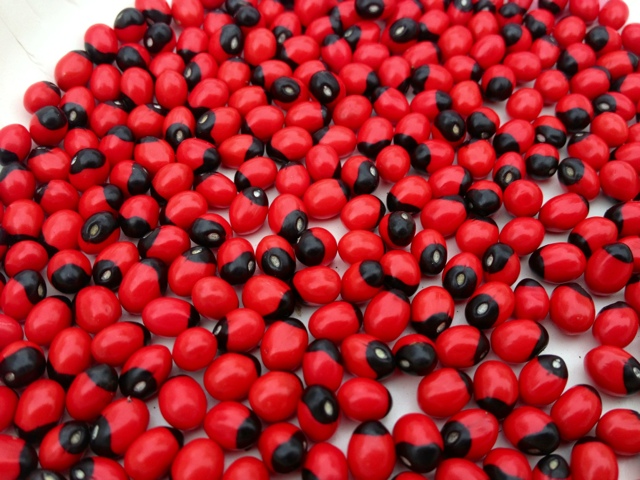
A berry, or rather a pea, and a rather poisonous one, spied on a ratty sump fence the day I arrived in Orlando. Marie asked what it was; a reader, friend, and expert in Peruvian culture suggested Ormosia coccinea and I called it a day. Yet something was nagging at me. A website stated the popular, good luck pea was the seed of a tree and my sump specimen was certainly not a tree. Although maybe it was young, maybe it suckered from so many hacks.

An image search yielded clusters of pods and peas that looked right, but of different species. Not the huayruro of Peru, but Abrus precatorius. A vine, not native, and invasive weed of Florida. That rings true -sump plants tend to be weeds.

Now I'm wondering if jewelry makers would be interested in these striking red seeds. I've already contacted Bonbon Oiseau, although peas may not fit her oeuvre. Would you wear poisonous seeds?


The Gaahrdener And His Gaahrlech.


This is Wolf. Carpenter by trade, gardener by the ocean. He grows lots and lots of garlic. This year he said he came up short, but won't bother with growing the grocery store stuff -he says it doesn't grow for him. He knows what he's doing. I like his plank system for spacing, lining up rows and keeping the soil less compacted. Perfect for a spot this size. He was smart enough to wait out the weather, not outsmarted by the freak October snowstorm into planting too far ahead of a freeze. I, on the other hand, was all too ready to match last year's planting date of middle November.

And this is what I have to show for it. Our beach farm soil hasn't dropped below green growth-inhibiting temperatures. Above is Tuscan, a turban variety. I've also noted Aglio Rosso, a creole variety, because it has not grown above the soil line and, after exploratory digging, I see that it has only leafed out about an inch or so. Most of the other garlic varieties down at the beach farm are above the soil line. They'll be fine, of course, but we best get some cold weather soon or they will use up too much of their stored energy long before they need it.

These should be long dead.

Fuzzy little tongues so brilliantly red.

Of course, the snap peas really do like this weather -an eternal spring.


Post Irene


On Saturday morning, as Hurricane Irene approached NYC, we floated toward the beach farm with ease. Yet, on Wednesday morning, three days after its departure, I was stopped by a park ranger. Park's closed, he said, then, what's your business here? Garden, I said. Go on, garden's only thing open today

I wondered why. Meanwhile, military copters zig zag across the sky. The ranger, in earshot of the beach farm, was chasing away beach goers all morning. I bet they relished the opportunity to close Tilden beach so that it could be what it was intended to be -a shore bird sanctuary, not a hip, no lifeguards please, hangout. Although, it was a really nice beach day.

A few short minutes into straightening up the farm, I believe I discovered the reason the beach was closed, and possibly even the reason for the military -an invasion of hungry mosquitoes and biting flies! My ankles are still swollen with bites. Sometimes it seems that rain simply multiplies mosquitoes, as if rain was a cloning agent. I suppose that 10 inches of rain in two weeks is enough to create an army.

As for the farm, it really did take all the weather rather well, which appears to be the scenario across the NYC area if gardening bloggers' reports are any indication. I did lose a few tomatoes, too small to ripen, although one was large and ripening on the ground, unaffected by the drop. Not so many plums had dropped either. It does seem the plants are living in late September over late August, however. They are in a state of decline.

I picked a couple of stout carrots and some orange pixie tomatoes and, of course, a couple of pounds of green beans. I also began pulling bean plants to make room for more broccoli. I would say the peppers fared the worst through the storm, losing small, green peppers to the ground while heavy rains washed away soil from the roots. 

I think it is fair to say that peppers are finicky growers, difficult even, with the exception of the hot peppers like habanero. I got one orange bell out of the ordinary bell pepper plant and it had some circular rot spots. Others fell off prematurely, or had holes bored by insects. Even the poblanos have been poor producers. Meanwhile there are healthy looking pepper plants sprouting all over the side yard back at home -what gives? 

 The snap peas are beginning to poke through where cucumbers once reigned.


Pea And Broccoli Pull


I pulled the broccoli and transplanted the remaining small plants to the fall-season broccoli bed. It was also time to pull the peas, although I was hesitant because they were still producing. But, it was now or never for the paste tomatoes, which were growing stiff and yellow in little pots. 

I was hungry, at the beach farm long after my intended stay, and I was fortunate to have every last snow and snap pea, and some pea flowers and leaves to feed on. As it turned out, the peas had become the target of aphids, which helped me feel better about pulling them.

Although I munched almost thoughtlessly, I noticed tiny, suspended eggs on one pod.

And then on a leaf, along with an aphid or two, more eggs. The peas had become a weakened host, and I was glad to let them go.


Beach Farm Morning


I am now beginning to curse the peas for continuing to produce. Tomatoes. Tomatoes. Tomatoes.

We get a handful or two each time we visit. Chard is pumping out the leaves now. And, I've decided to wrap up the broccoli for the season.

Despite the side shoots, and this lone central head yet to fully emerge.

I've released the broccoli from its tent, baring all to the sun and passers-by who wondered what ugly offspring could have needed to be covered so. Lay all the eggs you want, cabbage moths! By this weekend, or maybe Monday, Poblano seedlings I started two weeks ago will be in this bed, and an eggplant or two, and a hot pepper of some kind or another. And the other beds retro-fitted for green bean seeds.

The tomatoes are putting on some growth now, beginning to rise to the first run of netting. When we get back, I expect, the tomatoes will be at least twice as tall. 


I left for the farm around 6:45 am so that I could test the system, particularly the overheads, while no one was at the farm. Sour luck, the before work crowd was there. I waited till they were off, and tested, tested, tested.

Outside of imperfect coverage, it generally works. The overheads are needed for broadly seeded beds where dribbling emitters would be tedious. Herbs like parsley, the greens, the seeded carrots, and leeks are all good examples. Each tomato has its own in-line emitter -that works well, and was easy.

Refreshing on a hot day.


Bearing Fruit


Around five o'clock this afternoon we were racing to get barbecuing items together for an evening at the beach farm with my father-in-law. He wasn't much aware of the garden on the beach and we thought we should show him before he leaves tomorrow. While there, why not cook some food after snacking on snap peas and broccoli florets, which, by the way, were a complete surprise. But my point is that we were not listening to the radio, and weren't aware that the interview would be broadcast this evening, having first heard of it via Marie, on FB, several hours later!

The snap peas have been bearing fruit, not the least of which is the interview with WNYC. You can read the blog post at Last Chance Foods. Happily I see that they included a link to both this here blog and my art work. Below is the audio of the interview with Amy Eddings.


I discovered a few things about pea pods this season. One is, the 'Sugar Ann' snaps do not always grow true -a few have been fruiting as snow peas. Another is that you must wait for the snaps to truly plump up if you want them sweet as can be. Also, I have one purple-flowered snap out of 25 white-flowered plants, and I see that I can foretell this by observing the purplish leaf axils that only the purple-flowered peas seem to have. If you're eating the greens in a salad, the purple flower sure dresses it up.


Beach Farm Bugs, Rapture


Today we ate our first snap peas, not our last.

The broccoli tent is exploding with growth and I steel myself against taking off the cover.

Inside it's snail heaven, and being heaven, I suppose they need not eat, because they're not.

I reduced the leek rows from four to three, transplanting into the places where we lost leeks.  

When I dug out this leek, out came the grub in the same shovelful. The leek's leaves just fell away. I do not know what these larvae become, other than some form of bug or beetle, but they seem to be wreaking the most damage at the farm. I now blame them for the cut down broccoli and the wilting, cut down young chard. We find these wherever we dig, and I presume the snow cover helped more survive than usual.

I went over to the untended plot and thought about grabbing some asparagus tips, but I noticed these eggs. Click on these photos for much bigger images.

Then I realized there's a lot of reproduction going on.

Name that beetle. Please say asparagus beetle, because it was only on that, in numbers, and the name rings a bell.

We headed to the beach after 5 hours pulling weeds, building tomato trellis, repairing Federal fences, thinking of the rapture. It was all the talk, while everyone worked hard on their plots, sure in their actions, if not in their words.

And a wedding was held on the beach today, happy and hopeful.

And Betsy and I felt thankful that we could spend another day on this earth, rapt as we are with it. And since there will be a tomorrow, I'll plant all these tomatoes at the beach farm.


Minding The Peas


Growing tip of a snap pea.

Three years ago I inquired about purchasing a bunch of pea shoots at the one stall I figured most likely to have them of all the stalls at the Grand Army Plaza Greenmarket. The proud young ladies, who sell all kinds of edible sprouts and greens, pointed out the pea sprouts in a plastic-lined straw basket. I explained that I was looking for the shoots, err, the tendrils and leaves of a mature pea plant. They explained to me that selling those would ruin the pod and pea harvest. I thanked them, disappointed, and was on my way.

Pea sprouts after just a few days, sprouted in a pot on my windowsill.

Ever since I bought that one dollar bundle of pea greens from a Hmong American farmer at the Minneapolis Farmers' Market in 2008, I've scanned our Brooklyn greenmarkets for fresh-cut (in today's parlance -local) pea greens. I have always presumed the greens to be sensitive to lengthy storage, just as are the fresh peas and pods, and so have not looked to produce markets in Chinatown. Although, in season, I would expect to find them there because Chinese cooking demands snow pea greens and sprouts for several dishes. Lately I have been hearing that you can pick them up at the Union Square greenmarket, but haven't confirmed this myself.

A pea green -stem, leaves, tendril.

It makes sense that the garden, or shelling pea, Pisum sativum, would garner all the attention. It's wrapped green spheres are sweet and nutty little bites of spring perfection. Then there are the snap and snow peas, with their crispy crunch and phyto-saccharidity. This is where all the breeding work has gone -into bearing perfect, sweet fruit. It was Dr. Calvin Lamborn, at Gallatin Valley Seed Co., who discovered a swollen, edible-podded pea plant after crossing a mutant pea with the snow pea, Pisum sativum var. saccharatum. Immediately after his discovery, he began a breeding program to perfect Pisum sativum var. macrocarpon -the snap pea. Ten years later, snap peas became a marketing success and, today, can be found in almost every grocery store freezer.

Snap pea.

There hasn't been any significant breeding of peas for distinctive greens, although I am willing to bet this year's greens that there are local, heirloom snow peas in China that have been selected over generations just for their greens. It is worth saving your own open-pollinated pea seeds for selection toward the best greens. I've read in a few different places that the 'Oregon' snaps, such as 'Oregon Giant' and 'Oregon Sugar Pod,' are the best for pea greens, although any sugar snap or snow pea variety should do. In the interest of your health, it is wise not to eat the greens or peas of any ornamental peas, like the famously scented sweet peas, Lathyrus odoratus.

Our short double row of maybe 30 pea plants.

We are growing a dwarf variety of snap pea, called 'Sugar Ann'. I selected this variety for its diminutive size, usually less than 24 inches, because I began growing them in a small container garden. This year, at the beach farm, I've used the last of those seeds (they usually store well for three or so years), and the short size has helped overcome the winds at the site. Next year I plan to grow a taller variety, maybe one of the Oregons, tempting the winds of fate.

Looking closely, you can see where I snipped the greens from the main stem.

So, when do you harvest your pea greens? After you've harvested your pods? By then it may be too late, having warmed significantly, and your greens are likely to yellow, toughen, their tendrils stringy and branches woody, the plant possibly suffering from mildew. Before you harvest your pods, then? You may get significantly less pea pods if you harvest flowering branches and cut too many energy producing leaves, but before the pea pods form is when you should start eyeing your pea plants for their greens.

After snipping the pea greens, new growth will stem from the leaf axil.

It is important to let the plant mature enough to tolerate your trimming. Allow your peas to grow to at least one foot tall, because you only want to clip greens from a healthy, vigorous growing pea for the most tender and best-flavored greens. Depending on the weather and when you plant, the best pea greens can be harvested in the NYC area somewhere between April 30 and May 30. Of course, you can keep harvesting those greens as long as they are tender, no matter the date.

Edible pea flowers are either white or purple.

Give yourself a taste of those pea greens in the garden. If the tendrils are tough in the field, they won't get any better in the kitchen. Where the tendrils might be tough, the leaves and thicker stems may still be tender, or may soften under the influence of the saute pan. Experiment! I've found that semi-tender tendrils may toughen a bit with gentle cooking, and it is helpful to cut them smaller than the rest of the greens. I've read, too, that storage in the fridge for more than three days can toughen up pea greens, although I have not waited long enough to discover this myself.


Growing Conditions for snap and snow peas:

  • Any well-drained soil will do.
  • Work in compost.
  • Six hours of sunlight
  • In the NYC area, watch the weather and plant anywhere from March 10th - April 10th.
  • Soak seeds overnight and plant directly in prepared bed according to seed packet directions.
  • Mulch with straw to preserve moisture if necessary.
  • Spring rains are usually enough water until May, always water regularly during dry spells.
  • Ideal growing temperatures are 50 - 65 degrees F.
  • Add stakes or netting for peas to climb.
  • Once a foot tall, you can fertilize with just a little 5-10-10 -if any at all.
  • Watch for slugs.
  • Watch for aphids in fall growing season or early summer.


If you do not have access to a community garden, yard or container garden, you can raise pea sprouts on your windowsill. I have only tried this in spring, but I do suspect fall is a good time as well. Summer may be too hot and humid and winter too dry and dark on the windowsill, but why not try in every season?

Windowsill snap pea sprouts.

Purchase some snap or snow pea seeds and soak overnight in a bowl. Find a container with drainage and fill it 3/4 full with good quality potting soil or compost. Dampen the soil thoroughly. Make sure to have a pan to catch water underneath.


Place the soaked pea seeds evenly around the pot. You can fill more densely than I did here. Then cover with a thin layer of potting soil or compost and dampen. I covered it with cling wrap to maintain the moisture until the seeds sprouted.

Soil-covered seeds.

In just a few days your pea sprouts will emerge.

The pea sprouts after about 10 days from planting.

Snip above a set of leaves so that the plant will continue to grow new leaves. Keep the sprouts watered as long as you plan to snip new sprouts. You can eat these pea sprouts much like you would the pea greens - fresh in a salad, stir fried with garlic and chili pepper, with pasta, or any number of other ways. You can see my pea green recipe here.

Pea Sprouts - sprouted peas, young and tender.
Pea Greens - mature pea leaves, stems, flowers, and tendrils.
Tendrils - the curling, "grabby" apparatus of the vine.
Dou Miao (doh-meow) - pea tips or greens, pea sprouts sometimes labeled this way, the Chinese name for pea greens.
Mangetout (manzha-too) - French meaning "eat all," used to describe snap peas.
Snap Peas - edible rounded pods, peas, and greens.
Snow Peas - edible flat pods, and greens.
Shelling Peas - edible peas and stronger-flavored greens, inedible tough pods, the English pea.


Should Be Farming


My plan was to hit the beach farm today, but I simply could not get my act together enough to finish an application for a residency program last night. Post-mark deadline today, I will be desk-bound until I am finished. In lieu of going today, I will post some pictures from last Saturday's beach farm visit which in all the busyness never got posted.


I hope you can see how the front broccoli tent is ballooning out. That is because the broccoli is getting quite large. The back tent broccoli was planted 2 weeks later than the front and are much smaller. I now see the benefit of planting out earlier -despite slow green growth at first, strong roots develop and then speedy green growth when the temperature warms.

I released the stakes tying the whole tent apparatus together so the broccoli will lift the tenting as it grows upward. I really wanted to expose the broccoli to the cooler air, but I had to remind myself that the tent is to keep the moths out as much as it was for protection from the winds.

Inside the tent. It's hard to weed in there, and the broccoli is super tender, as if grown in a greenhouse.

The garlic is getting quite large, the stems at the soil level almost an inch in diameter. I'm expecting scapes sometime in the next two or three weeks.

And, of course, the peas.


Dinner With WNYC


The last thing I ever intended for this blog was to talk about food or cooking. To be fair, I began blogging with aesthetic gardening, flower gardening, with nothing of the vegetable kind, in mind. Since then, I began reading what others were saying around their gardens, and of that became an awareness of the accord between the garden and the kitchen.  It may be hard to believe, but I never gave that much thought, and most often saw the produce of any vegetable garden I have tended as a source of fresh vegetables to eat uncooked, there in the patch. 

But all this has changed, hasn't it? I am now a dedicated foodie, a forager, a farmer, my kitchen a forum for fresh and fancy foods? No, not really. Although I have a few tricks up my sleeve, my meal palette is actually quite limited, and my time for cooking quite the same. But the media does like talk of food way more than gardening, enough so that garden talk has become the preamble to food discussion. And I suppose that makes sense, especially as we talk of vegetable, ahem -food, gardening.

This Thursday I'll head down to the WNYC studios to record 20 minutes of talk with Amy Eddings about gardening peas, and more specifically pea shoots, and maybe some chat about city vegetable gardening, garden blogging, and community gardening. I hope to figure out a way to drop the word artist and frankmeuschke.com in there somewhere, maybe as a .exe, one that surreptitiously opens only after the 20 minutes has been edited down to the broadcast five. In preparation, I'm constructing statements on the confluence of painting and gardening.

As it so happens, I have had WNYC over for dinner once before, several years ago. My family's turkey stuffing was on the table, and Leonard Lopate and Ruth Reichl were guests. Ruth, editor of the now defunct Gourmet magazine, mentioned that the recipe had reminded her of polpettone. If you were listening, you may have heard the crickets, because I had no idea what that was and had little interest in admitting to my ignorance (until now, apparently). So, like everyone else, I looked it up online afterward, to find it's essentially meatloaf, Italian style, albeit more interesting than your average American loaf of ketchup, onions, and ground beef.

This time my guests would like to have pea shoots for dinner and I've harvested just enough to experiment with a pasta recipe before my appearance on Thursday. Of course, my instinct is to relate how delicious it is to eat them raw, snipped right off the plant, washing optional. After that, wouldn't one want to have it in a salad with the slightly bitter and snappy fresh greens also harvested now, a dash of olive oil and lemon, salt, and pepper? Those really are the first things to talk about and two things I've already eaten this spring. A way to eat cooked pea shoots is in a simple stir fry, which I made the first time I ate pea shoots several years ago, after I bought a rubber-banded bunch for one dollar from Hmong farmers at the Minneapolis Farmers' Market.

Pea shoots are sweet, a little nutty, distinctively pea, but without it's starchiness. They go well with earthy, woodsy ingredients, so I went to the farmers' market on Cortelyou to pick up cultivated mushrooms more exciting than the usual baby browns I can get around the corner -but those would work, too, in a pinch of any kind. The yellow and gray oysters were 7.99 a half pound and the hen of the woods was the same. My brown paper bagful cost me ten even. Dry, fresh mushrooms are fairly light-weighted and you'll get your money's worth in flavor.

I went to Caputos on Court to pick up some guanciale, fresh ricotta cheese, parmigiano, pecorino toscano, fresh pasta (out of pappardelle, out of fettuccine, had to settle for linguine), and ravioli. I bought the "wrong" ravioli, and left that out of the evening's exploration, saved for Wednesday when I will cook them with farmers' market asparagus and the remaining mushrooms. The guanciale is a cured, but not smoked pig jowl, a delicately textured "bacon," that reminds Betsy of flavors somewhere between turkey skin and pancetta.

Wild garlic, Allium vineale, has a very earthy flavor, with subtle hints of garlic and shallot. I foraged these from the fields at the beach farm on Saturday, clipped the roots and stems, peeled the first layer of skin, washing thoroughly, and chopped. You can find wild garlic in most any woods or unmowed field right now in the metro area.

I have been growing peas in house as well as at the farm. Those on the right are cut from mature, beach farm plants, earning them the right to be called shoots, as opposed to the sprouts seen on the left. There may be some confusion about which should be called shoots on the web, but there is no doubt in my mind about which is which. Recently sprouted peas should be called sprouts, while mature vegetation cut for eating can be called shoots, but should be called pea greens to save from any confusion. Don't confuse pea sprouts with mung bean sprouts, which are an entirely different food.

The field grown pea shoots are robust, leafy, and with flowers -a mouthful of fresh pea flavor.

The in house sprouts are similarly flavored, although I expected them to be less so, and slightly more tender, but without flowers, and an altogether different eating experience because of their diminutive size.

I sliced the guanciale, pronounced gwan-chee-ah-lay, and crisped it to a light golden brown over low heat. I poured the rendered cheek fat into a bowl for later use -it's liquid flavor gold. After placing the the guanciale on the side, I placed a couple of pats of unsalted butter in the pan and softened the wild garlic. Then I cut up some of the mushrooms, which were very clean and required no washing (nice! no water), and tossed them in. Meanwhile the salted water was boiling and ready to receive the fresh pasta.

I added a splash or two of cream, two spoonfuls of ricotta, two spoonfuls of the liquid guanciale fat, two spoonfuls of pasta water, some salt, some pepper, a dash of nutmeg. After draining the liquid from the pasta, I chopped the pea shoots into one or two inch pieces, and tossed them into the saute pan. The key to cooking with pea shoots is to not wilt them -just warm them up. Throw them in at the last minute and the heat of the food will do that. I stirred the whole mixture, quite sloppily, together and grated some parmigiano on top.


All in all, I think it came out pretty well, although I have some after eating thoughts. The first thing is more shoots -I wanted more shoots in the dish, yet I cut pretty conservatively at the farm because I am hoping for a few snap peas. The second is the ricotta, which I added haphazardly, and I think the dish could do without, or maybe just one spoonful. And lastly, the mushrooms: When I sampled the oyster mushrooms, I thought they were quite strong and opted for a greater hen to oyster ratio, but after cooked, the oysters lent a woodsy flavor and the hens seemed overwhelmed. Its possible that the dairy overwhelmed all of them and would consider making this with olive oil and butter, omitting the cream altogether. 

One final thought about eating pea greens (shoots). Eating the tendrils raw, they are tender and easy to eat. However, I find that when you cook them, they toughen up just a bit.  With this in mind, my recommendation is to cut the tendrils to one inch or less in length when cooking them, while leaving the leaves, flowers, and branches larger. Or you can simply remove the tendrils altogether, snacking on those while you cook.


Farmboy Racer


This Sunday I raced down to the beach farm in the hours before the studio where I needed to polish up my entry into the pinewood derby. The weather was brilliant, the weeds were abundant, and the lady who kept taking the pavers back last year was there yackin it up, and leaving, again, this time permanently. I was rushing about, weeding half-handedly, stepping on tiny leeks.

The lettuce were large enough for me to pull a few out and clip some others for our first greens of the season. I had lengthy thoughts about the human selection (as opposed to natural selection) of weeds, unintended as it may always be, to closely resemble desirable plants when young, and grow well at the base of desirable plants. It comes down to that, doesn't it? One hundred thousand years of weeding created the successful weeds we have today simply because the successful ones are the ones we missed year after year.

The greens were plucked, snipped, de-rooted, washed triply, spun, and placed in a bowl at dinner. We ate them with our fingers, ungarnished. They were the best damn greens I've had in years. Those clear clamshell greens have nothing to do with taste, nothing. In fact, a recent package I bought was filled with aphids. Others always have rotting reds, or rotting in general, which I hate to find, because, as far as I am concerned, rot ruins my appetite for salad.

It is exceptionally difficult to get a good shot under a fabric cover pinned to the ground. 

But look at that growth in two weeks. The weeds too, so difficult to pull that I needed to make swiping motions with my hand, scraping at the dirt. I wanted to lift the tents so that the broccoli could be exposed to the cooler air, but then I remembered the moths, and left the protection in place.

Yet this is all that remains of the broccoli I planted without a row cover. Two small standing plants, and all the others shriveled and out of the ground. But why -human, animal, insect, earthly elements? I don't think I'll ever know.

I'm expecting scapes in the coming two weeks. Can't wait.

And there's movement in the snap peas!

I could not resist snapping a leaf and tendril to taste as I worked. I snipped a few more for the bowl of greens -the sweet pea flavor to set off the slight bitterness of the greens. First bites of the growing season must be raw, without adulteration.

 I completely forgot about this -the bike tour. 

You should have seen the backup of cars behind this backup of bikes. Yikes. Thankfully, it was on the other side and I was able to make it to Greenpoint the fastest way just in time for racer check-in.

It's all a little silly, but my first derby proves to be a winner. That's my car on the far left.


A Pea Grows In Brooklyn


It is well too soon to say for sure, but it is quite possible that sometime in mid to late May I will be speaking with Amy Eddings, host of WNYC's All Things Considered, in a segment which I believe runs regularly under the title "Last Chance Foods" -produced by Joy Wang. It was Joy who had contacted me after visiting this here blog. It's possible we will talk about growing peas and pea shoots, and now I'm thinking of growing every pea seed I have in my seed box. What is it about being interviewed that makes you wish you were an expert?

Speaking of peas, I noticed this pea growing not far from our stoop, sharing the nasty, nasty space with the utility poles. A pea grows in Brooklyn -indeed, but from where did it's seed hail?

These are the tomatoes, their growth stunted somewhat by sending them outside on sunny days. Some are beginning to yellow, cotyledons shriveled, and roots extending below their bond tube pots. Now they begin to demand potting up and whisper to hell with your peas.

I recently watered with more fish fertilizer, which I think instigated this bout with fungus at the pots' bottoms. I rubbed it off, filled the plastic containers with some soil, and shrug it off. Still a month before tomato planting time at the beach farm.

A painting I have been working on, with which I am finally hitting my stride. When it's time to plant the tomatoes, the park will look like this, and when the tomatoes are planted, this painting ought to be finished.


Beach Farm: Week 18


The snap peas are flowering well now. A decision must be made. 

 I pulled most of the radishes.

The broccoli has been doing well, but there simply isn't enough energy in this low sun to have grown them for harvesting before a serious freeze. I also haven't brought more plastic to fully tent these. Ah, I suppose I'm giving up. Good luck broccoli.

I harvested most of the asian greens and arugula. This is what I left. I started snipping, but then just went with all out pulling.

 The bundle of greens.

 Recent heavy rains made lots of splash up and the wet soil stuck well to the growing roots.

 A bit of buttock.

 On my way to the compost, I spotted this in the field.

 The seed says nothing short of geranium.

This three bin system, instituted by our fearless NPS Ranger Thaddeus, will hardly work. All bins filled. Cannot turn the heap, cannot transfer into the next bin. A compost corral would be way better for the quantity of organic matter we're creating here.

On my way out, decision made. I chopped the snap peas for the greens. I will saute them in butter and garlic with pancetta and serve with pasta -better than waiting for 10 pea pods and then finding everything frozen on my next visit.


Beach Farm: Week 16.5 -Beyond The Garlic


Snap peas.

Some flowers.

Broccoli growing in its tent.

The sound of birds at Ft. Tilden needs to be heard to be believed. This is the season for birders, and the south shore of Long Island, the tidal marshes, are major stopping points for migratory birds.

Rosemary in bloom, unusual here, reminding me of its cool weather bloom in New Mexico.

Still harvesting greens and radishes.


Planting Against The Tide


The temperature was 48 when we got out of bed on Sunday, but by the time we reached the farm, it must've been near 60. I weeded. Sweater removed. Vegetable gardens are a little sad at this time of the year. Pulling the old is necessary, but planting new things is important. Take stock. Take note. Keep the growing going.

I noticed these 'stink horn' type mushrooms growing near the chard. I pulled the chard.

The Caribbean Hots are just coming into their own, with many green fruits and flowers.

The generic sweet bell peppers have been granted a stay of expulsion from the garden. One more week, probation, to show us that they can turn sweet, or the very least, warm-toned yellow, orange, or ... We've got about 4 of these, all carrying about 5 fruits.

This is the generic eggplant flower -there are lots of these. The plants are healthy, but unlikely to produce anything with these cool temperatures and the low-hanging sun. They've been spared till first frost -for looks.

This is where the ichiban eggplants were. They are now in the compost heap. Planted here now, with all sorts of positivity, are the 'Piracicaba' broccoli (thanks Marie) seedlings  I sprouted a few weeks ago. Yes, farming ends in two weeks, but I didn't know that, right? Good weather, and a plastic cover should yield me something from these guys. Positivity.

Nearby is the celery, more tender stalked now than during the heat of summer. More practice with this one.

Our collards next to the freshly-cleared patch of all kinds of small tomatoes of my neighbor, Jimmy, who's brother is in the band Black 47 -this much we know.

Now that the shade of those tomatoes is no more, I used this spot to plant some spinach in nice little rows.

And the snap peas, they're on their way now. Grow grow grow before the snow snow snow. 

 These little guys, umm, they're some kind of salad greens -mesclun or arugula.

Very popular around the greater Ft. Tilden Community Garden.  

And this? I'll explain that to you later.

To Pea or Not to Pea

That is the question and I have my answer.


The answer is no. I will not grow snap peas, or probably any peas again in my side garden.

First, growing them was easy. Sprouted no problem, seedling support no problem, transplant no problem, growing in pots no problem.

So what is the problem?

Beyond the minor cover, don't cover when cold nights threatened -its that I just don't get my effort's worth out of the few plants I could grow. I need a row of snap peas, not four planters!

That said, they were tasty. Nutty, sweet, green -definitely better than grocery-bought. The photo above -the latest harvest.

The plants are still producing, but by God -its time they moved on so the tomatoes can go in, the tomatoes for chrisake! What kind a world is it where tomatoes are waiting on peas, peas in a tomato's world!!


How Grows It?


The snap peas are producing lovely flowers, but barely a snack's worth of eating. Sorry snap pea 'Sugar Ann,' your probably off to compost land. I want to put in the tomatoes, so I will snip all the shoots and eat them instead.


The tomato seedlings, after many hardships are waiting to be potted up. They almost fried, they almost drowned in all that rain (I forgot to take them out of the pan), got pelted by roof drip, and then the slugs worked their stems a bit. Its time.


The broccoli 'Calabrese' has taken off, but warm weather looms. I do think it'll be better to grow the broccoli in the late summer and fall, tenting them when it frosts. The plants are sporting some mini florets.


The side yard broccoli already has the flat leaf parsley planted in its pot. The broccoli moving along slow, so I thought I'd give them some motivation. Its the parsley planter after all.


Leafy greens shooting back after their first haircut. Soon they'll have tomatoes to skirt.


Basil and cilantro are potted up.