potatoes

No Small Potato


Potatoes grow fast and huge, here. The frame can hardly contain them.


A couple of days back I went out in the morning to find one third of the potatoes flattened. Raccoon? Deer? Owl flapping its wings? Coyote maybe? Don't know, but I had to string them up to get them off the surrounding plant beds.


We hardly, if ever, consider potato flowers. These are light, light purple. Most of the others are white. They're nice to see, and appreciate, floating above the dense bed of green.


Lawn Of Plenty


It was about mid-May when I decided to carve five small rows into the front lawn for this year's vegetable patch. It is the sunniest, flat space on the land here. In the distance, the driveway and a hedgerow of Hydrangea arborescens -a solution to coarsely articulated snow-plowing and a mass of foundation plants in the way of a future house project. Seven weeks from the day the tiller expressed itself, the vegetables are taking advantage of our long, northern days.


My first round of green beans didn't arrive, quite possibly because I didn't water the seeds enough or maybe due to three year old seeds. They were all French beans, ones that trialled well, hmm -three years ago. So I bought new seed from the big box (so many home projects!) and planted those. Meanwhile it had been raining heavily for a few days -that's when some of the old seeds showed up, 'Velour,' I think. So far no problems with bunnies -or deer, raccoons, hedgehogs, and whatever other vegetable munching varmint one can have. So lucky -that's all it is.


One four inch pot of flat leaf parsley has become eighteen by twelve inches of parsley -use it daily.


One four inch pot of cilantro has become two feet by twelve inches of cilantro -makes a nice pesto!


The garlic is still green, but I know well enough to start harvesting them. As these go, their rows fill with herbs, green beans, and eventually those brassicas I fully intend to start one of these days...


Four pepper plants from a cell pack of four heirloom varieties. This one set fruit super early.


A cell pack of Japanese eggplant have provided us with an orb -not the usual thin and elongated fruit. What gives? I do prefer the way less seedy elongated varieties. Oh, Japanese eggplant doesn't always imply elongated fruit? These are 'Kyoto,' a round eggplant, and I ashamedly renounce my ignorance!


One four-cell pack of, hmm, I forget the name, but cucumber. I do recall it saying compact, and this one is definitely compact. We grew them in pots, elevated off the ground in metal pot stands that happened to be here. A couple of things to point out: these four plants in two pots have been productive for their size and have not succumbed to mildew. They have yet to reach the ground and have many flowers per vine. I recall googling the variety at the nursery, Shady Acres! Ahh, they have a plant list- It is Spacemaster. Pick them pickle size for best flavor.

A word about Shady Acres. Heirloom. That's the word. Seriously, Minnesota has some catching up to do when it comes to organic garden supplies and heirloom vegetable starts. It is very difficult to find what I came to expect -even at Larry's on the corner in Brooklyn (Best Deal on Bloodmeal!). I edify every nursery I come into contact with, including Shady in regards to fertilizer choice. I heard about Shady Acres from my neighbor who is busy trying to grow Minnesota's largest pumpkin, and was grateful for the recommendation -they carry heirloom vegetable starts. For me this means they have a variety of tomato beyond Rutgers, Beefsteak or Early Girl for the person who simply didn't get to starting his own.


Potatoes. They grew incredibly tall, so high that they could no longer be soil-mounded. Then a week of heavy thunderstorm rains, about seven inches in all, ensured that they would lay flat until they turned back up toward the sun, which they have, albeit more prostrate than before. They have been flowering for a few weeks now, with new potatoes sure to be available soon. I've decided to wait on those, aiming for the bigger potato of the future.


The tomato plants are some of the healthiest I've grown. Again, an heirloom variety pack from Shady Acres provided the starts. Ours have been in the ground for about five weeks, have grown over thirty inches tall, and some are producing tomatoes. We also have a grape variety, four plants in total. We won't get a ton of tomatoes out of four heirloom plants, but this year required low input, experimentation, and observation.


What is remarkable is the health of each plant. No visible disease, no wilt or cankers, no blossom end rot (can we thank high Cal-Mg soils?), simply robust plants. Look at that impressive stem. It helps to be gardening in a spot that has yet to see any vegetable growing. We haven't had any Colorado potato beetles either, so here's to hoping that our little clearing is protected by the woods and wetlands that surround it.


Lastly, the bug-eating army of amphibians can't hurt. And what of the pansies? It hasn't been a very warm summer so far, but plenty of days in the lower eighties. Here it may be that pansies just won't quit.


Garlic Shank Potatoes


Fridays have become a kind of domestic day this semester, often abetted by the promise of rain or cold. Things missed or avoided during the hectic work week are tackled, sometimes. A blog post, push harder on those taxes (they are complicated by farming), cook a little. Clean? Heck.


Beef shanks from Lowland Farm sprinkled with some of Hudson Clove garlic. Into the pan went the remaining braising sauce, frozen, from the two weeks prior pork hocks.


On garlic, I've come around to narrowing my choices for variety on the farm. Silverskin strains are in. They are small-cloved and less vigorous in the field, but they hold into the spring. Sure, some desiccate and some soften, but I've always managed to keep plenty well into May. I do this without any special storage conditions. Of course, fifty five to sixty degrees F and forty to fifty percent humidity would be ideal, yet I've kept mine in the studio where the humidity was glued to twenty five percent and the temperatures fluctuated from 70 through 90 this winter. I decided a month ago to bring them home where it was cooler with shifting levels of moisture. Still, most of the garlic has not sprouted or dried out. In other words -this is garlic to grow.


I learned something new about potatoes this winter. I had made the decision to buy only organic potatoes because conventionally grown are systemically treated with pesticides and fungicides. To keep prices in check I had been buying organic red, gold, and russets in three or five pound sacks. Here's what I learned -I shouldn't buy large quantities of potatoes beginning mid February because they'll sprout almost immediately. Shouldn't come as a surprise as garlic has a similar tendency, although I'm not at all familiar with the change of conditions required to promote potato budding and rooting. One bag of organic red and another of organic russets from two different farms (Colorado and California) sprouted within days to a week, so from now on, unless I will use them immediately, I will only buy individual potatoes after February.


So what to do with ten pounds of sprouting reds and russets? Against all proper advice, I think I will plant them at the beach farm. I've propped them in a window and will make a bed for them soon. The only concern is that these are not certified seed potatoes. Much like garlic, it is not common practice to grow potatoes from seed. This isn't because they do not produce seed, as is the case with garlic, but because potato seeds are highly erratic hybridizers, producing an incredible range of potato characteristics from sexual reproduction. This is a great trait if your a potato, but lousy if you are a farmer. So, like garlic, potatoes are propagated vegetatively.

Planting potato tubers is reliable and convenient but it also increases the chance of introducing disease organisms to the soil. Certified seed stock potatoes are grown and harvested, a selected lot then shipped off to a warmer climate (often Florida) and grown out for disease inspection all before the spring planting season. A farm's potatoes can be certified seed stock only if a great percentage of those potatoes growth-tested show no signs of significantly harmful diseases. When you plant store bought, organic food potatoes (conventionally grown potatoes may have been treated with growth inhibitors), there is always a risk of disease. I've discarded any damaged tubers and will plant only the healthy looking ones. No matter where you get your potatoes, there is always risk of disease. Let your level of caution be your guide.


Out Of The Woods


After a nearly four week visit to Minnesota, we've finally made it back to Brooklyn, leaving my father-in-law behind, in his house in the woods. It gets harder every time, for him and for us, to stay and to go. Winter is a hardship, yet it also puts a hold on nature's aggressive reclamation of his works, and its own. The apparent stasis, only more white or less, is an assurance against his decline, putting mortality on the table just long enough to consider your own strategy for facing it.
________________________


I've made a few resolutions, not the New Year's type, but a generally longer lasting set of conditions upon which I live. It's a small list, targeted and specific.
  • Grow and eat my own vegetables whenever possible.
  • Buy vegetables at farmers' markets and our local co-op only.
  • Buy only meat that I can be reasonably assured has been humanely raised and slaughtered.
  • I will not drink any more soda, except the soda in my occasional gin and tonic.
  • Only buy organic potatoes
  • No more canned tomatoes

The first one is obvious, what more can be said. I think everyone who can, ought to. I also want to support our local farmers. As I made my rounds at the Grand Army Plaza market today I found too little produce available, especially organic. We've become so accustomed to all vegetables all the time, and I'm okay with that. So I think that we, including our government, need to encourage local farmers to make whatever investments necessary to get more local produce during the winter. Consider the California drought that has the potential to disrupt our food supply, particularly our winter greens. More investment in hoop houses and storage facilities would go a long way to increasing produce availability, particularly on those farms in the southern area of the local radius.

Meat. This has been on my plate a long time, but I cannot look at another image or read another story of disgusting, inhumane slaughter practices. If you haven't seen Food Inc., find it on Netflix streaming. I love pork, but I can't buy chops from pigs slaughtered by crushing them to death a hundred at a time. The label 'organic' is reasonably well understood in terms of feeding and health, but USDA Organic label says nothing of the way the animal has been slaughtered. Since corporations know how valuable the organic label is to the buyer, they have been working to drive the prices down and they do this by applying practices from non-organic production. My point is that USDA Organic isn't enough, but it's a sign post that can lead you in the right direction at the grocery. When possible I would rather buy meat raised locally, even if not strictly organic, as long as I can be reasonably assured that the animal was treated well in life and in death.  Buying the whole animal is the best way to keep the prices down and nobody I know can store the whole animal so that splitting among 4-6 couples seems to be the best practice. If anyone wants to go in on a whole pig with us, send me an email. 

Soda? Sure -I drink it. We were raised on this stuff. I should be 600 pounds. But I am not, and I want to keep it that way. Bloomberg and I can agree on this: we can cut out soda. 

Organic potatoes? I like to eat these whole, and when I do, they are a nearly perfect food. I grew some potatoes this past year on the farm and learned a good amount of what it takes to produce them. If you buy good quality seed potatoes, your biggest problem is going to be Colorado potato beetles. What do they do? They eat all the leaves, removing the capacity for the plant to grab the sun and turn it into tuber. The number one problem of organically grown potatoes is diminished yield due to these pests. Diminished yield drives up the cost to the buyer. Stores don't like high-priced potatoes, especially conventionally grown, so to keep yield up potato growers use lots and lots of chemicals, some systemic (meaning that the whole plant contains the toxins). Yield drives the cost difference between organic and conventional potatoes. Organic growers have little in their arsenal to fight the tenacious potato beetle, so we accept lower yields and higher prices. I refuse to eat systemically treated potatoes any longer and will buy only organic. This was really hard to accept today at the farmers' market because I also love to buy the different varieties that have become staples at the market, yet only the conventional growers had great variety. I didn't buy there, but found organic Yukon Gold at the co-op and organic purple sweet potatoes for $1.99 per pound. If you haven't had these smaller, sweet, intensely colored, eat the whole thing, sweet potatoes, you're missing out.

I've just used my last can of tomatoes. Canned tomatoes? Yes, now I will only purchase glass or BPA-free aseptic packaging (i.e. Pomi) although I'm sure I'll read something negative about the latter type someday soon. Since I've always been disturbed by the hidden chemistry of packaging and products, glass wins. I'll try not to break any.


Despite my new conditions, I lack an unreasonable rigidity. Notice that I am only talking about buying, not eating. When I am at a friend's house, I will not scour his pantry to ensure I am eating organic potatoes. When I am out at a restaurant I will not require inspection of their meats. These things are what I plan to do at home. While the list is small I feel that if I ensure that these conditions are met, the attitude will spread on to other things, organically.


Last of the Potatoes


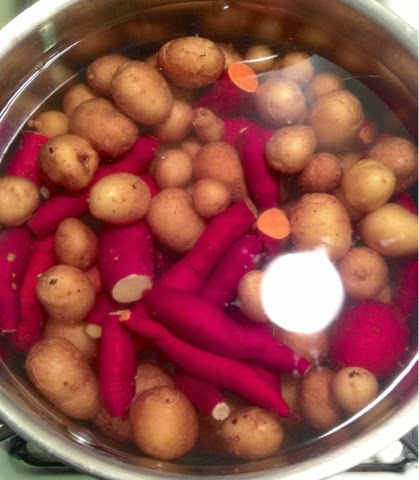
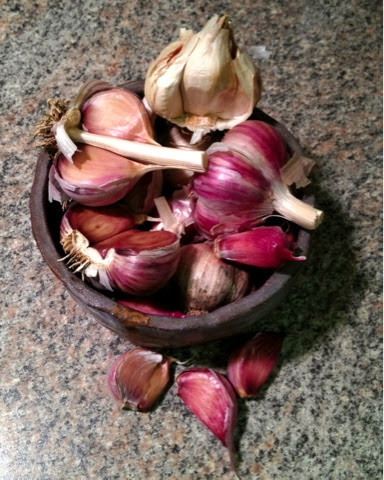
I'm boiling the last of my Amagansett grown potatoes and a handful of sweet potatoes given to me by a farmer out at the barn. They'll be softened by the boil, then tossed in a hot pan with olive oil. Towards the end I'll put some butter on and chopped garlic. I've noticed my Artichoke variety garlic has gotten downright buttery raw, now. So good. The one at the top of the bowl is Artichoke. It's important to know how garlic changes as it sits, sometimes for the better, sometimes for worse. 


Peas, Potatoes and Other Growings On


While I was at the farm for reasons garlic, and due to an exceptionally low number of weeds, I spent half my time there filling empty rows with other needs, wants, and experiments.


Pea greens. These multi-colored pea seeds belong to a variety which is known for producing quality vegetation over quality peas. I planted 80 feet of these, or about 2/5ths pound. If they do well, I will bunch and sell if you're interested.


I ordered three varieties of potatoes, choosing ones that I tasted last fall (all farmer market purchases). German Butter, Purple Viking, and Red Maria -all from Moose Tubers, a Fedco Seeds company, and all certified seed potatoes.  I cut them, probably later than is best practice, allowing them to begin suberization (form corky skins) for 36 hours. In retrospect, I should have planted the potatoes whole since I discovered that I had enough for one and two thirds rows and they weren't suberized at planting. I've never planted potatoes before, so this planting falls under experiments.


One row of potatoes. The light stuff all around is alfalfa meal.


I also planted patches of spring greens in all of my short garlic rows. Look at how tiny the Wild Arugula (also Roquette or Selvatica) seeds are. In addition to this, I planted spinach, regular arugula, pac choi (for salad), purple mizuna, and 'Ruby Streaks' Mustard. We were not able to plant at the beach farm this spring, so I decided to have a go with this personal crop at the garlic farm.

As for our tomatoes, peppers, lettuce, and what else, I am waiting to hear about the beach farm's opening. I would prefer to plant those nearer to Brooklyn because they will come into fruit after the garlic harvest and when you want a fresh tomato, a half hour away is way better than two and a half hours.