weeds

The Transplant


There is a patch between the curving drive and the yard, on the north side, where Rex's dogs used to reside. The dogs, Trixie and Elmo, passed away years ago. Last autumn, Betsy flew out of LaGuardia with a box of bulbs, roots, stolons, and rhizomes in her carry-on. She planted them here, among the old dog pens. This spring we sold the chain link pens to a woman tending goats, or was it pigs? 


As it turns out, this is a very prolific location, maybe the most fertile in the yard. The plants that grow here are a hodge podge of Lamium, Creeping Charlie, Jewelweed, Milkweed, Bellflower, Virginia Wetleaf, and smattering of Lambsquarters, clover, grasses, and other weeds. These surround the remaining dog house, one that is hard to part with because it was so lovingly crafted to resemble the human house it shared land with at Rex's old place.


This is the canopy of a single Jewelweed, Impatiens capensis.  I say canopy because it is built like a tree and is beginning to shade out the transplants.


Just look at the size of that stem, maybe three or four inches in circumference. To the right is a Maximilian sunflower, Helianthus maximiliani, carried to Brooklyn from southern New Mexico, and now to Minnesota. To the left is one of two Bleeding Hearts, Dicentra eximia, holding their own under the shade of the giant Jewelweed.


I'm happy to see what I know is an aster growing among the Milkweed, but I cannot tell if it is the weakly growing Anna Potschke or the more aggressive New York Aster. I'll take either, but would love to see Potschke do well here since it suffered so much in Brooklyn.


The Milkweed, Asclepias syriaca, grows strong here and like common Milkweeds everywhere, it appears rather randomly wherever it prefers. I suppose that's what makes it a weed to the farmer or landscaper. I hope gardeners appreciate it. I've seen some spectacular specimens in yards here -they are quite sculptural, exerting considerable presence. We are planning on a wildflower meadow over the septic drain field and will likely transplant some of these to that location.


Each lily transported from Brooklyn have made this home. They are all doing quite well, as they had in Brooklyn (people's sticky or damaging fingers aside). I may miss the bloom, or part of it, as I will be away in New York City for a presentation in late July and then in Vermont for the first part of August teaching my course Landscape Into Art.

When I am there I will pot up some rather large specimens that could not be, nor should have been, crammed into a box. Roots trimmed, watered heartily, I will leave them for the week while I am in Vermont, and then, on my return to Brooklyn, pick them up for the return trip to Minnesota. I do not look forward to this drive, haven't for years now, but the plants, their care, and the stowaway creatures that will make the van a home for the trip will make it a more interesting ride.


A Walk Around The Block


Across the road (it's wrong to call it a "street"), a stand of Quaking Aspen, Populus tremeloides. These are roughly forty feet tall, and maybe thirty years old. The trees grow in clonal stands, suckering off roots from the initial seedling. These stands can go on for hundreds or thousands of years if fire burns through at supportive intervals. The bark color can vary depending on the region, but in our locality they trend toward the white of a Paper Birch.


Our five mile walk around "the block" takes us by several properties with horses. That tells you something about the nature of the neighborhood (please don't feed the puns). The lots are large, generally over ten acres, many with rolling meadows and wetland basins (but little standing water). Taxes are high (but not by New Jersey standards), and there are probably property tax credits for agricultural uses ("Green Acres"). When you are this close to the city and agricultural, you need resources, you need to make the land "productive" or you will pay. The pressure to change the zoning is real and looming. Another post, another day, about what I call the development shadow.


Given such low-density zoning in this part of the "city," you'll find fairly long views often punctuated by a fairly large house.


You may also find a property named to conjure up salad dressing.


There's a little, err Long, lake, a remnant of a much longer lake, hemmed in by two fingers, one of which is a pronounced esker. In the distance, two blue ice-houses.


In winter we can walk (or drive) on the lake. In the distance you can see the road cut, traveling up the esker at its junction with the other ridge that encloses this body of water.


On this side, three fifths around the block, more horses and a varied, glacially-sculpted terrain.


The late sun gives glow to tilled acres and woods alike.


The cedars that grow on open, upland sites burn with the setting sun.


As do red houses.


To the northwest, some fields open to cultivation and livestock.


More rare, a field's infrastructure. This was dairy country awhile back.


Now, an attempt at viticulture.


To the west of our place, a partially-filled, old gravel pit has become a horse boarding operation. Rex had questions about how the open pit affected the hydrology of the area, and now that it is filled, more so. From what I've seen, and what I read, we have a complex hydrology, to be expanded in a later post.


Along the county road at dusk, about a half mile from our place, a stand of last season's weeds.


_______________________


On March 1, 2015 I will discontinue posting on NYCGarden. You can continue to read my posts here.


Never Trust A Weed


I've planted some pansies; I can't say I've ever done this before in my gardens. What is happening? These here in pots that were empty.


The lilies are up, no surprise as the garlic is also up -including the elephant garlic I've planted around the garden.


Never trust a weed. Never.


Smothering Potentilla indica, everyhere. A garden swan song.


Always trust Dicentra eximia, anywhere, everywhere. It died two years ago, under some heavy foot traffic, but reseeded itself. Here, at the edge of the poor man's patio, it seeded itself once again. It is one of my favorite plants, all time.


Out Like A Lion


A dandy lion.

The cold and blustery days of March, complete with three snowfalls, put my onion attempt to shame. A shame made all the more goading by the boisterous growth of the dandelions. Hoop-house dreams I guess.

Now, let's put melancholy March to bed.


Painted Pea


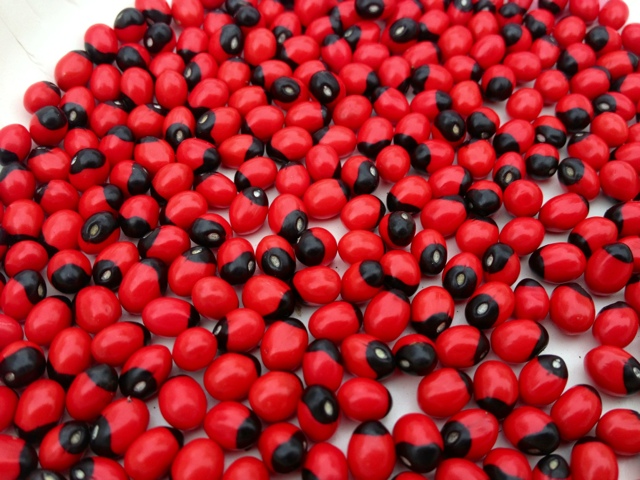
A berry, or rather a pea, and a rather poisonous one, spied on a ratty sump fence the day I arrived in Orlando. Marie asked what it was; a reader, friend, and expert in Peruvian culture suggested Ormosia coccinea and I called it a day. Yet something was nagging at me. A website stated the popular, good luck pea was the seed of a tree and my sump specimen was certainly not a tree. Although maybe it was young, maybe it suckered from so many hacks.

An image search yielded clusters of pods and peas that looked right, but of different species. Not the huayruro of Peru, but Abrus precatorius. A vine, not native, and invasive weed of Florida. That rings true -sump plants tend to be weeds.

Now I'm wondering if jewelry makers would be interested in these striking red seeds. I've already contacted Bonbon Oiseau, although peas may not fit her oeuvre. Would you wear poisonous seeds?


Change Of Season


The sun is now setting earlier, yet it feels that summer has only begun. That the peak of summer sunlight does not coincide with the peak of summer is a celestial twist, an affirmation of the skewed order of things. And here a divide in the vegetable kingdom, more pronounced this year than others, and maybe due to the warm spring and wet month of May.

The lettuce have peaked, with outer leaves folding down toward the soil. We've only 5 heads remaining, but wow, what a productive 20 square feet.

Cilantro now fully bolted and flowered, the young to return in a month's time. I wish I cooked enough for all the cilantro that can be grown in 2 square feet.

Snap peas, slow to start, but invigorated by the month of May, are finally letting go of the cucumber trellis. Fennel, finocchio romanesco, is close to flowering and bulbs are being pulled. Carrots here?

The French beans, first planted in the Turban garlic beds. Second planting was last Saturday.

Asclepias syriaca in bloom; scented evenings at the beach farm.

 Always worth a closer look.


The Cure


These curing Allium vineale inexplicably have the odor of the most intriguing garlic salt. Yes, garlic, but the clinging soil is possibly adding something else. When young and green, the field garlic has a more earthy onion/garlic scent. It is now intensifying into something quite a bit more beguiling.

Local Genius


It could only have been genius that struck when someone, probably the landlord's swift and conscientious workers,  realized they could eliminate the weeds with an herbicide spray. The only negatives could be the fact that a) it drifted onto my perennials and curled their leaves and b) didn't fully work because it rained afterward. 

Their greatest stroke of genius was spraying the tree pits with herbicide, because what they intuited isn't well understood -that trees are things, not herbs. Is it so hard for the landlord to have the weeds hoed or pulled? Besides the fact that I usually do it, but have been busy with the beach/upstate farm, school finals, the studio, and my mother's visit. I'd get to it soon enough. Given all the planting that I have accomplished, you'd think the landlady could let go of the weeds for a minute, maybe put a little effort into our dilapidated building, and leave the garden work to me.


Designing Weeds


They're known as hell strips -in this case a bus stop hell strip. Today it leaped out of place as background -the unseen, and I couldn't have planted it better. First, it's all weeds, and they take care of themselves. Secondly, a designer's sensibility seems to be at work. A mass of warm-weather Mallow, soon to be flush with pink flowers, companion-planted with the atmospheric, flowering stalks of the cool-weather mustard called Shepherd's Purse. For some that would be enough to carry the strip, but not this strip, no. Adding contrast to the wispy flowering stalks and mat-forming masses of round leaves are the strongly cut leaves of the upright Mugwort in brilliant green. And as if that is not enough, nature conspired to accentuate the whole of it with a large-leafed Plantain on one end and a spidery daylily on the other!

Common Mallow, Malva neglecta
Common Plantain, Plantago major
Shepherd's Purse, Capsella bursa-pastoris
Mugwort, Artemisia vulgaris
Common Daylily, Hemerocallis fulva

Crisis Partially Averted


Wow. How did it happen? The other day I noticed the new static page linking to my art page was no longer above. I investigated, found nothing, and went to reestablish the tab. Somehow in this process, Blogger created a second tab for the Our Weeds page, one of the most popular items on this blog. I left it alone. Until today.

I deleted the one, thinking it just a duplicate of the first, but I did not go about with due diligence. I erased the whole effing thing. The other tab was a dummy tab and linked to nothing. I could not get the information back. Nowhere. In fact, not even a question in Blogger's help forums. No one has ever done this? Seems so easy to do. I was upset -so much work there. I wasn't about to remake it given all else there is to do now. Yet, the weed file is probably the most popular page I have. So I started digging. Caches were no help. Finally,
I went to my posts, because pages is a relatively new aspect of Blogger and my original weed file was a simple post.

Lucky me. An update I did last year on the page I also saved to the original post! Whew. Lost are any additions I made this year, and there were several, but at least those redo's are something I can accomplish. Wow, so where can we save this data if there is no way to retrieve it online?

UPDATE! As I look again, the links above have two OUR WEEDS tabs. This must be a Blogger issue. BLOGGER!


Goosed


Our greens have finally exploded after this week's rains.

Potted parsley, with a winter's worth of roots, never died for lack of  cold. I transplanted  the several plants into beach farm soil.

What's wrong with this picture? Remember the corn gluten meal I put down for early spring nitrogen and weed-suppressing action two weeks back? The brand I bought was pelletized, so little kibbles were spread all over the garlic beds. You are supposed to water it in, turning pellets into a dispersed corn mush, but our water hasn't been turned on and it didn't rain for at least a week. So, what happened?


Geese happened. They are all over the Rockaways. They swooped in, eyeing that bright yellow meal from above. They probably ate it all up not long after I placed it, so the corn gluten could not do its job. Meanwhile, the geese trampled some of the smaller garlic, ripping leaves, squashing new growth, pecking holes in the ground, and pooping green and white.

And the weeds? They sprouted and survived. In fact, on this last trip I was amazed at the number of warm-weather weed sprouts -particularly the smart weed, mallow, and lambs quarters. Corn fed goose. Sounds tasty.


West Side Story


Not long ago, while stopping and going up the West Side Highway, I was struck by the weediness of the median plantings. It's no surprise that the plants have been suffering over the last few years. I recall driving by a summer or two ago and seeing roses and trees browned from drought and heat (how hard would it be to put irrigation in those pits (and if they have, why wasn't it working)). Then there's the salt spray from unending winter snows. So, the plants weaken, and without maintenance, the hardier plants move in. 

It's a nice idea, masses of ever-blooming roses, for drivers, but when the weeds fill in, it becomes compelling for this driver, and dangerous. I was glad to hit traffic, camera out the window, trying in vain to capture what I thought I was seeing.

See how the Mugwort and Wild Garlic add color and formal variety where previously there was none.


I cannot even tell if this grass was planted intentionally; it looks so weedy, but also atmospheric.

Can you see the wild garlic floating above? The roses on the retreat.

The Ailanthus, making its way back to favorite locations -hot, dry, with concrete.

But then, there is what appears to be Canada Thistle amongst the roses, adding harmony to the monotony.

There are swaths of still functioning Rosa monotona.

But, only for a half block or so.

Where monotones of Canada Thistle make headway.

When I see this, I think of the trees shading out whatever was planted here -that same, sun-loving grass? 

I suppose it could be like this, where maintenance is paid for, around new construction.

Or it could be like this -no doubt influenced by the Gehry building that the median fronts. By the way, does the Gehry building also require the cars that front it to be silver?


Expedition Pit


In the cultivated garden, now, the 'New Dawn' rose is beginning to bloom. Next to it, the young flowering tip of Allium sphaerocephalon. Yet, my excitement has not been focused on the garden lately, so much as it has been on the tree pits, planted in spring, 2010, with Zelkova serrata, or the Japanese Zelkova tree. Oh, yes, we had big intentions: to plant those extra large pits with flowers of one kind or another, build tree pit guards, protect and maintain them. But that hasn't panned out, for a variety of reasons, and now I find myself welcoming almost every aspect of tree pit neglect. In each pit an expedition into the world of plants.

 One of the three new tree pits, one year after creation, filling in nicely with an assortment of plants.

Of course, we have the usual suspects, like mugwort, Artemisia vulgaris.

And smartweed, Polygonum caespitosum.

The lamb's quarters, Chenopodium album.


And common mallow, Malva neglecta.

But then there is this toothier, lamb's quarter look-a-like that I suspect is an amaranthus spp.


This basal growth seems to have form, some cultivated history perhaps?

And this? Clearly the same as the above, but older. Silvery green, lanceolate foliage, upright habit, flower buds forming. It looks special -to me, and worth protecting to see what shall come of it.

But should I be surprised at all that one of my most prolifically self-seeding asters has shown up in droves just across three feet of sidewalk? Hardly. But exciting, nonetheless, because I am witness to a logic in its regeneration -it sprouts primarily at the interface between the concrete and the soil. Had the seeds washed or blown across the sidewalk, or both?

Nor should I be surprised that another prolifically spreading garden plant (an accepted weed), Persian Speedwell, Veronica persica, should have made it across the hot, concrete sidewalk plains of New York City.

So why is that I was utterly shocked to see my garden phlox growing in the tree pit? And why does it feel that if I was to pull all the unaccepted weeds, yet leave the accepted, only then would they get stepped on? It seems that if I leave all the weeds, all will survive and flourish. Does the plant community defend itself simply by appearances? Maybe people only see jumble and avoid it, naturally, as city folks are wont to do?

Yet, in avoiding, they miss out on little gems like this.

A snapdragon?

And this.

Possibly Viola arvensis, European Field Pansy.

What I enjoy in the pits is the sense of surprise, which isn't inherent to my cultivated garden, except where I forget what I planted or when something grows off plan. I think it is important to see what takes naturally to bare soil, to help understand soil, and the movement of offspring, and fecundity, to find flowers where there appears to be none, and to appreciate what follows us from there to here. 

But please, don't let it get out of hand, as is this curbside stand of curly dock, Rumex crispus, across the street. Eventually, one or two of those species will overtake the rest, allowing only a simple succession of one or two cool and warm weather weeds to flourish. 

Incidentally, said curly dock seems to house many aphids amongst its untouched branches. Here's the question, then -does it attract aphids, pulling them away from your precious, succulent plants? Or, does it create a perfect habitat for a super-society of thousands upon thousands of aphids that will then migrate to your precious, succulent plants after they use up the curly dock? Feast on that.


Sea Scapes and Other Weeds


An important trip to the beach farm yesterday to see how things are doing. It is very hard to get to the farm this spring -way too many activities. In fact, the rush of spring food gardening is outside of my favored behavior. It's a lot of do it now! Our small plot hasn't helped matters, either, where quick decisions have led to cramped quarters and footprints on young seedlings. 

But yesterday had the nicest weather of my spring visits thanks to only light winds. The great growing weather we've been having lately has been a boon to the vegetables as well as the weeds. Little to harvest in the plot, my favorite part came to be harvesting the wild garlic which is abundant, and everywhere you look around the beach farm.

Dandelion, Taraxacum officinale -king of the weeds, rising above the courtesan Dead Nettles and Chickweed. I'm told you can batter and fry the flowers, while the young greens are sought after by some for salads and cooking.

The field of Herb Robert, Geranium robertianium? I hear it may be edible, but I cannot imagine which part -the root? Wait, wait. Maybe it's Filaree, Erodium spp. Don't eat anything before you're sure!

What I believe is Field Forget-Me-Not, Myosotis arvensis

A closer look.

And finally, the wild garlic, Allium vineale. Easy to confuse with the wild onion, A. canadense, in the field and the internet. Apparently two distinguishing characteristics: wild garlic has hollow round stems and unsheathed bulbs, whereas the wild onion has flattened stems and fibrous-sheathing on its bulb. I'm going to add another -notice the curvy scape-like stems/leaves? My cultivated garlic will grow curving scapes in May, which I am eagerly awaiting. The scape is the flowering "stem" that will eventually produce bulblets.


Cool Weather, Flowering Weeds, Beach Farm


These are the weeds blooming in our beach farm's plots this week, maybe this whole month, and year? Click on the pictures for monster size.

Dead Nettle, Lamium purpureum.

Pretty enough for a weed. Below, its flowering-at-the-same-time look-a-like. Both have tooth-edged, hairy leaves that purple at the top, upright growth habit, tubular pink-purple flowers, and the purple-green square stems of the mint-family. But, they do have significantly different leaf shapes, venation, and upon close inspection, dissimilar flowers. 

Henbit, Lamium amplexicaule

At first appears to be a chickweed, either Stellaria spp. or Cerastium spp, but the four-petaled flower says Whitlow Grass, Draba verna. Compare.

Likes dry sites, hmm. Like the sandy farm.

Quite probably Geranium robertianum, or Herb Robert or Stinky Bob.

This bloomed late late late fall too.


Maroon


In September I posted about the three semi-look-alike weeds all in bloom concurrently: Lamb's Quarters or Chenopodium album, Mugwort or Artemisia vulgaris, and Ragweed or Ambrosia artemisiifolia. The villain in that particular post was Ragweed. Fast forward to witness how these three have all conspired once again to mimic each other, but this time in crimson.

Ragweed, Ambrosia artemisiifolia, leaves

Ragweed, Ambrosia artemisiifolia, female flowers (past bloom).

Lamb's Quarters, Chenopodium album, fruit.

More Lamb's Quarters, Chenopodium album, fruit, albeit more magenta than maroon.

Mugwort, Artemisia vulgaris, leaves and seeds.

This, of course, has nothing to do with all that, but is rose-colored and abundant in the garden -Smartweed, Persicaria spp., formerly Polygonum spp.

Beach Farm Allergy


These are the leaves of Common Ragweed, Ambrosia artemisiifolia, a widely dispersed North American native. Notice the deeply cut leaf with rounded edges. Click on any of these images for a more detailed look.

Above Common Ragweed's rounded, deeply lobed leaves are its flowering spikes. Notice how each individual flower appears green, is well spaced, and tends to hang down. Ragweed is wind pollinated, indicated in part by its drooping flowers. Wind blows, rustles ragweed, out falls the lightweight pollen, into the breeze, your nose, then sneeze. Below an illustration of its form.

USDA-NRCS PLANTS Database / USDA NRCS. Wetland flora: Field office illustrated guide to plant species. USDA Natural Resources Conservation Service.

There are a few plants that could be mistaken for the allergy causing plant. I photographed some in our community garden at Ft. Tilden, where they all grow in masses along plots and fence lines.

These are the deeply cut leaves of Mugwort, Artemisia vulgaris. Notice the pointy leaf tips and hairy stems.

These are the flowers of Mugwort, whitish/yellowish with a tinge of red. The flowers form in compound racemes, or panicles -branched clusters of flowering stems. It blooms alongside Common Ragweed in the late summer and fall.

These are the leaves and flowers of Lamb's Quarters, Chenopodium album. Notice how the lower leaves are spade-shaped and toothed. On large plants you'll find the upper leaves to be lance-shaped, or lanceolate, and smooth-edged.

These are the cymose, densely-branched, white and green flowers on a large specimen of Lamb's Quarters. It also blooms alongside Common Ragweed.

This is Seaside Goldenrod, Solidago sempervirens. It is one of a hundred types of Goldenrod that also bloom at the same time as Common Ragweed. Its flowers are bright yellow and face upwards -an indicator that this plant requires flying insects to pollinate it. Goldenrod's pollen is sticky, and does not blow in the wind.

It also does not cause hayfever. I have been hounded by allergies every time I go to harvest at the beach farm. The breezes of the ocean blow Common Ragweed's pollen, which is everywhere around us, right up the nose. I suffer for a day after, then diminishes. Ragweed is one of those barely noticeable green things that has for so long gone unidentifiable by most people. I hope this helps.

Nightshades


I've let this nightshade get real big. It does have nice form and it is in the weedy pole garden, after all.

Its flowers are white with yellow centers, its leaves and stems slightly to somewhat hairy.

These are the fruit. This weed should end up in my weed atlas, but is particularly hard to ID. There are several weedy nightshades, but I am willing to venture Hairy Nightshade or Solanum saccharoides. Are there any nightshade experts out there?