weather

Post Post


Is this now a post post journal in accord with our new post truth environment? I admit to being busy with so many different projects that the will to post has been minimal or rather, non-existent. To blog one has to make time or have time, an idea to flesh and flush out, images to give sight to sore eyes, and an editor -always have an editor. Is it that there is nothing new to report? Hardly -there are too many things to report.


The garlic is in last season's potato bed and even more at the neighbor's sheep farm. We may see Hudson Clove return to small sales next year. The bed of herbs is taking in the glories of climate changes that helped create the longest growing season in our region's written history. Depending on one's micro-climate it was possible to grow throughout November. I believe November 19 or so was the first time it froze long enough to do in the cold-sensitive plants and the brassicas lasted into December.

Our lawn has turned completely from grass to creeping charlie. I may use the language of the walking dead to describe it from now on: another area has turned. I could go into a description of creeping charlie, but a visit to Wikipedia should do. Creeping charlie was likely brought to our place, intentionally or otherwise, by my father in law. Our vegetable gardening created bare patches that allowed it to get stronger. The lawnmower chopped it into little bits; each sprouting into a new plant as the weather permits. Last summer and this summer the weather was all too permissive. It spread far and wide and quite literally there is now no more grass. It's also invading the perennial garden and after we had the dumpster removed from the drive, I discovered it growing underneath. Raking leaves is out of the question, unless you want it to spread wherever you move those leaves. My father in law raked and hauled leaves into the woods, over the slope -a good practice, generally. At slope bottom, however, there is now a large colony of charlie that I have low initiative to deal with. I've seen it in the middle slough, too and then again sliding down the slope into the back slough.


While everyone was lining up to buy things on black Friday, I lined up herbs and flowers to prep for a winter indoors. The rosemary was over-wintered in its pot last year and hung in there, but took until mid summer outside to really take off. Much larger and greener than last year, and not so delicately ripped from its summer bed, I hope it will survive once again. Along with lantana, it will be spending the winter in warm, dry, sunny bedroom window.


The pineapple sage wouldn't have made it to bloom if the season hadn't been so extended (although it may have in the greenhouse). There is nothing this red in November around here, poinsettia excluded (we overwintered and oversummered one from last Christmas). I've cut a few branches for rooting and even brought the whole plant in. I will cut it back hard after flowering is complete and see how it does.

Some Siberian cold (often the coldest place on earth) has been dislodged and is making itself felt now. The Army Corp wisely held up the DAPL so at least some of those protesting the pipeline would be inclined to head indoors. The ridiculously warm temperatures gave those not familiar with the Dakotas a false sense of our climate and would have been hit hard by the forty mile an hour winds and zero degree temperatures of the last few days. The cold and wind forced me to bring our agave and opuntia cacti in from the greenhouse. My educated guess is that these can survive zero degree F temperatures as long as they stay dry, but I decided not to chance it. They will also spend the winter in warm, sunny bedroom window.

I, however, will spend the sunny part of days out and semi-out of doors. You'd be surprised how easy it is to get used to 15 degrees F. I just spent 20 minutes outside this morning, sans jacket, to take some photos. It's the fingers one needs to worry about, especially where there's wind. 


Above is the south side of the studio building we've been working on for the last year. I think the temperature inside has stabilized at 34 degrees F despite the 17 degrees F outside and is warm enough to do some interior framing and insulating (where I'll be after this). With the luck of the longest growing season, the grass seed I planted here in early October not only sprouted, but grew in somewhat. Then, in one of the many furious acts born out of every last day above freezing, I tilled it all but a two foot wide grass strip in order to winter plant a native savanna garden from seed mixes I purchased from Prairie Moon.


I also tilled behind the building, on the west side, where I will broadcast a woodland mix of forbs and sedges. I do not expect this to be as easy as my milkweed experiment turned out to be. Disturbed areas like this are perfect for invasive plants (like garlic mustard) to take over, so I have to act immediately. In the greenhouse, towards late winter, I will also seed five inch deep cell trays with many of the grasses and some forbs. These will be planted directly around the building and elsewhere on the land where large oaks have fallen to create sunny openings.

As I look out the window, I see that it is flurrying again. Till next time.


The Boy's Winter


I was wakened by the subtle flash and rumble that, not more than a minute later, became the brilliant glare and shattering crash of this year's first post midnight, pre dawn thunderstorm. The rains came, soaking what would normally be earth frozen forty inches, give or take. The birds had been arriving for over a week, vees of geese are seen and heard, while the prehistoric calls of sand hill cranes are heard, all traveling northerly. Comb-playing chorus frogs have made their seasonal debut and chipmunks have ascended from their dens. The grays and pale orange-reds predominating the woods are often punctuated by intense, moisture-activated greens. Most lakes have lost their ice and those that haven't remain only a stormy-green skim coat of icy slush. Most of all, even by last year's early spring standard, the trees have been budding strong and flowering early. The silver maples of the middle slough have been fully in flower for over a week. This is El Nino in the Midwestern north.

It should still be winter by calendar, averages, and tradition and this post should be timely. It is not, however, by fact and experience. Winter is over before its time and this is its eulogy.


Strong winds raked snow and desiccated grasses across the large wetland, leaving easy access for bipeds like myself.


This winter's fluctuating temperatures created a nearly constant stream of runoff from the little wetland which pooled at the northern end of the large wetland. It was a popular watering hole for all the Big Woods' animals.


Freezing and thawing of the pool made for unique ice crystals.


The dead trees of the large wetland, killed by higher water or blight.


Orange lichens on the south side of the trunks.


Wet feet is not a problem for Red Osier Dogwood, Cornus sericea.


Its branches a brilliant red in the sunny open of the wetland.


A protective structure for warm season nesting.


An unknown plant, possible weed, growing in the center of the wetland.


A rare view of the house from the wetland.


The earliest sign of approaching spring -emerging buds of shrub willows.


Cedar Blush

The foggy morning was a prelude to the storm that just ended. Blue sky, something we've had little of this winter, is now in its stead. It is these weather events that make a cold climate tolerable, just rewards for what can be hard.


Moisture riding the push of warm advection crystallizes on cold twigs and grasses.


And sumac not yet pecked by the birds.


I love the cedars that grow here; reminding me of those that break the monotony of old fields on Long Island. They, of course, are the same species, and aren't truly cedars -Eastern Red Cedar, Juniperus virginiana. These are tough trees, can be over nine hundred years old, tolerate drought and wet, cold, and the poorest soils. While deer browse your expensive arborvitae hedges, by the looks of the Eastern Reds around here, they hardly touch them. There is gin, of course, and the aesthetics which, to my eye, are some of the best an evergreen can provide.

There is a moment every autumn, usually middle to late, when the cedars turn bronze, red, mauve, blushed or however you may see it. This change requires a loss of some of chlorophyll's green and the development of red anthocyanins and the two, together, create this bronzing effect. This is painter's stuff, mixing reds and greens to create blacks more green or more red. The dark bronze contrasts with the white of aspens and snow and plays well with ochre field plants.

Like so many plants you love, someone, somewhere lists them as invasive. How can this be, you ask, after all it is a native in its range! Well, I rationalize it this way -Eastern Reds grow readily in farm fields and get a bad rap for its ability to grow readily from bird-dropped seeds in these fields. The other reason is the loss of fire as a control agent, but this is our fault, and we shouldn't be blaming the cedar. Finally, because we plowed under so much prairie that there is less than one percent of it left, managers curse the Eastern Red for colonizing what's left that isn't being managed by fire. Given these rationalizations, I still wouldn't blink if I had the opportunity to plant one on our land.  I may well have that chance in one of the many clearings created by downed large oaks or bass that have given rise to another accomplished colonizer -common buckthorn.


Gardening at the Boundary


That day, maybe a week ago, it really came down.


I know nothing about late spring snow. Nothing. When I was a child, in New York, it snowed during our Easter break -it was early April. The day prior was warm, even the day it snowed it was warm, so much so that I was out riding my bike in the street with my brother. Although it was cloudy, the big, wet flake snow came without warning.


This snowfall is different, intermittent pellets and flakes. It was windy too, driving the pellets hard. As is often the case, the snow did not stick. The snow was not the trouble at all. It was the cold that presented itself the following night. 


I woke to find a frost on the little wetland.


 Crystals coated all the leafed out, saturated-looking plants in the early sun.


The parsley I had just planted showed crystallization along its veins (interesting that this happens, no?).


The  cilantro.


The Virginia Wetleaf succumbed (but recovered) to the eight or so hours well below freezing.

____________________

The last frost date for our location is roughly May twenty. I do not think anyone would suggest that the last two months have had ordinary temperatures, we haven't. Since March, we have had days that topped out at 10ºF and 82ºF, although most have been in the forties through the sixties. Our March monthly average high temperature was nearly 46ºF and the April average so far is 59ºF. Daytime temperatures have long suggested I should be growing things that California is having trouble providing. Think twice. I watch the trees and the vegetable gardens. Only this week are the oaks beginning to show the chartreuse of spring and there has been zero garden activity.

Warm air masses, heated by their descent from the Rockies and Great Plains, move in from the south and west, and locally there is sunlight warming the thermal mass of land without the cooling influence of great bodies of water. The day warms nicely. At night, however, without the moderating influence of clouds, radiational cooling is strong. I recall a typical temperature differential in NYC to be about 15 degrees. Here, in Minnesota, I have seen 20+ as the norm. Beyond nightly cooling, there is always the threat of a cold airmass coming down from the north whenever the jet stream decides to do something funky. Minnesota is the common entry point for cold air, it is the reason people think this state is cold. 


Which brings me to another weather detail. I noticed the window box of just planted pansies was bone dry. What? I had watered it in, deeply, just the day before. Hmm. Something unusual had happened -dry air, exceptionally dry air. Two days after the snowfall, and the day of the overnight freeze, our relative humidity had dropped to 12%, twelve percent! Our dewpoint was nearly 1ºF by the late afternoon. Meanwhile, our high temperature was 55ºF and the winds were up. The water simply evaporated. Despite this, the pansies toughed out the freeze and drought, as those in the pot above attest.


The dry air, the sudden cold from the north, the high temperatures, the wind, no rain, and of course, heavy rain are all typical. We live at a climactic boundary with little to moderate each influence. This is the education of a gardener.


Thy Thap Can Overfloweth


I neglected my sap cans after boiling down the first batch. Freezing at night and in the forties by day, the temperatures became perfect for sap flow after the warm spell had ended. I took the earlier flows to be the norm, but how wrong I was. Every can was overflowing, even the tree that could hardly produce a third of a can at last collection. 


There's no telling how much sap flowed over. The wooden spiles are leaky, but not this leaky. The snug-fitting lids were swollen, releasing a spritz of sap when relieved. All four cans tipped for an easy two hundred fifty six ounces boiled down the same day to a sticky eight. I'm kind of hoping the flow slows down as we will be away for a spell and unable to collect.


A Good Blanket


Raking leaves. This is a thing now, a must do thing. So why not do it when it is unseasonably warm in March? No good reason. Although the top inch of the soil is a mushy, slippery mess, underneath that top layer it's frozen solid. Except near tree trunks. There I find I can dig a little, but there's no good reason to.


 And, there's this.


But, also this. It took me too long to identify this garlic mustard. Shame on me. Visibly green before the snow had fully melted and the soil still completely frozen must have thrown me. It's the only thing growing out there, well, besides the garlic in our little plot and the duckweed in the swale.

Seventy degrees F on Sunday, a high temperature and highly unusual, possibly a record. I sat on the front porch steps in the evening swatting away mosquitoes. Yes (you say No). Yes. Thankfully, yesterday afternoon, a cold front came in. Twenty four degrees F when I rose this morning, and with St. Patrick's luck the mosquitoes had no warm places to hide. Our little pot of gold.


Brown Out

 I woke up to find it completely brown outside. From minus eleven to sixty two in five days. As the day wore on, into the late afternoon, it felt distinctly like late September in warmth, quality of light, and brown-ness.


Except for the squirrels, they're still gray, to match their favorite tree trunks.


22 To 50


A 22 degree halo on what was a very nice day, springtime really. This past Thursday we climbed out from a low of -11 degrees F. By next Thursday we will have had a string of sunny days 40, 50, and maybe even 60 degrees F. But hey, let's not get indulgent, I'll take the sunny, 40 degree day.

While I doubt the white ground cover will permanently take its leave (we did just get 5 inches last Tuesday), a good guess is that it will be gone by Monday evening. What I like best is the brilliance of snow covered ground, 45 degrees, little wind, and sun. In fact, that's what I'd like for my birthday.

My Beating Heart


Some days I wake before we've rolled around to meet the sun.


By the time I get dressed for the cold, stumbling through, half asleep, the sun has breached the canopy.


A light snow fallen the night before drew me out from the warmth. The farm field, behind the scrim of trees, changes weekly from white to mottled gray to black and then white, again.


It is still.


No rustling of cold-crisp leaves, no creaking of timber, no muffled doof of dropped snow glops. There was a squirrel motionless, vertical, on a dead or dying red oak. Fixed on that spot for quite awhile, I say this squirrel did not make a move. To my right, then, an explosion of noise! My head jerks upward to see a squirrel bursting out of a leafy nest wadded into the crotch of another red oak, then scrambling into the branches of a different tree. I thought how rare that I should get out of bed before squirrels.


I was about ready to come in from the cold when Betsy came out dressed for a walk. Not too far she promised, just around the bend in the road. Outside for half an hour, not moving but for camera work, I was pretty cold, but I joined her. 


- I am the still squirrel and Betsy the exuberant one. -


 At the end of the drive, up slope, frosted pines, spruce, and aspen grow in the clearing.


Down slope, sumac curlicues tickle the sky.


I see a prop plane traveling northwest and I think how cold it must be in that cabin, single engine planes fly in pleasant weather, and then I understand -it's about the stillness.


Around the bend, a roll of hay, unused, under a willow.


And the matted grasses.

___________________________


On March 1, 2015 I will discontinue posting on NYCGarden. You can continue to read my posts here.


A GPS Tempest


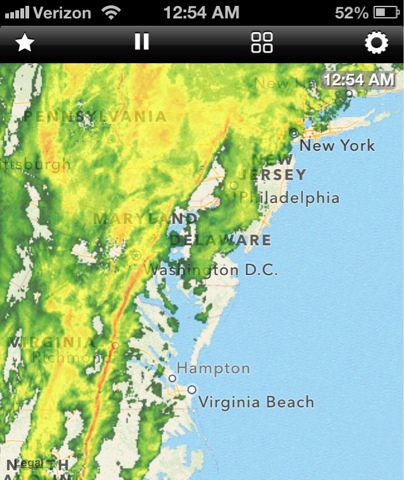
It may be quite a blog folly to represent my highway travel along and through a storm with handheld, geo-positioning technology. But to my mind the visuals of the highway are less interesting -the rush of vehicles, the monotony of pavement. I chronicle the birth of a tropical storm just to the southeast of my earthly coordinates -represented by the blue and white dot in the fourth image. On July three I begin my northward journey via I95, a road which coarsely follows the coastline and parallels the typical path of storms like Arthur. Humans, currents, coastlines, atmospheric pressures all following the same path. 


Outer bands of hurricanes can often fool the spectator. We expect wind, but there is little to none, yet certain quadrants develop stronger storms and in the south they often spawn tornados. It was night, heavy thunderstorms were building rapidly over northern North Carolina, just an hour or so before the Virginia line. Scanning the radar, my concern grew over two cells that were developing just to the east of I95. These aren't the typical tornado radar signatures, in fact they had little in common with those -but something about them was menacing and I pulled off at the next exit ramp to study the situation.

I had the radio on, which was then interrupted by meteorological talk, talk of tornados in this county and that county. At one point they stated that a large and dangerous tornado is on the ground, but then backpedaled, while continuing to wait for reports and issue NWS warnings. If it weren't for my handheld, I'd have to dig into roadmaps to decipher which county I was even traveling through! As it turns out, two tornado warnings (issued when there is a confirmed sighting or when radar signatures suggest a possible tornado) were issued for the region just two miles and ten miles or so to my north, both potentially impacting I95, just ahead of me.

Tension was high, the rain was heavy, and the lightning powerful. I waited out the first warning and then had to make a decision on the second: turn west toward Raleigh, then north (although storms were building fast to the west as well), or go as fast as I can on I95 and hope that I make it ahead of the the warning area. This kind of storm creates a very dynamic, unstable condition that undermines predictability but I had to do something, so I chose I95, as fast as possible, to get ahead of the warning zone. I made it, just as the storms built behind me, the lightning flashing in my mirror.


 My arrival in NYC


Green Shift


I do not have any pictures to bolster my observations, and long have I been aware of trees' change from bright, yellow green leaf coloration to the more deep, blue green of summer. It has happened, rather over night, and I think it was two nights ago when we had a three aye em thunderstorm that it tilted in favor of the summer coloration. Just a few days ago Greenwood's trees were still full of spring brilliance, but today they are fully summer green. I have nothing in the way of scientific observation, and I hardly think it requires a storm to push the trees to this state, but did it, can it?

I've gone on about the affect of thunderstorms on plant growth on these pages before, and so it is that the garden plant growth has also skyrocketed since Thursday's early morning storm. Right now, as a storm slowly moves to the southeast, I think again of the benefits of nitrogen fixing lightning, the boost the plants appear to gain. The garlic, given that both storms have traveled over the beach farm, should also look deep green, taller, and more turgid when I visit on Monday.

Blessed, Wondrous Rain


I can deal with the snow, but I tire of walking on slush ice sidewalks like an old man worried about his hip. The cold tenses the muscles, well it does mine, as I make my way here and there. It has also made simple chores which require using the van more work. If I leave my well-groomed spot, it's lost, and then I am stuck with the glaciated mounds left by others. Then, the sound of tires spinning effortlessly on wet trash and frozen water, the chipping of grayed ice with my Spear and Jackson, and the blue smoke, the friction-burned odor of vulcanized rubber.

When I forced my way through the crowd at the cave exit of Columbus Circle, beneath that awful Trump gray atlas earth, I popped out my umbrella in smooth fashion while everyone else huddled, wondering what or how it could be. For each step, up and away from the station's cavernous maw, an umbrella extracted, velcro unstitched, a button pressed, and a graciously-sized tarpaulin extended. Alone, I topped the final step, in praise of this vigorous rain.


Wind


Not a fan. Don't like wind.

Last night it was reported that some storms were moving through at 100 mph. That's pretty fast when you consider average travel speed for weather is about 35 mph. Some thunderstorms travel at 50 and rarer still is 70, making 100 pretty darn fast.

Along with with these storms came a good amount of wind. Wind gusts out on Long Island were recorded over 60 mph around 4am, just around the time I was awakened by the rain. Today, in NYC, we'll see winds over 20 and 30 with some higher gusts.

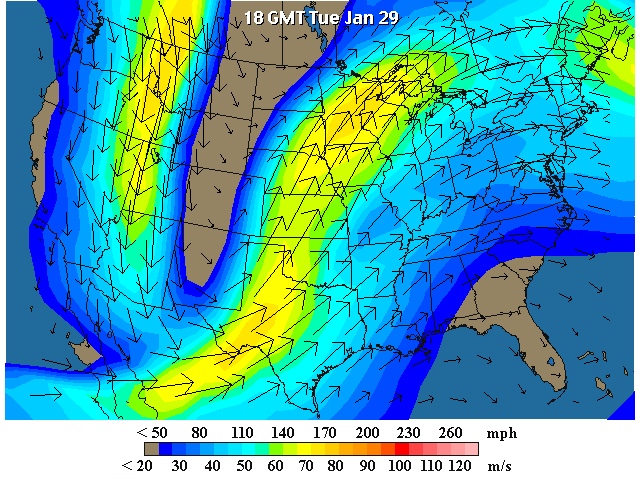
I've been reading lately about the effect ice cap melting will have on weather patterns across North America. In short, a warmer North Pole will increase the amplitude of the jet stream in winter (image below). Increased amplitude creates slower west to east movements of storms, increases their moisture content, and also amplifies the pressure gradient between troughs and ridges (ridges are high pressure and troughs are low). Science has modeled this effect of ice cap melting and this storm appears as a case study.


Snow For The Farm


The minor snow that has fallen on eastern Long Island will be helpful at the farm during the colder days and nights ahead. The turban varieties, ever eager to grow, were the first to sprout in early December and will benefit from a layer of insulating snow. The rest still underground, but not too deeply thanks to light soil and vigorous root growth, will also benefit from the 32 degree blanket. It wouldn't take much time to bring freezing temperatures several inches below ground with several days of hard freezing temperatures and no snow cover. Garlic is tough, however, and regularly survives much lower than the twenties and teens. Although, surviving it isn't exactly needing it, so I'll take the snow.


December Rain


Our shiny streets create the impression that it has rained, but out at the farm that couldn't be farther from the truth. Clouds haven't delivered more than a trace of rain, less than a 16th of an inch since November 1st. I may go out to the farm this weekend; see if there are any remaining saffron strands to harvest. And if I do, maybe I'll load the inside and outside of the van with as much straw as it can muster, because, perhaps, a real rain may never fall.

Update: it rained (significantly)!


Nearer Than Eden


I am usually the only one at the beach farm at this time of the year, but this Sunday I was not alone. There was FEMA and the Red Cross, National Park Rangers from other states, sanitation workers, police, hovering copters, a ready fire department, and Wolf.

As I pulled into the lot I saw him moving slowly toward the garden, cigarette dangling from his lip. His restless and sweet autistic grandson with him as always, but given the cold wind, he remained in the car. Wolf thinks about planting his garlic now, although the work will wait until the new moon of early December. He planted this superstition in my mind last year, and I thought of it as I planted thousands of garlic cloves at the farm through dark nights of November's new moon.

Under Wolf's watchful eye, I turned over the garlic bed once again. It had settled under the inundation, now a stone's throw from its prior glory. In s-curves and coils on the surface, earthworms lay dessicated. As I turned each spade full, we scanned the soil for life, marveling at a termite, a wireworm, and two grubs. I brought a sack of alfalfa meal from the farm to rake into the bed, then, showing off the wheel dibble, marked rows for one hundred eighteen cloves of eleven strains from eight varieties and a handful of French grey shallots.

Afterward, I pulled the fennel seed from our plot, convinced that it would spread all over despite salt water inundation. In fact, the old plants were sending out new shoots -no matter the salt, no matter the season.

The crusty presence on top of the soil is salt. Sandy was a dry storm, for us, and it hasn't rained all that much here since the inundation, certainly not enough to wash the salt down through the soil. Sunday's strong northwesterly winds set grit to my teeth and left a mouth full of brine, reminding me of the hazards of bare soil. I collected a sample to send to a university that has begun testing soils for contaminants likely to have been present in the waters around the metropolitan area. Hydrocarbons, PCBs, sewage, et cetera, et cetera. I think we'll be clean, or at the least, cleaner than some.

As I left the blustery beach farm, I stopped to ask a NPS ranger what he thought would come of the garden. He said that he didn't know, that he was from another state and was only here to help out. He said the Park is a mess, in disarray, and they've a lot to do. Of course. We know that the NPS has, at best, mixed feelings about our little messy paradise. It has crossed our minds that the destruction and possible soil contamination could be reason enough to shut the garden down. I know some gardeners may not be coming back any time soon -they've lost their homes, so what's to garden for? Others will be back, if not until spring. Men like Wolf and myself are already back, turning our beds under the whopping of copters, planting our cloves to the electronica honking of a hundred lifting geese, all within the aura of disaster.


Where The Sidewalk Ends


If you've ever made this approach to the beach at Ft. Tilden, you immediately sense what is wrong. Right, you would never have seen the ocean through the abandoned Cold War building.


To the east and to the west, the dunes which protected this barrier land from the strongest storms are completely washed away. Their sand washed across the peninsula or westward, deposited on Staten Island or Jersey shores. The old pilings used to encourage dunes are now visible. This shoreline is now ever more vulnerable to a winter's worth of nor'easter.

This sign, Unprotected Beach, had washed half way across the soccer fields. Unprotected. The most damage to the shore came at locations severely disturbed by human activity and it is no surprise that the wash over was complete around the dunes where thousands hang out in summer.

Inside this damaged structure a reminder of part of Gateway's mission. 


This location, mostly untouched by ocean waters, lies just to the east of the major pass through for beach goers.
___________________________________


The textures caused by the rush of water are beautiful, despite the destruction they suggest.


Signs of life return on the untouched sand. 

The Jacob Reis beach held up to the storm, having lost some sand, but remaining largely intact. The Robert Moses built ocean-front structures have been built with storms in mind.

The golf course took on water and sand, making it hospitable for the many shore and migratory birds we saw on the greens and floating on new ponds.

The ocean pushed through the peninsula over the road that cuts between Reis and Ft. Tilden, waters ponding in the low spots of the park.


Bittersweet everywhere; their seeds dispersed by flood waters.

A chair, looking no worse for the wear, embedded lightly into the sand as the storm tide receded. 


The Beach Into The Farm


Not a second after we parked our van beside Ft. Tilden did we see the evidence of the storm surge over the peninsula. Chain link like a sieve, capturing, recording the evidence of the height, direction, and speed of inundation.


Walking into the park, eerily without guard or spectator, our feet sunk slightly into the still spongy grounds. The residents of the brick dwellings inside the park were pumping water from basements while their children played amongst the fallen trees and debris.

Is it an irony that the Ft. Tilden gardens look almost as bad after a storm surge as they normally do? The disorder of our community garden was the target of the National Park Service, our hosts, this autumn. Gardeners were asked to clean up their plots, which some had, but many had not. Most of the debris scattered down surge belonged to the unkempt plots. It was, in fact, thanks to some more tangled plots upsurge from the beach farm, that our plot had fared rather well. That is if you consider soil soaked with salty brine faring well.


Just two weeks back I patted myself on the back for such excellent soil improvement in the tomato beds. These were prepared for Thanksgiving week's garlic planting. I marveled at the size and quantity of earth worms, the rich color and excellent tilth. But now, the beds were littered with desiccated earthworms; the water and salt too much for them. Earthworms rise to the soil surface whenever the soil becomes overly saturated. On Monday evening, they rose to find themselves under the sea.

In the garden shed was evidence of the water's height -silty striae cover all that stored inside. On the fences, deposits of plant litter suggested the movement of water across the peninsula. In the distance, white sand dunes splayed onto sports fields; the sea's glistening crenulations now visible from the farm.


Had there been much rain from the storm, our soils would have rinsed of some salt. Irrigation has been cut off since early October, so we cannot "wash" the soil of deposited salt. All we can do is wait for rain. How much contamination came with the water is difficult to say. The remaining water had not the oily film of flooded streets, so I can only reasonably assume this surge was as clean an ocean water as can be expected for the New York bight.

The remaining herbs, fennel bulbs, brassica, carrots, and Marie's strawberries had a grey film which clouded the air when disturbed. If the herbs survive the inundation, they will be cut back hard. We are forecast to receive a moderate nor'easter this Wednesday which won't be helpful to the recovery effort, but will help wash some of the salt through the soil.